Unit 4 · 8 teaching hours · 20 min read
Arrays and Strings
What the syllabus asks for 5
- One-dimensional arrays
- Searching and sorting
- Two-dimensional arrays
- Strings
- Eight uses of arrays and strings
One variable holds one value. To hold 100 marks you need an array: a fixed number of elements of the same type, stored side by side in memory and reached by an index.
Strings in C are simply arrays of char with a terminating null, which explains both their power and their dangers.
- One-dimensional arrays: declaration, initialisation, indexing, and the no-bounds-check rule.
- Classic array algorithms: max/min, reverse, linear and binary search, bubble, selection and insertion sort, with traces.
- Two-dimensional arrays: matrix sum, product, transpose.
- Strings: the null terminator,
<string.h>functions, and writing them yourself.
4.1 One-dimensional arrays
int marks[5]; reserves 5 int slots, indexed 0 to 4. Initialise with a list: int m[5] = {70, 82, 65, 90, 58};. Missing values are filled with zero: int z[5] = {1}; gives 1, 0, 0, 0, 0 and int z[100] = {0}; zeroes all.
If the size is omitted, the list sets it: int p[] = {3, 5, 7}; has 3 elements. sizeof(m) / sizeof(m[0]) gives the element count (it works only where the array is still an array, not inside a function that received a pointer; see Unit 6).
Elements are contiguous: if m[0] is at address A and int is 4 bytes, m[i] is at A + 4i. This is why indexing is fast and why C does not check bounds.
Writing m[5] or m[-1] compiles and may silently overwrite another variable; this is undefined behaviour and the origin of buffer-overflow attacks.
An array cannot be assigned or compared with = or ==; copy element by element (or memcpy).
#include <stdio.h>

int main(void)
{
    int a[] = {42, 7, 19, 88, 3, 56};
    int n = sizeof(a) / sizeof(a[0]);
    int max = a[0], min = a[0], sum = 0;
    for (int i = 0; i < n; i++) {
        if (a[i] > max) max = a[i];
        if (a[i] < min) min = a[i];
        sum += a[i];
    }
    printf("n=%d max=%d min=%d avg=%.2f\n", n, max, min, (double)sum / n);
    printf("reversed:");
    for (int i = n - 1; i >= 0; i--)
        printf(" %d", a[i]);
    printf("\n");
    return 0;
}
n=6 max=88 min=3 avg=35.83
reversed: 56 3 88 19 7 42
An array is a row of equal slots
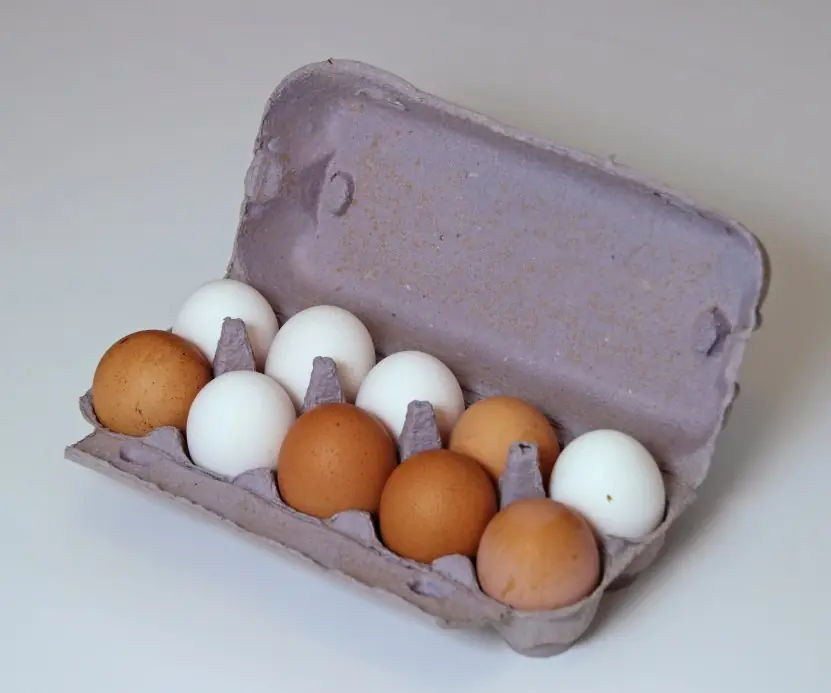
An array is the programmer's egg carton: a fixed number of slots, all the same size, numbered from 0.
Because the slots are equal and side by side, the computer finds element i by one multiplication, base address + i x size of element, without looking at the other slots. That is why a[900] costs the same as a[0].
The same rule also explains the danger: C never checks whether i is inside the carton.


4.2 Searching and sorting
Linear search: scan from the start; O(n). Works on unsorted data.
Binary search: on a sorted array, compare with the middle and discard half; O(\log n). For 1,000,000 items at most 20 comparisons.
#include <stdio.h>

int binsearch(int a[], int n, int key)
{
    int lo = 0, hi = n - 1;
    while (lo <= hi) {
        int mid = lo + (hi - lo) / 2;
        if (a[mid] == key) return mid;
        if (a[mid] < key) lo = mid + 1;
        else hi = mid - 1;
    }
    return -1;
}

int main(void)
{
    int a[] = {3, 7, 19, 42, 56, 88};
    printf("%d %d\n", binsearch(a, 6, 56), binsearch(a, 6, 40));
    return 0;
}
4 -1
mid = lo + (hi - lo) / 2 avoids the overflow that (lo + hi) / 2 can cause for very large arrays.
Bubble sort: repeatedly compare adjacent pairs and swap if out of order; after pass k the k largest items are in place. Worst and average O(n²); with a "swapped" flag the best case is O(n).
Trace of 5 3 8 1 on passes: [5 3 8 1] → [3 5 8 1] → [3 5 8 1] → [3 5 1 8] (pass 1); [3 1 5 8] (pass 2); [1 3 5 8] (pass 3).
Selection sort: find the minimum of the unsorted part, swap it to the front; always n(n−1)/2 comparisons, at most n−1 swaps.
Insertion sort: take the next element and slide it left into place among the sorted prefix; O(n²) worst, O(n) on nearly-sorted data.
#include <stdio.h>

int main(void)
{
    int a[] = {29, 10, 14, 37, 13};
    int n = 5;
    for (int i = 1; i < n; i++) {
        int key = a[i], j = i - 1;
        while (j >= 0 && a[j] > key) {
            a[j + 1] = a[j];
            j--;
        }
        a[j + 1] = key;
    }
    for (int i = 0; i < n; i++)
        printf("%d ", a[i]);
    printf("\n");
    return 0;
}
10 13 14 29 37



4.3 Two-dimensional arrays
int m[3][4]; is 3 rows by 4 columns, stored row by row (row-major). m[i][j] is row i, column j. Initialise: int m[2][3] = {{1,2,3},{4,5,6}}; (only the first dimension may be omitted when initialising).
#include <stdio.h>

int main(void)
{
    int a[2][3] = {{1, 2, 3}, {4, 5, 6}};
    int b[3][2] = {{7, 8}, {9, 10}, {11, 12}};
    int c[2][2] = {{0}};
    for (int i = 0; i < 2; i++)
        for (int j = 0; j < 2; j++)
            for (int k = 0; k < 3; k++)
                c[i][j] += a[i][k] * b[k][j];
    printf("product:\n");
    for (int i = 0; i < 2; i++)
        printf("%d %d\n", c[i][0], c[i][1]);
    printf("transpose of a:\n");
    for (int j = 0; j < 3; j++)
        printf("%d %d\n", a[0][j], a[1][j]);
    return 0;
}
product:
58 64
139 154
transpose of a:
1 4
2 5
3 6
Check c[0][0] = 1·7 + 2·9 + 3·11 = 58. Matrix product needs (columns of A) = (rows of B); the triple loop is O(n³). Other staples: sum of the diagonal (i == j), sum of the anti-diagonal (i + j == n − 1), row sums, symmetric test (a[i][j] == a[j][i]).
A table is an array of arrays
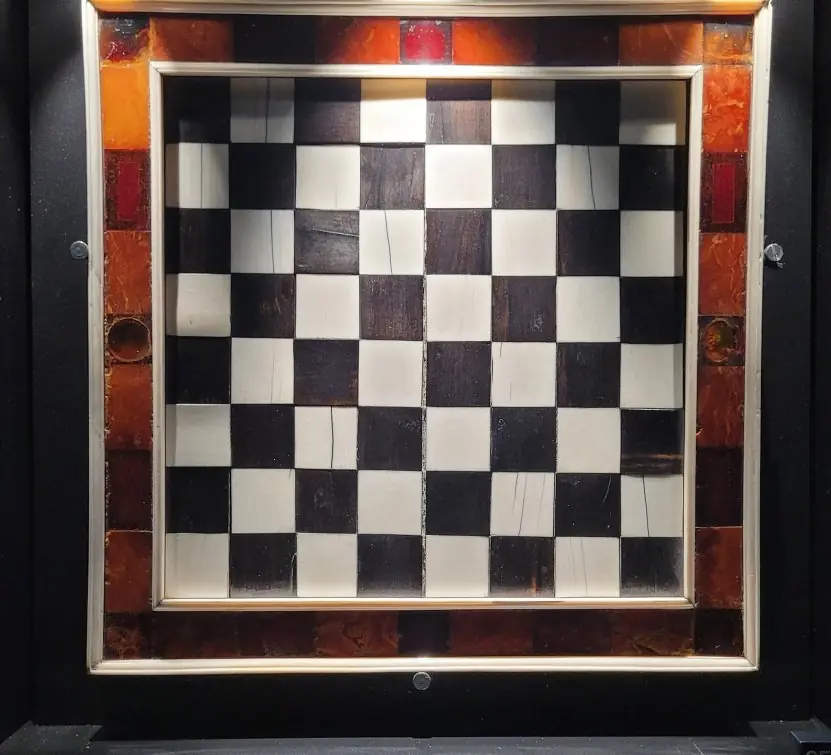
A two-dimensional array such as int g[8][8] looks like a chessboard, but memory is a single long line, so C stores it row after row (row-major order). Element g[i][j] is therefore the (i x 8 + j)-th integer from the start.
Plate 4.4 takes the square g[3][5] and measures its position with pointer subtraction in a real program.

4.4 Strings
A string is a char array ending with the null character '\0' (value 0). char s[] = "Nepal"; has 6 bytes: N e p a l \0. char s[5] = "Nepal"; leaves no room for the terminator and is a bug.
Every string function relies on that \0; overwrite it and functions run off the end.
Reading: scanf("%s", s) stops at white space and can overflow; scanf("%49s", s) limits the length for a 50-byte buffer; fgets(s, sizeof s, stdin) reads a line and keeps the \n, which you remove with s[strcspn(s, "\n")] = '\0';.
Printing: printf("%s", s) or puts(s) (adds a newline).
<string.h>
| Function | Does | Example |
|---|---|---|
strlen(s) |
length excluding \0 |
strlen("BCA") → 3 |
strcpy(d, s) |
copy s into d (d must be big enough) | |
strncpy(d, s, n) |
copy at most n chars (may not terminate!) | |
strcat(d, s) |
append s to d | |
strcmp(a, b) |
0 if equal, <0 if a < b, >0 if a > b (dictionary order by character code) | strcmp("apple","banana") < 0 |
strchr(s, c), strstr(s, t) |
first occurrence of a character, a substring | |
strrev |
not standard; write your own |
Never compare strings with ==: that compares two addresses. <ctype.h> gives isalpha, isdigit, isupper, toupper, tolower.
#include <stdio.h>
#include <string.h>
#include <ctype.h>

int main(void)
{
    char s[] = "Level";
    int n = strlen(s);
    char r[20];
    for (int i = 0; i < n; i++)
        r[i] = s[n - 1 - i];
    r[n] = '\0';

    int same = 1;
    for (int i = 0; i < n; i++)
        if (tolower(s[i]) != tolower(r[i]))
            same = 0;
    printf("%s reversed is %s; palindrome: %s\n", s, r, same ? "yes" : "no");

    char text[] = "Programming in C is fun";
    int vowels = 0, words = 1;
    for (int i = 0; text[i] != '\0'; i++) {
        char c = tolower(text[i]);
        if (c == 'a' || c == 'e' || c == 'i' || c == 'o' || c == 'u')
            vowels++;
        if (text[i] == ' ')
            words++;
    }
    printf("vowels=%d words=%d\n", vowels, words);

    char a[30] = "Tribhuvan";
    strcat(a, " University");
    printf("%s (%zu chars), strcmp=%d\n", a, strlen(a), strcmp("apple", "apple"));
    return 0;
}
Level reversed is leveL; palindrome: yes
vowels=6 words=5
Tribhuvan University (20 chars), strcmp=0
Vowels in "Programming in C is fun": o, a, i, i, i, u = 6. Writing strlen, strcpy, strcmp yourself in a loop until '\0' is a standard exam program.
strcpy(dest, src) with a dest smaller than src is a buffer overflow. char *p = "abc"; p[0] = 'x'; is undefined (string literals are read-only); use char p[] = "abc";. sizeof(s) is the array size, strlen(s) is the text length.
Remember the +1 for '\0' when sizing buffers.


4.5 Eight uses of arrays and strings
- Storing marks and records. One array of 40 marks replaces 40 separate variables, and a loop can total or rank them. A class result in a Tribhuvan University college is handled this way. Using
marks[i]makes the program the same size for 4 or 400 students. - Searching. Linear search checks each element, and binary search halves a sorted array each time. Finding a roll number in a list of 1,000 needs at most 10 steps with binary search. This is the idea behind every lookup in a database.
- Sorting and ranking. Bubble, selection and insertion sort arrange an array in order. Sorting marks in descending order gives the merit list. A sorted array also makes later searching much faster.
- Statistics. Mean, maximum, minimum, median and frequency of values are computed with one pass over the array. The daily rainfall of Pokhara for 30 days is a typical example. The result is only as good as the loop limits, so check
i < n. - Matrices. A two-dimensional array stores a table or a matrix, so addition, multiplication and transpose become nested loops. Image pixels, spreadsheet cells and the seating plan of an examination hall are also 2-D arrays. Elements are kept row by row in memory.
- Names and text. A string is an array of characters ending in
'\0', so names, addresses and messages can be stored and compared.strcmp,strcpy,strcatandstrlendo the common work. A student's name in a registration form is achar name[50]. - Text processing. Counting vowels, reversing a word, checking a palindrome and converting case are loops over the characters of a string. The same idea powers spell-checkers, search boxes and the Nepali SMS filters of mobile operators. Always leave one extra byte for
'\0'. - Buffers and tables. Programs keep data from a keyboard, a file or a network in an array called a buffer, and use look-up tables such as the days in each month. A table is faster than a long chain of
ifstatements. The danger is writing beyond the end of the array, which C does not check.
Formula and fact sheet
a[n]has indices 0 … n−1; no bounds checking. Element count =sizeof(a)/sizeof(a[0]).- Binary search needs sorted data: O(\log n). Bubble/selection/insertion: O(n²).
- 2-D arrays are row-major; matrix product needs inner dimensions equal.
- A string of length L needs L + 1 bytes. Compare with
strcmp, never==. fgetsfor lines, width-limited%Nsfor words, nevergets.
Chapter summary
- Arrays: same type, contiguous, zero-based, unchecked.
- Master four loops over arrays: scan, search, swap-based sort, nested matrix loops.
- Strings are
chararrays ended by'\0'; the library functions all depend on it. - Overflowing an array or a string buffer is the most common serious C bug.
Practice
A. Short questions
- How many bytes does
char s[] = "BCA";occupy, and why? - What happens when you access
a[10]inint a[5]? - Why is
if (s1 == s2)wrong for strings? What is the right test? - For
int m[3][4](4-byte int starting at address 1000), what is the address ofm[2][1]? - State the condition required to multiply an m×n matrix by a p×q matrix and the order of the result.
B. Predict the output
char s[] = "hello"; s[0] = 'J'; printf("%s %zu", s, strlen(s));int a[5] = {1, 2}; printf("%d%d%d", a[0], a[1], a[4]);char t[10] = "ab"; strcat(t, "cd"); printf("%d %s", (int)strlen(t), t);
C. Programs
- Read 10 integers and print the second largest.
- Remove duplicates from a sorted array in place and print the new length.
- Check whether a 3×3 matrix is symmetric.
- Count the frequency of each lowercase letter in a string.
Answers and worked solutions
1. 4 bytes: B, C, A and the terminating '\0'.
2. Undefined behaviour: it reads whatever lies after the array, or crashes. C inserts no check.
3. == compares the two addresses, not the text. Use strcmp(s1, s2) == 0.
4. Row-major: offset = (2 × 4 + 1) × 4 = 36, address 1036.
5. n must equal p; the result is m × q.
6. Jello 5.
7. {1, 2} sets a[0] = 1 and a[1] = 2; the other elements are zero. a[0], a[1], a[4] print 1, 2, 0: the output is 120.
8. 4 abcd.
9. Track first and second (start at INT_MIN): for each x, if x > first { second = first; first = x; } else if (x > second && x ≠ first) second = x.
10. int k = 0; for (i = 1; i < n; i++) if (a[i] != a[k]) a[++k] = a[i]; length = k + 1; For 1 1 2 2 3 the new length is 3.
11. Loop i from 0 to 2 and j from i+1 to 2; if any a[i][j] != a[j][i] it is not symmetric.
12. int f[26] = {0}; for (i = 0; s[i]; i++) if (s[i] >= 'a' && s[i] <= 'z') f[s[i] - 'a']++; then print the non-zero counts.
Model answers: medium (5 marks) and long (10 marks) questions
Q (5 marks). Explain the bubble sort algorithm and write a C program to sort five integers in ascending order. Show the passes for 5, 3, 8, 1, 4.
Bubble sort compares each pair of neighbouring elements and swaps them if they are in the wrong order.
After the first pass the largest value has "bubbled" to the last position; after the second pass the second largest is in place, and so on.
For n elements at most n - 1 passes are needed, and the sort can stop early when a whole pass makes no swap (Figure 4.2).
Algorithm. (1) Repeat for i = 0 to n - 2. (2) Set swapped = 0. (3) For j = 0 to n - 2 - i, if a[j] > a[j+1] swap them and set swapped = 1. (4) If swapped is 0, stop. (5) Print the array.
#include <stdio.h>
int main(void) {
    int a[5] = {5, 3, 8, 1, 4}, n = 5, i, j, t, swapped;
    for (i = 0; i < n - 1; i++) {
        swapped = 0;
        for (j = 0; j < n - 1 - i; j++)
            if (a[j] > a[j + 1]) { t = a[j]; a[j] = a[j + 1]; a[j + 1] = t; swapped = 1; }
        if (!swapped) break;
    }
    for (i = 0; i < n; i++) printf("%d ", a[i]);
    printf("\n");
    return 0;
}
1 3 4 5 8
Trace: start 5 3 8 1 4; pass 1 gives 3 5 1 4 8; pass 2 gives 3 1 4 5 8; pass 3 gives 1 3 4 5 8; pass 4 makes no swap and the sort stops. The time taken is proportional to n² in the worst case and to n for an already sorted list, and it needs no extra array.
Q (10 marks). What is a string in C? Explain how strings are declared, initialised, read and printed. Describe any five string-handling functions of <string.h> and write a program that reverses a string and checks a palindrome.
Introduction. C has no separate string type. A string is a one-dimensional array of characters that ends with the null character '\0' (Figure 4.1b). The null character marks the end, so string functions know where to stop.
Declaration and initialisation. char name[20]; reserves 20 bytes. char s[] = "NEPAL"; creates 6 bytes (five letters and '\0') and the size is counted by the compiler. char s[6] = {'N','E','P','A','L','\0'}; is the same. One extra byte must always be kept for '\0'.
Input and output. scanf("%s", name) reads one word and stops at a space, and no & is needed because an array name is already an address. fgets(name, 20, stdin) reads a full line safely and limits the length. printf("%s", name) and puts(name) print the string.
The function gets must never be used, because it cannot limit the input and causes buffer overflow.
Important functions.
| Function | Purpose | Example | Result |
|---|---|---|---|
strlen(s) |
length without '\0' |
strlen("Nepal") |
5 |
strcpy(d, s) |
copy s into d | strcpy(t, "Nepal-") |
t = "Nepal-" |
strcat(d, s) |
append s to d | strcat(t, "Level") |
"Nepal-Level" |
strcmp(a, b) |
compare; 0 if equal, <0 if a < b | strcmp("apple", "banana") |
negative |
strrev / manual loop |
reverse (not standard) | loop below | "leveL" |
Program. The program reverses "Level", compares it with the original ignoring case, and joins two strings.
#include <stdio.h>
#include <string.h>
int main(void) {
    char s[20] = "Level", r[20], t[40];
    int i, n = strlen(s), pal = 1;
    for (i = 0; i < n; i++) r[i] = s[n - 1 - i];
    r[n] = '\0';
    for (i = 0; i < n; i++)
        if (s[i] != r[i] && s[i] + 32 != r[i] && s[i] - 32 != r[i]) pal = 0;
    strcpy(t, "Nepal-");
    strcat(t, s);
    printf("%s %zu %s\n", r, strlen(t), t);
    printf("%d %d\n", strcmp("apple", "banana") < 0, pal);
    return 0;
}
leveL 11 Nepal-Level
1 1
The reversed string is leveL; it matches the original apart from case, so pal stays 1 (a palindrome). The joined string has 11 characters, and strcmp is negative, so the printed 1 means "apple" comes before "banana".
Conclusion. A string is only a char array with a terminator, so every error about arrays (writing beyond the end, forgetting '\0') is also a string error. Use fgets and strncpy-style limits, and always allocate one byte more than the longest text.