Chapter 1 · The Examination · 18 min read
The MECEE-BL Examination: Pattern, Weightage and Strategy
What the syllabus asks for 5
- Who sits the paper, the programme groups and the eligibility rules
- The paper: 200 questions, unit by unit, and how the marks are counted
- Negative marking and when to guess
- A study plan for the last 120, 60 and 15 days
- How to use the model papers in this book
This book contains five complete model papers for the MECEE-BL — the Medical Education Common Entrance Examination for bachelor-level health programmes, run by the Medical Education Commission (MEC), Sanothimi. This opening chapter explains the examination you are walking into: who may sit it, how the 200 questions are distributed, exactly how your score is computed, when guessing pays (the answer, proved below, is almost always), and how to spend your remaining days — whether you have 120 of them or 15. Read it once, carefully, before you touch Model Paper 1.
- Eligibility — +2 (or equivalent) with Physics, Chemistry and Biology at 50% aggregate or 2.4 GPA; or a PCL/diploma in a health-science subject at 50% with council registration.
- The paper — 200 single-best-answer MCQs, 3 hours, OMR sheet, based on the NEB Grade 11–12 Science syllabus (MEC syllabus, third revision, 28 April 2026).
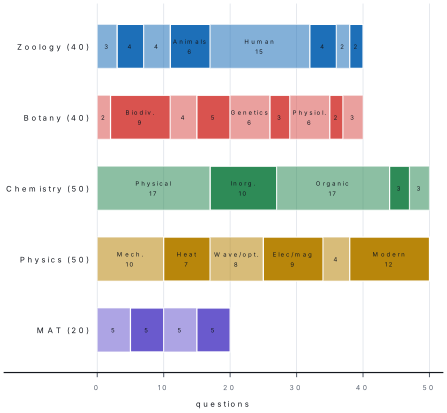
- The split — Zoology 40, Botany 40, Chemistry 50, Physics 50, Mental Agility Test 20.
- The scoring — +1 for a correct answer, −0.25 for a wrong one, 0 for a blank; merit list from the 50th percentile (not 100 marks).
- The arithmetic of guessing — even a blind guess has positive expected value (+1/16 mark); eliminating options makes it better. Never leave a bubble empty.
- The clock — 54 seconds per question on average; two-pass technique; no question deserves three minutes.
1.1 Who sits the paper, the programme groups and the eligibility rules
The MECEE-BL is Nepal's single gateway to bachelor-level health-science programmes — MBBS, BDS, BSc Nursing, BAMS, BPH, BMLT, BSc MLT, BASLP, B Perfusion Technology, pharmacy, optometry, radiography, physiotherapy and their relatives, in universities and academies across the country. Candidates apply for a programme group (Group I is the PCB group — MBBS, BDS, BSc Nursing, BASLP, B Perfusion Technology and similar programmes, and it is the group this book serves); the question paper is common within the group, and admission proceeds strictly by merit order within the quota categories, through MEC's matching system.
Eligibility for Group I programmes, in the form the notices repeat every year (always re-check the current MEC notice for your own session — dates and fees change, these academic rules barely do):
- +2 Science (or A-Level or equivalent) with Physics, Chemistry and Biology, securing at least 50% aggregate or a 2.4 GPA overall (equivalence certificate required for foreign boards); or
- a PCL/diploma in a health-science subject with at least 50%, plus registration with the relevant professional council.
Registration is online through the MEC portal in the window the notice announces (for MECEE-BL 2027, applications ran in August–September 2026 with a late double-fee window), and the examination is held at centres in and beyond the Kathmandu Valley. Treat any date or fee quoted by a website — including this paragraph — as provisional until you have seen it on mec.gov.np or in the MEC notice itself: the Commission's notice is the only authoritative source, and coaching-centre summaries have been wrong before.
1.2 The paper: 200 questions, unit by unit, and how the marks are counted
You receive one question booklet and one OMR answer sheet, and you have 3 hours (180 minutes). Every question has four options and one best answer; MEC instructs its paper-setters that a stem may run to at most 60 words and that the paper should mix roughly 50% recall, 30% understanding and 20% application questions. The syllabus is the NEB Grade 11 and 12 Science curriculum, organised by MEC into units with fixed question counts — these counts are the single most valuable planning fact you own:
| Subject | Questions | Where the weight sits (areas, with question counts) |
|---|---|---|
| Zoology | 40 | Evolution and Diversity 11 · Study of Selected Animals 6 · Human Biology and Physiology 15 · Applied Zoology 8 |
| Botany | 40 | Basic Components of Life 2 · Biodiversity 9 · Ecology and Vegetation 4 · Cell Biology 5 · Genetics 6 · Plant Anatomy 3 · Plant Physiology 6 · Developmental and Applied Botany 5 |
| Chemistry | 50 | Physical Chemistry 17 · Inorganic Chemistry 10 · Organic Chemistry 17 · Applied 3 · Analytical 3 (see the Chemistry book for the exact chapter split) |
| Physics | 50 | Mechanics 10 · Heat and Thermodynamics 7 · Waves and Optics 8 · Current Electricity and Magnetism 9 · Electrostatics and Capacitors 4 · Modern Physics 12 (chapter split in the Physics book) |
| Mental Agility Test | 20 | Verbal 5 · Numerical 5 · Logical sequencing 5 · Spatial/abstract 5 |
(The five subject books of this series distribute these area totals across their chapters, and every model paper in this book follows the same distribution question for question; the count table printed at the top of each paper lets you verify it.)
How the marks are counted. Each correct answer earns +1; each wrong answer deducts 0.25; an unattempted question scores 0. Your total out of 200 is therefore
To enter the merit list at all, a candidate must reach the 50th percentile of those who sat the paper. A percentile is a position, not a percentage: the 50th percentile is the score of the middle candidate, whatever that score happens to be — on a hard paper it may be well under 100. Do not let anyone tell you that you need "100 out of 200 to pass"; you need to finish in the top half of the hall, and your final admission then depends on your merit rank against the seats in your category.
More MECEE marks are lost to bubbling than to biology. Fill each circle completely with the prescribed pen; a question with two darkened circles, or a correction scrubbed into ambiguity, earns −0.25, not the benefit of the doubt. And track your position: if you skip question 87, make sure your next bubble is 88, not a second 87. Practice papers exist partly to make this mechanical discipline automatic.
1.3 Negative marking and when to guess
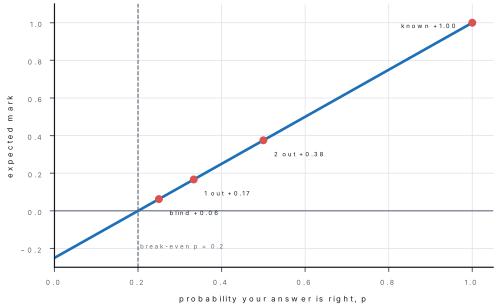
Candidates fear the −0.25 far more than arithmetic justifies. Consider a question about which you know literally nothing, and guess at random among the four options. One time in four you gain 1 mark; three times in four you lose 0.25. Your expected score is
A blind guess is worth, on average, +1/16 of a mark — better than the guaranteed zero of a blank. Any knowledge at all improves the odds:
| Your position | Chance of being right | Expected value |
|---|---|---|
| No idea (random among 4) | 1/4 | +0.06 |
| One option eliminated (guess among 3) | 1/3 | +0.17 |
| Two options eliminated (coin-flip) | 1/2 | +0.38 |
| Fairly confident | 3/4 | +0.69 |
The conclusion is absolute: attempt every question. There is no situation in this marking scheme in which leaving a bubble empty beats filling it with your best available guess. (This is a property of the gentle −0.25 penalty; with harsher penalties the answer would differ.)
Problem. In Model Paper 1 a student answers 130 questions correctly, 50 incorrectly, and leaves 20 blank. (a) What is her score? (b) What would she expect to gain by guessing those 20 blanks at random?
Solution. (a) Score = 130 - 0.25 \times 50 = 130 - 12.5 = \mathbf{117.5} out of 200.
(b) Each blind guess is worth +1/16 of a mark in expectation, so 20 guesses are worth 20/16 = \mathbf{+1.25} marks on average — typically about 5 right (+5) and 15 wrong (−3.75). One and a quarter marks is often dozens of merit ranks. The blanks were the most expensive answers on her sheet.
Guessing well is a skill, not luck, and it can be practised: eliminate before you guess (one impossible option raises your odds from 1/4 to 1/3); distrust options that are obviously longer, vaguer or differently worded from the other three; in numerical questions, first kill the options with impossible units, signs or orders of magnitude — often two die before any calculation; and remember that MEC's setters build distractors out of the common error (the answer you get if you forget to halve, square, or convert units), so if your quick answer matches an option suspiciously easily, re-read the stem once.
Time strategy. 180 minutes for 200 questions is 54 seconds each — but the questions are not equal, so do not spend them equally. Work in two passes: on the first pass, answer everything you can settle in under a minute (for most students 120–150 questions) and mark the rest, guessing the truly hopeless at once rather than later; on the second pass, spend the remaining time on the marked calculations and two-option dilemmas. No single question is worth three minutes while unseen questions remain — a stuck numerical and a one-line recall item are both worth exactly one mark. Keep five minutes at the end exclusively for OMR hygiene: every row filled, no doubles, no strays.
1.4 A study plan for the last 120, 60 and 15 days
Plans fail when they are built on topics instead of on questions. The weightage table in §1.2 tells you where marks live: Human Physiology alone is 15 of the 40 Zoology questions; Biodiversity is 9 of Botany; Physical and Organic Chemistry are 34 of 50; Modern Physics is 12 of 50. Whatever your horizon, spend time in proportion to marks, and spend most of it answering questions rather than re-reading theory — recall under mild pressure is what the examination measures.
With about 120 days: this is the full build. Work subject by subject through the five books of this series in weightage order, chapter by chapter, attempting each chapter's practice set closed-book and marking it honestly; keep an error notebook with four columns — topic, the trap, the correct fact, the page. Reserve the last 20 days of the 120 for the five model papers (one every fourth day, each sat like the real thing) and for re-attempting your error notebook. One full rest day a week is part of the plan, not a failure of it.
With about 60 days: compress, do not panic. Take the chapters in weightage order and stop when the calendar says stop: it is better to own the chapters carrying 150 of the 200 questions than to have skimmed all of them. Read each chosen chapter's key box and formula sheet first, attempt the practice sets, and read the full text only where your errors point. From day 40, alternate days: a model paper under exam conditions, then a day spent purely on its autopsy (every wrong or guessed question understood, not just re-keyed).
With about 15 days: this is triage, and triage can still win thirty marks. Days 1–9: the key boxes, formula and fact sheets and chapter summaries of the highest-weight units only (Human Physiology; Biodiversity, Genetics, Cell Biology, Plant Physiology; Physical and Organic Chemistry; Modern Physics and Mechanics; the MAT techniques chapters) — with each chapter's practice questions attempted and reviewed the same day. Days 10–14: Model Papers 1–4, one a day, 3-hour sittings at the real exam's clock time if you can, autopsied the same evening; use the papers to find and patch the specific facts you are losing, not to re-read whole units. Final day: Model Paper 5 or rest — sleep is a performance drug; nobody's rank ever rose on an all-night cram. Throughout, guard the basics that scores silently depend on: regular sleep, daylight, food your stomach already knows, and a phone that is off more than it is on.
1.5 How to use the model papers in this book
Each of the five papers that follow is a complete, original 200-question paper built to the official distribution, numbered as the real booklet is numbered (Zoology 1–40, Botany 41–80, Chemistry 81–130, Physics 131–180, MAT 181–200), with an explained key at the end. They are simulations, and they work only if you treat them as simulations:
- Sit the whole paper in one 3-hour block, on paper if you possibly can, bubbling a printed OMR-style grid, with no pauses, no phone and no book. A paper "done" in five sittings with the key open teaches almost nothing.
- Score it with the real rule (+1, −0.25), and record four numbers: correct, wrong, blank, and score — overall and per subject. Watch the wrong column as much as the score; it separates "did not know" from "knew but fumbled".
- Autopsy every error and every lucky guess. For each, find the fact in the subject book, write it in the error notebook, and classify the failure: never knew it · misremembered · misread the stem · calculation slip · OMR slip · ran out of time. The classification tells you what to fix next; the raw score does not.
- Space the papers out (one every 3–4 days at closest) and interleave them with targeted revision of what the last paper exposed. Papers taken back-to-back mostly rehearse your existing level instead of raising it.
- Track the trend, not a single score. Three papers near 120 with falling "misread" counts mean more than one paper at 140. If a whole subject lags, that subject's highest-weight chapters are your next week.
A last word of honesty: no model paper — this book's included — can tell you the questions MEC will set, and anyone who claims otherwise is selling something. What five honest rehearsals can do is remove every surprise except the questions themselves: the timing, the stamina, the bubbling, the negative marking, and your own recurring traps will all have been met before. Walk in having already sat the examination five times. That is the whole strategy.
Problem. On a 200-question MECEE-BL paper, a candidate knows 130 answers for sure, narrows 40 questions down to two options, and narrows 20 questions down to three options, leaving 10 untouched. What is the candidate's expected score?
Solution. Certain items: 130 \times 1 = 130. Two-option guesses (p = 1/2): E = 1.25(0.5) - 0.25 = +0.375 each, contributing 40 \times 0.375 = +15.0. Three-option guesses (p = 1/3): E = 1.25(1/3) - 0.25 = +1/6 each, contributing 20 / 6 = +3.33. Total expected score = 130 + 15 + 3.33 = \mathbf{148.33 / 200}.
Problem. A candidate completes Pass 1 (all direct recall and one-step items across Biology, Chemistry, and MAT) in 95 minutes, answering 125 questions and bubbling them per page. How much time remains per question for the 55 Physics and Physical Chemistry numericals saved for Pass 2, keeping 10 minutes at the end for final verification?
Solution. Usable Pass 2 time = 180 - 95 - 10 = 75\text{ minutes} = 4{,}500\text{ seconds}. Divided across 55 calculation items, the candidate has \mathbf{81.8\text{ seconds}} per numerical — 50 % more than the 54-second raw average.
Formula and fact sheet
- Score = correct − 0.25 × wrong (blank = 0). Time = 180 min ÷ 200 = 54 s per question.
- Merit threshold = 50th percentile of the cohort — a rank, not 50% marks.
- Expected value of a guess: blind +1/16; one option eliminated +1/6; two eliminated +3/8. Always attempt.
- Subject split: Zoo 40 · Bot 40 · Chem 50 · Phy 50 · MAT 20; difficulty mix about 50 : 30 : 20 recall : understanding : application; stems at most 60 words.
- Eligibility (Group I): +2 PCB ≥ 50% or 2.4 GPA, or health-science PCL/diploma ≥ 50% + council registration — verify in the current MEC notice.
- Two-pass rule: settle the sub-minute questions first, mark the rest, never spend 3 minutes while unseen questions remain, reserve 5 minutes for OMR checks.
Chapter summary
- The MECEE-BL is MEC's single 200-question, 3-hour OMR gateway to bachelor health programmes, sat by Group I candidates meeting the PCB eligibility rules.
- The paper's content is fixed and public: Zoology 40, Botany 40, Chemistry 50, Physics 50, MAT 20, distributed unit by unit — study in proportion to those marks.
- Scoring is +1/−0.25 with the merit list opening at the 50th percentile, a position in the cohort rather than a pass mark.
- Because a blind guess is worth +1/16 of a mark in expectation, every bubble should be filled; elimination guessing and the two-pass time strategy convert that arithmetic into rank.
- Study plans at 120, 60 and 15 days differ in depth, not in logic: weightage first, questions over re-reading, an error notebook, model papers as full rehearsals.
- Each model paper must be sat whole, scored strictly and autopsied question by question — the classification of your errors is the real syllabus of your remaining days.
Practice questions
Set A — Check the rules (10 questions)
- The MECEE-BL question paper consists ofa100 questions in 2 hoursb150 questions in 3 hoursc200 questions in 3 hoursd200 questions in 2 hours
- The marks deducted for each wrong answer in MECEE-BL area0.25b0.5c1.0d0.2
- To be included in the merit list, a candidate must score at least at thea40th percentileb50th percentilec60% marks leveld50% marks level
- A candidate answers 140 questions correctly and 40 incorrectly, leaving 20 blank. Her score isa140b135c120d130
- The expected value of a completely blind guess in this marking scheme isanegativebexactly zeroc+1/16 of a markd+1/4 of a mark
- The average time available per question in MECEE-BL is abouta54 secondsb90 secondsc36 secondsd2 minutes
- The largest single block of questions in the Zoology section comes fromaEvolutionbHuman Biology and PhysiologycAnimal DiversitydApplied Zoology
- The Mental Agility Test contributes how many questions to the paper?a10b15c25d20
- If two options of a question can be confidently eliminated, guessing between the remaining two has an expected value ofa0b+3/8 of a markc−1/8 of a markd+1 mark
- The syllabus on which the MECEE-BL paper is based isathe BSc first-year syllabusbeach university's own syllabuscthe NEB Grade 11–12 Science syllabus as organised by MECdthe SEE syllabus
Answers and explanations — Set A
1. (c) — 200 single-best-answer MCQs in 3 hours on an OMR sheet.
2. (a) — One mark gained for a right answer, a quarter-mark lost for a wrong one.
3. (b) — The 50th percentile of the cohort: the middle candidate's score, not 100/200.
4. (d) — 140 - 0.25 \times 40 = 140 - 10 = 130; the blanks contribute nothing either way.
5. (c) — \frac14(1) + \frac34(-0.25) = +\frac{1}{16}: a filled bubble beats an empty one even with no knowledge.
6. (a) — 10,800 seconds ÷ 200 = 54 seconds — hence the two-pass strategy.
7. (b) — Human physiology carries 15 of the 40 Zoology questions; diversity follows with 11.
8. (d) — 20 MAT questions: verbal, numerical, logical and spatial, five each.
9. (b) — \frac12(1) + \frac12(-0.25) = +\frac38 of a mark: elimination is the profitable part of guessing.
10. (c) — MEC's bachelor-level syllabus (third revision, 2026) reorganises the NEB +2 Science curriculum into weighted units.