Unit 4 · 21 min read
Induction, Recursion and Recurrence Relations
What the syllabus asks for 6
- Mathematical induction
- Recursive definitions
- Linear recurrence relations
- Divide-and-conquer recurrences
- The recursion tree of merge sort
- Eight uses of induction and recursion
A loop and a recursive function both compute by repeating. Induction proves that such repeated processes are correct; recurrence relations describe how their cost grows.
This unit gives you the tools to prove statements for all integers and to solve the recurrences that arise from algorithms.
- Mathematical induction (weak and strong), with six proof patterns.
- Recursive definitions and structural induction.
- Linear recurrences: homogeneous and non-homogeneous, with closed forms.
- Divide-and-conquer recurrences and the master theorem.
4.1 Mathematical induction
To prove P (n) for all integers n \geq n_{0}:
- Base case: prove P (n_{0}).
- Inductive step: assume P (k) (the inductive hypothesis) for an arbitrary k \geq n_{0} and prove P (k + 1).
Then P (n) holds for all n \geq n_{0}, like dominoes: the first falls, and each one knocks over the next.
Claim: 1 + 2 + \ldots + n = \frac{n (n + 1)}{2}.
Base: n = 1: LHS 1, RHS 1·2/2 = 1 ✓.
Step: assume 1 + \ldots + k = \frac{k (k + 1)}{2}. Then 1 + \ldots + k + (k + 1) = \frac{k (k + 1)}{2} + (k + 1) = (k + 1) \left( \frac{k}{2} + 1 \right) = \frac{(k + 1) (k + 2)}{2}, which is the formula for n = k + 1. ∎
Claim: 8^{n} - 1 is divisible by 7 for n \geq 1.
Base: 8 - 1 = 7 ✓. Step: assume 8^{k} - 1 = 7m. Then 8^{k+1} - 1 = 8 \cdot 8^{k} - 1 = 8 (7 m + 1) - 1 = 56m + 7 = 7 (8 m + 1). ∎
Claim: 2^{n} > n^{2} for n \geq 5.
Base: 32 > 25 ✓.
Step assume 2^{k} > k^{2} with k \geq 5. Then 2^{k+1} = 2 \cdot 2^{k} > 2 k^{2} = k^{2} + k^{2} \geq k^{2} + 5 k > k^{2} + 2 k + 1 = (k + 1)^{2} (since k^{2} \geq 5 k and 5 k > 2 k + 1). ∎
1 + 3 + \ldots + (2 n - 1) = n^{2}: base 1 = 1; step: k^{2} + (2 k + 1) = (k + 1)^{2}. ∎
Geometric: 1 + r + \ldots + r^{n} = \frac{r^{n+1} - 1}{r - 1} (r \neq 1): step: \frac{r^{k+1} - 1}{r - 1} + r^{k+1} = \frac{r^{k+1} - 1 + r^{k+2} - r^{k+1}}{r - 1} = \frac{r^{k+2} - 1}{r - 1}. ∎
Strong induction. Assume P (j) for all j with n_{0} \leq j \leq k, and prove P (k + 1).
Example every integer n \geq 2 is a product of primes.
If n is prime, done; otherwise n = a b with 2 \leq a ,\ b < n, and by hypothesis each is a product of primes, so n is too. ∎ Another: any postage of 12 cents or more can be made with 4-cent and 5-cent stamps (base cases 12, 13, 14, 15; for k + 1 \geq 16 use k - 3, add one 4-cent stamp).
Common mistakes: forgetting the base case; assuming what must be proved; using a step that only works for some k; "proving" false statements (all horses are the same colour fails at k = 1 \to 2).
Induction: knock over the first domino, then prove each one knocks the next
Mathematical induction is the domino argument written as a proof. The base case says the first domino falls. The inductive step says: if domino k falls, then domino k + 1 falls. Together they make every domino fall.
Plate 4.1 uses the claim "the sum of the first n odd numbers is n squared": the table checks it for the first eight values, and the step k^{2} + (2 k + 1) = (k + 1)^{2} is checked for k = 1 to 50, though the algebra proves it for every k.


4.2 Recursive definitions
A recursive definition has a base and a recursive rule.
- Factorial: 0 ! = 1 ,\ (n + 1) ! = ( n + 1)·n!.
- Fibonacci: F_{0} = 0 ,\ F_{1} = 1 ,\ F_{n} = F_{n-1} + F_{n-2} \to 0 ,\ 1 ,\ 1 ,\ 2 ,\ 3 ,\ 5 ,\ 8 ,\ 13 ,\ 21 ,\ \ldots
- Sets: the set of strings over {0, 1} with no "00"; well-formed formulas; binary trees (a tree is empty or a root with two subtrees).
Structural induction proves properties of recursively defined objects: show the base objects have it, and that each construction rule preserves it.
Example a full binary tree with i internal nodes has i + 1 leaves (base: a single leaf has 0 internal and 1 leaf; joining two trees with i_{1} ,\ i_{2} internal nodes under a new root gives i_{1} + i_{2} + 1 internal and (i_{1} + 1) + (i_{2} + 1) = i + 1 leaves).
Recursion in code. Every recursive function has a base case and a step that moves toward it:
long fact(int n) { return n <= 1 ? 1 : n * fact(n - 1); }
int fib(int n)   { return n < 2 ? n : fib(n - 1) + fib(n - 2); } /* exponential time */
The inductive proof that fact(n) returns n ! mirrors the code. The naïve fib takes about \varphi^{n} calls (\varphi \approx 1.618); memoisation reduces it to linear.
4.3 Linear recurrence relations
A recurrence relation gives a_{n} in terms of earlier terms. A linear homogeneous recurrence of order k with constant coefficients: a_{n} = c_{1} a_{n-1} + \ldots + c_{k} a_{n-k}.
Method. Try a_{n} = r^{n}: the characteristic equation r^{k} = c_{1} r^{k-1} + \ldots + c_{k}.
| Roots | General solution (order 2) |
|---|---|
| distinct r_{1} \neq r_{2} | a_{n} = A r_{1}^{n} + B r_{2}^{n} |
| repeated r | a_{n} = ( A + Bn) r^{n} |
Use the initial conditions to find A and B.
a_{n} = 5 a_{n-1} - 6 a_{n-2} ,\ a_{0} = 1 ,\ a_{1} = 0. Characteristic r^{2} − 5r + 6 = 0 \Rightarrow r = 2 ,\ 3. a_{n} = A \cdot 2^{n} + B \cdot 3^{n} ;\ a_{0}: A + B = 1 ;\ a_{1}: 2A + 3B = 0 \Rightarrow B = - 2 ,\ A = 3. a_{n} = 3 \cdot 2^{n} - 2 \cdot 3^{n}.
Check a_{2} = 5·0 − 6·1 = −6 and 3·4 − 2·9 = −6 ✓.
r^{2} = r + 1 \Rightarrow r = \frac{1 \pm \sqrt{5}}{2} = \varphi ,\ \psi. With F_{0} = 0 ,\ F_{1} = 1: F_{n} = \frac{(\varphi^{n} - \psi^{n})}{\sqrt{5}} (Binet). F_{10} = 55.
a_{n} = 4 a_{n-1} - 4 a_{n-2} ,\ a_{0} = 1 ,\ a_{1} = 3. (r - 2)^{2} = 0 \Rightarrow a_{n} = (A + B n) 2^{n} ;\ a_{0}: A = 1 ;\ a_{1}: 2 (1 + B) = 3 \Rightarrow B = \frac{1}{2}. a_{n} = \left( 1 + \frac{n}{2} \right) 2^{n}.
Check a_{2} = 4·3 − 4·1 = 8 and (1 + 1)·4 = 8 ✓.
Non-homogeneous a_{n} = (homogeneous part) + f (n): the solution is a_{n} = (homogeneous solution) + (one particular solution). For constant f ,\ t r y a constant; for f (n) = n ,\ t r y p n + q.
Example a_{n} = 2 a_{n-1} + 1 ,\ a_{0} = 0: particular a_{n} = - 1 (since - 1 = - 2 + 1), homogeneous A \cdot 2^{n} ;\ a_{0} = A - 1 = 0 ⇒ a_{n} = 2^{n} - 1.
Modelling.
Tower of Hanoi moving n discs needs T_{n} = 2 T_{n-1} + 1 ,\ T_{1} = 1 ⇒ T_{n} = 2^{n} - 1: 10 discs take 1023 moves; 64 discs take about 1.8 \times 10^{19}.
Compound interest B_{n} = 1.05 B_{n-1} + 1000 ( a yearly deposit). Bit strings with no two consecutive 0s: s_{n} = s_{n-1} + s_{n-2} ,\ s_{1} = 2 ,\ s_{2} = 3 \to 2 ,\ 3 ,\ 5 ,\ 8 ,\ 13 ( a Fibonacci shift: s_{5} = 13).
Counting regions n lines in a plane (general position) give R_{n} = R_{n-1} + n ,\ R_{0} = 1 \Rightarrow R_{n} = 1 + \frac{n (n + 1)}{2}.
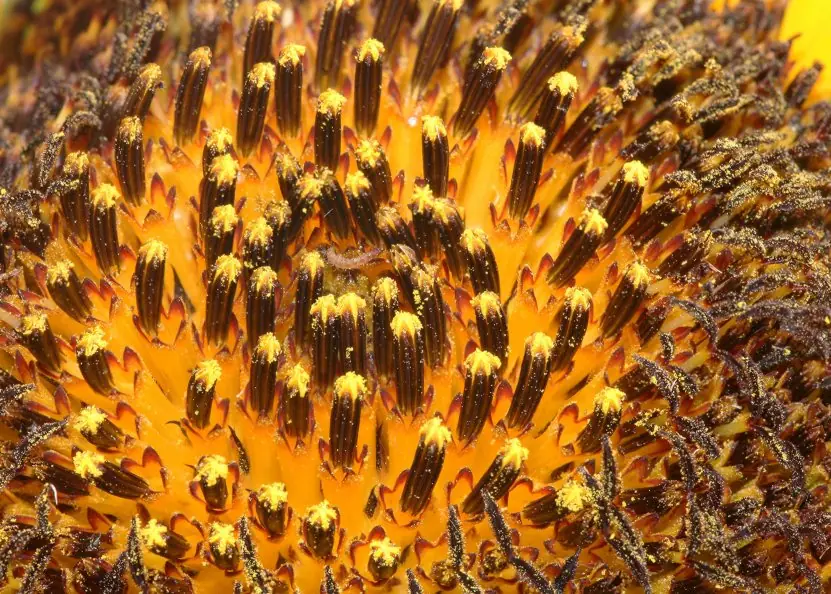
Fibonacci in a sunflower
The Fibonacci numbers come from the recurrence F (n + 1) = F (n) + F (n - 1).
The ratio of neighbours settles quickly at the golden ratio 1.618..., and a plant that places each new seed 137.5 degrees (the golden angle) round the previous one packs the seeds with no gaps and no straight rays.
Counting the spirals on a sunflower head usually gives two neighbouring Fibonacci numbers such as 34 and 55. Plate 4.2 computes the ratios for n = 1 to 12 and the golden angle.

4.4 Divide-and-conquer recurrences
Algorithms that split a problem of size n into a subproblems of size \frac{n}{b} plus f (n) extra work satisfy T (n) = a T \left( \frac{n}{b} \right) + f (n).
Master theorem (for f (n) = \Theta (n^{d})): compare d with \log_{b} a.
| Case | Condition | T (n) |
|---|---|---|
| 1 | d < \log_{b} a | \Theta (n^{\log_{b} a}) |
| 2 | d = \log_{b} a | \Theta (n^{d} \log n) |
| 3 | d > \log_{b} a | \Theta (n^{d}) |
| Algorithm | Recurrence | \log_{b} a v s d | Result |
|---|---|---|---|
| Binary search | T (n) = T \left( \frac{n}{2} \right) + 1 | \log_{2} 1 = 0 = d | \Theta (\log n) |
| Merge sort | T (n) = 2 T \left( \frac{n}{2} \right) + n | 1 = 1 | \Theta (n \log n) |
| Sum or maximum of an array by halving | T (n) = 2 T \left( \frac{n}{2} \right) + 1 | 1 > 0 | \Theta (n) |
| Karatsuba multiplication | T (n) = 3 T \left( \frac{n}{2} \right) + n | \log_{2} 3 \approx 1.585 > 1 | \Theta (n^{1} . 585) |
| Strassen | T (n) = 7 T \left( \frac{n}{2} \right) + n^{2} | \log_{2} 7 \approx 2.807 > 2 | \Theta (n^{2} . 807) |
| Naïve recursive Fibonacci | T (n) = T (n - 1) + T (n - 2) + 1 | not of this form | \Theta (\varphi^{n}) |
T (n) = 2 T \left( \frac{n}{2} \right) + n with n = 2^{k}: T (n) = 2 \left( 2 T \left( \frac{n}{4} \right) + \frac{n}{2} \right) + n = 4 T \left( \frac{n}{4} \right) + 2 n = \ldots = 2^{k} T (1) + k n = n \cdot T (1) + n \log_{2} n.
For T (1) = 0: T (n) = n \log_{2} n. For n = 1024 that is 10,240 comparisons-ish, versus about 10^{6} for an n^{2} method.
4.5 The recursion tree of merge sort
A divide-and-conquer recurrence such as T (n) = 2 T \left( \frac{n}{2} \right) + n can be read from a picture (Figure 4.1).
Sorting 8 items splits them into two halves of 4, then four of 2, then eight of 1: that is 3 splits, so the tree has \log_{2} 8 + 1 = 4 levels.
At every level the merging work adds up to n = 8 (each item is touched once), so the total is n per level × (\log_{2} n + 1) levels, about n \log n.
The same drawing explains why merge sort beats bubble sort (n^{2}) for large n: for n = 1,000,000 it is roughly 20 million steps against a million million.

4.6 Eight uses of induction and recursion
- Proving programs correct. A loop invariant is proved by induction on the number of iterations: true before the loop, preserved by each pass. This is how binary search and sorting routines are certified.
- Recursive programs. Factorial, Fibonacci, tree traversal and directory walking are recursive definitions turned into code. Each has a base case and a step that moves toward it, exactly as an induction proof does.
- Divide and conquer. Merge sort, quicksort and fast multiplication split a problem and combine the answers. Their running times are solved from recurrences like Figure 4.1.
- Algorithm cost. The recurrence H (n) = 2 H (n - 1) + 1 of the Tower of Hanoi gives 2^{n} - 1 moves, so 10 disks need 1,023 moves and 64 disks are hopeless. Recurrences predict whether a method will finish in a lifetime.
- Data structures. A binary tree, a linked list and a nested folder are recursive structures: each is either empty or a root with smaller copies. Their algorithms are naturally recursive.
- Growth models. Compound interest on a deposit, population growth and loan balances satisfy a_{n} = r \cdot a_{n - 1} + d. Solving the recurrence gives a formula for any month. Banks in Nepal compute EMIs this way.
- Dynamic programming. Shortest paths, edit distance and knapsack problems build the answer for size n from stored answers for smaller sizes. Spell-checkers and DNA matching use it.
- Language and grammars. Programming-language syntax is defined recursively (an expression is a number or an expression plus an expression). Compilers parse by recursion and check properties by structural induction.
Formula and fact sheet
- Induction: base case + (P (k) \Rightarrow P (k + 1)). Strong induction assumes all earlier cases.
- \sum i = \frac{n (n + 1)}{2} ;\ \sum (2 i - 1) = n^{2} ;\ \sum r^{i} = \frac{r^{n+1} - 1}{r - 1}.
- Characteristic equation: distinct roots → A r_{1}^{n} + B r_{2}^{n}; repeated → (A + B n) r^{n}.
- Hanoi T_{n} = 2^{n} - 1; Fibonacci F_{n} = \frac{(\varphi^{n} - \psi^{n})}{\sqrt{5}}.
- Master theorem: compare d with \log_{b} a.
Chapter summary
- Induction proves infinitely many statements with two finite checks; strong induction is the right tool when the step needs several earlier cases.
- Recursive definitions give structures and programs; structural induction proves their properties.
- Linear recurrences are solved through the characteristic equation; non-homogeneous ones add a particular solution.
- The master theorem gives the cost of divide-and-conquer algorithms at a glance.
Practice
- Prove by induction: 1^{2} + 2^{2} + \ldots + n^{2} = \frac{n (n + 1) (2 n + 1)}{6}.
- Prove: 3 divides n^{3} - n for all n \geq 1 (induction, or factorisation).
- Prove: 2^{n} \geq n + 1 for all n \geq 0.
- Solve a_{n} = 3 a_{n-1} - 2 a_{n-2} with a_{0} = 2 ,\ a_{1} = 3.
- Solve a_{n} = 6 a_{n-1} - 9 a_{n-2} ,\ a_{0} = 1 ,\ a_{1} = 6.
- Solve a_{n} = 2 a_{n-1} + 3 ,\ a_{0} = 1.
- How many bit strings of length 6 have no two consecutive 1s?
- Apply the master theorem to T (n) = 4 T \left( \frac{n}{2} \right) + n ,\ T (n) = 2 T \left( \frac{n}{2} \right) + n^{2} ,\ T (n) = 9 T \left( \frac{n}{3} \right) + n^{2}.
- Prove that every integer ≥ 14 can be written as 3 a + 8 b (non-negative a ,\ b) by strong induction.
- Find the number of moves for the Tower of Hanoi with 6 discs and write the recursive algorithm.
Answers and worked solutions
1. Base n = 1: 1 = 1·2·3/6 ✓. Step: \frac{k (k + 1) (2 k + 1)}{6} + (k + 1)^{2} = \frac{(k + 1) [k (2 k + 1) + 6 (k + 1)]}{6} = \frac{(k + 1) (2 k^{2} + 7 k + 6)}{6} = \frac{(k + 1) (k + 2) (2 k + 3)}{6} ✓. ∎
2. n^{3} - n = (n - 1) n (n + 1), a product of three consecutive integers, so one is divisible by 3. Induction: (k + 1)^{3} - (k + 1) = (k^{3} - k) + 3 (k^{2} + k). ∎
3. Base 1 \geq 1. Step: 2^{k+1} = 2 \cdot 2^{k} \geq 2 (k + 1) = 2 k + 2 \geq k + 2. ∎
4. r^{2} − 3r + 2 = 0 \Rightarrow r = 1 ,\ 2. a_{n} = A + B \cdot 2^{n} ;\ A + B = 2; A + 2B = 3 \Rightarrow B = 1 ,\ A = 1: a_{n} = 1 + 2^{n}. (a_{2} = 9 - 4 = 5 = 1 + 4 ✓)
5. (r - 3)^{2} = 0 \Rightarrow a_{n} = (A + B n) 3^{n} ;\ A = 1 ;\ 3 (1 + B) = 6 \Rightarrow B = 1: a_{n} = (1 + n) 3^{n}. (a_{2} = 36 - 9 = 27 = 3·9 ✓)
6. Particular: a = 2 a + 3 \Rightarrow a = - 3. a_{n} = A \cdot 2^{n} - 3 ;\ a_{0} = A - 3 = 1 \Rightarrow A = 4: a_{n} = 4 \cdot 2^{n} - 3 = 2^{n+2} - 3. (a_{1} = 5 ✓)
7. s_{n} = s_{n-1} + s_{n-2} with s_{1} = 2 ,\ s_{2} = 3: 2, 3, 5, 8, 13, 21 for n = 6.
8. 4 T \left( \frac{n}{2} \right) + n: \log_{2} 4 = 2 > 1 \Rightarrow \Theta (n^{2}). 2 T \left( \frac{n}{2} \right) + n^{2}: \log_{2} 2 = 1 < 2 \Rightarrow \Theta (n^{2}). 9 T \left( \frac{n}{3} \right) + n^{2}: \log_{3} 9 = 2 = d \Rightarrow \Theta (n^{2} \log n).
9. Base: 14 = 3·2 + 8, 15 = 3·5, 16 = 8·2. Step: for k + 1 \geq 17 ,\ k - 2 \geq 15 can be written as 3 a + 8 b by hypothesis; add one 3 to get k + 1. ∎
10. T_{n} = 2^{n} - 1 = 63 moves. hanoi(n, from, to, via): if n = 0 return; \mathrm{hanoi} ( n - 1, from, via, to); move disc n from → to; \mathrm{hanoi} ( n - 1, via, to, from).
Model answers: medium (5 marks) and long (10 marks) questions
Q1 (5 marks). Prove by mathematical induction that 1 + 3 + 5 + \ldots + (2 n - 1) = n^{2} for all n \geq 1.
Introduction. Induction proves a statement P (n) for every integer n \geq 1 in two steps: a base case and an inductive step.
Base case. For n = 1 the left side is 1 and the right side is 1^{2} = 1, so P (1) is true.
Inductive hypothesis. Assume P (k) holds for some k \geq 1: 1 + 3 + \ldots + (2 k - 1) = k^{2}.
Inductive step. Add the next odd number 2 (k + 1) - 1 = 2 k + 1 to both sides: 1 + 3 + \ldots + (2 k - 1) + (2 k + 1) = k^{2} + 2 k + 1 = (k + 1)^{2}. This is P (k + 1).
Conclusion. P (1) is true and P (k) implies P (k + 1), so by the principle of mathematical induction P (n) holds for all n \geq 1.
Check n = 4 gives 1 + 3 + 5 + 7 = 16 = 4^{2}.
Q2 (10 marks). Solve the recurrence a (n) = 5 a (n - 1) - 6 a (n - 2) with a (0) = 1 ,\ a (1) = 4, and explain how divide-and-conquer recurrences and the Tower of Hanoi recurrence are solved.
Introduction. A recurrence relation defines each term from earlier terms. Linear recurrences with constant coefficients are solved by the characteristic equation.
Linear recurrence.
- Characteristic equation. Try a (n) = r^{n}: r^{2} = 5r − 6, so r^{2} − 5r + 6 = 0.
- Roots. (r - 2) (r - 3) = 0 gives r = 2 and r = 3, distinct.
- General solution. a (n) = A \cdot 2^{n} + B \cdot 3^{n}.
- Initial conditions. a (0) = A + B = 1 and a (1) = 2A + 3B = 4. Subtracting twice the first equation from the second gives B = 2, so A = - 1.
- Answer. a (n) = 2 \cdot 3^{n} - 2^{n}. Check: a (2) = 5·4 − 6·1 = 14 and 2·9 − 4 = 14 ;\ a (3) = 5·14 − 6·4 = 46 and 2·27 − 8 = 46.
Other recurrences.
- Tower of Hanoi. H (n) = 2 H (n - 1) + 1 with H (0) = 0 gives H (n) = 2^{n} - 1; with 10 disks, 1,023 moves.
- Divide and conquer. T (n) = 2 T \left( \frac{n}{2} \right) + n (merge sort). Expand the recursion tree (Figure 4.1): \log_{2} n levels, n work each, so T (n) = \Theta (n \log n).
- Repeated roots. If the characteristic equation has a double root r, the solution is (A + B n) r^{n}.
| Recurrence | Solution | Use |
|---|---|---|
| a (n) = 5 a (n - 1) - 6 a (n - 2) | 2 \cdot 3^{n} - 2^{n} | linear, distinct roots |
| H (n) = 2 H (n - 1) + 1 | 2^{n} - 1 | Tower of Hanoi |
| T (n) = 2 T \left( \frac{n}{2} \right) + n | \Theta (n \log n) | merge sort |
Conclusion. The characteristic equation solves constant-coefficient recurrences exactly; recursion trees give the order of growth of divide-and-conquer algorithms.