Question bank · 24 min read
Computer Science: Unit-wise Objective Question Bank
Group A of the Grade 11 Computer Science paper is nine marks of multiple-choice items, one mark each. The paper is 2 hours and 50 marks, so nine marks is almost a fifth of it, and it is the part where a student who has read the book once can still score full marks in about ten minutes. Nothing is lost by a wrong answer, so never leave a bubble empty.
This chapter gives practice MCQs for all eight units of the Grade 11 syllabus, with an answer key and a one-line reason for every item, followed by a short study of how wrong options are built. The items test exactly what the matching chapter of the Computer Science textbook teaches.
Every item here is an original practice item written to the pattern and difficulty of a Group A question. None is claimed to be a question from a particular year's paper. A book that prints a board year beside every MCQ is usually guessing, and a wrong label teaches you to trust the wrong thing. Where a program is shown, its output was checked by compiling and running it.
14.1 How the nine marks are spread
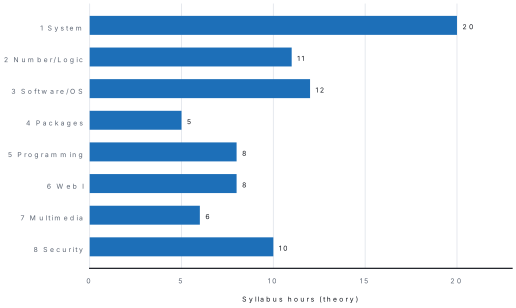
The syllabus carries 80 theory hours, and the weighting by unit is a better guide to the nine marks than any rumour about "important" topics.
| Unit | Hours | Share of 9 marks (approx.) | What the MCQs usually test |
|---|---|---|---|
| 1. Computer System | 20 | 2 | memory types, buses, input/output devices, units |
| 2. Number System and Boolean Logic | 11 | 1 to 2 | conversions, complements, gates, laws |
| 3. Software and Operating System | 12 | 1 | OS terms, software types, Linux and mobile OS |
| 4. Application Package | 5 | 0 to 1 | which package does which job |
| 5. Programming Concepts and Logics | 8 | 2 | C operators, loop output, errors, ASCII |
| 6. Web Technology I | 8 | 1 | tags, attributes, CSS types |
| 7. Multimedia | 6 | 0 to 1 | components, file types |
| 8. Information Security and Cyber Law | 10 | 1 | malware, cybercrime, IPR, cyber law |
Do the nine MCQs first, in order, and spend no more than a minute on any. For output questions, write the values of the variables on the margin line by line; do not do the program in your head. For concept questions, eliminate the two options that are plainly wrong, then choose between the remaining two by asking which word in the stem decides it (volatile, bidirectional, universal, closing tag).
14.2 Unit 1: Computer System
- The first generation of computers used [1]atransistorsbvacuum tubescintegrated circuitsdmicroprocessors
- The Intel 4004, which began the fourth generation, was a [1]amicroprocessorbtransistorcvacuum tubedhard disk
- The speed of a supercomputer is usually measured in [1]aMIPSbFLOPScbitsdbytes
- How many bytes are there in 2 KB? [1]a1000b2000c2048d1024
- Which of the following is the fastest memory in a computer? [1]ahard diskbRAMccache memorydDVD
- Which memory loses its contents when the power is switched off? [1]aROMbRAMcEPROMdflash BIOS chip
- Which bus is unidirectional, carrying the location of the memory cell to be read or written? [1]adata busbcontrol buscaddress busdexpansion bus
- The unit of the microprocessor that performs arithmetic and logical operations is the [1]acontrol unitbALUcregisterdcache
- Which device reads the pencil-filled bubbles on an objective answer sheet? [1]aOCRbOMRcMICRdBCR
- The special ink characters printed on the bottom of a bank cheque are read by [1]aMICRbOMRclight pendscanner
- Which printer forms characters by striking an inked ribbon with pins? [1]ainkjet printerblaser printercdot matrix printerdthermal plotter
- Which port carries both digital video and audio in a single cable? [1]aparallel portbserial portcHDMIdPS/2
- Which of the following is a mobile computing device? [1]amainframebsmartphonecdesktop towerdminicomputer
- The number of bits a CPU can process at one time is called its [1]aclock speedbword lengthcbus widthdcache size
- PROM, EPROM and EEPROM are types of [1]aRAMbROMccachedbuffer
- Which of these is a secondary storage device? [1]aregisterbcachechard diskdROM
Answers to Unit 1
1. (b) — first generation (1940 to 1956) used vacuum tubes.
2. (a) — the 4004 (1971) was the first single-chip microprocessor.
3. (b) — supercomputers are rated in FLOPS (floating-point operations per second); MIPS suits ordinary processors.
4. (c) — 1 KB = 1024 bytes, so 2 KB = 2048 bytes.
5. (c) — cache sits between the CPU and RAM and is faster than RAM.
6. (b) — RAM is volatile; ROM and flash keep their data.
7. (c) — the address bus is one-way, from the CPU to memory; the data bus is two-way.
8. (b) — the ALU does arithmetic and logic; the control unit directs operations.
9. (b) — Optical Mark Recognition senses marks; OCR reads printed characters.
10. (a) — Magnetic Ink Character Recognition is used on cheques.
11. (c) — dot matrix is an impact printer with a print head of pins.
12. (c) — HDMI carries digital video and audio together.
13. (b) — a smartphone is portable and connects wirelessly; the others are fixed machines.
14. (b) — word length is the number of bits processed in one operation (for example 64).
15. (b) — all three are programmable forms of read-only memory.
16. (c) — secondary storage is permanent and outside the CPU; the hard disk is the only one listed.
14.3 Unit 2: Number System and Boolean Logic
- The decimal value of the binary number (1101)_2 is [1]a11b12c13d14
- The binary equivalent of the decimal number 25 is [1]a10011b11001c11010d10101
- The decimal value of the hexadecimal number (2F)_{16} is [1]a37b45c47d51
- The octal number (17)_8 is equal to the decimal number [1]a15b16c17d7
- (101)_2 + (11)_2 equals [1]a(110)_2b(111)_2c(1000)_2d(1001)_2
- The 1's complement of 1010 is [1]a0101b0110c1011d1111
- The 2's complement of 0101 (4 bits) is [1]a1010b1011c1001d0110
- Which gate gives output 1 only when both inputs are 1? [1]aORbANDcNANDdXOR
- Which gate gives output 1 only when its two inputs are different? [1]aXNORbNORcXORdAND
- Which of the following gates is called a universal gate? [1]aANDbORcNANDdXOR
- According to Boolean algebra, A + A' is equal to [1]a0b1cAdA'
- A \cdot 0 is equal to [1]aAb1c0dA'
- By De Morgan's theorem, (A + B)' equals [1]aA' + B'bA' \cdot B'cA \cdot BdA + B'
- The number of rows in the truth table of a Boolean function of three variables is [1]a3b6c8d9
- In the hexadecimal system, the symbol E represents the decimal value [1]a13b14c15d16
Answers to Unit 2
1. (c) — 8 + 4 + 0 + 1 = 13.
2. (b) — 25 = 16 + 8 + 1 = 11001.
3. (c) — 2 \times 16 + 15 = 47.
4. (a) — 1 \times 8 + 7 = 15.
5. (c) — 5 + 3 = 8 = 1000 in binary.
6. (a) — flip every bit: 1010 becomes 0101.
7. (b) — 1's complement 1010, add 1 gives 1011.
8. (b) — AND outputs 1 only for (1, 1); NAND is its inverse.
9. (c) — XOR is 1 when inputs differ; XNOR is 1 when they are equal.
10. (c) — NAND (and NOR) can build every other gate.
11. (b) — the complement law: A + A' = 1.
12. (c) — the null law: anything ANDed with 0 is 0.
13. (b) — De Morgan: complement of an OR is the AND of the complements.
14. (c) — 2^3 = 8 combinations.
15. (b) — A=10, B=11, C=12, D=13, E=14, F=15.
14.4 Unit 3: Computer Software and Operating System
- Which of the following is system software? [1]aword processorboperating systemcweb browserdspreadsheet
- A program that scans a computer for viruses and removes them is [1]autility softwarebapplication softwarecan assemblerda compiler
- An operating system that keeps several programs in main memory and switches the CPU among them is called [1]amultiprogrammingbsingle-usercbatch onlydreal-time only
- A computer with more than one CPU working together is a [1]amultiprocessing systembsingle-tasking systemcembedded systemdtime-sharing terminal
- Which of the following is an open-source operating system? [1]aWindows 11bmacOScLinuxdiOS
- Ubuntu, Fedora and Debian are examples of [1]aLinux distributionsbUNIX shellscmobile operating systemsdantivirus programs
- Which of the following is a mobile operating system? [1]aAndroidbUbuntucMS-DOSdSolaris
- Which of the following is NOT a function of an operating system? [1]amemory managementbfile managementcdesigning web pagesddevice management
- In Windows, which tool is used to browse, copy, move and delete files and folders? [1]aFile ExplorerbNotepadcPaintdCalculator
- The kernel of Linux was first written by [1]aBill GatesbDennis RitchiecLinus TorvaldsdSteve Jobs
- A system in which many computers connected by a network work together as one is called a [1]adistributed systembstandalone systemcbatch systemdpalmtop
- Software that is downloaded and run through a web browser, without installing it, is called [1]autility softwarebweb-based applicationcsystem softwaredfirmware
Answers to Unit 3
1. (b) — the OS manages the machine itself; the others serve users' tasks.
2. (a) — antivirus is a utility program that maintains the system.
3. (a) — multiprogramming keeps many jobs in memory so the CPU is never idle.
4. (a) — two or more CPUs sharing the load is multiprocessing.
5. (c) — Linux source code is freely available; the others are proprietary.
6. (a) — each is a packaged version of the Linux kernel with its own tools.
7. (a) — Android is a mobile OS; Ubuntu and Solaris are desktop or server systems.
8. (c) — designing pages is the job of application tools, not of the OS.
9. (a) — File Explorer manages files and folders.
10. (c) — Linus Torvalds began the Linux kernel in 1991.
11. (a) — a distributed OS makes networked machines act as one system.
12. (b) — web-based applications run on a server and are used through a browser.
14.5 Unit 4: Application Package
- Which package is used to prepare a letter or a report? [1]aspreadsheetbword processorcDBMSdpresentation tool
- Which package is best for calculating and analysing marks in rows and columns, with formulas and charts? [1]aspreadsheetbword processorcbrowserdcompiler
- Microsoft PowerPoint is an example of a [1]apresentation toolbspreadsheetcDBMSdoperating system
- Microsoft Access is an example of a [1]aword processorbspreadsheetcdatabase management systemdweb browser
- Software that keeps the stock, purchases and sales records of a shop is a [1]apayroll systembweather forecasting systemcinventory management systemdhotel management system
- Software that calculates salary, tax and allowances of employees is a [1]apayroll systembschool management systemcinventory systemdhotel system
Answers to Unit 4
1. (b) — Word, Writer and similar programs create text documents.
2. (a) — a spreadsheet has cells, formulas and charts.
3. (a) — PowerPoint builds slides.
4. (c) — Access stores data in related tables and runs queries.
5. (c) — inventory systems track stock in and out.
6. (a) — a payroll system computes pay, deductions and payslips.
14.6 Unit 5: Programming Concepts and Logics
These items include output questions. Each program was compiled and run with gcc; the stated answer is the output.
- A translator that converts the whole source program into machine code before execution is a [1]acompilerbinterpretercassemblerdeditor
- A translator that converts assembly language into machine language is [1]aan assemblerba compilercan interpreterda linker
- An error caused by wrongly written program statements, such as a missing semicolon, is a [1]asyntax errorbruntime errorclogical errordsemantic error
- Division by zero during execution is an example of a [1]asyntax errorbruntime errorccompile-time errordtyping error
- The ASCII code of the capital letter
Ais [1]a48b65c97d66 - Which code can represent the characters of all the languages of the world? [1]aASCIIbBCDcUnicodedabsolute binary
- Which header file must be included to use
printf()andscanf()? [1]aconio.hbstdio.hcstring.hdmath.h - What is the output of
printf("%d", 7 / 2);? [1]a3.5b4c3d3.0 - What is the output of
printf("%d", 17 % 5);? [1]a3b2c3.4d5 - What are the values of
xandyafterint x = 5; int y = x++;? [1]ax = 5, y = 5bx = 6, y = 5cx = 6, y = 6dx = 5, y = 6 - What is printed by
int a = 4; a *= 3 + 2; printf("%d", a);? [1]a14b20c12d10 - What is the output of
printf("%d", 5 > 3 && 2 > 4);? [1]a1b0c5d2 - What is the output of
int i, s = 0; for (i = 1; i <= 4; i++) s += i; printf("%d", s);? [1]a4b6c10d24 - How many times is the loop body executed:
int i = 5; do { i--; } while (i > 7);? [1]a0b1c2dinfinite - What is printed by
int n = 2; switch (n) { case 1: printf("A"); case 2: printf("B"); case 3: printf("C"); break; default: printf("D"); }? [1]aBbBCcBCDdABC - What is the output of
int a[5] = {2, 4, 6, 8, 10}; printf("%d", a[1] + a[3]);? [1]a6b10c12d14 - What is the output of
printf("%d", strlen("NEPAL"));? [1]a4b5c6d0 - What is the output of
float f = 5 / 2; printf("%.1f", f);? [1]a2.5b2.0c3.0d2 - Which of the following is a valid identifier in C? [1]a2marksbtotal-marksctotal_marksdint
- Which control structure is used to repeat a block of statements? [1]asequencebselectionciterationddeclaration
Answers to Unit 5
1. (a) — a compiler translates the whole program first; an interpreter works line by line.
2. (a) — the assembler handles assembly language.
3. (a) — a missing semicolon breaks the grammar rules of the language.
4. (b) — the error appears only when the program runs.
5. (b) — A is 65, a is 97, 0 is 48.
6. (c) — Unicode covers the characters of nearly every script.
7. (b) — stdio.h declares the standard input and output functions.
8. (c) — both operands are int, so integer division gives 3.
9. (b) — 17 = 3 x 5 + 2, remainder 2.
10. (b) — post-increment: y takes the old value 5, then x becomes 6.
11. (b) — a *= 3 + 2 means a = a * (3 + 2) = 4 * 5 = 20.
12. (b) — 5 > 3 is 1 but 2 > 4 is 0; 1 AND 0 = 0.
13. (c) — 1 + 2 + 3 + 4 = 10.
14. (b) — a do-while body runs once before the condition is tested; after it, i is 4, and 4 > 7 is false.
15. (b) — no break after case 2, so execution falls through to case 3 and stops: output BC.
16. (c) — a[1] is 4 and a[3] is 8, so the sum is 12 (index starts at 0).
17. (b) — strlen counts the five letters, not the null character.
18. (b) — 5 / 2 is integer division (2), stored in a float as 2.0.
19. (c) — an identifier cannot begin with a digit, contain a hyphen, or be a keyword.
20. (c) — iteration (loops) repeats statements; selection chooses between them.
14.7 Unit 6: Web Technology I
- HTML stands for [1]aHyper Text Markup LanguagebHigh Text Machine LanguagecHyper Transfer Markup LanguagedHome Tool Markup Language
- Which tag does not need a closing tag? [1]a
<p>b<b>c<br>d<title> - Which heading tag gives the largest text? [1]a
<h6>b<h3>c<h1>d<head> - Which tag creates a hyperlink? [1]a
<link>b<a>c<href>d<url> - Which attribute of
<a>gives the address of the target page? [1]asrcbhrefcaltdname - Which tag is used for a table header cell? [1]a
<td>b<tr>c<th>d<thead> - Which attribute makes an ordered list count with lower-case letters? [1]a
type="a"btype="A"ctype="1"dtype="i" - Which HTML5 element is used to play a video file? [1]a
<movie>b<media>c<video>d<play> - Which HTML5 element provides a drawing surface that is drawn on with JavaScript? [1]a
<canvas>b<svg>c<draw>d<paint> - Which form control accepts several lines of text? [1]a
<input type="text">b<textarea>c<input type="radio">d<select> - Which type of CSS is written directly in the
styleattribute of a tag? [1]ainline CSSbembedded CSScexternal CSSdimported CSS - Where is embedded CSS written? [1]ain a
.cssfilebin a<style>tag in the headcin the tag's attributedin the<footer> - Which tag writes text as superscript, as in x2? [1]a
<sub>b<sup>c<super>d<small> - A software system that lets users create, edit and manage web content without coding is a [1]aCMSbcompilercDBMSdrouter
- In
<body bgcolor="yellow">,bgcoloris a(n) [1]atagbattributecelementdcomment
Answers to Unit 6
1. (a) — HyperText Markup Language.
2. (c) — <br> is an empty tag; <p>, <b> and <title> close.
3. (c) — <h1> is the largest heading and <h6> the smallest.
4. (b) — the anchor tag <a> makes links.
5. (b) — href holds the destination; src is for images and media.
6. (c) — <th> is a header cell; <td> is data and <tr> is a row.
7. (a) — type="a" gives a, b, c; "A" gives capitals; "i" gives Roman numerals.
8. (c) — HTML5 added <video> and <audio>.
9. (a) — <canvas> is drawn on by script; <svg> holds vector shapes written in markup.
10. (b) — <textarea> is the multi-line box.
11. (a) — inline CSS is placed in the tag's own style attribute.
12. (b) — embedded (internal) CSS sits in a <style> block in the page.
13. (b) — <sup> raises text; <sub> lowers it.
14. (a) — a Content Management System, such as WordPress.
15. (b) — bgcolor gives extra information to the <body> tag; it is an attribute.
14.8 Unit 7: Multimedia
- Which of the following is NOT a component of multimedia? [1]atextbaudiocanimationdprinter
- A sequence of still pictures shown quickly to create the illusion of motion is [1]aanimationbaudioctextdhypertext
- Which file type holds compressed music? [1]aMP3bJPEGcDOCdPDF
- Multimedia that lets the user control what is shown next, as in an educational game, is called [1]alinear multimediabinteractive multimediacprinted mediadanalog media
- Which of these is a graphics file format? [1]aWAVbMP4cPNGdTXT
- In which field is multimedia used for virtual classrooms and e-learning? [1]aeducationbmining onlycfarming onlydplumbing
Answers to Unit 7
1. (d) — the five components are text, graphics, audio, video and animation; a printer is hardware.
2. (a) — animation creates apparent motion from stills.
3. (a) — MP3 is a compressed audio format.
4. (b) — interactivity separates interactive from linear multimedia.
5. (c) — PNG is an image format; WAV is audio, MP4 video, TXT text.
6. (a) — education is a leading application of multimedia.
14.9 Unit 8: Information Security and Cyber Law
- A program that replicates by attaching itself to other files is a [1]avirusbfirewallcbrowserdcookie
- A malicious program that spreads on its own across a network without needing a host file is a [1]awormbtrojan horsecboot diskdpatch
- Software that pretends to be useful but secretly harms the system is a [1]aTrojan horsebsharewarecfreewaredutility
- Unwanted bulk email is called [1]aspambphishingccookiedcache
- Tricking users by a fake website or message to reveal passwords or bank details is called [1]aphishingbformattingcdefragmentingdcropping
- Software that demands money to restore access to locked files is [1]aransomwarebadwarecfreewaredmiddleware
- The legal right given to the creator of a book, program or song is [1]acopyrightbtrademarkcdomain namedlicence key
- The right that protects a brand name or logo is [1]acopyrightbtrademarkcpatentdcookie
- A digital signature is used to [1]acheck the identity of the sender and the integrity of a messagebcompress a filecprint a documentdincrease internet speed
- Nepal's principal cyber law is the [1]aElectronic Transactions Act, 2063bCopyright Act onlycEducation ActdPress Council Act
- A hardware or software barrier that filters traffic between a network and the internet is a [1]afirewallbrouter tableccookiedhub
- Using someone else's computer or account without permission is [1]ahackingbformattingcbackupdbooting
Answers to Unit 8
1. (a) — a virus needs a host file or program to spread.
2. (a) — a worm copies itself over networks by itself.
3. (a) — a Trojan horse hides harmful code inside something that looks useful.
4. (a) — spam is unsolicited bulk mail; phishing is a fraud that may arrive by it.
5. (a) — phishing uses fake pages or messages to steal information.
6. (a) — ransomware encrypts files and demands payment.
7. (a) — copyright protects original works of authorship.
8. (b) — a trademark protects names, logos and marks that identify a brand.
9. (a) — a digital signature proves who sent it and that it was not changed.
10. (a) — the Electronic Transactions Act 2063 (BS) is the main cyber law.
11. (a) — a firewall filters packets by rules.
12. (a) — unauthorised access is hacking.
14.10 Distractor analysis: how wrong options are built
A Group A question has one right option and three wrong ones, and the wrong ones are not random. Learning the four common builds lets you eliminate options even when you are unsure of the answer.
| Build | Example from this chapter | What to do |
|---|---|---|
| The neighbour: a term from the same family | In 14.2 item 3, MIPS is offered beside FLOPS | Recall which device the unit belongs to: supercomputers use FLOPS |
| The inverse: the opposite property | In 14.2 item 6, ROM is offered for "loses contents" | Re-read the stem for the key word (volatile) |
| The near-miss number: an off-by-one or a wrong base | In 14.3 item 2, 11010 against 11001; in 14.6 item 16, 6 for a[1] + a[3] | Redo the working on the margin; never trust memory |
| The common slip: the answer a careless student reaches | In 14.6 item 15, A is the output if the student ignores fall-through; in item 10, y = 6 if the student reads x++ as ++x |
Trace the program line by line |
- Reading
x++as++x. Iny = x++the old value is assigned first; iny = ++xthe new value is assigned. - Treating 1 KB as 1000 bytes. In a computer exam the unit is 1024 bytes unless the question says otherwise.
- Counting array positions from 1. The first element is
a[0]. In 14.6 item 16,a[1]is the second element, 4.
Chapter summary
- Group A is 9 x 1 = 9 marks; answer all nine, because nothing is lost for a wrong one.
- Units 1, 2 and 5 feed most of the harder items: memory and buses, conversions and gates, and C output.
- Conversions to remember: (1101)_2 = 13, 25 = (11001)_2, (2F)_{16} = 47, (17)_8 = 15; 2's complement = 1's complement + 1.
- Boolean laws: A + A' = 1, A \cdot A' = 0, A + 1 = 1, A \cdot 0 = 0, (A + B)' = A' \cdot B'.
- Memory: cache is the fastest; RAM and cache are volatile; ROM, PROM, EPROM, EEPROM and flash keep data.
- Programming:
7 / 2 = 3inint;y = x++gives oldx; ado-whileruns at least once; aswitchfalls through withoutbreak. - HTML:
<br>has no closing tag;hrefis the link address;<th>is a header cell; inline, embedded and external are the three CSS types. - Security: virus, worm, Trojan horse, ransomware, spam and phishing are different things; Nepal's main cyber law is the Electronic Transactions Act, 2063.
Practice questions
Group A: Multiple choice (1 mark each)
- The generation of computers that used integrated circuits is the [1]afirstbsecondcthirddfifth
- Which of the following is the smallest unit of storage? [1]abytebbitcnibbledword
- What is the output of
printf("%d", 20 / 6 + 20 % 6);? [1]a5b3c6d8 - Which HTML tag marks the start of the visible content of a web page? [1]a
<head>b<title>c<body>d<html>
Answers to Group A
1. (c) — third generation (1964 to 1971) used integrated circuits.
2. (b) — a bit is a single binary digit; a byte is eight bits.
3. (a) — 20 / 6 is 3 and 20 % 6 is 2, so the total is 5.
4. (c) — everything shown in the browser window sits inside <body>.
Group B: Short answer (5 marks each)
- Write the difference between RAM and ROM. Give any three points. [5]
- Convert (110101)_2 to decimal and (53)_{10} to binary. [5]
- Differentiate between a compiler and an interpreter. [5]
- What is a Trojan horse? State how it differs from a worm. [5]
Answers to Group B
1. RAM is read-write and volatile (it loses data at power off), holds programs and data in use, and is made of SRAM and DRAM. ROM is read-only in normal use, non-volatile, and stores start-up instructions such as the BIOS; its types are PROM, EPROM and EEPROM. RAM is also usually larger and faster to write than ROM.
2. (110101)_2 = 32 + 16 + 0 + 4 + 0 + 1 = 53. For 53 to binary: 53 \div 2 = 26 r 1; 26 \div 2 = 13 r 0; 13 \div 2 = 6 r 1; 6 \div 2 = 3 r 0; 3 \div 2 = 1 r 1; 1 \div 2 = 0 r 1. Reading remainders upward gives 110101, so (53)_{10} = (110101)_2.
3. A compiler translates the whole program into object code before it runs, reports all errors together, and the code then runs fast without the compiler (C is compiled). An interpreter translates and runs one statement at a time, stops at the first error, and needs the interpreter present each time (BASIC and Python are commonly interpreted).
4. A Trojan horse is a program that looks useful or harmless but secretly performs harmful acts, such as stealing passwords or opening a back door. It does not copy itself. A worm copies itself automatically across a network without a host program and without user action, and consumes bandwidth.
Group C: Long answer (8 marks each)
- Draw the truth table of the XOR gate with its Boolean expression, and prove A + AB = A using a truth table. [8]
- Write a C program to read a number and print whether it is positive, negative or zero, then print the sum of the first n natural numbers using a loop. [8]
Answers to Group C
1. XOR: output is 1 when the inputs differ. Boolean expression: Y = A \oplus B = A'B + AB'.
| A | B | Y = A XOR B |
|---|---|---|
| 0 | 0 | 0 |
| 0 | 1 | 1 |
| 1 | 0 | 1 |
| 1 | 1 | 0 |
Proof of A + AB = A:
| A | B | AB | A + AB |
|---|---|---|---|
| 0 | 0 | 0 | 0 |
| 0 | 1 | 0 | 0 |
| 1 | 0 | 0 | 1 |
| 1 | 1 | 1 | 1 |
The column A + AB equals the column A in every row, so A + AB = A (absorption law).
2. Program:
#include <stdio.h>
int main() {
    int n, i, sum = 0;
    printf("Enter a number: ");
    scanf("%d", &n);
    if (n > 0)
        printf("Positive\n");
    else if (n < 0)
        printf("Negative\n");
    else
        printf("Zero\n");
    for (i = 1; i <= n; i++)
        sum = sum + i;
    printf("Sum of first %d natural numbers = %d\n", n, sum);
    return 0;
}
For input 5 the output is Positive and Sum of first 5 natural numbers = 15. For a negative or zero input the loop does not run and the sum is 0.