Unit 1 · 21 min read
Functions and Graphs
What the syllabus asks for 6
- Functions, domain and range
- Standard families of functions
- Even, odd and one-to-one functions
- Composition and inverse
- Graph transformations
- Eight ways functions are used in computing
Calculus is the mathematics of change, and its objects are functions. Everything in later units (limits, derivatives, integrals, differential equations) is something we do to a function, so this unit makes sure you can read, build and combine functions fluently.
- Function, domain, range; how to find them from a formula.
- The standard families: polynomial, rational, power, exponential, logarithmic, trigonometric, absolute value, piecewise.
- Even/odd, one-to-one, composition and inverse functions.
- Graph transformations, and the exponent, logarithm and trigonometric facts used throughout the course.
1.1 Functions, domain and range
A function f from a set A to a set B assigns to every x in A exactly one y = f (x) in B. A is the domain; the set of values actually produced is the range. A curve is the graph of a function exactly when every vertical line meets it at most once (vertical line test).
Finding the domain. Start from \mathbb{R} and remove values that break the formula:
- division by zero (denominator = 0);
- even roots of negative numbers (radicand < 0);
- logarithm of a non-positive number (argument ≤ 0).
(a) f (x) = \frac{\sqrt{x - 2}}{x - 5}. Need x - 2 \geq 0 and x \neq 5. Domain = [2 ,\ 5 ) \cup ( 5 ,\ \infty).
(b) g (x) = \ln (4 - x^{2}). Need 4 - x^{2} > 0, so - 2 < x < 2. Domain = (−2, 2).
(c) h (x) = \frac{1}{\sqrt{x^{2} - 3 x + 2}}. Need x^{2} - 3 x + 2 > 0, i.e. (x - 1) (x - 2) > 0, so x < 1 or x > 2. Domain = (- \infty ,\ 1) \cup (2 ,\ \infty).
Finding the range. Complete the square, use known ranges, or solve y = f (x) for x and see which y give a real x.
f (x) = x^{2} - 4 x + 5 = (x - 2)^{2} + 1. Since (x - 2)^{2} \geq 0 ,\ f (x) \geq 1, and 1 is reached at x = 2. Range = [1 ,\ \infty).
1.2 Standard families of functions
| Family | Form | Notes |
|---|---|---|
| Linear | f (x) = m x + c | slope m, intercept c |
| Quadratic | a x^{2} + b x + c | parabola, vertex at x = - \frac{b}{2 a} |
| Polynomial | a_{n} x^{n} + \ldots + a_{0} | domain \mathbb{R}; degree n gives at most n roots |
| Rational | \frac{P (x)}{Q (x)} | undefined where Q = 0 (vertical asymptotes or holes) |
| Power / root | x^{a} ,\ \sqrt[n]{x} | \sqrt{x} needs x \geq 0 |
| Exponential | a^{x} (a > 0 ,\ a \neq 1) | range (0 ,\ \infty); growth if a > 1, decay if 0 < a < 1 |
| Logarithmic | \log_{a} x | inverse of a^{x}; domain (0 ,\ \infty) |
| Trigonometric | \sin ,\ \cos ,\ \tan \ldots | periodic |
| Absolute value | |x| | = x if x \geq 0 ,\ - x if x < 0 |
| Piecewise | different formulas on different intervals | check the join points |
| Floor / step | \lfloor x \rfloor | greatest integer ≤ x |
Exponent laws (a ,\ b > 0):
a^{m} \cdot a^{n} = a^{m+n} ;\ \frac{a^{m}}{a^{n}} = a^{m-n} ;\ (a^{m})^{n} = a^{mn} ;\ (a b)^{n} = a^{n} b^{n} ;\ a^{0} = 1 ;\ a^{-n} = \frac{1}{a^{n}} ;\ a^{\frac{1}{n}} = \sqrt[n]{a}
Logarithm laws.
\log_{a} (x y) = \log_{a} x + \log_{a} y ;\ \log_{a} \left( \frac{x}{y} \right) = \log_{a} x - \log_{a} y ;\ \log_{a} (x^{p}) = p \log_{a} x
Change of base and special values.
\log_{a} x = \frac{\ln x}{\ln a} ;\ \log_{a} a = 1 ;\ \log_{a} 1 = 0
The number e ≈ 2.71828 is the base of the natural logarithm ln.
Trigonometric facts used in calculus.
\sin^{2} \theta + \cos^{2} \theta = 1 ;\ 1 + \tan^{2} \theta = \sec^{2} \theta ;\ \sin 2 \theta = 2 \sin \theta \cos \theta ;\ \cos 2 \theta = \cos^{2} \theta - \sin^{2} \theta = 1 - 2 \sin^{2} \theta = 2 \cos^{2} \theta - 1 ;\ \sin (A \pm B) = \sin A \cos B \pm \cos A \sin B ;\ \cos (A \pm B) = \cos A \cos B \mp \sin A \sin B
Angles in calculus are always in radians (\pi\,\mathrm{rad} = 180 ^{\circ}).
| θ | 0 | \frac{\pi}{6} | \frac{\pi}{4} | \frac{\pi}{3} | \frac{\pi}{2} |
|---|---|---|---|---|---|
| \sin \theta | 0 | \frac{1}{2} | \frac{\sqrt{2}}{2} | \frac{\sqrt{3}}{2} | 1 |
| \cos \theta | 1 | \frac{\sqrt{3}}{2} | \frac{\sqrt{2}}{2} | \frac{1}{2} | 0 |
| \tan \theta | 0 | \frac{1}{\sqrt{3}} | 1 | \sqrt{3} | undefined |

1.3 Even, odd and one-to-one functions
- Even: f (- x) = f (x); graph symmetric about the y-axis (x^{2} ,\ \cos x ,\ |x|).
- Odd: f (- x) = - f (x); symmetric about the origin (x^{3} ,\ \sin x ,\ \tan x).
- Most functions are neither. Sums of even functions are even; product of two odd functions is even.
f (x) = x^{3} - x: f (- x) = - x^{3} + x = - f (x), so odd. g (x) = x^{4} + \cos x: g (- x) = x^{4} + \cos x = g (x), so even. h (x) = x^{2} + x: h (- x) = x^{2} - x, which is neither h (x) nor - h (x), so neither.
A function is one-to-one (injective) if different inputs give different outputs; the horizontal line test checks it on a graph. Only one-to-one functions have inverses. x^{2} is not one-to-one on \mathbb{R} but is on [0 ,\ \infty).
1.4 Composition and inverse
The composite (f \circ g) (x) = f (g (x)): apply g first. In general f \circ g \neq g \circ f. The domain of f \circ g is those x in the domain of g for which g (x) is in the domain of f.
f (x) = 2 x + 3 ,\ g (x) = x^{2}. Then (f \circ g) (x) = 2 x^{2} + 3, and (g \circ f) (x) = (2 x + 3)^{2}. At x = 1: f \circ g = 5 but g \circ f = 25.
The inverse f^{-1} undoes f: f^{-1} (f (x)) = x. To find it: write y = f (x), solve for x, swap the names. The graph of f^{-1} is the mirror image of f's graph in the line y = x; domain and range swap.
f (x) = \frac{3 x - 1}{x + 2}. Put y = \frac{3 x - 1}{x + 2}, so y (x + 2) = 3 x - 1, giving x y + 2 y = 3 x - 1, so x (y - 3) = - 1 - 2 y, hence x = \frac{2 y + 1}{3 - y}. Therefore f^{-1} (x) = \frac{2 x + 1}{3 - x}.
Check f (0) = - \frac{1}{2} and f^{-1} \left( - \frac{1}{2} \right) = \frac{- 1 + 1}{3.5} = 0. ✓
The logarithm is the inverse of the exponential: y = a^{x} \Leftrightarrow x = \log_{a} y.

1.5 Graph transformations
From the graph of y = f (x):
| Change | Effect |
|---|---|
| y = f (x) + k | shift up k (down if k < 0) |
| y = f (x - h) | shift right h (left if h < 0) |
| y = - f (x) | reflect in the x-axis |
| y = f (- x) | reflect in the y-axis |
| y = a \cdot f (x) ,\ a > 1 | stretch vertically by a |
| y = f (b x) ,\ b > 1 | compress horizontally by b |
| y = |f (x)| | reflect the part below the x-axis upward |
Example: y = (x - 3)^{2} + 2 is the parabola y = x^{2} moved 3 right and 2 up, with vertex (3, 2).
Piecewise and absolute-value functions. |x − 2| = x - 2 for x \geq 2 and 2 - x for x < 2. Solving |x − 2| < 3 means - 3 < x - 2 < 3, so - 1 < x < 5. Solving |x − 2| ≥ 3 gives x \leq - 1 or x \geq 5.

1.6 Eight ways functions are used in computing
- Input-output rules in programs. A C function
float vat(float price)is a mathematical function: one input gives exactly one output. When the same input could give two outputs the program becomes unpredictable. Thinking in functions makes code easy to test. A shopkeeper's billing program in Pokhara is a chain of such functions. - Mobile data and mobile top-up. The cost of a data pack as a function of megabytes is a piecewise function: a fixed price per pack and extra charges beyond it. NTC and Ncell use such step functions in their tariffs. Reading the graph tells a customer which pack is cheapest for his usage. The taxi fare in Practice 10 is the same idea.
- Hash functions. A hash maps any input to a fixed-size number, for example a student roll number to a table slot. It is a function (same input, same output) but not one-to-one, so collisions occur. This is the basis of fast database indexes and password storage.
- Graphics and screens. Every pixel on a screen is placed with coordinates, and shifting, scaling and reflecting a picture uses exactly the transformations of Section 1.5. A phone zooming into a photo is applying y = f (b x). Game engines apply these transformations millions of times per second.
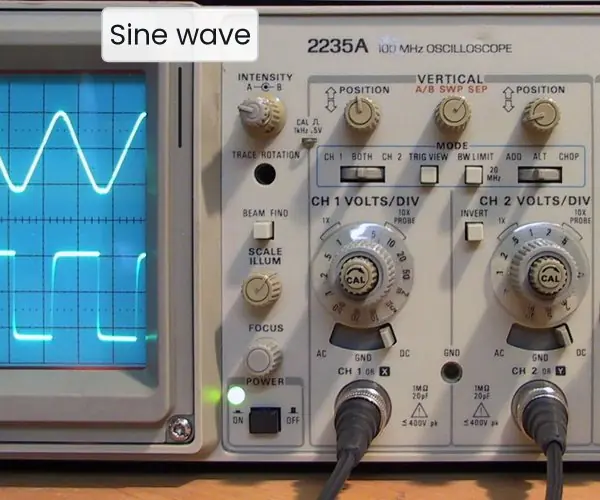
- Signals and sound. Music, radio and AC electricity are sine-type functions of time, as the oscilloscope in Plate 1.1 shows. Changing the amplitude is a vertical stretch and changing the frequency is a horizontal compression. FM radio stations in Kathmandu differ only in the carrier frequency.
- Growth and decay. Money in a savings account at 8% interest grows as 100000 \times 1.08^{t}, an exponential function. Bacteria and the spread of a rumour on social media follow similar curves. The inverse function, the logarithm, tells us how many years are needed to double the money.
- Algorithm analysis. The running time of a program is a function of the input size n, such as n ,\ n^{2} or \log n. Comparing the graphs shows why a \log n search in a sorted list beats an n search for a million records. Computer scientists compare programs by comparing function growth.
- Encoding and decoding. Encryption is an invertible function: a message goes in and a cipher comes out, and the inverse function recovers the message. Only a one-to-one function can be reversed. This is why Section 1.3 matters for the security of ConnectIPS and Fonepay payments.
Formula and fact sheet
- Domain restrictions: denominators ≠ 0, even-root radicands ≥ 0 ,\ \log arguments > 0.
- Even: f (- x) = f (x). Odd: f (- x) = - f (x).
- (f \circ g) (x) = f (g (x)). Inverse: swap x and y, solve; graph reflects in y = x.
- \log (x y) = \log x + \log y ;\ \log (x^{p}) = p \log x ;\ \log_{a} x = \frac{\ln x}{\ln a}.
- \sin^{2} \theta + \cos^{2} \theta = 1 ;\ \sin 2 \theta = 2 \sin \theta \cos \theta ;\ \cos 2 \theta = 1 - 2 \sin^{2} \theta.
- |x| < a \Leftrightarrow - a < x < a ;\ |x| > a \Leftrightarrow x < - a or x > a.
Chapter summary
- A function pairs each input with exactly one output; domain and range come from restrictions of the formula.
- Even and odd symmetry, composition and inverses are the algebra of functions.
- Transformations shift, stretch and reflect graphs; knowing them saves plotting.
- Exponent, logarithm and trigonometric rules are the toolkit used in every later unit.
Practice
- Find the domain ofaf (x) = \sqrt{6 - x - x^{2}},bg (x) = \ln (x^{2} - 5 x + 6),ch (x) = \frac{x + 1}{x^{2} - 4}.
- Find the range of f (x) = 3 - 2 x^{2} and of g (x) = 2^{x} + 1.
- If f (x) = x^{2} + 1 and g (x) = \frac{1}{x - 1}, find f \circ g ,\ g \circ f and their domains.
- Show that f (x) = \frac{2 x + 1}{x - 3} is one-to-one and find f^{-1}.
- Classify as even, odd or neither:ax \sin x,bx^{2} + \sin x,c\frac{(e^{x} - e^{-x})}{2}.
- Solve |2x − 3| ≤ 5.
- Sketch y = \mid x^{2} − 4| by describing the transformation.
- Simplify \log_{2} 40 - \log_{2} 5 + 2 \log_{2} 3.
- If f (x + 1) = x^{2} + 3 x + 2 find f (x).
- A taxi charges Rs 60 for the first km and Rs 40 for each further km (or part). Write the fare as a piecewise function of distance d and evaluate f (3.5).
Answers and worked solutions
1.(a) 6 - x - x^{2} \geq 0 \Leftrightarrow x^{2} + x - 6 \leq 0 \Leftrightarrow (x + 3) (x - 2) \leq 0, so [−3, 2].(b) x^{2} - 5 x + 6 = (x - 2) (x - 3) > 0, so x < 2 or x > 3.(c) x^{2} \neq 4, so all reals except \pm 2.
2. f (x) = 3 - 2 x^{2} \leq 3, maximum 3 at x = 0: (- \infty, 3]. g: 2^{x} > 0, so g > 1: (1 ,\ \infty).
3. (f \circ g) (x) = \frac{1}{(x - 1)^{2}} + 1, domain x \neq 1. (g \circ f) (x) = \frac{1}{x^{2} + 1 - 1} = \frac{1}{x^{2}}, domain x \neq 0.
4. If \frac{2 a + 1}{a - 3} = \frac{2 b + 1}{b - 3}, cross-multiplying gives 2 a b - 6 a + b - 3 = 2 a b - 6 b + a - 3, so 7 b = 7 a, hence a = b. Inverse: y (x - 3) = 2 x + 1 \Rightarrow x (y - 2) = 3 y + 1 ⇒ f^{-1} (x) = \frac{3 x + 1}{x - 2}.
5.(a) x \sin x is odd × odd = even.(b) x^{2} is even, \sin x is odd, so neither.(c) odd (this is \sinh x).
6. - 5 \leq 2 x - 3 \leq 5 \Rightarrow - 2 \leq 2 x \leq 8 ⇒ - 1 \leq x \leq 4.
7. Draw the parabola y = x^{2} - 4 (vertex (0, −4), roots \pm 2), then reflect the part between x = - 2 and 2 (below the axis) upward: a "W" with a peak (0, 4).
8. \log_{2} \left( \frac{40}{5} \right) + \log_{2} 9 = \log_{2} 8 + \log_{2} 9 = 3 + \log_{2} 9 = \log_{2} 72 \approx 6.17.
9. Put t = x + 1: f (t) = (t - 1)^{2} + 3 (t - 1) + 2 = t^{2} + t. So f (x) = x^{2} + x.
10. f (d) = 60 for 0 < d \leq 1, and f (d) = 60 + 40 \cdot \lceil d - 1 \rceil for d > 1. f (3.5) = 60 + 40 \times \lceil 2.5 \rceil = 60 + 120 = Rs 180.
Model answers: medium (5 marks) and long (10 marks) questions
Q (5 marks). Define even and odd functions. Test f (x) = x^{3} - x ,\ g (x) = x^{2} + x and h (x) = x^{2} \cos x, and state what the symmetry of each graph is.
A function f is even if f (- x) = f (x) for every x in its domain, and odd if f (- x) = - f (x). The test is to replace x by - x, simplify, and compare with f (x) and with - f (x).
Both definitions need the domain to be symmetric about 0 (if 3 is in the domain, so is −3).
- f (x) = x^{3} - x. f (- x) = (- x)^{3} - (- x) = - x^{3} + x = - (x^{3} - x) = - f (x). So f is odd. Its graph is symmetric about the origin: rotating it by 180 ^{\circ} leaves it unchanged.
- g (x) = x^{2} + x. g (- x) = x^{2} - x. This is neither g (x) nor - g (x), so g is neither even nor odd. The parabola is symmetric about the line x = - \frac{1}{2}, not about the y-axis.
- h (x) = x^{2} \cos x. h (- x) = (- x)^{2} \cos (- x) = x^{2} \cos x = h (x). So h is even (even × even = even). Its graph is the mirror image in the y-axis.
| Type | Test | Graph symmetry | Examples |
|---|---|---|---|
| Even | f (- x) = f (x) | about the y-axis | x^{2} ,\ |x| ,\ \cos x |
| Odd | f (- x) = - f (x) | about the origin | x^{3} ,\ \sin x ,\ \frac{1}{x} |
Use. Symmetry halves the work: to plot an even or odd function we draw it for x \geq 0 and complete the rest by reflection. In integration, an odd function over [- a ,\ a] always gives 0.
Q (5 marks). Find the domain and range of f (x) = \sqrt{9 - x^{2}} and g (x) = \ln (x - 1), and sketch the shape of each in words.
The domain is the set of inputs for which the formula makes sense, and the range is the set of outputs obtained.
Three restrictions control almost every exam question: the denominator cannot be 0, an even root needs a non-negative radicand, and a logarithm needs a positive argument.
- f (x) = \sqrt{9 - x^{2}}. We need 9 - x^{2} \geq 0, that is x^{2} \leq 9, so - 3 \leq x \leq 3. The domain is [−3, 3]. Inside, 9 - x^{2} runs from 0 up to 9, so its square root runs from 0 up to 3. The range is [0, 3]. The graph is the upper half of the circle x^{2} + y^{2} = 9, a semicircle of radius 3.
- g (x) = \ln (x - 1). We need x - 1 > 0, so x > 1. The domain is (1 ,\ \infty). As x \to 1^{+} the value goes to - \infty and as x \to \infty it increases without bound, so the range is all real numbers. The graph is the curve y = \ln x moved 1 unit to the right (Section 1.5); the line x = 1 is a vertical asymptote.
Check. Take x = 5 in g: \ln 4 \approx 1.386, a valid output. Take x = 4 in f: 9 - 16 < 0, so 4 is not in the domain.
Q (10 marks). What is a function? Explain domain and range, the standard families of functions with their graphs, composition and inverse functions, and the rules for transforming graphs.
Introduction. A function f from a set A to a set B is a rule that assigns to each element x of A exactly one element f (x) of B. The set A is the domain, and the set of values actually produced is the range.
A graph represents a function only if every vertical line cuts it at most once (the vertical line test). Calculus studies how such rules change, so this chapter is its alphabet.
Domain and range. Domain restrictions come from three rules: no division by zero, no even root of a negative number, and only positive arguments in a logarithm. For example the domain of \ln (x^{2} - 5 x + 6) is x < 2 or x > 3 (Practice 1).
Standard families (Figure 1.1).
| Family | Example | Domain | Range | Key feature |
|---|---|---|---|---|
| Polynomial | x^{2} ,\ x^{3} | all reals | [0 ,\ \infty) for x^{2}; all reals for x^{3} | smooth, no breaks |
| Rational | \frac{1}{x} | x \neq 0 | y \neq 0 | vertical and horizontal asymptotes |
| Root | \sqrt{x} | x \geq 0 | [0 ,\ \infty) | starts at origin, rises slowly |
| Exponential | e^{x} | all reals | (0 ,\ \infty) | always positive, grows fast |
| Logarithm | \ln x | x > 0 | all reals | inverse of e^{x} |
| Trigonometric | \sin x | all reals | [−1, 1] | periodic, period 2 \pi |
Even and odd functions. An even function has f (- x) = f (x) (symmetric about the y-axis, like x^{2}); an odd function has f (- x) = - f (x) (symmetric about the origin, like x^{3} and \sin x).
Composition and inverse. The composition (f \circ g) (x) = f (g (x)) applies g first and then f; in general f \circ g \neq g \circ f.
A one-to-one function has an inverse f^{-1} found by swapping x and y and solving; its graph is the reflection of f in the line y = x (Figure 1.2).
Only one-to-one functions can be inverted, which is why x^{2} is restricted to x \geq 0 before taking √.
Transformations (Figure 1.3). From y = f (x): f (x) + k shifts up, f (x - h) shifts right, - f (x) reflects in the x-axis, f (- x) reflects in the y-axis, a \cdot f (x) stretches vertically and f (b x) compresses horizontally.
For example y = (x - 3)^{2} + 2 is y = x^{2} moved 3 right and 2 up, with vertex (3, 2).
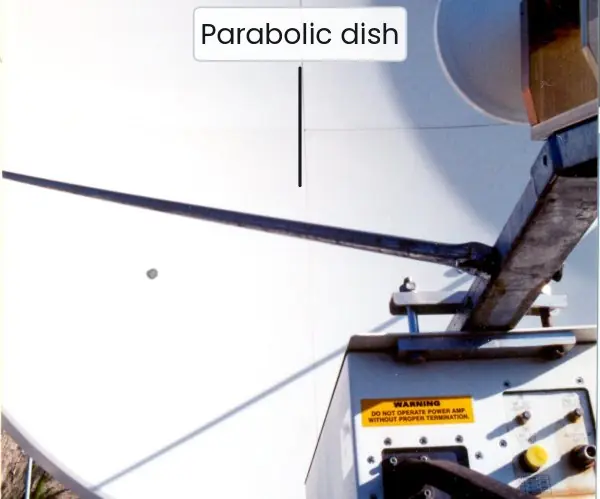
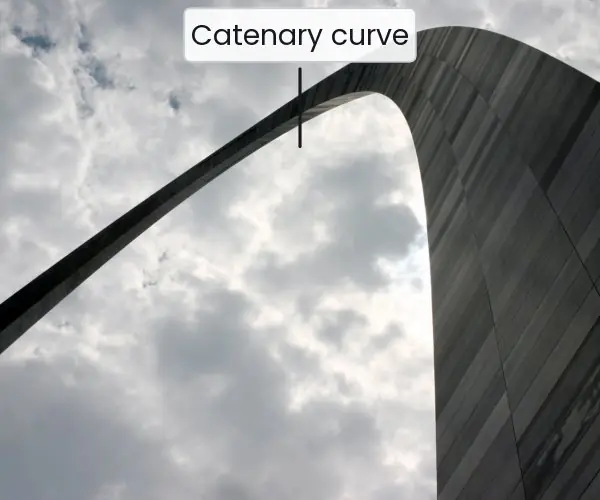
Applications. Dish antennas use the parabola, loans use the exponential, and sound uses the sine (Plate 1.1).
Conclusion. Every later idea (limit, derivative, integral) is applied to these functions. A student who can name the family, find the domain and range, and sketch the graph by transformation has done most of the work of a calculus problem.