Unit 5 · 20 min read
Integration
What the syllabus asks for 8
- Indefinite integrals
- Integration by substitution
- Integration by parts
- Partial fractions
- The definite integral and the Fundamental Theorem
- Applications
- Improper integrals
- Eight uses of integration
Integration reverses differentiation and also adds up infinitely many infinitesimal pieces. With it we compute areas, volumes, total change, averages and, in the next unit, solve differential equations.
- Antiderivatives, the table of standard integrals, and the substitution, parts and partial-fraction methods.
- The definite integral, the Fundamental Theorem of Calculus, and its properties.
- Area between curves, volume of revolution, average value, and improper integrals.
5.1 Indefinite integrals
F is an antiderivative of f if F' = f. The family of all antiderivatives is the indefinite integral \int f (x) \,d x = F (x) + C, where C is an arbitrary constant.
| f (x) | \int f \,d x | f (x) | \int f \,d x |
|---|---|---|---|
| x^{n} (n \neq - 1) | \frac{x^{n+1}}{n + 1} | \frac{1}{x} | ln|x| |
| e^{x} | e^{x} | a^{x} | \frac{a^{x}}{\ln} a |
| \sin x | - \cos x | \cos x | \sin x |
| \sec^{2} x | \tan x | \csc^{2} x | - \cot x |
| \sec x \tan x | \sec x | \frac{1}{(1 + x^{2})} | \tan^{-1} x |
| \frac{1}{\sqrt{1 - x^{2}}} | \sin^{-1} x | \tan x | ln|sec x| |
| \frac{1}{\sqrt{x^{2} + a^{2}}} | ln|x + \sqrt{x^{2} + a^{2}} \mid | \frac{1}{(x^{2} - a^{2})} | \left( \frac{1}{2 a} \right) ln|(x − a ) / ( x + a)| |
Linearity: ∫ (af + bg) = a \int f + b \int g. Always check an answer by differentiating it.
5.2 Integration by substitution
If an integral has the form \int f (g (x)) g' (x) \,d x, put u = g (x) ,\ d u = g' (x) d x, and integrate in u.
(a) \int 2 x e^{x^{2}} \,d x: u = x^{2} ,\ d u = 2 x d x, so \int e^{u} \,d u = e^{x^{2}} + C.
(b) \frac{\int x}{x^{2} + 1} \,d x: u = x^{2} + 1 ,\ d u = 2 x d x, so \frac{1}{2} \frac{\int d u}{u} = \frac{1}{2} \ln (x^{2} + 1) + C.
(c) \int \tan x \,d x = \frac{\int \sin x}{\cos x} \,d x: u = \cos x ,\ d u = - \sin x d x, so −ln|cos x| + C = ln|sec x| + C.
(d) \int \cos^{3} x \,d x = \int (1 - \sin^{2} x) \cos x \,d x: u = \sin x, so \sin x - \frac{\sin^{3} x}{3} + C.
(e) \frac{\int 1}{x \ln x} \,d x: u = \ln x, so ln|ln x| + C.
(f) \int (2 x + 3)^{5} \,d x = \frac{(2 x + 3)^{6}}{12} + C.
5.3 Integration by parts
From (u v)' = u' v + u v': \int u \,d v = u v - \int v \,d u. Choose u in the order LIATE (Logarithmic, Inverse trig, Algebraic, Trig, Exponential): the first type that appears becomes u.
(a) \int x e^{x} \,d x: u = x ,\ \,d v = e^{x} \,d x \Rightarrow x e^{x} - \int e^{x} \,d x = (x - 1) e^{x} + C.
(b) \int x^{2} \ln x \,d x: u = \ln x ,\ \,d v = x^{2} \,d x \Rightarrow \left( \frac{x^{3}}{3} \right) \ln x - \frac{\int x^{2}}{3} \,d x = \left( \frac{x^{3}}{3} \right) \ln x - \frac{x^{3}}{9} + C.
(c) \int \ln x \,d x: u = \ln x ,\ d v = d x \Rightarrow x \ln x - x + C.
(d) \int x \sin x \,d x = - x \cos x + \sin x + C.
(e) \int e^{x} \sin x \,d x = I. By parts twice, I = e^{x} \sin x - e^{x} \cos x - I, so I = \frac{e^{x} (\sin x - \cos x)}{2} + C.
(f) \int \tan^{-1} x \,d x = x \tan^{-1} x - \frac{1}{2} \ln (1 + x^{2}) + C.
5.4 Partial fractions
A proper rational function \frac{P (x)}{Q (x)} (degree P < degree Q) is split into simpler fractions by factors of Q: a linear factor (x - a) gives \frac{A}{x - a}; a repeated factor (x - a)^{2} gives \frac{A}{x - a} + \frac{B}{(x - a)^{2}}; an irreducible quadratic gives (Ax + B ) / ( x^{2} + p x + q).
If the degree of P ≥ degree of Q, divide first.
(a) \frac{1}{(x - 1) (x + 2)} = \frac{A}{x - 1} + \frac{B}{x + 2}. Then 1 = A (x + 2) + B (x - 1) ;\ x = 1 gives A = \frac{1}{3} ;\ x = - 2 gives B = - \frac{1}{3}. So \int = \frac{1}{3} ln|x − 1| − \frac{1}{3} ln|x + 2| = \frac{1}{3} ln|(x − 1 ) / ( x + 2)| + C.
(b) \frac{3 x + 5}{((x + 1)^{2})} = \frac{3}{x + 1} + \frac{2}{(x + 1)^{2}}. \int = 3 ln|x + 1| − \frac{2}{x + 1} + C.
(c) \frac{\int (x^{2} + 1)}{x - 1} \,d x: divide, x^{2} + 1 = (x - 1) (x + 1) + 2, so \int \left( x + 1 + \frac{2}{x - 1} \right) \,d x = \frac{x^{2}}{2} + x + 2 ln|x − 1| + C.
5.5 The definite integral and the Fundamental Theorem
The definite integral \int_{a}^{b} f (x) \,d x is the limit of Riemann sums \sum f (x_{i}) \Delta x, the signed area between the graph and the x-axis from a to b. The Fundamental Theorem of Calculus connects it to antiderivatives:
- Part 1: if F (x) = \int_{a}^{x} f (t) \,d t then F' (x) = f (x).
- Part 2: \int_{a}^{b} f (x) \,d x = F (b) - F (a) for any antiderivative F.
Properties. \int_{a}^{b} f = - \int_{a}^{b} f ;\ \int_{a}^{a} f = 0 ;\ \int_{a}^{b} f = \int_{a}^{c} f + \int^{cb} f ;\ \int_{a}^{b} f (x) \,d x = \int_{a}^{b} f (a + b - x) \,d x; for even f ,\ \int_{-a}^{a} f = 2 \int_{0}^{a} f; for odd f ,\ \int_{-a}^{a} f = 0.
When substituting in a definite integral, change the limits too.
(a) \int_{0}^{\pi} \sin x \,d x = [- \cos x]_{0}^{\pi} = 1 + 1 = 2.
(b) \frac{\int_{1}^{2} d x}{x} = \ln 2 - \ln 1 = \ln 2 \approx 0.693.
(c) \int_{0}^{1} 2 x e^{x^{2}} \,d x: u = x^{2}, limits 0 \to 1: \int_{0}^{1} e^{u} \,d u = e - 1 \approx 1.718.
(d) \int_{0}^{\frac{\pi}{2}} \sin^{3} x \,d x = \int_{0}^{\frac{\pi}{2}} (1 - \cos^{2} x) \sin x \,d x ,\ u = \cos x: \int_{0}^{1} (1 - u^{2}) \,d u = 1 - \frac{1}{3} = \frac{2}{3}.
(e) \int_{-1}^{1} x^{3} \,d x = 0 (odd function).
(f) \int_{0}^{1} x e^{x} \,d x = [(x - 1) e^{x}]_{0}^{1} = 0 - (- 1) = 1.

5.6 Applications
Area between curves. If f \geq g on [a ,\ b]: A = \int_{a}^{b} [f (x) - g (x)] \,d x. If the curves cross, split at the intersections.
Volume of revolution about the x-axis (disc method): V = \pi \int_{a}^{b} [f (x)]^{2} \,d x; with a hole (washer): V = \pi \int (R^{2} - r^{2}) \,d x. About the y-axis (shell method): V = 2 \pi \int x f (x) \,d x.
Average value of f on [a ,\ b]: \left( \frac{1}{b - a} \right) \int_{a}^{b} f \,d x. Arc length: L = \int_{a}^{b} \sqrt{1 + (f')^{2}} \,d x. Total change: ∫ of a rate gives the net change (distance = ∫ speed d t).
Area between y = x and y = x^{2}: intersections x = 0 ,\ 1 ;\ A = \int_{0}^{1} (x - x^{2}) \,d x = \frac{1}{2} - \frac{1}{3} = \frac{1}{6}.
Area under y = \sin x from 0 to π: 2.
Volume of y = x^{2} about the x-axis from 0 to 1: V = \pi \int_{0}^{1} x^{4} \,d x = \frac{\pi}{5}. For y = \sqrt{x} on [0, 4]: V = \pi \int_{0}^{4} x \,d x = 8 \pi.
Average value of f (x) = x^{2} on [0, 3]: \left( \frac{1}{3} \right) \left( \frac{27}{3} \right) = 3.
Net displacement for velocity v (t) = 3 t^{2} - 6 t + 2 from t = 0 to 2: [t^{3} - 3 t^{2} + 2 t]_{0}^{2} = 8 - 12 + 4 = 0 (the body returns to its start; the distance travelled is \int |v| \,d t, which is larger).

5.7 Improper integrals
An integral with an infinite limit or an infinite integrand is defined as a limit.
(a) \int_{1}^{\infty} x^{-2} \,d x = \lim_{b \to \infty} \left[ - \frac{1}{x} \right]_{1}^{b} = 1 - 0 = 1 (converges).
(b) \frac{\int_{1}^{\infty} 1}{x} \,d x = \lim \ln b = \infty (diverges).
(c) \int_{0}^{1} x^{- \frac{1}{2}} \,d x = \lim_{a \to 0^{+}} \left[ 2 \sqrt{x} \right]_{a}^{1} = 2 (converges).
(d) \int_{0}^{\infty} e^{- x} \,d x = 1.
Rule: \int_{1}^{\infty} x^{- p} \,d x converges iff p > 1 ;\ \int_{0}^{1} x^{- p} \,d x converges iff p < 1.

5.8 Eight uses of integration
- Area of irregular land. The area under a curve is a definite integral, so surveyors and map software can find the area of a plot with a curved boundary. In Nepal land is measured in ropani and kattha, and the same idea converts a measured outline into area. A smaller strip width gives a more exact answer (Figure 5.1).
- Volume of tanks and solids. Cutting a solid into thin discs and adding them gives volume (Figure 5.2b). Water tank, bottle and d a m designers use it to know how much each shape holds. The reservoir of a hydropower plant is estimated this way.
- Distance from speed. If the speed v (t) of a bus is known, the distance travelled is \int v \,d t. A GPS tracker adds many small distances to give the trip length. This is the reverse of differentiation: position is the integral of speed.
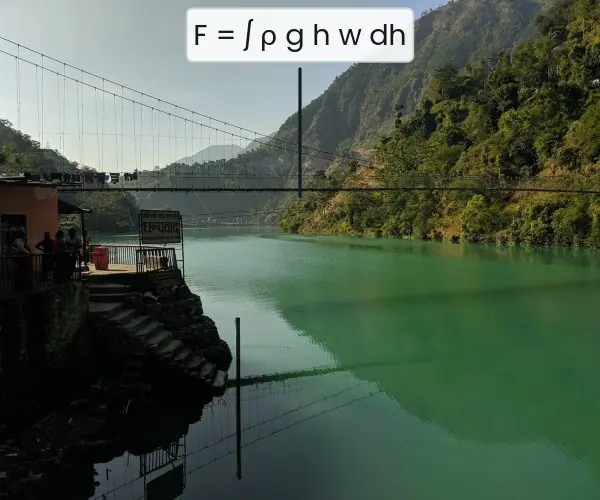
- Work, force and pressure. The pressure on a d a m wall increases with depth, so the total force is an integral of pressure over the wall (Plate 5.1c). Engineers of the Kaligandaki and Marsyangdi plants need this to make the wall strong enough. A constant-force formula alone would be wrong.
- Probability and statistics. For a continuous variable, the probability that a value lies between a and b is the area under its density curve. The normal curve of exam marks is integrated to find how many students score above 60. Tribhuvan University result analysis is built on such areas.
- Electricity and signals. The charge stored in a capacitor is the integral of the current, and the energy used by a house is the integral of power over time. Nepal Electricity Authority meters add power over hours in the same way. Digital signal processing also integrates signals to find their average and energy.
- Computer graphics and numerical methods. Computers cannot do symbolic integration for every function, so they use Riemann-type sums such as the trapezoidal and Simpson's rules. These give an accurate area with a fast loop. Games and simulations use them for physics.
- Average value and economics. The average value of a function on [a ,\ b] is \left( \frac{1}{b - a} \right) \int f \,d x. An economist finds the average daily electricity demand or the total revenue from a marginal revenue curve. The consumer surplus in a market is also an area between two curves.
Formula and fact sheet
- \int x^{n} \,d x = \frac{x^{n+1}}{n + 1} ;\ \frac{\int d x}{x} = ln|x|; \int e^{x} = e^{x} ;\ \int \sin = - \cos ;\ \int \cos = \sin.
- Substitution: u = g (x). Parts: \int u \,d v = u v - \int v \,d u, LIATE.
- FTC: \int_{a}^{b} f = F (b) - F (a). Even: 2 \int_{0}^{a}; odd: 0.
- Area = ∫ (top − bottom). Disc volume = \pi \int f^{2}. Average = \left( \frac{1}{b - a} \right) \int f.
- Improper: \int_{1}^{\infty} x^{- p} converges for p > 1.
Chapter summary
- Integration is reverse differentiation; always add C for indefinite integrals and verify by differentiating.
- Substitution undoes the chain rule, parts undoes the product rule, partial fractions handle rational functions.
- The Fundamental Theorem lets us compute definite integrals from antiderivatives.
- Areas, volumes, averages and total change are all definite integrals; improper integrals are limits.
Practice
- Evaluatea\int \left( 4 x^{3} - \frac{3}{x} + e^{x} \right) \,d x,b\int (x^{2} + 1)^{2} \,d x,c\int \cos^{2} x \,d x.
- Evaluate by substitutiona\int x \sqrt{x^{2} + 4} \,d x,b\int e^{3 x + 1} \,d x,c\int \sin x \cos^{4} x \,d x.
- Evaluate by partsa\int x \cos x \,d x,b\int x e^{2 x} \,d x,c\int x \ln x \,d x.
- Evaluate \frac{\int (2 x + 3)}{(x - 1) (x + 2)} \,d x.
- Evaluatea\int_{0}^{2} (3 x^{2} - 2 x) \,d x,b\int_{0}^{\frac{\pi}{4}} \sec^{2} x \,d x,c\frac{\int_{1}^{e} (\ln x)}{x} \,d x.
- Find the area enclosed by y = x^{2} and y = 4 x - x^{2}.
- Find the volume generated by revolving y = x^{2} about the x-axis between x = 1 and x = 2.
- Find the average value of \sin x on [0 ,\ \pi].
- Does \frac{\int_{1}^{\infty} 1}{\sqrt{x}} \,d x converge? Does \frac{\int_{1}^{\infty} 1}{x^{\frac{3}{2}}} \,d x?
- If F (x) = \int_{0}^{x} t e^{t} \,d t find F' (x) and F (1).
Answers and worked solutions
1.(a) x^{4} - 3 ln|x| + e^{x} + C.(b) \frac{x^{5}}{5} + \frac{2 x^{3}}{3} + x + C.(c) \frac{x}{2} + \frac{\sin 2 x}{4} + C.
2.(a) u = x^{2} + 4: \frac{1}{3} (x^{2} + 4)^{\frac{3}{2}} + C.(b) \frac{1}{3} e^{3 x + 1} + C.(c) u = \cos x: - \frac{\cos^{5} x}{5} + C.
3.(a) x \sin x + \cos x + C.(b) \left( \frac{x}{2} \right) e^{2 x} - \frac{e^{2 x}}{4} + C.(c) \left( \frac{x^{2}}{2} \right) \ln x - \frac{x^{2}}{4} + C.
4. \frac{2 x + 3}{(x - 1) (x + 2)} = \frac{A}{x - 1} + \frac{B}{x + 2}: A = \frac{5}{3} ,\ B = \frac{1}{3}. ∫ = \left( \frac{5}{3} \right) ln|x − 1| + \left( \frac{1}{3} \right) ln|x + 2| + C.
5.(a) [x^{3} - x^{2}]_{0}^{2} = 8 - 4 = 4.(b) \tan \left( \frac{\pi}{4} \right) - 0 = 1.(c) [ (ln x)²/2 ]₁^e = \frac{1}{2}.
6. Intersections: x^{2} = 4 x - x^{2} \Rightarrow x = 0 ,\ 2. A = \int_{0}^{2} (4 x - 2 x^{2}) \,d x = \left[ 2 x^{2} - \frac{2 x^{3}}{3} \right]_{0}^{2} = 8 - \frac{16}{3} = \frac{8}{3}.
7. V = \pi \int_{1}^{2} x^{4} \,d x = \frac{\pi (32 - 1)}{5} = \frac{31 \pi}{5} \approx 19.48.
8. \left( \frac{1}{\pi} \right) [- \cos x]_{0}^{\pi} = \frac{2}{\pi} ≈ 0.637.
9. \int_{1}^{\infty} x^{- \frac{1}{2}} diverges \left( p = \frac{1}{2} \leq 1 \right). \int_{1}^{\infty} x^{- \frac{3}{2}} = \left[ - 2 x^{- \frac{1}{2}} \right]_{1}^{\infty} = 2, converges.
10. F' (x) = x e^{x}. F (1) = \int_{0}^{1} t e^{t} \,d t = [(t - 1) e^{t}]_{0}^{1} = 1.
Model answers: medium (5 marks) and long (10 marks) questions
Q (5 marks). Evaluate \int x e^{x} \,d x by parts and hence find \int_{0}^{1} x e^{x} \,d x.
Integration by parts comes from the product rule: \int u \,d v = u v - \int v \,d u. The skill is to choose u so that d u is simpler than u. The order of preference is LIATE: Logarithmic, Inverse trigonometric, Algebraic, Trigonometric, Exponential.
- In x e^{x} the algebraic factor x comes before the exponential, so let u = x and d v = e^{x} d x.
- Then d u = d x and v = e^{x}.
- Apply the formula: \int x e^{x} \,d x = x e^{x} - \int e^{x} \,d x.
- The remaining integral is e^{x}, so \int x e^{x} \,d x = x e^{x} - e^{x} + C = (x - 1) e^{x} + C.
- Check by differentiating: \frac{d}{d x} [(x - 1) e^{x}] = e^{x} + (x - 1) e^{x} = x e^{x} ✓.
For the definite integral use the Fundamental Theorem: \int_{0}^{1} x e^{x} \,d x = [(x - 1) e^{x}]_{0}^{1} = (0) (e) - (- 1) (1) = 1. The area under the curve y = x e^{x} between x = 0 and x = 1 is exactly one square unit.
Q (5 marks). Find the area between y = x and y = x^{2} and the volume generated when the curve y = \sqrt{x} ,\ 0 \leq x \leq 4, is rotated about the x-axis.
*Area (Figure 5.2 a ) . \ast The curves meet where x = x^{2}, that is x = 0 and x = 1. Between them the line is above the parabola (at x = 0.5: 0.5 > 0.25).
The area is the integral of (upper − lower): \int_{0}^{1} (x - x^{2}) \,d x = \left[ \frac{x^{2}}{2} - \frac{x^{3}}{3} \right]_{0}^{1} = \frac{1}{2} - \frac{1}{3} = \frac{1}{6} square unit.
*Volume (Figure 5.2 b ) . \ast A thin slice at position x is a disc of radius y = \sqrt{x} and thickness d x, so its volume is \pi y^{2} d x = \pi x d x. Adding all slices from 0 to 4:
V = \pi \int_{0}^{4} x \,d x = \pi \left[ \frac{x^{2}}{2} \right]_{0}^{4} = \pi \times 8 = 8 \pi \approx 25.13 cubic units.
Remark. The disc formula is V = \pi \int y^{2} \,d x. If the region lies between two curves a washer (a disc with a hole) is used: V = \pi \int (R^{2} - r^{2}) \,d x. Always sketch the region first and write which curve is on top.
Q (10 marks). Define the definite integral through Riemann sums. State the Fundamental Theorem of Calculus. Explain the methods of integration (substitution, parts, partial fractions) with an example of each, and explain improper integrals.
Introduction. Integration reverses differentiation and also measures accumulated quantities such as area, distance and volume.
The indefinite integral \int f \,d x is the family of antiderivatives F (x) + C, and the definite integral \int_{a}^{b} f \,d x is a number, the signed area under the curve.
Riemann sums (Figure 5.1). Divide [a ,\ b] into n strips of width \Delta x = \frac{b - a}{n}, build a rectangle of height f (x_{i}) on each, and add: \sum f (x_{i}) \Delta x.
The definite integral is the limit of this sum as n \to \infty. For f = x^{2} on [0, 2] the sums are 1.75 (left, n = 4), 3.75 (right, n = 4) and tend to \frac{8}{3}.
Fundamental Theorem of Calculus. (1) If F (x) = \int_{a}^{x} f (t) \,d t then F' (x) = f (x). (2) If G' = f then \int_{a}^{b} f \,d x = G (b) - G (a).
Example \int_{0}^{2} x^{2} \,d x = \left[ \frac{x^{3}}{3} \right]_{0}^{2} = \frac{8}{3} ✓.
Methods of integration.
| Method | When used | Example | Result |
|---|---|---|---|
| Substitution | a function and its derivative appear | \int 2 x \cos (x^{2}) \,d x ,\ u = x^{2} | \sin (x^{2}) + C |
| By parts | product of different types | \int x e^{x} \,d x ,\ u = x | (x - 1) e^{x} + C |
| Partial fractions | rational function with factorable denominator | \frac{\int (3 x + 5)}{(x + 1) (x + 2)} \,d x | 2 ln|x + 1| + ln|x + 2| + C |
For the last example write \frac{3 x + 5}{(x + 1) (x + 2)} = \frac{A}{x + 1} + \frac{B}{x + 2}. Then 3 x + 5 = A (x + 2) + B (x + 1); putting x = - 1 gives A = 2 and x = - 2 gives B = 1.
Applications (Figure 5.2). Area between curves is \int ( \mathrm{upper} − lower)dx, volume of revolution is \pi \int y^{2} \,d x, and average value is \left( \frac{1}{b - a} \right) \int f \,d x.
Improper integrals (Figure 5.3). An integral with an infinite limit is defined by a limit: \frac{\int_{1}^{\infty} d x}{x^{2}} = \lim_{b \to \infty} \left( 1 - \frac{1}{b} \right) = 1 (converges), but \frac{\int_{1}^{\infty} d x}{x} = \lim \ln b = \infty (diverges).
The p-test: \frac{\int_{1}^{\infty} d x}{x^{p}} converges if and only if p > 1.
Conclusion. Integration accumulates small pieces into a total. The Fundamental Theorem makes it practical by connecting it with antiderivatives, and the three methods cover most examination problems.