Chapter 10 · Coordinate Geometry · 3 questions in the paper · 11 min read
Circle and Conic Sections
What the syllabus asks for 2
- Equation of a circle, centre and radius, tangent
- Parabola, ellipse and hyperbola in standard form
Conics carry about three questions: the centre or radius of a circle, the focus or latus rectum of a parabola, and the eccentricity or axis of an ellipse or hyperbola. Everything is a substitution into a standard form; the work is recognising which form you have.
- Circle: (x-h)^2+(y-k)^2=r^2, general form, tangent conditions.
- Parabola y^2=4ax: focus, directrix, latus rectum.
- Ellipse and hyperbola: axes, foci, eccentricity, asymptotes.
- Eccentricity: circle 0, ellipse < 1, parabola 1, hyperbola > 1.
10.1 Circle: equation, centre, radius, tangent
- Centre (h,k), radius r: (x-h)^2+(y-k)^2=r^2. Centre at the origin: x^2+y^2=r^2.
- General form x^2+y^2+2gx+2fy+c=0: centre (-g,-f), radius \sqrt{g^2+f^2-c}. It passes through the origin when c=0.
- A line touches a circle when the distance from the centre to the line equals r.
- Tangent at (x_1,y_1) to x^2+y^2=r^2: xx_1+yy_1=r^2. Length of tangent from an outside point =\sqrt{x_1^2+y_1^2-r^2}.
- A point is inside, on or outside according as x_1^2+y_1^2-r^2 is negative, zero or positive.
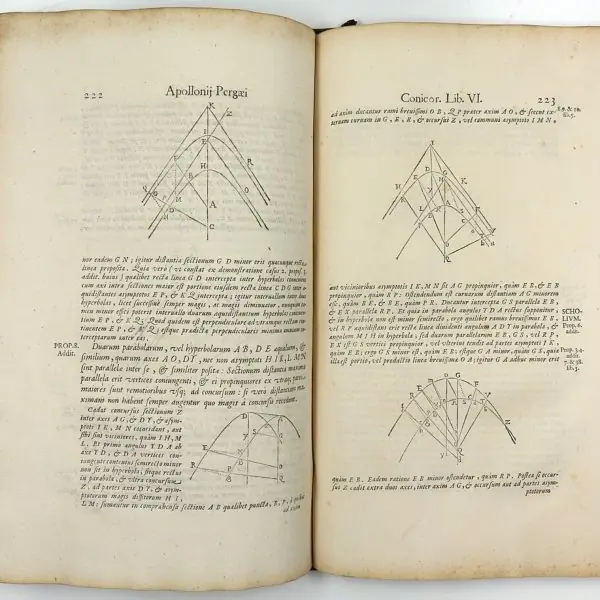


10.2 Parabola, ellipse and hyperbola in standard form
| Conic | Equation | Key facts |
|---|---|---|
| Parabola | y^2=4ax | vertex (0,0), focus (a,0), directrix x=-a, latus rectum 4a, e=1 |
| Parabola | x^2=4ay | opens upward, focus (0,a) |
| Ellipse (a>b) | \frac{x^2}{a^2}+\frac{y^2}{b^2}=1 | e=\sqrt{1-\frac{b^2}{a^2}}, foci (\pm ae,0), major axis 2a, latus rectum \frac{2b^2}{a}, area \pi ab |
| Hyperbola | \frac{x^2}{a^2}-\frac{y^2}{b^2}=1 | e=\sqrt{1+\frac{b^2}{a^2}}, foci (\pm ae,0), asymptotes y=\pm\frac{b}{a}x |
| Rect. hyperbola | xy=c^2 or x^2-y^2=a^2 | asymptotes at right angles |
For an ellipse the larger denominator belongs to the major axis, so \frac{x^2}{16}+\frac{y^2}{25}=1 has its major axis along the y-axis. Distance between the foci =2ae.


10.3 Eight traps in circles and conics
Conic questions come from a small set of formulas, and the hardest part is knowing which letters mean what. These eight traps are drawn from the model questions on circles, parabolas, ellipses and hyperbolas.
- The centre in (x-h)^2+(y-k)^2=r^2 is (h,k); in the general form it is (-g,-f). For (x-3)^2+(y+2)^2=25 the centre is (3,-2), so the sign inside the bracket is opposite to the coordinate. For x^2+y^2-6x+4y-12=0 we have g=-3, f=2, centre (3,-2), radius \sqrt{9+4+12}=5 (Fig 10.1). The radius squared must be positive, or there is no real circle.
- Test a point by comparing distances. Compute S_1=x_1^2+y_1^2+2gx_1+2fy_1+c for the point: negative means inside, zero means on the circle and positive means outside. The tangent length from an outside point is \sqrt{S_1}. For (3,6) that is \sqrt{39}=6.24.
- A tangent is perpendicular to the radius. A line touches a circle when its distance from the centre equals r. The tangent at (x_1,y_1) on x^2+y^2=r^2 is xx_1+yy_1=r^2. If the radius slope is \frac43 the tangent slope is -\frac34.
- Use the diameter form when two end points are given. The circle with diameter ends (x_1,y_1) and (x_2,y_2) is (x-x_1)(x-x_2)+(y-y_1)(y-y_2)=0. This is faster than finding the centre and radius separately. A circle through the origin has c=0.
- Parabola y^2=4ax has focus (a,0), directrix x=-a and latus rectum 4a. For y^2=8x, a=2, so the focus is (2,0) (Fig 10.2). The form x^2=4ay opens upward instead. Do not take the coefficient 8 as a: it equals 4a.
- For the ellipse, the bigger denominator decides the major axis. In \frac{x^2}{25}+\frac{y^2}{9}=1 we have a=5, b=3, c^2=a^2-b^2=16, e=\frac45, foci (\pm4,0). The latus rectum is \frac{2b^2}{a}=3.6 and the sum of focal distances is 2a=10. Always e<1.
- For the hyperbola, c^2=a^2+b^2 and the sign between the terms is minus. In \frac{x^2}{16}-\frac{y^2}{9}=1 we get c=5, e=\frac54=1.25 and asymptotes y=\pm\frac34x. A rectangular hyperbola has a=b, so e=\sqrt2. Do not use the ellipse relation a^2-b^2 here.
- Name the conic from the general equation. Equal coefficients of x^2 and y^2 give a circle; same sign but unequal give an ellipse; opposite signs give a hyperbola; only one squared term gives a parabola (Fig 10.3). A quick check is the eccentricity: 0, below 1, equal to 1, above 1.
10.3.1 Worked checks
Q. Find the centre and radius of x^2+y^2-6x+4y-12=0, and the length of the tangent from (3,6).
Answer. 2g=-6, 2f=4, so the centre is (3,-2) and r=\sqrt{9+4+12}=5. Tangent length =\sqrt{S_1}=\sqrt{9+36-18+24-12}=\sqrt{39}\approx6.24.
Check the distance from (3,6) to the centre is 8 and \sqrt{64-25}=\sqrt{39}.
Q. For y^2=12x find the focus, directrix and length of the latus rectum.
Answer. 4a=12, so a=3. The focus is (3,0), the directrix is x=-3 and the latus rectum is 4a=12. The point (3,6) lies on the curve since 36=12\times3, and it is an end of the latus rectum.
Q. Find the eccentricity and foci of \frac{x^2}{25}+\frac{y^2}{9}=1.
Answer. a=5, b=3, c=\sqrt{25-9}=4, so e=\frac45=0.8 and the foci are (\pm4,0). Check: the sum of distances from (0,3) to the foci is 5+5=10=2a.
Formula and fact sheet
| Item | Result |
|---|---|
| Circle general | centre (-g,-f), r=\sqrt{g^2+f^2-c} |
| Parabola y^2=4ax | focus (a,0), directrix x=-a |
| Ellipse | e^2=1-\frac{b^2}{a^2} |
| Hyperbola | e^2=1+\frac{b^2}{a^2} |
Chapter summary
- Complete the square or use g,f,c to read a circle off its equation.
- For y^2=4ax read a from the coefficient: y^2=12x gives a=3.
- Ellipse: e<1; hyperbola: e>1.
- Major axis follows the larger denominator.
- Tangent length is \sqrt{S_1}, the power of the point.
Practice questions
Set A — Recall (20 questions)
- The radius of the circle x^2+y^2=25 isa25b10c5d2.5
- The centre of (x-2)^2+(y+3)^2=16 isa(-2,3)b(2,-3)c(2,3)d(-2,-3)
- The focus of y^2=4x isa(4,0)b(0,1)c(2,0)d(1,0)
- The eccentricity of a parabola isa1b0cless than 1dgreater than 1
- The directrix of y^2=8x isax=2bx=-2cx=-8dy=-2
- The length of the latus rectum of y^2=12x isa3b6c12d24
- The centre of x^2+y^2-4x+6y-12=0 isa(2,-3)b(-2,3)c(4,-6)d(-4,6)
- The eccentricity of a circle isa1bgreater than 1c0.5d0
- The eccentricity of a hyperbola isa0b1cgreater than 1dless than 1
- The length of the major axis of \frac{x^2}{25}+\frac{y^2}{9}=1 isa5b10c6d3
- The foci of \frac{x^2}{25}+\frac{y^2}{9}=1 area(\pm4,0)b(\pm5,0)c(\pm3,0)d(0,\pm4)
- The circle with centre the origin and radius 3 isax^2+y^2=3bx+y=9cx^2-y^2=9dx^2+y^2=9
- The vertex of y^2=4ax isa(a,0)b(-a,0)c(0,0)d(0,a)
- The asymptotes of \frac{x^2}{a^2}-\frac{y^2}{b^2}=1 areay=\pm\frac{b}{a}xby=\pm\frac{a}{b}xcy=\pm xdx=\pm a
- The radius of x^2+y^2+2gx+2fy+c=0 isag^2+f^2-cb\sqrt{g^2+f^2-c}c\sqrt{g^2+f^2+c}dg+f-c
- The parabola x^2=4ay with a>0 opensato the rightbto the leftcdownwarddupward
- Which point lies on x^2+y^2=25?a(2,3)b(4,4)c(3,4)d(5,5)
- For \frac{x^2}{16}+\frac{y^2}{25}=1 the major axis lies along theay-axisbx-axiscline y=xdnone: it is a circle
- The focus of x^2=8y isa(2,0)b(0,2)c(0,8)d(8,0)
- The curve xy=4 representsaa parabolaban ellipseca circleda rectangular hyperbola
Answers and explanations — Set A
1. (c) — r² = 25.
2. (b) — centre is (h, k) with the signs reversed inside the brackets.
3. (d) — 4a = 4, a = 1.
4. (a) — by definition.
5. (b) — 4a = 8, a = 2, directrix x = −2.
6. (c) — the latus rectum is 4a = 12.
7. (a) — 2g = −4 and 2f = 6 give (−g, −f) = (2, −3).
8. (d) — a circle is an ellipse with a = b.
9. (c) — hyperbola has e > 1.
10. (b) — 2a = 10.
11. (a) — c² = 25 − 9 = 16.
12. (d) — x² + y² = r².
13. (c) — the vertex is the origin.
14. (a) — slope b/a.
15. (b) — remember the square root.
16. (d) — x² = 4ay opens up when a > 0.
17. (c) — 9 + 16 = 25.
18. (a) — 25 is the larger denominator, under y².
19. (b) — 4a = 8, a = 2, focus (0, 2).
20. (d) — xy = c² is a rectangular hyperbola.
Set B — Understanding (12 questions)
- The circle with centre (3,4) passing through the origin isax^2+y^2-6x-8y=0bx^2+y^2-6x-8y+25=0cx^2+y^2=25dx^2+y^2+6x+8y=0
- The radius of x^2+y^2-6x+8y-11=0 isa11b5c36d6
- The line y=5 and the circle x^2+y^2=25ado not meetbcut at two pointsctouch each otherdmeet at the centre
- The parabola with vertex at the origin and focus (3,0) isay^2=3xby^2=12xcx^2=12ydy^2=6x
- The eccentricity of \frac{x^2}{25}+\frac{y^2}{16}=1 isa\frac{4}{5}b\frac{5}{3}c\frac{9}{25}d\frac{3}{5}
- The eccentricity of \frac{x^2}{9}-\frac{y^2}{16}=1 isa\frac{5}{3}b\frac{3}{5}c\frac{4}{3}d\frac{25}{9}
- The latus rectum of \frac{x^2}{25}+\frac{y^2}{9}=1 has lengtha5b\frac{9}{5}c\frac{18}{5}d10
- The tangent to x^2+y^2=25 at (3,4) isa4x+3y=25b3x+4y=25c3x-4y=25dx+y=7
- The distance between the foci of \frac{x^2}{25}+\frac{y^2}{9}=1 isa4b5c10d8
- A circle has the join of (0,0) and (6,8) as a diameter. Its radius isa5b10c7d14
- The area of x^2+y^2=49 (take \pi=\frac{22}{7}) isa44b154c308d49
- On y^2=4x, the positive value of y when x=9 isa3b9c6d36
Answers and explanations — Set B
1. (a) — (x − 3)² + (y − 4)² = 25 expands to this with c = 0.
2. (d) — g = −3, f = 4: √(9 + 16 + 11) = 6.
3. (c) — the distance from the centre is 5 = r, so tangent.
4. (b) — a = 3 so y² = 12x.
5. (d) — √(1 − 16/25) = 3/5.
6. (a) — √(1 + 16/9) = 5/3.
7. (c) — 2b²/a = 18/5.
8. (b) — xx₁ + yy₁ = r².
9. (d) — 2ae = 2 × 4 = 8.
10. (a) — diameter = √(36 + 64) = 10.
11. (b) — (22/7) × 49 = 154.
12. (c) — y² = 36.
Set C — Application (8 questions)
- The radius of x^2+y^2+4x-2y-4=0 isa9b2c4d3
- The length of the tangent from (5,0) to x^2+y^2=9 isa4b5c16d3
- A circle of radius 3 lies in the first quadrant touching both axes. Its centre is at distance from the origina3b6c3\sqrt{2}d9
- On y^2=16x, the distance of the point with x=5 from the focus isa4b9c5d20
- The area of the ellipse \frac{x^2}{4}+y^2=1 isa2\pib4\pic\pid\frac{\pi}{2}
- The angle between the asymptotes of x^2-y^2=1 isa30°b45°c60°d90°
- The number of tangents that can be drawn to a circle from a point outside it isa1b2c3d0
- The point (2,2) with respect to the circle x^2+y^2=9 isaoutsidebon the circlecinsidedcannot be said
Answers and explanations — Set C
1. (d) — g = 2, f = −1: √(4 + 1 + 4) = 3.
2. (a) — √(25 − 9) = 4.
3. (c) — centre (3, 3), distance 3√2.
4. (b) — focal distance = x + a = 5 + 4.
5. (a) — π × 2 × 1.
6. (d) — asymptotes y = ±x are perpendicular.
7. (b) — two tangents from an external point.
8. (c) — 4 + 4 = 8 < 9.