Chapter 8 · Trigonometry · 4 questions in the paper · 11 min read
Trigonometry
What the syllabus asks for 4
- Trigonometric ratios, standard angles and identities
- Compound, multiple and half angles
- Trigonometric equations and inverse functions
- Heights and distances, triangle properties
Trigonometry carries 2–5 questions, and the Dean's Office model asks only the most basic (\cos0^\circ).
The usual mix is one value from the standard-angle table, one identity or compound-angle question, one height-and-distance problem and sometimes an equation or inverse function.
All of it comes from a one-page table and about ten identities, so learn them by heart.
- Standard angles (0°, 30°, 45°, 60°, 90°), radians and degrees, signs by quadrant.
- Identities: \sin^2\theta+\cos^2\theta=1, 1+\tan^2\theta=\sec^2\theta, complementary angles.
- Compound and multiple angles: \sin(A\pm B), \cos2A, \tan(A+B).
- Equations and inverse functions: general solutions, principal values.
- Heights and distances, sine and cosine rules, area of a triangle.
8.1 Trigonometric ratios, standard angles and identities
| \theta | 0° | 30° | 45° | 60° | 90° |
|---|---|---|---|---|---|
| \sin\theta | 0 | \frac{1}{2} | \frac{1}{\sqrt{2}} | \frac{\sqrt{3}}{2} | 1 |
| \cos\theta | 1 | \frac{\sqrt{3}}{2} | \frac{1}{\sqrt{2}} | \frac{1}{2} | 0 |
| \tan\theta | 0 | \frac{1}{\sqrt{3}} | 1 | \sqrt{3} | not defined |
- \csc\theta=\frac{1}{\sin\theta}, \sec\theta=\frac{1}{\cos\theta}, \cot\theta=\frac{\cos\theta}{\sin\theta}, \tan\theta=\frac{\sin\theta}{\cos\theta}.
- \sin^2\theta+\cos^2\theta=1; 1+\tan^2\theta=\sec^2\theta; 1+\cot^2\theta=\csc^2\theta.
- \sin(90^\circ-\theta)=\cos\theta, \tan(90^\circ-\theta)=\cot\theta. \pi rad =180^\circ.
- Signs (ASTC): all positive in I; only sin in II; only tan in III; only cos in IV. Range of \sin,\cos is [-1,1]; period 2\pi.

8.2 Compound, multiple and half angles
- \sin(A\pm B)=\sin A\cos B\pm\cos A\sin B; \cos(A\pm B)=\cos A\cos B\mp\sin A\sin B; \tan(A+B)=\frac{\tan A+\tan B}{1-\tan A\tan B}.
- \sin2A=2\sin A\cos A; \cos2A=\cos^2A-\sin^2A=2\cos^2A-1=1-2\sin^2A; \tan2A=\frac{2\tan A}{1-\tan^2A}.
- \sin3A=3\sin A-4\sin^3A; \cos3A=4\cos^3A-3\cos A.
- Maximum of a\sin\theta+b\cos\theta is \sqrt{a^2+b^2}; \sin\theta\cos\theta\le\frac{1}{2}.

8.3 Trigonometric equations and inverse functions
- General solutions: \sin\theta=\sin\alpha\Rightarrow\theta=n\pi+(-1)^n\alpha; \cos\theta=\cos\alpha\Rightarrow\theta=2n\pi\pm\alpha; \tan\theta=\tan\alpha\Rightarrow\theta=n\pi+\alpha. \sin\theta=0\Rightarrow\theta=n\pi.
- Principal values: \sin^{-1}x\in[-\frac{\pi}{2},\frac{\pi}{2}]; \cos^{-1}x\in[0,\pi]; \tan^{-1}x\in(-\frac{\pi}{2},\frac{\pi}{2}). \sin^{-1}x+\cos^{-1}x=\frac{\pi}{2}.

8.4 Heights and distances, triangle properties
- Angle of elevation is measured up from the horizontal; depression down. \tan\theta=\frac{\text{height}}{\text{distance}}.
- Sine rule: \frac{a}{\sin A}=\frac{b}{\sin B}=\frac{c}{\sin C}=2R. Cosine rule: a^2=b^2+c^2-2bc\cos A. Area =\frac{1}{2}ab\sin C.


8.5 Eight traps in trigonometry
Trigonometry has fewer ideas than algebra but more places to slip on a sign. These eight traps cover the identity, equation and height-and-distance questions of the model paper.
- Learn the standard values with the 0-1-2-3-4 rule. The sines of 0, 30, 45, 60, 90 degrees are \frac{\sqrt0}{2},\frac{\sqrt1}{2},\frac{\sqrt2}{2},\frac{\sqrt3}{2},\frac{\sqrt4}{2}, and the cosines run in the opposite order (Fig 8.1). So \sin30^\circ=\frac12 but \cos30^\circ=\frac{\sqrt3}{2}. A common error is to swap them, and \tan45^\circ=1 is the value that is never mixed up.
- Fix the sign by the quadrant (ASTC). \sin150^\circ=+\frac12, \cos120^\circ=-\frac12 and \tan135^\circ=-1. Reduce the angle to an acute one first, then attach the sign of the quadrant. Remember \sin(180^\circ-\theta)=\sin\theta and \cos(180^\circ-\theta)=-\cos\theta.
- The three Pythagorean identities. \sin^2\theta+\cos^2\theta=1, 1+\tan^2\theta=\sec^2\theta and 1+\cot^2\theta=\operatorname{cosec}^2\theta. Expressions such as (\sin\theta+\cos\theta)^2 expand to 1+\sin2\theta. Do not cancel \sin from \sin(A+B) as if it were a factor.
- Compound angles do not distribute. \sin(A+B)\neq\sin A+\sin B; the true rule is \sin A\cos B+\cos A\sin B (Fig 8.2). For cosine the sign flips: \cos(A+B)=\cos A\cos B-\sin A\sin B. Use 75^\circ=45^\circ+30^\circ to get \sin75^\circ=\frac{\sqrt6+\sqrt2}{4}.
- Pick the right form of \cos2A. \cos2A=\cos^2A-\sin^2A=2\cos^2A-1=1-2\sin^2A, and the choice depends on what is given. Also \sin2A=2\sin A\cos A and \sin3A=3\sin A-4\sin^3A. For half angles the sign of the root comes from the quadrant of \frac A2, not of A.
- For equations, list all solutions in the interval. \sin x=\frac12 has two solutions in [0^\circ,360^\circ), namely 30 and 150 (Fig 8.3). The general solutions are x=n\pi+(-1)^n\alpha for sine, 2n\pi\pm\alpha for cosine and n\pi+\alpha for tangent. Never divide by \sin x in \sin x\cos x=\sin x, because you lose the roots with \sin x=0.
- Inverse functions give principal values only. \sin^{-1}x\in[-\frac\pi2,\frac\pi2], \cos^{-1}x\in[0,\pi] and \tan^{-1}x\in(-\frac\pi2,\frac\pi2). So \sin^{-1}(\sin150^\circ)=30^\circ, not 150. Also \sin^{-1}x+\cos^{-1}x=\frac\pi2, and \sin^{-1}x does not mean \frac1{\sin x}.
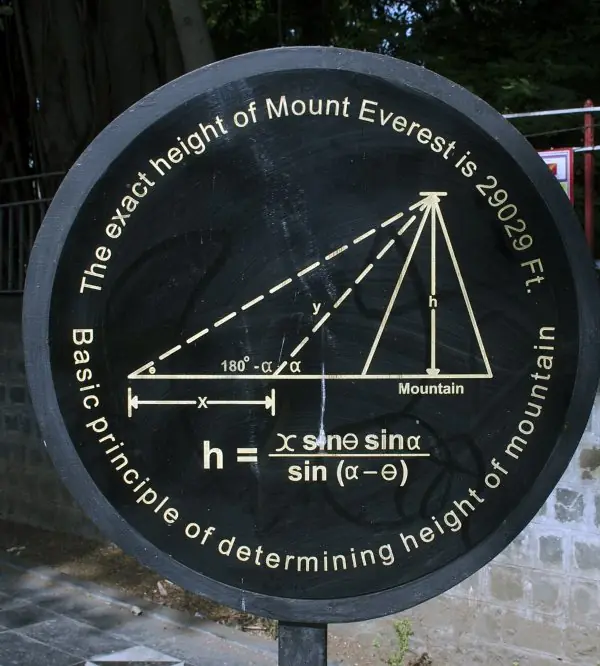
- Draw the triangle and measure elevation from the horizontal. The angle of elevation is between the line of sight and the horizontal, so for a tower of height h at distance d we have \tan\theta=\frac hd (Fig 8.4). With two sightings use h=\frac{x}{\cot\alpha-\cot\beta}. For a general triangle use the sine rule \frac{a}{\sin A}=2R and the cosine rule, and check that the longest side faces the largest angle (Fig 8.5).
8.5.1 Worked checks
Q. Find the exact value of \sin75^\circ and of \cos15^\circ.
Answer. \sin75^\circ=\sin(45^\circ+30^\circ)=\frac{1}{\sqrt2}\cdot\frac{\sqrt3}{2}+\frac1{\sqrt2}\cdot\frac12=\frac{\sqrt3+1}{2\sqrt2}=\frac{\sqrt6+\sqrt2}{4}\approx0.9659. Since \cos15^\circ=\sin75^\circ, the second value is the same.
Check numerically with a calculator in degree mode.
Q. Solve 2\sin^2x-\sin x-1=0 for 0^\circ\le x<360^\circ.
Answer. Factorise: (2\sin x+1)(\sin x-1)=0, so \sin x=1 or \sin x=-\frac12. The first gives x=90^\circ. The second needs the third and fourth quadrants: x=210^\circ and 330^\circ. So x=90^\circ,210^\circ,330^\circ, as marked in Fig 8.3.
Q. The angle of elevation of the top of a tower is 30^\circ from a point 50 m from its foot. Find its height. What if a second point 100 m nearer gives 45^\circ and the distance is unknown?
Answer. First case: h=50\tan30^\circ=\frac{50}{\sqrt3}=28.87 m. Second case: h=\frac{100}{\cot30^\circ-\cot45^\circ}=\frac{100}{\sqrt3-1}=136.6 m, as in Fig 8.4.
Formula and fact sheet
| Item | Result |
|---|---|
| Pythagorean | \sin^2\theta+\cos^2\theta=1 |
| Double angle | \sin2A=2\sin A\cos A, \cos2A=1-2\sin^2A |
| Sum | \tan(A+B)=\frac{\tan A+\tan B}{1-\tan A\tan B} |
| \sin\theta=0 | \theta=n\pi |
| Sine rule | \frac{a}{\sin A}=2R |
Chapter summary
- Memorise the 0°–90° table; every other value reduces to it.
- Complementary angles swap sin with cos, tan with cot.
- Three forms of \cos2A; pick the one that fits the data.
- General solution needs n\pi for tan and sine, 2n\pi for cosine.
- In height problems, draw a right triangle and use tan.
Practice questions
Set A — Recall (20 questions)
- The value of \cos0^\circ isa0b1c\frac{1}{2}d-1
- The value of \sin30^\circ isa\frac{\sqrt{3}}{2}b1c\frac{1}{\sqrt{2}}d\frac{1}{2}
- \sin^2\theta+\cos^2\theta equalsa1b0c2d\sin2\theta
- The value of \tan45^\circ isa0b\sqrt{3}c1d\frac{1}{\sqrt{3}}
- 180^\circ in radians isa\frac{\pi}{2}b\pic2\pid\frac{3\pi}{2}
- \sec\theta equalsa\frac{1}{\sin\theta}b\frac{1}{\tan\theta}c\cos\thetad\frac{1}{\cos\theta}
- \sin(90^\circ-\theta) equalsa\sin\thetab-\cos\thetac\cos\thetad\tan\theta
- 1+\tan^2\theta equalsa\sec^2\thetab\csc^2\thetac\cot^2\thetad1
- The value of \tan60^\circ isa\frac{1}{\sqrt{3}}b1c\frac{1}{2}d\sqrt{3}
- \sin2A equalsa2\sin Ab2\sin A\cos Ac\sin^2Ad\cos^2A-\sin^2A
- \sin(A+B) equalsa\sin A\cos B+\cos A\sin Bb\sin A\sin B+\cos A\cos Bc\sin A\cos B-\cos A\sin Bd\cos A\cos B-\sin A\sin B
- \cos2A equalsa2\cos^2A+1b2\sin^2A-1c1-2\sin^2Ad1+2\sin^2A
- The value of \cos90^\circ isa1b-1c\frac{1}{2}d0
- 30^\circ in radians isa\frac{\pi}{6}b\frac{\pi}{3}c\frac{\pi}{4}d\frac{\pi}{2}
- The range of \sin x isa[0,1]b[-1,1]call real numbersd[-\pi,\pi]
- In which quadrant is \sin\theta positive and \cos\theta negative?afirstbthirdcseconddfourth
- The period of \sin x isa\pib\frac{\pi}{2}c4\pid2\pi
- The value of \sin^{-1}\frac{1}{2} isa\frac{\pi}{3}b\frac{\pi}{6}c\frac{\pi}{4}d\frac{\pi}{2}
- \cot\theta equalsa\frac{\cos\theta}{\sin\theta}b\frac{\sin\theta}{\cos\theta}c\frac{1}{\cos\theta}d\frac{1}{\sin\theta}
- The value of \csc30^\circ isa\frac{1}{2}b\sqrt{2}c2d\sqrt{3}
Answers and explanations — Set A
1. (b) — cos 0° = 1.
2. (d) — sin 30° = 1/2; (a) is sin 60°.
3. (a) — the Pythagorean identity.
4. (c) — equal legs in a 45° triangle.
5. (b) — π rad = 180°.
6. (d) — sec is the reciprocal of cos, not sin.
7. (c) — complementary angle.
8. (a) — divide sin² + cos² = 1 by cos².
9. (d) — tan 60° = √3; (a) is tan 30°.
10. (b) — double-angle formula; (d) is cos 2A.
11. (a) — signs are + for sin of a sum.
12. (c) — cos 2A = 1 − 2 sin²A.
13. (d) — cos 90° = 0.
14. (a) — 30 × π/180 = π/6.
15. (b) — sin lies between −1 and 1.
16. (c) — second quadrant: sin +, cos −.
17. (d) — sin repeats every 2π (tan every π).
18. (b) — sin 30° = 1/2.
19. (a) — cot = cos/sin.
20. (c) — 1 / sin 30° = 2.
Set B — Understanding (12 questions)
- If \sin\theta=\frac{3}{5} with \theta acute, then \tan\theta isa\frac{4}{3}b\frac{3}{5}c\frac{3}{4}d\frac{5}{4}
- The value of \sin60^\circ\cos30^\circ+\cos60^\circ\sin30^\circ isa1b0c\frac{1}{2}d\frac{\sqrt{3}}{2}
- If \cos\theta=\frac{3}{5}, then \cos2\theta isa\frac{7}{25}b\frac{6}{5}c\frac{18}{25}d-\frac{7}{25}
- The shadow of a tower is \sqrt{3} times its height. The angle of elevation of the sun isa60°b30°c45°d15°
- If \tan\theta=1 with 0^\circ<\theta<90^\circ, then \sin\theta+\cos\theta isa\sqrt{2}b1c2d\frac{1}{\sqrt{2}}
- The value of \tan30^\circ\tan60^\circ isa0b2c1d\sqrt{3}
- The general solution of \sin\theta=0 isa2n\pib(2n+1)\frac{\pi}{2}c\frac{n\pi}{2}dn\pi
- \sin^{-1}x+\cos^{-1}x equalsa\pib\frac{\pi}{2}c0d\frac{\pi}{4}
- In a triangle a=5 and A=30^\circ. The circumradius R isa10b2.5c5d7.5
- From a point 20 m away the angle of elevation of the top of a pole is 45°. The height of the pole isa10 mb20\sqrt{3} mc40 md20 m
- (1+\tan^2\theta)\cos^2\theta equalsa1b\sin^2\thetac\tan^2\thetad0
- If \tan\theta=\frac{1}{2}, then \sin2\theta isa\frac{3}{5}b\frac{4}{5}c\frac{1}{2}d\frac{2}{5}
Answers and explanations — Set B
1. (c) — 3-4-5 triangle: tan = 3/4.
2. (a) — it is sin(60° + 30°) = sin 90° = 1.
3. (d) — 2(9/25) − 1 = −7/25.
4. (b) — tan θ = h/shadow = 1/√3.
5. (a) — θ = 45°: 2 × (1/√2) = √2.
6. (c) — (1/√3)(√3) = 1.
7. (d) — sine vanishes at every multiple of π.
8. (b) — complementary inverse functions.
9. (c) — 2R = 5 / (1/2) = 10.
10. (d) — tan 45° = 1, so height = distance.
11. (a) — sec² × cos² = 1.
12. (b) — 2t/(1 + t²) = 1/1.25 = 4/5.
Set C — Application (8 questions)
- If \sec\theta=\frac{5}{4} and \theta is acute, then \tan\theta isa\frac{4}{3}b\frac{5}{3}c\frac{4}{5}d\frac{3}{4}
- A 10 m ladder makes 60° with the ground. The height it reaches isa5\sqrt{3} mb5 mc10\sqrt{3} md\frac{10}{\sqrt{3}} m
- The sum of the solutions of \cos\theta=\frac{1}{2} in [0,2\pi] isa\pib\frac{5\pi}{3}c2\pid\frac{\pi}{3}
- The value of 2\sin15^\circ\cos15^\circ isa1b\frac{1}{2}c\frac{\sqrt{3}}{2}d\frac{1}{4}
- If \tan A=\frac{1}{2} and \tan B=\frac{1}{3}, then \tan(A+B) isa\frac{5}{6}b\frac{1}{6}c\frac{5}{7}d1
- The area of a triangle with sides 6 and 8 and included angle 30° isa12b24c12\sqrt{3}d48
- The maximum value of 3\sin\theta+4\cos\theta isa7b12c5d1
- The maximum value of \sin\theta\cos\theta isa1b\frac{1}{2}c2d\frac{1}{4}
Answers and explanations — Set C
1. (d) — cos = 4/5, sin = 3/5, tan = 3/4.
2. (a) — 10 sin 60° = 5√3.
3. (c) — solutions π/3 and 5π/3, sum 2π.
4. (b) — it is sin 30° = 1/2.
5. (d) — \dfrac{5/6}{1 - 1/6} = 1, so A + B = 45°.
6. (a) — ½ · 6 · 8 · ½ = 12.
7. (c) — √(9 + 16) = 5.
8. (b) — ½ sin 2θ ≤ ½.