Chapter 1 · Mental Agility Test · 5 questions in the paper · 36 min read
Verbal Reasoning
What the syllabus asks for 6
- Direction sense and distance
- Blood relations
- Coding and decoding
- Analogy and classification (odd one out)
- Ranking, ordering and seating arrangement
- Syllogisms and statement–conclusion reasoning
Verbal reasoning is the first block of the Mental Agility Test: 5 of the 20 MAT questions, each worth one mark, with 0.25 deducted for a wrong answer. The questions are short puzzles written in words — a walk with turns, a family relation, a coded word, a pair of related words, a queue or a table of people, a pair of statements. None needs any fact from outside the question. Each type has a fixed method, and once you draw the right picture (a path, a family tree, a row, a circle, a Venn diagram) most questions take under a minute. The official MEC sample question for this block is a direction walk, so that type opens the chapter.
- Direction sense: a right turn is a quarter-turn clockwise, a left turn a quarter-turn anticlockwise; add up the east–west and north–south legs separately, then use Pythagoras (3-4-5, 5-12-13, 6-8-10) for the straight-line distance.
- Shadows: in the morning the sun is in the east, so shadows fall to the west; in the evening they fall to the east.
- Blood relations: draw a family tree; never assume a person's gender from a name or a letter.
- Coding: letter positions A = 1 … Z = 26 (learn E J O T Y = 5, 10, 15, 20, 25); opposite letters add to 27 (A↔Z, M↔N).
- Analogy and odd one out: say the relation of the first pair as a sentence and apply exactly that sentence to the second pair.
- Ranking: total = rank from one end + rank from the other end − 1.
- Seating: around a table, people facing the centre have their left in the clockwise direction.
- Syllogisms: draw the smallest Venn diagram the statements allow; a conclusion follows only if it is true in every diagram the statements allow.
1.1 Direction sense and distance
The compass and the turns
There are four main directions — north (N), east (E), south (S), west (W) — and four in-between ones: north-east (NE), south-east (SE), south-west (SW) and north-west (NW). On paper, north is up and east is to the right.
| You face | After a right turn | After a left turn | After an about-turn |
|---|---|---|---|
| North | East | West | South |
| East | South | North | West |
| South | West | East | North |
| West | North | South | East |
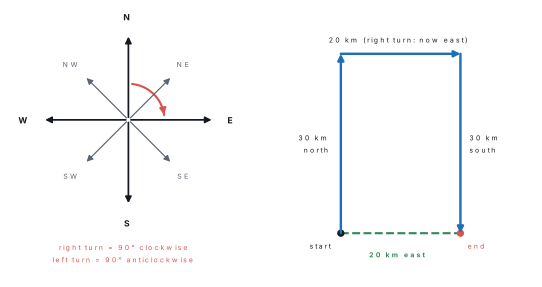
A right turn is 90° clockwise; a left turn is 90° anticlockwise. A turn of 45° takes you from a main direction to the in-between one next to it (N → NE for 45° clockwise).
The method (works for every walk)
- Put the start at the origin. East is +x, north is +y.
- Track the facing direction after every turn (use the table above).
- Add each leg to the running totals: net east (x) and net north (y). Opposite legs cancel — 30 km north and then 30 km south is zero.
- Distance from the start = \sqrt{x^2 + y^2}. If one of x, y is zero, the distance is simply the other one.
- Direction from the start: read the signs. x > 0, y > 0 is north-east; x > 0, y = 0 is due east; x < 0, y < 0 is south-west, and so on.
Fast trick. Most walks are built on Pythagorean triples: 3-4-5, 6-8-10, 5-12-13, 8-15-17, 9-12-15, 12-16-20. When you see two net legs like 12 and 5, the answer 13 is already among the options.
Problem. Rita goes 30 km towards north from a fixed point, then after turning to her right she goes 20 km. After this she goes 30 km after turning to her right. How far and in what direction is she from her starting point?
Solution. Facing north, 30 km: y = 30. Right turn → facing east, 20 km: x = 20. Right turn → facing south, 30 km: y = 30 − 30 = 0. Net displacement: 20 km east, 0 km north. She is 20 km east of the start (key C in the official sample).
Problem. Dinesh walks 6 km east, turns left and walks 4 km, then turns left again and walks 9 km. Where is he now with respect to his starting point?
Solution. East 6 → x = 6. Left of east is north: y = 4. Left of north is west, 9 km: x = 6 − 9 = −3. Net: 3 km west, 4 km north. Distance \sqrt{3^2 + 4^2} = 5 km; x < 0 and y > 0, so he is 5 km north-west of the start.
Shadows
The sun rises in the east and sets in the west, and a shadow always points away from the sun:
| Time | Sun in the | Shadow falls towards the |
|---|---|---|
| Morning (after sunrise) | east | west |
| Evening (before sunset) | west | east |
(Nepal lies north of the Tropic of Cancer, so at noon the sun is due south and a shadow points north — but noon shadows are rarely asked.)
Problem. One morning Ram and Shyam stood face to face. Ram's shadow fell exactly to his right. Which direction was Shyam facing?
Solution. Morning → shadows fall to the west. Ram's right hand points west, so Ram faces south (facing south, your right is west). Shyam faces Ram, so Shyam faces north.
- "Which direction is he facing?" and "In which direction is he from the start?" are different questions. Rita (above) ends 20 km east of the start but is facing south.
- "Where is the start from him?" is the reverse direction: if he is south-east of the start, the start is north-west of him.
- In rotated-compass questions ("if south-east becomes north…"), every direction turns through the same angle and the same way. SE → N is 135° anticlockwise, so W → SE.
1.2 Blood relations
The vocabulary
| Relation | Means | Nepali term |
|---|---|---|
| Paternal grandfather / grandmother | father's father / father's mother | हजुरबुबा / हजुरआमा |
| Maternal uncle | mother's brother | मामा |
| Paternal aunt | father's sister | फुपू |
| Uncle (father's brother) | elder / younger brother of father | ठूलोबुबा / काका |
| Nephew / niece | son / daughter of your brother or sister | भतिजा, भान्जा / भतिजी, भान्जी |
| Cousin | child of your uncle or aunt | — |
| Brother-in-law | spouse's brother, or sister's husband | — |
| Sister-in-law | spouse's sister, or brother's wife | — |
| Son-in-law / daughter-in-law | daughter's husband / son's wife | ज्वाइँ / बुहारी |
Two phrases decide many questions:
- "The only son of my father" — if the speaker is male, that son is the speaker himself. "The only daughter of my mother", said by a woman, is the speaker herself.
- "The only son of my father's father" is the speaker's own father.
The method: draw the tree
Use one symbol for each person: a square for a male, a circle for a female, and a plain label when the gender is not known. A double line joins a married couple; a vertical line goes down one generation; a horizontal line joins brothers and sisters. Read each sentence once, add it to the drawing, and answer from the drawing — never in your head.
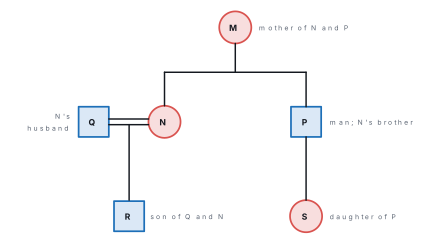
Problem. M is the mother of N and P. N is married to Q. R is the son of N and Q, and S is the daughter of P. Q is the father of R, and P is a man. How is P related to R, and how is S related to R?
Solution. Draw it (figure above). N is R's mother, and P is N's brother, so P is R's mother's brother — maternal uncle (mama). S is the daughter of R's maternal uncle, so S is R's cousin.
Coded relations
Some questions code the relations with symbols. Translate each symbol into words, left to right, then draw.
Problem. A + B means "A is the brother of B", A − B means "A is the sister of B" and A × B means "A is the father of B". What does M − N × O mean?
Solution. M − N: M is the sister of N. N × O: N is the father of O. So M is the sister of O's father: M is O's paternal aunt (phupu).
"A is the child of B" does not say whether A is a son or a daughter, and "P is the parent of Q" does not say father or mother. If an option needs the gender and the question does not fix it, the answer is "cannot be determined" or a word without gender (child, sibling, cousin). Names do not settle it either unless the question uses he or she.
1.3 Coding and decoding
Letter positions — learn them cold
| Letter | A | B | C | D | E | F | G | H | I | J | K | L | M |
|---|---|---|---|---|---|---|---|---|---|---|---|---|---|
| Position | 1 | 2 | 3 | 4 | 5 | 6 | 7 | 8 | 9 | 10 | 11 | 12 | 13 |
| Reverse position | 26 | 25 | 24 | 23 | 22 | 21 | 20 | 19 | 18 | 17 | 16 | 15 | 14 |
| Letter | N | O | P | Q | R | S | T | U | V | W | X | Y | Z |
|---|---|---|---|---|---|---|---|---|---|---|---|---|---|
| Position | 14 | 15 | 16 | 17 | 18 | 19 | 20 | 21 | 22 | 23 | 24 | 25 | 26 |
| Reverse position | 13 | 12 | 11 | 10 | 9 | 8 | 7 | 6 | 5 | 4 | 3 | 2 | 1 |
E J O T Y = 5, 10, 15, 20, 25. From these anchors any letter is one or two steps away: R = T − 2 = 18. Opposite letters add to 27: A↔Z, B↔Y, C↔X, D↔W, E↔V, F↔U, G↔T, H↔S, I↔R, J↔Q, K↔P, L↔O, M↔N. The opposite of a letter at position p is at 27 − p.
The common code types
| Type | What happens | Example |
|---|---|---|
| Shift | every letter moves the same number of places | COLD → DPME (+1) |
| Changing shift | the shift grows: +1, +2, +3 … | ABC → BDF |
| Opposite letter | each letter replaced by its partner (sum 27) | GOD → TLW |
| Reversal | the word is written backwards | PAPER → REPAP |
| Pair swap | letters swapped in pairs | MOTHER → OMHTRE |
| Letter to number | sum (or product) of the positions | CAT → 3 + 1 + 20 = 24 |
| Letter to digit | each letter has a fixed digit | ROSE → 6821 |
| Substitution | one word is "called" another | sky is called sea … |
| Sentence code | words of sentences coded as code words | "pit na sor" = "drink clean water" |
Method. Write the word and its code one above the other, letter by letter, and write the position change under each pair (+1, +1, +1 … or 26 − … ). The pattern shows itself at once. Then apply the same rule to the new word.
Problem. If GREEN is coded HSFFO, how is BLACK coded?
Solution. G→H, R→S, E→F, E→F, N→O: every letter +1. B→C, L→M, A→B, C→D, K→L, so BLACK is CMBDL.
Problem. In a code language, "ka la ta" means "eat green vegetables", "pa ka ma" means "eat ripe fruit" and "ta sa pa" means "green fruit juice". What is the code for "ripe"?
Solution. A word common to two sentences has its code common to the same two sentences. Sentences 1 and 2 share eat and ka: eat = ka. Sentences 1 and 3 share green and ta: green = ta. Sentences 2 and 3 share fruit and pa: fruit = pa. Sentence 2 is "pa ka ma" = "eat ripe fruit", so ripe = ma.
In "sky is called sea, sea is called water, water is called air…", the question asks for the code name of the real thing. We drink water, and water is called air — the answer is "air", not "water".
1.4 Analogy and classification (odd one out)
Analogy
An analogy A : B :: C : ? says "C is related to the answer in the same way that A is related to B". Put the first relation into a short sentence — "a doctor uses a stethoscope", "a nephrologist treats the kidney" — and test each option in exactly that sentence. Only one option fits as precisely.
| Relation | Example pair |
|---|---|
| worker : tool | carpenter : saw, surgeon : scalpel, mason : trowel |
| specialist : organ | cardiologist : heart, nephrologist : kidney, ophthalmologist : eye |
| instrument : quantity measured | thermometer : temperature, barometer : atmospheric pressure, hygrometer : humidity, ammeter : current |
| unit : quantity | ohm : resistance, pascal : pressure, joule : energy |
| cause : effect | virus : infection, drought : famine |
| part : whole | petal : flower, chapter : book |
| animal : young one | cow : calf, frog : tadpole, horse : foal |
| animal : home | bee : hive, horse : stable, spider : web |
| country : capital | Nepal : Kathmandu, Bhutan : Thimphu |
| word : synonym / antonym | brave : bold, ancient : modern |
| number rule | 3 : 27 (cube), 6 : 35 (n^2 - 1), 7 : 50 (n^2 + 1) |
| letter rule | ACE : BDF (each +1) |
For numbers, test in this order: square, cube, n^2 \pm 1, n^3 \pm 1, n(n+1), double, double plus one. For letters, write the positions.
Problem. 6 : 35 :: 8 : ?
Solution. 35 = 5 × 7 = (6 − 1)(6 + 1) = 6^2 - 1. So the answer is 8^2 - 1 = 7 × 9 = 63.
Classification (odd one out)
Three items share a property; the fourth does not. Find the property that splits exactly three from one.
| Items | Usual sorting properties |
|---|---|
| Words | category (organ, instrument, metal, planet), function, living / non-living |
| Numbers | prime, even/odd, perfect square, perfect cube, n^2 \pm 1, n^3 \pm 1, digit sum, divisible by 7 or 11 |
| Letter groups | gaps between the letters, vowels, opposite-letter pairs, positions |
If one property splits the items 3 : 1 and another splits them 2 : 2, the 3 : 1 split is the answer. If two different properties each give a 3 : 1 split with a different odd item, prefer the more specific one (perfect cube beats odd number), and re-read the options: the setter usually intends only one.
1.5 Ranking, ordering and seating arrangement
Ranking in a row or a class
If a person is L-th from the left (or top) and R-th from the right (or bottom) in a row of N people:
and the rank from the other end is N - L + 1. The 1 is subtracted because the person is counted from both ends.
Problem. In a row of 45 children, Rina is 17th from the left and Hari is 20th from the right. How many children sit between them?
Solution. Hari from the left = 45 − 20 + 1 = 26th. Between 17th and 26th there are 26 − 17 − 1 = 8 children.
When two people exchange places, the new rank of one of them equals the old rank of the other — this links the two ends of the row (Set C, question 8).
Ordering by comparison
"P is taller than Q but shorter than R" gives a chain Q < P < R. Write every clue as a chain with < signs and join the chains. Who is tallest, who is in the middle, and who is second from the top can then be read off directly. If two people are never compared, their order is unknown — and "cannot be determined" becomes a live option.
Seating in a row
People in a row usually face north (towards you, the reader, they face away from you). For a person facing north, left is west and right is east: their left and right are the same as yours. If they face south, their left and right are the reverse of yours.
Seating around a table
For people seated round a table facing the centre, left = clockwise and right = anticlockwise (picture yourself at the bottom of the table, facing up: your left hand points to the next seat clockwise). If everyone faces outwards, both are reversed. "Second to the left of X" means two seats clockwise from X.
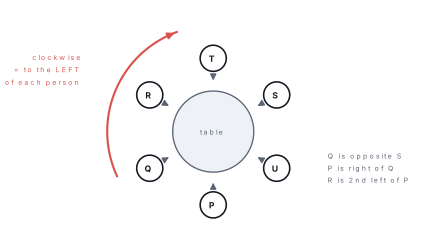
Problem. P, Q, R, S, T and U sit round a table facing the centre. Q sits opposite S. P is to the immediate right of Q. R is second to the left of P. T is not to the immediate left of S. Who sits opposite P?
Solution. Fix P at the bottom. Q is to the left of P (P is on Q's right), so Q is the next seat clockwise from P. R is two seats clockwise from P — next to Q. S is opposite Q, three seats on from Q. Two seats remain: the one between R and S, and the one between S and P. The seat between S and P is S's immediate left, so T cannot sit there: T sits between R and S, and U between S and P. Clockwise from P: P, Q, R, T, S, U. Opposite P is T.
Begin with the clue that pins a person to a seat (an end of the row, "opposite", "at the extreme left"), then add the "immediate" clues, and leave the "not" clues to the end — they only decide between the cases left over.
1.6 Syllogisms and statement–conclusion reasoning
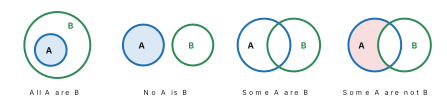
The four statement forms
| Form | Statement | Venn picture | What it gives for certain |
|---|---|---|---|
| All | All A are B | A inside B | Some A are B; Some B are A |
| No | No A is B | A and B apart | No B is A; Some A are not B |
| Some | Some A are B | A and B overlap | Some B are A |
| Some … not | Some A are not B | part of A outside B | nothing about B |
Combining two statements
Two statements share a middle term (B below). Put them in the order "A–B, B–C" and read the result:
| First | Second | Definite conclusion |
|---|---|---|
| All A are B | All B are C | All A are C |
| All A are B | No B is C | No A is C |
| Some A are B | All B are C | Some A are C |
| Some A are B | No B is C | Some A are not C |
| No A is B | All B are C | Some C are not A |
| All A are B | Some B are C | no definite conclusion about A and C |
| Some A are B | Some B are C | no definite conclusion |
| No A is B | No B is C | no definite conclusion |
The two rules that settle every question
- Draw the smallest picture. Draw only the overlaps the statements force. Then ask: can I redraw the circles, still obeying every statement, so that this conclusion is false? If yes, the conclusion does not follow.
- Converse rules. "Some A are B" ⇔ "Some B are A". "No A is B" ⇔ "No B is A". "All A are B" gives only "Some B are A" — never "All B are A".
Either–or. When neither of two conclusions follows on its own, but they are a complementary pair about the same two terms — "Some A are B" with "No A is B", or "All A are B" with "Some A are not B" — then one of them must be true, and the answer is "either I or II follows".
Problem. Statements: All doctors are graduates. Some graduates are singers. Conclusions: I. Some doctors are singers. II. Some singers are graduates.
Solution. Draw doctors inside graduates and let singers overlap graduates. The singers can be drawn to touch only the part of graduates that holds no doctor, so I does not follow. II is the converse of the second statement, so II follows. Answer: only II.
Statement and conclusion (everyday statements)
A conclusion follows only if it is directly supported by the statement, without outside knowledge and without going beyond what is said. Words like only, all, never, always, definitely in a conclusion usually make it go too far. "Exercise lowers the risk of heart disease" supports "his risk is lower", not "he will never get heart disease".
"Some A are B" does not mean "some A are not B". If the question proves that all A are B, the conclusion "Some A are B" is still true. Do not read the everyday meaning of "some" ("not all") into a syllogism.
Formula and fact sheet
| Topic | Rule |
|---|---|
| Turns | right = 90° clockwise, left = 90° anticlockwise, about-turn = 180° |
| Distance | net x (east +), net y (north +); distance = \sqrt{x^2 + y^2} |
| Triples | 3-4-5, 6-8-10, 5-12-13, 8-15-17, 9-12-15, 12-16-20, 7-24-25 |
| Shadows | morning → shadow to the west; evening → shadow to the east |
| Reverse direction | the start as seen from the end is the opposite direction (SE ↔ NW) |
| Speaker clues | "only son of my father" (male speaker) = himself; "only son of my father's father" = my father |
| Letter positions | E J O T Y = 5 10 15 20 25; opposite letter = 27 − position |
| Ranking | N = L + R − 1; rank from the other end = N − L + 1 |
| Between two people | (larger position − smaller position) − 1, both counted from the same end |
| Circular seating | facing the centre: left = clockwise, right = anticlockwise |
| Row seating | facing north: their left = your left; facing south: reversed |
| All A are B | gives "Some A are B" and "Some B are A", never "All B are A" |
| No A is B | gives "No B is A" and "Some A are not B" |
| Some A are B | gives "Some B are A" |
| Either–or | the pair "Some A are B" / "No A is B" (or "All A are B" / "Some A are not B") |
Chapter summary
- Verbal reasoning carries 5 of the 20 MAT questions; the MEC sample is a direction walk.
- Direction walks: track the facing direction, add east–west and north–south legs separately, and finish with Pythagoras; right = clockwise.
- Morning shadows point west, evening shadows east; "facing" and "is from the start" are different questions.
- Blood relations: draw the tree with squares (male), circles (female) and double lines (marriage); never assume gender.
- Coding: write the code under the word, find the change letter by letter (shift, opposite letter with sum 27, reversal, pair swap, sum of positions).
- Analogy: turn the first pair into a sentence and apply it; odd one out: find the property that splits the items exactly 3 : 1.
- Ranking: N = L + R − 1. Around a table facing the centre, left is clockwise.
- Syllogisms: draw the least the statements force; a conclusion follows only if no allowed drawing makes it false; use "either–or" for a complementary pair.
Practice questions
Set A — Recall (25 questions)
- A man is facing north. He turns right, then right again, then left. Which direction is he facing now?aNorthbSouthcEastdWest
- Sunita walks 12 m east, then turns left and walks 5 m. How far is she from her starting point?a13 mb17 mc7 md12 m
- A person facing west turns 90° clockwise. Which direction is he facing now?aSouthbNorthcEastdSouth-west
- Soon after sunrise, Hari stood facing his own shadow. Which direction was he facing?aEastbNorthcSouthdWest
- From her home, Asha walks 4 km north and then 3 km west. Where is she now with respect to her home?a7 km north-westb5 km north-eastc5 km north-westd1 km west
- Pointing to a boy, Gita said, "His mother is the only daughter of my mother." How is Gita related to the boy?asisterbauntcgrandmotherdmother
- Introducing a girl, Raju said, "She is the daughter of the only son of my father." How is the girl related to Raju?adaughterbsistercniecedcousin
- A is B's brother. C is A's mother. D is C's father. How is D related to B?afatherbunclecgrandfatherdbrother
- If P × Q means "P is the father of Q" and P + Q means "P is the sister of Q", then A + B × C meansaA is the mother of CbA is the aunt of CcA is the sister of CdA is the grandmother of C
- If COLD is written as DPME in a code, how is WARM written in that code?aXBTNbVZQLcYCTOdXBSN
- If each letter is replaced by its opposite letter of the alphabet (A↔Z, B↔Y, C↔X, …), HEART is written asaSVAIGbSVZIGcTVZIGdSUZIG
- If A = 1, B = 2, …, Z = 26 and CAT = 24, then DOG =a26b24c27d30
- If PAPER is written as REPAP in a code, how is NURSE written in that code?aERSUNbESRNUcESRUNdNESRU
- If "sky" is called "sea", "sea" is called "water", "water" is called "air", "air" is called "cloud" and "cloud" is called "rain", what do we drink when thirsty?awaterbseacclouddair
- Doctor : Stethoscope :: Carpenter : ?aSawbNeedlecScalpeldTrowel
- Kidney : Nephrologist :: Heart : ?aNeurologistbDermatologistcCardiologistdHepatologist
- 4 : 64 :: 6 : ?a36b216c180d125
- Choose the odd one out.aThermometerbBarometercHygrometerdMicroscope
- Choose the odd one out.a51b29c37d43
- Choose the odd one out.aCEGbGIKcPRUdMOQ
- In a row of students, Kiran is 12th from the left and 17th from the right. How many students are in the row?a29b28c27d30
- In a class of 40 students, Mina is 9th from the top. What is her rank from the bottom?a31b33c30d32
- P is taller than Q but shorter than R. S is taller than R, and T is the shortest of the five. Who is the tallest?aRbScPdQ
- Statements: All roses are flowers. All flowers are plants. Which conclusion follows?aAll roses are plantsbAll plants are rosescSome plants are not flowersdNo rose is a plant
- Statement: No doctor is a lawyer. Which of the following must be true?aSome lawyers are doctorsbNo lawyer is a doctorcAll lawyers are doctorsdSome doctors are lawyers
Answers and explanations — Set A
1. (c) — North → right → east → right → south → left → east. Facing south, a left turn points east.
2. (a) — The legs are 12 m east and 5 m north: \sqrt{12^2 + 5^2} = 13 m (the 5-12-13 triple). 17 m is the path length, not the distance.
3. (b) — Clockwise from west is north (W → N → E → S → W).
4. (d) — In the morning the sun is in the east, so his shadow falls to the west; facing the shadow means facing west.
5. (c) — 4 km north and 3 km west: \sqrt{4^2 + 3^2} = 5 km, and north + west = north-west. 7 km adds the legs.
6. (d) — The only daughter of Gita's mother is Gita herself, so Gita is the boy's mother.
7. (a) — The only son of Raju's father is Raju himself; the girl is the daughter of Raju.
8. (c) — C is the mother of A and B (they are brothers/sisters); D is C's father, so D is B's (maternal) grandfather.
9. (b) — A is the sister of B, and B is the father of C: A is C's father's sister — C's aunt.
10. (d) — COLD → DPME moves every letter one place on (+1). W→X, A→B, R→S, M→N: XBSN.
11. (b) — Opposite letters add to 27: H(8)→S(19), E(5)→V(22), A→Z, R(18)→I(9), T(20)→G(7): SVZIG.
12. (a) — CAT = 3 + 1 + 20 = 24, so the code is the sum of positions. DOG = 4 + 15 + 7 = 26.
13. (c) — The word is written backwards. NURSE reversed is ESRUN.
14. (d) — We drink water, and in this code water is called "air". Option (a) is the real name, not the code name.
15. (a) — A doctor's working tool is the stethoscope; a carpenter's is the saw. A trowel is a mason's tool, a scalpel a surgeon's.
16. (c) — A nephrologist is the specialist for the kidney; a cardiologist for the heart.
17. (b) — 64 = 4^3, so the answer is 6^3 = 216. 36 is the square; 125 is the cube of the wrong number.
18. (d) — The thermometer, barometer and hygrometer measure temperature, pressure and humidity; a microscope only magnifies.
19. (a) — 29, 37 and 43 are prime; 51 = 3 × 17 is not.
20. (c) — CEG, GIK and MOQ step +2, +2 (C 3, E 5, G 7). PRU steps +2, +3 (P 16, R 18, U 21).
21. (b) — N = L + R − 1 = 12 + 17 − 1 = 28. Adding without the −1 gives 29, which counts Kiran twice.
22. (d) — Rank from the other end = 40 − 9 + 1 = 32.
23. (b) — The chain is T < Q < P < R < S, so S is the tallest.
24. (a) — Roses ⊂ flowers ⊂ plants, so all roses are plants. "All plants are roses" reverses the "all" statement, which is never allowed.
25. (b) — A "no" statement converts both ways: no doctor is a lawyer ⇔ no lawyer is a doctor.
Set B — Understanding (15 questions)
- If south-east becomes north, north-east becomes west, and all other directions change in the same way, what does west become?aNorth-eastbSouthcSouth-eastdNorth-west
- Bikash walks 10 m south, turns left and walks 12 m, then turns left again and walks 15 m. How far and in which direction is he from his starting point?a13 m north-eastb13 m south-eastc17 m north-eastd37 m east
- A man facing north turns 45° clockwise, then 180° clockwise, then 270° anticlockwise. Which direction is he facing now?aNorth-eastbSouth-westcSouth-eastdNorth-west
- One evening before sunset, Sita and Bina stood talking face to face. Bina's shadow fell exactly to Bina's left. Which direction was Sita facing?aEastbNorthcWestdSouth
- Pointing to a woman in a photograph, Arjun said, "Her mother's only son is my father." How is the woman related to Arjun?amotherbsistercgrandmotherdpaternal aunt
- A is the son of B. C, the sister of B, has a son D and a daughter E. How is A related to D?abrotherbcousincnephewduncle
- A @ B means "A is the brother of B", A # B means "A is the mother of B" and A % B means "A is the daughter of B". In P # Q @ R % S, how is P related to S?asisterbmothercwifeddaughter
- In a code language, "pit na sor" means "drink clean water", "sor tak lim" means "water is life" and "ral pit na" means "drink clean milk". Which code word means "milk"?apitbralcnadtak
- If TEACHER is written as VGCEJGT in a code, how is DOCTOR written in that code?aFQEVQTbFQDVQTcEPDUPSdFQEUQT
- In a code, CAB = 6 and DAB = 8. What is the code for BED?a11b40c20d30
- 7 : 50 :: 9 : ?a81b72c90d82
- BDF : CEG :: MOQ : ?aNPRbNOPcLNPdOQS
- Choose the odd one out.a28b126c63d217
- In a row of 45 children, Rina is 17th from the left and Hari is 20th from the right. How many children sit between Rina and Hari?a7b9c8d10
- Statements: Some doctors are singers. All singers are dancers. Conclusions: I. Some doctors are dancers. II. All dancers are singers.aOnly I followsbOnly II followscBoth I and II followdNeither I nor II follows
Answers and explanations — Set B
1. (c) — SE (135°) has become N (0°): every direction turns 135° anticlockwise. Check: NE (45°) → 45° − 135° = 270° = W, as stated. West (270°) → 135° = south-east.
2. (a) — South 10, left → east 12, left → north 15: net 12 m east and 15 − 10 = 5 m north. \sqrt{12^2 + 5^2} = 13 m, north-east.
3. (d) — Net turn = +45 + 180 − 270 = −45°, i.e. 45° anticlockwise from north: north-west.
4. (b) — Evening sun is in the west, so shadows point east. Bina's left is east, so Bina faces south; Sita faces her, so Sita faces north.
5. (d) — The woman's mother's only son is the woman's brother, and he is Arjun's father. So she is Arjun's father's sister — his paternal aunt (phupu).
6. (b) — A is the child of B, and D is the child of B's sister C: children of a brother and sister are cousins.
7. (c) — P is the mother of Q; Q and R are siblings, so P is R's mother too; R is the daughter of S, so S is R's other parent, the father. P is S's wife.
8. (b) — Sentences 1 and 3 share "drink clean" and the codes pit, na; the only new word in sentence 3 is "milk" and the only new code is ral.
9. (a) — Each letter moves +2: T→V, E→G, A→C … So D→F, O→Q, C→E, T→V, O→Q, R→T: FQEVQT.
10. (b) — The sum rule gives CAB = 6 but DAB = 7, so the code is the product of positions: 4 × 1 × 2 = 8. BED = 2 × 5 × 4 = 40. Option (a) is the sum.
11. (d) — 50 = 7^2 + 1, so the answer is 9^2 + 1 = 82. 81 forgets the +1.
12. (a) — Each letter of BDF moves +1 to give CEG; MOQ +1 gives NPR.
13. (c) — 28 = 3^3 + 1, 126 = 5^3 + 1, 217 = 6^3 + 1, but 63 = 4^3 - 1. (All four are multiples of 7, so divisibility does not separate them.)
14. (c) — Hari from the left = 45 − 20 + 1 = 26th. Between the 17th and the 26th: 26 − 17 − 1 = 8.
15. (a) — Some doctors are singers and all singers are dancers, so those doctors are dancers: I follows. II reverses an "all" statement, so it does not follow.
Set C — Application (11 questions)
- Ramesh walks 20 m north, turns right and walks 30 m, turns right and walks 35 m, turns left and walks 15 m, and finally turns left and walks 15 m. How far and in which direction is he from his starting point?a15 m eastb30 m north-eastc45 m westd45 m east
- Kamal walks 8 km south, then turns east and walks 6 km. In which direction, and how far, is his starting point from where he now stands?a10 km south-eastb14 km north-westc10 km north-eastd10 km north-west
- In a family, R is the son of P. Q is the father of P, and S is the wife of Q. T is the brother of R, and U is the sister of P. How is S related to T?amotherbauntcgrandmotherdsister
- If ROSE is coded as 6821, CHAIR as 73456 and PREACH as 961473, what is the code for SEARCH?a214673b214763c241673d216473
- In a certain code, MOTHER is written as OMHTRE. How is SISTER written in that code?aISSTREbISTSREcSITSERdISTSER
- Five students P, Q, R, S and T sit in a row facing north. S sits at one end. R is second to the right of S. P is to the immediate left of Q. T does not sit at an end. Who sits in the middle of the row?aTbPcRdQ
- Six friends A, B, C, D, E and F sit around a round table facing the centre. A sits opposite D. B is to the immediate left of A. F is to the immediate right of D. C is to the immediate right of A. Who sits opposite B?aEbFcCdD
- In a row, Anil is 10th from the left and Bimal is 9th from the right. When they exchange places, Anil becomes 15th from the left. How many people are in the row?a22b24c25d23
- Statements: All cats are dogs. Some dogs are rats. Conclusions: I. Some rats are cats. II. No rat is a cat.aOnly I followsbOnly II followscEither I or II followsdNeither I nor II follows
- Statements: Regular exercise lowers the risk of heart disease. Ramesh exercises regularly. Conclusions: I. Ramesh will never get heart disease. II. Ramesh's risk of heart disease is lower than it would be without exercise.aOnly I followsbOnly II followscBoth I and II followdNeither I nor II follows
- Statements: Some pens are books. No book is a bag. Conclusions: I. Some pens are not bags. II. Some bags are pens.aOnly I followsbOnly II followscBoth I and II followdNeither I nor II follows
Answers and explanations — Set C
1. (d) — North 20 (y = 20); right → east 30 (x = 30); right → south 35 (y = −15); left → east 15 (x = 45); left → north 15 (y = 0). He is 45 m due east of the start.
2. (d) — Kamal is 6 km east and 8 km south of the start, i.e. 10 km south-east of it (6-8-10). The start, seen from Kamal, is in the opposite direction: 10 km north-west. Option (a) is the trap.
3. (c) — S is the wife of P's father, so S is P's mother. T is R's brother, so T is also P's child. S is therefore T's grandmother.
4. (a) — From the three words: R = 6, O = 8, S = 2, E = 1, C = 7, H = 3, A = 4, I = 5, P = 9 (R = 6 in all three, which confirms the code). SEARCH = 2 1 4 6 7 3.
5. (b) — MO TH ER → OM HT RE: each pair of letters is swapped. SI ST ER → IS TS RE = ISTSRE.
6. (c) — R cannot be second to the right of S if S is at the right end, so S is at the left end and R is third. P and Q must be adjacent, so they take places 4 and 5, and T takes place 2: S T R P Q. R is in the middle.
7. (a) — Going clockwise (= leftwards for people facing the centre) from A: A, B (A's left), F, D (opposite A), then E, C (C is A's right, the seat before A). B is opposite E.
8. (d) — After the exchange Anil stands in Bimal's old place, which is 9th from the right, and he is now 15th from the left: N = 15 + 9 − 1 = 23.
9. (c) — The rats may or may not overlap the cats, so neither I nor II follows alone. But "Some rats are cats" and "No rat is a cat" are a complementary pair about the same two terms — one of them must be true.
10. (b) — The statement supports only a lower risk. "Never" goes beyond what is said.
11. (a) — The pens that are books cannot be bags (no book is a bag), so some pens are not bags: I follows. Whether any bag is a pen is not known.