Chapter 2 · Mental Agility Test · 5 questions in the paper · 30 min read
Numerical Reasoning
What the syllabus asks for 5
- Percentages, ratio and proportion, averages
- Profit and loss, simple and compound interest
- Time and work, speed, distance and time
- Ages, mixtures and number properties
- Fast calculation and estimation
Numerical reasoning carries 5 of the 20 MAT questions. They are arithmetic word problems of the kind met up to Grade 10 — percentages, ratios, averages, profit and interest, work, speed, ages, mixtures, number facts — set so that the student who knows the shortcut answers in thirty seconds and the student who sets up long equations answers in three minutes. There is no calculator. The official MEC sample is a percentage-change question (a rectangle's length up 15 %, breadth up 25 %: area up 43.75 %, "44 %"). This chapter gives, for each type, the one formula or picture that answers it fastest, and the trap that the wrong options are built from.
- Successive percentage change: a\% then b\% gives a net change of a + b + ab/100 per cent (a decrease is negative).
- Percent of what? Profit and loss per cent are on the cost price, discount per cent on the marked price; "A is r\% more than B" is on B.
- Interest: SI = PRT/100; amount at CI = P(1 + R/100)^T; for two years CI − SI = P(R/100)^2.
- Work: turn days into work per day (1/a), add rates, invert. The LCM of the days makes everything whole numbers.
- Speed: km/h × 5/18 = m/s; equal distances at x and y give an average speed of 2xy/(x + y); trains add their lengths, and opposite directions add speeds.
- Mixtures: the alligation cross gives the ratio at once.
- Numbers: divisibility rules, unit-digit cycles, HCF × LCM = product.
- Estimation: round, compute roughly, and pick the nearest option.
2.1 Percentages, ratio and proportion, averages
Percentages
"Per cent" means per hundred: x\% = x/100. Learn these fraction values — they turn percentage questions into mental arithmetic.
| Fraction | 1/2 | 1/3 | 1/4 | 1/5 | 1/6 | 1/8 | 1/9 | 1/10 | 1/11 | 1/12 | 1/16 | 1/20 |
|---|---|---|---|---|---|---|---|---|---|---|---|---|
| Per cent | 50 | 33⅓ | 25 | 20 | 16⅔ | 12½ | 11 1/9 | 10 | 9 1/11 | 8⅓ | 6¼ | 5 |
| Situation | Formula |
|---|---|
| Percentage change | (new − old) / old × 100 |
| Increase by r\% | multiply by (1 + r/100); 20 % up = × 1.2 |
| Decrease by r\% | multiply by (1 - r/100); 20 % down = × 0.8 |
| Two successive changes a\%, b\% | net change = a + b + \frac{ab}{100} per cent |
| Price up r\%, same spending | cut consumption by \frac{r}{100 + r} \times 100\% |
| A is r\% more than B | B is \frac{r}{100 + r} \times 100\% less than A |
The successive-change formula covers area (length × breadth), revenue (price × quantity) and population over two years — any product of two quantities.
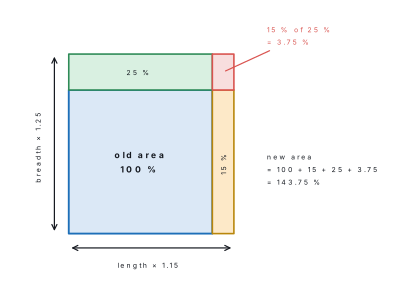
Problem. The length and breadth of a rectangle are increased by 15 % and 25 % respectively. What is the percentage increase in the area? (a) 20 % (b) 30 % (c) 40 % (d) 44 %
Solution. Net change = 15 + 25 + (15 × 25)/100 = 40 + 3.75 = 43.75 %, which the options round to 44 % (key D). Check with numbers: 1.15 × 1.25 = 1.4375. The tempting 40 % forgets the corner piece.
Ratio and proportion
| Idea | Rule |
|---|---|
| Ratio | a : b = a/b; multiply or divide both terms by the same number freely |
| Sharing an amount in a : b : c | share of A = amount × a/(a + b + c) |
| Joining a : b and b : c | make the two b's equal (multiply crosswise) |
| Proportion a : b = c : d | ad = bc (product of extremes = product of means) |
| Fourth proportional to a, b, c | d = bc/a |
| Mean proportional of a and b | \sqrt{ab} |
| Third proportional to a and b | b^2/a |
| Direct proportion | x doubles → y doubles (y/x constant) |
| Inverse proportion | x doubles → y halves (xy constant), e.g. workers and days |
Problem. Rs 5,400 is divided among Anil, Bina and Chandra in the ratio 2 : 3 : 4. How much does Chandra get?
Solution. Total parts = 2 + 3 + 4 = 9; one part = 5400/9 = Rs 600. Chandra gets 4 × 600 = Rs 2,400.
Averages
Average = sum ÷ number of items, so sum = average × number. Work with sums, not averages, whenever an item is added, removed or replaced.
- The average of equally spaced numbers is the middle one (or the mean of the first and the last). Average of 1, 2, …, n is (n + 1)/2.
- Replacing one member changes the sum by (new − old), so the average changes by (new − old) / n.
- Adding a member raises the average by d: the newcomer = old average + d × (new count).
Problem. The average weight of 8 people rises by 2.5 kg when one of them, who weighs 65 kg, is replaced by a new person. What is the new person's weight?
Solution. The total rose by 8 × 2.5 = 20 kg, so the newcomer is 65 + 20 = 85 kg.
2.2 Profit and loss, simple and compound interest
Profit, loss and discount
CP = cost price, SP = selling price, MP = marked (list) price.
| Quantity | Formula | Calculated on |
|---|---|---|
| Profit % | (SP − CP)/CP × 100 | CP |
| Loss % | (CP − SP)/CP × 100 | CP |
| SP from CP | SP = CP × (100 + profit%)/100 | CP |
| CP from SP | CP = SP × 100/(100 + profit%) | — |
| Discount % | (MP − SP)/MP × 100 | MP |
| Two discounts d_1, d_2 | single discount = d_1 + d_2 - d_1 d_2/100 | MP |
| Marked m\% above CP, discount d\% | multiply: (1 + m/100)(1 - d/100) | CP |
| Same SP, x\% gain on one and x\% loss on the other | always a loss of x^2/100 per cent | — |
| False weight (sells w g for 1000 g at cost price) | gain = \frac{1000 - w}{w} \times 100\% | — |
Problem. A shopkeeper buys a jacket for Rs 800, marks it 25 % above the cost and then gives a 10 % discount. What is the profit per cent?
Solution. SP = 800 × 1.25 × 0.90 = Rs 900. Profit = 100 on a cost of 800: 12.5 %. (Shortcut: 1.25 × 0.9 = 1.125.)
Buying at Rs 400 and selling at Rs 500 is a 25 % profit (100 on 400), not 20 % (100 on 500). A discount is on the marked price. If a CP is found from an SP with 20 % profit, divide by 1.2 — do not multiply by 0.8.
Simple and compound interest
P = principal (Rs), R = rate per cent per annum, T = time in years, A = amount (principal + interest). Compound interest CI = A − P.
| Fact | Rule |
|---|---|
| Money doubles at SI in T years | R = 100/T |
| CI − SI for 2 years | P(R/100)^2 |
| CI − SI for 3 years | P(R/100)^2(3 + R/100) |
| Interest compounded half-yearly | use R/2 per half-year and 2T half-years |
| Successive years at CI | the amounts form a geometric progression (× (1 + R/100) each year) |
| Rule of 72 (estimate) | money doubles at CI in about 72/R years |
Problem. Find the difference between the compound and the simple interest on Rs 20,000 for 2 years at 10 % per annum.
Solution. SI = 20000 × 10 × 2/100 = Rs 4,000. A = 20000 × 1.1² = Rs 24,200, so CI = Rs 4,200. Difference = Rs 200 — the same as P(R/100)^2 = 20000 × 0.01. The difference is the interest on the first year's interest.
2.3 Time and work, speed, distance and time
Time and work
If A finishes a job in a days, A does 1/a of it each day. Rates add when people (or pipes) work together:
LCM method (faster). Take the total work = LCM of the days. A in 10 days and B in 15 days: total 30 units; A does 3 units a day, B 2; together 5 a day, so 30/5 = 6 days.
| Situation | Rule |
|---|---|
| A and B together | T = ab/(a + b) |
| A + B together in t days, A alone in a days | B's rate = 1/t - 1/a |
| Workers and days | M_1 D_1 H_1 / W_1 = M_2 D_2 H_2 / W_2 (men, days, hours, work) |
| Filling pipe and emptying pipe | rates subtract: 1/a - 1/b |
| Work partly done, someone leaves | find the fraction done, then finish the rest at the new rate |
Problem. Asha can paint a room in 10 days and Binod in 15 days. How long do they take together?
Solution. LCM 30 units. Asha 3 units/day, Binod 2 units/day, together 5/day: 30/5 = 6 days. Check: 10 × 15/(10 + 15) = 150/25 = 6.
Speed, distance and time
Distance = speed × time. To change units: km/h × 5/18 = m/s and m/s × 18/5 = km/h (72 km/h = 20 m/s, 54 km/h = 15 m/s, 36 km/h = 10 m/s, 18 km/h = 5 m/s).
| Situation | Rule |
|---|---|
| Average speed | total distance ÷ total time — never the plain mean of speeds |
| Equal distances at x and y | average speed = 2xy/(x + y) |
| Same direction | relative speed = difference of speeds |
| Opposite directions | relative speed = sum of speeds |
| Train passes a pole or a person | distance = length of the train |
| Train passes a platform or a bridge | distance = train length + platform length |
| Two trains pass each other | distance = sum of lengths, at the relative speed |
| Boat of speed u in still water, stream v | downstream u + v, upstream u - v |
| From downstream D and upstream U | boat = (D + U)/2, stream = (D - U)/2 |
| Late at one speed, early at another | the difference of the two times = the total of "late" and "early" |
Problem. A 240 m train running at 54 km/h crosses a 360 m platform. How long does it take?
Solution. 54 km/h = 15 m/s. Distance = 240 + 360 = 600 m. Time = 600/15 = 40 s. Forgetting the platform gives 16 s; forgetting the train gives 24 s.
Problem. Sunil cycles to a village at 30 km/h and returns along the same road at 20 km/h. What is his average speed for the whole trip?
Solution. Equal distances: 2 × 30 × 20/(30 + 20) = 1200/50 = 24 km/h, not 25. (Take the distance as 60 km: 2 h out, 3 h back, 120 km in 5 h = 24 km/h.)
2.4 Ages, mixtures and number properties
Ages
Let the present age be x. "n years ago" is x - n; "after n years" is x + n — and the difference of two people's ages never changes. With a ratio, write the ages as 3x and 5x.
Fastest route: put each option into the conditions. Age questions almost always have whole-number answers, and checking an option takes ten seconds.
Problem. The ages of Ram and Hari are in the ratio 4 : 5. Five years ago the ratio was 3 : 4. What is Hari's present age?
Solution. Ages 4x and 5x: (4x − 5)/(5x − 5) = 3/4 → 16x − 20 = 15x − 15 → x = 5. Hari is 25 years. Check: 20 and 25 now; 15 and 20 five years ago, which is 3 : 4.
Mixtures and alligation
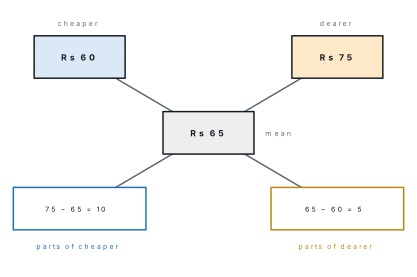
When two ingredients at prices (or strengths) c (cheaper) and d (dearer) are mixed to give a mean m:
Replacement. If x litres are taken out of V litres of a liquid and replaced by water, n times over, the pure liquid left is V(1 - x/V)^n.
Number properties
| Divisible by | Test |
|---|---|
| 2, 5, 10 | last digit even; 0 or 5; 0 |
| 3, 9 | sum of digits divisible by 3, by 9 |
| 4, 8 | last two digits by 4; last three digits by 8 |
| 6 | by 2 and by 3 |
| 11 | (sum of digits in odd places) − (sum in even places) is 0 or a multiple of 11 |
- The 25 primes below 100: 2, 3, 5, 7, 11, 13, 17, 19, 23, 29, 31, 37, 41, 43, 47, 53, 59, 61, 67, 71, 73, 79, 83, 89, 97. 1 is neither prime nor composite; 2 is the only even prime.
- For two numbers, HCF × LCM = product of the numbers.
- Numbers that leave the same remainder r when divided by a, b and c are k × LCM(a, b, c) + r (k = 0, 1, 2, …).
- 1 + 2 + \dots + n = n(n + 1)/2; the sum of the first n odd numbers is n^2.
Unit digits repeat in cycles. The last digit of a power depends only on the last digit of the base:
| Last digit of base | Cycle of last digits of powers | Cycle length |
|---|---|---|
| 0, 1, 5, 6 | always itself | 1 |
| 4 | 4, 6 | 2 |
| 9 | 9, 1 | 2 |
| 2 | 2, 4, 8, 6 | 4 |
| 3 | 3, 9, 7, 1 | 4 |
| 7 | 7, 9, 3, 1 | 4 |
| 8 | 8, 4, 2, 6 | 4 |
Problem. What is the unit digit of 3^{47}?
Solution. The cycle for 3 is 3, 9, 7, 1 (length 4). 47 = 4 × 11 + 3, so take the 3rd term of the cycle: 7.
2.5 Fast calculation and estimation
Squares and cubes worth knowing
| n | 11 | 12 | 13 | 14 | 15 | 16 | 17 | 18 | 19 | 20 | 25 |
|---|---|---|---|---|---|---|---|---|---|---|---|
| n^2 | 121 | 144 | 169 | 196 | 225 | 256 | 289 | 324 | 361 | 400 | 625 |
| n | 2 | 3 | 4 | 5 | 6 | 7 | 8 | 9 | 10 | 11 | 12 |
|---|---|---|---|---|---|---|---|---|---|---|---|
| n^3 | 8 | 27 | 64 | 125 | 216 | 343 | 512 | 729 | 1000 | 1331 | 1728 |
Tricks that save time
| Trick | Example |
|---|---|
| × 5 = × 10 ÷ 2 | 468 × 5 = 4680 ÷ 2 = 2340 |
| × 25 = × 100 ÷ 4 | 36 × 25 = 3600 ÷ 4 = 900 |
| Square of a number ending in 5 | 85²: 8 × 9 = 72, then 25 → 7225 |
| (a + b)(a - b) = a^2 - b^2 | 48 × 52 = 50² − 2² = 2496 |
| × 11 for two digits: put the digit sum in the middle | 35 × 11 = 3 (3+5) 5 = 385 |
| Split a percentage | 17 % of 240 = 10 % (24) + 5 % (12) + 2 % (4.8) = 40.8 |
| x\% of y = y\% of x | 16 % of 25 = 25 % of 16 = 4 |
| Order of operations | brackets, then ÷ and ×, then + and − (BODMAS) |
Estimation
When the options are far apart, round every number to one or two significant figures, compute, and choose the nearest option. Round some numbers up and some down so the errors cancel. Stop as soon as only one option is possible.
Problem. 19.98 % of 501.2 + 3.01 × 49.9 ≈ ? (a) 150 (b) 200 (c) 250 (d) 300
Solution. 20 % of 500 = 100, and 3 × 50 = 150. Total ≈ 250. (Exactly: 250.34.)
In numerical MCQs the options are information. Check divisibility (is the answer a whole number of rupees, people, days?), the last digit, and the size before computing anything. A ratio answer must make the total come out whole; an age must be positive in every year the question mentions. Plugging the options back into the question is a legitimate and fast method.
Formula and fact sheet
| Topic | Formula or fact |
|---|---|
| Successive change | a + b + ab/100 (%) |
| Same spending after a price rise of r\% | cut consumption by 100r/(100 + r) % |
| Profit %, loss % | on CP; SP = CP(100 + P%)/100 |
| Discount | on MP; two discounts: d_1 + d_2 - d_1 d_2/100 |
| Equal SP, x\% gain and x\% loss | loss of x^2/100 % |
| False weight w g for 1 kg | gain 100(1000 - w)/w % |
| SI | PRT/100; doubles in T years when R = 100/T |
| CI | A = P(1 + R/100)^T; CI − SI (2 years) = P(R/100)^2 |
| Work | together ab/(a + b); use LCM units |
| Pipes | filling +, emptying − |
| Units | km/h × 5/18 = m/s |
| Average speed (equal distances) | 2xy/(x + y) |
| Trains | pole: own length; platform: sum of lengths; relative speed: sum (opposite) / difference (same direction) |
| Boats | boat = (down + up)/2, stream = (down − up)/2 |
| Alligation | cheaper : dearer = (d − m) : (m − c) |
| Replacement | V(1 - x/V)^n |
| HCF and LCM | HCF × LCM = product of the two numbers |
| Unit digits | cycles of 4 for 2, 3, 7, 8; of 2 for 4, 9 |
| Sums | 1 + \dots + n = n(n + 1)/2; first n odd numbers = n^2 |
Chapter summary
- Numerical reasoning carries 5 of the 20 MAT questions; the MEC sample is a successive-percentage (area) question: 15 % and 25 % give 43.75 %.
- Two successive changes: a + b + ab/100; a price rise of r\% needs a consumption cut of 100r/(100 + r) % to keep spending the same.
- Profit and loss are on the cost price, discount on the marked price; multiply the factors (1.25 × 0.9) for mark-up then discount.
- SI = PRT/100; CI from P(1 + R/100)^T; CI − SI for 2 years = P(R/100)^2.
- Work: add rates (1/a + 1/b) or use LCM units; pipes that empty subtract.
- Speed: × 5/18 for m/s; average speed is total distance ÷ total time; trains add lengths; opposite directions add speeds.
- Ages: test the options; mixtures: the alligation cross; numbers: divisibility rules, HCF × LCM = product, unit-digit cycles.
- Estimate when options are far apart; use the options to check size and last digit.
Practice questions
Set A — Recall (25 questions)
- 25 % of 480 isa96b120c125d140
- 12 is what per cent of 80?a12 %b18 %c15 %d20 %
- When a number is increased by 20 %, it becomes 360. The number isa300b288c320d432
- A price is increased by 10 % and then by 20 %. The total increase isa30 %b28 %c35 %d32 %
- The price of sugar rises by 25 %. By what per cent must a family cut its consumption so that its spending on sugar does not change?a25 %b20 %c15 %d30 %
- A's salary is 20 % more than B's. By what per cent is B's salary less than A's?a20 %b18 %c16⅔ %d25 %
- Rs 7,200 is divided between two brothers in the ratio 4 : 5. The larger share isaRs 4,000bRs 3,200cRs 4,500dRs 3,600
- If a : b = 2 : 3 and b : c = 4 : 5, then a : b : c isa2 : 3 : 5b6 : 12 : 15c8 : 15 : 12d8 : 12 : 15
- The fourth proportional to 4, 6 and 10 isa12b15c20d24
- The mean proportional between 4 and 25 isa10b14.5c29d100
- The average of six numbers is 15. If the number 25 is removed, the average of the remaining five isa12b14c13d15
- The average of the first 20 natural numbers isa10b11c21d10.5
- A shopkeeper buys an article for Rs 400 and sells it for Rs 500. His profit per cent isa25 %b20 %c10 %d15 %
- An article sold for Rs 960 gives a profit of 20 %. Its cost price isaRs 768bRs 780cRs 800dRs 1,152
- A bag marked at Rs 1,200 is sold at a discount of 15 %. Its selling price isaRs 1,035bRs 1,020cRs 1,080dRs 1,180
- The simple interest on Rs 5,000 at 8 % per annum for 3 years isaRs 400bRs 1,250cRs 6,200dRs 1,200
- The compound interest on Rs 10,000 at 10 % per annum for 2 years, compounded yearly, isaRs 2,000bRs 12,100cRs 2,100dRs 2,010
- At what rate of simple interest does a sum of money double itself in 8 years?a12.5 %b8 %c10 %d16 %
- A can finish a job in 12 days and B in 24 days. Working together, they finish it ina18 daysb8 daysc6 daysd9 days
- A speed of 72 km/h is equal toa25 m/sb7.2 m/sc259.2 m/sd20 m/s
- A bus covers 150 km in 2 hours 30 minutes. Its average speed isa50 km/hb75 km/hc60 km/hd65 km/h
- A 200 m long train running at 72 km/h passes an electric pole ina10 sb2.8 sc20 sd36 s
- The sum of the ages of a father and his son is 50 years, and the father is four times as old as the son. The son's age isa12.5 yearsb10 yearsc40 yearsd8 years
- The unit digit of 7^{23} isa7b9c3d1
- 98 × 102 =a10,004b9,994c9,896d9,996
Answers and explanations — Set A
1. (b) — 25 % = 1/4; 480/4 = 120.
2. (c) — 12/80 × 100 = 15 %.
3. (a) — The number × 1.2 = 360, so the number = 360/1.2 = 300. Taking 20 % off 360 (288) is the trap: the 20 % was of the original number.
4. (d) — 10 + 20 + (10 × 20)/100 = 32 %. Check: 1.1 × 1.2 = 1.32.
5. (b) — Cut = 25/(100 + 25) × 100 = 20 %. Check: 1.25 × 0.8 = 1.
6. (c) — 20/(100 + 20) × 100 = 16⅔ %. If B = 100, A = 120, and 20 out of 120 is 1/6.
7. (a) — One part = 7200/9 = 800; the larger share = 5 × 800 = Rs 4,000.
8. (d) — Make b equal: a : b = 8 : 12 and b : c = 12 : 15, so a : b : c = 8 : 12 : 15.
9. (b) — 4 : 6 = 10 : d gives d = 6 × 10/4 = 15.
10. (a) — \sqrt{4 \times 25} = 10. 14.5 is the arithmetic mean, not the mean proportional.
11. (c) — Sum = 6 × 15 = 90; without 25 it is 65; 65/5 = 13.
12. (d) — (n + 1)/2 = 21/2 = 10.5.
13. (a) — Profit 100 on a cost of 400 is 25 %. 20 % is the profit on the selling price — the classic wrong base.
14. (c) — CP = 960/1.2 = Rs 800. 768 (= 960 × 0.8) takes 20 % of the selling price.
15. (b) — 1200 × 0.85 = Rs 1,020.
16. (d) — 5000 × 8 × 3/100 = Rs 1,200. Rs 6,200 is the amount, not the interest.
17. (c) — Amount = 10000 × 1.1² = 12,100; CI = 12,100 − 10,000 = Rs 2,100.
18. (a) — Doubling means SI = P: R = 100/T = 100/8 = 12.5 %.
19. (b) — 12 × 24/(12 + 24) = 288/36 = 8 days. (LCM 24: A does 2 units/day, B 1; 24/3 = 8.)
20. (d) — 72 × 5/18 = 20 m/s. 259.2 multiplies by 18/5, the wrong way.
21. (c) — 150/2.5 = 60 km/h.
22. (a) — 72 km/h = 20 m/s; the train covers its own length: 200/20 = 10 s.
23. (b) — Son x, father 4x: 5x = 50, so x = 10. (40 is the father's age.)
24. (c) — Powers of 7 end in 7, 9, 3, 1 (cycle 4). 23 = 4 × 5 + 3, so the 3rd term: 3.
25. (d) — (100 − 2)(100 + 2) = 10000 − 4 = 9,996.
Set B — Understanding (15 questions)
- The length of a rectangle is increased by 20 % and its breadth is decreased by 20 %. Its areaadoes not changebdecreases by 4 %cincreases by 4 %ddecreases by 2 %
- The population of a town is 20,000. It rises by 10 % in the first year and by 20 % in the second. The population after two years isa26,000b24,000c26,400d28,000
- Two successive discounts of 20 % and 10 % are equal to a single discount ofa28 %b30 %c25 %d72 %
- A man sells two watches for Rs 990 each. On one he gains 10 % and on the other he loses 10 %. On the whole he makesano profit, no lossb1 % gainc2 % lossd1 % loss
- A dishonest shopkeeper sells rice at cost price but uses a 900 g weight in place of 1 kg. His gain per cent isa10 %b11 1/9 %c9 %d12.5 %
- The difference between the compound interest (compounded yearly) and the simple interest on Rs 8,000 for 2 years at 5 % per annum isaRs 20bRs 40cRs 10dRs 80
- A and B together can do a piece of work in 10 days, and A alone can do it in 15 days. B alone can do it ina25 daysb5 daysc30 daysd6 days
- Pipe A can fill a tank in 6 hours and pipe B can empty the full tank in 9 hours. If both are opened together in the empty tank, it fills ina3 hoursb15 hoursc3.6 hoursd18 hours
- A car goes from Butwal to Bhairahawa at 40 km/h and returns along the same road at 60 km/h. Its average speed for the round trip isa50 km/hb48 km/hc45 km/hd52 km/h
- Two trains, 150 m and 100 m long, run on parallel tracks in opposite directions at 54 km/h and 36 km/h. The time they take to cross each other isa10 sb50 sc25 sd18 s
- A boat goes downstream at 15 km/h and upstream at 9 km/h. The speed of the stream isa6 km/hb12 km/hc3 km/hd4.5 km/h
- The ages of Ram and Hari are in the ratio 4 : 5. Five years ago the ratio was 3 : 4. Hari's present age isa20 yearsb30 yearsc15 yearsd25 years
- In what ratio must rice at Rs 60 per kg be mixed with rice at Rs 75 per kg so that the mixture is worth Rs 65 per kg?a2 : 1b1 : 2c3 : 2d13 : 15
- The HCF of two numbers is 12 and their LCM is 360. If one number is 72, the other isa30b60c120d180
- (19.98 % of 501.2) + (3.01 × 49.9) is closest toa150b200c250d300
Answers and explanations — Set B
1. (b) — 20 + (−20) + (20 × −20)/100 = −4 %. Check: 1.2 × 0.8 = 0.96. "No change" is the trap.
2. (c) — 20000 × 1.1 × 1.2 = 26,400. Adding 30 % to 20,000 (26,000) ignores the growth on the first year's growth.
3. (a) — 20 + 10 − (20 × 10)/100 = 28 %. You pay 0.8 × 0.9 = 72 % of the marked price.
4. (d) — Equal SPs with equal gain and loss always give a loss of x^2/100 = 1 %. Check: CPs are 990/1.1 = 900 and 990/0.9 = 1,100; total 2,000 against 1,980 received.
5. (b) — He gives 900 g but charges for 1000 g: gain = 100/900 × 100 = 11 1/9 %. The gain is on what he gives, not on 1 kg.
6. (a) — P(R/100)^2 = 8000 × 0.05² = Rs 20.
7. (c) — B's rate = 1/10 − 1/15 = 1/30, so 30 days.
8. (d) — Net rate = 1/6 − 1/9 = 1/18 per hour: 18 hours. 3.6 hours adds the rates as if both pipes filled.
9. (b) — 2 × 40 × 60/(40 + 60) = 48 km/h. 50 km/h is the plain mean, which is wrong because more time is spent at the lower speed.
10. (a) — Relative speed = 54 + 36 = 90 km/h = 25 m/s; distance = 150 + 100 = 250 m; time = 10 s. 50 s uses the difference of speeds.
11. (c) — Stream = (15 − 9)/2 = 3 km/h; the boat's own speed is (15 + 9)/2 = 12 km/h.
12. (d) — Ages 4x, 5x: (4x − 5)/(5x − 5) = 3/4 gives x = 5, so Hari is 25. Check: 15 : 20 = 3 : 4.
13. (a) — Alligation: (75 − 65) : (65 − 60) = 10 : 5 = 2 : 1 (cheaper : dearer).
14. (b) — Other = 12 × 360/72 = 60. Check: HCF(72, 60) = 12, LCM = 360.
15. (c) — 20 % of 500 = 100 and 3 × 50 = 150: about 250 (exactly 250.34).
Set C — Application (11 questions)
- The price of petrol rises by 20 %. A driver wants his spending on petrol to rise by only 8 %. By what per cent must he reduce his consumption?a12 %b10 %c8 %d20 %
- A shopkeeper marks his goods 40 % above the cost price and allows a discount of 10 %. His profit per cent isa30 %b36 %c26 %d24 %
- A sum of money amounts to Rs 13,310 in 3 years at 10 % per annum compound interest, compounded yearly. The sum isaRs 10,000bRs 9,000cRs 11,000dRs 10,241
- A can do a job in 20 days and B in 30 days. They work together for 6 days, and then A leaves. B finishes the remaining work ina12 daysb18 daysc9 daysd15 days
- A train crosses a 300 m long platform in 30 s and an electric pole in 15 s. The length of the train isa300 mb150 mc450 md600 m
- A vendor has 40 litres of milk. He takes out 4 litres and replaces it with water. After mixing, he again takes out 4 litres of the mixture and replaces it with water. How much milk is left?a32 litresb36 litresc32.4 litresd30.4 litres
- The average age of 30 students is 15 years. When the teacher's age is included, the average rises by 1 year. The teacher's age isa31 yearsb45 yearsc16 yearsd46 years
- Walking at 3 km/h, a student reaches school 10 minutes late; walking at 4 km/h, he reaches 10 minutes early. The distance to the school isa4 kmb6 kmc2 kmd12 km
- The smallest two-digit number that leaves a remainder of 3 when divided by each of 4, 6 and 9 isa36b39c42d75
- A father is three times as old as his son. After 10 years he will be twice as old as his son. The father's present age isa40 yearsb20 yearsc30 yearsd45 years
- A sum lent at simple interest amounts to Rs 7,200 in 2 years and to Rs 8,400 in 4 years. The rate of interest isa8 %b12 %c15 %d10 %
Answers and explanations — Set C
1. (b) — New spending = 1.2 × (new consumption) = 1.08, so consumption = 1.08/1.2 = 0.9: a 10 % cut.
2. (c) — 1.4 × 0.9 = 1.26, a 26 % profit. Subtracting (40 − 10 = 30 %) ignores that the discount is on the higher, marked price.
3. (a) — P = 13310/1.1³ = 13310/1.331 = Rs 10,000.
4. (d) — In 6 days they do 6 × (1/20 + 1/30) = 6 × 1/12 = 1/2 of the work. B does the other half at 1/30 per day: 15 days.
5. (a) — Speed = L/15 = (L + 300)/30, so 2L = L + 300 and L = 300 m (speed 20 m/s).
6. (c) — Each replacement keeps 9/10 of the milk: 40 × 0.9 × 0.9 = 32.4 litres. 32 litres would be right only if 8 litres of pure milk were removed.
7. (d) — New total = 31 × 16 = 496; old total = 30 × 15 = 450; teacher = 46 years. (Shortcut: 16 + 30 × 1 = 46.)
8. (a) — The two times differ by 20 minutes: d/3 − d/4 = 1/3 hour, so d/12 = 1/3 and d = 4 km. Check: 80 min and 60 min around a 70-minute schedule.
9. (b) — LCM(4, 6, 9) = 36, so the numbers are 36k + 3: 3, 39, 75, … The smallest two-digit one is 39.
10. (c) — Son s, father 3s: 3s + 10 = 2(s + 10) gives s = 10, so the father is 30. Check: in 10 years, 40 = 2 × 20.
11. (d) — Two years' interest = 8400 − 7200 = 1,200, so Rs 600 a year. P = 7200 − 1200 = 6,000; R = 600/6000 × 100 = 10 %.