Unit 4 · Development Economics · 8 teaching hours · 30 min read
Development Economics (विकास अर्थशास्त्र)
What the syllabus asks for 4
- Economic growth and economic development; indicators of development
- Theories of economic development: classical, Marxian, Schumpeter, Rostow's stages, balanced and unbalanced growth
- Capital formation, population and development; human development index
- Bases of a socialist-oriented economy; features and problems of the Nepali economy
An economy can grow without developing. If a country's oil wells double its income while its schools, hospitals and land ownership stay exactly as they were, the national income figure rises and the life of an ordinary family does not change. Development economics is the study of the difference. It asks what growth is, what development is, how development can be measured, why some countries develop and others do not, and what capital, population and human welfare have to do with it. The unit ends where Nepal stands — a country whose economy has grown, whose people have moved a long way on health and schooling, and which still carries the problems of poverty, unemployment and dependence.
Group A asks: "Distinguish between economic growth and economic development", "What is capital formation?", "What is the Human Development Index?", "Write any two features of the Nepali economy". Group B asks for the indicators of development, or the theories of development, or the bases of a socialist-oriented economy as provided in Nepal's Constitution. Group C may ask for the features, problems and prospects of the Nepali economy. "समाजवादउन्मुख अर्थतन्त्र" with its three sectors — public, private and cooperative — is almost certain to appear somewhere.
4.1 Economic growth, economic development and their indicators
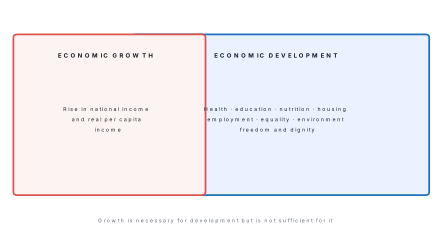
Economic growth (आर्थिक वृद्धि) is a quantitative increase in a country's output of goods and services over time — an increase in national income or in real per capita income. It is measured by the annual percentage increase in real GDP, and it can be achieved by using more factors of production or by using the existing ones better.
Economic development (आर्थिक विकास) is a qualitative and quantitative improvement in the whole life of a country's people — growth in income together with improvement in health, education, nutrition, housing, employment, income distribution and freedom from want. Development necessarily includes growth, but growth alone is not development.
| Point | Economic growth | Economic development |
|---|---|---|
| Nature | Quantitative — more output | Qualitative and quantitative — better life |
| What it measures | Rise in national income or real per capita income | Income plus health, education, nutrition, equality and freedom |
| Scope | Narrower — one dimension | Wider — the whole society |
| Indicators | GDP growth rate, per capita income | Human Development Index, poverty rate, literacy, life expectancy, Gini coefficient |
| Relation | Growth is a part of development | Development includes growth but goes beyond it |
| Example | A country's income rises by 6 % a year, but poverty stays the same | A country's income rises by 3 %, but school enrolment, life expectancy and equality all improve |
Indicators of development.
- Per capita income — the simplest measure: national income ÷ population. Its weakness is that it is an average and says nothing about how the income is distributed, and nothing about health, education or the environment.
- Human Development Index (HDI) — prepared by the United Nations Development Programme, it combines life expectancy at birth (health), mean and expected years of schooling (education) and gross national income per capita (income) into one figure between 0 and 1. Countries are graded very high, high, medium and low human development. It is the most widely used single measure because it counts people and not only output.
- Physical Quality of Life Index (PQLI) — an older composite of literacy, infant mortality and life expectancy.
- Poverty rate and the Gini coefficient — the share of the population below the poverty line, and a measure of inequality from 0 (perfect equality) to 1 (perfect inequality).
- Other indicators — literacy rate, life expectancy, infant and maternal mortality, access to drinking water, per capita energy consumption, road density, employment structure, and the share of agriculture, industry and services in GDP.
Theories of economic development. Four lines of thinking are named in the syllabus.
The classical theory. Adam Smith explained growth as the result of the division of labour and capital accumulation in a free market, with the size of the market setting the limit. Malthus and Ricardo added a warning: as population grows and poorer land is brought into cultivation, food and raw material become dearer, rent rises, profit falls and the economy settles into a stationary state. The classical school thus saw growth as self-limiting.
The Marxian theory. Karl Marx saw history as a succession of stages — primitive communism, slavery, feudalism, capitalism, socialism and communism — driven by the mode of production and by class conflict. Under capitalism, the owners of capital extract surplus value from labour; competition forces them to accumulate, and accumulation produces crises, a falling rate of profit and the growing misery of the working class, until the contradictions bring about revolution and socialism. Whatever one thinks of the conclusion, Marx's contribution was to put institutions, ownership and conflict at the centre of development.
Schumpeter's theory of innovation. Joseph Schumpeter explained development as creative destruction brought about by the entrepreneur. Development is not the slow accumulation of capital but a discontinuous change, set off when an innovator introduces a new product, a new method, a new market, a new source of supply or a new form of organisation. The profit earned by the innovator is temporary: imitators copy him, the profit disappears, and the economy settles at a higher level until the next innovation. The entrepreneur, not the saver, is the engine.
Rostow's stages of growth. W. W. Rostow described every economy as passing through five stages: the traditional society; the pre-conditions for take-off; the take-off, a short period in which investment rises above 10 per cent of national income and a leading sector pulls the economy forward; the drive to maturity, when the economy can produce anything it chooses; and the age of high mass consumption. The take-off is the critical stage, and its condition is a rise in the rate of investment and the appearance of a leading sector.
Balanced and unbalanced growth. The balanced growth approach (Rosenstein-Rodan, Nurkse) argues that a poor country should invest simultaneously in a range of industries, because one industry's workers are the other industry's customers; a single factory in a poor country has nobody to sell to. The unbalanced growth approach (Hirschman, Singer) replies that a poor country has neither the capital nor the skill to do everything at once, and that deliberate investment in a few strategic sectors creates shortages and pressures that pull the rest of the economy along. In practice, planners do both: they choose a few leading sectors and try to keep the rest of the economy growing with them.
4.2 Capital formation, population and development
Capital formation (पुँजी निर्माण) is the process by which a country adds to its stock of capital goods — machines, tools, buildings, roads, irrigation, power — so that future output is larger. It is the single most important condition of development, because a country that consumes everything it produces can never produce more next year.
The three stages of capital formation.
- Saving. Someone must forgo present consumption. The level of saving depends on the ability to save (the level of income and its distribution), the willingness to save (the thrift of the people, the security of the banking system, the rate of interest) and the institutions that make saving possible.
- Mobilisation of savings through financial institutions. Saving lying in a pot or in gold cannot build a factory. Banks, cooperatives, insurance companies and the stock exchange collect small savings into large investible funds.
- Investment. The funds must actually be put into capital goods — and that requires entrepreneurship, technology, skilled labour, infrastructure and a stable environment.
Nepal's investment rate is far below the level reached by countries that have taken off, which is why the country grows slowly despite a high saving effort by households.
Capital formation is financed from domestic saving (household, corporate and government), from foreign aid and grants, from foreign loans and from foreign direct investment. The advantage of domestic saving is that it does not have to be repaid in foreign currency; the advantage of foreign capital is that it brings technology and foreign exchange along with the money.
Population and development. Population is both a resource and a burden, and the balance depends on the ratio between the number of people and the resources available:
- Population as a resource — a labour force, a market, and the source of skills and ideas.
- Population as a burden — if it grows faster than the economy, per capita income falls or stagnates; savings are eaten up by consumption; land is fragmented; forests, water and soil are over-used; unemployment and under-employment grow; and schools, hospitals and jobs cannot be provided fast enough.
- The demographic dividend — a country whose birth rate has fallen sharply has, for a period, a large working-age population and a small dependent population. That is an opportunity for rapid growth, but only if the young people are educated and employed. Nepal is passing through this window now.
- Migration and remittance — foreign employment relieves the pressure of unemployment at home and brings in foreign exchange, but it removes the young and the skilled, and leaves agriculture to the old.
Human development puts people at the centre. Development is not only more factories but longer life, better schooling, better nutrition and more freedom. This is the idea the Human Development Index measures, and it is why Nepal's HDI rank is watched as closely as its GDP growth rate.
Problem. A country's national income in year 1 was Rs. 4,000 billion with a population of 25 million; in year 2 the national income was Rs. 4,400 billion with a population of 25.75 million. Investment in year 2 was Rs. 1,100 billion. Find (a) the growth rate of national income, (b) the per capita income in both years, (c) the growth rate of per capita income, and (d) the rate of capital formation.
Solution. Step 1 — Growth\ of\ national\ income = \frac{4{,}400 - 4{,}000}{4{,}000} \times 100 = 10\%. Step 2 — Per capita income, year 1 = \frac{4{,}000\ billion}{25\ million} = Rs.\ 160{,}000; year 2 = \frac{4{,}400\ billion}{25.75\ million} = Rs.\ 170{,}874. Step 3 — Growth\ of\ per\ capita\ income = \frac{170{,}874 - 160{,}000}{160{,}000} \times 100 = 6.8\%. Step 4 — Rate\ of\ capital\ formation = \frac{1{,}100}{4{,}400} \times 100 = 25\%. Step 5 — Note what happened: income grew by 10 %, but because population grew by 3 % (from 25 to 25.75 million), per capita income grew by only 6.8 %. Growth in population devoured a third of the growth in income.
Answer. (a) 10 %; (b) Rs. 1,60,000 and Rs. 1,70,874; (c) 6.8 %; (d) 25 %. What it means. This single piece of arithmetic explains why family planning is an economic policy. A country whose population grows at 3 % must grow by more than 3 % merely to stand still in per capita terms.
4.3 Bases of a socialist-oriented economy
The Constitution of Nepal declares the country's economic system to be a socialist-oriented economy (समाजवादउन्मुख अर्थतन्त्र), resting on three sectors side by side — a public sector, a private sector and a cooperative sector — and directed towards the reduction of poverty, inequality and unemployment.
The bases of this system are:
- Three-pillar economic structure. The constitution and the law protect private property and private enterprise; the state runs the public sector in areas of strategic and public importance; and cooperatives are promoted as a third, member-owned sector for production, distribution, credit and consumption.
- Social justice and equality. The state is directed to reduce inequality of income and wealth, to end all forms of exploitation, and to ensure that the benefits of development reach the poor, the marginalised and the backward regions.
- A welfare role for the state. Free and compulsory basic education, free basic health services, social security for the aged and the disabled, and the guarantee of a minimum standard of living for every citizen.
- Public welfare over private profit. In cases of conflict between public interest and private profit, the law gives priority to public interest, and the state may impose a ceiling on the ownership of land and of productive assets.
- Lawful enterprise with social responsibility. Private enterprise is protected and encouraged, but it must pay taxes, obey labour and environmental law and contribute to national development.
- A planned, independent economy. Development is guided by periodic plans, aimed at self-reliance and the protection of the national economy from exploitation by foreign capital, while remaining open to foreign investment on terms that serve the country.
- Cooperative and cooperative-friendly development. Cooperative institutions are encouraged and protected, and the law is amended from time to time to enable them to grow.
The aim is not state ownership of everything — that was the socialist model of the twentieth century — but a mixed economy with a socialist orientation: markets and private enterprise to create wealth, and the state, the law and the cooperative sector to distribute it fairly.
4.4 Features and problems of the Nepali economy
Features.
- An agrarian economy. Agriculture still employs about three-fifths of the working population and provides between a fifth and a quarter of the Gross Domestic Product; industry is small and most of it is light.
- Low per capita income and low productivity. Income per head is one of the lowest in South Asia, and output per worker in agriculture is very low because holdings are small, unirrigated and worked by hand.
- A growing share of services, and of remittance. The service sector, trade and, above all, remittance now dominate the economy; consumption is financed partly from abroad rather than from production at home.
- Low rate of capital formation. Saving is inadequate and much government capital spending depends on foreign aid and loans.
- A mixed economy with a socialist orientation, using the public, private and cooperative sectors together.
- A landlocked, transit-dependent economy with an open border with India, heavily dependent on that one market and on Indian ports for third-country trade.
- A young and mobile population. A large working-age population, a demographic dividend, and a very large outflow of young workers abroad.
- Dependence on foreign aid, loans and remittance, and a chronic trade deficit.
- Uneven development between the Kathmandu valley and the hills and mountains; between the Terai and the high mountains; and between well-connected districts and remote ones.
Problems.
- Poverty and inequality. A large minority still lives below the poverty line, and income and land are very unequally distributed.
- Unemployment and under-employment. Each year the labour force grows by hundreds of thousands, the domestic economy cannot absorb them, and foreign employment becomes the only option for many — while educated unemployment at home remains high.
- Low agricultural productivity. Small and fragmented holdings, dependence on the monsoon, poor irrigation, low use of improved seed and fertiliser, and weak marketing.
- Capital deficiency and low saving. Domestic saving does not meet investment needs, so the country depends on foreign saving.
- Weak industrial base. Industry is small, mostly light, hampered by high energy and transport costs, irregular power in the past, labour unrest, and the difficulty of competing with Indian and Chinese goods.
- Poor infrastructure. Roads, electricity, irrigation, water supply, health facilities and schools are least adequate exactly where they are most needed.
- A chronic trade deficit and narrow exports, which drain foreign exchange.
- Brain drain. The emigration of skilled and educated people costs the country the money it spent on their education and their future contribution.
- Political instability, weak governance and corruption, which delay projects, raise their cost and discourage investment.
- Natural disasters — earthquakes, floods, landslides and droughts — which destroy capital and push households back into poverty.
Prospects. Nepal's potential lies in hydroelectricity and its export, in tourism based on the mountains, culture and pilgrimage sites, in agricultural modernisation — irrigation, high-value crops, tea, coffee, ginger, cardamom, dairy — in remittance-financed small enterprise and education, and in the demographic dividend if the young can be educated and employed at home. None of it happens by itself; each depends on infrastructure, on policy stability and on investment.
Problem. In a certain year a country's GDP was made up as follows (in Rs. billion): agriculture 500, industry 300, services 700; and the shares of employment were agriculture 60 %, industry 15 %, services 25 %. Find (a) the GDP and the sectoral shares of output, and (b) describe the structure and name two problems that follow from it.
Solution. Step 1 — GDP = 500 + 300 + 700 = Rs.\ 1{,}500 billion. Step 2 — Shares of output: agriculture = \frac{500}{1{,}500} \times 100 = 33.3\%; industry = \frac{300}{1{,}500} \times 100 = 20\%; services = \frac{700}{1{,}500} \times 100 = 46.7\%. Step 3 — Compare output with employment: agriculture produces 33.3 % of output with 60 % of the workers, while services produce 46.7 % of output with only 25 % of the workers. Step 4 — Name the problems. First, low productivity in agriculture: too many people share too little output, so the average farmer is poor. Second, disguised unemployment: some of the 60 % could leave agriculture without reducing its output, which means they are not really adding anything. Step 5 — The remedy follows from the arithmetic: raise agricultural productivity and move labour into industry and services, where each worker produces more.
Answer. GDP Rs. 1,500 billion; agriculture 33.3 %, industry 20 %, services 46.7 % of output but 60 %, 15 % and 25 % of employment. What it means. This is roughly Nepal's structure. The gap between the share of output and the share of employment in agriculture is the clearest single symptom of underdevelopment.
Problem. Country A has a per capita income of Rs. 4,00,000, a life expectancy of 62 years and a mean schooling of 5 years. Country B has a per capita income of Rs. 1,60,000, a life expectancy of 71 years and a mean schooling of 9 years. Which country is more developed, and why is per capita income alone a poor measure?
Solution. Step 1 — Compare the three dimensions. A is ahead on income; B is ahead on health (life expectancy 71 against 62) and much ahead on education (9 years against 5). Step 2 — Apply the HDI logic: the index combines all three, so B's advantage in two of the three dimensions will place it above A. Step 3 — Conclude that Country B is the more developed: its people live longer and are better educated, even though their average income is lower. Step 4 — Explain why per capita income is a poor measure. It is an average and hides distribution; it counts output that may be earned by foreigners or from a depletable resource; it says nothing about health, education, nutrition or freedom; and it takes no account of the environment, unpaid work or the informal economy.
Answer. Country B is more developed. Per capita income is only an average of output and ignores health, education, distribution and freedom. What it means. The HDI was invented precisely for this comparison — so that a country which converts income into health and schooling is ranked above one which does not.
"Economic development means the same as economic growth" is the error the examiner is looking for. Growth is the increase in income; development is the improvement in human welfare, of which growth is one necessary part. A second frequent error is to say that a socialist-oriented economy means state ownership of everything: it means a mixed economy with public, private and cooperative sectors, directed by the state towards social justice, with private property protected by law.
Chapter summary
- Economic growth is a quantitative increase in national income or real per capita income. Economic development is growth together with improvement in health, education, nutrition, housing, employment, equality and freedom. Growth is necessary for development but not sufficient for it.
- Indicators of development: per capita income (a mere average); the Human Development Index (life expectancy, schooling and GNI per capita, prepared by the UNDP); the PQLI; the poverty rate and the Gini coefficient; and literacy, life expectancy, infant mortality, access to water, road density and the sectoral structure of output and employment.
- Theories: the classical school (division of labour and capital accumulation, leading to a stationary state as Malthus and Ricardo argued); the Marxian theory (stages of history driven by the mode of production and class conflict, surplus value, and the collapse of capitalism); Schumpeter (development as creative destruction brought about by the entrepreneur's innovation); Rostow (five stages, with the take-off at an investment rate above 10 per cent and a leading sector); and the debate between balanced growth (invest in many industries at once) and unbalanced growth (invest in a few strategic sectors and let them pull the rest along).
- Capital formation is the addition to the stock of capital goods. Its three stages are saving, mobilisation through financial institutions and investment; its rate is Investment \div National\ income. It is financed from domestic saving, foreign aid and grants, foreign loans and foreign direct investment.
- Population is a resource when its skills are used and a burden when it grows faster than the economy: it eats into per capita income and saving, fragments land and strains services. The demographic dividend is the growth opportunity created when the working-age share of the population rises.
- The small arithmetic of the unit: growth in income must exceed growth in population for per capita income to rise at all.
- The bases of a socialist-oriented economy in Nepal are the three-pillar structure (public, private and cooperative sectors), social justice and equality, a welfare role for the state, public welfare over private profit, lawful enterprise with social responsibility, a planned and independent economy, and the promotion of cooperatives. It is a mixed economy with a socialist orientation, not state ownership of everything.
- The features of the Nepali economy are an agrarian base with a growing service sector, low per capita income and productivity, a low rate of capital formation, a mixed economy with a socialist orientation, landlocked and transit-dependent trade, a young and mobile population, dependence on aid, loans and remittance, and uneven development.
- Its problems are poverty and inequality, unemployment and under-employment, low agricultural productivity, capital deficiency, a weak industrial base, poor infrastructure, a chronic trade deficit, brain drain, political instability and corruption, and vulnerability to natural disasters. Its prospects lie in hydropower, tourism, agricultural modernisation, remittance-financed enterprise and the demographic dividend.
Practice questions
Group A — Very short answer (1 mark each)
- What is economic growth? [1]
- What is economic development? [1]
- Write any two indicators of economic development. [1]
- What is the Human Development Index? [1]
- What is capital formation? [1]
- Write any two stages of capital formation. [1]
- What is meant by the demographic dividend? [1]
- Name the three sectors of Nepal's socialist-oriented economy. [1]
- Write any two features of the Nepali economy. [1]
- Write any two problems of the Nepali economy. [1]
- What is Rostow's take-off? [1]
- What is meant by balanced growth? [1]
Answers to Group A
1. Economic growth is a quantitative increase in a country's output of goods and services over time — a rise in national income or in real per capita income.
2. Economic development is growth in income together with a qualitative improvement in the whole life of the people — health, education, nutrition, housing, employment, equality and freedom.
3. Any two of: per capita income, Human Development Index, poverty rate, Gini coefficient, literacy rate, life expectancy, infant mortality rate.
4. The Human Development Index is a composite measure prepared by the UNDP combining life expectancy at birth, years of schooling and gross national income per capita into a single figure between 0 and 1.
5. Capital formation is the process by which a country adds to its stock of capital goods — machines, buildings, roads, irrigation and power — so that future output is larger.
6. Any two of: saving, mobilisation of savings through financial institutions, investment.
7. The demographic dividend is the growth opportunity that arises when a fall in the birth rate gives a country a large working-age population and a small dependent population — useful only if the young are educated and employed.
8. The public sector, the private sector and the cooperative sector.
9. Any two of: an agrarian economy; low per capita income and productivity; a growing service sector and dependence on remittance; a low rate of capital formation; a mixed economy with a socialist orientation; landlocked and transit-dependent; a young and mobile population; dependence on aid and loans; uneven development.
10. Any two of: poverty and inequality; unemployment and under-employment; low agricultural productivity; capital deficiency; a weak industrial base; poor infrastructure; a chronic trade deficit; brain drain; political instability and corruption; natural disasters.
11. Rostow's take-off is the short critical stage of growth in which the rate of investment rises above about 10 per cent of national income and a leading sector pulls the economy forward.
12. Balanced growth is the approach which argues that a poor country should invest simultaneously in a range of industries, because the workers in one industry are the customers of another.
Group B — Short answer (5 marks each)
- Distinguish between economic growth and economic development. [5]
- Explain the indicators of economic development. [5]
- What is capital formation? Explain its stages and sources of finance. [5]
- Explain the relation between population and economic development. [5]
- Explain the bases of the socialist-oriented economy provided for in the Constitution of Nepal. [5]
- Explain the main features of the Nepali economy. [5]
- Explain the main problems of the Nepali economy and state its prospects. [5]
Answers to Group B
1. Growth is quantitative — a rise in national income or real per capita income, measured by the GDP growth rate. Development is qualitative as well as quantitative — growth plus better health, education, nutrition, housing, employment, equality and freedom, measured by the HDI and other social indicators. Growth is one dimension and is necessary but not sufficient for development; development includes growth and goes beyond it. Example: a country whose income rises by 6 % but whose poverty and schooling do not change has grown but has not developed.
2. Per capita income — simple but only an average, ignoring distribution and welfare. Human Development Index — life expectancy, years of schooling and GNI per capita, giving a figure between 0 and 1. PQLI — literacy, infant mortality and life expectancy. Poverty rate and Gini coefficient — the extent of poverty and the degree of inequality. Other indicators — literacy, life expectancy, infant and maternal mortality, access to drinking water, energy consumption, road density, the structure of output and of employment.
3. Definition as in Group A answer 5. Stages: saving — forgoing present consumption, which depends on the ability to save, the willingness to save and the institutions available; mobilisation of savings — banks, cooperatives, insurance and the capital market collect small savings into large funds; investment — the funds are actually put into capital goods, which needs entrepreneurship, technology, skilled labour, infrastructure and stability. Sources of finance: domestic saving (household, corporate and government); foreign aid and grants; foreign loans; and foreign direct investment.
4. Population is a resource — a labour force, a market and a source of skills — and a burden if it grows faster than the economy. A population growing at 3 % a year absorbs a third of a 9 % growth in income, so per capita income rises by only about 6 %. High population growth also reduces saving, fragments land, over-uses forests and water, and strains schools, hospitals and jobs. A fall in the birth rate, on the other hand, produces the demographic dividend — a large working-age population and a small dependent population — which becomes an advantage if the young are educated and employed. Migration abroad relieves unemployment and brings remittance, but removes the young and skilled.
5. The Constitution declares Nepal's economic system a socialist-oriented economy resting on three sectors — public, private and cooperative. Bases: the three-pillar structure with private property protected and cooperatives promoted; social justice and equality, with the state directed to end exploitation and reduce inequality; a welfare role for the state in basic education, basic health and social security; public welfare given priority over private profit, with ceilings permitted on land and productive assets; lawful private enterprise carrying social responsibility; a planned and independent economy guided by periodic plans and self-reliance; and cooperative-friendly development.
6. An agrarian economy, with agriculture providing a fifth to a quarter of GDP and employing about three-fifths of the workers; low per capita income and very low productivity per worker; a growing service sector and heavy dependence on remittance; a low rate of capital formation financed substantially by foreign aid and loans; a mixed economy with a socialist orientation; a landlocked and transit-dependent economy with an open border with India; a young and mobile population with a large outflow of workers abroad; dependence on aid, loans and remittance with a chronic trade deficit; and uneven development between the Kathmandu valley, the Terai, the hills and the mountains.
7. Problems: poverty and inequality; unemployment and under-employment, including educated unemployment; low agricultural productivity; capital deficiency and low saving; a weak industrial base; poor infrastructure; a chronic trade deficit and narrow exports; brain drain; political instability, weak governance and corruption; and vulnerability to natural disasters. Prospects: export of hydroelectricity; tourism based on mountains, culture and pilgrimage; modernisation of agriculture with irrigation and high-value crops such as tea, coffee, ginger, cardamom and dairy; remittance-financed small enterprise and education; and the demographic dividend if the young are educated and employed at home. Each depends on infrastructure, policy stability and investment.
Group C — Long answer (8 marks each)
- Explain the meaning of economic growth and economic development, the indicators of development, and the main theories of economic development. [8]
- Explain the meaning of a socialist-oriented economy and its bases as provided in the Constitution of Nepal, and state the features, problems and prospects of the Nepali economy. [8]
Answers to Group C
1. Meaning (2). Growth is a quantitative rise in national income or real per capita income; development is growth together with qualitative improvement in the life of the people. Give the comparison table and the example of a country that grows without developing. Indicators (3). Per capita income and its weaknesses; the Human Development Index and its three dimensions; the PQLI; the poverty rate and the Gini coefficient; and the supporting indicators of literacy, life expectancy, infant mortality, access to water and the structure of output and employment. Theories (3). Classical — division of labour, capital accumulation, and the stationary state of Malthus and Ricardo; Marxian — stages of history, mode of production, class conflict, surplus value and the collapse of capitalism; Schumpeter — development as creative destruction driven by the entrepreneur's innovation; Rostow — the five stages, with take-off at an investment rate above 10 per cent and a leading sector; and the balanced against the unbalanced growth approach, with Rosenstein-Rodan and Nurkse on one side and Hirschman on the other.
2. Socialist-oriented economy (2). A mixed economy with a socialist orientation, resting on three sectors — public, private and cooperative — and directed to the reduction of poverty, inequality and unemployment. Bases (3). The three-pillar structure; social justice and equality; the welfare role of the state in basic education, health and social security; public welfare preferred to private profit, with ceilings on land and productive assets; lawful private enterprise with social responsibility; a planned, self-reliant and independent economy; and the promotion and protection of cooperatives. Features, problems and prospects (3). Features: agrarian base, low per capita income and productivity, a growing service sector and remittance, a low rate of capital formation, landlocked and transit-dependent trade, a young and mobile population, dependence on aid and loans, uneven development. Problems: poverty and inequality, unemployment and under-employment, low agricultural productivity, capital deficiency, a weak industrial base, poor infrastructure, a chronic trade deficit, brain drain, instability and corruption, natural disasters. Prospects: hydroelectricity and its export, tourism, agricultural modernisation and high-value crops, remittance-financed small enterprise and education, and the demographic dividend.
Practise more: Economics question bank