Unit 1 · Office Management · 10 teaching hours · 35 min read
Office Management and Procedure (कार्यालय व्यवस्थापन र कार्यविधि)
What the syllabus asks for 12
- Office and office management: meaning, definitions and features
- Importance and areas of office management
- Office layout (कार्यालय विन्यास): principles, types, advantages and limits
- Office procedure (कार्यालय कार्यविधि): meaning, stages and principles
- Noting (टिप्पणी): meaning, importance and points to observe
- Drafting (प्रस्ताव): meaning, essentials of a good draft
- Report (प्रतिवेदन): meaning, types, points to observe while preparing one
- Office order and toc order (टोक आदेश)
- Filing (फाइलिङ): meaning, objectives, essential features
- Types and methods of filing; centralised and decentralised filing
- Indexing (अनुक्रमणिका): meaning, types, advantages
- Records management: retention, disposal and safety of records
An office is the place where an organisation's information is created, recorded, stored and moved. Every business, school, hospital and government body has one, because somebody has to receive the letter, keep the file, write the report and pay the bill. This unit explains how that work is managed and what rules make it orderly. You will meet the meaning and importance of office management, how an office should be laid out, how a piece of work travels through the office as a procedure, and the four everyday documents of an office — the noting, the draft, the report and the order. Then you will learn how papers are kept after the work is over: filing, indexing and the safe disposal of old records.
Group A asks one-mark questions straight from the definitions and the lists — "name any two office procedures", "what is a noting?", "write any two objectives of filing". Group B asks a five-mark explanation, usually of office layout, filing methods or the points to remember while drafting. Group C rarely comes from this unit alone, but a filing question can appear as the alternative to a numerical question in Group C. Learn the definitions word for word, then the lists in points.
1.1 Office and office management
An office is a place where clerical and administrative work is done: information is received, recorded, arranged, analysed and supplied to the people who need it. It is not only a room with tables. In a modern organisation the office is a function — the place where the records of the whole organisation are kept and from which instructions go out.
Office management (कार्यालय व्यवस्थापन) is the task of planning, organising, directing, coordinating and controlling the work of an office so that its objectives are achieved efficiently and economically. The textbook gives three definitions that are worth knowing because Group A often quotes one of them:
| Thinker | Definition in one line |
|---|---|
| George R. Terry | The task of planning, coordinating and motivating the efforts of others towards a specific objective in the office. |
| Leffingwell and Robinson | Performing office work effectively, whenever and wherever it has to be done. |
| J. C. Denyer | Directing and controlling an office so that its specific purpose is achieved in the most economical way. |
All three agree on four things. Office management plans the work, organises the people and materials, directs the staff, and controls the result. It uses three kinds of resource: human resources (the staff), physical resources (building, furniture, machines, stationery) and procedural resources (the systems and forms by which work moves).
Main features. Office management is a service function — it does not manufacture anything, it supports those who do. It is a continuous activity, because work arrives every day. It is management of information rather than of goods. And it is goal-oriented: every procedure exists to help the organisation reach a stated objective.

1.2 Importance and areas of office management
Office management earns its place because of what goes wrong without it.
- Speed of work. A laid-out office with a written procedure clears a file in days, not weeks.
- Accuracy of records. Systematic recording means the organisation can answer "what did we buy, when and for how much?" without a search.
- Coordination. Every department routes its paper through one office, so all departments work from the same information.
- Cost control. Correct stationery, correct furniture and correct staffing keep office cost per transaction low.
- Goodwill. A prompt, polite and accurate reply to a customer or a citizen creates goodwill that advertising cannot buy.
- Decision making. Managers decide on the basis of the reports and figures the office supplies.
- Legal protection. Properly filed records are evidence when a dispute goes to court or to an audit.
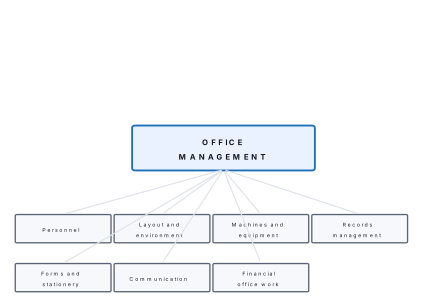
Areas (scope). Office management covers:
- Personnel work — recruiting, training and supervising office staff.
- Office layout and environment — space, light, air, furniture, safety.
- Machines and equipment — typewriters in the past, today computers, printers, photocopiers, scanners, telephones, internet.
- Records management — correspondence, filing, indexing, retention and disposal.
- Forms and stationery — designing a form once so that a thousand copies collect exactly the same information in the same places.
- Communication — receiving, sorting, distributing and dispatching mail, both paper and electronic.
- Financial office work — handling petty cash, maintaining registers and preparing routine statements.
1.3 Office layout (कार्यालय विन्यास)
Office layout is the arrangement of furniture, machines, departments and people within the available floor space so that work flows smoothly. A good layout is not about beauty; it is about the distance a paper has to travel.
Principles.
- Straight-line flow. Work should move forward from one desk to the next, never backward.
- Minimum movement. Desks that exchange papers constantly should be near each other; the reception and the dispatch section should be near the door.
- Noise and concentration. Loud machines (photocopier, printer, telephone exchange) should be away from sections that need concentration.
- Light and ventilation. Light should fall on the work from the left for a right-handed worker; cross-ventilation avoids draughts and stale air.
- Space for movement. At least 1 metre of clear walking space between rows, and no desk blocking a fire exit.
- Flexibility. Furniture on wheels and movable partitions allow the layout to change when the organisation grows.
- Supervision. A supervisor should be able to see the whole section without standing up.
- Safety and cleanliness. First-aid box, fire extinguisher, clear exits, clean floors.
Types of layout.
| Type | How it looks | Advantages | Disadvantages |
|---|---|---|---|
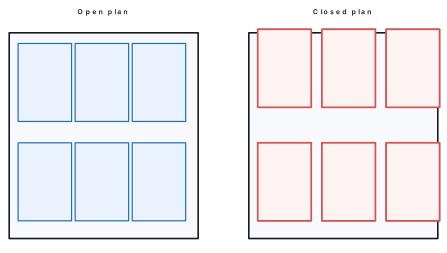
| Open (landscape) | All desks in one big hall, low partitions or none | Easy supervision, cheaper, no wall-hugging, work moves quickly | Noise, no privacy, confidential work overheard, distractions |
| Closed (cellular / cabin) | Separate rooms for each officer or section | Privacy and quiet, confidential work is safe, status symbol | Higher rent and furniture cost, poor supervision, paper travels further, more walls need light and air |
| Mixed (semi-open) | Large open hall with a few enclosed cabins for senior posts and confidential work | Most of the benefits of both | Needs careful planning of which work must be screened |
Problem. A municipal office has 12 clerks in one hall and 3 officers who handle land-revenue records. The clerks complain of noise; the officers complain that confidential files are read over their shoulders. Rent is limited. Which layout do you advise?
Solution. Step 1 — Identify the conflicting needs. Clerks: many people, routine repetitive work, need supervision and quick paper movement, noise is tolerable. Officers: few people, confidential and varied work, need quiet and privacy. Step 2 — Match layout to need. Routine mass work suits an open plan; confidential individual work suits a closed cabin. Step 3 — Combine within the budget. Keep the 12 clerks in the open hall (cheap, well supervised) and give the 3 officers screened cubicles along one wall, not full rooms. This is a mixed layout. Step 4 — Add the principles: the record room is placed next to the officers' cubicles, the public counter next to the entrance, and the photocopier at the far end away from both. Answer. A mixed layout — open hall for the clerks, screened cubicles for the confidential work.
Students write "closed layout is better because there is privacy" without weighing cost. A five-mark answer must compare. Always give the advantage and the cost in the same sentence: open layout is cheaper and better supervised but noisier and less private; closed layout is private and quiet but costs more space and weakens supervision.
1.4 Office procedure (कार्यालय कार्यविधि)
An office procedure is the fixed sequence of steps by which a particular item of office work is completed. A letter asking for a quotation, a bill to be paid, a leave application — each has a procedure. The procedure tells every clerk what happens next, who signs, and where the paper goes.
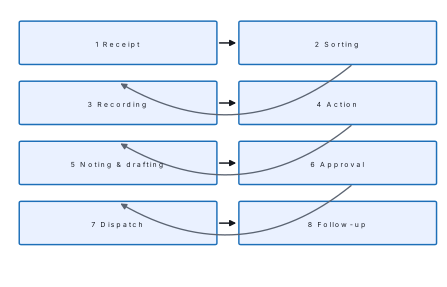
Stages of a typical procedure.
- Receipt — the paper arrives (by post, by hand, by e-mail) and is entered in the inward register (or the electronic inward).
- Sorting — separating urgent from routine, and routing each item to the right section.
- Recording — giving the item a number, date and file reference.
- Action — the concerned section does the work: inspects, calculates, collects information.
- Noting and drafting — the clerk records the facts and proposes a decision (the noting), then writes the outgoing letter (the draft).
- Approval and signature — the authorised officer approves; the fair copy is signed.
- Dispatch — the outgoing letter is entered in the outward register and sent; a copy is filed.
- Follow-up — reminders are sent if a reply is due, and the file is closed only when the matter is settled.
Principles of a good procedure. It should be simple (no unnecessary stage), economical (cost less than the value of the work), flexible (an urgent case can jump the queue), written down (so a new clerk can follow it) and reviewed from time to time, because any procedure repeated for years grows extra steps that nobody needs.
1.5 Noting (टिप्पणी)
A noting (टिप्पणी) is a written record of the facts of a case, the rules that apply to it, the views of the sections concerned, and a proposed decision, written on the file itself by the dealing clerk for the information of the officer who must decide.
The noting is the memory of the office. Years later, when an auditor asks why a payment was made, the noting answers. So a good noting is written as if a stranger will read it.
Points to observe while writing a noting.
- Begin with a short subject line and the file number.
- State the facts first, in chronological order, with dates and amounts.
- Quote the rule, order or precedent that applies — for a government office this is essential, because an auditor tests the decision against the rule.
- Give the views of the other sections or offices consulted, briefly.
- End with a clear proposal: "It is proposed that sanction be accorded to ...". Do not leave the officer to guess what you want.
- Language must be courteous, impersonal and free of emotion. Never write personal remarks about a colleague or a party.
- Do not repeat what is already on the file; refer to the earlier page number instead.
- Keep it short. A noting of half a page read twice is better than two pages read once.
A noting is internal — it stays on the file and is written to the officer. A draft is external — it becomes the outgoing letter and is written to the outside party. Same facts, different audience and different style.
1.6 Drafting (प्रस्ताव)
Drafting is the preparation, in the form in which it will finally be issued, of a letter or order to be sent out of the office. The draft is put up on the file with the noting; once approved and signed, it becomes the fair copy and is dispatched.
Essentials of a good draft.
- The seven parts should be present: office name and address (letterhead), reference number and date, the name and address of the receiver, the subject line, the salutation, the body, and the complimentary close with the signature block, designation and seal.
- The purpose must appear in the first two lines. The reader should not have to hunt for it.
- One draft, one subject. Two unrelated matters in one letter get two different answers at two different times.
- Language must be clear, polite, brief and complete; avoid slangs, abbreviations the reader may not know, and words that can carry two meanings.
- All facts and figures must be checked against the file — a wrong amount in a government letter can be very expensive.
- Keep a courteous tone even when refusing. "It is regretted that your request cannot be acceded to for the following reason." never "Your request is rejected."
- The draft must follow any standing format of the office (for a government office, the standard letter and the order format of the A.G.F. series).
Types. A draft may be a letter (to an outsider), a memorandum or office order (to staff), a circular (to many offices at once), a notice (to the public) or a telegram-style urgent message.
1.7 Report (प्रतिवेदन)
A report (प्रतिवेदन) is a written statement in which a person or a committee presents the facts it has found and the conclusions and recommendations it draws from them, so that a decision can be taken.
Points to observe while preparing a report.
- Clear terms of reference — say at the start what you were asked to examine.
- Method — how the information was collected (inspection, interview, records, measurement).
- Facts before opinion. Present findings with dates, figures and sources; keep your opinion for a separate part.
- Structure: title, terms of reference, method, findings, analysis, conclusion, recommendations, signature and date; annexes at the end.
- Objectivity. A report that hides an inconvenient finding is worthless. State what you found, even if it criticises your own office.
- Recommendations must be practical and specific — "two additional clerks for three months", not "more staff are needed".
- Brevity and clear language. A long report is read by nobody; use headings, numbered points and tables.
- Confidential reports on the work of an employee (for promotion, confirmation or punishment) are written only by the authorised officer and are strictly confidential.
1.8 Office order and toc order (टोक आदेश)
Once a decision is taken, it has to reach the people who must act on it. Two of the commonest instruments are the office order and the toc order.
An office order (कार्यालय आदेश) is a written instruction issued by the head of the office to the staff, telling them what to do. It is used for posting a clerk to a section, granting leave, ordering overtime, fixing a duty roster, or directing that a routine be followed. An office order states the order number and date, the name of the person addressed, the instruction, the authority under which it is issued, and the signature and designation of the issuing officer.
A toc order is the office's internal note that a file has been dealt with — in the old manual system each section maintained a toc register (from "T.O.C.", taken over from the earlier English practice of a "table of contents" register) in which every paper handled during the day is entered with its number, date, sender and a one-line description. The toc register is the day book of the office: if a paper is entered in the toc and not found afterwards, the office knows exactly when and where it was lost. In an electronic office the same function is served by the dispatch log and the document management system's audit trail.
1.9 Filing (फाइलिङ)
Once an item of work is finished, the paper cannot be thrown away and cannot be left loose on a table. It has to be filed.
Filing is the systematic arrangement and storage of documents — letters, bills, vouchers, agreements, reports — in such a way that any document can be traced and produced whenever it is needed.
Objectives of filing.
- To keep papers safe from loss, dirt, damp, insects and fire.
- To make every document easy to trace in the shortest possible time.
- To bring related papers together, so that the whole history of a case lies in one place.
- To preserve evidence for audit, for tax assessment and for court.
- To serve as the memory of the office, since staff change but the file remains.
- To save space and cost by disposing of papers that are no longer needed.
Essential features of a good filing system.
- Simplicity — a clerk must be able to file and retrieve without training for weeks.
- Prompt location — a wanted file must come out in minutes.
- Economy — the cost of the system must be less than the cost of what it protects.
- Flexibility — new files can be opened as the work grows.
- Safety — protection from fire, water, insects, theft and unauthorised eyes.
- Accessibility — the right staff can reach the file; confidential files are kept separately and issued only against a signature.
- Compactness — minimum space for the maximum papers.
- Cross-reference — a paper that belongs to two cases is filed in one place with a cross-reference note in the other.
1.10 Types and methods of filing
Filing systems are described in two ways: the method (how the paper is placed inside the holder) and the classification (the rule by which the file is named).
By method.
| Method | How it works | Use |
|---|---|---|
| Horizontal filing | Files lie flat one above another inside a drawer or cabinet | Ordinary correspondence; suits loose papers that must not hang |
| Vertical filing | Files stand upright, suspended from a rail, with the title on the visible tab | The commonest method; fastest retrieval |
| Lateral filing | Files stand upright but the title tabs face sideways | High-volume offices with limited floor space |
| Suspension filing | Files hang from rails on the drawer's sides so they cannot fall | Mixed-size documents |
By classification (the rule by which files are named).
- Alphabetical — by the name of the person or firm (A, B, C ...). Simple and familiar; but all letters to the many people whose names begin with S end in one drawer.
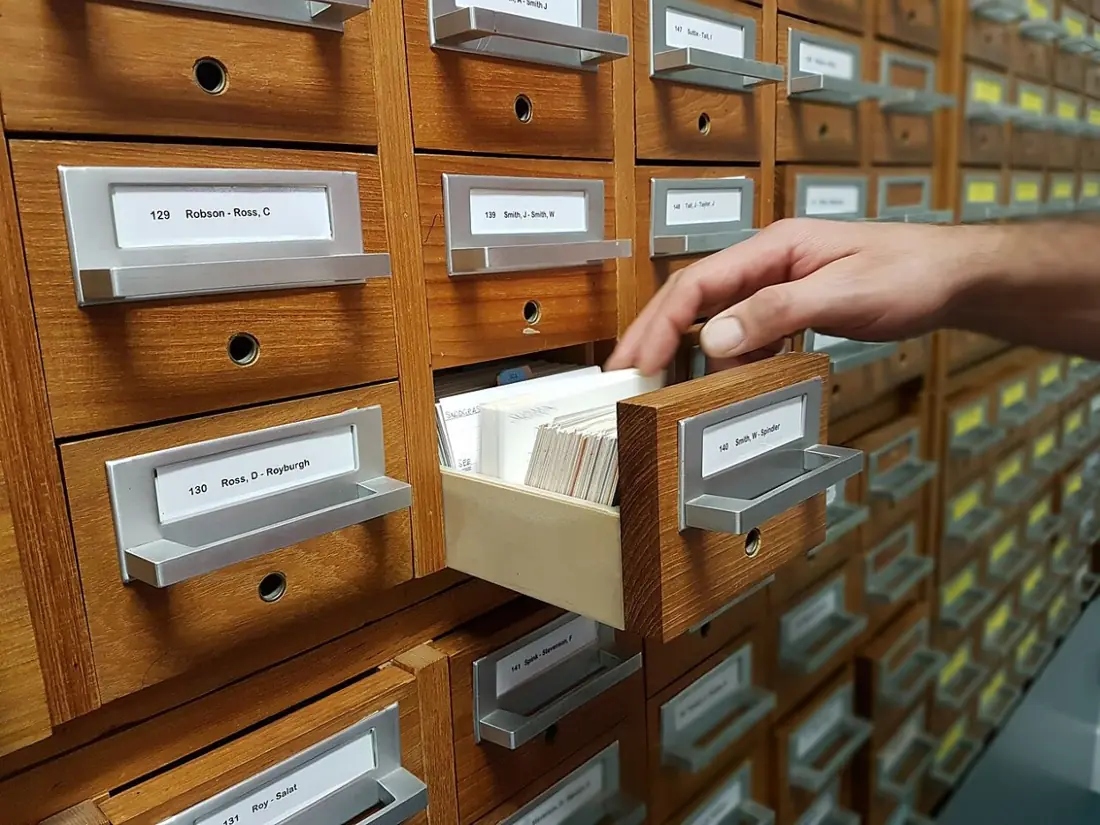
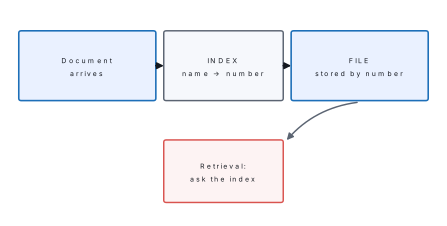
- Numerical — each file gets a number (e.g. 145/2082). Unlimited expansion, and the number itself is confidential; but it needs an index to turn a name into a number.
- Alphanumerical (alpha-numeric) — a letter for the section and a number for the file (A/12, B/7). Good for large offices with departments.
- Chronological — by date; the ticket, the daily register, the accounting voucher.
- Subject or functional — by subject or function ("Purchase", "Vehicle", "Land Revenue"). The best rule for technical work.
- Geographical — by place (Koshi, Madhesh, Bagmati ...). Used by banks, districts and sales offices.
- Decimal — file 532.25, where 5 is the main head, 3 the sub-head and 25 the individual file. Groups related files logically.
- Colour coding — a coloured tab for each group, so a misplaced file is visible at a glance.
Centralised versus decentralised filing.
| Point | Centralised | Decentralised |
|---|---|---|
| Who files | One filing section for the whole organisation | Each department files its own papers |
| Equipment and staff | One trained staff, one set of cabinets | Duplicated cabinets and clerks |
| Cost | Lower | Higher |
| Records | All records in one place; no duplication | Each department's records complete but partial for the organisation |
| Supervision and safety | Easier; one confidential record room | Harder; many keys |
| Speed of retrieval | Slower for a distant department | Faster for that department |
| Confidentiality | Easier to control | Depends on every department |
Most offices use a compromise: routine, whole-of-organisation records (accounts, land, personnel) are filed centrally, while day-to-day working papers stay with the department that uses them and are transferred to the central record room when the case is closed.
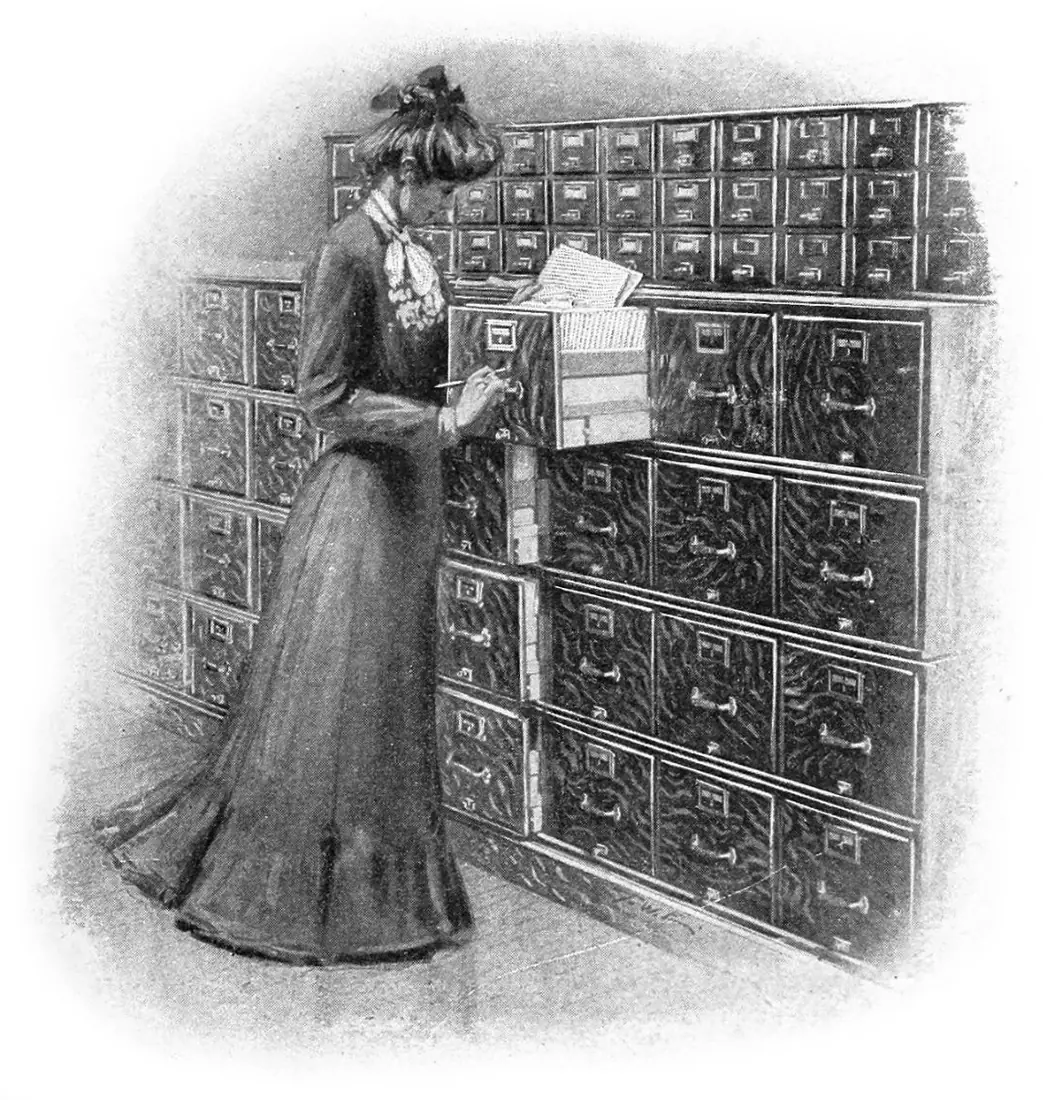
Problem. A district survey office files by the name of the landowner. As the district is subdivided, several owners now have identical names, and clerks frequently pull the wrong file. The office also needs to answer questions such as "how many plots of arable land in ward 4 were registered last year?", which the present system cannot answer at all. Suggest a better classification and say why.
Solution. Step 1 — Diagnose. Alphabetical filing by a non-unique key (a name shared by many people) causes collisions. It also carries no geographic or subject information, so a ward-wise query cannot be answered. Step 2 — Choose a rule that gives every plot a unique key and groups related plots. A numerical file number based on the plot number with a geographical prefix for the ward is unique by construction: ward 4, plot 218, file number 4/218. Step 3 — Add the link back to the name. Keep an index from owner name to file number, updated whenever land is transferred. Step 4 — Check the objectives: simplicity (a clerk can use it), prompt location (the number is unique), economy (no extra cabinets), flexibility (new wards get a new prefix), safety and easy cross-reference (a sale touches two plots; the file notes both). Answer. Replace alphabetical filing with a geographical-plus-numerical system (ward number / plot number), retaining a name index.
1.11 Indexing (अनुक्रमणिका)
An index is a guide that tells you where a particular record is kept. Filing stores the paper; indexing finds it. A file without an index is a book without a table of contents.
Advantages of indexing.
- A wanted file is traced in seconds, and even a new clerk can do it.
- Papers cannot easily be lost, because every file has a known address.
- Cross-referencing becomes possible: one case, two entries, one file.
- It makes numerical filing usable, since the number is useless without a key.
- It saves the time of the senior staff, who no longer have to be asked "where is that file?".
Main types.
| Type | What it lists | Notes |
|---|---|---|
| Page index | Contents of one file, page by page | Kept at the front of the file |
| Card index | One card per file, in a card cabinet | Commonest; easy to insert and remove |
| Slip index | A small slip in a loose container, sorted daily | Cheap, suits small offices |
| Visible index | Cards on a flat tray so the edge of every card is visible at once | Fast for ledgers, registers and stock |
| Strip index | A strip per entry on a board | Fixed entries, e.g. staff positions |
| Wheel index | Cards on a rotating wheel | Space saving in small offices |
| Loose-leaf index | Detachable leaves in a binder | Easy to update, easy to copy |
| Computer index | A database keyed by any field | Today's standard; searching is instant and several keys can exist at once |
Problem. A village municipality is clearing its record room and has to decide what to do with each of the following. Advise the office, giving a reason in each case. (a) The cash book and the annual financial statements for the last 12 years. (b) Paid vouchers and bills for the last 8 years that have already been audited. (c) Correspondence about a street-light repair completed five years ago. (d) Land ownership and plot maps of the whole municipality. (e) A tender file for a road contract that was completed last month but carries a two-year defect liability period.
Solution. Step 1 — Apply the rule: the retention period follows legal and audit need, not the age of the paper. Step 2 — (a) Cash books and annual statements are permanent records of accountability — retain permanently. Step 3 — (b) Vouchers supporting audited accounts are usually kept five to ten years; at eight years and already audited, they may be transferred to the record room and disposed of under a written disposal order once the period fixed by the prescribed authority has run. Step 4 — (c) Routine correspondence is kept two to five years — due for disposal after making sure no dispute or claim is pending. Step 5 — (d) Title and property documents are permanent; they must never be destroyed. Step 6 — (e) The contract file must remain until the defect liability period expires, because a claim can still arise — retain for at least two more years.
Answer. (a) permanent, (b) dispose after the fixed period and a written order, (c) dispose, (d) permanent, (e) retain until the liability period ends. What it means. Two rules decide every case: keep what the law and the audit require, and destroy nothing that forms part of an audited account without the written permission of the prescribed authority.
1.12 Records management: retention, disposal and safety
Not every paper can be kept for ever, and not every paper may be destroyed. Records management is the policy that decides how long each class of record is kept, where, and how it is finally disposed of.
Classes of record. A record passes through three stages: current (in daily use, kept in the section), semi-current (used occasionally, sent to the record room) and non-current (no longer used, awaiting disposal).
Retention period. The period depends on legal and audit needs, not on sentiment. In a typical Nepali office:
| Record | Usually kept |
|---|---|
| Cash book, ledger, annual financial statements | Permanently |
| Vouchers and bills supporting accounts | 5 to 10 years (audit requirement) |
| Personnel files | Until 3 years after retirement or exit |
| Routine correspondence and enquiries | 2 to 5 years |
| Tender and contract files | Until the contract ends plus the warranty or limitation period |
| Land, title and property documents | Permanently |
Methods of disposal. Retention (keep as it is), transfer (move to the record room, or to an archives office), microfilming or scanning (keep the image, destroy the paper once the image is verified and legally acceptable), destruction (shredding or burning), and sale as waste paper.
Safety of records. Adequate shelves and cabinets, protection from damp, sunlight and insects, a fire-proof record room with an extinguisher, a locked room with limited keys, a register of files issued and received, and — for electronic records — daily backup in more than one place plus user rights so that only authorised staff can alter a record.
The three real dangers are fire, water and careless disposal. Red-tape bundles stored on the floor near a water tank, or a clerk clearing a cupboard without a disposal order, destroy more records than any thief. In a government office, no paper that forms part of an audited account may be destroyed without the written permission of the prescribed authority — destroying it is itself an offence.
Office management = plan, organise, direct, control. Layout = open / closed / mixed. Procedure = receipt, sorting, recording, action, noting, draft, approval, dispatch. Four documents = noting (internal), draft (external), report (findings + recommendation), order (instruction). Filing = store. Indexing = find. Records = current, semi-current, non-current, then retain / transfer / destroy.
Chapter summary
- An office is where information is received, recorded, arranged and supplied; office management is planning, organising, directing, coordinating and controlling that work efficiently and economically.
- The areas of office management are personnel, layout and environment, machines and equipment, records, forms and stationery, communication, and routine financial work.
- Office layout arranges space for straight-line flow, minimum movement, light, space, flexibility, supervision and safety. Open layout is cheap and easy to supervise but noisy and public; closed layout is private and quiet but costly; most offices use a mixed plan.
- An office procedure is the fixed sequence for one kind of work: receipt, sorting, recording, action, noting and drafting, approval, dispatch, follow-up. It must be simple, economical, flexible, written and reviewed.
- A noting is the internal record of facts, rules, views and a proposal, written for the deciding officer. A draft is the outgoing letter, prepared in final form, with the seven standard parts and one subject only.
- A report states terms of reference, method, findings, conclusions and practical recommendations. An office order instructs staff; a toc order is the day-book entry by which every paper handled is traceable.
- Filing keeps documents safe and traceable. It must be simple, prompt, economical, flexible, safe, accessible and compact.
- Filing is done by method (horizontal, vertical, lateral, suspension) and by classification (alphabetical, numerical, alphanumerical, chronological, subject, geographical, decimal, colour). The choice must fit the query the office must answer.
- Filing may be centralised (one record room, cheap, easy to control, slower for distant departments) or decentralised (fast locally, duplicated cost); most offices use both.
- Indexing tells where a record is kept and is what makes numerical filing usable. Card, visible, strip, loose-leaf and computer indexes are the common forms.
- Records management fixes the retention period for each class of record and provides for safe retention, transfer, conversion or destruction, with fire, water and carelessness as the real enemies.
Practice questions
Group A — Very short answer (1 mark each)
- Define office management. [1]
- Write any two areas of office management. [1]
- What is office layout? [1]
- Name any two office procedures related to decision making. [1]
- What is a noting? [1]
- Write the full form of the register in which a government office enters every paper handled during the day. [1]
- Define filing. [1]
- Write any two objectives of filing. [1]
- What is indexing? [1]
- Write any two points to be remembered while drafting a letter. [1]
- What is meant by the retention period of a record? [1]
Answers to Group A
1. Office management is the task of planning, organising, directing, coordinating and controlling the work of an office so that its objectives are achieved efficiently and economically. (Terry: planning, coordinating and motivating the efforts of others towards a specific objective in the office.)
2. Any two of: personnel, layout and environment, machines and equipment, records management, forms and stationery, communication, financial office work.
3. Office layout is the arrangement of furniture, machines, departments and staff within the available floor space so that work flows smoothly.
4. Any two of: receipt and sorting of mail, recording and numbering, action, noting and drafting, approval and signature, dispatch, follow-up.
5. A noting is a written record of the facts of a case, the applicable rules or precedents, the views of the sections concerned and a proposed decision, written on the file for the deciding officer.
6. The toc register (the day-book of papers handled).
7. Filing is the systematic arrangement and storage of documents so that any document can be traced and produced whenever needed.
8. Any two of: to keep papers safe, to make documents easy to trace, to keep related papers together, to preserve evidence, to serve as the office memory, to save space and cost.
9. An index is a guide that tells where a particular record is kept — it converts a name or subject into the file's address.
10. Any two of: state the purpose in the first two lines, one subject only, seven parts present, clear and courteous language, check every figure against the file.
11. The retention period is the fixed length of time for which a particular class of record must be kept before it may be transferred or destroyed.
Group B — Short answer (5 marks each)
- Explain any five importance of office management in a business organisation. [5]
- What is office layout? Explain any four principles to be followed while arranging an office. [5]
- Compare the open and the closed office layout, giving two advantages and two disadvantages of each. [5]
- Mention the aspects to be considered while preparing a report. [5]
- Introduce alphabetical filing and mention any four of its advantages and disadvantages. [5]
- What is filing? Explain any five essential features of a good filing system. [5]
- Explain the objectives of indexing and describe any four types of index. [5]
Answers to Group B
1. (i) Speed of work — a laid-out office with a written procedure clears a file quickly. (ii) Accuracy of records — systematic recording answers any question about a past transaction. (iii) Coordination — every department works from the same information. (iv) Cost control — right stationery, furniture and staffing keep cost per transaction low. (v) Goodwill — prompt and accurate replies win the confidence of customers and citizens. (Also acceptable: decision making, legal protection.)
2. Layout is the arrangement of furniture, machines, departments and people in the available space. Principles: (i) straight-line flow — work moves forward, never backward; (ii) minimum movement — sections that exchange papers sit near each other; (iii) light and ventilation — light from the left of a right-handed worker, cross-ventilation; (iv) flexibility — movable furniture and partitions. (Also: space for movement, supervision, safety and cleanliness.)
3. Open: advantages — cheap, easy supervision, quick paper movement; disadvantages — noise, no privacy, distraction. Closed: advantages — privacy and quiet, confidential work protected, status; disadvantages — high rent and furniture cost, weak supervision, longer paper travel, more lighting.
4. (i) Clear terms of reference stated at the beginning. (ii) Method of collecting information. (iii) Facts with dates and figures before opinion. (iv) Proper structure — title, terms of reference, method, findings, analysis, conclusion, recommendations. (v) Objectivity, practical and specific recommendations, brevity, and confidentiality where required.
5. Alphabetical filing names each file by the name of the person or firm and stores files in A–Z order. Advantages: simple and understood by everyone; no index strictly needed; cheap; a new name is inserted easily. Disadvantages: uneven distribution — one letter's drawer overflows; similar names are confused; it cannot be used where the key is not a name; it cannot answer subject or place queries. (Any four advantages and disadvantages as asked.)
6. Filing is the systematic arrangement and storage of documents for safe and prompt retrieval. Essential features: simplicity, prompt location, economy, flexibility, safety, accessibility, compactness, cross-reference. (Explain any five.)
7. Objectives of indexing: to trace a file in the shortest time, to prevent loss, to enable cross-reference, to make numerical filing workable, to save the time of senior staff. Types: page, card, slip, visible, strip, wheel, loose-leaf and computer index. (Any four described.)
Group C — Long answer (8 marks each)
- What is an office procedure? Explain the stages of an office procedure and state the principles of a good procedure. [8]
- Explain the different methods and classifications of filing, and discuss the advantages and disadvantages of centralised filing against decentralised filing. [8]
- What is records management? Explain the stages in the life of a record and the method of disposing of records that are no longer needed. [8]
Answers to Group C
1. Definition (2). An office procedure is the fixed sequence of steps by which a particular item of office work is completed and which tells every clerk what happens next, who signs and where the paper goes. Stages (4). (i) Receipt — paper arrives and is entered in the inward register. (ii) Sorting — urgent separated from routine, each item routed to the right section. (iii) Recording — number, date and file reference given. (iv) Action — the concerned section does the work. (v) Noting and drafting — facts recorded and the outgoing letter prepared. (vi) Approval and signature — the authorised officer approves and the fair copy is signed. (vii) Dispatch — entered in the outward register and sent, a copy filed. (viii) Follow-up — reminders sent, the file closed only when the matter is settled. Principles (2). Simple, economical, flexible, written down and reviewed periodically, because an old procedure collects unnecessary steps.
2. Methods (3). Horizontal (files lie flat, suits loose papers); vertical (files stand upright with the title on a visible tab — the commonest and fastest); lateral (upright with the tabs facing sideways, saves floor space); suspension (files hang from rails so they cannot fall). Classifications (3). Alphabetical by name; numerical; alphanumerical; chronological by date; subject or functional; geographical; decimal; colour coded. Each should be described with its main advantage and limit. Centralised vs decentralised (2). Centralised: one filing section, one trained staff, one set of cabinets, lower cost, all records in one place, easy supervision and control of confidentiality, but slower for a distant department and a single point of failure. Decentralised: each department files its own papers, faster locally and more convenient, but duplicated equipment and staff, higher cost, harder supervision and weaker record security. Most offices combine the two.
3. Definition (1). Records management is the policy and practice that decides how long each class of record is kept, where it is kept, and how it is disposed of. Life of a record (4). Current — in daily use, kept in the section. Semi-current — used occasionally, transferred to the record room. Non-current — no longer used, awaiting disposal. The retention period of each class is fixed by law, audit requirement and administrative need (cash books and ledgers permanently; vouchers five to ten years; personnel files until three years after exit; routine correspondence two to five years; title documents permanently). Methods of disposal (2). Retention; transfer to the record room or to the archives; microfilming or scanning followed by destruction of the paper once the image is verified; destruction by shredding or burning, under a written disposal order; sale as waste paper. Safety (1). Proper shelving, protection from damp, sunlight and insects, a fire-proof record room with an extinguisher, locked access with a register of files issued, and daily backup and user rights for electronic records. No record forming part of an audited account may be destroyed without the prescribed authority's written permission.
Practise more: Accountancy question bank