Unit 9 · Government Accounting of Nepal · 3 teaching hours · 20 min read
Revenue Accounting (राजस्व लेखा)
What the syllabus asks for 6
- Revenue accounting: introduction and objectives
- Revenue accounting codes (सङ्केतहरू)
- Formats used in revenue accounting
- Banking arrangement of revenue accounting
- Reporting arrangement of revenue accounting
- Preparation of the revenue statement (फाँटबारी)
A government office collects money as well as spends it. It receives tax, fees for a passport, examination fees, rent from government property, income from the sale of old goods. Every rupee of it must be entered against the right head, deposited into the consolidated fund through a bank on the same day as it is collected, and reported upwards. Revenue accounting is that side of government accounting. This unit covers what it is, the codes that name each revenue head, the formats used, the banking arrangement (why a government office may not keep cash), and how the monthly revenue statement is prepared.
Group A asks: "What is revenue accounting?", "Why is revenue deposited into the bank?", "What is a revenue statement?". Group B may give you a list of revenues collected by an office and ask you to prepare the revenue statement (फाँटबारी). Learn the columns of that statement: head and description, revenue collected up to the month, amount deposited into the consolidated fund, and the cash balance still in hand.
9.1 Revenue accounting: introduction and objectives
Revenue accounting (राजस्व लेखा) is the branch of government accounting that records the collection of government revenue, its deposit into the consolidated fund through the bank, and its reporting to the Treasury and Comptroller Office and the Financial Comptroller General Office.
Objectives.
- To record every rupee of revenue collected, with the evidence — the receipt, the voucher and the bank deposit slip.
- To deposit the whole collection into the consolidated fund, so that no money lies with the office and none is spent before it is appropriated.
- To show, head by head, how much revenue has been collected against the estimate — which is how the ministry knows whether the revenue target will be met.
- To detect leakage: revenue collected but not deposited, or a receipt book missing a leaf.
- To provide the figures for the annual financial statement of the government and for the audit.
- To let the citizen see where the money goes: government revenue is public money and its account is public.
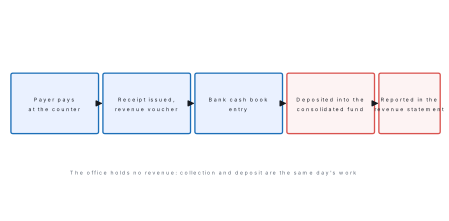
Why the revenue must go to the bank at once. A government office is not allowed to hold its collection as cash and spend out of it. Two things would go wrong if it were. First, expenditure would escape the budget, because the office would be spending money that no appropriation had authorised. Second, money would lie idle and unaccounted in thousands of drawers. So the rule is simple and absolute: collect, deposit the same day into the government account in the bank, and record it in the bank cash book. The only cash an office may hold is the petty cash expressly allowed to it.
9.2 Revenue accounting codes
Every revenue head has a code (सङ्केत) from the uniform chart of accounts, so that a rupee collected as an examination fee in Jhapa and a rupee collected as an examination fee in Kailali land in the same head and can be added together.
Structure. Government revenue is first divided into tax revenue and non-tax revenue, and each is then grouped and sub-grouped.
| Code | Head | What it covers |
|---|---|---|
| 11000 | कर (tax revenue) | The Tax group |
| 11111 | एकलौटी फर्म तथा व्यक्तिगत आयमा लाग्ने कर | Income tax on sole proprietorships and individuals |
| 13000 / 14000 / 15000 | गैरकर राजस्व (non-tax revenue) | The non-tax groups |
| 14151 | सरकारी सम्पत्तिको बहाल तथा अन्य आय | Rent of government property and other income |
| 14212 | सरकारी सम्पत्तिको बिक्रीबाट प्राप्त रकम | Receipts from the sale of government property |
| 14213 | अन्य बिक्रीबाट प्राप्त रकम | Receipts from other sales |
| 14216 | निजी धाराबापतको शुल्क | Fee for private use of a water source |
| 14221 | न्यायिक दस्तुर | Judicial fee |
| 14222 | हुलाक सेवा शुल्क | Postal service charge |
| 14223 | शिक्षा क्षेत्रको आम्दानी | Income from the education sector |
| 14224 | परीक्षा शुल्क | Examination fee |
| 14227 | राहदानी शुल्क | Passport fee |
| 14251 | कम्पनी रजिस्ट्रेसन दस्तुर | Company registration fee |
| 14252 | एजेन्सी रजिस्ट्रेसन दस्तुर | Agency registration fee |
| 14311 | न्यायिक दण्ड | Judicial fine |
The pattern is worth noticing: the first digit group tells you whether the money is tax or non-tax, the next digits the department or sector, and the last digits the individual head. A wrongly coded receipt is as bad as an unrecorded one, because the department's revenue statement will be wrong.
9.3 Formats used in revenue accounting
| Format | Used for |
|---|---|
| Receipt (रसिद) | Issued to the payer the moment money is received; pre-numbered and accounted for leaf by leaf |
| आम्दानी भौचर (revenue voucher) | Recording the revenue in the accounts, naming the head, the payer, the amount and the evidence |
| Bank deposit slip (बैंक दाखिला फाराम) | The paying-in slip by which the money reaches the government account in the bank |
| Bank cash book (म.ले.प.फा.नं. २०९) | The office's record of the money received and deposited, month by month |
| Revenue statement (राजस्वको फाँटबारी) | The monthly return sent to the Treasury and Comptroller Office |
| Receipt and issue register | The register in which the pre-numbered receipt books are issued to staff and returned |
The rule on formats is the same as everywhere in government accounting: only the prescribed form may be used, and every entry must name the head, the payer and the evidence.
9.4 Banking arrangement of revenue accounting
All government revenue is deposited into the consolidated fund through the government's banking arrangement with the Nepal Rastra Bank and the commercial banks.
- Every office has a designated bank account — under the single account fund, one account for its transactions.
- Revenue is deposited the same day it is collected. If the bank is closed or the office is far away, the deposit is made on the first working day and the reason is recorded.
- No revenue may be spent directly. The office may not pay an expense out of the revenue it has collected; revenue and expenditure run through separate records and separate appropriations.
- Cheques are not accepted for government revenue without the prescribed authority; the ordinary mode is cash or a direct transfer into the government account.
- The bank reconciliation is prepared every month so that the office's bank cash book and the passbook agree.
- The Treasury and Comptroller Office watches the deposits made by every office against the collections reported.
9.5 Reporting arrangement of revenue accounting
Revenue is reported upwards on a fixed timetable, and each report has its own form.
- Daily. The revenue collected is entered in the bank cash book the same day, and the receipt book's counterfoils are checked against the cash received.
- Monthly. The office prepares the revenue statement (राजस्वको फाँटबारी) for the month and sends it to the Treasury and Comptroller Office, together with the bank statement and the bank reconciliation.
- Quarterly. The Treasury and Comptroller Office and the ministry review the collection against the estimate and report any shortfall.
- Annually. The Financial Comptroller General Office consolidates every office's revenue into the government's annual financial statement, which is audited by the Office of the Auditor General and laid before Parliament.
The point of all the reporting is the same: by the time the money is a month old, three different offices know exactly how much was collected, under which head, and where it is.
9.6 Preparation of the revenue statement (फाँटबारी)
The revenue statement is the monthly return that shows, head by head, how much revenue the office has collected and how much of it has reached the consolidated fund.
The columns. The prescribed form carries the head code and description, the revenue collected up to the month, the amount deposited into the consolidated fund, and a column for the cash position — the balance of cash held and the amounts collected in earlier years but deposited late. The vertical check is the important one:
If that does not hold, revenue is lying somewhere — with a clerk, in a drawer, or in a receipt book whose counterfoil has not been accounted for.
Problem. During the month of Mangsir a District Education Office collected the following revenue. Prepare the revenue statement and show the amount to be deposited into the consolidated fund. It had no opening cash balance.
| Head | Description | Amount collected (Rs.) |
|---|---|---|
| 14223 | Income from the education sector | 4,42,600 |
| 14224 | Examination fee | 1,75,500 |
| 14227 | Passport fee | 60,000 |
| 14151 | Rent of government property | 2,38,800 |
Of the examination fee, Rs. 35,100 had not yet been deposited into the bank at the end of the month.
Solution. Step 1 — Add the collection: 4{,}42{,}600 + 1{,}75{,}500 + 60{,}000 + 2{,}38{,}800 = Rs.\ 9{,}16{,}900. Step 2 — The undeposited amount is Rs. 35,100, so the deposit made in the month is 9{,}16{,}900 - 35{,}100 = Rs.\ 8{,}81{,}800. Step 3 — Check: collected = deposited + cash in hand → 9{,}16{,}900 = 8{,}81{,}800 + 35{,}100. ✔ Step 4 — Write the statement head by head.
Revenue statement for the month of Mangsir
| Head code | Description | Revenue collected (Rs.) | Deposited into the consolidated fund (Rs.) | Cash in hand (Rs.) |
|---|---|---|---|---|
| 14151 | Rent of government property and other income | 2,38,800 | 2,38,800 | — |
| 14223 | Income from the education sector | 4,42,600 | 4,42,600 | — |
| 14224 | Examination fee | 1,75,500 | 1,40,400 | 35,100 |
| 14227 | Passport fee | 60,000 | 60,000 | — |
| Total | 9,16,900 | 8,81,800 | 35,100 |
Answer. Total revenue collected Rs. 9,16,900; to be deposited Rs. 8,81,800 in the month; Rs. 35,100 still to be deposited on the first working day of the next month. What it means. The last column is the whole purpose of the statement. A revenue statement with a cash-in-hand figure that is not explained is the first thing an auditor looks at.
Problem. Choose the correct revenue code for each of the following: (a) a fee charged to a private company for drawing water from a government spring; (b) the fee paid by a company when it is registered; (c) the rent received for a government building let to a bank; (d) a fine imposed by a court; (e) the fee paid by a candidate sitting an examination.
Solution. Step 1 — (a) Private use of a water source → 14216 निजी धाराबापतको शुल्क. Step 2 — (b) Registration of a company → 14251 कम्पनी रजिस्ट्रेसन दस्तुर. Step 3 — (c) Rent of government property → 14151 सरकारी सम्पत्तिको बहाल तथा अन्य आय. Step 4 — (d) A court fine → 14311 न्यायिक दण्ड. Step 5 — (e) An examination fee → 14224 परीक्षा शुल्क.
Answer. (a) 14216, (b) 14251, (c) 14151, (d) 14311, (e) 14224. What it means. Every one of these is non-tax revenue — money the government earns from a service, a property or a penalty, not a compulsory contribution. That is why none of them falls under the 11000 tax group.
Problem. An office collects Rs. 2,00,000 of revenue in a month. Its electricity bill for the month is Rs. 18,000. The head clerk proposes to pay the bill out of the money collected, "so that the office does not have to ask for a release". Say whether this is allowed, and what should be done instead.
Solution. Step 1 — State the rule. All revenue must be deposited into the consolidated fund; money may be spent only under an appropriation made by law, through a payment order and a budget release. Step 2 — Applying the rule, the proposal is not allowed. Paying an expense out of collected revenue would create expenditure outside the budget, and the Auditor General would report it as an irregular payment. Step 3 — What should be done: deposit the whole Rs. 2,00,000 into the government account the same day, record it in the bank cash book and the revenue statement, and pay the electricity bill in the normal way — by issuing a payment order against the budget head for electricity, and entering the payment in the bank cash book when the release is received.
Answer. Not allowed. Deposit the revenue in full and pay the bill through the appropriation and the bank cash book. What it means. The separation of revenue and expenditure is the whole foundation of legislative control. Once an office may spend what it collects, the budget has stopped being a law.
"Non-tax revenue is not really revenue, so it may be kept for office expenses" is wrong. Non-tax revenue is government revenue: it must be receipted, coded, deposited into the consolidated fund and reported exactly like a tax. An office that treats a service fee as its own money has committed a serious irregularity.
Chapter summary
- Revenue accounting records the collection of government revenue, its deposit into the consolidated fund through the bank, and its reporting to the Treasury and Comptroller Office and the FCGO.
- Its objectives are to record every rupee with evidence, to deposit the whole collection into the consolidated fund, to compare collection with the estimate, to detect leakage, to supply the annual financial statement and to keep the account public.
- Revenue must be deposited the same day. A government office may not hold its collection as cash and may not spend out of it; expenditure requires a separate appropriation.
- Every revenue head carries a code in the uniform chart of accounts: 11000 is the tax group (for example 11111 income tax on sole proprietorships and individuals); 13000, 14000 and 15000 are the non-tax groups (for example 14224 examination fee, 14227 passport fee, 14251 company registration fee, 14221 judicial fee, 14151 rent of government property, 14311 judicial fine).
- The formats are the pre-numbered receipt, the आम्दानी भौचर (revenue voucher), the bank deposit slip, the bank cash book (No. 209), the revenue statement and the receipt-and-issue register.
- Under the banking arrangement each office has one designated bank account, deposits revenue the same day, never pays an expense from it, reconciles the bank every month, and is watched by the Treasury and Comptroller Office.
- Reporting is daily (bank cash book), monthly (the revenue statement with the bank reconciliation), quarterly (review against the estimate) and annual (consolidation into the government's financial statement and audit by the Auditor General).
- The revenue statement (फाँटबारी) shows head by head the revenue collected, the amount deposited into the consolidated fund and the cash still in hand, and must satisfy revenue collected = amount deposited + cash in hand.
Practice questions
Group A — Very short answer (1 mark each)
- What is revenue accounting? [1]
- Why must revenue be deposited into the bank on the same day? [1]
- What is a revenue statement? [1]
- Write the code for examination fee. [1]
- Write any two examples of non-tax revenue with their codes. [1]
- What is a revenue voucher? [1]
- To which office is the monthly revenue statement sent? [1]
- Where is the revenue of a government office deposited? [1]
- May a government office pay its electricity bill out of the revenue it has collected? [1]
- Write the formula for checking a revenue statement. [1]
- Write any two objectives of revenue accounting. [1]
Answers to Group A
1. Revenue accounting is the branch of government accounting that records the collection of government revenue, its deposit into the consolidated fund through the bank and its reporting to the higher offices.
2. Because revenue must be accounted for and must reach the consolidated fund, and because an office that holds the collection as cash could spend it outside the budget. Revenue and expenditure must never be mixed.
3. The revenue statement (राजस्वको फाँटबारी) is the monthly return showing, head by head, the revenue collected, the amount deposited into the consolidated fund and the cash still in hand.
4. 14224.
5. Any two of: 14227 passport fee, 14251 company registration fee, 14151 rent of government property, 14221 judicial fee, 14311 judicial fine.
6. The आम्दानी भौचर, the voucher by which revenue is recorded in the accounts, naming the head, the payer, the amount and the evidence.
7. The Treasury and Comptroller Office (कोष तथा लेखा नियन्त्रक कार्यालय).
8. Into the consolidated fund, through the office's designated bank account.
9. No. All revenue must be deposited into the consolidated fund and the bill must be paid under an appropriation, through a payment order and the bank cash book.
10. Revenue collected = amount deposited into the consolidated fund + cash still in hand.
11. Any two of: to record every rupee with evidence; to ensure deposit into the consolidated fund; to compare collection with the estimate; to detect leakage; to supply the annual financial statement; to keep the account public.
Group B — Short answer (5 marks each)
- What is revenue accounting? Explain its objectives. [5]
- Explain the banking arrangement of revenue accounting in Nepal. [5]
- Explain the formats used in revenue accounting. [5]
- Write in brief about the revenue codes used in Nepal's government accounting, with examples. [5]
- A District Health Office collected the following revenue in the month of Falgun: 14213 other sales Rs. 41,000; 14223 income from the education sector Rs. 44,26,600; 14224 examination fee Rs. 1,75,500 of which Rs. 35,100 was not deposited; 14151 rent of government property Rs. 2,38,800. Prepare the revenue statement. [5]
Answers to Group B
1. Definition as in Group A answer 1. Objectives: to record every rupee with evidence; to deposit the whole collection into the consolidated fund; to compare collection head by head with the estimate; to detect leakage such as an unaccounted receipt book; to provide the figures for the government's annual financial statement and for the audit; to keep the revenue account public.
2. Each office has a designated bank account under the single account fund; all revenue is deposited into the consolidated fund through the Nepal Rastra Bank or a commercial bank; the deposit is made the same day the revenue is collected, or on the first working day with the reason recorded; the office may not pay any expense out of its collection; the bank reconciliation is prepared every month; and the Treasury and Comptroller Office watches every office's deposits against its reported collection.
3. Pre-numbered receipt issued to the payer; the आम्दानी भौचर (revenue voucher) recording the head, payer, amount and evidence; the bank deposit slip; the bank cash book (No. 209); the monthly revenue statement; and the receipt-and-issue register in which the pre-numbered receipt books are issued and returned. Only the prescribed forms may be used.
4. Revenue heads are coded in the uniform chart of accounts, and the code is the same in every district. The tax group is 11000 (11111 income tax on sole proprietorships and individuals). Non-tax revenue falls in 13000, 14000 and 15000 (14151 rent of government property, 14213 receipts from other sales, 14221 judicial fee, 14223 income from the education sector, 14224 examination fee, 14227 passport fee, 14251 company registration fee, 14252 agency registration fee, 14311 judicial fine). The early digits identify the group and the department, the later digits the individual head.
5.
| Head code | Description | Revenue collected (Rs.) | Deposited (Rs.) | Cash in hand (Rs.) |
|---|---|---|---|---|
| 14151 | Rent of government property and other income | 2,38,800 | 2,38,800 | — |
| 14213 | Receipts from other sales | 41,000 | 41,000 | — |
| 14223 | Income from the education sector | 44,26,600 | 44,26,600 | — |
| 14224 | Examination fee | 1,75,500 | 1,40,400 | 35,100 |
| Total | 48,81,900 | 48,46,800 | 35,100 |
Check: 48{,}81{,}900 = 48{,}46{,}800 + 35{,}100. ✔
Group C — Long answer (8 marks each)
- What is revenue accounting? Explain the banking arrangement and the reporting arrangement of revenue accounting in Nepal. [8]
- What is a revenue statement? A District Administration Office collected the following revenue up to the month of Poush: 14151 rent of government property Rs. 2,38,800; 14213 other sales Rs. 41,000; 14223 education sector income Rs. 44,26,600; 14224 examination fee Rs. 1,75,500; 14227 passport fee Rs. 60,000. Of the examination fee Rs. 35,100 and of the passport fee Rs. 12,000 had not been deposited. Prepare the revenue statement and show how you verify it. [8]
Answers to Group C
1. Definition (2). As in Group A answer 1, with the point that revenue accounting is one of the areas of government accounting, alongside expenditure, store, fund and deposit accounting. Banking arrangement (3). Designated bank account under the single account fund; all revenue deposited into the consolidated fund through the Nepal Rastra Bank or a commercial bank; deposit on the same day of collection, or on the first working day with the reason recorded; no expense may be paid out of the collection; monthly bank reconciliation; supervision by the Treasury and Comptroller Office. Reporting arrangement (3). Daily entry in the bank cash book and checking of receipt counterfoils; the monthly revenue statement with the bank statement and reconciliation to the Treasury and Comptroller Office; quarterly review of collection against the estimate by the ministry and the Treasury Office; annual consolidation by the FCGO into the government's financial statement, audit by the Office of the Auditor General and laying before Parliament.
2. Definition (1). The revenue statement is the prescribed monthly return showing head by head the revenue collected, the amount deposited into the consolidated fund and the cash balance in hand; its purpose is to prove that every rupee collected either reached the fund or is still held and accounted for. Preparation (5).
| Head code | Description | Revenue collected (Rs.) | Deposited (Rs.) | Cash in hand (Rs.) |
|---|---|---|---|---|
| 14151 | Rent of government property and other income | 2,38,800 | 2,38,800 | — |
| 14213 | Receipts from other sales | 41,000 | 41,000 | — |
| 14223 | Income from the education sector | 44,26,600 | 44,26,600 | — |
| 14224 | Examination fee | 1,75,500 | 1,40,400 | 35,100 |
| 14227 | Passport fee | 60,000 | 48,000 | 12,000 |
| Total | 49,41,900 | 48,94,800 | 47,100 |
Verification (2). Revenue collected = 49{,}41{,}900; deposited + cash in hand = 48{,}94{,}800 + 47{,}100 = 49{,}41{,}900. They agree, so the statement is complete; the Rs. 47,100 in hand must be deposited on the first working day of the next month and the fact recorded in the statement.
Practise more: Accountancy question bank