Unit 12 · Fund and Retention Accounting · 8 teaching hours · 24 min read
Fund Accounting and Retention Account (कोष लेखाङ्कन र धरौटी लेखा)
What the syllabus asks for 9
- Fund (कोष): concept and practice
- Fund accounting: introduction and need
- Consolidated fund (सञ्चित कोष): introduction, need and use
- Operation of the consolidated fund
- Divisible fund and revenue sharing (विभाज्य कोष र राजस्व बाँडफाँट)
- Importance of revenue sharing
- Fund accounting methods and formats used
- Retention accounting (धरौटी लेखाविधि) and the formats used
- Personal retention, goods retention and the retention bank cash book
Not all the money a government holds is its own to spend. Some of it is held for a purpose fixed by law — a bridge that will be built in three years, an emergency that has not happened yet, a province's share of the national tax — and some of it is not the government's money at all but the contractor's, the employee's or the supplier's, held back until a condition is met. Fund accounting keeps the first kind in its place, and retention accounting keeps the second. This unit explains what a fund is, why government accounting is organised by funds, the consolidated fund and how it operates, the divisible fund and revenue sharing, and finally retention — how it arises, how it is recorded and when it is released.
Group A asks: "What is a fund?", "What is retention?", "What is a divisible fund?", "Show the retention journal voucher at the time the retention money is received." Group B asks about the consolidated fund and its operation, the importance of revenue sharing, or retention accounting. Learn the retention voucher entries both ways — when the money is withheld as a deduction from the contractor's bill, and when it is released or forfeited.
12.1 Fund: concept and practice
A fund (कोष) is a separate pool of money set aside for a specified purpose, kept and accounted for separately from other money, so that the money can be used only for that purpose and its use can be seen on its own.
The idea is old and simple. Imagine a household that keeps a separate tin for the daughter's school fees, another for the house repair, and another for emergencies. Money is earmarked, and the tin is opened only for its own purpose. Governments do exactly the same, and for two further reasons:
- Legal control. The legislature wants to see, fund by fund, where the money came from and where it went. Mixing everything into one account would hide it.
- Purpose protection. Money collected for one purpose must not be spent on another. A retention deposit is the contractor's money; a provident fund deduction is the employee's money; a province's share of VAT is the province's money.
Practice in Nepal. Government accounting is organised by funds. The main funds are:
| Fund | What it is |
|---|---|
| Consolidated fund (सञ्चित कोष) | The main fund of the federation, the province or the local level, into which all revenue is paid and from which expenditure is met only under an appropriation |
| Contingency fund (आकस्मिक कोष) | A fund placed at the disposal of the head of government to meet an unforeseen expenditure between sessions of the legislature; the amount is later regularised by an appropriation |
| Divisible fund (विभाज्य कोष / राजस्व बाँडफाँट) | The pool of federal revenue that is shared with the provinces and local levels under the constitution |
| Retention and deposit fund (धरौटी कोष) | Money held on behalf of others — retention from contractors, provident fund, income tax deducted at source — and returned or paid over when the condition is met |
| Reserve and other special funds | Funds created by law for a special purpose, such as a local infrastructure fund or a fund for a specific project |
12.2 Fund accounting: introduction and need
Fund accounting (कोष लेखाङ्कन) is the system of keeping a separate account — a separate set of books, a separate bank account and a separate statement — for each fund, so that the receipts and payments of each fund are recorded and reported on their own.
Need for fund accounting.
- To obey the law. Each fund is created and governed by a law; the law requires the money to be accounted for separately.
- To prevent the wrong use of money. Expenditure from the consolidated fund needs an appropriation; a retention deposit must be returned to the contractor even if the office is short of budget.
- To make control possible. The legislature, the auditor and the ministry of finance see each fund on its own, instead of one undivided heap of cash.
- To keep trust money out of revenue. Retention, provident fund and tax deducted are liabilities, not income, and fund accounting keeps them out of the revenue figures.
- To plan. A fund earmarked for a project shows how much has accumulated and how much is still needed.
12.3 Consolidated fund and its operation
The consolidated fund (सञ्चित कोष) is the government's main fund. Under the Constitution of Nepal, all revenue received by the federation — taxes, fees, loans and grants — must be paid into the consolidated fund, and no money may be spent out of it except under an appropriation made by law.
Provisions for its operation.
- All receipts go in. Every government receipt must be credited to the consolidated fund; no office may keep a receipt outside it.
- No payment without appropriation. Money may be withdrawn only under an appropriation act passed by the legislature (the federal Parliament, the provincial assembly or the local assembly).
- Purpose only. The money may be spent only for the purpose for which the appropriation was made.
- Emergency expenditure. An unforeseen expenditure needed while the legislature is not in session is met from the contingency fund, and the amount is later regularised by an appropriation.
- Custody and management. The fund is managed by the Ministry of Finance and accounted for by the Financial Comptroller General Office; the money is kept with the Nepal Rastra Bank and other banks.
- Reporting and audit. The annual financial statement of the fund is laid before the legislature and audited by the Office of the Auditor General.
- Authority to draw. Only the officer authorised by the rules may draw from the fund, and only within the release he has received.
12.4 Divisible fund and revenue sharing
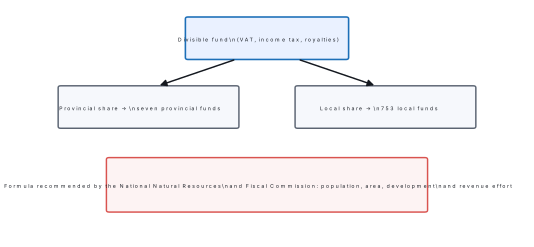
Some taxes are collected by the federation but belong, in part, to the provinces and the local levels. The money that is shared is called the divisible fund (विभाज्य कोष), and the process of distributing it is revenue sharing (राजस्व बाँडफाँट).
How it works in Nepal.
- The federation collects the taxes that are to be shared — principally value added tax, income tax, royalties and some registration fees.
- The National Natural Resources and Fiscal Commission recommends what share of this divisible fund should go to the provinces and what share to the local levels, and on what basis it should be divided among them.
- The amount is divided between the provinces and the local levels according to the recommended shares.
- The provincial share is then divided among the provinces and the local share among the local levels, using a formula that considers population, the area, the level of development, the revenue effort and other indicators.
- Each recipient credits what it receives to its own consolidated fund and uses it under its own appropriation.
Importance of revenue sharing.
- It gives the provinces and the local levels the money to do work that the constitution assigns to them, although the big taxes are collected by the federation.
- It reduces inequality: a formula that gives more to the poorer districts narrows the gap between the rich and the poor parts of the country.
- It strengthens federalism, because a province that has its own money can act on its own.
- It links revenue effort to reward: a local level that collects its own taxes properly is credited for doing so.
- It keeps the country's tax system uniform, because the taxes are collected once, federally, and then shared, instead of each province inventing its own.
12.5 Fund accounting methods and formats
Methods. Government funds are accounted for by the double-entry method, with each fund having its own ledger accounts, its own bank account and its own statement, and by the single account fund arrangement under which an office runs all its transactions through one bank account while still recording them fund by fund.
Formats. Each fund has its own forms:
| Format | Used for |
|---|---|
| Voucher (भौचर) | Every entry, naming the fund, the head and the party |
| Fund ledger (कोष खाता) | The account of the fund, showing receipts, payments and balance |
| Bank cash book (म.ले.प.फा.नं. २०९) | An office's cash and bank record, in which the fund of each receipt is shown |
| Deposit and retention ledger | Money held on behalf of others, party by party |
| Fund statement (फाँटबारी) | The periodic statement of the fund's position, sent to the higher office |
The rule is the same as everywhere: an entry that does not say which fund it belongs to is incomplete.
12.6 Retention accounting and formats
Retention (धरौटी) is money that a government office withholds from a payment due to a supplier, a contractor or an employee, and holds until a stated condition is satisfied.
The commonest case is a works contract. A contractor who builds a road is paid on running bills as the work proceeds, but the office withholds a part of each bill — usually five per cent — as security. If a defect appears during the defect liability period, the cost of repairing it is taken from the retention money; if no defect appears, the retention is released to the contractor at the end of the period. The retention is therefore not government revenue and not an expenditure; it is a liability of the office to the contractor.
Three kinds of retention.
- Goods retention (जिन्सी धरौटी) — money withheld on the purchase of goods until the goods are supplied and accepted.
- Works retention (निर्माण/कार्य धरौटी) — money withheld from a construction bill until the end of the defect liability period.
- Personal retention (व्यक्तिगत धरौटी) — money held on behalf of a person: provident fund, income tax deducted at source, citizen investment trust, an employee's security deposit.
Formats. The धरौटी भौचर records the deduction; the धरौटी खाता (retention ledger) carries one account per contractor or person, showing what was deducted, what was released and what was forfeited; the व्यक्तिगत धरौटी खाता and the गोश्वारा धरौटी खाता separate the personal accounts from the general account; and the retention money is kept in a separate धरौटीको बैंक नगदी किताब so that the office always knows what it is holding for others. Money that has remained unclaimed for the prescribed period is forfeited and credited to government revenue.
Problem. A contractor's running bill for a road contract is Rs. 4,00,000. The office withholds retention at 5 per cent. Show the journal voucher (a) when the bill is passed and the retention is deducted, and (b) when the retention is released after the defect liability period, and (c) when the retention is forfeited because the contractor failed to remedy a defect costing Rs. 12,000.
Solution. Step 1 — Retention = 5\% \times 4{,}00{,}000 = Rs.\ 20{,}000; the contractor is paid 4{,}00{,}000 - 20{,}000 = Rs.\ 3{,}80{,}000. Step 2 — (a) The whole bill is expenditure; part of it is paid and part is held. Road construction expenditure A/c Dr. 4,00,000 To Contractors' retention A/c 20,000 To Bank / DTCO A/c 3,80,000 (Being the running bill of the contractor passed, retention of 5 per cent withheld and the balance paid.) Step 3 — (b) No defect appeared, so the money is the contractor's and is paid to him. Contractors' retention A/c Dr. 20,000 To Bank A/c 20,000 (Being the retention money released to the contractor on the expiry of the defect liability period.) Step 4 — (c) A defect costing Rs. 12,000 was not remedied; the office will get the work done at the contractor's cost and the balance is forfeited to the government. Contractors' retention A/c Dr. 20,000 To Repair and maintenance expenditure A/c 12,000 To Miscellaneous revenue A/c 8,000 (Being the retention money adjusted against the cost of remedying the defect and the balance forfeited to government revenue.)
Answer. Retention Rs. 20,000 in each case; the net paid on the bill Rs. 3,80,000; on forfeiture Rs. 12,000 is set against the repair expenditure and Rs. 8,000 becomes revenue. What it means. Until the retention is released or forfeited, it is a liability, not revenue. An office that treats retention as income overstates its revenue for the year and will be short when the contractor is finally paid.
Problem. The salary bill of a section is Rs. 2,20,000. The office deducts provident fund Rs. 20,000 and income tax Rs. 2,000 and pays the net. A week later it deposits the deductions into the concerned office. Show the journal vouchers and state what kind of retention each deduction is.
Solution. Step 1 — The whole salary is expenditure; only the net leaves the bank. Remuneration expenditure A/c Dr. 2,20,000 To Provident fund payable (personal retention) A/c 20,000 To Income tax payable (personal retention) A/c 2,000 To Bank / DTCO A/c 1,98,000 (Being the salary of the month passed after the prescribed deductions.) Step 2 — The deductions belong to the employees and to the tax authority, so the office merely holds and then pays them over. Provident fund payable A/c Dr. 20,000 Income tax payable A/c Dr. 2,000 To Bank A/c 22,000 (Being the amount deducted from salary deposited into the concerned office.)
Answer. Both deductions are personal retention — money held on behalf of a person. Net paid Rs. 1,98,000; Rs. 22,000 deposited a week later. What it means. The office was never entitled to that Rs. 22,000. It is the employee's money in the provident fund account and the state's money in the tax account, and the office is only a custodian.
Problem. The divisible fund for a year is Rs. 1,20,000 crore. The recommended shares are 30 per cent to the provinces and 25 per cent to the local levels, the remainder staying with the federation. A province receives its share according to a formula in which population has a weight of 50 per cent, area 25 per cent and development 25 per cent. Province A has 20 per cent of the national population, 15 per cent of the area and ranks as a less developed province with a development indicator of 30 per cent. Compute (a) the total provincial share, (b) the total local share and (c) Province A's entitlement as a percentage of the provincial share.
Solution. Step 1 — Provincial share = 30\% imes 1{,}20{,}000 = Rs.\ 36{,}000 crore. Step 2 — Local share = 25\% imes 1{,}20{,}000 = Rs.\ 30{,}000 crore. Step 3 — Province A's weighted index = (50\% imes 20\%) + (25\% imes 15\%) + (25\% imes 30\%) = 10\% + 3.75\% + 7.5\%. Step 4 — Weighted index = 21.25 per cent of the total weight, which after normalising across all provinces gives its share of the provincial pool.
Answer. (a) Rs. 36,000 crore to the provinces, (b) Rs. 30,000 crore to the local levels, (c) Province A's weighted entitlement works out to an index of 21.25 per cent before normalisation. What it means. The formula is the political heart of federal revenue sharing: give population the largest weight and a big province gains; raise the weight on area and development and a remote, backward province gains. That is why the weights are recommended by an independent commission rather than fixed by the government of the day.
The classic error is to credit the whole bill to the contractor's account and forget the retention, or to treat retention as revenue. Both are wrong. The second is worse: the office will spend money that belongs to a contractor who will come back for it, and the shortage will appear in the next year's accounts.
Chapter summary
- A fund (कोष) is a separate pool of money set aside for a specified purpose, kept and accounted for separately so that it can be used only for that purpose. Governments keep funds for legal control and to protect the purpose of the money.
- In Nepal the main funds are the consolidated fund, the contingency fund, the divisible fund, the retention and deposit fund and other funds created by law.
- Fund accounting keeps a separate account, bank account and statement for each fund. It is needed to obey the law, to prevent the wrong use of money, to make control possible, to keep trust money out of revenue and to plan.
- The consolidated fund is the government's main fund: all revenue is paid into it and nothing may be spent from it except under an appropriation made by law. It is managed by the Ministry of Finance, accounted for by the FCGO, and reported to the legislature and audited by the Auditor General. Unforeseen expenditure is met from the contingency fund and later regularised.
- The divisible fund is the pool of federal revenue shared with the provinces and local levels. The National Natural Resources and Fiscal Commission recommends the shares and the formula; each recipient credits its share to its own consolidated fund.
- Revenue sharing gives the lower tiers the money to do their constitutional work, reduces inequality between regions, strengthens federalism, rewards local revenue effort and keeps the tax system uniform.
- Retention (धरौटी) is money withheld from a payment and held until a condition is met. It is a liability, never revenue.
- Its three kinds are goods retention, works retention and personal retention (provident fund, income tax deducted, citizen investment trust).
- Its formats are the धरौटी भौचर, the धरौटी खाता (retention ledger, one account per party), the personal and general retention ledgers and the retention bank cash book. Unclaimed money is forfeited to government revenue after the prescribed period.
Practice questions
Group A — Very short answer (1 mark each)
- What is a fund? [1]
- What is fund accounting? [1]
- What is the consolidated fund? [1]
- What is the contingency fund used for? [1]
- What is the divisible fund? [1]
- Which body recommends the shares of the divisible fund? [1]
- What is retention? [1]
- Write any two kinds of retention. [1]
- Show the retention journal voucher at the time the retention money is received (deducted). [1]
- Is retention revenue? [1]
- Write the name of the book in which retention held for others is kept. [1]
Answers to Group A
1. A fund is a separate pool of money set aside for a specified purpose and accounted for separately from other money.
2. Fund accounting is the system of keeping a separate account, bank account and statement for each fund so that its receipts and payments are recorded and reported on their own.
3. The consolidated fund is the government's main fund, into which all government revenue must be paid and from which nothing may be spent except under an appropriation made by law.
4. To meet unforeseen expenditure, usually while the legislature is not in session; the amount is later regularised by an appropriation.
5. The pool of federal revenue (principally VAT, income tax and royalties) that is shared with the provinces and the local levels.
6. The National Natural Resources and Fiscal Commission.
7. Retention is money withheld from a payment due to a contractor, supplier or employee and held until a stated condition is satisfied.
8. Any two of: goods retention, works (construction) retention, personal retention.
9. Construction or supplies expenditure A/c Dr. (full bill); To Contractors' retention A/c (the amount withheld); To Bank/DTCO A/c (the net paid).
10. No. Retention is a liability of the office to the party from whom it was withheld.
11. The retention ledger (धरौटी खाता), supported by the retention bank cash book.
Group B — Short answer (5 marks each)
- What is a fund? Explain the need for fund accounting in government. [5]
- What is the consolidated fund? Explain the provisions for its operation. [5]
- What is revenue sharing? Explain its importance in a federal Nepal. [5]
- What is retention accounting? Explain the three kinds of retention and the formats used. [5]
- A contractor's bill of Rs. 5,00,000 is passed and retention of 5 per cent is withheld. After the defect liability period the retention is released. Show the journal vouchers. [5]
Answers to Group B
1. Definition as in Group A answer 1. Need: to obey the law that creates each fund; to prevent the money of one fund being used for another purpose; to make control by the legislature and the auditor possible; to keep trust money such as retention and provident fund out of revenue; and to plan a project fund by showing what has accumulated and what is still needed. Give the example of a retention deposit that must be returned to the contractor even when the office has no budget left.
2. Definition as in Group A answer 3. Provisions: all government receipts must be credited to it; no payment without an appropriation act; expenditure only for the approved purpose; unforeseen expenditure met from the contingency fund and later regularised; managed by the Ministry of Finance and accounted for by the FCGO, the money kept with the Nepal Rastra Bank and other banks; annual financial statement laid before the legislature and audited by the Office of the Auditor General; only the authorised officer may draw, and only within the release received.
3. Revenue sharing is the distribution of the divisible fund — the federal taxes that are to be shared — between the provinces and the local levels, on the recommendation of the National Natural Resources and Fiscal Commission and under a formula based on population, area, development and revenue effort. Importance: it gives the lower tiers the money to do their constitutional work although the major taxes are collected federally; it reduces inequality between developed and backward regions; it strengthens federalism by giving the provinces and local levels their own resources; it rewards local revenue effort; and it keeps the tax system uniform across the country.
4. Retention accounting is the branch that records money withheld from a payment and held until a condition is met, and its later release, adjustment or forfeiture. Kinds: goods retention — withheld on the purchase of goods until supply and acceptance; works retention — withheld from a construction bill until the end of the defect liability period; personal retention — held on behalf of a person, such as provident fund, income tax deducted at source and the citizen investment trust. Formats: the धरौटी भौचर for the deduction, the धरौटी खाता (retention ledger) with one account per party, the personal and general retention ledgers, and the retention bank cash book.
5. Retention = 5\% \times 5{,}00{,}000 = Rs.\ 25{,}000; net paid = Rs.\ 4{,}75{,}000. When the bill is passed: Construction expenditure A/c Dr. 5,00,000 To Contractors' retention A/c 25,000 To Bank / DTCO A/c 4,75,000 (Being the running bill passed and retention of 5 per cent withheld.) When the retention is released: Contractors' retention A/c Dr. 25,000 To Bank A/c 25,000 (Being the retention money released to the contractor on the expiry of the defect liability period.)
Group C — Long answer (8 marks each)
- Introduce the fund accounting system of Nepal. Explain the consolidated fund, the provisions for its operation and the divisible fund with revenue sharing. [8]
- What is retention accounting? Explain the three kinds of retention and, with journal vouchers, show how retention is recorded when it is withheld on a contractor's bill, when it is released, and when it is forfeited after a defect is not remedied. [8]
Answers to Group C
1. Introduction (2). A fund is a separate pool of money for a specified purpose. Nepal's government accounting is fund based: the consolidated fund, the contingency fund, the divisible fund, the retention and deposit fund and other funds created by law. Each fund has its own account, bank account, formats and statement, because the legislature must see each separately and because money collected for one purpose must not be spent on another. Consolidated fund and its operation (3). All revenue paid in; no payment without an appropriation act; expenditure only for the approved purpose; contingency fund for unforeseen expenditure, later regularised; managed by the Ministry of Finance, accounted for by the FCGO, money kept with the Nepal Rastra Bank; reported to the legislature and audited by the Auditor General; drawn only by the authorised officer within the release. Divisible fund and revenue sharing (3). The divisible fund is the pool of federal revenue — principally VAT, income tax and royalties — that is shared with the provinces and local levels. The National Natural Resources and Fiscal Commission recommends the shares and the formula (population, area, development, revenue effort). Each recipient credits its share to its own consolidated fund. Importance: money for the lower tiers' constitutional duties; reduction of regional inequality; strengthening of federalism; reward for local revenue effort; a uniform tax system.
2. Definition and nature (2). Retention is money withheld from a payment due to a contractor, supplier or employee and held until a condition is satisfied; it is a liability, not revenue and not an expenditure. Kinds (2). Goods retention, works retention and personal retention (provident fund, income tax deducted, citizen investment trust), each explained in a sentence. Formats (1). धरौटी भौचर, धरौटी खाता with one account per party, personal and general retention ledgers, retention bank cash book. Journal vouchers (3). (i) When the bill is passed and retention withheld: expenditure A/c Dr. (full bill); To Contractors' retention A/c (amount withheld); To Bank/DTCO A/c (net paid). (ii) When released: Contractors' retention A/c Dr.; To Bank A/c. (iii) When forfeited after the defect is not remedied: Contractors' retention A/c Dr.; To Repair and maintenance expenditure A/c (cost of remedying); To Miscellaneous revenue A/c (balance forfeited). Show the figures of a worked example, for instance a bill of Rs. 4,00,000 with 5 per cent retention and a defect costing Rs. 12,000.
Practise more: Accountancy question bank