Unit 13 · Control and Audit · 4 teaching hours · 26 min read
Internal Control and Auditing (आन्तरिक नियन्त्रण र लेखा परीक्षण)
What the syllabus asks for 5
- Internal control: introduction, need and use
- Audit: meaning, importance and types
- Internal audit (आन्तरिक लेखा परीक्षण)
- Final audit (अन्तिम लेखा परीक्षण)
- Government audit in Nepal and the Office of the Auditor General
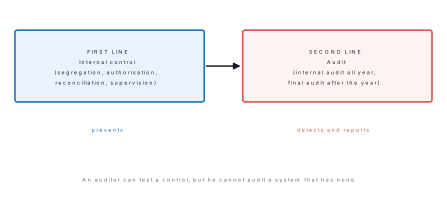
Books can be kept perfectly and still be wrong, if the person keeping them is the person who could gain by writing them wrongly. Two lines of defence exist against that. The first is internal control — the rules an organisation builds into its own work so that no single person can both do a thing and hide it. The second is audit — an independent examination by somebody with no stake in the answer. This unit explains what internal control is and what it must contain, what an audit is and what kinds there are, the difference between an internal audit and a final audit, and how government audit works in Nepal through the Office of the Auditor General.
Group A asks: "What is internal control?", "Write any two objectives of internal control", "What is auditing?", "What is internal audit?", "Which is the apex auditing body in Nepal?". Group B asks for the objectives of internal control, the types of audit, or the difference between internal and final audit. Learn the elements of internal control (segregation of duties, authorisation, documentation, physical control, reconciliation, supervision, rotation, internal audit) as a list of five.
13.1 Internal control: introduction, need and use
Internal control (आन्तरिक नियन्त्रण) is the whole system of policies, procedures, records and checks that an organisation adopts so that its work is carried on accurately, efficiently, lawfully and honestly, and so that its assets are protected from loss.
It is not a person and it is not a form. It is the way the work is organised. If the clerk who writes the receipt is not the clerk who enters it in the register, and neither of them is the clerk who reconciles the bank, the office has internal control — without anybody being called an internal controller.
Objectives of internal control.
- To safeguard the assets of the organisation from loss, theft, misuse and waste.
- To ensure that the records are accurate and complete, so that the accounts show what actually happened.
- To ensure that the work is done efficiently, without duplication and without waste.
- To ensure compliance with the law and with the organisation's own rules — the budget head, the procurement rules, the tax rules.
- To prevent and detect fraud and error early, before they become large.
- To make an audit possible: an auditor can test a control, but he cannot audit a system that has none.
Elements (the tools of internal control).
| Element | What it means in an office |
|---|---|
| Segregation of duties | The person who authorises, the person who pays and the person who records must be three different people |
| Authorisation and approval | Every payment and every entry needs the signature of the officer competent to sanction it |
| Documentation | Every transaction on a pre-numbered, prescribed form, with evidence attached |
| Physical control | A locked store and cash box, restricted access to the record room and the computer system, custody of the assets with named persons |
| Reconciliation | Bank reconciliation every month, the bin card against the store ledger, physical verification of cash and stock |
| Supervision and review | A senior officer checks the work of the junior, and the monthly figures are reviewed |
| Rotation of duties and leave | Staff are transferred and made to take leave, because a fraud usually needs one person to stay in one seat for a long time |
| Internal audit | An independent check inside the organisation, testing whether the controls are actually working |
| Budget and standard costs | Comparing what is spent with what was allowed, and acting on the difference |
Students answer "internal control means the internal auditor checks the accounts". That is only the last element. Internal control is the whole system — the separation of duties, the authorisations, the documents, the physical safeguards, the reconciliations and the supervision — of which the internal audit is only the testing. In a small office with no internal auditor, internal control can still exist, and it often does, because the owner signs every cheque.
13.2 Audit: meaning, importance and types
An audit (लेखा परीक्षण) is an independent examination of the books of account, the records and the supporting documents of an organisation, carried out to enable the auditor to express an opinion on whether the financial statements show a true and fair view of the results and of the financial position.
Notice three words in that definition. Independent — the auditor has no interest in the answer. Examination — he tests evidence, he does not merely read the statements. Opinion — the auditor reports what he has found; he does not guarantee that no fraud exists anywhere.
Importance of audit.
- It gives the owners, the lenders and the government confidence that the accounts can be believed.
- It detects and deters fraud and error, because people are careful about what will be examined.
- It checks compliance with the law — the Companies Act, the tax law, the budget and the procurement rules.
- It points out weaknesses in internal control and advises how to cure them.
- It protects the honest employee, who has written evidence that everything he did was regular.
- In government it is the instrument by which the legislature holds the executive to account for public money.
Types of audit. Audits are classified in several ways.
| Basis | Types |
|---|---|
| Who conducts it | Internal audit — by the organisation's own staff; external (statutory) audit — by an independent auditor appointed from outside |
| When it is done | Continuous audit — throughout the year; interim audit — during the year, for part of the period; final (annual) audit — after the year end, on the completed accounts |
| Scope | Complete audit — all the books; partial audit — a part only; special audit — a particular matter, ordered by the authority |
| Object | Financial (regularity) audit — whether the accounts are true and the rules followed; performance (value-for-money) audit — whether money was spent economically, efficiently and effectively; management audit — whether management's decisions and systems are sound; propriety audit — whether a transaction is proper and above suspicion |
| Nature of the organisation | Commercial audit, government audit, cooperative audit |
13.3 Internal audit
An internal audit (आन्तरिक लेखा परीक्षण) is an audit carried out by employees of the organisation itself, working under the management, to check that the internal control system is working and that the records are accurate and the rules followed.
Features. The internal auditor is an employee; he reports to the management or to the audit committee; he works continuously through the year, not once at the end; his main business is internal control rather than the final opinion on the accounts; and he can be called on to investigate a particular matter at any time.
Duties and use. The internal auditor tests whether the prescribed procedures are being followed — whether every payment has a sanction, whether cash is counted, whether the store ledger agrees with the bin card, whether the bank reconciliation is up to date, whether the deductions are deposited in time. He reports each weakness with a recommendation, and follows up whether it has been cured. He is a friend of the management: he finds the problem while it is still small.
Limitations. Because the internal auditor is an employee, his independence is limited: he reports to the very people whose work he examines, and he may be asked to soften a finding. He also cannot give the shareholders or the government the independent opinion they need. That is why an external audit is still necessary.
13.4 Final audit
A final audit (अन्तिम लेखा परीक्षण), also called the annual or statutory audit, is an audit carried out after the end of the financial year on the completed books and the final accounts, by an independent auditor appointed from outside the organisation.
Features. It is done once a year, after the accounts are closed; it covers the whole year's transactions; it ends in a written report with the auditor's opinion; the auditor is independent of the management; and his appointment, his duties and his report are usually prescribed by law.
What the final auditor does. He examines the trial balance and the final accounts; tests the entries back to the vouchers on a sample basis; verifies the assets — cash in hand, bank balance, stock, debtors, fixed assets; verifies the liabilities; checks compliance with the law; examines the internal control system and decides how far he may rely on it; and then reports. His report may be clean (unqualified) or qualified, with the matters he disagrees with set out separately.
Difference between internal audit and final audit.
| Point | Internal audit | Final audit |
|---|---|---|
| Conducted by | An employee of the organisation | An independent external auditor |
| When | Continuously during the year | After the end of the year |
| Reports to | Management or the audit committee | The owners, the members or the legislature |
| Main object | To test internal control and prevent error and fraud | To express an opinion on the truth and fairness of the accounts |
| Independence | Limited | Full |
| Report | Interim reports and recommendations | One statutory report with an opinion |
| Frequency | Continuous or periodic | Annual |
13.5 Government audit in Nepal and the Office of the Auditor General
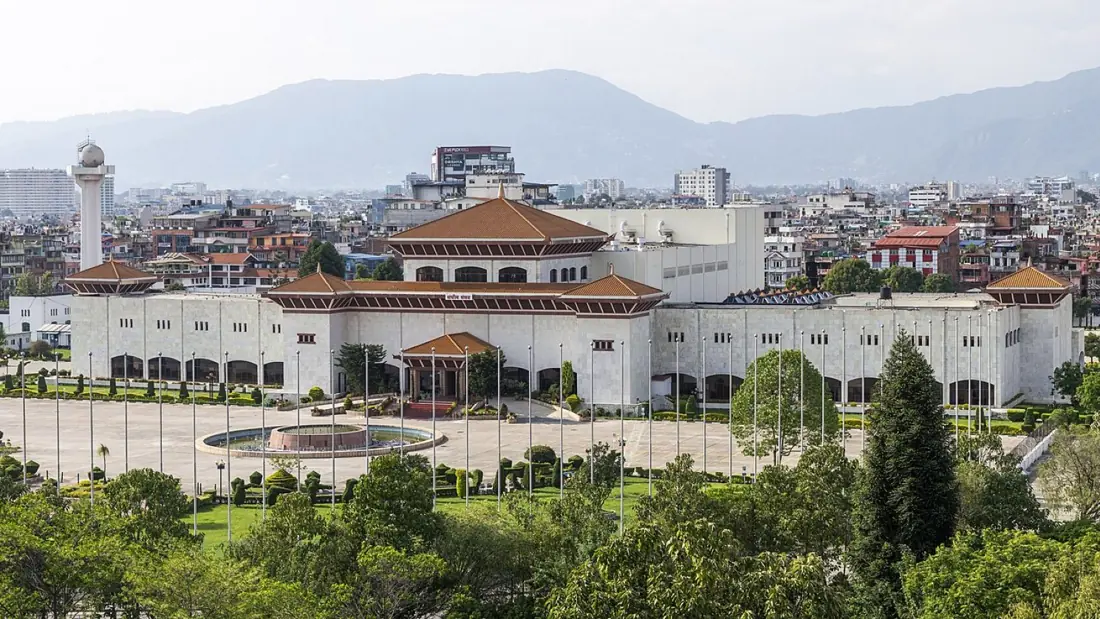
In Nepal the audit of public money is done by the Office of the Auditor General (महालेखापरीक्षकको कार्यालय), a constitutional body. Its head, the Auditor General, is appointed by the President on the recommendation of the Constitutional Council, holds office for six years, and may be removed only in the manner provided for a judge of the Supreme Court — all of which exist to make the office independent of the government it audits.
What the Office of the Auditor General audits.
- The accounts of all federal offices, ministries and departments.
- The accounts of the provinces and the local levels.
- The constitutional bodies and their offices.
- The courts and the offices of the judiciary.
- Government-owned corporations and authorities, and offices that receive government grants.
- The accounts of foreign loans and grants.
- The stores and assets of government offices, as well as the money.
Kinds of government audit. Regularity (financial) audit — whether the accounts are correct and whether the rules, particularly the budget and the procurement rules, were followed. Performance audit — whether the money produced the intended result, economically and efficiently. Special audit — an investigation of a particular matter, such as a large contract or a suspected loss. Propriety audit — whether a transaction, though within the letter of the rules, is proper and beyond suspicion.
The audit process and after. The Office audits during and after the year, records each observation with the evidence, issues an audit report on the annual financial statements, and sends every office a report of the irregularities found for correction. The report is submitted to the President, who lays it before Parliament. There it goes to the Public Accounts Committee (सार्वजनिक लेखा समिति), a committee of the legislature which examines the officials concerned, takes evidence, and directs what action must be taken. The committee is the point at which the words in an audit report become consequences.
Audit observations and their settlement. Every observation is followed up. A simple observation is settled by explaining the matter or producing the missing evidence. A serious irregularity requires the recovery of the money from the person responsible or the regularisation of the payment by the competent authority. An unsettled amount remains on the books as an amount recoverable, and it is reported again in the following year until it is settled.
Problem. In a small office, Mr. A receives cash from customers, writes the receipt, enters it in the cash book, and also prepares the monthly bank reconciliation. State what weaknesses exist and suggest the minimum changes possible with only two other staff members (Mr. B and Ms. C).
Solution. Step 1 — Identify the duties that must not be in one pair of hands. Receipt of cash, writing the receipt, recording it, banking it and reconciling the bank. Step 2 — The danger of the present arrangement. Mr. A could receive cash, not issue a receipt, not enter it and not deposit it, and then prepare a bank reconciliation that hides the shortage. No other person would ever see the difference. Step 3 — Redistribute with two staff. Let Mr. B write the receipt and hold the receipt book, while Mr. A receives the cash and enters the cash book; let Ms. C take the daily collection to the bank and keep the deposit slips; and let the bank reconciliation be prepared by Ms. C — or, better, by the owner or the senior officer — from the passbook, not from Mr. A's cash book. Step 4 — Add the cheap controls. Pre-numbered receipt books accounted for leaf by leaf; daily deposit of the collection; surprise counting of cash by the senior officer; and monthly comparison of the receipt-book counterfoils with the cash book. Step 5 — State the result. No single person can now both misappropriate money and conceal it, so the internal control is adequate for a small office.
Answer. Separate the receipt custody, the recording and the bank reconciliation among Mr. A, Mr. B and Ms. C; make the deposit daily; and have the senior officer make surprise checks and compare the counterfoils. What it means. Good internal control in a small office is not expensive equipment. It is the rule that no one person touches a transaction from beginning to end.
Problem. Say what kind of audit is required in each case: (a) the annual audit of a public limited company by a chartered accountant; (b) a check by the organisation's own staff that the store ledger agrees with the bin card each month; (c) an examination by the Office of the Auditor General of whether a road built for Rs. 10 crore produced the traffic benefits claimed for it; (d) an examination, ordered from outside, of the purchase of land by a municipality at a price much above the market rate.
Solution. Step 1 — (a) It is done after the year end, by an independent outsider, for the owners — final (statutory) external audit. Step 2 — (b) It is done by the organisation's own staff, continuously, and it tests a control — internal audit (as part of internal control). Step 3 — (c) The question is not whether the accounts are right but whether value was obtained — performance (value-for-money) audit. Step 4 — (d) A particular transaction is under investigation on a specific order, and propriety as well as regularity is in question — special audit, with a propriety angle.
Answer. (a) final external audit, (b) internal audit, (c) performance audit, (d) special audit. What it means. The type of audit follows from two questions: who is asking, and what they want to know. Where the question is "are the accounts true?", it is a financial audit; where it is "was the money well spent?", it is a performance audit.
Problem. An audit of a district office finds that Rs. 40,000 was paid for office furniture but no furniture was entered in the store ledger, and that Rs. 15,000 of revenue collected in Ashad was deposited only in Bhadra. Advise the office on how each observation should be settled.
Solution. Step 1 — Furniture Rs. 40,000, paid but not in the store ledger. The auditor cannot see that the government got anything for the money, so this is a serious observation. The office must produce the goods, enter them in the store ledger and the bin card with the purchase voucher and the जिन्सी दाखिला फाराम, and report the correction; if the goods cannot be produced, the amount becomes recoverable from the officer who passed the bill. Step 2 — Revenue of Rs. 15,000 deposited late. Money was held outside the consolidated fund for about two months, contrary to the rule that revenue is deposited the same day. The office must explain the delay with evidence (for example, that the bank was closed and the office was in a remote area), produce the deposit slip, and record the reason; if the delay is unexplained, it is a regularity observation requiring explanation and, if there is any loss of interest, recovery. Step 3 — Record the settlement. Both observations are answered in writing to the Office of the Auditor General, with the evidence attached; the store ledger is corrected; and the file is kept so that the same observation is not raised again next year.
Answer. The furniture observation is settled by bringing the goods into the store records, failing which the amount is recovered; the late deposit is settled by a written explanation with evidence and, if unexplained, by recovery. What it means. An audit observation is not closed by an argument. It is closed by producing the asset, the money or the authority — and every Nepali government office carries a list of the observations still unsettled against it.
Chapter summary
- Internal control is the whole system of policies, procedures, records and checks by which an organisation keeps its work accurate, efficient, lawful and honest and protects its assets. It is a system, not a person.
- Its objectives are to safeguard assets, to keep the records accurate and complete, to secure efficiency, to ensure compliance with the law, to prevent and detect fraud and error, and to make an audit possible.
- Its elements are segregation of duties, authorisation, documentation, physical control, reconciliation, supervision and review, rotation of duties and compulsory leave, internal audit, and comparison with the budget.
- An audit is an independent examination of the books and records, carried out so that the auditor may express an opinion on whether the financial statements show a true and fair view.
- The importance of audit is confidence for owners and lenders, deterrence and detection of fraud, compliance with the law, advice on internal control, protection of the honest employee, and accountability of the executive to the legislature.
- Types of audit: internal and external; continuous, interim and final; complete, partial and special; and by object — financial (regularity), performance, management and propriety.
- An internal audit is done by the organisation's own employees, continuously, reporting to the management, mainly to test the internal control system; its independence is limited.
- A final audit is done after the year end, by an independent external auditor, and ends in a statutory report with an opinion on the accounts.
- In Nepal government audit is carried out by the Office of the Auditor General, a constitutional body whose independence is protected by the manner of the Auditor General's appointment and removal. It audits the federation, the provinces, the local levels, the constitutional bodies, the courts, government corporations and foreign aid, and it audits stores and assets as well as money.
- Government audits are of four kinds — regularity, performance, special and propriety — and the report goes to the President and then to Parliament, where the Public Accounts Committee examines it and decides what action follows. Observations are settled by producing the asset, the money or the authority, or by recovery.
Practice questions
Group A — Very short answer (1 mark each)
- What is internal control? [1]
- Write any two objectives of internal control. [1]
- Write any two elements of internal control. [1]
- What is an audit? [1]
- Write any two importance of audit. [1]
- What is an internal audit? [1]
- What is a final audit? [1]
- Write any two types of audit on the basis of object. [1]
- Who conducts internal audit? [1]
- Which is the apex auditing body of Nepal? [1]
- Name the parliamentary committee that examines the audit report in Nepal. [1]
Answers to Group A
1. Internal control is the whole system of policies, procedures, records and checks adopted by an organisation to keep its work accurate, efficient, lawful and honest and to safeguard its assets.
2. Any two of: to safeguard assets; to keep records accurate and complete; to secure efficiency; to ensure compliance with law; to prevent and detect fraud and error; to make an audit possible.
3. Any two of: segregation of duties; authorisation and approval; documentation; physical control; reconciliation; supervision and review; rotation of duties and leave; internal audit; budget comparison.
4. An audit is an independent examination of the books of account, records and supporting documents of an organisation so that the auditor may express an opinion on whether the financial statements show a true and fair view.
5. Any two of: confidence for owners and lenders; detection and deterrence of fraud; compliance with the law; advice on internal control; protection of the honest employee; accountability of the executive to the legislature.
6. An internal audit is an audit carried out by the organisation's own employees, continuously, to test whether the internal control system is working and whether the records are accurate and the rules followed.
7. A final audit is the audit carried out after the end of the financial year on the completed books and final accounts by an independent external auditor, ending in a report with an opinion.
8. Any two of: financial (regularity) audit, performance audit, management audit, propriety audit.
9. The employees of the organisation itself, working under the management or the audit committee.
10. The Office of the Auditor General (महालेखापरीक्षकको कार्यालय).
11. The Public Accounts Committee (सार्वजनिक लेखा समिति).
Group B — Short answer (5 marks each)
- What is internal control? Explain its objectives. [5]
- Explain any five elements of a good internal control system. [5]
- What is auditing? Explain its importance. [5]
- Explain the types of audit on the basis of time, scope and object. [5]
- Distinguish between internal audit and final audit. [5]
- Who is the apex auditing body in Nepal? Explain what it audits and what happens to its report. [5]
Answers to Group B
1. Definition as in Group A answer 1. Objectives: safeguard assets from loss, theft and waste; ensure the records are accurate and complete; secure efficiency and avoid duplication; ensure compliance with the law, the budget and the procurement rules; prevent and detect fraud and error early; and make an independent audit possible.
2. (i) Segregation of duties — the person who authorises, the person who pays and the person who records must be different. (ii) Authorisation — every payment and entry needs the signature of the competent officer. (iii) Documentation — pre-numbered prescribed forms with evidence attached. (iv) Physical control — locked store and cash box, restricted access, custody with named persons. (v) Reconciliation — monthly bank reconciliation, store ledger against bin card, physical verification. (Also: supervision, rotation and compulsory leave, internal audit, budget comparison.)
3. Definition as in Group A answer 4. Importance: it gives owners, lenders and the government confidence in the accounts; it deters and detects fraud and error; it tests compliance with the Companies Act, the tax law, the budget and the procurement rules; it identifies weaknesses in internal control and recommends improvements; it protects the honest employee by providing written evidence; and in government it is the means by which the legislature holds the executive to account.
4. By time: continuous (throughout the year), interim (during the year for part of the period), final (after the year end on the completed accounts). By scope: complete (all the books), partial (a part), special (a particular matter on a special order). By object: financial or regularity (are the accounts true and the rules followed), performance or value-for-money (was the money spent economically and efficiently), management (are the systems and decisions sound), propriety (is the transaction proper and above suspicion).
5. Internal audit: conducted by an employee of the organisation; continuous during the year; reports to the management or the audit committee; its main object is to test internal control and prevent error and fraud; independence is limited; reports are interim, with recommendations. Final audit: conducted by an independent external auditor; after the year end; reports to the owners or the legislature; its main object is to express an opinion on the truth and fairness of the accounts; independence is full; it ends in one statutory report with an opinion.
6. The Office of the Auditor General (महालेखापरीक्षकको कार्यालय), a constitutional body headed by the Auditor General, appointed by the President on the recommendation of the Constitutional Council for six years and removable only in the manner provided for a Supreme Court judge. It audits the federal ministries, departments and offices; the provinces and the local levels; the constitutional bodies and the courts; government corporations and grant-receiving offices; foreign loans and grants; and the stores and assets as well as the money. Its report is submitted to the President, laid before Parliament, and examined there by the Public Accounts Committee, which takes evidence from the officials concerned and directs the action to be taken.
Group C — Long answer (8 marks each)
- What is internal control? Explain its objectives and elements, and show what would go wrong in an office where the same clerk receives cash, writes the receipt, records it and reconciles the bank.
- What is auditing? Explain the meaning of internal control and audit, the types of audit, and the government audit system of Nepal including the Office of the Auditor General and the settlement of audit observations. [8]
Answers to Group C
1. Definition (1). As in Group A answer 1. Objectives (3). Safeguard assets; accurate and complete records; efficiency; compliance with law and budget; prevention and detection of fraud and error; a basis for audit. Explain each in one sentence. Elements (2). Segregation of duties, authorisation, documentation, physical control, reconciliation, supervision, rotation and compulsory leave, internal audit, budget comparison — any five or six explained. The danger of one pair of hands (2). If one clerk receives cash, writes the receipt, enters it in the cash book and prepares the bank reconciliation, he can receive cash without issuing a receipt, omit it from the cash book, fail to deposit it, and then draw a reconciliation that hides the shortage. No second person ever sees the transaction, so the error or the fraud continues until it is large; and the honest clerk is also exposed, because there is no evidence of what he did. The cure is to separate custody, recording and reconciliation, to account for pre-numbered receipt books leaf by leaf, to deposit daily and to have the senior officer make surprise checks.
2. Auditing (2). Definition as in Group A answer 4, with the three features — independence, examination of evidence, and the expression of an opinion rather than a guarantee. Internal control and the types of audit (3). Internal control as the system of checks; internal and external audit; continuous, interim and final audit; complete, partial and special audit; and by object the financial, performance, management and propriety audits. Distinguish an internal audit (an employee, continuous, reports to management, tests control, limited independence) from a final audit (an independent outsider, after the year end, reports to the owners or the legislature, gives an opinion). Government audit of Nepal (3). The Office of the Auditor General as a constitutional body; the appointment and protection of the Auditor General; what it audits — the federation, the provinces, the local levels, the constitutional bodies, the courts, government corporations, foreign aid and the stores; the four kinds of government audit; the report to the President and then to Parliament; the Public Accounts Committee's examination and action; and the settlement of observations by explanation with evidence, by recovery from the person responsible, or by regularisation.
Practise more: Accountancy question bank