Unit 3 · Tax · 4 teaching hours · 20 min read
Introduction to Tax (करको परिचय)
What the syllabus asks for 5
- Revenue (राजस्व): meaning and sources
- Tax: introduction, principles and objectives of taxation
- Classification of taxes: direct and indirect, progressive and regressive
- Permanent Account Number (स्थायी लेखा नम्बर) and its use
- Value Added Tax (मूल्य अभिवृद्धि कर): meaning, features and calculation
A government cannot run on goodwill. Roads, schools, police, pensions and the salaries of its own staff all have to be paid for, and the money comes mainly from revenue, of which tax is by far the largest part. In Nepal more than 85 per cent of total government revenue comes from tax. This unit explains where revenue comes from, what a tax is and what makes a good tax, how taxes are classified, and then two things every office worker in Nepal must know in practice — the Permanent Account Number (PAN) and Value Added Tax (VAT).
The questions here are short and definitional: "What is indirect tax?", "Write the full form of VAT.", "What is PAN and how many digits does it have?". The numerical question, when it comes, is always the VAT chain — a producer, a wholesaler and a retailer, each selling at a higher price, and you are asked for the tax each pays and the total tax the government collects. Learn that one chain perfectly.
3.1 Revenue: meaning and sources
Revenue (राजस्व) is the income a government raises to meet its public expenditure. The CDC textbook defines a tax as the money that the people are compelled by law to pay to the government for the public good, for which they do not receive a direct, individual benefit in return.
The sources of government revenue in Nepal fall into two groups.
| Group | What it is | Examples |
|---|---|---|
| Tax revenue | Compulsory payments, no direct return to the payer | Income tax, house and land tax, capital gains tax, value added tax, excise duty, customs duty, vehicle tax |
| Non-tax revenue | Income from services, property and other sources | Fees and charges for services, fines and penalties, registration fees, royalties from mines and forests, dividends from public enterprises, interest on loans, rent of government property, foreign grants and aid |
Tax revenue is further divided into direct and indirect taxes, and it is this division that Group A likes to test.
3.2 Tax: introduction, principles and objectives
A tax is a compulsory contribution imposed by the government on persons, goods, services and transactions, to meet the expenses of the state, without any direct and proportionate return to the person who pays it.
Principles (canons) of taxation. Adam Smith set out four canons in 1776 and they are still the standard answer.
- Equality or ability to pay. Those who earn more should pay more; the burden should be distributed fairly.
- Certainty. The taxpayer must know when, how much and where to pay. Nobody should be at the mercy of an official's guess.
- Convenience. The tax should be collected at a time and in a manner that suits the taxpayer — which is why VAT is collected at the moment of sale and income tax through deduction at source.
- Economy. The cost of collecting the tax must be small compared with the amount collected.
To these modern writers add simplicity, flexibility (the rate can be changed as the economy changes), elasticity and neutrality (the tax should not distort business decisions more than necessary).
Objectives of taxation.
- To raise revenue for public expenditure — the primary objective.
- To redistribute income and wealth, by taxing the rich at a higher rate and spending on the poor.
- To control inflation, by taking purchasing power out of the hands of consumers.
- To protect domestic industry, by placing a heavy customs duty on imported goods.
- To discourage harmful consumption — high excise duty on alcohol, tobacco and gambling.
- To encourage saving and investment, by giving concessions on amounts saved or invested.
- To promote balanced regional development, by giving tax holidays to industries set up in backward areas.
3.3 Classification of taxes
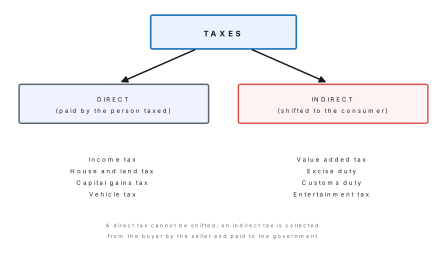
Direct tax. A direct tax is levied on a person's income or property and is paid by the person on whom it is legally imposed; the burden cannot be passed to anybody else. Dalton's words: "A direct tax is really paid by the person on whom it is legally imposed." For example, the tax on a salary is deducted from the salary of the person who earns it, and he cannot make anybody else bear it.
Indirect tax. An indirect tax is imposed on one person but borne by another. Dalton: "An indirect tax is imposed to one person but paid partly or wholly by another." A shopkeeper pays VAT to the government, but the money came from the customer who bought the goods. The tax is shifted along the chain of sale until it rests on the final consumer.
| Point | Direct tax | Indirect tax |
|---|---|---|
| Burden | Cannot be shifted | Can be shifted to the consumer |
| Levied on | Income, profit, property | Goods and services, transactions |
| Who collects | Government directly from the taxpayer | The seller, who pays it to the government |
| Example | Income tax, house rent tax, capital gains tax | VAT, excise duty, customs duty |
| Effect on prices | Does not directly raise prices | Raises the price of the goods |
| Nature | Usually progressive — the rate rises with income | Usually regressive in effect — the same rate hits the poor harder |
Taxes may also be classified as progressive (rate rises as income rises), proportional (same rate for all), regressive (rate falls as income rises) and digressive; and by the base on which they fall as taxes on income, on capital, on expenditure and on property.
3.4 Permanent Account Number (PAN)
A Permanent Account Number (स्थायी लेखा नम्बर) is a unique nine-digit number given by the Inland Revenue Department to a taxpayer and meant to last his whole working life. Once allotted, the same number stays with the taxpayer for ever — and that is why it is called permanent. In English it is the Permanent Account Number, shortened to PAN.
Who must take a PAN. Any person who carries on an industry, trade, business or profession, who is employed, and anyone who wishes to earn an assessable income or who must deduct tax at source, must obtain a PAN before doing so. Anyone else may also apply voluntarily.
Two kinds of PAN. A number taken by an individual is a personal PAN; a number taken for a firm or company is a business PAN.
Documents needed. For a personal PAN: name, surname, permanent address, father's name, date of birth, citizenship or identity card, and a passport-size photograph. For a business PAN: a copy of the firm's or company's registration certificate, the memorandum and articles of association or the constitution, the application form signed by the partners or directors, passport-size photographs of the signatories, copies of their citizenship certificates and any other prescribed documents.
Why it matters. The PAN must be quoted in bank transactions, in bills and invoices issued, in returns of income and in any other prescribed dealing. Without a PAN, a business cannot be registered properly, cannot deduct tax at source and cannot claim the benefits the tax law gives. The PAN is also the key by which the tax office can see all of a taxpayer's transactions in one place, which is exactly what makes tax evasion harder.
3.5 Introduction to Value Added Tax (VAT)
Value Added Tax (मूल्य अभिवृद्धि कर) is an indirect tax charged on the value added at each stage of production and distribution of goods and services. When a good travels from the producer to the wholesaler to the retailer to the final consumer, its value rises at every step; VAT is charged on that rise in value.
In Nepal, VAT has been in force from 1 Mangsir 2054 B.S. It is governed by the Value Added Tax Act, 2052 and the Value Added Tax Rules, 2053, and the present rate is a single rate of 13 per cent.
How it works — the input-credit method. Every registered dealer charges VAT on his sales (output tax) and pays VAT on his purchases (input tax). At the end of the period he deposits only the difference, output tax minus input tax, with the Inland Revenue Office. Because each dealer gets credit for the tax already paid by his supplier, no tax is charged twice on the same value. That is what makes VAT a tax only on the value added by each dealer.
A person whose annual turnover crosses the prescribed limit must register for VAT. A registered dealer must issue a tax invoice showing the seller's PAN, the buyer's PAN, the description, the quantity, the price, the rate and the amount of VAT, and must keep accounts and file returns at the prescribed intervals. Certain goods and services — basic agricultural produce, education and health services, and prescribed social goods — are exempt or zero-rated.
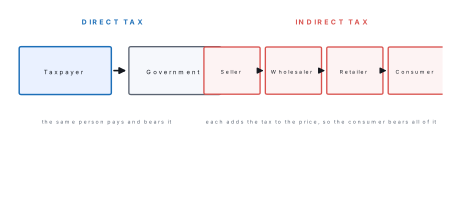
Problem. A producer makes goods worth Rs. 1,00,000 and sells them to a wholesaler for Rs. 1,00,000 plus VAT. The wholesaler sells the same goods to a retailer for Rs. 1,20,000 plus VAT, and the retailer sells them to the final consumer for Rs. 1,30,000 plus VAT. The rate of VAT is 13 per cent. Find the VAT each of the three dealers deposits and the total VAT the government receives. Show that this equals the VAT on the final sale price.
Solution. Step 1 — Write down each dealer's sale and purchase and compute output and input tax. Step 2 — Producer: output tax = 13\% \times 1{,}00{,}000 = Rs.\ 13{,}000; input tax = 0; tax deposited = 13{,}000 - 0 = Rs.\ 13{,}000. Step 3 — Wholesaler: sale Rs. 1,20,000; output tax = 13\% \times 1{,}20{,}000 = Rs.\ 15{,}600; input tax = Rs.\ 13{,}000; tax deposited = 15{,}600 - 13{,}000 = Rs.\ 2{,}600. Step 4 — Retailer: sale Rs. 1,30,000; output tax = 13\% \times 1{,}30{,}000 = Rs.\ 16{,}900; input tax = Rs.\ 15{,}600; tax deposited = 16{,}900 - 15{,}600 = Rs.\ 1{,}300. Step 5 — Total deposited = 13{,}000 + 2{,}600 + 1{,}300 = Rs.\ 16{,}900. Step 6 — Check: 13\% \times 1{,}30{,}000 = Rs.\ 16{,}900. Equal.
| Stage | Sale price (Rs.) | Value added (Rs.) | Output tax (Rs.) | Input tax (Rs.) | Tax deposited (Rs.) |
|---|---|---|---|---|---|
| Producer | 1,00,000 | 1,00,000 | 13,000 | — | 13,000 |
| Wholesaler | 1,20,000 | 20,000 | 15,600 | 13,000 | 2,600 |
| Retailer | 1,30,000 | 10,000 | 16,900 | 15,600 | 1,300 |
| Total | 1,30,000 | 16,900 |
Answer. Producer Rs. 13,000, wholesaler Rs. 2,600, retailer Rs. 1,300; total Rs. 16,900, which is exactly 13 % of the final price of Rs. 1,30,000. What it means. The final consumer bears the whole tax, but no dealer bears more than 13 % of the value he himself added. The tax is collected in instalments along the chain, which is why VAT is difficult to evade.
Problem. An employee's annual salary is Rs. 6,00,000. The tax-free threshold is Rs. 5,00,000 and the amount above it is taxed at 10 per cent. Find the tax payable and state whether the tax is direct or indirect, with a reason.
Solution. Step 1 — Taxable income = salary − threshold = 6{,}00{,}000 - 5{,}00{,}000 = Rs.\ 1{,}00{,}000. Step 2 — Tax = 10\% \times 1{,}00{,}000 = Rs.\ 10{,}000. Step 3 — Classify. The employee who earns the salary is the person who pays the tax and he cannot pass the burden to anybody else.
Answer. Rs. 10,000; direct tax, because it is imposed on, and borne by, the same person.
Problem. A municipality expects the following receipts in a year: house and land tax Rs. 40,00,000; business tax Rs. 15,00,000; building-permit fees Rs. 8,00,000; fines for illegal construction Rs. 2,00,000; dividend from a municipal enterprise Rs. 5,00,000; and a grant from the provincial government Rs. 30,00,000. Find the total revenue, the tax revenue and the non-tax revenue, and the share of tax revenue.
Solution. Step 1 — Tax revenue = 40{,}00{,}000 + 15{,}00{,}000 = Rs.\ 55{,}00{,}000. Step 2 — Non-tax revenue = 8{,}00{,}000 + 2{,}00{,}000 + 5{,}00{,}000 + 30{,}00{,}000 = Rs.\ 45{,}00{,}000. Step 3 — Total revenue = 55{,}00{,}000 + 45{,}00{,}000 = Rs.\ 1{,}00{,}00{,}000. Step 4 — Share of tax revenue = \frac{55{,}00{,}000}{1{,}00{,}00{,}000} \times 100 = 55\%.
Answer. Total Rs. 1,00,00,000; tax Rs. 55,00,000; non-tax Rs. 45,00,000; tax share 55 %. What it means. A local body that raises only 55 % of its money from its own taxes depends heavily on money from above — which is exactly why local governments are pressed to widen their own tax base.
"Direct tax means paid directly to the government" is wrong. A shopkeeper pays VAT directly to the government too. The test is not who hands over the money but who bears the burden. If the payer can pass it on to somebody else, the tax is indirect; if he cannot, it is direct.
Chapter summary
- Revenue is the income a government raises for public expenditure. It is tax revenue (compulsory, no direct return) or non-tax revenue (fees, fines, royalties, dividends, interest, rent, grants). In Nepal more than 85 % of revenue comes from taxes.
- A tax is a compulsory contribution imposed by law on persons, goods, services and transactions without a direct and proportionate return.
- Adam Smith's canons: equality (ability to pay), certainty, convenience and economy; modern writers add simplicity, flexibility, elasticity and neutrality.
- Objectives of taxation: revenue, redistribution of income, control of inflation, protection of domestic industry, discouragement of harmful consumption, encouragement of saving and investment, and balanced regional development.
- Direct tax is borne by the person on whom it is legally imposed and cannot be shifted (income tax, house and land tax, capital gains tax). Indirect tax is shifted to the final consumer (VAT, excise, customs).
- PAN is a unique nine-digit, permanent number issued by the Inland Revenue Department. It is compulsory for industry, trade, business, profession and employment. It is a personal PAN for an individual and a business PAN for a firm or company, and it must be quoted in bank transactions and in bills.
- VAT is an indirect tax on the value added at each stage of production and distribution. In Nepal it has applied from 1 Mangsir 2054 B.S., under the VAT Act, 2052 and VAT Rules, 2053, at a single rate of 13 per cent.
- A registered dealer deposits output tax minus input tax. The sum of the amounts deposited by all the dealers equals the VAT on the final sale price, so the whole tax is finally borne by the consumer.
Practice questions
Group A — Very short answer (1 mark each)
- What is revenue? [1]
- Write any two sources of non-tax revenue. [1]
- What is indirect tax? [1]
- Write any two examples of direct tax. [1]
- Write the full form of VAT. [1]
- When was VAT introduced in Nepal? [1]
- What is the present rate of VAT in Nepal? [1]
- Write the full form of PAN. [1]
- How many digits are there in a PAN? [1]
- Write any two objectives of taxation. [1]
- Which tax is called a progressive tax? [1]
Answers to Group A
1. Revenue is the income a government raises to meet its public expenditure.
2. Any two of: fees and service charges, fines and penalties, registration fees, royalties, dividends from public enterprises, interest, rent, foreign grants.
3. An indirect tax is a tax imposed on one person but borne by another — the burden can be shifted to the final consumer; examples are VAT, excise and customs duty.
4. Any two of: income tax, house and land tax, capital gains tax, vehicle tax.
5. Value Added Tax.
6. 1 Mangsir 2054 B.S.
7. 13 per cent (a single rate).
8. Permanent Account Number.
9. Nine.
10. Any two of: to raise revenue, redistribute income, control inflation, protect domestic industry, discourage harmful consumption, encourage saving and investment, promote balanced regional development.
11. A tax whose rate rises as the income or wealth of the taxpayer rises, so that the rich pay a larger share of their income than the poor.
Group B — Short answer (5 marks each)
- What is tax? Explain the principles of a good tax system. [5]
- Distinguish between direct tax and indirect tax with suitable examples. [5]
- Explain any five objectives of taxation. [5]
- What is meant by Permanent Account Number? Explain its importance and the persons who must obtain it. [5]
- What is VAT? Explain how it is calculated by the input-credit method. [5]
- What is revenue? Describe the sources of government revenue in Nepal. [5]
Answers to Group B
1. A tax is a compulsory contribution imposed by the government on persons, goods, services and transactions to meet the expenses of the state, without a direct and proportionate return. Principles: equality — the burden should be distributed according to ability to pay; certainty — the taxpayer must know how much, when and where to pay; convenience — collection should suit the taxpayer (VAT at the point of sale, income tax at source); economy — collection cost must be low. Add simplicity, flexibility, elasticity and neutrality.
2. Direct tax: levied on income or property; borne by the person legally liable; cannot be shifted; collected directly from the taxpayer; examples income tax, house and land tax, capital gains tax. Indirect tax: levied on goods, services and transactions; collected by the seller and paid to the government; burden shifted to the final consumer; raises the price of the goods; examples VAT, excise duty, customs duty, entertainment tax.
3. (i) To raise revenue for public expenditure. (ii) To redistribute income and wealth between rich and poor. (iii) To control inflation by withdrawing purchasing power. (iv) To protect domestic industries through customs duty. (v) To discourage harmful consumption such as alcohol and tobacco. (Also: encourage saving and investment, promote balanced regional development.)
4. PAN is a unique nine-digit permanent number issued by the Inland Revenue Department to a taxpayer and valid for life. Importance: it identifies the taxpayer, enables tax deduction at source, is required in bank transactions and in bills and invoices, lets the tax office cross-check a taxpayer's transactions, and thus reduces evasion. It is compulsory for those carrying on industry, trade, business or profession, for employees and for anyone who must deduct tax at source; others may take it voluntarily. It is personal for an individual and business for a firm or company.
5. VAT is an indirect tax charged on the value added at each stage of production and distribution of goods and services; in Nepal it applies from 1 Mangsir 2054 B.S. under the VAT Act 2052 and Rules 2053 at a single rate of 13 per cent. Method: every registered dealer charges tax on his sales (output tax) and pays tax on his purchases (input tax); at the end of the period he deposits output tax minus input tax. Because each dealer is credited with the tax already paid by his supplier, tax falls only on the value he added, and the total collected equals the VAT on the final sale price, borne by the final consumer.
6. Revenue is the income raised by a government for public expenditure. Sources: tax revenue — direct taxes (income tax, house and land tax, capital gains tax, vehicle tax) and indirect taxes (VAT, excise duty, customs duty, entertainment tax); non-tax revenue — fees and service charges, fines and penalties, registration fees, royalties from mines and forests, dividends from public enterprises, interest on loans, rent of government property, and foreign grants and aid. Tax revenue provides more than 85 per cent of Nepal's total revenue.
Group C — Long answer (8 marks each)
- What is tax? Explain the classification of taxes with examples, and state the principles of a good tax system. [8]
- A producer sells goods to a wholesaler for Rs. 2,00,000, the wholesaler sells to a retailer for Rs. 2,40,000 and the retailer sells to the consumer for Rs. 2,60,000, all prices being exclusive of VAT. The VAT rate is 13 per cent. Compute the VAT deposited by each dealer, the total VAT received by the government, and verify the total against the VAT on the final price. [8]
Answers to Group C
1. Definition (1). A tax is a compulsory contribution imposed by the government on persons, goods, services and transactions to meet public expenditure, without a direct and proportionate return to the payer. Classification (4). (i) Direct tax — borne by the person on whom it is legally imposed and not shiftable: income tax, house and land tax, capital gains tax, vehicle tax. (ii) Indirect tax — imposed on one person but borne by another, shifted to the final consumer: VAT, excise duty, customs duty, entertainment tax. (iii) By effect on income — progressive, proportional, regressive, digressive. (iv) By base — tax on income, on capital, on expenditure, on property. Explain each with one example. Principles (3). Adam Smith's canons of equality (ability to pay), certainty, convenience and economy, plus the modern additions of simplicity, flexibility and neutrality.
2. Producer: sale Rs. 2,00,000; output tax = 13\% \times 2{,}00{,}000 = Rs.\ 26{,}000; input tax nil; deposit Rs. 26,000. Wholesaler: sale Rs. 2,40,000; output tax = 13\% \times 2{,}40{,}000 = Rs.\ 31{,}200; input tax Rs. 26,000; deposit = 31{,}200 - 26{,}000 = Rs. 5,200. Retailer: sale Rs. 2,60,000; output tax = 13\% \times 2{,}60{,}000 = Rs.\ 33{,}800; input tax Rs. 31,200; deposit = 33{,}800 - 31{,}200 = Rs. 2,600. Total deposited = 26{,}000 + 5{,}200 + 2{,}600 = Rs.\ 33{,}800. Verification: 13\% \times 2{,}60{,}000 = Rs.\ 33{,}800. Equal — the whole tax is ultimately borne by the consumer and collected in instalments along the chain.
Practise more: Accountancy question bank