Question bank · 14 min read
Social Studies: Unit-wise Objective Question Bank
Compulsory Social Studies in the SEE is a 75-mark, three-hour paper. Its very short questions, worth one mark each, are the objective part: a fact, a date, a name, a place. They are the quickest marks in the paper and the ones lost most often through careless recall. This chapter gives practice items for all ten units of the Grade 10 Social Studies book, with an answer key and a one-line reason for every item.
Every item here is an original practice item written to the pattern of the SEE and to the facts of the Social Studies book chapters in this series. None is claimed to be a question from a particular year's paper. A year printed beside a question is usually a guess, and a wrong label teaches you to trust the wrong thing.
14.1 Where objective items sit in the paper
The Curriculum Development Centre (CDC) grid for Grade 10 Social Studies, as published for the 2080 curriculum, is a 75-mark paper of 24 questions: 11 very short answer questions of 1 mark, 9 short answer questions of 4 marks and 4 long answer questions of 7 marks. Another source I checked prints a different split of the same 75 marks (11 x 1, 4 x 4 and 8 x 6). The 11 one-mark items are the same in both, which is why this chapter concentrates on them; check the exact short and long split in the grid your school gives you.
| Group | Questions | Marks each | Total | Style |
|---|---|---|---|---|
| A. Very short | 11 | 1 | 11 | one fact, one word, a date or a name |
| B. Short | 9 | 4 | 36 | give reasons, define and explain |
| C. Long | 4 | 7 | 28 | explain, describe, analyse |
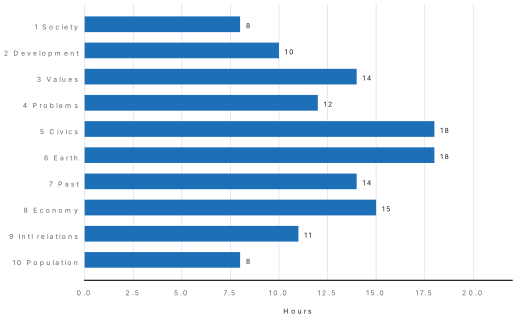
The unit hours below are those reported for the Grade 10 curriculum and are a good guide to how the 11 one-mark items are spread: almost every unit supplies one.
| Unit | Hours (reported) | One-mark items to expect |
|---|---|---|
| 1. Our Society and We | 8 | 1 |
| 2. Development and Foundations of Development | 10 | 1 |
| 3. Our Social Values and Beliefs | 14 | 1 to 2 |
| 4. Social Problems and Solutions | 12 | 1 |
| 5. Civic Consciousness | 18 | 1 to 2 |
| 6. Our Earth | 18 | 1 to 2 |
| 7. Our Past | 14 | 1 to 2 |
| 8. Economic Activities | 15 | 1 |
| 9. International Relations | 11 | 1 |
| 10. Population and Its Management | 8 | 1 |
Answer ten items of one unit in five minutes without notes, then check the key. For each miss, find the sentence in the book chapter and write the fact on a card. Numbers, dates and names are what these items test, so the cards should carry numbers, dates and names.
14.2 Unit 1: Our Society and We
- Which agency of socialization is the first and strongest?aschoolbfamilycmass mediadpeer group
- A citizenship certificate in Nepal is issued from the age ofa14b16c18d21
- The Census 2021 counted Nepal's population asa26,494,504b29,164,578c31,000,000d23,151,423
- Census 2021 recorded how many caste/ethnic groups?a125b142c103d200
- The number of mother tongues recorded in Census 2021 isa92b124c142d10
- Nepal's national flower is thealotusbrhododendroncmarigolddorchid
- Nepal's national bird is theaeaglebpeacockcdanpheddove
- The national game of Nepal isafootballbcricketcvolleyballdkabaddi
- The height of Sagarmatha used in the book isa8,848 mb8,848.86 mc8,611 md8,586 m
- The national anthem of Nepal isaSayaun Thunga PhulkabResham FiriricJaya NepaldGorkhali Gaun
Answers: Unit 1
1. (b) — the family teaches language and values first.
2. (b) — 16.
3. (b) — 29,164,578.
4. (b) — 142.
5. (b) — 124.
6. (b) — rhododendron (lali gurans).
7. (c) — danphe (Himalayan monal).
8. (c) — volleyball.
9. (b) — 8,848.86 m.
10. (a) — Sayaun Thunga Phulka, adopted in 2007.
14.3 Unit 2: Development and the Foundations of Development
- HDI is published byathe World BankbUNDPcIMFdWHO
- The three dimensions of HDI are health, education andastandard of livingbpeacectradeddemocracy
- Nepal's HDI value in the book isa0.482b0.622c0.722d0.822
- Nepal's HDI rank in the book isa100b145c168d190
- The Brundtland definition of sustainable development dates froma1972b1987c2000d2015
- The number of Sustainable Development Goals isa8b12c17d25
- The number of provinces in Nepal isa5b7c9d14
- The number of local levels in Nepal isa753b750c744d77
- The Constitution of Nepal was promulgated ona15 Jestha 2065b3 Ashwin 2072c7 Falgun 2007d1 Poush 2017
- The number of rural municipalities isa276b460c753d11
Answers: Unit 2
1. (b) UNDP, since 1990.
2. (a) standard of living (measured by GNI per capita).
3. (b) 0.622, in the medium group.
4. (b) 145.
5. (b) 1987.
6. (c) 17 goals, adopted in 2015 for 2030.
7. (b) 7.
8. (a) 753 (6 metropolitan, 11 sub-metropolitan, 276 municipalities, 460 rural municipalities).
9. (b) 3 Ashwin 2072 (20 September 2015). 15 Jestha 2065 is the day the republic was declared.
10. (b) 460.
14.4 Unit 3: Our Social Values and Beliefs
- How many World Heritage Sites does Nepal have, according to the book?a2b4c6d10
- Lumbini was listed as a World Heritage Site ina1979b1984c1997d2006
- Which of these is a string instrument?amadalbsarangicbansuridjhyali
- Panche baja is played traditionally by theaDamaibNewar priestscTharudMagar
- Unity Day is observed ona27 Poushb16 Maghc7 Falgund3 Ashwin
- Martyrs' Day is observed ona27 Poushb16 Maghc7 Falgund15 Jestha
- Republic Day is observed ona3 Ashwinb15 Jesthac7 Falgund11 Baisakh
- Nelson Mandela is remembered foranon-violencebfighting apartheidcserving the poordthe civil rights march
- Mother Teresa received the Nobel Peace Prize ina1950b1964c1979d1993
- Which of these is a folk song of Nepal?aAsarebCharyacSonatadGhazal
Answers: Unit 3
1. (b) — Kathmandu Valley, Sagarmatha National Park, Chitwan National Park and Lumbini.
2. (c) 1997 (Kathmandu Valley and Sagarmatha 1979; Chitwan 1984).
3. (b) — sarangi; madal and damphu are drums, bansuri a wind instrument, jhyali a cymbal.
4. (a) Damai.
5. (a) 27 Poush (Prithvi Narayan Shah's birthday).
6. (b) 16 Magh.
7. (b) 15 Jestha.
8. (b) — anti-apartheid; Nobel 1993.
9. (c) 1979.
10. (a) Asare, a folk song; Charya is a classical dance.
14.5 Unit 4: Social Problems and Solutions
- World Day against Trafficking in Persons is observed ona30 Julyb10 Decemberc8 Marchd15 March
- The Human Trafficking and Transportation (Control) Act was made ina2054b2064c2074d2079
- The Domestic Violence Act was passed ina2059b2064c2066d2075
- The anti-corruption body of Nepal is theaCIAAbNRBcNPCdNHRC
- Nepal's score in the Corruption Perception Index 2024, as given in the book, wasa24b34c54d64
- The Prevention of Corruption Act was made ina2059b2064c2066d2074
- The Right to Information Act is ofa2059b2064c2066d2074
- The child helpline number isa100b1098c1145d1111
- Chhaupadi is an example ofaa superstitionba festivalca gameda tax
- The Criminal Code of Nepal is ofa2064b2066c2074d2075
Answers: Unit 4
1. (a) 30 July.
2. (b) 2064.
3. (c) 2066.
4. (a) CIAA, the Commission for the Investigation of Abuse of Authority.
5. (b) 34 out of 100.
6. (a) 2059.
7. (b) 2064.
8. (b) 1098 is the child helpline; 100 is the police number.
9. (a) — a harmful belief that keeps women out of the home during menstruation.
10. (c) 2074.
14.6 Unit 5: Civic Consciousness
- The House of Representatives hasa110 membersb165 membersc275 membersd334 members
- Of these, the number elected by first-past-the-post isa110b165c275d59
- The National Assembly hasa59 membersb275 membersc100 membersd25 members
- The term of a National Assembly member isa4 yearsb5 yearsc6 yearsd8 years
- The Council of Ministers has not more thana15b21c25d30 members
- The federal budget is presented ona15 Jesthab1 Baisakhc1 Shrawand15 Ashadh
- The UDHR was adopted ona10 December 1948b24 October 1945c15 March 1962d1 January 1950
- Fundamental rights in Part 3 of Nepal's Constitution numbera21b31c41d51
- The voting age in Nepal isa16b18c20d21
- World Consumer Rights Day isa15 Marchb8 Marchc10 Decemberd5 June
Answers: Unit 5
1. (c) 275.
2. (b) 165 (the other 110 by proportional representation).
3. (a) 59.
4. (c) 6 years; one-third retire every two years.
5. (c) 25.
6. (a) 15 Jestha.
7. (a) 10 December 1948; it has 30 articles.
8. (b) 31.
9. (b) 18.
10. (a) 15 March.
14.7 Unit 6: Our Earth
- Climate is the average weather of abouta1 yearb10 yearsc30 yearsd100 years
- Temperature falls by about ____ for every 1,000 m of altitude.a1 °Cb3.5 °Cc6.5 °Cd10 °C
- Which continent is the second largest by area?aAsiabAfricacNorth AmericadSouth America
- The highest peak of Africa isaKilimanjarobAconcaguacDenalidMont Blanc
- The highest peak of South America isaDenalibAconcaguacKilimanjarodElbrus
- The highest peak of North America isaDenalibAconcaguacKilimanjarodLogan
- The point on the ground directly above the focus of an earthquake is theaepicentrebfaultccrustdcore
- The earthquake of 2015 in Nepal measureda6.8b7.8c8.1d5.8
- The safe action in an earthquake isarun outsidebdrop, cover and holdcuse the liftdstand near a window
- Contour lines on a map showarainfallbreliefcpopulationdroads
Answers: Unit 6
1. (c) 30 years.
2. (c) 6.5 °C.
3. (b) Africa (about 30.3 million km²).
4. (a) Kilimanjaro (5,895 m).
5. (b) Aconcagua (about 6,960 m).
6. (a) Denali (6,190 m).
7. (a) epicentre; the focus is underground.
8. (b) 7.8.
9. (b) drop, cover and hold.
10. (b) relief (height and shape of land).
14.8 Unit 7: Our Past
- The revolution of 2007 BS ended ____ years of Rana rule.a80b104c120d140
- The Delhi Agreement was signed inaFalgun 2007bPoush 2017cChaitra 2046dJestha 2065
- The first general election of Nepal was held ina2007b2015 BS (1959)c2037d2046
- The first elected Prime Minister wasaB. P. KoiralabM. P. KoiralacTanka Prasad AcharyadK. I. Singh
- King Mahendra's coup took place ona1 Poush 2017b7 Falgun 2007c26 Chaitra 2046d20 Ashwin 2072
- The Panchayat system lasted from 2019 toa2037b2046c2063d2072
- The Peace Accord was signed ona21 November 2006b28 May 2008c20 September 2015d1 June 2001
- Nepal was declared a republic ona28 May 2008b21 November 2006c20 September 2015d7 Falgun 2007
- The First World War began after the assassination ataSarajevobBerlincParisdVienna
- The League of Nations was set up after the treaty ofaVersaillesbViennacParis 1815dTilsit
Answers: Unit 7
1. (b) 104.
2. (a) Falgun 2007 BS.
3. (b) 1959 (2015 BS); the Nepali Congress won 74 of 109 seats.
4. (a) B. P. Koirala.
5. (a) 1 Poush 2017.
6. (b) 2046 (the Panchayat period was 2019–2046).
7. (a) 21 November 2006.
8. (a) 28 May 2008, declared by the first Constituent Assembly.
9. (a) Sarajevo, 28 June 1914.
10. (a) Versailles (1919).
14.9 Unit 8: Economic Activities
- Nepal's hydropower potential in the book is abouta3,500 MWb42,000 MWc83,000 MWd456 MW
- The capacity of Upper Tamakoshi isa456 MWb900 MWc3,500 MWd45 MW
- The Nepal Tourism Board was set up ina1978b1988c1998d2008
- The rate of value added tax in Nepal isa10%b13%c15%d18%
- The fiscal year begins ona1 Baisakhb1 Shrawanc1 Poushd1 Magh
- The banking regulator of Nepal isaNepal Rastra BankbNEPSEcNPCdCIAA
- The stock exchange of Nepal isaNEPSEbNRBcNTBdNPC
- Simple interest is given byaP R T / 100bP (1 + R/100)^ncP + R + TdP R / T
- Cooperatives follow the rule ofaone share one votebone member one votecno votedthe largest member decides
- The First Periodic Plan began ina2007 BSb2013 BSc2037 BSd2055 BS
Answers: Unit 8
1. (c) about 83,000 MW (about 42,000 MW viable).
2. (a) 456 MW.
3. (c) 1998.
4. (b) 13%.
5. (b) 1 Shrawan, ending at the end of Ashadh.
6. (a) NRB.
7. (a) NEPSE.
8. (a) S.I. = PRT/100.
9. (b) one member, one vote.
10. (b) 2013 BS (1956 AD), with the National Planning Commission (NPC) leading planning.
14.10 Unit 9: Our International Relations and Cooperation
- Nepal became a member of the United Nations ina1945b1955c1961d1985
- SAARC was founded ina1955b1985c1997d2004
- The SAARC Secretariat is inaKathmandubColombocDhakadNew Delhi
- BIMSTEC was formed ina1985b1997c2004d2015
- Nepal became a member of the WTO ina1995b2004c2010d2015
- The UN was founded ona24 October 1945b10 December 1948c1 January 1945d15 August 1945
- The International Court of Justice sits ataThe HaguebGenevacNew YorkdParis
- The headquarters of UNESCO is inaParisbGenevacRomedWashington
- The headquarters of WHO is inaGenevabPariscNew YorkdRome
- The UN Security Council has ____ permanent members.a3b5c10d15
Answers: Unit 9
1. (b) 1955.
2. (b) 1985.
3. (a) Kathmandu.
4. (b) 1997.
5. (b) 2004.
6. (a) 24 October 1945.
7. (a) The Hague.
8. (a) Paris.
9. (a) Geneva.
10. (b) 5, each with the power of veto.
14.11 Unit 10: Population and Its Management
- Nepal's population growth rate in the 2021 census wasa0.92%b1.35%c2.62%d2.25%
- The highest growth rate recorded was ina1971b1981c1991d2001
- The sex ratio in Census 2021 wasa94.16b95.59c99.80d105
- The literacy rate in the book isa65.9%b71.2%c76.2%d82%
- The population density of Nepal is abouta98b198c298d498 per square km
- The province with the highest density isaMadheshbBagmaticKoshidLumbini
- The province with the lowest density isaKarnalibSudurpashchimcGandakidKoshi
- Which ecological region is the most densely populated?aMountainbHillcTeraidHimalayan
- Growth rate (without migration) equalsaCBR minus CDR divided by 10bCBR plus CDRcCBR times CDRdCDR minus CBR
- Nepal was declared polio-free ina2004b2010c2014d2019
Answers: Unit 10
1. (a) 0.92% (1.35% in 2011).
2. (b) 1981 (2.62%).
3. (b) 95.59.
4. (c) 76.2%.
5. (b) 198.
6. (a) Madhesh (633 per square km).
7. (a) Karnali (60).
8. (c) Terai (460), then Hill 192 and Mountain 34.
9. (a) (CBR − CDR) ÷ 10, in per cent.
10. (c) 2014 (ODF was declared in 2019).
14.12 Mixed fill-in-the-blank and match items
A. Fill in the blanks (1 mark each)
- The legislature makes laws, the executive implements them and the ____ interprets them.
- The _ is the height of land above sea level; the _ is the point above the focus of an earthquake.
- The three pillars of sustainable development are economic, social and ____.
- A cheque, a draft and a card are examples of financial ____.
- The population of Nepal in 2021 was ____.
B. Match the pairs (1 mark each)
| Column A | Column B |
|---|---|
| 6. FAO | (a) Geneva, labour |
| 7. ILO | (b) Rome, food and agriculture |
| 8. World Bank | (c) Washington |
| 9. UNICEF | (d) a UN programme for children |
Answers: mixed
1. judiciary.
2. altitude; epicentre.
3. environmental.
4. instruments.
5. 29,164,578.
6. (b).
7. (a).
8. (c).
9. (d).
Chapter summary
- Group A of the paper is 11 one-mark items; the CDC grid then has 9 short (4-mark) and 4 long (7-mark) answers, so Group A is about 15% of the paper.
- Nepal's key numbers: population 29,164,578 (2021); 142 caste/ethnic groups; 124 languages; 7 provinces; 753 local levels; HoR 275 (165 + 110); NA 59.
- Key dates: 7 Falgun 2007 (Democracy Day), 1 Poush 2017 (royal coup), 7 Falgun – 26 Chaitra 2046 (Jana Andolan I), 21 Nov 2006 (Peace Accord), 28 May 2008 (republic), 20 Sept 2015 (Constitution), 3 Ashwin 2072.
- International: Nepal joined the UN in 1955, NAM in 1961, SAARC in 1985, BIMSTEC in 1997, WTO in 2004; the UN has 193 members and 6 organs.
- Population: growth rate 0.92%, peak 2.62% in 1981, density 198, sex ratio 95.59, literacy 76.2%.
- Economy: hydropower potential about 83,000 MW, installed about 3,500 MW; VAT 13%; fiscal year begins 1 Shrawan.
- Earth: temperature falls 6.5 °C per 1,000 m; Kilimanjaro 5,895 m, Aconcagua about 6,960 m, Denali 6,190 m.
Practice questions
Group A: Very short answer (1 mark each)
- In how many provinces is Nepal divided? [1]a5b7c9d14
- Which organ of the UN sits in The Hague? [1]athe General Assemblybthe Security Councilcthe International Court of Justicedthe Secretariat
- On which date is Constitution Day observed? [1]a15 Jesthab3 Ashwinc7 Falgund27 Poush
- What does the growth rate of population measure? [1]
Answers to Group A
1. (b) — seven provinces.
2. (c) — ICJ.
3. (b) — 3 Ashwin.
4. The yearly change in population as a percentage of the base population, found as (CBR − CDR) ÷ 10 when migration is ignored.
Group B: Short answer (4 marks each)
- Differentiate between weather and climate. [4]
- State four causes of human trafficking. [4]
Answers to Group B
1. Weather is the day-to-day condition of the atmosphere in a place; climate is the long-term (30-year) average. Weather changes hour by hour, climate changes slowly; weather is studied in forecasts, climate in climate records.
2. Poverty; illiteracy and lack of awareness; fake job and marriage offers; open borders and weak control.