Question bank · 17 min read
Social Studies: Model Question Sets and Predicted Questions
Social Studies has a wide syllabus: ten units, 128 reported teaching hours and a 75-mark paper. This chapter sets out the grid, gives two complete model papers with solutions, and ends with a ranked list of predicted questions. The ranking rests on one fact only: the grid fixes the question types and the syllabus fixes the units. Nothing here is a forecast of what will appear, and no question is copied from a past paper.
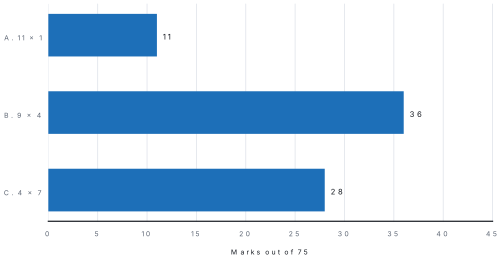
| Group | Questions | Marks each | Total |
|---|---|---|---|
| A. Very short answer | 11 | 1 | 11 |
| B. Short answer | 9 | 4 | 36 |
| C. Long answer | 4 | 7 | 28 |
| Total | 24 | 75 |
This split is the one published by the CDC for the 2080 curriculum and repeated by two education sites I checked. A third source prints the same 75 marks as 11 x 1, 4 x 4 and 8 x 6. If your school's grid differs, keep the models below and change only the numbers of questions: the answering skills are the same.
16.1 Pattern analysis
| Group | Marks | Share of 75 | Where marks are lost |
|---|---|---|---|
| A | 11 | 15% | careless recall of dates, numbers and names |
| B | 36 | 48% | answers with fewer points than the marks ask for |
| C | 28 | 37% | answers with no facts, or without a conclusion |
Group A: 15 minutes. Group B: 9 questions at 8 minutes, 72 minutes. Group C: 4 questions at 18 minutes, 72 minutes. Check: 21 minutes. Do not spend more than two minutes on a 1-mark item.
16.2 Model Set 1
Time: 3 hours. Full marks: 75. Attempt all questions.
Question paper
Group A: Very short answer. [11 x 1 = 11]
- Which agency of socialization is the first and strongest?
- Which organisation publishes the Human Development Index?
- On which date is Unity Day observed?
- Write the full form of CIAA.
- How many members does the National Assembly have?
- Which is the highest peak of Africa?
- In which month and year was the Delhi Agreement signed?
- On which date does Nepal's fiscal year begin?
- Where is the headquarters of UNESCO?
- What was the sex ratio of Nepal in Census 2021?
- What is a social problem?
Group B: Short answer. [9 x 4 = 36]
- Write four national symbols of Nepal with a fact about each. [4]
- What is federalism? Name the three levels of government in Nepal. [4]
- Mention four measures to control sexual abuse. [4]
- State four functions of political parties. [4]
- What is an earthquake? Differentiate between focus and epicentre. [4]
- State four causes of the Second World War. [4]
- A family earns Rs 30,000 a month and spends Rs 22,500.(a) Find the monthly saving.(b) If the yearly saving is deposited at 6% simple interest for 2 years, find the interest. [4]
- Write one function each of WHO, UNESCO, FAO and ILO. [4]
- In Nepal the population aged 0–14 is 27.83%, aged 15–59 is 61.96% and aged 60 and above is 10.21%. Find the dependent population and the dependency ratio. [4]
Group C: Long answer. [4 x 7 = 28]
- Explain the importance of the Kathmandu Valley as a World Heritage Site. [7]
- Describe the structure and functions of the judiciary of Nepal. [7]
- Describe the causes and results of Jana Andolan I (2046 BS). [7]
- Explain the factors affecting the distribution of population in Nepal. [7]
Answers to Model Set 1
1. The family.
2. UNDP (United Nations Development Programme).
3. 27 Poush.
4. Commission for the Investigation of Abuse of Authority.
5. 59.
6. Kilimanjaro (5,895 m).
7. Falgun 2007 BS.
8. 1 Shrawan.
9. Paris.
10. 95.59.
11. A problem that harms many people in society and needs collective action to solve it.
12. (i) The flag: two pennons, adopted in 1962 (crimson with blue border). (ii) The anthem: Sayaun Thunga Phulka (2007). (iii) The national flower is the rhododendron and the national bird is the danphe. (iv) The national animal is the cow, the national colour crimson and the national sport volleyball.
13. Federalism is a system of government in which power is divided among federal, provincial and local governments, each with its own rights. Nepal has the federal government, 7 provincial governments and 753 local governments.
14. (i) Teach children about consent and body safety. (ii) Give counselling to victims and offenders. (iii) Strict and quick justice under the Criminal Code 2074. (iv) Helplines: 100, 1098, 1145; and awareness about online safety.
15. (i) They contest elections for power. (ii) They form the government or serve as the opposition. (iii) They shape public opinion. (iv) They connect citizens with government and train future leaders.
16. An earthquake is the sudden shaking of the ground. The focus is the point underground where the rocks break and energy is released; the epicentre is the point on the surface directly above the focus, where shaking is strongest. Nepal lies on the Indian–Eurasian plate boundary.
17. (i) The harsh Treaty of Versailles left Germany bitter. (ii) The Great Depression caused misery and helped dictators rise. (iii) Dictators (Hitler, Mussolini) chose aggression. (iv) Appeasement by Britain and France, and the invasion of Poland in 1939.
18. (a) Saving = income − expenditure = 30,000 − 22,500 = Rs 7,500. (b) Yearly saving = 7,500 × 12 = Rs 90,000. S.I. = PRT/100 = 90,000 × 6 × 2 / 100 = Rs 10,800.
19. WHO (Geneva) promotes health and fights disease. UNESCO (Paris) works for education, science and culture. FAO (Rome) works for food and agriculture. ILO (Geneva) protects workers' rights and labour standards.
20. Dependent population = 27.83 + 10.21 = 38.04%. Dependency ratio = dependents ÷ working-age × 100 = 38.04 ÷ 61.96 × 100 = 61.4 (about 61 dependents per 100 working-age people).
21. Introduction. The Kathmandu Valley was listed as a World Heritage Site in 1979 for its rich cultural heritage. Seven monument zones. Kathmandu, Patan and Bhaktapur Durbar Squares, Swayambhunath, Boudhanath, Pashupatinath and Changu Narayan. Importance. (i) It carries centuries of art, architecture and religion. (ii) It attracts tourists and gives income and jobs. (iii) The listing brings international help for conservation. (iv) It gives Nepalis a sense of identity and pride. (v) It is a record of history for future generations. Conclusion. We must protect these monuments from decay, encroachment and earthquake damage.
22. Introduction. The judiciary interprets laws and gives justice. Structure. The Supreme Court (the Chief Justice and up to 20 other judges), seven High Courts (one for each province), 77 District Courts and the local Judicial Committees. Functions. (i) Hearing cases and giving justice. (ii) Judicial review: it can declare a law void if it contradicts the Constitution. (iii) Protecting fundamental rights by writs. (iv) Settling disputes among individuals, organisations and governments. Conclusion. An independent judiciary keeps the rule of law.
23. Introduction. Jana Andolan I was the people's movement that began on 7 Falgun 2046 and ended on 26 Chaitra 2046. Causes. (i) Parties had been banned under the Panchayat system since 2017. (ii) The 1980 referendum kept the system by only 54.8%. (iii) People wanted human rights and free speech. Course. The Nepali Congress and the left parties led a joint movement with mass protests. Results. (i) The king lifted the ban on parties. (ii) Multi-party democracy was restored. (iii) The Constitution of 2047 made Nepal a constitutional monarchy. (iv) A general election followed. Conclusion. The movement gave people political freedom.
24. Introduction. Nepal's average density is 198 persons per km², but it varies: Terai 460, Hill 192, Mountain 34; Madhesh 633 (highest province) and Karnali 60 (lowest). Factors. (i) Relief: steep mountains are thinly settled; flat land is crowded. (ii) Climate: mild climates attract people, harsh cold repels. (iii) Soil: fertile plains support agriculture. (iv) Transport: roads and airports attract people. (v) Jobs and services: cities like Kathmandu (5,169 per km²) attract migrants for jobs, schools and hospitals. Conclusion. The uneven distribution can be reduced by building roads, services and industries outside the big cities.
16.3 Model Set 2
Time: 3 hours. Full marks: 75. Attempt all questions.
Question paper
Group A: Very short answer. [11 x 1 = 11]
- From what age is a citizenship certificate issued in Nepal?
- How many Sustainable Development Goals are there?
- Name one wind instrument of Nepal.
- On which date is the World Day against Trafficking in Persons observed?
- What is the term of the House of Representatives?
- By how many degrees Celsius does temperature fall for every 1,000 m of altitude?
- Who was Nepal's first elected Prime Minister?
- What is the rate of VAT in Nepal?
- Where is the headquarters of WHO?
- In which year was Nepal declared polio-free?
- What is remittance?
Group B: Short answer. [9 x 4 = 36]
- Write four things that give Nepal national pride. [4]
- What is HDI? Write the four HDI groups and their ranges. [4]
- Name the four types of Nepali musical instruments with one example of each. [4]
- Write four roles of international organisations in solving social problems. [4]
- What are human rights? Name three bodies that protect them. [4]
- State three ways of showing the scale of a map and two modern mapping technologies. [4]
- Describe Nepal's role in the world wars. [4]
- What is insurance? Explain the terms premium, policy and claim. [4]
- Differentiate between globalisation and localisation. [4]
Group C: Long answer. [4 x 7 = 28]
- Explain federalism in Nepal: its meaning, structure and advantages. [7]
- What is corruption? Explain its causes, effects and measures to control it. [7]
- Why is Nepal at risk of earthquakes? Describe the effects and safety measures. [7]
- Explain the importance of hydropower in the economy of Nepal. [7]
Answers to Model Set 2
1. 16 years.
2. 17.
3. Bansuri (or narsingha).
4. 30 July.
5. Five years.
6. 6.5 °C.
7. B. P. Koirala.
8. 13%.
9. Geneva.
10. 2014.
11. Money sent home by Nepalis working abroad.
12. (i) Sagarmatha, the highest peak (8,848.86 m). (ii) Lumbini, the birthplace of Buddha. (iii) The monuments of the Kathmandu Valley and the Janaki Temple. (iv) Great persons and our rich culture.
13. HDI (Human Development Index) is a measure of development combining health, education and standard of living, from 0 to 1. Very high: 0.800 and above; high: 0.700–0.799; medium: 0.550–0.699; low: below 0.550. (Nepal, 0.622, is in the medium group.)
14. String: sarangi. Wind: bansuri or narsingha. Drum: madal, damphu or dhime. Cymbal: jhyali.
15. They (i) give money and technical help, (ii) set standards and laws, (iii) rescue and rehabilitate victims, and (iv) monitor and report progress. Examples: UNICEF for children, ILO for workers, UN Women for women's rights, IOM for migrants.
16. Human rights are the inherent rights of all people simply because they are human. They are protected by the National Human Rights Commission, the courts, NGOs and UN bodies. (The UDHR was adopted on 10 December 1948.)
17. Scale may be shown as a statement (1 cm = 1 km), a representative fraction (RF, 1:100,000) or a graphic scale. Modern mapping uses remote sensing and GIS (also aerial photos and GPS).
18. Gurkhas of Nepal served with Britain in both wars: about 200,000 in the First and about 250,000 in the Second, and many died. Nepal supported the Allies, and Britain recognised Nepal's independence in 1923.
19. Insurance is an agreement under which a company pays for a loss in return for regular payments. The premium is the amount paid regularly; the policy is the written contract; the claim is the request for payment when a loss occurs. Types: life and non-life.
20. Globalisation is the growing worldwide connection of trade, ideas and people; it helps trade, technology and remittance but increases inequality and threatens local culture. Localisation is the protection and promotion of local products, culture and decisions; it keeps identity and supports local producers.
21. Meaning. Federalism is a system in which power is divided among federal, provincial and local governments. Nepal was declared a federal democratic republic on 15 Jestha 2065, and the Constitution was promulgated on 3 Ashwin 2072. Structure. 1 federal government, 7 provincial governments and 753 local governments (6 metropolitan cities, 11 sub-metropolitan cities, 276 municipalities and 460 rural municipalities). Advantages. (i) Decisions are taken closer to the people. (ii) Local needs are better met. (iii) People take part in planning. (iv) Regions develop more evenly. (v) Diverse groups get a share of power. Conclusion. Federalism needs trained staff and fair resource sharing to succeed.
22. Meaning. Corruption is the misuse of power for personal gain. Causes. Greed, weak laws, low pay, lack of awareness and political protection. Effects. Wasted public money, poor roads and services, unfair opportunities, loss of trust and slow development; Nepal scored 34 out of 100 in CPI 2024. Measures. (i) A strong CIAA (anti-corruption body) and the Prevention of Corruption Act 2059. (ii) The Right to Information Act 2064. (iii) Education in honesty and public awareness. (iv) Quick, equal punishment. Conclusion. Control needs both laws and a change in attitudes.
23. Risk. Nepal lies on the boundary of the Indian and Eurasian plates, which keep pushing against each other, so the ground shakes. Major earthquakes occurred in 1934, 1988 and 2015 (magnitude 7.8). Effects. Deaths and injuries, destroyed houses and heritage, landslides, loss of jobs and long recovery. Safety. (i) Drop, cover and hold during shaking. (ii) Build to the building code. (iii) Keep an emergency kit and a family plan. (iv) Go to an open space after shaking stops. Conclusion. Preparation saves more lives than rescue after the quake.
24. Introduction. Nepal has about 83,000 MW of hydropower potential, of which about 42,000 MW is considered viable; installed capacity is about 3,500 MW. Importance. (i) It gives cheap, clean electricity for homes and industry. (ii) It replaces imported fuel. (iii) Exports bring income: to India since 2021 and to Bangladesh since 2025. (iv) Projects such as Upper Tamakoshi (456 MW) create jobs. (v) It supports tourism and irrigation. Conclusion. Using more of the potential, with care for the environment, can speed up the economy.
16.4 Predicted questions
These are not forecasts. Ranks follow two reasons: how much of the syllabus a topic can carry (the units' reported hours) and how often a question type is asked (every paper has Groups A, B and C). A topic ranked low is not unimportant. A topic that has just appeared in a past paper is not "used up" either; examiners do not follow a rotation that anyone outside the board knows.
Tier A: practise before anything else
| Rank | Question | Reason |
|---|---|---|
| 1 | Federalism, the Constitution and the three organs (Units 2 and 5) | Longest units; fit 7-mark answers |
| 2 | Social problems: causes, effects, solutions (Unit 4) | Every problem has a three-part answer |
| 3 | Events of 2007, 2046 and 2062/63 BS and the republic (Unit 7) | Dates and results make good long answers |
| 4 | Population: composition, density and distribution with calculations (Unit 10) | Numbers allow 4-mark calculations |
| 5 | Interest, saving, budget or growth rate calculations (Units 8 and 10) | Fast marks if the formula is known |
| 6 | The United Nations, its organs and agencies (Unit 9) | Many facts per question |
| 7 | Climate factors, earthquakes and map work (Unit 6) | Second-longest unit |
| 8 | Group A facts: dates, numbers, headquarters, full forms | Eleven sure marks |
Tier B: likely second line
| Rank | Question | Reason |
|---|---|---|
| 9 | Hydropower, tourism and employment (Unit 8) | Economy topics with figures |
| 10 | Human rights, consumer rights and elections (Unit 5) | Rights lists make 4-mark answers |
| 11 | Heritage sites, folk songs, instruments and dances (Unit 3) | Lists and one-mark facts |
| 12 | HDI, SDGs and national pride projects (Unit 2) | Definitions and examples |
| 13 | Socialization, identity and national symbols (Unit 1) | Short unit; Group A friendly |
| 14 | World wars: causes and results (Unit 7) | Standard long answers |
Tier C: smaller but still in the syllabus
| Rank | Question | Reason |
|---|---|---|
| 15 | Globalisation, localisation and ICT (Unit 9) | Compare-and-contrast items |
| 16 | Insurance, cooperatives and financial instruments (Unit 8) | Definitions |
| 17 | Population and environment, community health (Unit 10) | Short answers |
| 18 | Continents: North America, South America, Africa (Unit 6) | Relief and climate points |
| 19 | Problem-solving steps and the problem tree (Unit 4) | A 4-mark answer |
Week 1: write one 7-mark answer from each of Units 2, 4, 5, 7, 9 and 10, and do all the calculations once. Week 2: do one full model set in three hours; then read the Group A facts of Chapter 14 daily.
Chapter summary
- The paper is Group A (11 x 1) + Group B (9 x 4) + Group C (4 x 7) = 75 marks in 3 hours, per the CDC grid for the 2080 curriculum; check your school's grid for any difference.
- A 4-mark answer needs four points; a 7-mark answer needs an introduction, five facts and a conclusion.
- Calculations to know: S.I. = PRT/100; A = P(1 + R/100)ⁿ; growth rate = (CBR − CDR)/10; density = population ÷ area; dependency ratio = dependents ÷ working-age × 100.
- Facts to know: 7 provinces, 753 local levels, HoR 275, NA 59, 17 SDGs, UN 1945/193 members, Nepal in the UN 1955.
- The rankings above come from the grid and the syllabus, not from any knowledge of the paper.
Practice questions
Group A: Very short answer (1 mark each)
- What is the full form of UNDP? [1]
- On which date is Democracy Day observed? [1]
- What is the population density of Nepal in the book? [1]
Answers to Group A
1. United Nations Development Programme.
2. 7 Falgun.
3. 198 persons per square km.
Group B: Short answer (4 marks each)
- Find the compound interest on Rs 20,000 at 10% a year for 2 years. [4]
- State four effects of climate on human life. [4]
Answers to Group B
1. A = 20,000 × (1.1)² = 20,000 × 1.21 = Rs 24,200. Compound interest = 24,200 − 20,000 = Rs 4,200.
2. Climate and relief decide vegetation and wildlife, the density of population (monsoon plains hold the densest populations), clothing and food, and the kind of work people do.
Group C: Long answer (7 marks each)
- Explain the role of the three organs of the state. [7]
Answers to Group C
1. Introduction: the Constitution of Nepal 2072 divides state power among three organs. The legislature (the Federal Parliament: President, House of Representatives of 275 and National Assembly of 59) makes laws and approves the budget. The executive (the President as head of state, the Prime Minister and a Council of Ministers of not more than 25) carries out laws and policies and presents the budget on 15 Jestha. The judiciary (Supreme Court, 7 High Courts, 77 District Courts) interprets laws, gives justice and protects rights. Conclusion: the separation of powers prevents misuse of power.