Unit 3 · Botany · 21 teaching hours · 50 min read
Genetics
What the syllabus asks for 4
- Genetic Materials
- Mendelian genetics
- Linkage and crossing over
- Mutation and polyploidy
Genetics is the study of heredity and variation — how a Pisum sativum plant in Mendel's monastery garden passes "tallness" to its offspring, and why the offspring are never quite identical to the parents. This unit works from the molecule upwards. First we ask what the hereditary material actually is and how it copies and expresses itself. Then we follow Mendel's crosses and the rules they yield, the exceptions to those rules, and what happens when genes travel together on one chromosome or when the material itself is damaged.
Genetics carries the most marks of any Botany unit (21 hours). Four things come almost every year: a labelled DNA / replication / translation diagram; a worked cross — you must draw the Punnett square, not just quote the ratio; a difference table (DNA vs RNA, linkage vs crossing over, mitosis vs meiosis, autopolyploidy vs allopolyploidy); and a numerical or pedigree problem. Show parental genotypes, gametes, the square, and the ratio. Marks are given for each of those four steps, so never jump straight to the answer.
3.1 Genetic Materials
Discovery of the genetic material
By 1900 it was clear that chromosomes carry heredity, but chromosomes contain both protein and DNA, and protein — with its twenty different amino acids — looked like the better candidate. Four experiments settled it.
Griffith (1928) — transformation. Frederick Griffith worked with Streptococcus pneumoniae, which occurs in two strains: the S strain (smooth, capsulated, virulent) and the R strain (rough, non-capsulated, avirulent). Mice injected with live S bacteria died; live R bacteria, or heat-killed S bacteria alone, were harmless. But a mixture of heat-killed S and live R killed the mice, and live S bacteria were recovered from their bodies. Some "transforming principle" had passed from the dead S cells into the living R cells and changed them permanently.
Avery, MacLeod and McCarty (1944). They repeated Griffith's experiment in a test tube and destroyed each class of molecule in turn. Protease and RNase did not stop transformation; DNase did. The transforming principle was DNA.
Hershey and Chase (1952). They grew bacteriophage T2 in medium containing radioactive ³²P (which labels DNA, because only DNA has phosphorus) or ³⁵S (which labels protein, because only protein has sulphur). Phages were allowed to infect Escherichia coli, the empty phage coats were stripped off in a blender and the cells spun down. The ³²P was found inside the bacteria and in the next generation of phages; the ³⁵S stayed outside. Only DNA entered the host, so DNA is the genetic material.
Fraenkel-Conrat and Singer (1957). In tobacco mosaic virus, which has no DNA, reconstituted viruses always produced the type of the RNA donor, not the protein donor. So in some viruses RNA is the genetic material.
A genetic material must (i) replicate accurately, (ii) be chemically and structurally stable, (iii) carry information, and (iv) allow slow change (mutation) so that evolution is possible. DNA satisfies all four. RNA has a reactive 2′-OH group and is far less stable, which is why RNA is used only as a short-lived messenger in cellular organisms.
Chemical structure of DNA
DNA is a polymer of nucleotides. Each nucleotide has three parts: a phosphate group, a pentose sugar (deoxyribose in DNA) and a nitrogenous base. A base joined to a sugar alone is a nucleoside; add the phosphate and it becomes a nucleotide.
The bases are of two kinds. Purines — adenine (A) and guanine (G) — have a double ring (a six-membered ring fused to a five-membered ring). Pyrimidines — cytosine (C), thymine (T) in DNA and uracil (U) in RNA — have a single six-membered ring.
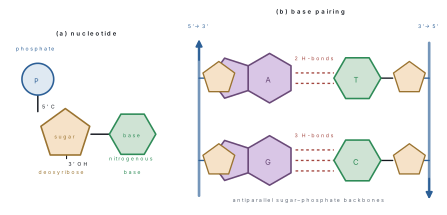
Nucleotides are joined into a chain by phosphodiester bonds, which link the 3′ carbon of one sugar to the 5′ carbon of the next through a phosphate. Every DNA strand therefore has a free phosphate at one end (the 5′ end) and a free hydroxyl at the other (the 3′ end), and so has direction.
Chargaff's rules (1950). Erwin Chargaff analysed DNA from many species and found that the amount of adenine always equals thymine and guanine always equals cytosine:
that is, purines = pyrimidines. The ratio (A+T)/(G+C), however, differs from species to species.
The Watson–Crick double helix
Using Chargaff's data and the X-ray diffraction photographs of Rosalind Franklin and Maurice Wilkins, James Watson and Francis Crick proposed the double-helix model in 1953 (Nobel Prize, 1962). Its features:
- Two polynucleotide chains are coiled round a common axis to form a right-handed helix.
- The chains are antiparallel: one runs 5′→3′, the other 3′→5′.
- Sugar–phosphate backbones lie outside; the bases project inwards, perpendicular to the axis.
- Bases pair by hydrogen bonds — A with T (two bonds), G with C (three). A purine always pairs with a pyrimidine, so the width of the helix is constant.
- Diameter 2 nm; one complete turn (pitch) is 3.4 nm and contains 10 base pairs, so adjacent base pairs are 0.34 nm apart.
- The coiling produces a wide major groove and a narrow minor groove, where regulatory proteins bind.
- The two strands are complementary: the sequence of one fixes the sequence of the other. This is the chemical basis of accurate copying.
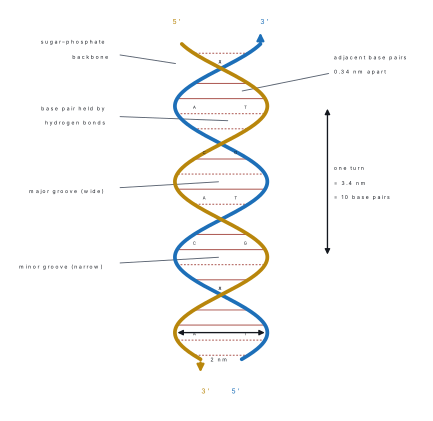
A–T has two hydrogen bonds and G–C has three. DNA rich in G–C therefore needs a higher temperature to melt (denature). Writing "A=T by three bonds" loses a mark every time.
RNA and its types
RNA differs from DNA in the sugar (ribose), one base (uracil replaces thymine) and usually in being single-stranded.
| Feature | DNA | RNA |
|---|---|---|
| Sugar | deoxyribose (no 2′-OH) | ribose (2′-OH present) |
| Bases | A, G, C, T | A, G, C, U |
| Strands | double, helical | mostly single |
| Occurrence | nucleus, mitochondria, plastids | nucleus and cytoplasm |
| Amount in a cell | constant | varies with protein synthesis |
| Stability | very stable | unstable, short-lived |
| Chargaff's rule | obeyed (A=T, G=C) | not obeyed |
| Function | stores genetic information | expresses it (and is genetic material in some viruses) |
| Hydrolysed by | DNase | RNase |
Three classes of RNA take part in protein synthesis:
- mRNA (messenger RNA, ~3–5%) carries the copy of the gene from nucleus to ribosome. Its bases are read in threes as codons.
- tRNA (transfer RNA, ~15%) is the adapter. It is the smallest RNA (~75–90 nucleotides), folds into a clover-leaf shape with an anticodon loop at one end and the amino-acid attachment site (the sequence –CCA) at its 3′ end. There is at least one tRNA for each of the 20 amino acids.
- rRNA (ribosomal RNA, ~80%) combines with protein to build the ribosome and has catalytic (ribozyme) activity — the peptide bond itself is made by rRNA.
DNA replication
Replication is semi-conservative: the two strands separate and each acts as a template, so every daughter molecule has one old (parental) and one new strand. This was proved by Meselson and Stahl (1958), who grew E. coli for many generations in medium containing heavy ¹⁵N, then transferred it to ordinary ¹⁴N. After one generation all the DNA was of intermediate density (hybrid); after two generations half was hybrid and half was light. Neither the conservative nor the dispersive model predicts this pattern.
Replication begins at a fixed sequence called the origin of replication and proceeds at a Y-shaped replication fork. The chief enzymes are:
| Enzyme | Function |
|---|---|
| Helicase | unwinds the double helix, breaking hydrogen bonds |
| Topoisomerase (gyrase) | relieves the supercoiling ahead of the fork |
| SSB proteins | hold the separated strands apart |
| Primase | lays down a short RNA primer with a free 3′-OH |
| DNA polymerase III | adds deoxyribonucleotides 5′→3′; main elongating enzyme |
| DNA polymerase I | removes the RNA primer and fills the gap with DNA |
| DNA ligase | seals the nicks by forming phosphodiester bonds |
Because DNA polymerase can add nucleotides only to a free 3′-OH end, it can synthesise only in the 5′→3′ direction. On the strand whose template runs 3′→5′ towards the fork, synthesis is smooth and continuous — the leading strand. On the other template the enzyme must work away from the fork, so it makes short pieces of 1000–2000 nucleotides called Okazaki fragments which are later joined by ligase — the lagging strand. Replication is therefore semi-discontinuous.
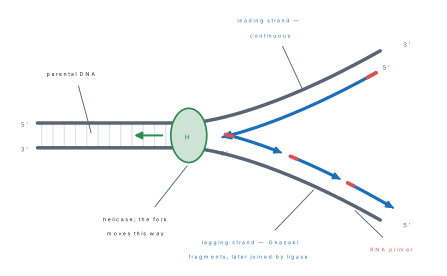
The new strand is always built 5′→3′; the template is read 3′→5′. Saying "the lagging strand is made 3′→5′" is wrong — each Okazaki fragment is itself made 5′→3′; it is only the overall growth of the lagging strand that runs away from the fork.
From gene to protein — the central dogma
Crick's central dogma (1958) states the flow of information:
DNA --replication--> DNA --transcription--> RNA --translation--> protein
In retroviruses such as HIV the flow is partly reversed: reverse transcriptase copies RNA back into DNA (Temin and Baltimore, 1970).
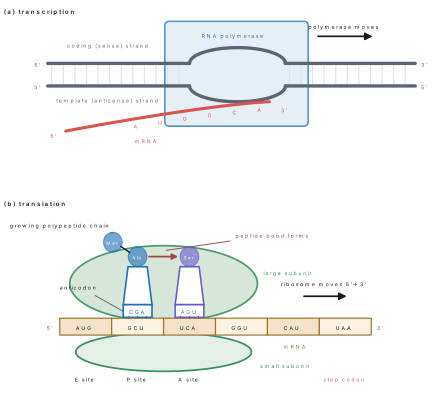
Transcription is the copying of one strand of a gene into RNA. Only one strand, the template (antisense) strand, is copied; the other, the coding (sense) strand, has the same sequence as the mRNA except that T replaces U. RNA polymerase binds the promoter, unwinds a short stretch, and adds ribonucleotides 5′→3′ until it meets the terminator. In eukaryotes the first transcript (hnRNA) is then processed: a 5′ cap is added, a poly-A tail is added at the 3′ end, and the non-coding introns are cut out while the coding exons are joined — splicing.
| Replication | Transcription | |
|---|---|---|
| Product | two DNA molecules | one RNA molecule |
| Template used | both strands | one strand only |
| Enzyme | DNA polymerase | RNA polymerase |
| Primer | RNA primer needed | not needed |
| Raw material | deoxyribonucleotides | ribonucleotides |
| Base inserted opposite A | T | U |
| Extent | the whole genome | one gene or operon |
| Occurs in | S phase of the cell cycle | as and when a product is needed |
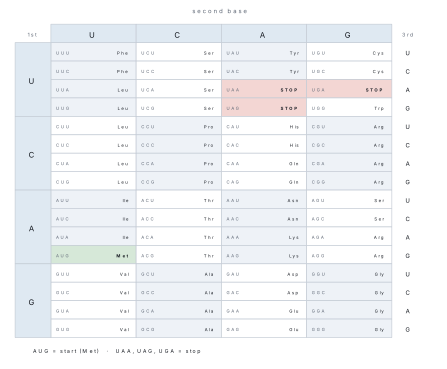
The genetic code. The message is read in non-overlapping groups of three bases called codons. With four bases there are 4^{3} = 64 codons — 61 sense codons that specify amino acids and 3 stop (nonsense) codons, UAA, UAG and UGA. AUG is both the start codon and the codon for methionine. The code was cracked by Nirenberg and Matthaei (poly-U gave polyphenylalanine), Khorana and Holley.
Its properties: it is triplet, non-overlapping, comma-less (read continuously from a fixed starting point), degenerate (most amino acids have more than one codon — only methionine and tryptophan have a single codon), unambiguous (one codon never codes for two amino acids) and almost universal (the same in Escherichia coli, in rice and in humans, with minor exceptions in mitochondria).
Translation builds the polypeptide on the ribosome (70S in prokaryotes, 80S in eukaryotes) in four steps:
- Activation. Each amino acid is joined to its own tRNA by an aminoacyl-tRNA synthetase, using ATP, giving aminoacyl-tRNA.
- Initiation. The small ribosomal subunit binds the mRNA and moves to the AUG start codon; the initiator tRNA (carrying formyl-methionine in bacteria) pairs with it; the large subunit joins, placing this tRNA in the P site.
- Elongation. The next aminoacyl-tRNA enters the A site, its anticodon pairing with the codon. Peptidyl transferase (an rRNA ribozyme) forms the peptide bond, and the ribosome translocates one codon along the mRNA; the empty tRNA leaves from the E site.
- Termination. When a stop codon reaches the A site no tRNA fits; a release factor binds, the polypeptide is freed and the ribosome dissociates.
Several ribosomes usually translate one mRNA at once, forming a polysome.
The gene
A gene is a segment of DNA that carries the information for one polypeptide or one functional RNA. In the classical (Mendelian) sense it is the unit of inheritance occupying a fixed position, the locus, on a chromosome; alternative forms of a gene at the same locus are alleles. In molecular terms the unit of function is the cistron, the smallest unit of mutation the muton and of recombination the recon. Eukaryotic genes are usually split genes — coding exons interrupted by non-coding introns.
3.2 Mendelian genetics
Mendel and his material
Gregor Johann Mendel (1822–1884), an Austrian monk, worked on the garden pea Pisum sativum between 1856 and 1863 and published Experiments in Plant Hybridisation in 1866. His results were ignored until 1900, when de Vries, Correns and Tschermak rediscovered them independently. He succeeded where others had failed because of four decisions:
- He chose one pair of contrasting characters at a time, instead of comparing whole plants.
- He used pure (true-breeding) lines, obtained by self-pollinating for several generations before starting.
- He counted the offspring and treated the counts mathematically.
- He followed the cross for more than one generation (F₁, F₂, F₃).
Pisum sativum itself was a lucky choice: it is naturally self-pollinating (the keel encloses the stamens and stigma), so pure lines are easy to keep; it can be cross-pollinated by hand after emasculation; it has a short life cycle and many seeds per plant; and it showed seven clear-cut pairs of characters.
| Character | Dominant | Recessive |
|---|---|---|
| Stem height | tall | dwarf |
| Flower position | axial | terminal |
| Flower colour | violet | white |
| Pod shape | inflated | constricted |
| Pod colour | green | yellow |
| Seed shape | round | wrinkled |
| Cotyledon colour | yellow | green |
Gene — a unit of inheritance, a DNA segment at a fixed locus. Allele — one of the alternative forms of a gene (T and t). Dominant — the allele expressed in the heterozygote; recessive — the one masked in it. Homozygous (TT, tt) — both alleles alike; heterozygous (Tt) — alleles different. Genotype — the genetic constitution; phenotype — the appearance. Monohybrid cross — a cross following one character; dihybrid — two. Back cross — F₁ crossed with either parent; test cross — F₁ crossed with the homozygous recessive parent.
Monohybrid cross and the first two laws
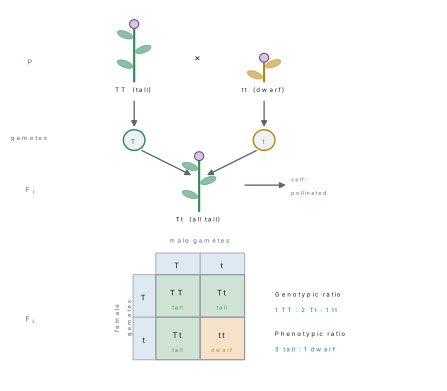
Mendel crossed a pure tall plant (TT) with a pure dwarf (tt). All the F₁ were tall. When these F₁ plants were self-pollinated, the F₂ contained tall and dwarf plants in the ratio 3 : 1 (Mendel counted 787 tall : 277 dwarf, a ratio of 2.84 : 1). The dwarf character had not been destroyed in F₁; it had only been hidden.
Two laws follow.
Law of dominance. When two contrasting alleles are brought together in a hybrid, only one — the dominant — is expressed; the other, the recessive, remains unexpressed but unchanged.
Law of segregation (law of purity of gametes). The two alleles of a pair separate from each other during gamete formation, so that every gamete receives only one of them. A gamete is never hybrid.
The cytological basis is anaphase I of meiosis, when the two homologous chromosomes carrying T and t move to opposite poles.
Problem. A pure tall pea plant is crossed with a dwarf one. The F₁ plants are self-pollinated and give 1,200 F₂ plants. (a) How many are expected to be tall and how many dwarf? (b) How many of the tall plants breed true? (c) If one tall F₂ plant is picked at random, what is the probability that it is heterozygous?
Solution.
P: TT × tt → F₁ all Tt (tall). F₁ selfed: Tt × tt is not the cross — it is Tt × Tt, giving the genotypic ratio 1 TT : 2 Tt : 1 tt.
(a) Phenotypes are 3 tall : 1 dwarf, so
(b) True-breeding tall plants are TT, which is 1/4 of the F₂:
(c) Among the 900 tall plants, 300 are TT and 600 are Tt, so
Test cross and back cross
A tall plant may be TT or Tt, and the two look identical. The genotype is revealed by a test cross — crossing the individual with the homozygous recessive (dwarf). If the plant is TT, every offspring is tall; if it is Tt, the offspring are 1 tall : 1 dwarf. The test cross therefore converts a hidden genotype into a visible ratio, and the F₁ ratio is a direct copy of the gamete ratio of the unknown parent.
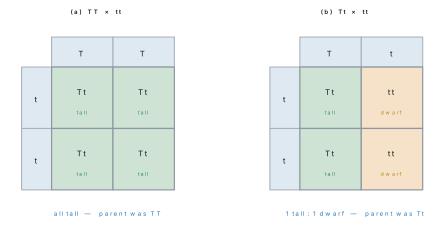
Every test cross is a back cross, but not every back cross is a test cross. A back cross uses either parent; a test cross uses only the homozygous recessive parent. If the question says "test cross", the second parent must be the recessive one.
Problem. A pea plant with violet flowers, whose genotype is unknown, is test crossed. Out of 80 offspring, 38 have violet flowers and 42 have white flowers. (a) What was the genotype of the violet parent? (b) What proportion of gametes of that parent carried the recessive allele?
Solution. Let V = violet (dominant), v = white. The tester is vv.
The offspring are close to 1 violet : 1 white. If the parent had been VV, every offspring would have received a V and all would be violet. A 1 : 1 ratio can only come from a parent producing two kinds of gametes in equal numbers, so the parent was Vv.
(b) Half the gametes carried v, i.e. 50 %. The observed 38 : 42 is a normal sampling deviation from the expected 40 : 40.
Dihybrid cross and independent assortment
Mendel next followed two characters at once. He crossed a pure round-yellow seeded plant (RRYY) with a pure wrinkled-green one (rryy). All F₁ seeds were round and yellow (RrYy). Selfing the F₁ gave four phenotypes in the ratio 9 round yellow : 3 round green : 3 wrinkled yellow : 1 wrinkled green.
A double heterozygote RrYy makes 2^{2} = 4 kinds of gamete — RY, Ry, rY and ry — in equal numbers, because the R/r pair segregates independently of the Y/y pair. Combining four kinds of male gamete with four kinds of female gamete gives the 16 boxes of the Punnett square.
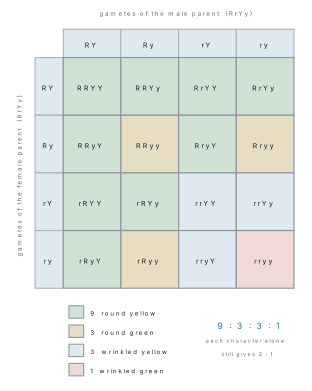
Law of independent assortment. When two pairs of contrasting characters are followed together, the members of one pair assort into the gametes independently of the members of the other pair. Consequently, every possible combination of alleles appears in the gametes with equal frequency.
Notice that each character taken separately still shows 3 : 1 — in the 16 boxes there are 12 round : 4 wrinkled and 12 yellow : 4 green. The 9 : 3 : 3 : 1 ratio is simply (3:1)\times(3:1). This is the product rule: the probability of two independent events happening together is the product of their separate probabilities.
| Number of heterozygous pairs, n | Kinds of gamete | F₂ phenotypes | F₂ genotypes | Size of Punnett square |
|---|---|---|---|---|
| 1 | 2 | 2 | 3 | 4 |
| 2 | 4 | 4 | 9 | 16 |
| 3 | 8 | 8 | 27 | 64 |
| n | 2^{n} | 2^{n} | 3^{n} | 4^{n} |
Problem. In Pisum sativum, round (R) is dominant to wrinkled (r) and yellow (Y) to green (y). A plant of genotype RrYy is self-pollinated and produces 1,600 seeds. Find (a) the number of seeds in each of the four phenotypic classes, (b) the number of seeds of genotype RrYy, and (c) the probability that a randomly chosen round yellow seed is homozygous for both genes.
Solution. RrYy × RrYy gives 9 : 3 : 3 : 1 out of 16.
(a) Multiply each fraction by 1600:
(b) For one gene, Rr × Rr gives Rr with probability 1/2; likewise Yy. By the product rule,
(c) Round yellow seeds are 9 of the 16 boxes; only one of those boxes is RRYY. So
Testing a ratio: the chi-square test
Real counts never match the expected ratio exactly. The chi-square (\chi^2) goodness-of-fit test decides whether the difference is small enough to be due to chance.
where O is the observed number and E the expected number in each class. The degrees of freedom are df = n - 1, where n is the number of classes. Compare the calculated value with the critical value at the 5 % level:
| df | 1 | 2 | 3 | 4 | 5 |
|---|---|---|---|---|---|
| Critical \chi^{2} at p = 0.05 | 3.841 | 5.991 | 7.815 | 9.488 | 11.070 |
If calculated \chi^{2} is less than the critical value, the deviation is not significant and the hypothesis (the expected ratio) is accepted.
Problem. Mendel's F₂ from a dihybrid cross gave 315 round yellow, 108 round green, 101 wrinkled yellow and 32 wrinkled green seeds, a total of 556. Test whether these agree with a 9 : 3 : 3 : 1 ratio.
Solution. Expected numbers are \frac{9}{16}, \frac{3}{16}, \frac{3}{16}, \frac{1}{16} of 556:
| Class | O | E | O-E | (O-E)^2/E |
|---|---|---|---|---|
| Round yellow | 315 | 312.75 | +2.25 | 0.016 |
| Round green | 108 | 104.25 | +3.75 | 0.135 |
| Wrinkled yellow | 101 | 104.25 | −3.25 | 0.101 |
| Wrinkled green | 32 | 34.75 | −2.75 | 0.218 |
| Total | 556 | 556 | 0 | 0.470 |
There are 4 classes, so df = 4 - 1 = 3 and the critical value at p = 0.05 is 7.815. Since 0.470 < 7.815, the deviation is not significant: the data agree with the 9 : 3 : 3 : 1 ratio.
O and E must be actual counts of individuals. Feeding percentages or fractions into the formula gives a meaningless answer. Also, E is calculated from the same total as O — the two columns must add to the same number.
Deviations from Mendelism
Incomplete dominance. Neither allele is fully dominant, and the heterozygote is intermediate. In the four o'clock plant Mirabilis jalapa (and in Antirrhinum majus, the snapdragon), red (RR) × white (rr) gives pink (Rr). Selfing the F₁ gives 1 red : 2 pink : 1 white — the phenotypic ratio is now the same as the genotypic ratio, 1 : 2 : 1.
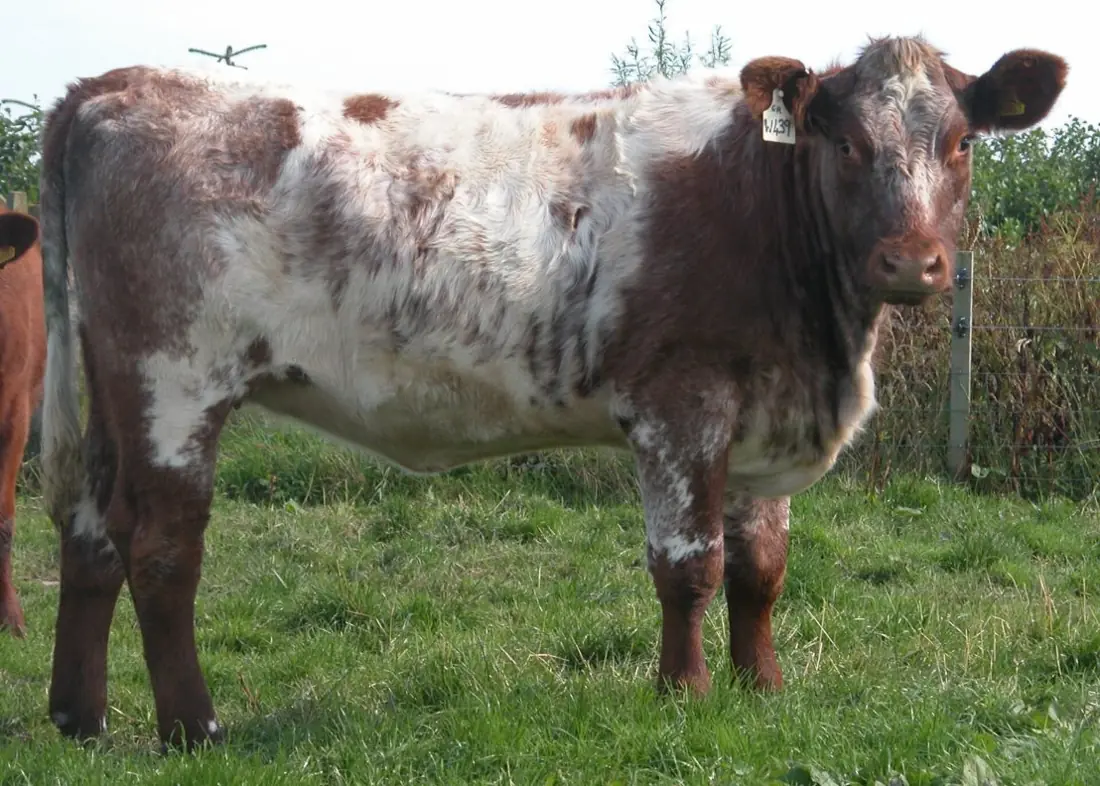
Codominance. Both alleles are fully expressed in the heterozygote, side by side, without blending. In cattle, red (C^R^C^R^) × white (C^W^C^W^) gives roan — a coat with red hairs and white hairs mixed, not pink hairs. In humans the I^A^I^B^ genotype gives blood group AB, with both A and B antigens on the red cells.
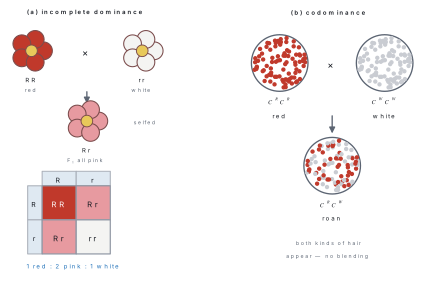
Multiple alleles. A gene may have more than two alleles in the population, although any one diploid individual carries only two of them. The standard example is the human ABO blood group, controlled by the gene I with three alleles: I^A^, I^B^ and i. I^A^ and I^B^ are codominant with each other and both are dominant over i.
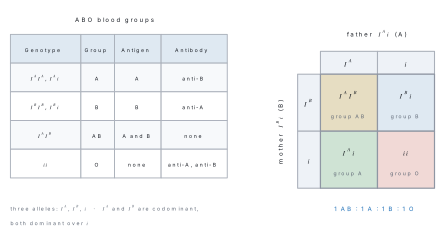
Problem. A woman of blood group O gives birth to a child of blood group B. She names a man of blood group AB as the father, but he denies it and points to another man of group O. (a) Can the AB man be the father? (b) Can the O man be the father? (c) If a group A man (heterozygous) marries a group B woman (heterozygous), what is the chance that their first child is group O?
Solution.
(a) Mother is group O = ii, so she can give only i. The child is group B, which must be I^B^I^B^ or I^B^i. Since one allele came from the mother and it was i, the child must be I^B^i, and the I^B^ came from the father. The AB man is I^A^I^B^ and can donate I^B^. Yes — he could be the father.
(b) A group O man is ii and can donate only i. A child of ii × ii is always ii, i.e. group O. No — the group O man cannot be the father.
(c) I^A^i × I^B^i gives four equally likely genotypes: I^A^I^B^ (AB), I^A^i (A), I^B^i (B) and ii (O). So
A blood-group test can show that a man cannot be the father. It can never prove that he is, because millions of other men share the same group. Write "could be" and "cannot be", never "is".
Lethal genes. Some alleles kill the homozygote. In maize and in snapdragon, chlorophyll-deficient seedlings die, so a cross between two heterozygous green plants gives 3 green : 1 white, but the white ones die and the surviving ratio becomes 2 green : 1 white-carrier green, i.e. a modified 2 : 1 ratio.
Sex determination
Sex is decided by a special pair of chromosomes, the sex chromosomes or allosomes; the rest are autosomes. Humans have 22 pairs of autosomes plus one pair of sex chromosomes (44 + XX in the female, 44 + XY in the male).
| Type | Female | Male | Examples |
|---|---|---|---|
| XX–XY | XX (homogametic) | XY (heterogametic) | humans, Drosophila, Melandrium album |
| XX–XO | XX | XO (one X, no Y) | grasshopper, cockroach, Dioscorea |
| ZZ–ZW | ZW (heterogametic) | ZZ | birds, butterflies, some fish |
| Haplo-diploid | diploid (fertilised egg) | haploid (unfertilised egg) | honey bee, ant, wasp |
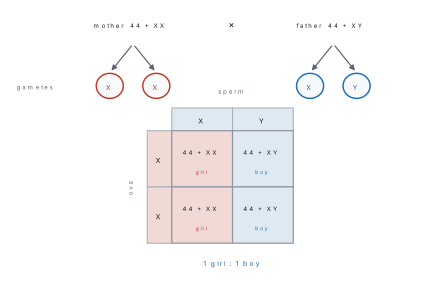
Because the mother can give only an X, the sex of the child is decided by the father's sperm. Blaming the mother for the sex of a baby, still common in parts of Nepal, has no biological basis.
Sex-linked inheritance
Genes on the X chromosome, other than in the tiny region it shares with Y, have no partner allele in the male. A male is therefore hemizygous: a single recessive allele on his one X is enough to show the character. This is why red–green colour blindness and haemophilia are far commoner in men.
The pattern is called criss-cross inheritance: an affected father passes the allele to all his daughters (who become carriers) but to none of his sons; a carrier mother passes it to half her sons, who are affected.
Problem. A woman with normal colour vision, whose father was colour blind, marries a man with normal colour vision. Using X^C^ for the normal allele and X^c^ for the colour-blind allele, find (a) the genotypes of the parents, (b) the expected proportion of colour-blind children, and (c) the probability that their first son is colour blind.
Solution.
(a) Her father was X^c^Y. A father gives his only X to every daughter, so she received X^c^ from him and X^C^ from her mother. She is a carrier, X^C^X^c^. Her husband has normal vision, so he is X^C^Y.
(b) The cross X^C^X^c^ × X^C^Y gives four equally likely offspring:
| X^C^ (from father) | Y (from father) | |
|---|---|---|
| X^C^ | X^C^X^C^ normal girl | X^C^Y normal boy |
| X^c^ | X^C^X^c^ carrier girl | X^c^Y colour-blind boy |
One of the four is colour blind, so
All the daughters see normally, though half of them are carriers.
(c) Among sons only, half are X^c^Y:
Pedigree analysis
A pedigree is a family tree drawn with standard symbols. It is the geneticist's substitute for a controlled cross in humans, where crosses cannot be arranged.
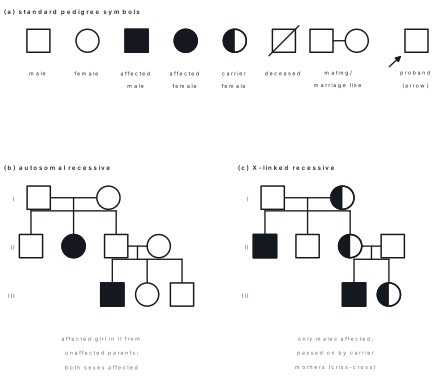
Reading a pedigree follows four questions, in this order:
- Does the trait appear in every generation? If yes, suspect dominant; if it skips a generation, suspect recessive.
- Do two unaffected parents have an affected child? If yes, the trait is certainly recessive and the parents are carriers.
- Are both sexes affected equally? If yes, the gene is autosomal; if almost all the affected are male, suspect X-linked.
- Does an affected father pass it to every daughter but no son? That is the signature of an X-linked gene.
Problem. In figure (b) above, an unaffected couple in generation I have an affected daughter (II-2). Their unaffected son (II-3) marries an unrelated unaffected woman and they have an affected son (III-1). (a) Is the gene dominant or recessive, autosomal or sex-linked? (b) Give the genotypes of the couple in generation I. (c) If the couple II-3 × II-4 have another child, what is the probability that it is affected?
Solution. Let the alleles be A (normal) and a (affected).
(a) Two unaffected parents in generation I produced an affected daughter. A trait that is absent in the parents but present in the child must be recessive. It cannot be X-linked recessive, because an X-linked recessive daughter would need an affected father (she gets one X from him), and her father is normal. So the gene is autosomal recessive.
(b) Each parent in generation I is unaffected but has passed an a allele to II-2, who is aa. Both must therefore be heterozygous: Aa × Aa.
(c) II-3 is unaffected and comes from Aa × Aa, so he is Aa with probability 2/3 and AA with probability 1/3. His wife II-4 must also be a carrier, because their son III-1 is aa — so she is Aa for certain, and II-3 must in fact also be Aa (he gave an a to III-1). For a known Aa × Aa couple,
3.3 Linkage and crossing over
Linkage
Mendel's third law works only for genes on different chromosomes. Each chromosome carries hundreds of genes, and genes on the same chromosome travel together into the same gamete. This tendency is linkage.
The first evidence came from Bateson and Punnett (1906) working on the sweet pea Lathyrus odoratus. They crossed a purple-flowered, long-pollen plant (PPLL) with a red-flowered, round-pollen plant (ppll). The F₁ were all purple long, as expected, but the F₂ did not fit 9 : 3 : 3 : 1:
| F₂ class | Observed | Expected on 9:3:3:1 |
|---|---|---|
| Purple, long | 284 | 214.3 |
| Purple, round | 21 | 71.4 |
| Red, long | 21 | 71.4 |
| Red, round | 55 | 23.8 |
| Total | 381 | 381 |
The two parental combinations were far commoner than expected and the two new combinations far rarer. Bateson and Punnett explained this with the coupling and repulsion hypothesis: alleles that entered the cross together tend to stay together (coupling, or cis), while those that entered apart tend to stay apart (repulsion, or trans).
T. H. Morgan (1910), working on Drosophila melanogaster, showed that coupling and repulsion are simply two arrangements of the same phenomenon, and gave it the name linkage. He proposed that linked genes lie on the same chromosome and that the strength of linkage depends on the distance between them: the closer two genes are, the more tightly they are linked.
Linkage is the tendency of two or more genes located on the same chromosome to be inherited together into the same gamete, so that they do not assort independently. A group of all the genes on one chromosome forms a linkage group, and the number of linkage groups in an organism equals its haploid chromosome number.
| Organism | 2n | Linkage groups (n) |
|---|---|---|
| Pisum sativum | 14 | 7 |
| Zea mays | 20 | 10 |
| Drosophila melanogaster | 8 | 4 |
| Homo sapiens | 46 | 23 |
Linkage is of two kinds. In complete linkage the linked genes are always inherited together and no new combination appears; it is rare, and is seen in the male Drosophila and the female silkworm Bombyx mori, where crossing over does not occur. In incomplete linkage a few new combinations do appear, because crossing over separates the genes in a small proportion of meioses. Most linkage is of this second type.
Crossing over
Crossing over is the mutual exchange of corresponding segments between non-sister chromatids of a pair of homologous chromosomes. It takes place in the pachytene stage of prophase I of meiosis, at points called chiasmata, and produces new (recombinant) combinations of linked genes.
The steps are: synapsis (pairing of homologues to form a bivalent in zygotene) → duplication (each homologue is already two chromatids, so the bivalent is a tetrad) → chiasma formation and breakage of two non-sister chromatids at exactly corresponding points (pachytene) → reunion of the broken pieces with the opposite chromatid, catalysed by endonuclease and ligase → terminalisation of the chiasmata in diplotene and diakinesis. The chiasmatype theory of Janssens (1909) states that a chiasma is the visible result of a crossover that has already happened.
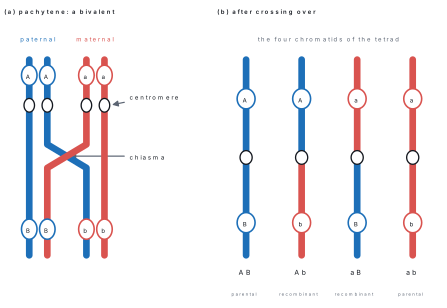
Kinds of crossing over. A single crossover involves one chiasma between two chromatids; a double crossover has two chiasmata in the same pair; and a multiple crossover has more than two. Double crossovers between two genes restore the parental combination and so make genes look closer together than they are.
Factors affecting the frequency of crossing over:
- Distance between the genes — the chief factor; the farther apart, the more often a chiasma falls between them.
- Sex — absent in male Drosophila and female Bombyx mori; generally higher in the female.
- Age — frequency falls in older organisms.
- Temperature — very high and very low temperatures increase it.
- Radiation and chemicals — X-rays and some chemicals raise it.
- Distance from the centromere — crossing over is rare very close to the centromere.
Gene mapping
Because the chance of a chiasma falling between two genes is proportional to the distance between them, the recombination frequency measures that distance:
Sturtevant (1913) defined one map unit (1 centiMorgan, cM) = 1 % recombination, and used recombination frequencies to draw the first genetic map, showing that genes lie in a fixed linear order on the chromosome. The maximum observable recombination frequency is 50 %, which is the same result as independent assortment; genes more than 50 cM apart therefore appear unlinked.
Problem. In Zea mays, coloured aleurone (C) is dominant to colourless (c), and full endosperm (Sh) to shrunken (sh). A plant heterozygous for both genes was test crossed with a colourless, shrunken plant. The offspring were:
coloured full 4032, coloured shrunken 149, colourless full 152, colourless shrunken 4035.
(a) Are the genes linked? (b) Find the recombination frequency and the map distance. (c) Write the genotype of the heterozygous parent.
Solution.
(a) A test cross of a double heterozygote on unlinked genes would give 1 : 1 : 1 : 1. Here two classes are huge and two are tiny, so the genes are linked.
(b) Total offspring = 4032 + 149 + 152 + 4035 = 8368. The two rare classes are the recombinants, 149 + 152 = 301:
So the two genes are 3.6 map units (3.6 cM) apart.
(c) The parental (commonest) classes are coloured-full and colourless-shrunken, so C travelled with Sh and c with sh. The heterozygote was in the coupling (cis) arrangement, written C Sh / c sh.
In a linkage test cross, identify the recombinants by frequency, not by appearance. The two smallest classes are always the recombinants, whatever phenotypes they happen to show.
| Linkage | Crossing over | |
|---|---|---|
| Effect on genes | keeps linked genes together | separates linked genes |
| Result | parental combinations | recombinant (new) combinations |
| Frequency | high for close genes | low for close genes |
| Stage | acts throughout meiosis | pachytene of prophase I |
| Relation to distance | decreases with distance | increases with distance |
| Evolutionary value | keeps useful combinations intact | creates variation |
3.4 Mutation and polyploidy
Mutation
A mutation is a sudden, random, heritable change in the genetic material of an organism that is not caused by segregation or recombination. The term was coined by Hugo de Vries (1901) from his work on the evening primrose Oenothera lamarckiana.
Mutations are sudden (they appear in one step, not gradually), random (they cannot be directed towards a need), heritable if they occur in germ cells, recurrent, usually recessive and usually harmful, because any random change in a finely tuned system is more likely to damage it than improve it. They are also rare — typically 1 in 10⁵ to 10⁶ gametes per gene per generation.
Mutations are classified in three ways:
| Basis | Types |
|---|---|
| Cell involved | somatic (body cells; not inherited, e.g. a bud sport) and germinal (gametes; inherited) |
| Origin | spontaneous (natural, from replication errors) and induced (by a mutagen) |
| Extent | gene (point) mutation and chromosomal mutation |
Gene or point mutations change one or a few base pairs.
- Substitution — one base pair is replaced by another. A transition replaces a purine by a purine (or pyrimidine by pyrimidine); a transversion replaces a purine by a pyrimidine or the reverse. A substitution may be silent (the codon still codes for the same amino acid, because the code is degenerate), missense (a different amino acid) or nonsense (a stop codon appears and the chain is cut short).
- Frameshift — insertion or deletion of bases in a number that is not a multiple of three. Every codon after the change is misread, so the whole protein downstream is wrong. Frameshifts are far more damaging than substitutions.
The classic example of a missense mutation is sickle-cell anaemia: a single substitution GAG → GTG in the gene for the β-chain of haemoglobin puts valine in place of glutamic acid at the sixth amino acid, and the altered haemoglobin makes the red cells sickle-shaped when oxygen is low.
Chromosomal mutations (aberrations) change chromosome structure or number. The four structural changes are shown below.
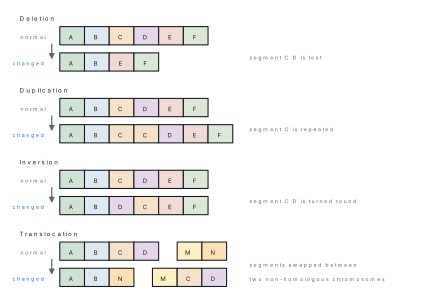
Changes in number are of two kinds. Euploidy is a change by whole sets (n, 3n, 4n …). Aneuploidy is a change of one or a few individual chromosomes:
| Aneuploid | Formula | Human example |
|---|---|---|
| Nullisomy | 2n − 2 | lethal in humans |
| Monosomy | 2n − 1 | Turner's syndrome, 45, XO |
| Trisomy | 2n + 1 | Down's syndrome, 47, trisomy-21; Klinefelter's, 47, XXY |
| Tetrasomy | 2n + 2 | rare |
Aneuploidy arises from non-disjunction — the failure of a homologous pair (or of sister chromatids) to separate at anaphase, so that one gamete gets an extra chromosome and the other gets none.
Mutagens are agents that raise the mutation rate: physical — X-rays, gamma rays, UV light (which makes thymine dimers), high temperature; chemical — mustard gas, nitrous acid, ethyl methane sulphonate (EMS), base analogues such as 5-bromouracil, acridine dyes (which cause frameshifts), and colchicine; biological — transposons and some viruses.
Mutation is the only original source of new alleles. Recombination and crossing over merely shuffle alleles that already exist; mutation creates them. Without mutation there would be no raw material for natural selection and no evolution. In agriculture, mutation breeding with gamma rays or EMS has produced short-strawed, early-maturing and disease-resistant varieties of rice, wheat and barley.
Polyploidy
Polyploidy is the presence of more than two complete sets of chromosomes in a cell or organism — triploid (3n), tetraploid (4n), hexaploid (6n) and so on. It arises when the chromosomes duplicate but the cell fails to divide, or when unreduced (2n) gametes fuse.
It is common in flowering plants — roughly half of all angiosperm species are polyploid — but rare in animals, where it upsets sex determination.
Autopolyploidy multiplies the chromosome set of a single species (AA → AAAA). Examples: tetraploid potato Solanum tuberosum (2n = 4x = 48), triploid banana (2n = 3x = 33) and triploid seedless watermelon, tetraploid Citrullus and the giant forms of Datura.
Allopolyploidy (amphidiploidy) combines the chromosome sets of two different species, usually after a sterile hybrid doubles its chromosomes (AB → AABB). Examples: bread wheat Triticum aestivum (2n = 6x = 42), Gossypium hirsutum (New World cotton), Nicotiana tabacum, Brassica napus, Triticale (Triticum × Secale cereale, the first man-made cereal) and Raphanobrassica, produced by Karpechenko in 1928 by crossing radish Raphanus sativus with cabbage Brassica oleracea.
| Autopolyploidy | Allopolyploidy | |
|---|---|---|
| Source of sets | one species | two different species |
| Constitution | AAAA | AABB |
| Pairing at meiosis | multivalents form | normal bivalents |
| Fertility | often low | usually fertile |
| Examples | potato, banana, watermelon | Triticum aestivum, Raphanobrassica, Triticale |
Polyploidy is induced artificially with colchicine, an alkaloid from Colchicum autumnale, which destroys the spindle so that the doubled chromosomes stay in one nucleus. Its effects include the gigas effect — larger cells, thicker leaves, bigger flowers and fruits — greater vigour and more chemical content; and, in odd-numbered polyploids such as 3n, sterility, because an odd number of sets cannot pair evenly at meiosis. That sterility is useful: it is exactly why bananas and triploid watermelons are seedless.
Polyploidy changes the number of whole sets (3n, 4n); aneuploidy changes the number of individual chromosomes (2n + 1, 2n − 1). Down's syndrome is aneuploidy, not polyploidy; bread wheat is polyploidy, not aneuploidy.
Chapter summary
- DNA is the genetic material — Griffith's transformation, Avery's enzyme test, and the Hershey–Chase ³²P/³⁵S experiment; in some viruses (TMV) it is RNA. Chargaff's rules: A = T, G = C, so A + G = T + C.
- B-DNA is a right-handed antiparallel double helix, diameter 2 nm, pitch 3.4 nm, 10 bp per turn, rise 0.34 nm per base pair; A=T has two hydrogen bonds, G≡C has three.
- Replication is semi-conservative (Meselson–Stahl): helicase opens the fork, primase lays an RNA primer, DNA polymerase III builds only 5′ → 3′, so one strand is leading (continuous) and one lagging (Okazaki fragments joined by ligase).
- Central dogma: DNA → (transcription) → mRNA → (translation) → protein. The code is a triplet, degenerate, non-overlapping, comma-less and nearly universal code of 64 codons; AUG starts, UAA, UAG and UGA stop.
- Mendel's laws: dominance, segregation (monohybrid 3 : 1 phenotypic, 1 : 2 : 1 genotypic) and independent assortment (dihybrid 9 : 3 : 3 : 1; test cross 1 : 1 : 1 : 1). A heterozygote of n genes makes 2ⁿ kinds of gamete.
- Chi-square tests a ratio: \chi^2 = \sum (O-E)^2/E with df = (classes − 1); if \chi^2 is less than the critical value (3.841 at df = 1, 7.815 at df = 3, p = 0.05) the deviation is due to chance and the ratio is accepted.
- Deviations from Mendelism: incomplete dominance (1 : 2 : 1, Mirabilis jalapa), codominance (roan cattle, AB blood), multiple alleles (I^A, I^B, i), lethal genes (2 : 1) and sex linkage.
- Linkage keeps genes on one chromosome together; crossing over at the chiasma in pachytene breaks that linkage. Recombination frequency = (\text{recombinants}/\text{total}) \times 100\ \%, and 1 % = 1 map unit (cM); the maximum useful value is 50 %.
- Mutation is the only source of new alleles: point mutations (substitution — transition or transversion; frameshift) and chromosomal mutations (deletion, duplication, inversion, translocation; aneuploidy 2n ± 1, euploidy). Polyploidy is auto- (AAAA, potato, banana) or allo- (AABB, Triticum aestivum, Raphanobrassica, Triticale) and is induced by colchicine.
Practice questions
Group A — Multiple choice (1 mark each)
- Which nitrogenous base is present in RNA but not in DNA? [1]aadeninebthyminecuracildcytosine
- In the Watson–Crick model, one complete turn of the DNA helix measures [1]a0.34 nmb2 nmc3.4 nmd20 nm
- The phenotypic ratio of a dihybrid test cross is [1]a9 : 3 : 3 : 1b1 : 1 : 1 : 1c3 : 1d1 : 2 : 1
- A man of blood group AB marries a woman of group O. Which group can never appear among their children? [1]aAbBcABdA and B both
- Crossing over takes place during [1]aleptotenebzygotenecpachyteneddiplotene
- Raphanobrassica is an example of [1]aautopolyploidyballopolyploidycmonosomydtrisomy
Answers to Group A
1. (c) — RNA has uracil in place of thymine.
2. (c) — the pitch is 3.4 nm; 0.34 nm is the rise per base pair and 2 nm the diameter.
3. (b) — the F₁ makes four kinds of gamete in equal numbers and the tester contributes only recessives.
4. (c) — the parents can only give I^A or I^B with i, so the children are A (I^A i) or B (I^B i).
5. (c) — chiasmata form and the segments are exchanged in pachytene of prophase I.
6. (b) — it combines the sets of two species, Raphanus sativus and Brassica oleracea.
Group B — Short answer (4 marks each)
- State Mendel's law of segregation and illustrate it with a monohybrid cross in pea up to the F₂ generation, giving both ratios. [4]
- A pure tall pea plant with round seeds (TTRR) is crossed with a dwarf plant with wrinkled seeds (ttrr). Give the F₁, the gametes of the F₁, the F₂ phenotypic ratio, and the result of test crossing the F₁. [4]
- Differentiate between DNA and RNA (any four points) and name the three types of RNA with one function each. [4]
- Define linkage and crossing over. In a test cross of a double heterozygote, 1600 offspring were obtained of which 96 were recombinants. Calculate the recombination frequency and the map distance between the two genes. [4]
- What is polyploidy? Differentiate between autopolyploidy and allopolyploidy with one example of each, and name the chemical used to induce polyploidy. [4]
Answers to Group B
1. Law of segregation: the two alleles of a gene, which stay together in the body cells of a heterozygote, separate from each other without being altered during gamete formation, so that each gamete receives only one of them. Cross TT (tall) × tt (dwarf) → F₁ all Tt, tall. Selfing the F₁ gives gametes T and t from each parent, so the F₂ Punnett square gives TT : Tt : Tt : tt. Phenotypic ratio 3 tall : 1 dwarf; genotypic ratio 1 TT : 2 Tt : 1 tt. The reappearance of pure dwarfs in the F₂ proves the alleles were never blended.
2. F₁ = TtRr, all tall with round seeds. The F₁ makes 2² = 4 kinds of gamete: TR, Tr, tR, tr in equal numbers. Selfing gives the F₂ ratio 9 tall round : 3 tall wrinkled : 3 dwarf round : 1 dwarf wrinkled. A test cross (TtRr × ttrr) gives 1 tall round : 1 tall wrinkled : 1 dwarf round : 1 dwarf wrinkled, i.e. 1 : 1 : 1 : 1, which directly reveals the four gamete types of the F₁.
3.
| Feature | DNA | RNA |
|---|---|---|
| Sugar | deoxyribose | ribose |
| Bases | A, T, G, C | A, U, G, C |
| Strands | double (usually) | single (usually) |
| Site | nucleus, mitochondria, plastids | mostly cytoplasm |
| Amount | constant in a species | varies with protein synthesis |
mRNA carries the codon message from gene to ribosome; tRNA carries an amino acid and reads the codon with its anticodon; rRNA builds the ribosome and has peptidyl transferase activity.
4. Linkage is the tendency of genes on the same chromosome to be inherited together. Crossing over is the exchange of corresponding segments between non-sister chromatids of homologous chromosomes at the chiasma in pachytene, producing recombinants.
Since 1 % recombination = 1 map unit, the two genes lie 6 map units (6 cM) apart.
5. Polyploidy is the presence of more than two complete sets of chromosomes in a cell. In autopolyploidy the extra sets come from the same species (AAAA), pairing gives multivalents and fertility is often low — e.g. tetraploid potato Solanum tuberosum (2n = 4x = 48) or triploid banana. In allopolyploidy the sets come from two different species (AABB), pairing is normal and the plant is fertile — e.g. bread wheat Triticum aestivum (2n = 6x = 42) or Raphanobrassica. Polyploidy is induced by colchicine, obtained from Colchicum autumnale, which prevents spindle formation.
Group C — Long answer (8 marks each)
- Describe the Watson–Crick model of DNA with a labelled diagram. Explain how DNA replicates semi-conservatively, naming the enzymes and explaining why one strand is made continuously and the other in fragments. [8]
- What is sex-linked inheritance? Explain X-linked recessive inheritance by working out a cross between a carrier woman and a normal man for colour blindness, and state the criteria by which an X-linked recessive trait is recognised in a pedigree. [8]
- In a dihybrid cross in pea, the F₂ generation of 160 plants consisted of 95 tall round, 27 tall wrinkled, 30 dwarf round and 8 dwarf wrinkled. Test whether these results agree with the expected 9 : 3 : 3 : 1 ratio using the chi-square test, and explain what your conclusion means. [8]
Answers to Group C
1. Outline. (i) DNA is a right-handed double helix of two antiparallel polynucleotide chains, one running 5′ → 3′ and the other 3′ → 5′. (ii) Each nucleotide = deoxyribose + phosphate + base; the sugar–phosphate backbone lies outside, joined by 3′–5′ phosphodiester bonds, and the bases face inward. (iii) Base pairing is complementary: A = T by two hydrogen bonds, G ≡ C by three, which satisfies Chargaff's rules and keeps the diameter constant. (iv) Dimensions: diameter 2 nm, pitch 3.4 nm, 10 base pairs per turn, rise 0.34 nm; major and minor grooves run along the outside. (v) Replication is semi-conservative — each daughter molecule keeps one parental strand, proved by Meselson and Stahl with ¹⁵N. (vi) Helicase unwinds the helix at the origin, topoisomerase relieves the strain and single-strand binding proteins hold the strands apart. (vii) Primase lays a short RNA primer; DNA polymerase III adds nucleotides only to a free 3′ end, so synthesis is always 5′ → 3′. (viii) Because the two templates are antiparallel, only one of them faces the fork in the right direction: that new strand is the leading strand and grows continuously, while the other is made backwards in short Okazaki fragments (the lagging strand), whose primers are replaced by DNA polymerase I and whose nicks are sealed by DNA ligase. Credit is given for a labelled diagram of the fork.
2. Outline. (i) Genes carried on the sex chromosomes are sex-linked; most lie on the non-homologous part of the X, so they are X-linked. (ii) A male is hemizygous — he has only one X, so a single recessive allele is expressed in him; a female must be homozygous recessive to show the trait. (iii) Cross X^C X^c (carrier woman) × X^C Y (normal man). Her gametes are X^C and X^c; his are X^C and Y. The offspring are X^C X^C, X^C X^c, X^C Y, X^c Y — that is, among the daughters half are normal and half carriers, none affected; among the sons half are normal and half are colour blind. Overall 1/4 of the children, or 1/2 of the sons, are affected. (iv) The trait passes from carrier mother to son and from affected father to all his daughters as carriers — criss-cross inheritance. (v) Pedigree criteria for an X-linked recessive trait: far more affected males than females; an affected male's parents are both unaffected but his mother is a carrier; no father-to-son transmission; every daughter of an affected male is a carrier; affected females appear only when an affected father marries a carrier or affected mother. Examples: colour blindness, haemophilia, Duchenne muscular dystrophy.
3. Total = 160. Expected numbers on 9 : 3 : 3 : 1 (total parts 16):
| Class | O | E | O − E | (O−E)²/E |
|---|---|---|---|---|
| Tall round | 95 | 90 | +5 | 0.278 |
| Tall wrinkled | 27 | 30 | −3 | 0.300 |
| Dwarf round | 30 | 30 | 0 | 0.000 |
| Dwarf wrinkled | 8 | 10 | −2 | 0.400 |
| Total | 160 | 160 | 0 | 0.978 |
E values: 160\times 9/16 = 90, 160\times 3/16 = 30, 160\times 3/16 = 30, 160\times 1/16 = 10.
Degrees of freedom = 4 - 1 = 3; the critical value at p = 0.05 is 7.815. Since 0.978 < 7.815, the deviation is not significant: it is within the range expected from chance sampling alone. The null hypothesis is accepted, so the data agree with a 9 : 3 : 3 : 1 ratio and the two genes are assorting independently. Note that the test never proves the hypothesis true — it only says the data give no reason to reject it.
Practise more: Biology question bank