Unit 7 · Zoology · 6 teaching hours · 25 min read
Developmental Biology
What the syllabus asks for 2
- Gametogenesis
- Development of frog
Developmental biology asks how a single cell becomes an animal. The answer has two halves. First gametogenesis makes the haploid sperm and egg, halving the chromosome number so that fertilisation can restore it. Then the zygote divides, rearranges itself into three germ layers, and those layers build every organ. The frog, which spawns in every paddy field in Nepal during the monsoon, is the standard animal for studying this because its eggs are large, transparent enough to follow, and develop outside the mother.
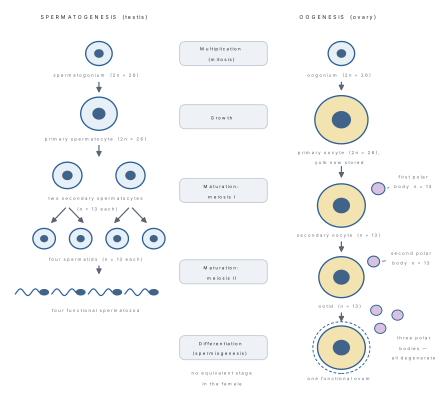
Two diagrams carry most of the marks: the flow chart of spermatogenesis and oogenesis with the chromosome number written at every stage, and the sequence zygote → cleavage → blastula → gastrula drawn in section. Add the germ-layer derivative table and you have covered almost every question set on this unit in the last ten years.
7.1 Gametogenesis
Gametogenesis is the process by which diploid primordial germ cells in the gonad are converted into haploid gametes. It is called spermatogenesis in the testis and oogenesis in the ovary.
Both processes pass through the same three phases.
- Multiplication phase. Primordial germ cells in the germinal epithelium divide repeatedly by mitosis to give many spermatogonia or oogonia. All are diploid (2n).
- Growth phase. One gonium enlarges and becomes a primary spermatocyte or primary oocyte, still 2n. The growth is slight in the male but enormous in the female, because the oocyte stores yolk, RNA and organelles for the embryo.
- Maturation phase. Two meiotic divisions halve the chromosome number. Meiosis I is reductional (2n \to n); meiosis II is equational.
In the male a fourth phase follows: spermiogenesis, in which the round spermatid is remodelled into a motile sperm. Nothing corresponding happens in the female.
| Feature | Spermatogenesis | Oogenesis |
|---|---|---|
| Site | seminiferous tubules of the testis | ovary |
| Begins at | puberty, and continues for life | in the foetus; arrested, resumed at puberty |
| Growth phase | slight | enormous — yolk is stored |
| Cytokinesis in meiosis | equal | unequal — polar bodies are tiny |
| Products per primary cell | 4 functional sperms | 1 functional ovum + 3 polar bodies |
| Extra phase | spermiogenesis | none |
| Product | small, motile, almost no cytoplasm | large, non-motile, full of cytoplasm and yolk |
| Completion of meiosis II | before release | only after the sperm enters |
Both sexes carry out exactly two meiotic divisions, so both produce four haploid nuclei from one primary cell. The difference is the cytoplasm: in oogenesis all of it goes to one cell, and the other three nuclei are pinched off as polar bodies with almost no cytoplasm. Polar bodies cannot be fertilised and soon degenerate.
Problem. The frog Rana tigrina has 2n = 26. For a primary spermatocyte about to begin meiosis, state (a) the number of chromosomes and the number of chromatids at the start of prophase I, (b) the number of chromosomes and chromatids in each secondary spermatocyte, and (c) in each spermatid. (d) If the nucleus of a spermatogonium contains 6.0\ \text{pg} of DNA in G₁, how much DNA is in one sperm nucleus?
Solution.
(a) DNA has already been replicated in the S phase, so there are still 26 chromosomes, but each has two chromatids:
(b) Meiosis I separates the homologous pairs. Each secondary spermatocyte gets 13 chromosomes, each still two-chromatid, so 13 \times 2 = 26 chromatids.
(c) Meiosis II separates the sister chromatids, so each spermatid has 13 chromosomes of one chromatid each — 13 chromatids.
(d) A sperm is haploid and unreplicated, so it carries half the G₁ amount:
Fertilisation adds the egg's 3.0\ \text{pg} and restores the zygote to 6.0\ \text{pg} and to 2n = 26.
Problem. A frog's testis contains 500 primary spermatocytes and its ovary 600 primary oocytes, all of which complete gametogenesis. (a) How many sperms and how many ova are formed? (b) How many polar bodies? (c) What percentage of the haploid nuclei produced in the ovary can actually be fertilised?
Solution.
(a) Each primary spermatocyte gives 4 sperms:
Each primary oocyte gives only 1 ovum:
(b) Each primary oocyte also gives 3 polar bodies:
(c) Each oocyte produces 4 haploid nuclei in all, of which 1 is usable:
The male converts 100% of his meiotic products into gametes, the female only 25% — but each of her gametes is stocked with the food and machinery for the first days of development.
The gametes themselves
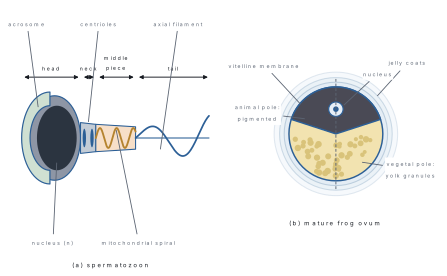
The frog's egg is mesolecithal (a moderate amount of yolk) and telolecithal (the yolk is pushed to one pole). Its dark, pigmented animal pole holds the nucleus and most of the cytoplasm; the pale vegetal pole holds the yolk. Egg types are classified on exactly these two features — how much yolk, and where it lies.
| Type (amount of yolk) | Distribution | Diameter | Example |
|---|---|---|---|
| Alecithal | no yolk | ~0.1 mm | eutherian mammals, human |
| Microlecithal | little, evenly spread (isolecithal) | 0.1–0.2 mm | Amphioxus, sea urchin |
| Mesolecithal | moderate, at one pole (telolecithal) | 1.5–2.0 mm | frog, lungfish |
| Macrolecithal | very large, at one pole (telolecithal) | 25–30 mm | hen, reptiles, birds |
| Centrolecithal | yolk in the centre | ~0.5 mm | insects, other arthropods |
7.2 Development of frog
The common Nepali frog Rana tigrina (now Hoplobatrachus tigerinus) breeds in the monsoon. The male clasps the female in amplexus; she sheds 2,500–3,000 eggs into the water and he sheds sperm over them at once, so fertilisation is external. The eggs float in a mass of swollen jelly that protects them and absorbs heat from the sun.
Fertilisation
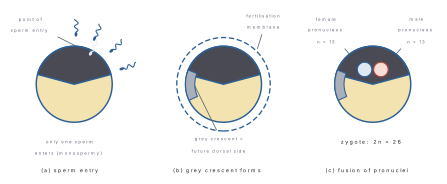
The moment a sperm touches the vitelline membrane, the egg reacts. Cortical granules burst and the vitelline membrane lifts away from the surface as the fertilisation membrane, which no second sperm can cross — so fertilisation is monospermic. The pigmented cortex then rotates about 30° towards the point of entry, uncovering a pale crescent of cytoplasm on the opposite side: the grey crescent. This is the single most important landmark in the egg, because it becomes the dorsal lip of the blastopore and so fixes the dorsal surface and the whole body axis. Finally the male pronucleus (n = 13) fuses with the female pronucleus (n = 13) to make a diploid zygote (2n = 26) — amphimixis.
Cleavage
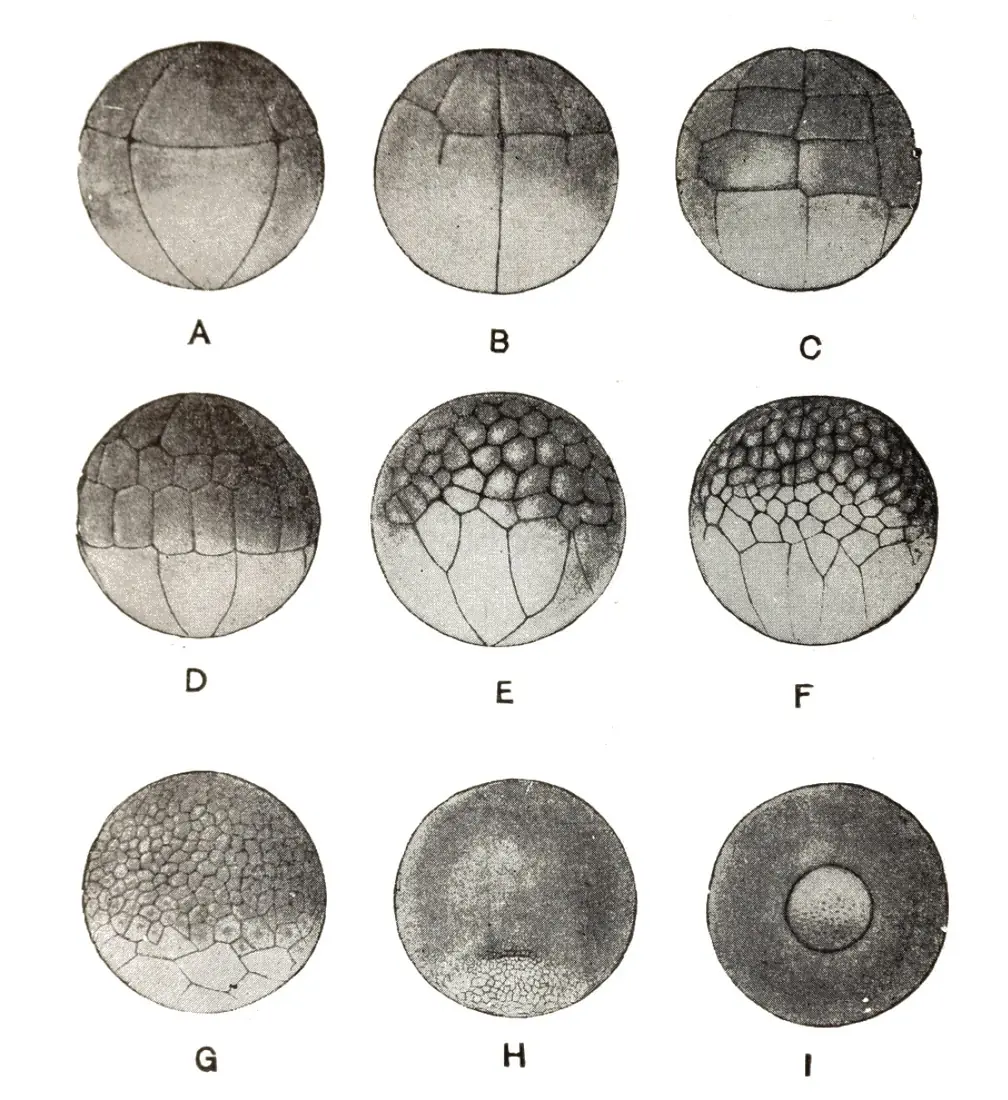
Cleavage is the rapid series of mitotic divisions that converts the zygote into a many-celled blastula. There is no growth phase between divisions, so the cells, called blastomeres, get smaller at every step while the embryo as a whole stays the same size.
The amount and position of yolk decide how an egg cleaves, because yolk resists the cleavage furrow.
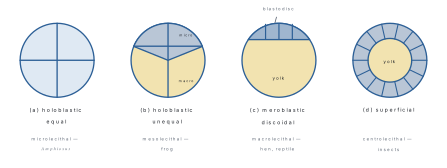
In the frog the cleavage is holoblastic (the furrow cuts right through) but unequal (the yolky vegetal cells end up larger).
| Division | Plane | Result |
|---|---|---|
| First (about 1 hour after fertilisation) | vertical (meridional), through both poles, bisecting the grey crescent | 2 equal blastomeres |
| Second | vertical, at right angles to the first | 4 equal blastomeres |
| Third | horizontal (latitudinal), above the equator | 4 small micromeres + 4 large macromeres |
| Fourth | two vertical furrows | 16 cells |
| Fifth | two horizontal furrows | 32 cells, then a solid morula |
Problem. A frog's egg is a sphere of diameter 1.8\ \text{mm}. Assume the first seven cleavages are synchronous and that the embryo does not change in total volume. (a) How many blastomeres are present after the 7th cleavage? (b) What is the average diameter of one blastomere then? (c) Explain why the answer to (b) shows that cleavage is division without growth.
Solution.
(a) Each cleavage doubles the number of cells, so after n cleavages there are 2^{n} cells:
(b) The total volume is unchanged, so each blastomere has 1/128 of the original volume. For spheres, volume \propto d^{3}, so
(c) The number of cells has gone up 128-fold but the embryo is still 1.8\ \text{mm} across, so no new material has been made — the same cytoplasm has simply been partitioned into smaller boxes. The nucleus-to-cytoplasm ratio rises towards the normal value of a body cell, which is the point of cleavage.
Blastula
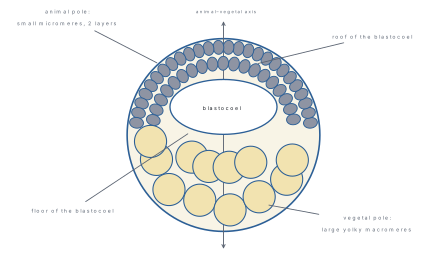
By about the 32-cell stage a fluid-filled cavity, the blastocoel, appears among the blastomeres. The embryo is now a hollow ball — a coeloblastula. Because the vegetal macromeres are swollen with yolk, the cavity is not central but pushed up into the animal half; it is eccentric. Its roof is two layers of small micromeres, its floor a thick mass of macromeres.
Gastrulation
Gastrulation is the set of coordinated cell movements that converts the one-layered blastula into a three-layered gastrula with an archenteron (the primitive gut) opening to the outside at the blastopore.
Nothing new is made during gastrulation — cells simply move to where they will be needed. Two movements do the work.
- Epiboly. The small animal micromeres divide fast and spread downwards as a sheet over the vegetal region, like a sock being pulled on. They become ectoderm.
- Emboly. Cells at the margin roll inwards over the lip of the blastopore (involution) and move forward inside. They become mesoderm and endoderm.
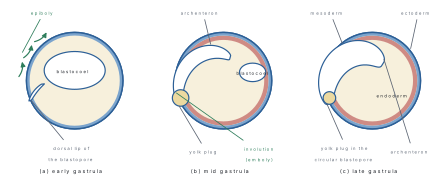
The sequence is easy to remember if you follow the blastopore. A crescentic groove appears just below the grey crescent — its upper edge is the dorsal lip. Cells stream over it, so an inward pocket, the archenteron, grows towards the animal pole and pushes the blastocoel aside until it disappears. Lateral and then ventral lips form, so the blastopore becomes a complete ring with a knob of pale yolky endoderm, the yolk plug, sticking out of it. At the end the embryo has three layers: ectoderm outside, endoderm lining the archenteron, and mesoderm squeezed between them.
The dorsal lip of the blastopore is the primary organiser. Hans Spemann and Hilde Mangold showed in 1924 that grafting a dorsal lip from one newt gastrula onto the belly of another makes the host grow a complete second embryo. The dorsal lip comes from the grey crescent — which is why the grey crescent decides the body axis.
The frog is a deuterostome ("second mouth"): the blastopore of the gastrula becomes the anus, and the mouth breaks through later at the opposite end. Students routinely write the reverse. The blastopore becomes the mouth only in protostomes such as earthworms and insects.
Neurulation and the three germ layers
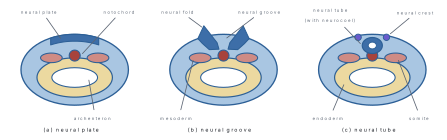
The roof of the archenteron rolls off as a solid rod, the notochord. It induces the ectoderm directly above it to thicken into a neural plate. The edges of the plate rise as neural folds, the middle sinks as a neural groove, and the folds meet and fuse to make the hollow neural tube — the future brain and spinal cord. Cells left at the join form the neural crest. Meanwhile the mesoderm on each side splits into an upper epimere (somites → muscles and vertebrae), a middle mesomere (→ kidney) and a lower hypomere, whose cavity is the coelom.
| Germ layer | What it becomes |
|---|---|
| Ectoderm | epidermis and its glands; whole nervous system (brain, spinal cord, nerves); retina and lens of the eye; receptor cells of sense organs; lining of mouth and anus; enamel of teeth; adrenal medulla |
| Mesoderm | all three muscle types; bone and cartilage; dermis; notochord; blood, lymph, heart and blood vessels; kidneys and their ducts; gonads; peritoneum lining the coelom |
| Endoderm | epithelial lining of the alimentary canal (except mouth and anus); liver and pancreas; lining of the trachea, bronchi and lungs; thyroid, parathyroid and thymus; lining of the urinary bladder and the Eustachian tube |
"Outside, inside, in between." Anything on the outside or made of nerve is ectoderm. Anything lining a tube that opens into the gut is endoderm. Everything in between — muscle, bone, blood, kidney — is mesoderm.
Hatching and metamorphosis
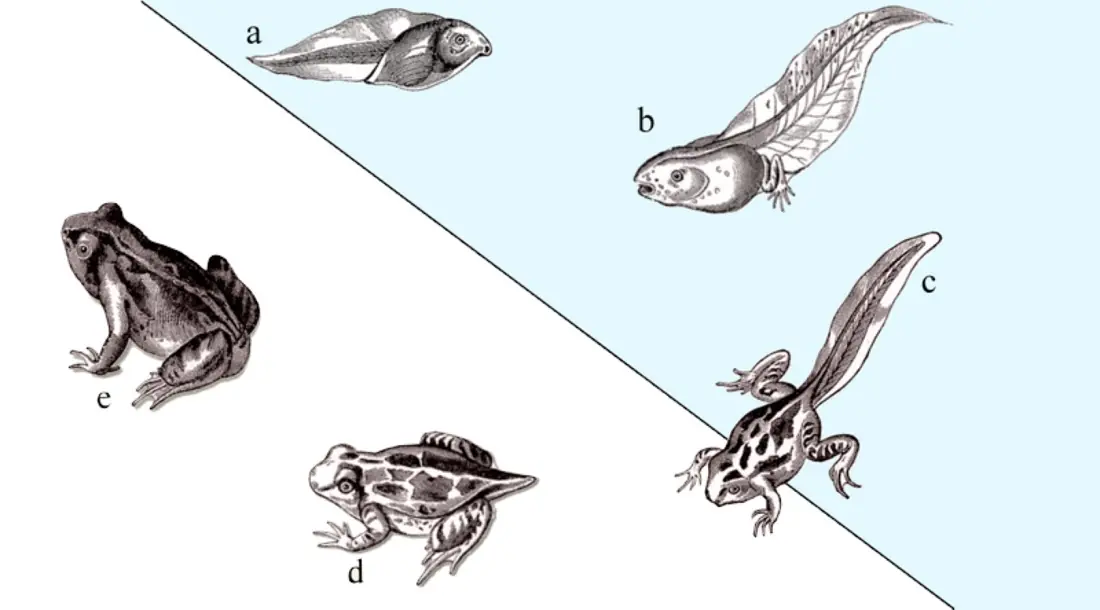
The tadpole hatches about six days after fertilisation. At first it has external gills, an adhesive sucker and no mouth, and lives on its remaining yolk. A mouth with horny jaws then opens; the tadpole becomes a herbivore with a long coiled intestine, and a fold of skin, the operculum, grows back over internal gills, leaving one opening, the spiracle, on the left side. Hind limbs appear first, then forelimbs; lungs replace the gills; and the tail and gills are digested away by lysosomal enzymes. The gut shortens as the animal turns carnivore. From egg to froglet takes about two to three months.
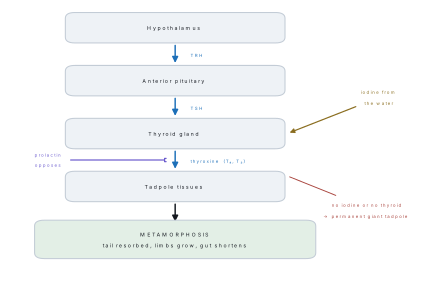
Metamorphosis is driven by thyroxine from the thyroid gland, which needs iodine to be made, and the thyroid is in turn driven by TSH from the anterior pituitary. Feed thyroxine to a young tadpole and it turns into a minute frog far too early. Remove the thyroid, or keep the tadpole in iodine-free water, and it simply grows into a giant tadpole that never metamorphoses.
Problem. A female Rana tigrina lays 2,800 eggs in one season. 85% are fertilised, 60% of the fertilised eggs hatch into tadpoles, and only 3% of those tadpoles survive to become adult frogs. (a) How many adults are produced? (b) What percentage of the eggs laid reaches adulthood? (c) On average, how many adults does one breeding pair leave, and what does this tell you about the size of the frog population from year to year?
Solution.
(a) Work through the chain step by step:
(b)
(c) One pair leaves about 43 adults, but only 2 are needed to replace the parents. The population would explode if every egg had this success rate, so in practice predation, drying of the pond and disease cut the survivors down to roughly 2 per pair. External fertilisation with no parental care can only work if the number of eggs is enormous — exactly the opposite of the mammalian strategy, where one or two young get heavy protection.
Chapter summary
- Gametogenesis has three phases — multiplication (mitosis), growth, and maturation (two meiotic divisions); spermatogenesis adds a fourth, spermiogenesis.
- One primary spermatocyte gives 4 sperms; one primary oocyte gives 1 ovum + 3 polar bodies. Both divide meiotically twice; only the cytoplasm is shared unequally.
- In the frog 2n = 26, so every gamete carries n = 13 and the zygote is restored to 2n = 26.
- The frog's egg is mesolecithal and telolecithal: dark animal pole with the nucleus, pale vegetal pole with the yolk.
- Fertilisation is external and monospermic; the fertilisation membrane blocks extra sperms, and the grey crescent appears opposite the point of entry and fixes the dorsal side.
- Cleavage is holoblastic but unequal: furrows 1 and 2 vertical, furrow 3 horizontal above the equator giving 4 micromeres and 4 macromeres. After n cleavages there are 2^{n} blastomeres and the embryo has not grown.
- The coeloblastula has an eccentric blastocoel with a micromere roof and a macromere floor.
- Gastrulation uses epiboly and emboly; the archenteron replaces the blastocoel, the yolk plug fills the circular blastopore, and three germ layers appear. The dorsal lip is Spemann's organiser, and the blastopore becomes the anus.
- Ectoderm → skin and nervous system; mesoderm → muscle, bone, blood, kidney; endoderm → gut lining, liver, pancreas, lungs.
- Metamorphosis of the tadpole is controlled by thyroxine, which requires iodine and is stimulated by TSH.
Practice questions
Group A — Multiple choice (1 mark each)
- The number of functional gametes formed from one primary oocyte is [1]aonebtwocthreedfour
- The grey crescent of the frog's egg appears [1]aat the point of sperm entrybopposite the point of sperm entrycat the vegetal poledaround the whole equator
- The third cleavage furrow in the frog's egg is [1]avertical and through both polesbvertical at right angles to the firstchorizontal, above the equatordhorizontal, below the equator
- The blastocoel of the frog's blastula is eccentric because [1]athe egg is alecithalbthe macromeres are packed with yolkccleavage is meroblasticdthe blastopore has already formed
- The dorsal lip of the blastopore is called the primary organiser because it [1]aforms the yolk plugbinduces the neural platecbecomes the mouthdsecretes thyroxine
- Which of the following is not a derivative of mesoderm? [1]akidneybheartcliverdskeletal muscle
- A tadpole kept in iodine-free water will [1]ametamorphose earlybremain a tadpole and keep growingcdie within a weekddevelop lungs but no limbs
- An egg with a moderate amount of yolk collected at one pole is [1]aalecithalbcentrolecithalcmesolecithal and telolecithaldmacrolecithal and isolecithal
Answers to Group A
1. (a) — the other three haploid nuclei are shed as polar bodies.
2. (b) — the cortex rotates towards the entry point, uncovering pale cytoplasm on the far side.
3. (c) — it lies above the equator, so the micromeres are smaller than the macromeres.
4. (b) — the bulky yolky macromeres push the cavity into the animal half.
5. (b) — Spemann and Mangold's graft induced a complete secondary embryo.
6. (c) — the liver is endodermal; kidney, heart and muscle are mesodermal.
7. (b) — no iodine means no thyroxine, so it becomes a permanent giant tadpole.
8. (c) — that is exactly the frog's egg.
Group B — Short answer questions (4 marks each)
- Define gametogenesis. With the help of a flow chart, compare spermatogenesis and oogenesis in any four respects. [4]
- A frog has 2n = 26. Trace the chromosome number through one primary spermatocyte, one secondary spermatocyte, one spermatid and the zygote, and state how many sperms 250 primary spermatocytes will produce. [4]
- What is the grey crescent? Explain why it is important in the development of the frog. [4]
- Describe the cleavage of the frog's egg up to the 8-cell stage, mentioning the plane of each furrow. Why is it called holoblastic unequal cleavage? [4]
- Distinguish between epiboly and emboly. Name the three germ layers formed at the end of gastrulation and give one derivative of each. [4]
- Write short notes on the role of thyroxine in the metamorphosis of the frog. [4]
Answers to Group B
1. Gametogenesis is the formation of haploid gametes from diploid germ cells in the gonad. Flow chart: gonium (2n) → mitosis → primary gametocyte (2n) → meiosis I → secondary gametocyte(s) (n) → meiosis II → 4 spermatids / 1 ootid + 3 polar bodies. Four differences: site (testis / ovary); growth phase (slight / enormous with yolk); cytokinesis (equal / unequal); yield (4 sperms / 1 ovum + 3 polar bodies). A fifth mark-worthy point is the extra phase of spermiogenesis in the male.
2. Primary spermatocyte = 26 chromosomes (52 chromatids, since DNA is replicated). Secondary spermatocyte = 13 chromosomes (26 chromatids). Spermatid = 13 chromosomes (13 chromatids). Zygote = 13 + 13 = 26 chromosomes. Sperms from 250 primary spermatocytes: 250 \times 4 = \mathbf{1000} sperms.
3. The grey crescent is the crescent-shaped, lightly pigmented area that appears on the surface of the fertilised frog's egg opposite the point of sperm entry, formed when the pigmented cortex rotates about 30° towards the entry point. Importance: (i) it marks the future dorsal side; (ii) the first cleavage furrow passes through it and divides it equally, so each of the first two blastomeres can form a complete embryo; (iii) the dorsal lip of the blastopore — Spemann's organiser — develops from it, so it fixes the body axis.
4. First furrow — vertical (meridional), passing through both poles and bisecting the grey crescent → 2 equal blastomeres. Second furrow — vertical, at right angles to the first → 4 equal blastomeres. Third furrow — horizontal (latitudinal) but above the equator → 4 small micromeres at the animal pole and 4 large macromeres at the vegetal pole. It is holoblastic because the furrow cuts completely through the egg, and unequal because the yolk at the vegetal pole slows the furrow, so the resulting blastomeres are of different sizes.
5. Epiboly is the downward spreading of the small, rapidly dividing animal micromeres as a sheet over the vegetal cells; they become ectoderm. Emboly is the inward movement of marginal cells over the lip of the blastopore by involution and invagination; they become mesoderm and endoderm. Germ layers and one derivative each: ectoderm → brain and spinal cord (or epidermis); mesoderm → skeletal muscle (or kidney, blood); endoderm → lining of the alimentary canal (or liver, lungs).
6. Thyroxine (T₄, converted to the more active T₃) is secreted by the tadpole's thyroid gland under the control of TSH from the anterior pituitary, and its synthesis requires iodine absorbed from the water. It triggers the whole of metamorphosis: resorption of the tail and gills by lysosomal enzymes, growth of hind and then fore limbs, replacement of gills by lungs, shortening of the intestine as the animal changes from herbivore to carnivore, and development of eyelids. Feeding thyroxine to a young tadpole causes precocious metamorphosis into a tiny frog; removing the thyroid or withholding iodine gives a permanent giant tadpole. Prolactin acts against thyroxine and keeps the larva larval.
Group C — Long answer questions (8 marks each)
- Describe the process of gametogenesis in animals. Draw a labelled flow chart of spermatogenesis and oogenesis showing the chromosome number at each stage, and tabulate any four differences between the two processes. [8]
- Describe the development of the frog from the fertilised egg up to the formation of the gastrula. Draw labelled diagrams of the blastula and the late gastrula, and state the fate of each germ layer. [8]
Answers to Group C
1. Outline. (i) Define gametogenesis; name the two types and their sites. (ii) Multiplication phase — repeated mitosis of primordial germ cells giving spermatogonia / oogonia, all 2n. (iii) Growth phase — one gonium enlarges into a primary spermatocyte or primary oocyte, still 2n; in the female this involves massive storage of yolk, RNA and organelles, which is why the oocyte may be a thousand times the volume of a spermatocyte. (iv) Maturation phase — meiosis I is reductional (2n \to n) and meiosis II is equational; in the male cytokinesis is equal, giving 2 secondary spermatocytes and then 4 spermatids, while in the female it is grossly unequal, giving a secondary oocyte plus a first polar body, then an ootid plus a second polar body. (v) Spermiogenesis — the spermatid loses cytoplasm, the Golgi body forms the acrosome, the nucleus condenses into the head, the centrioles form the neck, mitochondria form the spiral of the middle piece and the distal centriole grows the axial filament of the tail. (vi) Flow chart as in Figure 1, with 2n = 26 down to n = 13 marked at every stage. (vii) Four differences from the table in §7.1 — site, growth phase, cytokinesis, number and nature of the products. Conclude with the functional reason: the sperm is specialised to travel, the ovum to feed the embryo.
2. Outline. (i) Fertilisation — external, in water, during amplexus; monospermic; cortical reaction lifts the fertilisation membrane; the pigmented cortex rotates and the grey crescent appears opposite the entry point; male and female pronuclei (n = 13 each) fuse to give a zygote with 2n = 26. (ii) Cleavage — holoblastic and unequal: first and second furrows vertical and at right angles giving 4 equal blastomeres, third furrow horizontal above the equator giving 4 micromeres and 4 macromeres, then 16, 32 and a solid morula. No growth occurs, so the blastomeres get steadily smaller. (iii) Blastulation — a fluid-filled blastocoel appears and, being pushed up by the yolk-laden macromeres, lies eccentrically in the animal half; the roof is two layers of micromeres, the floor a mass of macromeres. Draw and label as in Figure 6. (iv) Gastrulation — epiboly carries micromeres downward; emboly carries marginal cells inward over the dorsal lip; the archenteron grows as the blastocoel shrinks and vanishes; lateral and ventral lips complete a circular blastopore plugged by the yolk plug. Draw and label as in Figure 7(c), showing ectoderm, mesoderm, endoderm, archenteron, blastopore and yolk plug. (v) Fate of the germ layers — ectoderm gives the epidermis and the entire nervous system; mesoderm gives muscles, skeleton, dermis, blood, heart, kidneys and gonads; endoderm gives the lining of the gut and its glands (liver, pancreas) and of the respiratory tract. Mention that the dorsal lip is Spemann's organiser and that in this deuterostome the blastopore becomes the anus.
Practise more: Biology question bank