Unit 5 · Botany · 7 teaching hours · 35 min read
Biotechnology
What the syllabus asks for 7
- Tissue culture
- Plant breeding
- Disease-resistant plants
- Green manure, bio-fertilizer, bio-pesticide
- Genetic engineering and GMOs
- Bio-engineering
- Food safety and food security
Biotechnology is the use of living organisms, or parts of them, to make products and services that people need. It is old — curd, gundruk, jaand and chhurpi are all biotechnology — but since the 1970s the ability to cut and rejoin DNA has turned it into the fastest-moving branch of biology. This unit covers what plant biotechnology can actually do: grow a whole plant from a few cells, breed better crops, build disease resistance, replace chemicals with living fertilisers and pesticides, move a gene from one species to another, and help keep a country's food both sufficient and safe.
Long questions come from tissue culture (steps plus applications) and genetic engineering (tools, steps of recombinant DNA technology, and GMOs with named examples). Short questions come from bio-fertilizers and bio-pesticides (name the organism, name what it does), Bt crops and the difference between food safety and food security. Learn the named organisms and the named enzymes — marks here are given for the right name, not for general description.
5.1 Tissue culture
Plant tissue culture is the growth of cells, tissues or organs of a plant on a sterile, chemically defined nutrient medium under controlled conditions of temperature, light and humidity — that is, in vitro. It rests on totipotency, the ability of a single living plant cell to divide and regenerate a complete plant.
Totipotency was proposed by Haberlandt in 1902 and first demonstrated by F. C. Steward in 1957, who grew whole carrot plants (Daucus carota) from single phloem cells suspended in coconut water.
The medium
The standard medium is MS medium (Murashige and Skoog, 1962). It contains:
| Component | Examples | Role |
|---|---|---|
| Macronutrients | N, P, K, Ca, Mg, S salts | bulk nutrition |
| Micronutrients | Fe, Mn, Zn, B, Cu, Mo | enzyme cofactors |
| Carbon source | sucrose, 2–3 % | energy (cultures are not photosynthetic) |
| Vitamins | thiamine, nicotinic acid, pyridoxine, myo-inositol | growth factors |
| Amino acid | glycine | nitrogen source |
| Growth regulators | auxin (IAA, NAA, 2,4-D) and cytokinin (kinetin, BAP) | control what the tissue becomes |
| Gelling agent | agar, 0.8 % | support |
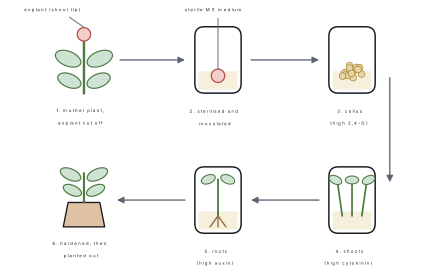
The ratio of auxin to cytokinin decides the result (Skoog and Miller, 1957): a high auxin : low cytokinin ratio makes roots, a low auxin : high cytokinin ratio makes shoots, and a roughly equal ratio keeps the tissue as an unorganised mass of dividing cells, the callus.
The steps
- Choice of explant — a small piece of tissue (shoot tip, node, leaf disc, anther, embryo) from a healthy, disease-free mother plant.
- Surface sterilisation — 70 % ethanol for a few seconds, then 0.1 % mercuric chloride or 1 % sodium hypochlorite, followed by several rinses in sterile distilled water.
- Inoculation — the explant is transferred aseptically to the medium inside a laminar air-flow cabinet.
- Callus formation and multiplication — incubation at about 25 °C with a 16-hour photoperiod; the callus is subcultured every 3–4 weeks.
- Organogenesis — the callus is shifted to a high-cytokinin medium to make shoots, then to a high-auxin medium to make roots.
- Hardening (acclimatisation) — the tiny plantlets are moved to a greenhouse with high humidity, then gradually to normal conditions.
- Transfer to the field.
Kinds of culture and what they are used for
| Culture | What is grown | Chief use |
|---|---|---|
| Callus culture | unorganised mass on solid medium | starting point for regeneration; somaclonal variation |
| Suspension culture | free cells in shaken liquid | industrial production of secondary metabolites |
| Meristem / shoot-tip culture | the 0.2–0.5 mm apical dome | virus-free plants, because viruses do not reach the meristem |
| Anther / pollen culture | microspores | haploid plants; doubling with colchicine gives instantly homozygous lines |
| Embryo culture (embryo rescue) | a young hybrid embryo | saves wide-cross hybrids that would abort in the seed |
| Protoplast culture | wall-less cells made by cellulase and pectinase | somatic hybridisation — the "pomato" from potato + tomato protoplasts |
Applications. Micropropagation multiplies elite plants by the thousand — banana, orchid, potato, sugarcane and strawberry are produced this way in commercial labs, including in Kathmandu and Chitwan. Meristem culture gives virus-free seed potato. Cryopreservation in liquid nitrogen at −196 °C conserves germplasm. Cell suspensions make alkaloids and other secondary metabolites. And tissue culture is the essential last step of every genetic engineering project in plants: the transformed cell must be regenerated into a whole plant.
Its limits are real too: it is expensive, it needs skilled staff and absolute asepsis, contamination can destroy a whole batch, and unwanted somaclonal variation can creep in.
Problem. A single shoot-tip explant of banana is subcultured every 4 weeks, and each subculture multiplies the number of shoots by 4. (a) How many shoots are available after 24 weeks? (b) If 5 % are lost during hardening, how many plants reach the field?
Solution.
(a) In 24 weeks there are 24 \div 4 = 6 subcultures, so
(b) Survivors = 4096 \times 0.95 = 3891.2, that is about 3891 plants. From one bud in under six months — which is why the method is used for banana, whose seeds are useless because it is a sterile triploid.
5.2 Plant breeding
Plant breeding is the deliberate improvement of the heredity of crop plants for human benefit — raising yield, quality and resistance — by selecting and recombining the variation that exists in a species and its relatives.
Objectives: higher yield; better quality (more protein, oil, vitamins); resistance to diseases and pests; tolerance of drought, cold, heat and salinity; early maturity, so that two or three crops fit into one year; dwarf, stiff-strawed habit that does not lodge under heavy fertiliser; and suitability for machinery.
The steps of a breeding programme:
- Collection of germplasm — gathering landraces, wild relatives and released varieties into a gene bank.
- Evaluation and selection of parents — screening the collection for the desired character.
- Hybridisation — the chosen female parent is emasculated (its anthers removed before they dehisce) and bagged; when the stigma is receptive, pollen from the male parent is dusted on and the flower is bagged and tagged again.
- Selection among the progeny — the F₁ is selfed and superior recombinants are selected from the F₂ onwards, generation after generation.
- Testing, release and multiplication — yield trials at several sites over several years, then release by the National Seed Board and multiplication of certified seed.
Methods of breeding: introduction of a variety from elsewhere; selection (mass selection, pure-line selection, clonal selection); hybridisation (intervarietal, interspecific, intergeneric); mutation breeding with gamma rays or EMS; polyploidy breeding with colchicine; and, most recently, marker-assisted selection, in which DNA markers linked to a useful gene let the breeder pick the right seedling in the laboratory instead of waiting for the adult plant.
The Green Revolution of the 1960s was plant breeding on a national scale: Norman Borlaug's semi-dwarf, rust-resistant wheats and IRRI's IR8 rice (1966) roughly doubled cereal yields in South Asia. Nepal's own programme, run by the Nepal Agricultural Research Council (NARC), has released wheat varieties such as Bhrikuti (1994) and Gautam, rice varieties such as Sabitri, Radha-4 and Khumal-4, and maize varieties such as Rampur Composite and Manakamana-3.
Two ideas underlie hybrid breeding. Heterosis (hybrid vigour) is the superiority of an F₁ hybrid over both its parents in size, yield and vigour; inbreeding depression is the opposite loss of vigour when a cross-pollinating crop such as maize is repeatedly selfed. Hybrid seed must therefore be bought fresh each season, because the F₂ segregates and the vigour is lost.
Biofortification is the newest objective: breeding varieties that are richer in iron, zinc, protein or vitamins, so that nutrition improves without anyone having to change what they eat.
5.3 Disease-resistant plants
A plant is resistant when it can prevent or limit infection by a pathogen. Resistance is of two kinds:
| Vertical (race-specific) resistance | Horizontal (field) resistance | |
|---|---|---|
| Genetic basis | one or a few major genes | many genes, each of small effect |
| Effect | complete immunity to some races | partial protection against all races |
| Durability | breaks down when a new race appears | durable |
| Inheritance | simple, easy to breed | difficult to breed |
The gene-for-gene hypothesis (H. H. Flor, 1956) explains vertical resistance: for every resistance (R) gene in the host there is a matching avirulence (Avr) gene in the pathogen, and the plant resists only when both are present.
Sources of resistance genes are wild relatives and old landraces, which is why gene banks matter: the terraces of Nepal's mid-hills still hold rice and barley landraces carrying genes that modern varieties have lost.
Methods of producing resistant plants:
- Conventional breeding, usually by the backcross method — the resistance gene is crossed into a good variety, and the hybrid is repeatedly backcrossed to that variety so that only the resistance gene is retained.
- Mutation breeding — mildew-resistant barley (the mlo mutants) came this way.
- Genetic engineering, which can bring in a gene from any organism at all.
The best-known transgenic resistance uses the cry genes of the soil bacterium Bacillus thuringiensis.
B. thuringiensis makes the toxin as an inactive crystal protoxin, which is why it is harmless to the bacterium itself and to us. When a caterpillar eats it, the alkaline pH of the insect midgut dissolves the crystal, gut proteases cut it into the active toxin, the toxin binds to specific receptors on the midgut epithelium and punches pores in the cells. The cells swell, burst, and the larva stops feeding and dies. Our stomachs are acidic and have no such receptors, so the toxin passes through us unchanged.
| Transgene | Source | Protects against | Crop |
|---|---|---|---|
| cry1Ac, cry2Ab | Bacillus thuringiensis | cotton bollworm | Bt cotton |
| cry1Ab | Bacillus thuringiensis | maize stem borer | Bt maize |
| cry1Ac | Bacillus thuringiensis | brinjal fruit-and-shoot borer | Bt brinjal |
| viral coat protein gene | papaya ringspot virus | the virus itself | virus-resistant papaya |
| chitinase, glucanase | fungi, plants | fungal pathogens | several |
| RNA interference construct | the nematode's own gene | root-knot nematode Meloidogyne incognita | tobacco |
Bt cotton was approved for commercial planting in India by the GEAC in 2002 and now covers roughly 90 % of the cotton area there. Bt brinjal was approved by Bangladesh's National Committee on Biosafety on 30 October 2013 and has been grown there since 2014 — the first genetically engineered food crop released in South Asia.
5.4 Green manure, bio-fertilizer, bio-pesticide
Green manure
Green manure is undecomposed green plant material — usually a quick-growing legume — that is grown in a field and then ploughed into the same soil while still green, to enrich it with nitrogen and organic matter.
The common green-manure crops are dhaincha Sesbania aculeata, sunn hemp Crotalaria juncea, cowpea Vigna unguiculata, guar Cyamopsis tetragonoloba and Trifolium. When the leaves of a tree are cut and carried to a field instead, it is called green-leaf manure — in Nepal the leaves of Azadirachta indica (neem), Gliricidia and Artocarpus are used this way.
Green manuring adds nitrogen (a good dhaincha crop can add 60–90 kg N per hectare), raises the organic-matter content, improves soil structure and water-holding capacity, encourages soil microbes, suppresses weeds and checks erosion between crops.
Bio-fertilizers
A bio-fertilizer is a preparation of living micro-organisms that, when applied to seed, soil or root, increases the supply of nutrients to the plant. It does not itself contain the nutrient; it makes the nutrient available.
| Group | Organism | What it does |
|---|---|---|
| Symbiotic N-fixers | Rhizobium in legume root nodules | fixes atmospheric N₂ |
| Frankia in Alnus nepalensis (utis) | fixes N₂ in a non-legume tree | |
| Anabaena azollae inside the fern Azolla | classic bio-fertilizer of paddy fields | |
| Free-living N-fixers | Azotobacter (aerobic), Clostridium (anaerobic) | fix N₂ in the soil |
| Associative N-fixer | Azospirillum | lives around the roots of cereals |
| Blue-green algae | Nostoc, Anabaena, Aulosira | fix N₂ in flooded rice fields |
| Phosphate solubilisers | Bacillus megaterium, Pseudomonas striata, Aspergillus | release insoluble soil phosphate as acids |
| Mycorrhiza | vesicular-arbuscular mycorrhiza, Glomus | greatly extends the root surface for phosphorus and water uptake |
Bio-pesticides
A bio-pesticide is a living organism, or a substance obtained from one, used to control pests.
| Type | Agent | Target |
|---|---|---|
| Bacterial | Bacillus thuringiensis | caterpillars (Lepidoptera) |
| Fungal | Trichoderma viride, T. harzianum | soil-borne fungal diseases |
| Beauveria bassiana, Metarhizium anisopliae | many insects | |
| Viral | nuclear polyhedrosis virus (NPV) | Helicoverpa, Spodoptera |
| Botanical | neem Azadirachta indica (azadirachtin) | broad-spectrum antifeedant |
| pyrethrum Chrysanthemum cinerariifolium, Derris (rotenone) | many insects | |
| Predator / parasitoid | Trichogramma wasp, ladybird beetle | eggs of borers, aphids |
Compared with chemical pesticides, bio-pesticides are specific (they spare bees, birds and natural enemies), biodegradable so they leave no residue on food, and they do not accumulate along food chains or cause resistance as quickly. Against that, they act slowly, they are sensitive to sunlight and temperature, and they have a short shelf life.
Manure and compost supply nutrients directly. A bio-fertilizer supplies almost no nutrients itself — it is a culture of living organisms that fix nitrogen or unlock phosphate. If a question asks for a bio-fertilizer, the answer must be an organism (Rhizobium, Azolla, Glomus), not a substance.
5.5 Genetic engineering and GMOs
Genetic engineering is the deliberate alteration of an organism's genome by isolating a gene, joining it to a carrier DNA molecule in vitro and introducing it into a living cell, so that the cell expresses a character it could never have obtained by breeding. Because the DNA made in the test tube combines pieces from two sources, it is called recombinant DNA, and the method is recombinant DNA (rDNA) technology.
The tools
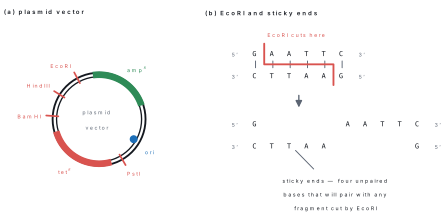
1. Restriction endonucleases — the molecular scissors. These bacterial enzymes recognise a short palindromic sequence of 4–8 base pairs and cut the DNA within it. EcoRI, from Escherichia coli strain RY13, recognises G↓AATTC and cuts between G and A on both strands, leaving four-base single-stranded sticky (cohesive) ends that can base-pair with any other fragment cut by the same enzyme. Some enzymes, such as SmaI, cut straight across and give blunt ends. Arber, Nathans and Smith shared the 1978 Nobel Prize for this discovery.
2. DNA ligase — the molecular glue. It seals the phosphodiester backbone between the joined fragments.
3. Vectors — the carriers. A good vector needs an origin of replication (ori) so that it multiplies in the host, selectable marker genes such as antibiotic resistance so that transformed cells can be picked out, and unique restriction sites where the foreign gene can be slotted in. The commonest are plasmids — small circular extra-chromosomal DNA of bacteria, such as pBR322 — along with bacteriophages, cosmids and, for plants, the Ti plasmid of Agrobacterium tumefaciens, a natural genetic engineer that normally inserts its own T-DNA into plant cells and causes crown gall.
4. Host cells — Escherichia coli, yeast, or the plant cell itself.
Steps of recombinant DNA technology
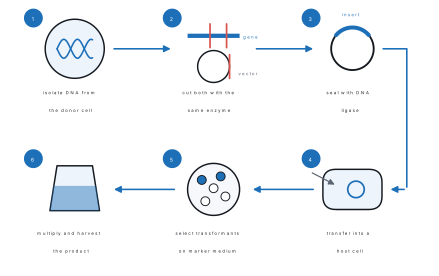
- Isolation of DNA. The cells of the donor organism are broken open with lysozyme (bacteria) or cellulase (plant cells), the proteins are digested with protease and the RNA removed with ribonuclease. Chilled ethanol is then added; the DNA separates out as fine white threads that can be spooled on a glass rod.
- Cutting. The donor DNA and the vector are cut with the same restriction enzyme, so that both carry complementary sticky ends.
- Ligation. The gene of interest and the cut vector are mixed. Their sticky ends base-pair, and DNA ligase seals the nicks. The product is recombinant DNA (rDNA).
- Transformation. The rDNA is pushed into a host cell.
- Selection and screening. Only a few host cells actually take up the rDNA, so the marker genes are used to pick them out (see below).
- Multiplication and downstream processing. The selected cell is grown in a fermenter or regenerated into a whole plant, and the product — protein, metabolite or transgenic plantlet — is harvested and purified.
A vector is the DNA molecule that carries the foreign gene into the host. Gene cloning is the production of many identical copies of one gene by multiplying the host cell that carries it.
Methods of transferring DNA into the host
| Method | How it works | Chiefly used for |
|---|---|---|
| CaCl₂ + heat shock | Ca²⁺ makes the bacterial wall porous; a 42 °C pulse draws plasmid in | E. coli |
| Electroporation | A brief high-voltage pulse opens transient pores in the membrane | bacteria, protoplasts |
| Microinjection | DNA injected into the nucleus with a fine glass needle | animal cells, eggs |
| Gene gun (biolistics) | Gold or tungsten particles coated with DNA fired at cells | monocots, chloroplasts |
| Agrobacterium method | T-DNA of the Ti plasmid is transferred naturally into the plant genome | dicots |
Selection. In pBR322 the gene is inserted into tetᴿ. Cells carrying the recombinant plasmid have a working ampᴿ but a broken tetᴿ, so they grow on ampicillin but die on tetracycline — this is insertional inactivation. Modern vectors use lacZ instead: recombinant colonies cannot make β-galactosidase and stay white, while non-recombinants turn blue on X-gal. This is called blue–white screening.
The polymerase chain reaction (PCR)
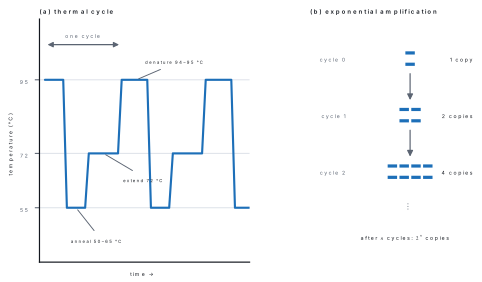
PCR, devised by Kary Mullis in 1983 (Nobel Prize 1993), makes millions of copies of one chosen stretch of DNA in vitro, without any host cell. The reaction tube contains the template DNA, two short primers (about 18–25 nucleotides) that flank the target, the four dNTPs, Mg²⁺ buffer and a heat-stable DNA polymerase — Taq polymerase, isolated from the hot-spring bacterium Thermus aquaticus, which survives 95 °C. A thermal cycler then repeats three temperature steps:
| Step | Temperature | What happens |
|---|---|---|
| Denaturation | 94–95 °C, 30 s | hydrogen bonds break; the duplex separates into two strands |
| Annealing | 50–65 °C, 30 s | primers base-pair with their complementary sites |
| Extension | 72 °C, ~1 min per kb | Taq polymerase adds dNTPs 5′ → 3′ from each primer |
Each cycle doubles the number of target molecules, so after n cycles one molecule becomes 2^n copies. Thirty cycles take about two hours and give over a billion copies. PCR is used in disease diagnosis, DNA fingerprinting, prenatal testing, detecting GM material in imported grain, and amplifying a gene before cloning it.
Problem. A PCR tube starts with 5 copies of a target gene and is run for 30 cycles at 100 % efficiency. How many copies of the target are present at the end? Roughly how many would 35 cycles give?
Solution. Copies after n cycles = N_0 \times 2^n.
N = 5 \times 2^{30} = 5 \times 1.0737 \times 10^{9} = 5.37 \times 10^{9} copies.
For 35 cycles, N = 5 \times 2^{35} = 5 \times 3.436 \times 10^{10} = 1.72 \times 10^{11} copies.
Five extra cycles multiply the yield by 2^5 = 32. In practice the enzyme and the dNTPs run out, so the curve flattens after about 30–35 cycles — this is the plateau phase.
Gel electrophoresis
To check that the right fragment has been cut or amplified, the DNA is separated by agarose gel electrophoresis. A slab of agarose gel is laid in a buffer tank; the samples are loaded into wells at the cathode (−) end. Because its phosphate groups make DNA negatively charged at all pH values, every fragment moves towards the anode (+). The gel acts as a molecular sieve: short fragments thread through the pores quickly and travel far, long fragments lag behind, so distance moved is inversely related to the logarithm of fragment length. The bands are stained with ethidium bromide and seen as orange bands under UV light. Comparing them with a DNA ladder of known sizes run alongside gives the size of each fragment. The wanted band is then cut out of the gel and the DNA recovered — this is called elution.
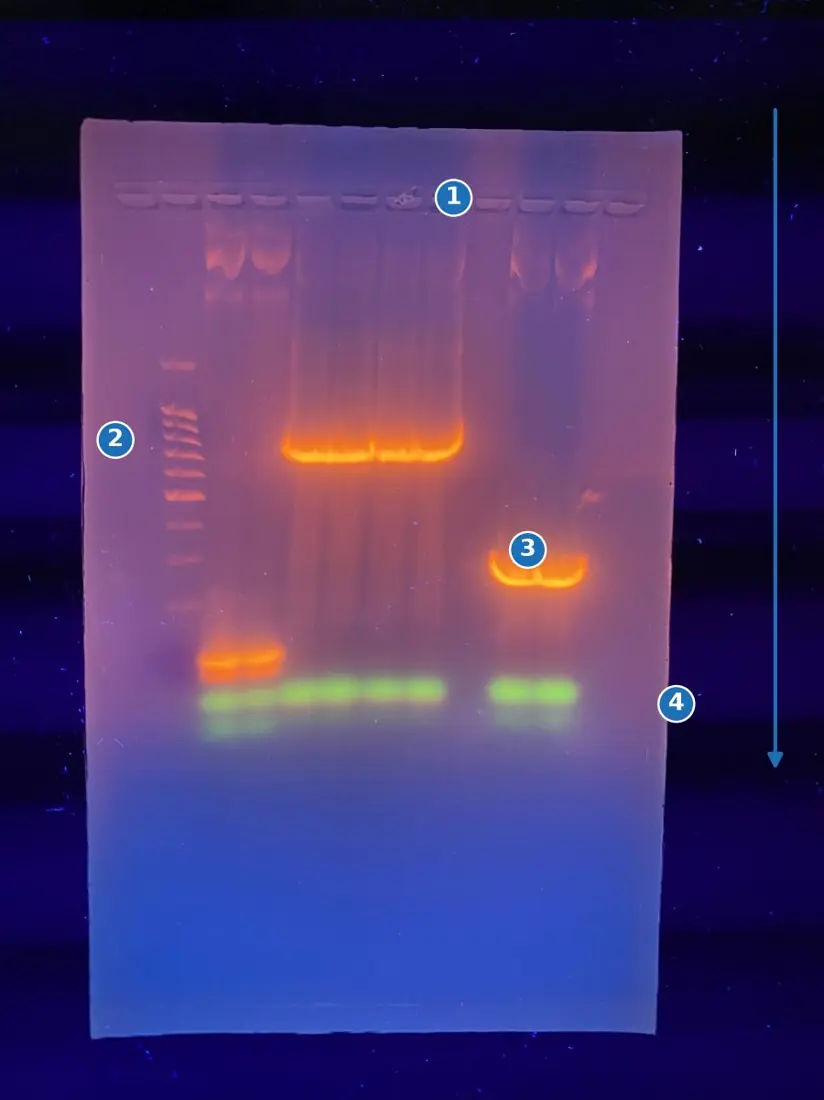
Problem. A linear DNA molecule 12 kb long has three EcoRI sites. A circular plasmid 12 kb long also has three EcoRI sites. How many bands does each give after complete digestion, and what is the total length in each lane?
Solution. A linear molecule cut at n internal sites gives n + 1 = 3 + 1 = 4 fragments, so up to 4 bands. A circular molecule cut at n sites gives n = 3 fragments, so 3 bands. In both lanes the fragment lengths must add up to the original 12 kb, because digestion removes no DNA.
If the linear fragments were 5, 4, 2 and 1 kb, the 1 kb band lies nearest the anode and the 5 kb band nearest the well. (Two fragments of equal size would run together and appear as one brighter band — a common trap in questions.)
Genetically modified organisms
A genetically modified organism (GMO) is an organism whose genome has been deliberately altered by inserting, deleting or silencing a gene using rDNA technology. A GMO that carries a gene from a different species is called transgenic.
| GMO | Gene transferred | Result |
|---|---|---|
| E. coli producing humulin (1982) | human insulin genes A and B | cheap, non-allergenic human insulin |
| Bt cotton (India, 2002) | cry1Ac from Bacillus thuringiensis | resists bollworm; now over 90 % of India's cotton area |
| Bt brinjal (Bangladesh, approved 2013) | cry1Ac | resists fruit and shoot borer |
| Golden Rice | psy (daffodil/maize) + crtI (Erwinia) | grain makes β-carotene, a vitamin A precursor |
| Flavr Savr tomato (1994) | antisense polygalacturonase | slower softening, longer shelf life |
| Roundup Ready soybean | bacterial EPSPS | tolerates the herbicide glyphosate |
| Bt maize | cry1Ab | resists stem borer |
Benefits. Higher yield with less pesticide, tolerance of drought, salt and herbicides, longer shelf life, biofortified food such as Golden Rice, and cheap medicines (insulin, human growth hormone, hepatitis B vaccine, clotting factor VIII).
Concerns. Possible allergens in new proteins; antibiotic-resistance marker genes; gene flow to wild relatives, creating "superweeds"; harm to non-target insects; loss of local landraces and farmer dependence on bought seed; and the ethical objection to patenting life. Because of these risks, every country that ratified the Cartagena Protocol on Biosafety regulates GM release.
Nepal ratified the Cartagena Protocol in 2001 and adopted a National Biosafety Framework in 2006, the same year as the Biotechnology Policy 2063 BS. A Supreme Court interim order in January 2014 stopped the import of GM seed; the restriction was partly relaxed in November 2021 for imported canola, soybean and maize grain, which is screened by the Plant Quarantine and Pesticides Management Centre. No GM crop is registered for cultivation in Nepal, and the Seed Quality Control Centre laboratory tests border samples by PCR each year. Golden Rice was given a commercial biosafety permit in the Philippines in July 2021, but a Court of Appeals order in April 2024 halted it pending further safety review.
A hybrid is produced by ordinary sexual crossing within or between closely related species; a transgenic plant carries a gene inserted in the laboratory, often from an unrelated kingdom. Bt cotton is transgenic; a maize hybrid from two inbred lines is not a GMO. Do not write "GMO" for every improved variety.
5.6 Bio-engineering
Bio-engineering (biochemical engineering) applies engineering design to living systems so that biological reactions can be run on an industrial scale. The central piece of hardware is the bioreactor or fermenter — a stirred, sterilised stainless-steel vessel in which temperature, pH, dissolved oxygen and nutrient feed are controlled automatically while microbes or cultured cells make the product.
| Area | Principle | Example |
|---|---|---|
| Industrial fermentation | microbes grown in a bioreactor secrete a product | penicillin from Penicillium chrysogenum, citric acid from Aspergillus niger |
| Enzyme technology | enzymes immobilised on beads and reused | glucose isomerase for high-fructose syrup |
| Biofuel | plant biomass or oil converted to fuel | ethanol from sugarcane, biodiesel from Jatropha curcas |
| Biogas | anaerobic digestion of dung by methanogens | about 450,000 household biogas plants in Nepal |
| Bioremediation | microbes break down pollutants | Pseudomonas putida ("superbug") degrades oil |
| Phytoremediation | plants take up heavy metals from soil | Brassica juncea accumulates lead |
| Biosensors | an enzyme or microbe coupled to an electrode | glucometer for blood sugar |
| Bioleaching | bacteria release metal from low-grade ore | Thiobacillus ferrooxidans leaches copper |
| Single-cell protein | microbial biomass used as food or feed | Spirulina, Methylophilus methylotrophus |
| Biomedical engineering | engineered tissues and devices | artificial skin, dialysis membranes, stents |
Nepal's biogas programme, begun in 1992, is the best local example: a fixed dome digester loaded with cattle dung and water produces a gas of roughly 60 % methane for cooking and lighting, and the spent slurry returns to the field as manure. It replaces firewood, cuts indoor smoke and reduces pressure on forests.
5.7 Food safety and food security
These two terms are often confused. Food safety is about the quality of food — that it is free from anything that could harm the eater. Food security is about access — that everyone always has enough of it.
Food security exists when all people, at all times, have physical, social and economic access to sufficient, safe and nutritious food that meets their dietary needs and food preferences for an active and healthy life. Its four pillars are availability, access, utilisation and stability.
Hazards in food
| Type of hazard | Examples |
|---|---|
| Biological | Salmonella, E. coli O157:H7, Vibrio cholerae, hepatitis A virus, Entamoeba, aflatoxin from Aspergillus flavus on damp maize and groundnut |
| Chemical | pesticide residue, heavy metals, excess food colour, adulterants such as melamine or chemical ripening agents |
| Physical | glass, metal, stone, hair, insect parts |
How safety is ensured. Good agricultural and hygienic practice in the field; correct drying and storage to keep grain below the moisture level at which moulds grow; pasteurisation, canning, refrigeration and irradiation; HACCP (Hazard Analysis and Critical Control Points), in which every step of processing is examined and the critical points are monitored; and labelling to Codex Alimentarius standards. In Nepal the Food Act 2023 BS (1966) and the Department of Food Technology and Quality Control (DFTQC) enforce these rules, and the Right to Food and Food Sovereignty Act, 2075 (2018) gives every citizen a legal right to food, implementing Article 36 of the Constitution of Nepal.
Where biotechnology helps. Higher-yielding and stress-tolerant varieties raise availability; biofortified crops such as Golden Rice, iron-rich beans and zinc-rich wheat improve utilisation; tissue culture supplies disease-free planting material; bio-pesticides and bio-fertilizers cut chemical residues; and PCR and ELISA allow rapid detection of pathogens, aflatoxin and undeclared GM material in a consignment. Post-harvest technology matters just as much: Nepal loses roughly a fifth of its cereal harvest to poor storage and transport, and saving that loss adds as much food as a large rise in yield.
Answering the 8-mark biotechnology question
Long questions almost always ask you to "describe the steps" of something — tissue culture, rDNA technology, PCR, or plant breeding. Number the steps, give one sentence and the key reagent or temperature for each, and finish with two applications. A labelled sketch of the plasmid or the cycle earns marks even when the question does not ask for a diagram.
Chapter summary
- Tissue culture works because plant cells are totipotent. Explant → surface sterilisation → MS medium → callus → shoots (high cytokinin) → roots (high auxin) → hardening. It gives disease-free, genetically identical clones all year round.
- Plant breeding improves crops by selection, introduction, hybridisation and mutation breeding; the Green Revolution used dwarf, fertiliser-responsive varieties such as wheat Bhrikuti and rice Sabitri in Nepal.
- Disease resistance is vertical (one R gene, complete but easily broken, gene-for-gene) or horizontal (many genes, partial but durable). Bacillus thuringiensis cry genes make a protoxin that becomes active only in the alkaline insect gut, so Bt crops kill the pest but not the eater.
- Green manure adds organic matter and nitrogen by ploughing in a legume; bio-fertilizers are living organisms (Rhizobium, Azotobacter, Azolla–Anabaena, mycorrhiza, blue-green algae) that supply nutrients; bio-pesticides are living or natural agents (Bt, Trichoderma, neem) that control pests without residues.
- Genetic engineering needs four tools: restriction enzymes to cut (EcoRI cuts G↓AATTC and leaves sticky ends), DNA ligase to join, a vector with ori + marker + unique sites, and a host cell. Steps: isolate → cut → ligate → transform → select → multiply.
- PCR copies a target in vitro using primers and Taq polymerase from Thermus aquaticus: denature 94–95 °C, anneal 50–65 °C, extend 72 °C; after n cycles one molecule becomes 2^n copies.
- In gel electrophoresis DNA is negatively charged and moves to the anode; small fragments travel furthest. A linear molecule with n cut sites gives n+1 fragments, a circular one gives n.
- GMOs include Bt cotton, Bt brinjal, Golden Rice and humulin-producing E. coli. Their release is controlled under the Cartagena Protocol; no GM crop is approved for cultivation in Nepal.
- Food safety is freedom from biological, chemical and physical hazards (HACCP, DFTQC); food security is availability, access, utilisation and stability of enough safe food for all.
Practice questions
Group A — Multiple choice (1 mark each)
- The capacity of a single differentiated plant cell to regenerate a complete plant is called [1]atotipotencybpluripotencycapomixisdsenescence
- In a tissue culture medium, shoot formation from callus is favoured by [1]ahigh auxin : low cytokininbhigh cytokinin : low auxincauxin alonedgibberellin alone
- EcoRI recognises and cuts the sequence [1]aGGATCCbAAGCTTcGAATTCdCTGCAG
- Taq polymerase used in PCR is obtained from [1]aEscherichia colibThermus aquaticuscAgrobacterium tumefaciensdBacillus thuringiensis
- During agarose gel electrophoresis DNA fragments move towards the anode because DNA is [1]apositively chargedbneutralcnegatively chargeddamphoteric
- Which one of the following is a bio-fertilizer? [1]aureabRhizobiumcBacillus thuringiensisdneem oil
Answers to Group A
1. (a) — totipotency is the basis of all plant tissue culture.
2. (b) — a high cytokinin to auxin ratio induces shoots; the reverse induces roots.
3. (c) — EcoRI cuts the palindrome G↓AATTC, leaving four-base sticky ends.
4. (b) — T. aquaticus lives in hot springs, so its polymerase survives 95 °C.
5. (c) — the phosphate groups of the backbone carry a negative charge at all pH.
6. (b) — Rhizobium fixes nitrogen; Bt and neem are bio-pesticides, urea is chemical.
Group B — Short answer (4 marks each)
- What is micropropagation? List its steps in order and give two advantages over conventional propagation. [4]
- Differentiate between vertical and horizontal resistance in plants, with one example of each. [4]
- Explain how the Bt toxin kills a caterpillar but is harmless to human beings. [4]
- A PCR tube contains 8 copies of a target sequence and is run for 25 cycles at full efficiency. Calculate the number of copies formed, and state why the actual yield is lower after about 35 cycles. [4]
- Distinguish between green manure and bio-fertilizer, giving two examples of each. [4]
Answers to Group B
1. Micropropagation is the rapid multiplication of plants in vitro from small explants using tissue culture. Steps: (i) select and surface-sterilise the explant with 0.1 % HgCl₂ or sodium hypochlorite; (ii) inoculate on MS medium with a high cytokinin : auxin ratio to get shoots (through callus if needed); (iii) transfer the shoots to a high auxin medium for rooting; (iv) harden the plantlets in a greenhouse, then transfer to the field. Advantages: thousands of genetically identical, disease-free plants from one mother plant in a small space, all the year round; it works for species that are sterile or slow to propagate, such as banana and orchids.
2. | Vertical resistance | Horizontal resistance | |---|---| | Governed by one or a few major R genes | Governed by many minor genes (polygenic) | | Complete immunity, but only to certain races | Partial, slows the disease down | | Breaks down when a new race appears | Durable across races | | Easy to transfer by breeding | Difficult, needs many crosses | | Example: Sr stem-rust genes in wheat | Example: field resistance to late blight of potato |
3. Bacillus thuringiensis makes a crystalline protoxin (Cry protein) that is inactive as made. The caterpillar eats leaf tissue containing it. The insect midgut is strongly alkaline (pH about 9–10), so the crystal dissolves there and gut proteases cut it into the active toxin. The toxin binds to specific receptors on the midgut epithelium and makes pores, so the cells swell and burst; the insect stops feeding and dies. The human stomach is strongly acidic (pH 1.5–3), the crystal does not dissolve, the activating proteases are absent and human gut cells carry no receptor for it — so the protein is simply digested like any other protein.
4. Copies = N_0 \times 2^n = 8 \times 2^{25}. 2^{25} = 33{,}554{,}432, so N = 8 \times 33{,}554{,}432 = 268{,}435{,}456 \approx 2.68 \times 10^{8} copies. After about 35 cycles the primers and dNTPs are used up, Taq polymerase loses activity from repeated heating, and the many product strands re-anneal to each other instead of to primers, so the reaction enters the plateau phase and the number of copies stops doubling.
5. | Green manure | Bio-fertilizer | |---|---| | A green crop grown and ploughed back into the same field | A preparation of living micro-organisms applied to seed, soil or root | | Adds organic matter, nitrogen and improves soil structure | Supplies nutrients by fixing N₂ or solubilising phosphate | | Acts after decomposition, over one season | Acts as long as the organism stays alive in the soil | | Examples: Sesbania aculeata (dhaincha), Crotalaria juncea (sunn hemp) | Examples: Rhizobium, Azotobacter, Azolla–Anabaena, mycorrhiza |
Group C — Long answer (8 marks each)
- Describe the steps of recombinant DNA technology. Mention the role of restriction endonuclease, DNA ligase and a cloning vector, and explain how recombinant cells are selected. [8]
- Describe plant tissue culture under the headings: principle, medium, steps and applications. [8]
- Define food safety and food security. Explain the four pillars of food security and describe four ways in which biotechnology can improve food safety and food security in Nepal. [8]
Answers to Group C
1. Outline. (i) Isolation of DNA — lyse cells with lysozyme or cellulase, digest protein with protease and RNA with ribonuclease, precipitate DNA with chilled ethanol. (ii) Cutting — a restriction endonuclease such as EcoRI cuts both the donor DNA and the vector at the same palindromic sequence (G↓AATTC), giving complementary sticky ends. (iii) Ligation — the sticky ends base-pair and DNA ligase seals the phosphodiester bonds, producing recombinant DNA. (iv) Vector — the plasmid (pBR322) or Ti plasmid carries an ori so it replicates in the host, selectable marker genes, and unique restriction sites. (v) Transformation — the rDNA is introduced by CaCl₂ + heat shock, electroporation, gene gun or Agrobacterium. (vi) Selection — insertional inactivation: the insert destroys tetᴿ, so recombinants grow on ampicillin but not on tetracycline; or blue–white screening on X-gal, where recombinant colonies are white. (vii) Culture and downstream processing — the selected clone is grown in a bioreactor or regenerated into a plant and the product purified. Applications: insulin, vaccines, Bt crops, Golden Rice.
2. Principle: totipotency — every living plant cell carries the whole genome and can regenerate a complete plant under the right conditions. Medium: Murashige and Skoog (1962) medium supplying macronutrients, micronutrients, 2–3 % sucrose, vitamins, myo-inositol, agar and growth regulators; autoclaved at 121 °C and kept at pH 5.6–5.8. Steps: choose the explant (shoot tip, node, anther, embryo) → surface sterilise → inoculate aseptically → callus induction with 2,4-D → organogenesis: high cytokinin : auxin gives shoots, high auxin gives roots → subculture → hardening and transfer to soil. Types: callus, suspension, meristem, anther (haploids), embryo rescue and protoplast culture. Applications: rapid clonal multiplication of banana, orchid, potato and sugarcane; virus-free plants from meristem tips; haploids and homozygous lines from anther culture; somatic hybrids by protoplast fusion; germplasm conservation by cryopreservation; secondary metabolites from cell suspension; and it is the essential regeneration step in making any transgenic plant.
3. Food safety means food that is free from biological, chemical and physical hazards and is fit to eat. Food security (FAO, 1996) exists when all people, at all times, have physical, social and economic access to sufficient, safe and nutritious food for an active, healthy life. Four pillars: availability (enough food produced or imported); access (people can afford and reach it); utilisation (the body can use it — safe food, clean water, balanced diet); stability (the first three do not fail in drought, flood or price shock). Contribution of biotechnology in Nepal: (i) tissue culture supplies disease-free potato, banana and orchid planting material, raising yield; (ii) improved and stress-tolerant varieties bred with marker-assisted selection add availability and stability; (iii) bio-fertilizers and bio-pesticides cut chemical residues, so food is safer and cheaper to grow; (iv) PCR and ELISA in the DFTQC and Seed Quality Control Centre laboratories detect pathogens, aflatoxin and unapproved GM material in imports; (v) biofortified crops such as Golden Rice and zinc-rich wheat and better post-harvest storage reduce malnutrition and the large storage losses.
Practise more: Biology question bank