Unit 12 · Science and Technology · 22 min read
Universe
What the syllabus asks for 3
- Stars, galaxies, solar system
- formation of the universe
- space exploration
On a clear night in the hills of Nepal, you can see thousands of stars and a pale band of light across the sky, the Milky Way. People have watched the sky for thousands of years and asked: what are the stars? How did everything begin? Are we alone? In this unit you will learn about the stars, galaxies and the solar system, the Big Bang theory of how the universe began, and how humans explore space with telescopes, satellites, rockets and probes.
Definitions (universe, galaxy, star, light year, constellation, planet, dwarf planet, asteroid, comet), the planets in order with their features, the life cycle of a star, the Big Bang theory and the evidence for it, uses of artificial satellites, and famous space missions. Numericals on light years and light travel time are common.
12.1 Stars, galaxies, solar system
The universe and its size
The universe is everything that exists: all matter, energy, space and time, including the stars, planets, galaxies and everything in between.
The universe is so large that kilometres are too small to measure it. Astronomers use two bigger units.
- Astronomical unit (AU): the average distance from the Earth to the Sun, about 1.5\times10^{8} km. Used inside the solar system.
- Light year (ly): the distance travelled by light in one year in vacuum. Used for stars and galaxies.
The "year" in light year can mislead. A light year measures distance, not time. Light from a star 10 light years away takes 10 years to reach us.
Problem. The Sun is 1.5\times10^{8} km from the Earth. How long does sunlight take to reach the Earth? (Speed of light = 3\times10^{5} km s⁻¹.)
Solution. t = \dfrac{d}{v} = \dfrac{1.5\times10^{8}}{3\times10^{5}} = 500 s = 8 min 20 s.
So we see the Sun as it was about 8 minutes ago.
Problem. The nearest star after the Sun, Proxima Centauri, is 4.24 light years away. Express this distance in kilometres.
Solution. d = 4.24 \times 9.46\times10^{12} = 4.0\times10^{13} km.
Even the nearest star is about 40 trillion kilometres away.
Stars
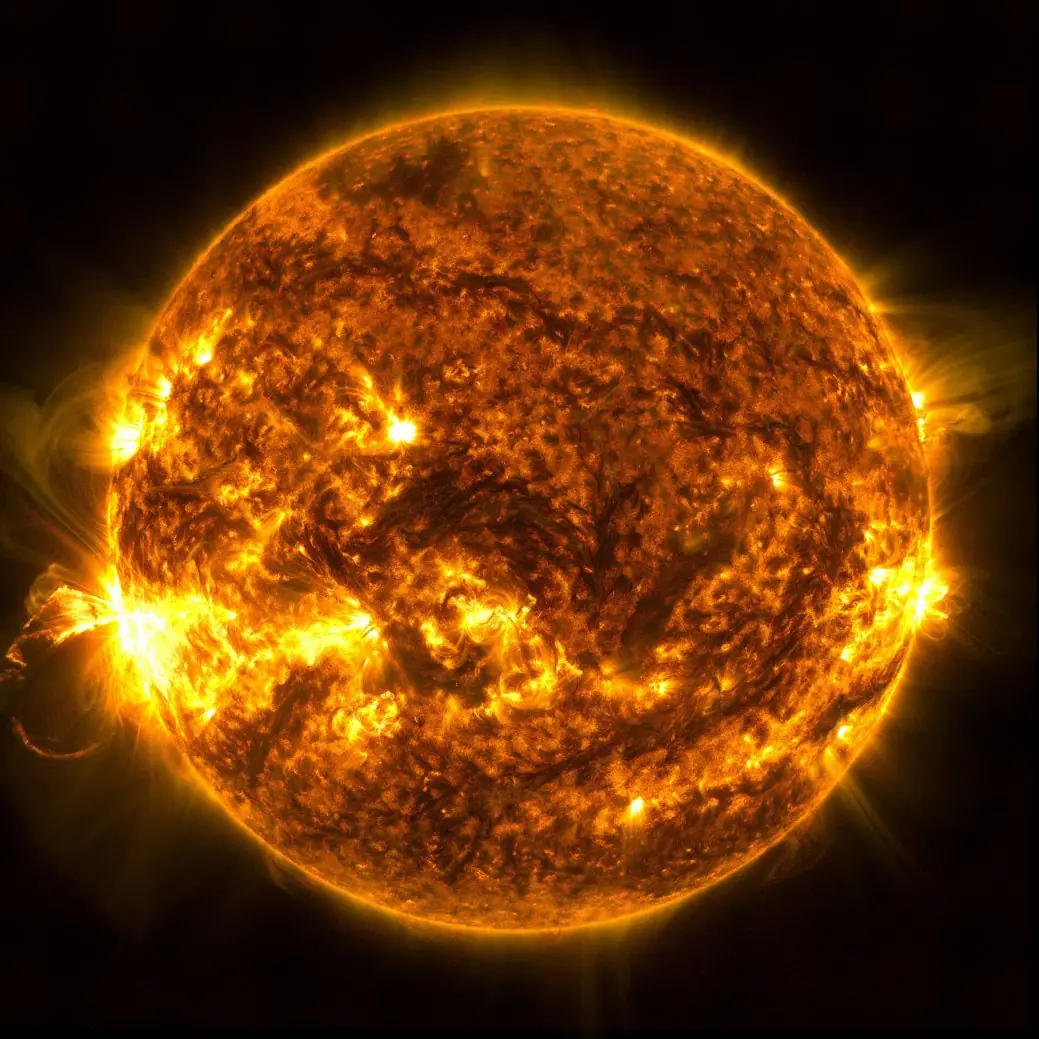
A star is a huge, hot, glowing ball of gas (mostly hydrogen and helium) that produces its own heat and light by nuclear fusion in its core.
In the core of a star, the temperature is millions of degrees. Hydrogen nuclei fuse to form helium and a vast amount of energy is released (nuclear fusion). The outward push of this energy balances the inward pull of gravity, so the star stays stable for billions of years.
- Our nearest star is the Sun. It is a medium-sized yellow star about 4.6 billion years old, and is expected to shine for about another 5 billion years.
- Stars twinkle because their light passes through the moving layers of the Earth's atmosphere and is refracted differently from moment to moment. Planets are nearer and look like tiny discs, so they do not twinkle much.
- The colour of a star shows its surface temperature: blue-white stars are the hottest, yellow (like the Sun) are medium, red stars are cooler.
- Stars differ in size, from tiny neutron stars to supergiants hundreds of times the Sun's diameter, and in brightness.
Life cycle of a star
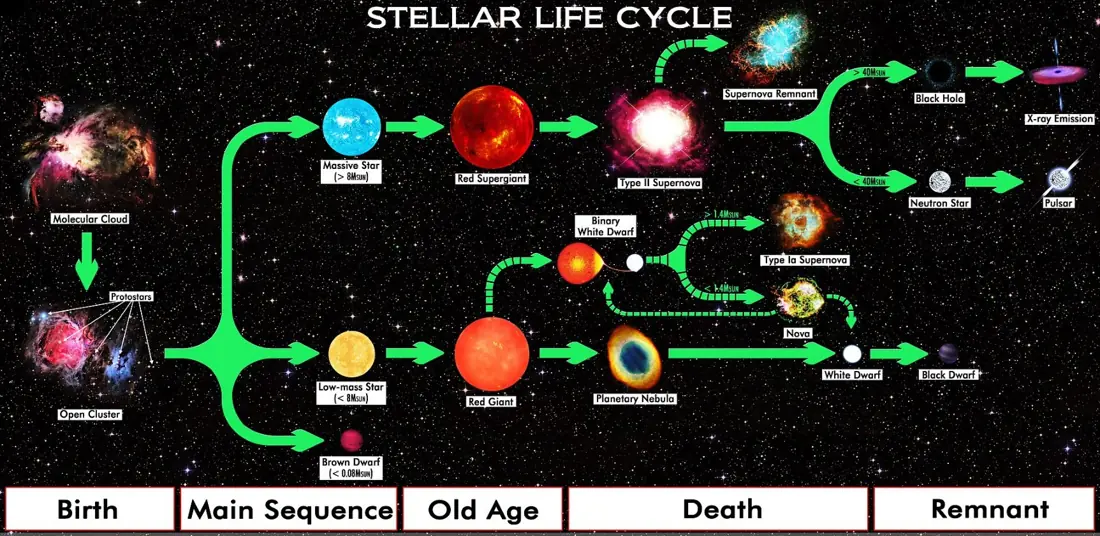
A star is born, lives and dies. The path depends on its mass.
- Nebula. A huge cloud of gas (hydrogen) and dust.
- Protostar. Gravity pulls the cloud together; it becomes denser and hotter.
- Main-sequence star. Hydrogen fusion begins in the core; the star shines steadily for most of its life (about 10 billion years for the Sun).
- Red giant (or red supergiant). When hydrogen in the core runs out, the star swells and cools on the outside.
- Death. - A star like the Sun throws off its outer layers (a planetary nebula) and the core shrinks into a white dwarf, which cools slowly into a black dwarf. - A star much heavier than the Sun (about 8 or more solar masses) ends in a violent explosion called a supernova. The core then becomes a neutron star, or, if the star was very heavy, a black hole.
Problem. The Sun is about 4.6 billion years old and will live about 10 billion years in total on the main sequence. How much longer will it shine as a main-sequence star?
Solution. Remaining life \approx 10 - 4.6 = 5.4 billion years, or roughly 5 billion years.
Constellations
A constellation is a group of stars that looks like a pattern in the sky. The stars in a constellation are not close together; they only appear so as we look from Earth. There are 88 official constellations.
- Ursa Major (Great Bear, Saptarshi): seven bright stars forming a ladle or plough. Two of its stars, the "pointers", point toward the Pole Star.
- Orion (Mrigashira): a hunter with three stars in a row as his belt; seen in the winter sky.
- Cassiopeia: a W-shaped group.
- Pole Star (Polaris, Dhruva Tara): appears almost fixed in the northern sky, because it lies almost exactly above the Earth's axis of rotation. Travellers once used it for finding north.
All stars appear to move from east to west during the night because the Earth spins from west to east.
Galaxies
A galaxy is a huge system of billions of stars, gas, dust and dark matter, held together by gravity.
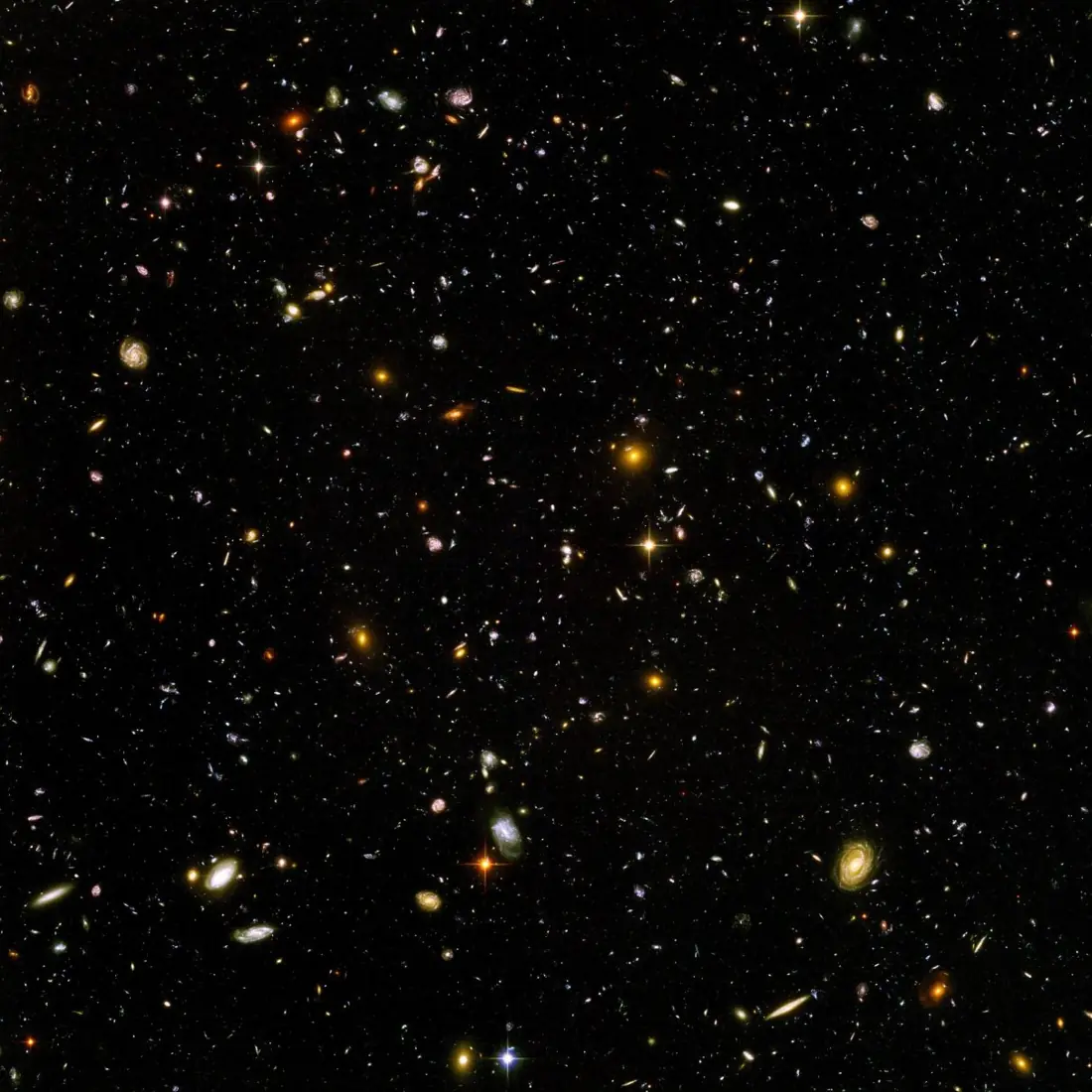
There are hundreds of billions of galaxies in the observable universe. Galaxies are classified by shape:
| Type | Shape | Example |
|---|---|---|
| Spiral | Flat rotating disc with spiral arms and a central bulge | Milky Way, Andromeda |
| Elliptical | Round or oval ball of old stars | M87 |
| Irregular | No definite shape | Large and Small Magellanic Clouds |
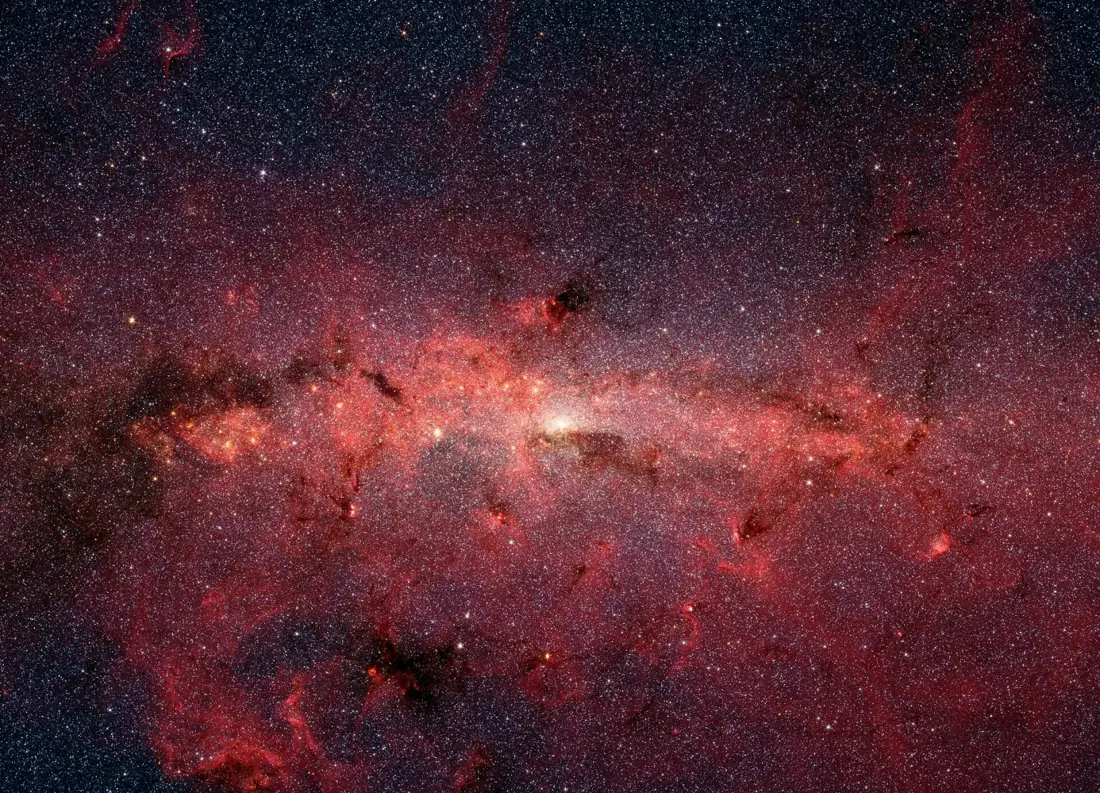
The Milky Way is our home galaxy: a spiral galaxy about 100,000 light years across with at least 100 billion stars. Our Sun lies in one of its arms, about 26,000 light years from the centre, and takes about 230 million years to go once around it. From the Earth we see the Milky Way edge-on as a band of light across the sky. The nearest large galaxy is Andromeda, about 2.5 million light years away.
The solar system
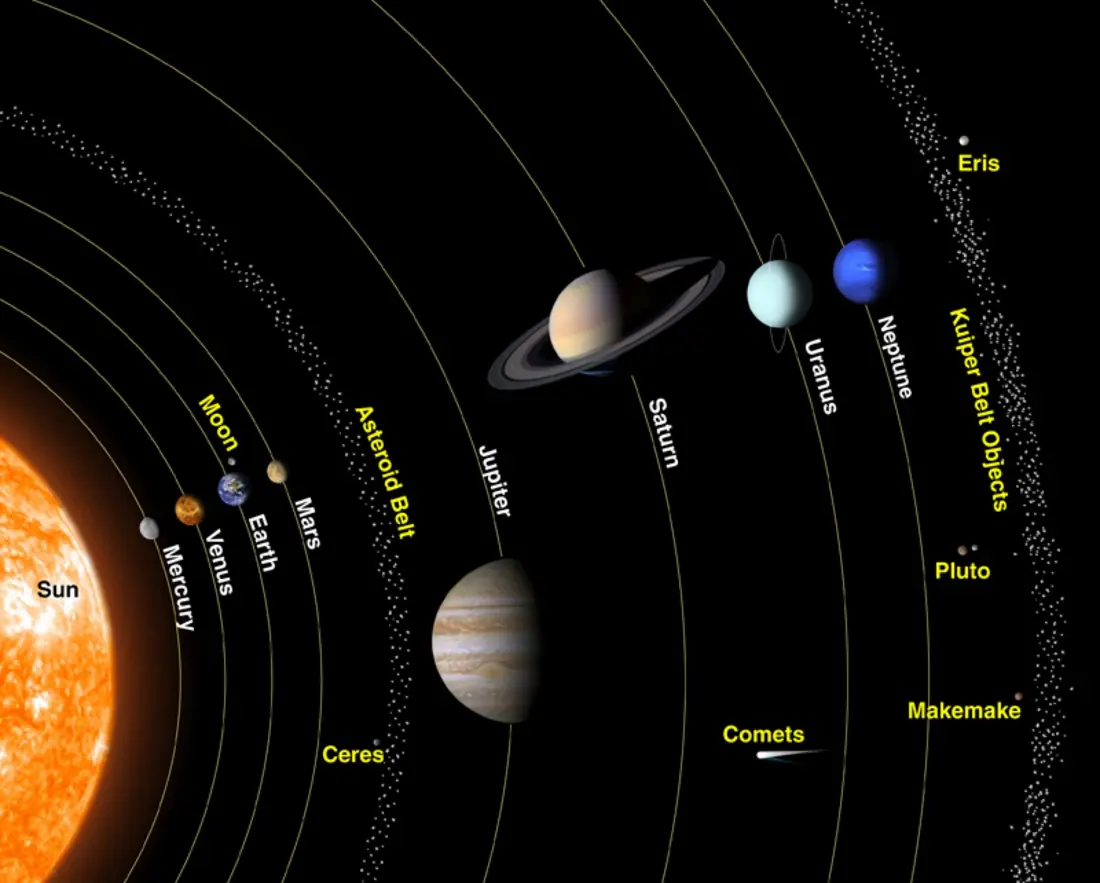
The solar system is the Sun together with all the bodies that move around it: eight planets, their moons, dwarf planets, asteroids, comets and meteoroids.
The Sun contains more than 99 % of the mass of the solar system, and its gravity holds everything in orbit. The solar system is about 4.6 billion years old.
The planets in order from the Sun: Mercury, Venus, Earth, Mars, Jupiter, Saturn, Uranus, Neptune.
My Very Educated Mother Just Served Us Noodles.
| Planet | Distance from Sun (AU) | Diameter (km) | Time for one revolution | Moons | Notes |
|---|---|---|---|---|---|
| Mercury | 0.39 | 4,879 | 88 days | 0 | Smallest planet; nearest to the Sun |
| Venus | 0.72 | 12,104 | 225 days | 0 | Hottest planet (about 460 °C, thick CO₂ atmosphere); spins backwards |
| Earth | 1.00 | 12,742 | 365.25 days | 1 | Only known planet with life |
| Mars | 1.52 | 6,779 | 687 days | 2 | "Red planet" (iron oxide); Olympus Mons is the biggest volcano |
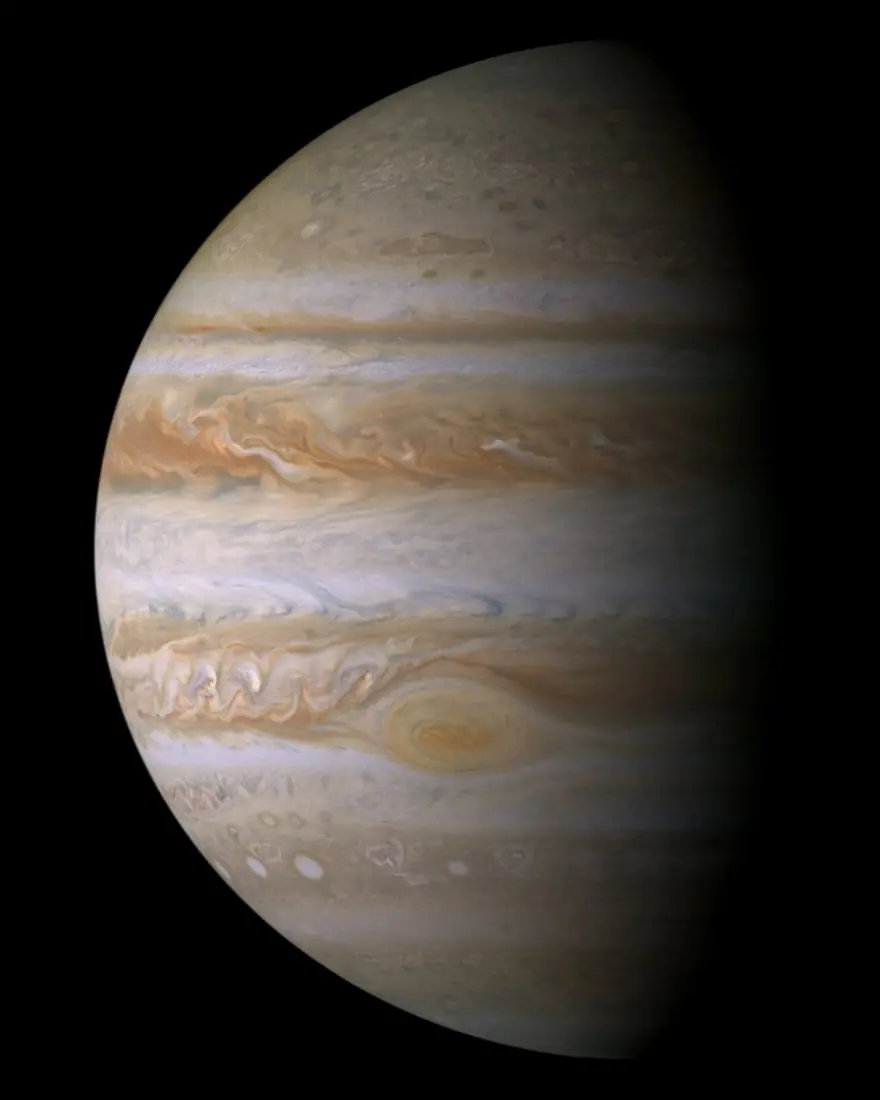
| Jupiter | 5.20 | 139,820 | 11.9 years | many (90+) | Largest planet; Great Red Spot storm |
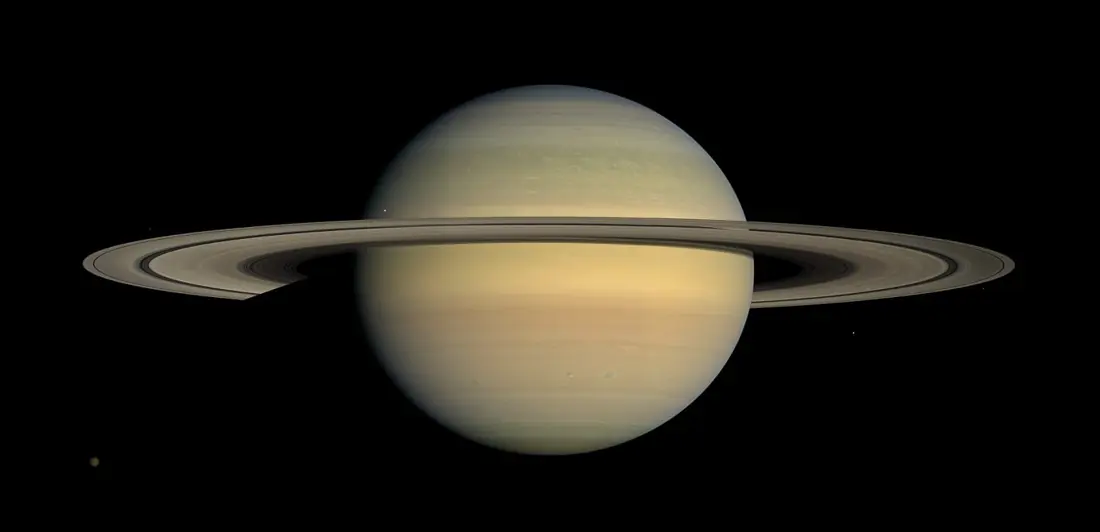
| Saturn | 9.58 | 116,460 | 29.5 years | many (140+) | Bright rings of ice; less dense than water |
| Uranus | 19.2 | 50,724 | 84 years | 28 | Rotates on its side; blue-green (methane) |
| Neptune | 30.1 | 49,244 | 165 years | 16 | Farthest planet; windy and cold |
The first four (Mercury to Mars) are the inner (terrestrial) planets: small, rocky and dense. Jupiter, Saturn, Uranus and Neptune are the outer (giant) planets: very large, made mostly of gas and ice, and having rings. Jupiter and Saturn are gas giants; Uranus and Neptune are ice giants.
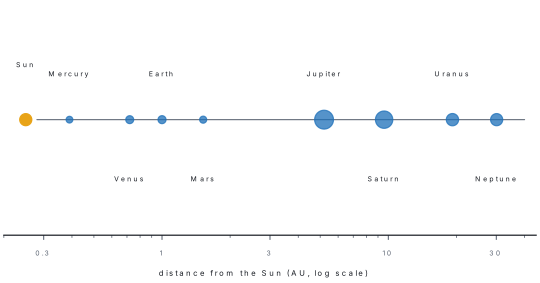
Kepler's third law. For planets orbiting the Sun, the square of the time of one revolution is proportional to the cube of the average distance from the Sun: T^2 \propto r^3. If T is in years and r in AU, then T^2 = r^3.
Problem. A planet orbits the Sun at an average distance of 4 AU. Find its time period.
Solution. T^2 = r^3 = 4^3 = 64, so T = 8 years.
Dwarf planets. In 2006 the International Astronomical Union defined a planet as a body that orbits the Sun, is round, and has cleared its orbit of other bodies. Pluto does not clear its orbit, so it is a dwarf planet, as are Ceres, Eris, Haumea and Makemake.
Moon. The Moon is the Earth's only natural satellite. Its diameter is about one quarter of the Earth's, and it is about 384,000 km away. It takes about 27.3 days to orbit the Earth and shows the same face to us always. It has no air or water, so the daytime is hot (about 127 °C) and the night is very cold (about −173 °C). Its gravity is one sixth of the Earth's. The phases of the Moon (new moon to full moon) arise because we see different portions of the lit half as the Moon goes round the Earth. Tides in the sea are caused mainly by the Moon's gravity.
Eclipses. A solar eclipse occurs when the Moon comes between the Sun and the Earth (on a new moon day) and its shadow falls on the Earth. A lunar eclipse occurs when the Earth comes between the Sun and the Moon (on a full moon day) and the Moon moves into the Earth's shadow. We do not get an eclipse every month because the Moon's orbit is tilted by about 5° to the Earth's orbit.
Other members.
| Body | What it is |
|---|---|
| Asteroids | Rocky lumps, mostly in the asteroid belt between Mars and Jupiter |
| Comets | Balls of ice, dust and rock in long orbits. Near the Sun they develop a glowing head and a tail pointing away from the Sun. Halley's comet returns about every 76 years |
| Meteoroids | Small rocky pieces in space |
| Meteors ("shooting stars") | Meteoroids burning up as they enter the Earth's atmosphere |
| Meteorites | Meteors that reach the ground |
12.2 Formation of the universe
The Big Bang theory
The most widely accepted explanation for the origin of the universe is the Big Bang theory.
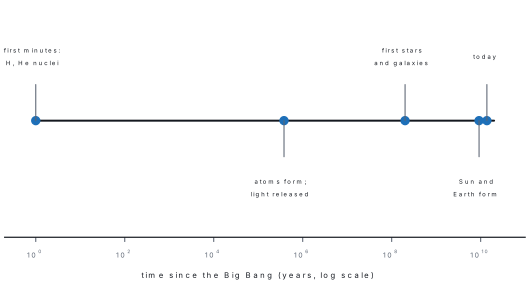
According to the Big Bang theory, the universe began about 13.8 billion years ago from an extremely hot and dense point, which expanded rapidly in a huge explosion-like event. The universe has been expanding and cooling ever since.
It is not an explosion in space; it is the expansion of space itself. A useful picture is a balloon with dots drawn on it. As the balloon is blown up, every dot moves away from every other dot, and no dot is the centre.
Main stages:
- Beginning (time zero): all matter and energy are packed in a tiny, hot, dense state.
- First fraction of a second: rapid expansion; fundamental particles (quarks, electrons) form.
- First few minutes: protons and neutrons join to form the nuclei of hydrogen and helium.
- About 380,000 years: the universe has cooled enough for atoms to form; light is free to travel. This relic light is still seen today as the cosmic microwave background.
- After a few hundred million years: gravity pulls gas together to form the first stars and galaxies.
- About 9 billion years after the Big Bang (4.6 billion years ago): our Sun and solar system form from a cloud of gas and dust.
Evidence for the Big Bang
- Expanding universe (Hubble, 1929). Edwin Hubble found that distant galaxies are moving away from us, and the farther the galaxy, the faster it recedes (v = H_0 d, where H_0 \approx 70 km s⁻¹ per megaparsec). The light of receding galaxies is shifted toward the red end of the spectrum (red shift), like a siren that sounds lower when the ambulance moves away (the Doppler effect). If the galaxies are moving apart now, they must have been together in the past.
- Cosmic microwave background radiation. Discovered by Penzias and Wilson in 1965: a faint microwave glow coming equally from all directions, at a temperature of about 2.7 K. It is the cooled afterglow of the early hot universe.
- Abundance of light elements. About 75 % hydrogen and 25 % helium by mass in the universe, as the theory predicts.
Fate and other ideas
Observations show that the expansion is speeding up, driven by something called dark energy. Galaxies also contain much more mass than we can see; the unseen matter is called dark matter. Together dark matter and dark energy make up about 95 % of the universe, and their nature is not yet known. An older competing idea, the Steady State theory, said that the universe has no beginning and looks the same at all times, but it could not explain the microwave background and has been given up.
Problem. A galaxy is 100 megaparsecs away. Using H_0 = 70 km s⁻¹ Mpc⁻¹, find the speed with which it moves away.
Solution. v = H_0 d = 70 \times 100 = 7000 km s⁻¹.
12.3 Space exploration
Why explore space?
To understand the origin and future of the universe, to find life elsewhere, to find new resources, to improve life on Earth with new technologies (weather forecasting, communication, GPS, medical imaging), and to study threats such as asteroids.
Tools of space exploration
Telescopes. Optical telescopes collect visible light. Radio telescopes collect radio waves from space (Jodrell Bank, Arecibo). Space telescopes avoid the blurring and absorption of the atmosphere: the Hubble Space Telescope (1990) and the James Webb Space Telescope (launched 2021, infrared) have shown galaxies at enormous distances.
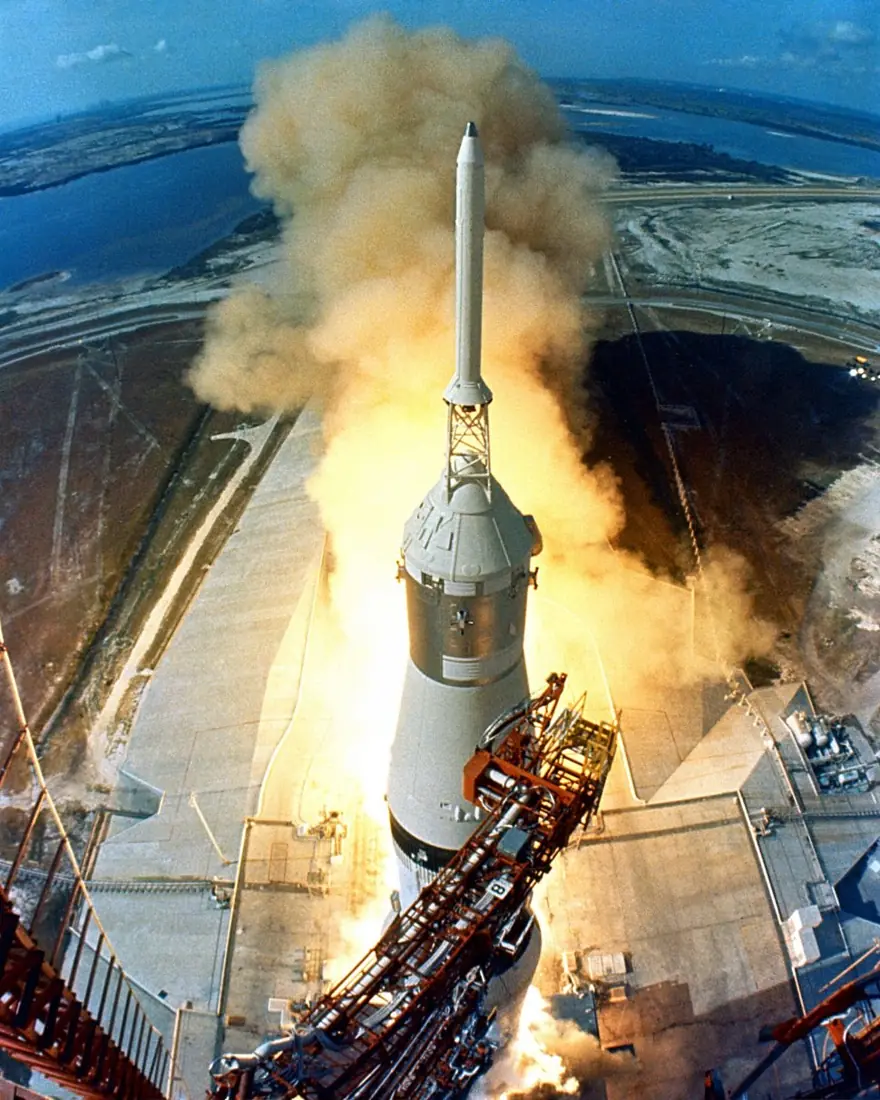
Rockets. A rocket works on Newton's third law: hot gas is thrown out backward at high speed, and the rocket moves forward with an equal momentum. To reach orbit, the rocket must reach about 8 km s⁻¹. Rockets are built in stages; each stage is dropped when its fuel is used up so that the remaining rocket is lighter.
Problem. An object must have a speed called the escape velocity v = \sqrt{2gR} to leave the Earth for ever. Find it for g = 9.8 m s⁻² and R = 6.4\times10^{6} m.
Solution. v = \sqrt{2 \times 9.8 \times 6.4\times10^{6}} = \sqrt{1.254\times10^{8}} = 1.12\times10^{4} m s⁻¹ = 11.2 km s⁻¹.
(The speed needed to stay in a low orbit is smaller, \sqrt{gR} \approx 7.9 km s⁻¹.)
Artificial satellites
An artificial satellite is a man-made object that revolves around the Earth (or another body). It stays in orbit because the gravitational pull supplies the force needed to keep it moving in a circle; it is in a continuous free fall around the Earth.
| Type | Height | Period | Uses |
|---|---|---|---|
| Low Earth orbit (LEO) | 200–2,000 km | about 90 min | Earth observation, International Space Station, spy and remote-sensing satellites |
| Polar orbit | about 800 km | about 100 min | Map-making, weather, covers the whole Earth as it turns below |
| Geostationary orbit | 36,000 km above the equator | 24 h | Communication, TV broadcast, weather. It stays above the same point on the Earth |
A geostationary satellite revolves from west to east with the same period as the Earth's rotation (24 h), so it always appears fixed over one point of the sky.
Uses of satellites: communication (telephone, TV, internet), weather forecasting, navigation (GPS), remote sensing (forests, glaciers, floods, land use), military surveillance, and scientific research.
Nepal in space. In 2019 Nepal sent its first satellite, NepaliSat-1, a small cube about 10 cm on a side built by Nepali engineers in Japan as part of the BIRDS-3 project. It was launched to the International Space Station and released into orbit to take images of Nepal's land and mountains. Nepal also uses foreign satellites for weather and remote sensing, e.g. monitoring glaciers and glacial lakes.
Milestones of space exploration
| Year | Event |
|---|---|
| 1957 | USSR launches Sputnik 1, the first artificial satellite (4 October). Dog Laika orbits in Sputnik 2 |
| 1961 | Yuri Gagarin (USSR) becomes the first human in space (12 April) |
| 1963 | Valentina Tereshkova, first woman in space |
| 1969 | Apollo 11 (USA): Neil Armstrong and Buzz Aldrin walk on the Moon (20 July) |
| 1977 | Voyager 1 and 2 launched; Voyager 1 later entered interstellar space |
| 1981–2011 | Space Shuttle flights |
| 1990 | Hubble Space Telescope launched |
| 1998 | First part of the International Space Station (ISS) launched |
| 2008 | India's Chandrayaan-1 finds evidence of water on the Moon |
| 2021 | NASA's Perseverance rover lands on Mars; James Webb Space Telescope launched |
| 2023 | Chandrayaan-3 (India) lands near the Moon's south pole |
Space stations, probes and rovers
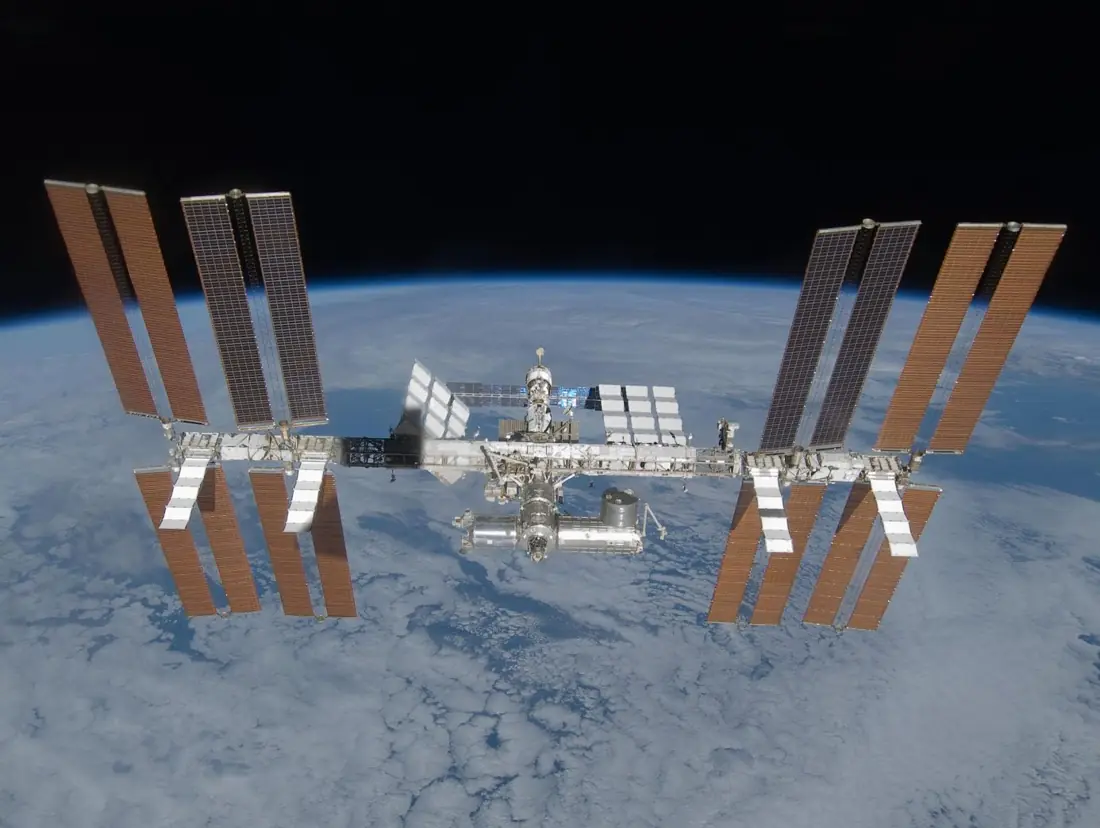
- Space station. The International Space Station is a large laboratory orbiting about 400 km above the Earth, built and run by the USA, Russia, Europe, Japan and Canada. Astronauts live there for months and carry out experiments in weightlessness.
- Space probes are unmanned spacecraft sent to study planets and other bodies from near or far: Voyager, Cassini (Saturn), New Horizons (Pluto).
- Rovers are vehicles that drive on another world: Curiosity and Perseverance on Mars.
Problems and dangers
- Space debris. Thousands of broken satellites and pieces of rocket orbit the Earth at high speed and can damage working satellites.
- Cost and risk to human life; harmful radiation and weightlessness (muscle and bone loss).
- Pollution of the upper atmosphere from rocket launches.
When asked to "explain how a geostationary satellite is useful", give: orbit at 36,000 km above the equator, period 24 h, appears fixed in the sky, therefore a single dish antenna on the ground can keep pointing at it for TV and communication.
Chapter summary
- The universe is everything. 1 light year = 9.46\times10^{12} km (distance); 1 AU = 1.5\times10^{8} km. Sunlight takes 8 min 20 s to reach the Earth.
- A star is a ball of hot gas shining by nuclear fusion of hydrogen. Life cycle: nebula → protostar → main sequence → red giant → white dwarf (Sun-like) or supernova → neutron star / black hole (massive).
- A galaxy is a system of billions of stars. The Milky Way is a spiral galaxy. Constellations are patterns of stars; the Pole Star shows north.
- The solar system has eight planets: Mercury, Venus, Earth, Mars (terrestrial), Jupiter, Saturn, Uranus, Neptune (giants), plus dwarf planets, asteroids, comets and meteors. T^2 = r^3 (years, AU).
- Big Bang: the universe began about 13.8 billion years ago and is still expanding. Evidence: red shift of galaxies, cosmic microwave background, abundance of H and He.
- Satellites stay in orbit because gravity supplies the circular-motion force. Geostationary satellites orbit at 36,000 km with a 24 h period.
- Milestones: Sputnik 1 (1957), Gagarin (1961), Apollo 11 (1969), Hubble (1990), ISS (1998), NepaliSat-1 (2019).
Practice questions
Group A — Objective (1 mark each)
- A light year is a unit of [1]atimebdistancecspeeddbrightness
- The planet nearest to the Sun is [1]aVenusbMarscMercurydEarth
- The most accepted theory of the origin of the universe is the [1]aSteady State theorybBig Bang theorycNebular theory onlydPulsating theory
- The star at the end of a Sun-like star's life is a [1]ablack holebneutron starcwhite dwarfdsupernova
- A geostationary satellite has a period of [1]a90 minutesb12 hoursc24 hoursd365 days
Answers to Group A
1. (b) — it is the distance light travels in a year.
2. (c) — Mercury is 0.39 AU from the Sun.
3. (b) — supported by red shift and the microwave background.
4. (c) — a Sun-like star sheds its outer layers and leaves a white dwarf.
5. (c) — it matches the Earth's rotation, so it stays above one spot.
Group B — Short answer (2 marks each)
- Define a light year. How long does light from the Sun take to reach the Earth? [2]
- Why do stars twinkle but planets do not? [2]
- Name the types of galaxy. To which type does the Milky Way belong? [2]
- Why is Pluto not called a planet? [2]
- Give any two uses of artificial satellites. [2]
Answers to Group B
1. A light year is the distance travelled by light in one year in vacuum (9.46\times10^{12} km). Sunlight takes about 8 min 20 s (500 s).
2. The light of stars is refracted by the moving layers of the atmosphere, so its apparent position and brightness keep changing. Planets are nearer and look like small discs; the changes from different points average out.
3. Spiral, elliptical and irregular. The Milky Way is a spiral galaxy.
4. Pluto has not cleared its orbit of other bodies, so in 2006 it was classified as a dwarf planet.
5. Any two: communication, weather forecasting, navigation (GPS), remote sensing, TV broadcast.
Group C — Long answer (4 marks each)
- Describe the life cycle of a star like the Sun and of a massive star. [4]
- State the Big Bang theory and give two pieces of evidence for it. [4]
- A star is 8.6 light years away. Find its distance in kilometres and the time light from it takes to reach us. [4]
- A planet is 9 AU from the Sun. Find the time it takes to go once round the Sun. [4]
- What is a geostationary satellite? Write the conditions it must satisfy and two uses. [4]
Answers to Group C
1. Sun-like: nebula → protostar → main sequence → red giant → planetary nebula → white dwarf. Massive: nebula → protostar → main sequence → red supergiant → supernova → neutron star or black hole.
2. Statement: the universe began about 13.8 billion years ago from a hot, dense state and has been expanding. Evidence: red shift of distant galaxies (they recede, faster if farther); cosmic microwave background of 2.7 K; abundance of hydrogen and helium.
3. d = 8.6 \times 9.46\times10^{12} = 8.14\times10^{13} km. Time = 8.6 years.
4. T^2 = r^3 = 9^3 = 729, so T = 27 years.
5. A satellite that appears fixed above one point of the Earth. Conditions: orbit above the equator at about 36,000 km, revolves west to east, period 24 h. Uses: TV and communication, weather watching.
Practise more: Science and Technology question bank