Unit 15 · Science and Technology · 16 min read
Chemical Reaction
What the syllabus asks for 4
- Types of reactions
- balancing equations
- rate of reaction
- acids, bases and salts
Cooking rice, rusting of an iron gate, curd forming from milk, a match burning and a lemon turning a tea light in colour are all chemical reactions. In each of them old substances disappear and new ones appear. This chapter teaches you to describe a reaction in the language of chemistry: how to write it, how to balance it, how to classify it, how fast it goes, and how the acids, bases and salts that you meet every day take part in it.
Expect: balancing a chemical equation (2 marks), naming the type of reaction in a given equation (1 mark), factors that change the rate of a reaction (2 to 4 marks), the properties and uses of acids and bases, the pH scale, neutralisation and the preparation of a salt (4 marks).
15.1 Types of reactions
Physical and chemical change
| Physical change | Chemical change |
|---|---|
| No new substance is formed. | One or more new substances are formed. |
| Usually easy to reverse. | Usually difficult to reverse. |
| Only physical properties (shape, state) change. | Composition and properties both change. |
| Melting of ice, dissolving sugar | Burning of wood, rusting, digestion of food |
Chemical equation
A chemical equation is the short way of describing a chemical reaction using symbols and formulae. The substances on the left are reactants; the substances on the right are products. The arrow means "gives".
Magnesium burns in oxygen to give magnesium oxide:
2Mg + O₂ → 2MgO
Symbols in brackets show the state: (s) solid, (l) liquid, (g) gas, (aq) dissolved in water. An upward arrow ↑ after a product means a gas is released, and a downward arrow ↓ means a solid (precipitate) settles.
Evidence that a chemical reaction has taken place
- change of colour (iron nail in copper sulphate solution turns brown);
- evolution of a gas (bubbles when zinc is put in acid);
- formation of a precipitate (white solid when silver nitrate is added to salt solution);
- change of temperature (heat released when quicklime is added to water);
- change of state or smell.
Types of chemical reactions
1. Combination (synthesis) reaction
Two or more substances join to form one product.
- C + O₂ → CO₂
- 2H₂ + O₂ → 2H₂O
- CaO + H₂O → Ca(OH)₂ (slaking of lime, heat is given out)
2. Decomposition reaction
One compound breaks into two or more simpler substances. It needs heat, light or electricity.
| Type | Example |
|---|---|
| Thermal decomposition | CaCO₃ --Δ--> CaO + CO₂ ↑ |
| Thermal decomposition | 2HgO --Δ--> 2Hg + O₂ ↑ |
| Electrolysis | 2H₂O --electricity--> 2H₂ ↑ + O₂ ↑ |
| Photolysis (light) | 2AgCl --sunlight--> 2Ag + Cl₂ ↑ |
The decomposition of limestone (CaCO₃) in a kiln is the first step of making cement and quicklime.
3. Displacement (single replacement) reaction
A more reactive element replaces a less reactive element from its compound.
- Fe + CuSO₄ → FeSO₄ + Cu (the blue solution turns pale green and brown copper settles on the nail)
- Zn + CuSO₄ → ZnSO₄ + Cu
- Zn + 2HCl → ZnCl₂ + H₂ ↑
4. Double displacement (double decomposition) reaction
Two compounds exchange their ions to form two new compounds. If one product is an insoluble solid, it is called a precipitation reaction.
- AgNO₃ + NaCl → AgCl ↓ + NaNO₃ (white precipitate)
- BaCl₂ + Na₂SO₄ → BaSO₄ ↓ + 2NaCl (white precipitate)
- NaOH + HCl → NaCl + H₂O (neutralisation is also double displacement)
5. Exothermic and endothermic reactions
| Exothermic reaction | Endothermic reaction |
|---|---|
| Heat is released to the surroundings. | Heat is absorbed from the surroundings. |
| The container becomes warm. | The container becomes cold. |
| Burning of fuel, respiration, CaO + H₂O | Photosynthesis, decomposition of CaCO₃ |
6. Oxidation and reduction (redox)
In the simple school definition, oxidation is the gain of oxygen or the loss of hydrogen; reduction is the loss of oxygen or the gain of hydrogen. Both happen together in one reaction.
CuO + H₂ → Cu + H₂O
Here CuO loses oxygen, so it is reduced; H₂ gains oxygen, so it is oxidised. The substance that is reduced is the oxidising agent (CuO) and the substance that is oxidised is the reducing agent (H₂).
OIL RIG — Oxidation Is Loss (of electrons), Reduction Is Gain. For oxygen: oxidation = gain of oxygen, reduction = loss of oxygen.
15.2 Balancing equations
Law of conservation of mass
Antoine Lavoisier showed that in a chemical reaction, mass is neither created nor destroyed. The total mass of the reactants equals the total mass of the products. This means that atoms of every element on the left must equal those on the right. An equation that obeys this is balanced.
Steps to balance an equation (hit and trial method)
- Write the correct formulae of all reactants and products (skeleton equation).
- Count the atoms of each element on both sides.
- Balance the element that appears in the most complex formula first; leave hydrogen and oxygen for last.
- Put a coefficient (a number) in front of a formula. Never change a subscript inside a formula.
- Recount all atoms. Check that the equation is balanced.
Problem. Balance H₂ + O₂ → H₂O.
Solution. Count atoms: left H = 2, O = 2; right H = 2, O = 1. Oxygen is unequal. Put 2 before H₂O: H₂ + O₂ → 2H₂O. Now right H = 4, O = 2. Put 2 before H₂: 2H₂ + O₂ → 2H₂O. Check: left H = 4, O = 2; right H = 4, O = 2. Balanced.
Problem. Balance Fe + H₂O → Fe₃O₄ + H₂.
Solution. Fe₃O₄ has 3 Fe and 4 O. Put 3 before Fe and 4 before H₂O: 3Fe + 4H₂O → Fe₃O₄ + H₂. Now H on the left is 8, so put 4 before H₂: 3Fe + 4H₂O → Fe₃O₄ + 4H₂. Check: Fe 3 = 3; O 4 = 4; H 8 = 8.
Problem. Balance Al + HCl → AlCl₃ + H₂.
Solution. Cl: right has 3, so put 3 before HCl: Al + 3HCl → AlCl₃ + H₂. H: left 3, right 2. Make both 6: multiply HCl by 2 and H₂ by 3: Al + 6HCl → AlCl₃ + 3H₂. Now Cl: left 6, so put 2 before AlCl₃ and 2 before Al: 2Al + 6HCl → 2AlCl₃ + 3H₂. Check: Al 2 = 2; Cl 6 = 6; H 6 = 6.
To balance oxygen in H₂ + O₂ → H₂O, some students write H₂O₂. That is hydrogen peroxide, a different substance. You may only place numbers in front of formulae.
Problem. 24 g of magnesium burns completely in oxygen and produces 40 g of magnesium oxide. Find the mass of oxygen used.
Solution. Mass of reactants = mass of products. 24 g + mass of O₂ = 40 g. Mass of oxygen = 40 − 24 = 16 g.
15.3 Rate of reaction
Some reactions are fast (burning of petrol, firecrackers) and some are slow (rusting, ripening of fruit). The rate of reaction is the speed at which reactants are used up or products are formed.
Collision theory in simple words
A reaction takes place when particles collide with enough energy. The more often they collide, and the harder they collide, the faster the reaction.
Factors affecting the rate
| Factor | Effect on rate | Reason / example |
|---|---|---|
| Nature of reactants | Depends on the substance | Sodium reacts violently with water; iron reacts slowly. |
| Concentration | Higher concentration, faster | More particles in the same volume, so more collisions. Marble chips react faster with strong HCl than with dilute HCl. |
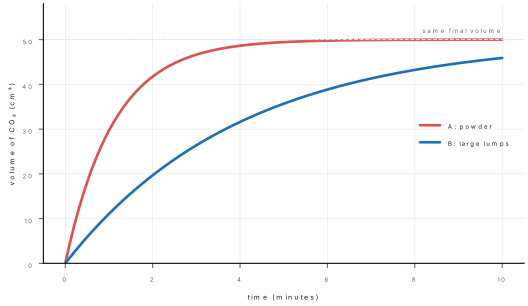
| Surface area (size of particles) | Smaller pieces, faster | More surface is exposed. Powdered chalk reacts faster than a lump; coal dust can explode. |
| Temperature | Higher temperature, faster | Particles move faster and collide harder. Food cooks faster in a pressure cooker; milk is stored in a fridge to slow souring. |
| Catalyst | Changes the rate, itself unchanged | MnO₂ speeds up the decomposition of H₂O₂ to H₂O and O₂. |
| Light | Some reactions speed up | Photosynthesis; AgBr in photographic film. |
A catalyst is a substance that changes the rate of a chemical reaction without being used up in the reaction. Example: MnO₂ in 2KClO₃ → 2KCl + 3O₂.
Problem. In a reaction, 3.0 g of a reactant is used up in 5 minutes. Find the average rate. If the rate is doubled by heating, how long would 3.0 g take?
Solution. Rate = 3.0 g / 5 min = 0.6 g per minute. If the rate doubles it becomes 1.2 g per minute, so time = 3.0 / 1.2 = 2.5 minutes.
15.4 Acids, bases and salts
Acids
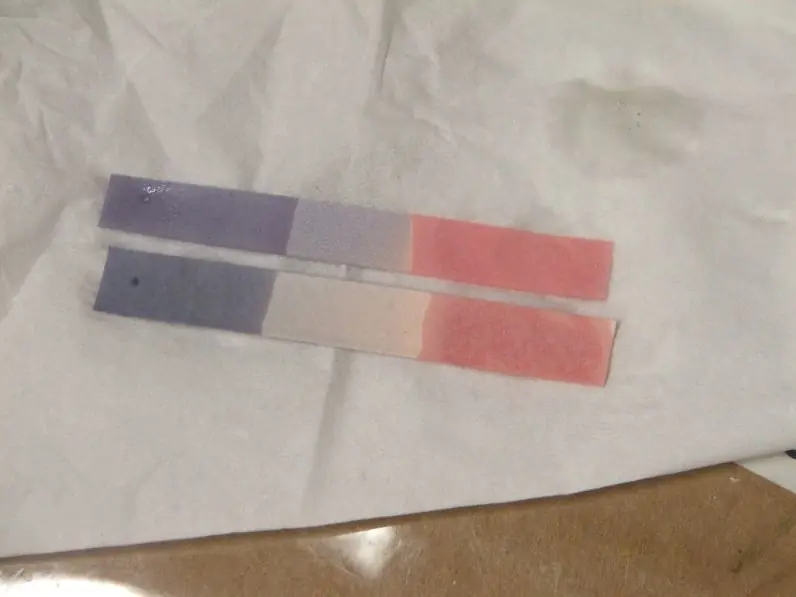
An acid is a substance that gives hydrogen ions (H⁺) in water. It tastes sour, turns blue litmus red and reacts with metals to release hydrogen.
| Acid | Formula | Source / use |
|---|---|---|
| Hydrochloric acid | HCl | gastric juice; cleaning |
| Sulphuric acid | H₂SO₄ | car batteries; fertiliser |
| Nitric acid | HNO₃ | fertilisers, explosives |
| Acetic acid | CH₃COOH | vinegar |
| Citric acid | C₆H₈O₇ | lemon, orange |
| Lactic acid | C₃H₆O₃ | curd |
| Carbonic acid | H₂CO₃ | soda water |
Properties of acids
- With metals: Zn + H₂SO₄ → ZnSO₄ + H₂ ↑
- With metal carbonates: CaCO₃ + 2HCl → CaCl₂ + H₂O + CO₂ ↑ (lime water turns milky)
- With bases: HCl + NaOH → NaCl + H₂O
Bases and alkalis
A base is a substance that reacts with an acid to give salt and water. Bases that dissolve in water are called alkalis and give hydroxide ions (OH⁻). Alkalis feel soapy and taste bitter, turn red litmus blue.
| Base | Formula | Use |
|---|---|---|
| Sodium hydroxide (caustic soda) | NaOH | soap making |
| Potassium hydroxide | KOH | soft soap |
| Calcium hydroxide (lime water) | Ca(OH)₂ | whitewash, testing CO₂ |
| Ammonium hydroxide | NH₄OH | cleaning, fertiliser |
| Magnesium hydroxide | Mg(OH)₂ | milk of magnesia (antacid) |
Copper oxide (CuO) and iron(III) oxide are bases because they neutralise acids, but they do not dissolve in water, so they are not alkalis.
Indicators
An indicator is a substance that shows by a change in colour whether a solution is acidic or basic.
| Indicator | In acid | In base |
|---|---|---|
| Blue litmus | red | blue (no change) |
| Red litmus | red (no change) | blue |
| Phenolphthalein | colourless | pink |
| Methyl orange | red | yellow |
| Turmeric | yellow | red-brown |
The pH scale
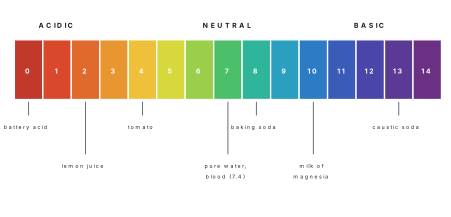
The pH scale measures how acidic or basic a solution is. It runs from 0 to 14.
- pH less than 7: acidic (the lower the number, the stronger the acid)
- pH equal to 7: neutral (pure water)
- pH more than 7: basic (the higher the number, the stronger the base)
Universal indicator and pH paper show the pH by colour.
Neutralisation
The reaction between an acid and a base to form a salt and water is neutralisation.
Acid + Base → Salt + Water
- HCl + NaOH → NaCl + H₂O
- H₂SO₄ + 2NaOH → Na₂SO₄ + 2H₂O
- 2HCl + Ca(OH)₂ → CaCl₂ + 2H₂O
Applications in daily life: an antacid tablet (Mg(OH)₂) removes extra acid in the stomach; lime (CaO) is added to acidic soil; baking soda soothes a bee sting (acid) while vinegar soothes a wasp sting (alkali); toothpaste (a base) neutralises acids produced by bacteria in the mouth.
Salts
A salt is a compound formed when the hydrogen of an acid is replaced by a metal (or ammonium ion). Common salt is NaCl.
| Type of salt | Formed from | Example |
|---|---|---|
| Normal salt | complete neutralisation | NaCl, K₂SO₄, CaCO₃ |
| Acid salt | partial replacement of H of an acid | NaHCO₃, NaHSO₄ |
| Basic salt | partial neutralisation of a base | Mg(OH)Cl |
Common salts and uses
| Salt | Formula | Use |
|---|---|---|
| Sodium chloride | NaCl | food, preservative, making NaOH and Cl₂ |
| Sodium bicarbonate (baking soda) | NaHCO₃ | baking, antacid, fire extinguisher |
| Sodium carbonate (washing soda) | Na₂CO₃·10H₂O | washing, softening hard water, glass |
| Calcium sulphate (plaster of Paris) | CaSO₄·½H₂O | plaster for broken bones, statues |
| Bleaching powder | CaOCl₂ | disinfecting water, bleaching |
| Blue vitriol | CuSO₄·5H₂O | fungicide |
Preparation of salts
A salt can be prepared by (i) acid + metal, (ii) acid + base, (iii) acid + carbonate, or (iv) double displacement. For example, zinc sulphate crystals: add excess zinc to dilute H₂SO₄ until hydrogen stops, filter off the extra zinc, heat the filtrate to saturation and cool it so that crystals of ZnSO₄·7H₂O form.
Problem. 20 cm³ of sodium hydroxide solution needs 10 cm³ of 0.2 M hydrochloric acid for neutralisation. Find the concentration of the sodium hydroxide. (NaOH + HCl → NaCl + H₂O, 1 : 1)
Solution. For a 1 : 1 reaction, M_1V_1 = M_2V_2. Acid: 0.2 × 10 = 2.0. Base: M_2 × 20 = 2.0, so M_2 = 2.0/20 = 0.1 M.
Write the acid's negative part (Cl⁻, SO₄²⁻, NO₃⁻) and the base's positive part (Na⁺, Ca²⁺), then criss-cross the charges. Ca²⁺ with Cl⁻ gives CaCl₂.
Chapter summary
- A chemical reaction forms new substances; it is shown by a balanced equation (reactants → products).
- Types: combination, decomposition, displacement, double displacement, exothermic/endothermic and redox.
- Mass is conserved: balance equations by writing coefficients, never by changing subscripts.
- Rate of reaction increases with concentration, surface area, temperature and a catalyst.
- Acids give H⁺, bases (alkalis) give OH⁻; pH below 7 is acidic, 7 is neutral, above 7 is basic.
- Acid + base → salt + water is neutralisation; Acid + metal → salt + H₂; Acid + carbonate → salt + water + CO₂.
- Important salts: NaCl, NaHCO₃, Na₂CO₃·10H₂O, plaster of Paris, bleaching powder.
Practice questions
Group A — Objective questions (1 mark each)
- The reaction CaO + H₂O → Ca(OH)₂ is a [1]adecomposition reactionbcombination reactioncdisplacement reactionddouble displacement reaction
- The white precipitate formed on mixing AgNO₃ and NaCl solutions is [1]aAgClbNaNO₃cAg₂OdNaCl
- Phenolphthalein turns ______ in a base. [1]aredbcolourlesscpinkdyellow
- A solution has pH 3. It is [1]astrongly basicbneutralcweakly basicdacidic
- A catalyst [1]ais consumed in the reactionbchanges the rate of reaction without being used upcchanges the productsdalways slows down a reaction
- Which is the balanced equation? [1]aH₂ + O₂ → H₂Ob2H₂ + O₂ → 2H₂OcH₂ + 2O₂ → 2H₂Od2H₂ + 2O₂ → 2H₂O
Answers to Group A
1. (b) — two substances join to form one.
2. (a) — AgCl is insoluble.
3. (c) — pink in alkali.
4. (d) — below 7.
5. (b) — definition of a catalyst.
6. (b) — 4 H and 2 O on each side.
Group B — Short answer (2 marks each)
- Balance: Na + H₂O → NaOH + H₂. [2]
- Why does powdered zinc react faster with acid than a lump of zinc? [2]
- What is neutralisation? Write one equation. [2]
- A student burns 12 g of carbon and obtains 44 g of CO₂. How much oxygen reacted? State the law used. [2]
- Distinguish between exothermic and endothermic reactions with one example each. [2]
Answers to Group B
1. 2Na + 2H₂O → 2NaOH + H₂ (Na 2 = 2, O 2 = 2, H 4 = 4).
2. Powder has a larger surface area, so more particles are exposed to the acid and more collisions occur per second.
3. Reaction of an acid with a base to form a salt and water. HCl + NaOH → NaCl + H₂O.
4. Oxygen = 44 − 12 = 32 g. Law of conservation of mass.
5. Exothermic: releases heat (burning of coal). Endothermic: absorbs heat (decomposition of CaCO₃).
Group C — Long answer (4 marks each)
- Explain with examples four factors that affect the rate of a chemical reaction. [4]
- Describe the properties of acids with the help of equations. [4]
- Write the steps to balance Fe + O₂ → Fe₂O₃ and give the balanced equation. [4]
- Explain the pH scale and state how you would find whether a liquid is acidic, basic or neutral using litmus paper. [4]
Answers to Group C
1. Concentration (more concentrated acid reacts faster with marble); surface area (powdered chalk faster than a lump); temperature (food cooks faster at higher temperature); catalyst (MnO₂ speeds up decomposition of H₂O₂). Each is explained by more or harder collisions.
2. Sour taste; blue litmus turns red; reaction with metals gives hydrogen (Zn + 2HCl → ZnCl₂ + H₂); with carbonates gives CO₂ (CaCO₃ + 2HCl → CaCl₂ + H₂O + CO₂); with bases gives salt and water (HCl + NaOH → NaCl + H₂O).
3. Fe₂O₃ has 2 Fe and 3 O. Put 2 before Fe: 2Fe. Oxygen is 3 on the right and 2 on the left; take the lowest common multiple 6: 3O₂ on the left and 2Fe₂O₃ on the right; then Fe is 4, so 4Fe. 4Fe + 3O₂ → 2Fe₂O₃.
4. pH is a scale from 0 to 14 that shows acidity or basicity: below 7 acidic, 7 neutral, above 7 basic. With litmus: if blue litmus turns red, the liquid is acidic; if red litmus turns blue, it is basic; if neither changes, it is neutral.
Practise more: Science and Technology question bank