Unit 4 · Science and Technology · 20 min read
Heredity
What the syllabus asks for 4
- Mendel's experiments and laws
- chromosomes and genes
- sex determination
- genetic disorders
Why do you have your mother's eyes or your father's curly hair? Why do two children of the same parents look alike, but not exactly the same? The passing of characters from parents to their children is called heredity, and the study of heredity and variation is called genetics. Genetics began in a monastery garden with an Austrian monk who grew peas. This unit explains his experiments and laws, how chromosomes and genes carry the characters, how the sex of a child is decided, and some diseases that run in families.
Most marks come from crosses: a monohybrid cross with the 3 : 1 phenotypic ratio and a dihybrid cross with the 9 : 3 : 3 : 1 ratio, drawn with a Punnett square (4 marks). Also expect definitions (heredity, gene, allele, dominant, recessive, genotype, phenotype), the XX-XY mechanism of sex determination, and the cause of Down's syndrome, haemophilia and colour blindness.
4.1 Mendel's experiments and laws
Heredity and variation
Heredity is the transmission of characters (traits) from parents to offspring through genes.
Variation is the difference between individuals of the same species, even between brothers and sisters. Variation arises because the offspring receive a mixture of genes from two parents and because of changes in genes called mutations. Variation helps a species to survive when the environment changes.
Gregor Johann Mendel
Gregor Johann Mendel (1822–1884) was an Austrian monk. Between 1856 and 1863 he did experiments on the garden pea (Pisum sativum) in the garden of his monastery in Brno (now in the Czech Republic) and published them in 1866. His work was not noticed until 1900, when three scientists (de Vries, Correns, Tschermak) found his results independently. Mendel is called the father of genetics.
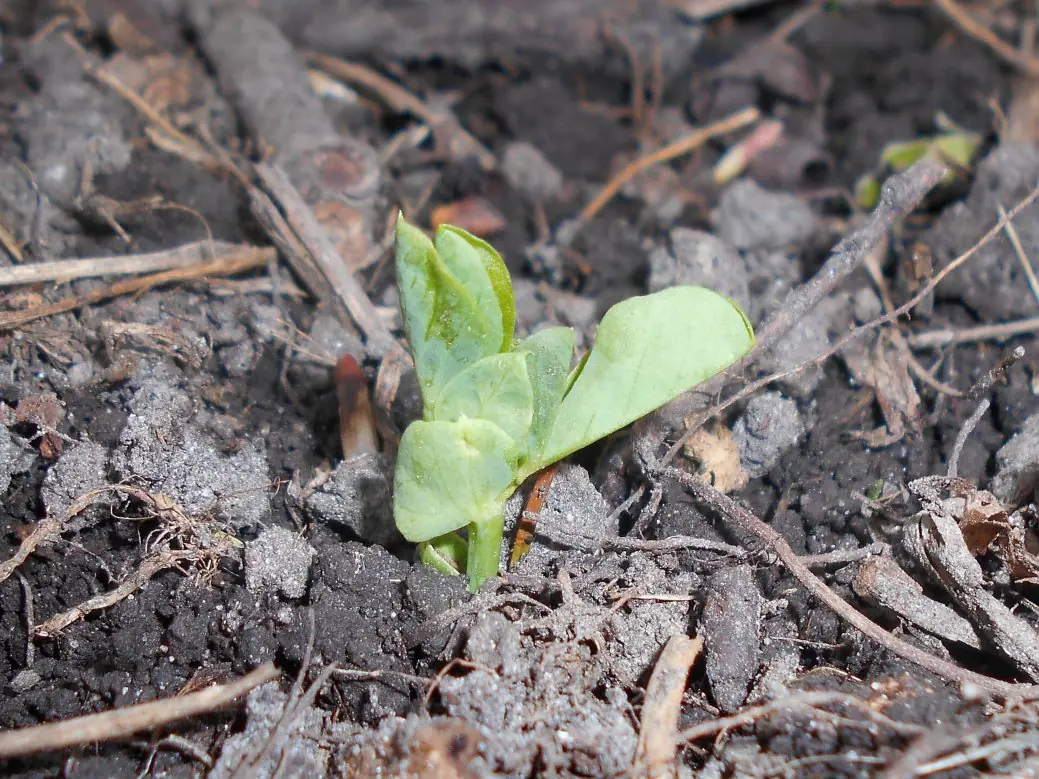
Why did Mendel choose the pea plant?
- It has clear, contrasting characters (tall or dwarf, round or wrinkled seed).
- It is self-pollinating, so pure lines (true-breeding plants) are easy to get, but it can also be cross-pollinated by hand.
- Its life cycle is short and it produces many seeds.
- It is easy to grow and the flowers are large enough to handle.
Mendel studied seven pairs of contrasting characters:
| Character | Dominant form | Recessive form |
|---|---|---|
| Height of stem | Tall | Dwarf |
| Seed shape | Round | Wrinkled |
| Seed colour | Yellow | Green |
| Pod shape | Inflated (full) | Constricted |
| Pod colour | Green | Yellow |
| Flower colour | Violet (purple) | White |
| Flower position | Axial (along the stem) | Terminal (at the tip) |
Terms used in genetics
| Term | Meaning |
|---|---|
| Character / trait | A feature that can be inherited, e.g. height |
| Gene | A segment of DNA on a chromosome that controls a character |
| Allele | One of the alternative forms of a gene (T for tall and t for dwarf) |
| Dominant | An allele that shows its effect even when only one copy is present (capital letter) |
| Recessive | An allele that shows its effect only when two copies are present (small letter) |
| Homozygous (pure) | Two identical alleles: TT or tt |
| Heterozygous (hybrid) | Two different alleles: Tt |
| Genotype | The genetic make-up of an organism (TT, Tt, tt) |
| Phenotype | The visible character (tall, dwarf) |
| Hybrid | Offspring of parents that differ in one or more characters |
| P generation | Parental generation |
| F₁ and F₂ | First and second filial generation (children and grandchildren) |
Monohybrid cross
A monohybrid cross studies the inheritance of one pair of contrasting characters.
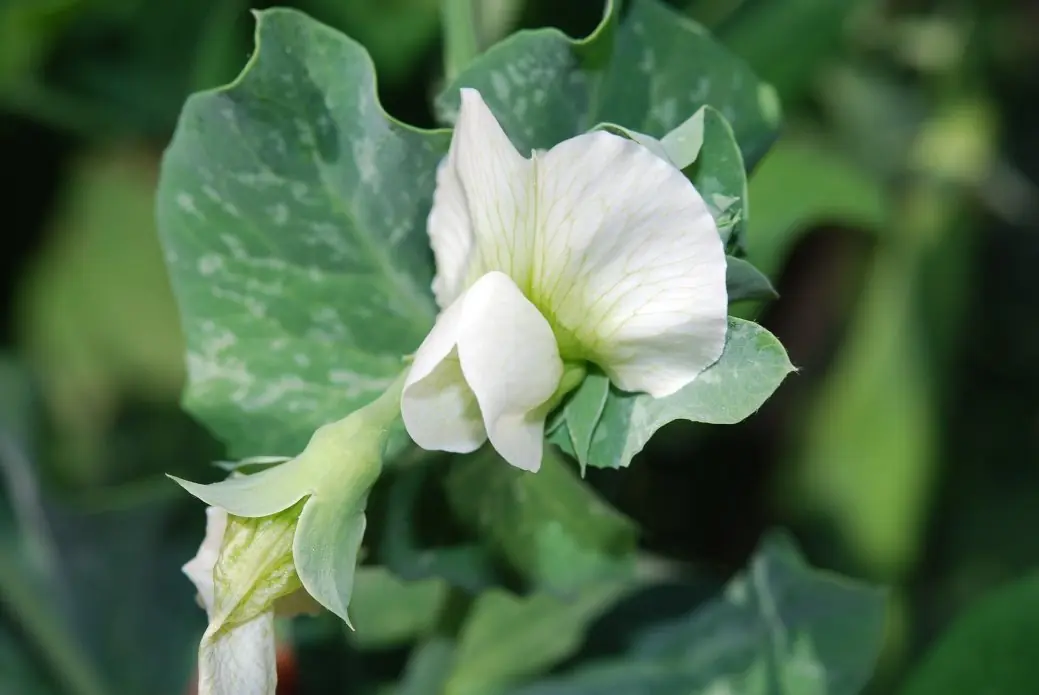
Mendel crossed a pure tall plant (TT) with a pure dwarf plant (tt).
- The F₁ generation: all plants were tall. The dwarf character seemed to have disappeared.
- He then let the F₁ plants self-pollinate. The F₂ generation had both tall and dwarf plants in the ratio 3 : 1: about 787 tall and 277 dwarf in his counts.
So the dwarf character was not lost; it was hidden in F₁.
Explanation: A pure tall plant (TT) makes only T gametes; a pure dwarf (tt) makes only t gametes. Every F₁ plant is Tt, and shows tall because T is dominant. Tt plants make two kinds of gametes, T and t, in equal numbers. They combine at random:
| Gametes | T | t |
|---|---|---|
| T | TT (tall) | Tt (tall) |
| t | Tt (tall) | tt (dwarf) |
- Phenotypic ratio F₂: 3 tall : 1 dwarf.
- Genotypic ratio F₂: 1 TT : 2 Tt : 1 tt.
Problem. A pea plant heterozygous for round seeds (Rr) is self-pollinated, and 400 seeds are produced. Round (R) is dominant over wrinkled (r). How many seeds are expected to be round and how many wrinkled?
Solution. Gametes of Rr: R and r. Punnett square: RR, Rr, Rr, rr.
Phenotypic ratio = 3 round : 1 wrinkled.
Round seeds = 3/4 × 400 = 300. Wrinkled seeds = 1/4 × 400 = 100.
Genotypes: 100 RR, 200 Rr, 100 rr.
Test cross
A tall plant may be TT or Tt. To find its genotype, it is crossed with a recessive (dwarf, tt) plant. This is the test cross.
- If all offspring are tall, the plant tested was TT (homozygous).
- If half tall and half dwarf (1 : 1), the plant was Tt (heterozygous).
Dihybrid cross
A dihybrid cross studies the inheritance of two pairs of contrasting characters at the same time.
Mendel crossed a pure plant with round yellow seeds (RRYY) with a pure plant with wrinkled green seeds (rryy).
- F₁: all plants had round yellow seeds (RrYy).
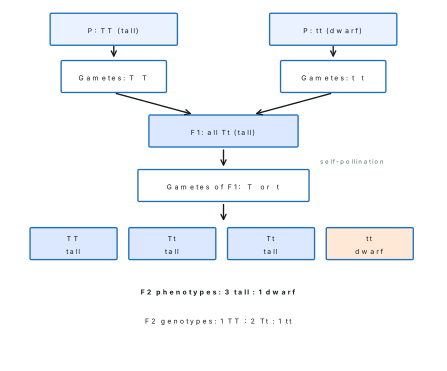
- F₂ (by self-pollination of F₁): four kinds of seeds in the ratio 9 : 3 : 3 : 1.
Each F₁ plant (RrYy) makes four kinds of gametes in equal numbers: RY, Ry, rY, ry. The 16 combinations are shown in the Punnett square:
| RY | Ry | rY | ry | |
|---|---|---|---|---|
| RY | RRYY | RRYy | RrYY | RrYy |
| Ry | RRYy | RRyy | RrYy | Rryy |
| rY | RrYY | RrYy | rrYY | rrYy |
| ry | RrYy | Rryy | rrYy | rryy |
Counting the phenotypes:
| Phenotype | Number of boxes |
|---|---|
| Round yellow | 9 |
| Round green | 3 |
| Wrinkled yellow | 3 |
| Wrinkled green | 1 |
Two new combinations (round green and wrinkled yellow) appeared that were not in either parent. This shows that the two characters are inherited independently.
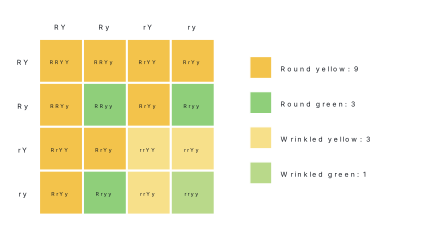
Problem. In a dihybrid cross RrYy × RrYy, 1,600 seeds are produced. How many are expected to be (a) round yellow, (b) wrinkled green, (c) round green?
Solution. Ratio 9 : 3 : 3 : 1, total 16 parts. One part = 1,600 / 16 = 100 seeds.
(a) Round yellow = 9 × 100 = 900.
(b) Wrinkled green = 1 × 100 = 100.
(c) Round green = 3 × 100 = 300.
Check: 900 + 300 + 300 + 100 = 1,600.
Mendel's laws of inheritance
- Law of dominance. When two pure parents with contrasting characters are crossed, only one character, the dominant one, appears in F₁. The other, the recessive, is hidden.
- Law of segregation (law of purity of gametes). The two alleles of a gene separate (segregate) from each other during the formation of gametes, so each gamete carries only one allele of each gene.
- Law of independent assortment. When two or more pairs of characters are inherited together, the alleles of each pair separate independently of those of the other pair. This gives new combinations such as round green and wrinkled yellow.
The 3 : 1 ratio is the phenotypic ratio; the genotypic ratio is 1 : 2 : 1. Many students write the wrong one. Also, dominant does not mean "more common" or "stronger"; it only means that the character shows when the allele is present with a recessive one.
Incomplete dominance
Sometimes neither allele is fully dominant. In the four o'clock plant (Mirabilis jalapa), a cross between red (RR) and white (rr) flowers gives pink (Rr) flowers in F₁. In F₂ the ratio is 1 red : 2 pink : 1 white. This is incomplete dominance, and here the phenotypic and genotypic ratios are the same.
4.2 Chromosomes and genes
Where are genes found?
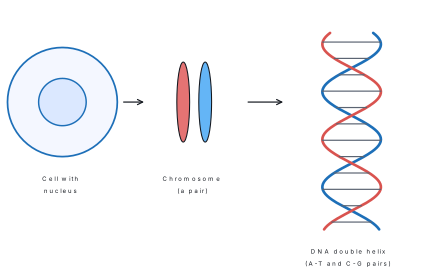
Every cell of a living thing has a nucleus. In the nucleus there are thread-like structures called chromosomes. They are visible as thick rods only when the cell is dividing. A chromosome is made of DNA (deoxyribonucleic acid) wound round proteins. A gene is a small section of DNA that has the instruction for making one protein, and so controls one character.
Hierarchy: cell → nucleus → chromosome → DNA → gene.
Chromosome number
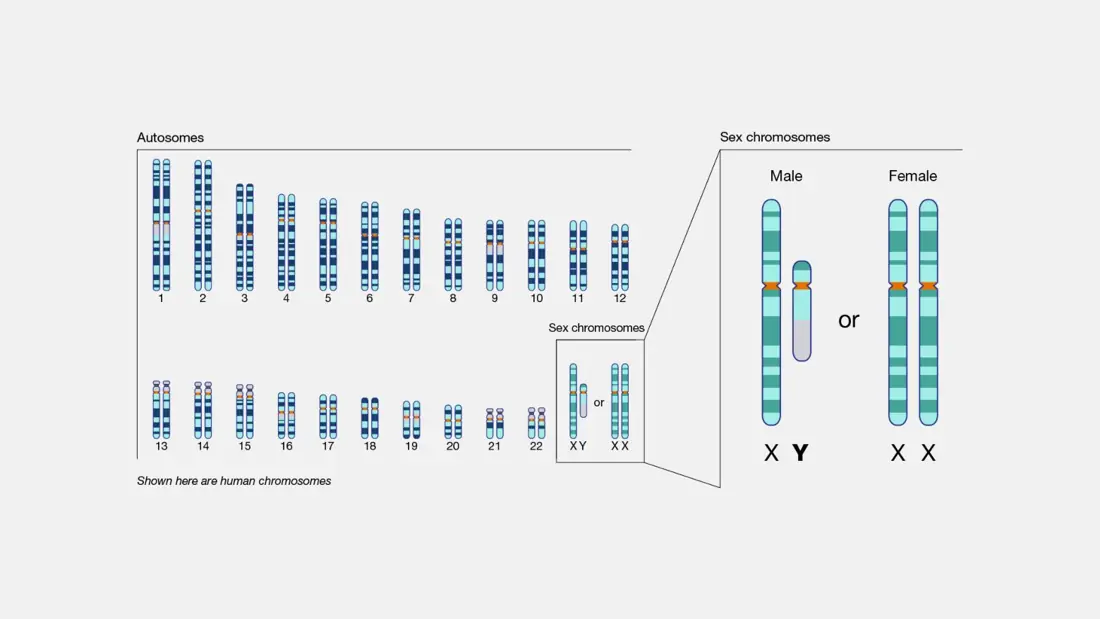
Each species has a fixed number of chromosomes. They occur in pairs (one from each parent), called homologous chromosomes.
| Organism | Number of chromosomes in body cell (2n) |
|---|---|
| Human | 46 (23 pairs) |
| Pea | 14 |
| Maize | 20 |
| Rice | 24 |
| Housefly | 12 |
| Dog | 78 |
| Chimpanzee | 48 |
The number of chromosomes does not show the complexity of an organism.
Body cells have two sets of chromosomes (diploid, 2n). Gametes (sperm and egg) have one set (haploid, n). In humans, 2n = 46 and n = 23. When a sperm (n = 23) fuses with an egg (n = 23), the zygote has 2n = 46 again.
In human beings, the 46 chromosomes are 22 pairs of autosomes (control body characters) and one pair of sex chromosomes (XX in female, XY in male).
Chromosomal basis of Mendel's laws
Mendel's "factors" are the genes on chromosomes. The segregation of alleles is explained by the separation of the homologous chromosomes in meiosis, the cell division that makes gametes. The independent assortment of two characters is explained by the random way different pairs of chromosomes line up and separate. Walter Sutton and Theodor Boveri (1902) put forward this chromosome theory of inheritance.
Cell divisions: mitosis and meiosis
| Mitosis | Meiosis |
|---|---|
| In body (somatic) cells | In reproductive organs, to make gametes |
| One division | Two divisions |
| 2 daughter cells | 4 daughter cells |
| Chromosome number stays the same (2n → 2n) | Number is halved (2n → n) |
| Daughter cells identical to the parent | Daughter cells differ (variation) |
| For growth and repair | For sexual reproduction |
DNA
DNA was described as a double helix by James Watson and Francis Crick in 1953, using the X-ray pictures of Rosalind Franklin and Maurice Wilkins. It looks like a twisted ladder.
- The sides of the ladder are made of alternate sugar (deoxyribose) and phosphate.
- The rungs are pairs of nitrogen bases: adenine (A) pairs with thymine (T), and cytosine (C) pairs with guanine (G).
- The order of bases along DNA is the genetic code.
DNA can make an exact copy of itself (replication), so the same instructions pass to new cells. RNA carries the message from DNA to make proteins.
4.3 Sex determination
The sex of a child is decided at the moment of fertilisation by the sex chromosomes.
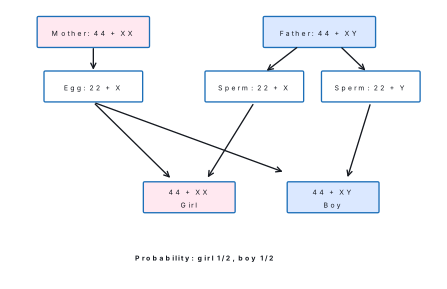
- A female has two X chromosomes (XX). All her egg cells carry one X: she makes only one kind of gamete.
- A male has one X and one Y chromosome (XY). Half of the sperm carry X and half carry Y: he makes two kinds of gametes.
At fertilisation:
- an X-sperm + X-egg gives XX = a girl;
- a Y-sperm + X-egg gives XY = a boy.
| Egg (from mother) | X-sperm | Y-sperm |
|---|---|---|
| X | XX (girl) | XY (boy) |
| X | XX (girl) | XY (boy) |
The chance of a boy or a girl is 50 : 50 (1 : 1) each time, whatever the sex of the earlier children.
Problem. A couple already have three daughters. What is the probability that the fourth child will be a son? Who decides the sex of a child, the father or the mother?
Solution. Each fertilisation is independent. The sperm that reaches the egg is X or Y with equal chance, so the probability of a son (XY) is 1/2 = 50%, whatever the sex of the earlier children.
All eggs carry X, but sperm carry X or Y, so the father's sperm decides the sex of the child. A mother cannot be blamed for having only daughters.
Sex determination in other animals
In birds, butterflies and some reptiles the male has two similar chromosomes (ZZ) and the female has two different ones (ZW), so the female decides the sex. In bees, fertilised eggs give females and unfertilised eggs give males (see Unit 3). In some reptiles (turtles, crocodiles) the incubation temperature of the egg decides the sex.
Sex-linked inheritance
Genes on the X chromosome are said to be sex-linked. The Y chromosome is much smaller and carries few of these genes. A man has only one X, so a recessive gene on it shows (there is no second X to hide it). A woman needs two copies of the recessive allele to show the trait. So these traits are more common in men. A woman with one copy is a carrier: she is normal but can pass the allele to her children.
4.4 Genetic disorders
A genetic disorder is a disease or condition caused by a change in a gene or chromosome and passed on in families. Some are caused by faulty genes; others by a wrong number of chromosomes.
Gene disorders
Colour blindness. The person cannot tell red from green. The gene is recessive and lies on the X chromosome. It is more common in boys (about 8% of men and 0.5% of women).
Haemophilia ("bleeder's disease"). The blood does not clot well, so a small cut can bleed for a long time. It is caused by a recessive gene on the X chromosome. Queen Victoria was a carrier and passed it to many royal families in Europe.
In writing the genotypes, X with the letter C stands for the normal allele and X with the letter c for the colour-blind allele:
| Genotype | Phenotype |
|---|---|
| X^C Y | Normal man |
| X^c Y | Colour-blind man |
| X^C X^C | Normal woman |
| X^C X^c | Normal woman (carrier) |
| X^c X^c | Colour-blind woman |
Albinism. The person lacks the pigment melanin, and so has very light skin, hair and eyes. It is caused by a recessive gene on an autosome (aa); both parents may be normal carriers (Aa).
Sickle cell anaemia. A recessive autosomal disorder in which haemoglobin is abnormal and red blood cells take a sickle shape, blocking small blood vessels. Common in some parts of Africa and India.
Thalassaemia. An inherited disorder of haemoglobin that causes severe anaemia; it occurs in South Asia, including Nepal, and the main way to prevent it is screening before marriage and genetic counselling.
Problem. A normal woman who is a carrier for colour blindness (X^C X^c) marries a normal man (X^C Y). What are the chances of colour-blind children?
Solution. Gametes of the mother: X^C and X^c. Gametes of the father: X^C and Y.
| X^C | Y | |
|---|---|---|
| X^C | X^C X^C (normal girl) | X^C Y (normal boy) |
| X^c | X^C X^c (carrier girl) | X^c Y (colour-blind boy) |
- All daughters are phenotypically normal; half of them are carriers.
- Half of the sons (1 in 4 of all children) are colour-blind.
- Overall: 1/4 normal girl, 1/4 carrier girl, 1/4 normal boy, 1/4 colour-blind boy.
Chromosomal disorders
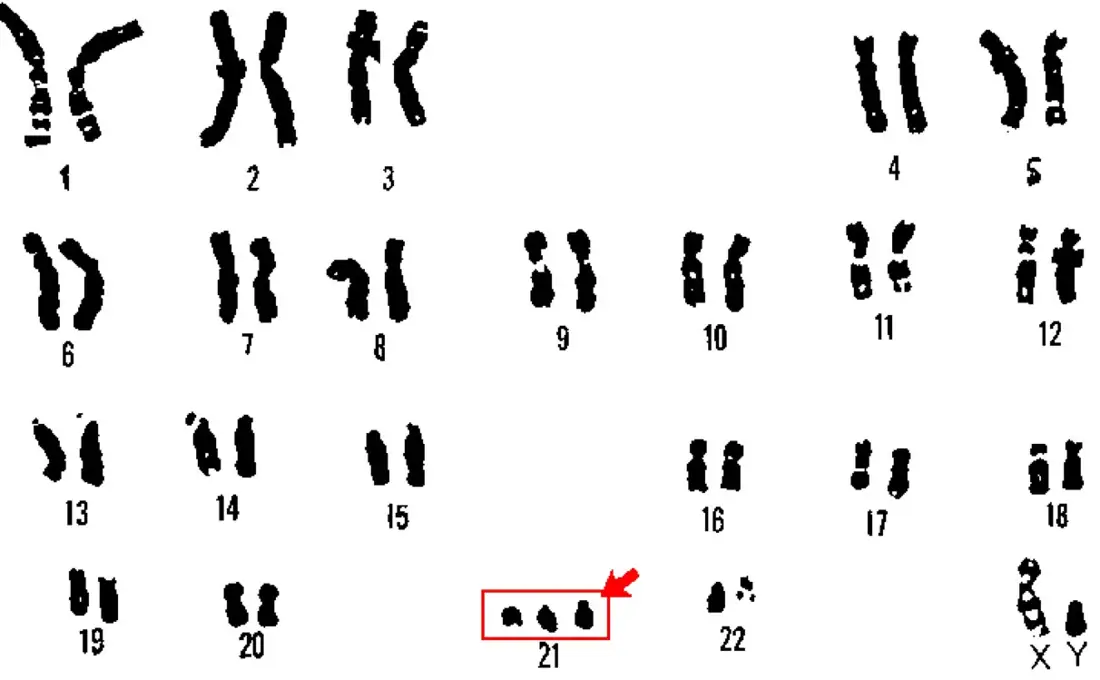
These are due to a change in the number of chromosomes, usually from a mistake in meiosis (non-disjunction), when a pair of chromosomes fails to separate.
| Disorder | Chromosomes | Features |
|---|---|---|
| Down's syndrome | 47: an extra chromosome 21 (trisomy 21) | Short height, flat face, slanting eyes, mental retardation; the risk increases with the age of the mother |
| Turner's syndrome | 45: one X only (XO), female | Short, no ovaries, infertile |
| Klinefelter's syndrome | 47: XXY, male | Tall, small testes, infertile, some breast growth |
Prevention and management
- Genetic counselling for families with a history of disorders.
- Avoid marriage between close relatives, since both partners may carry the same harmful recessive gene.
- Medical tests before and during pregnancy (blood test, ultrasound, amniocentesis) to find disorders early.
- Healthy living; avoiding smoking, alcohol and radiation during pregnancy reduces some risks.
- Many genetic disorders cannot be cured, but some can be managed (e.g. giving blood factor to haemophilia patients).
Importance of genetics
- Agriculture: improved crop varieties (high-yielding rice, maize) and cattle breeds by selecting parents.
- Medicine: diagnosis, gene therapy and making insulin by genetic engineering.
- Forensics: DNA fingerprinting to identify criminals and the parents of a child.
- Conservation: studying the genetic variety of endangered species such as the tiger and rhino.
Chapter summary
- Heredity is the passing of characters from parents to offspring through genes. Mendel, the father of genetics, worked with pea plants and discovered the laws of inheritance.
- Monohybrid cross Tt × Tt gives phenotypic ratio 3 : 1 and genotypic ratio 1 : 2 : 1; a test cross with the recessive parent shows whether a dominant plant is pure.
- Dihybrid cross RrYy × RrYy gives 9 : 3 : 3 : 1.
- Laws: dominance, segregation (purity of gametes), independent assortment.
- Cell → nucleus → chromosome → DNA → gene. Humans have 46 chromosomes (22 pairs autosomes + XX or XY). DNA is a double helix with A–T and C–G pairing.
- Sex is decided by the father's sperm: X-sperm gives a girl, Y-sperm gives a boy; chance 50 : 50.
- Sex-linked recessive disorders (colour blindness, haemophilia) are commoner in males.
- Chromosomal disorders: Down's (47, trisomy 21), Turner's (XO, 45), Klinefelter's (XXY, 47). Genetic counselling helps prevention.
Practice questions
Group A — Objective questions (1 mark each)
- Who is called the father of genetics? [1]aDarwinbMendelcWatsondLamarck
- The genotypic ratio in the F₂ generation of a monohybrid cross is [1]a3 : 1b9 : 3 : 3 : 1c1 : 2 : 1d1 : 1
- The sex of a human baby is decided by [1]athe eggbthe spermcthe mother's agedthe food
- Down's syndrome is caused by [1]aa missing X chromosomeban extra chromosome 21can extra Y chromosomeda gene on the X chromosome
- A plant with the genotype Tt is called [1]ahomozygousbheterozygouscrecessivedpure
- The base that pairs with adenine in DNA is [1]acytosinebguaninecthymineduracil
Answers to Group A
1. (b) — Mendel.
2. (c) — 1 TT : 2 Tt : 1 tt.
3. (b) — the sperm carries X or Y.
4. (b) — trisomy 21, giving 47 chromosomes.
5. (b) — two different alleles.
6. (c) — A pairs with T (uracil is in RNA).
Group B — Short answer (2 marks each)
- Define gene and allele. [2]
- Differentiate between genotype and phenotype. [2]
- State Mendel's law of segregation. [2]
- Why is colour blindness more common in males than in females? [2]
- What is a test cross? What is its use? [2]
Answers to Group B
1. A gene is a section of DNA on a chromosome that controls a character. An allele is one of the alternative forms of a gene.
2. Genotype is the genetic make-up (e.g. Tt); phenotype is the visible character (e.g. tall).
3. The two alleles of a gene separate during gamete formation, so each gamete gets only one allele.
4. The gene is recessive and on the X chromosome. A male has one X, so one copy of the allele shows; a female needs two copies.
5. A test cross is the cross of an individual with the dominant character with a homozygous recessive individual. It is used to find out whether the individual is homozygous or heterozygous.
Group C — Long answer (4 marks each)
- Explain Mendel's monohybrid cross between pure tall and pure dwarf pea plants up to the F₂ generation with a Punnett square. [4]
- In a dihybrid cross of RrYy × RrYy, find the phenotypic ratio. If there are 800 offspring, how many are wrinkled green? [4]
- A colour-blind man marries a normal woman who is not a carrier. Find the genotypes and phenotypes of their children. [4]
- Explain how the sex of a child is determined in human beings, with a diagram. [4]
Answers to Group C
1. P: TT × tt. Gametes T and t. F₁: all Tt (tall). F₁ self: gametes T, t from each parent; Punnett square gives TT, Tt, Tt, tt. F₂: 3 tall : 1 dwarf, genotypic ratio 1 : 2 : 1.
2. 9 round yellow : 3 round green : 3 wrinkled yellow : 1 wrinkled green. Wrinkled green = 1/16 × 800 = 50.
3. Man X^c Y, woman X^C X^C. Gametes: X^c, Y and X^C. Children: X^C X^c (carrier girls, normal sight) and X^C Y (normal boys). All children have normal sight; the daughters are carriers.
4. Female XX makes eggs with X only. Male XY makes sperms of X and Y in equal numbers. X-sperm + egg = XX girl; Y-sperm + egg = XY boy. The chance is 50 : 50. The father's sperm decides.
Practise more: Science and Technology question bank