Unit 18 · Science and Technology · 14 min read
Hydrocarbon and its Compounds
What the syllabus asks for 4
- Alkanes, alkenes, alkynes
- homologous series
- alcohols
- carboxylic acids
LPG in your kitchen, petrol in a motorbike, the wax of a candle, the plastic of a bucket, vinegar in a pickle and the alcohol in a hand sanitiser are all compounds of carbon. Carbon forms more compounds than all other elements together, because its atoms join to each other in long chains and rings. The study of these compounds is called organic chemistry. This chapter starts with the simplest organic compounds, the hydrocarbons, and then moves to two families that you meet in daily life: alcohols and carboxylic acids.
Expect: the general formula and the first members of alkanes, alkenes and alkynes (1 to 2 marks); drawing the structural formula of a given compound (2 marks); the chemical tests that tell an alkane from an alkene (2 marks); the preparation, properties and uses of ethanol and ethanoic acid (4 marks).
18.1 Alkanes, alkenes and alkynes
Why carbon forms so many compounds
- Tetravalency. Carbon has 4 valence electrons (2, 4) and forms four covalent bonds.
- Catenation. Carbon atoms join to each other in long chains, branched chains and rings.
- It forms single, double and triple bonds.
A hydrocarbon is a compound made only of carbon and hydrogen. Hydrocarbons are of two types:
- Saturated hydrocarbons contain only single bonds (alkanes).
- Unsaturated hydrocarbons contain at least one double or triple bond (alkenes and alkynes).
Alkanes (paraffins)
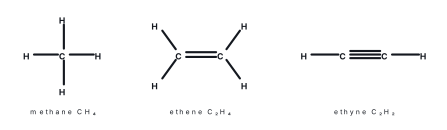
Alkanes have only C–C and C–H single bonds. The general formula is
| n | Name | Molecular formula | Condensed formula | State at room temperature |
|---|---|---|---|---|
| 1 | Methane | CH₄ | CH₄ | gas |
| 2 | Ethane | C₂H₆ | CH₃CH₃ | gas |
| 3 | Propane | C₃H₈ | CH₃CH₂CH₃ | gas |
| 4 | Butane | C₄H₁₀ | CH₃CH₂CH₂CH₃ | gas |
| 5 | Pentane | C₅H₁₂ | CH₃(CH₂)₃CH₃ | liquid |
| 6 | Hexane | C₆H₁₄ | CH₃(CH₂)₄CH₃ | liquid |
Names of the first four are historical (meth-, eth-, prop-, but-). From five onward the Greek number is used (pent-, hex-, hept-, oct-, non-, dec-). All alkane names end in -ane.
Properties of alkanes
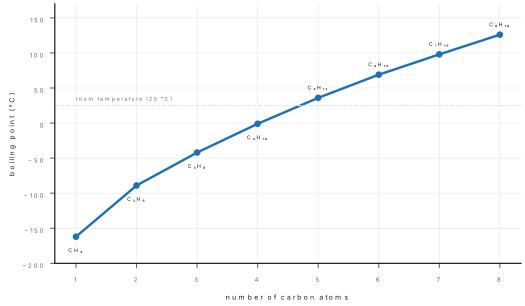
- Physical: colourless; insoluble in water, soluble in organic solvents; boiling point rises with size; lighter than water.
- Chemical: fairly unreactive because all bonds are single and strong.
| Reaction | Equation |
|---|---|
| Combustion (burning in excess air) | CH₄ + 2O₂ → CO₂ + 2H₂O + heat |
| Combustion of propane (LPG) | C₃H₈ + 5O₂ → 3CO₂ + 4H₂O |
| Substitution (with chlorine in sunlight) | CH₄ + Cl₂ --sunlight--> CH₃Cl + HCl |
In substitution, one hydrogen atom is replaced by another atom or group.
Uses. Methane (biogas, natural gas) for cooking; propane and butane (LPG); petrol, kerosene and diesel as fuel; paraffin wax in candles; bitumen on roads.
Biogas plants in Nepali villages produce methane (about 60 %) from cattle dung and kitchen waste by anaerobic decay. It burns with a clean blue flame and replaces firewood.
Alkenes (olefins)
Alkenes have one C=C double bond. General formula:
| n | Name | Formula | Structure |
|---|---|---|---|
| 2 | Ethene (ethylene) | C₂H₄ | CH₂=CH₂ |
| 3 | Propene | C₃H₆ | CH₃CH=CH₂ |
| 4 | Butene | C₄H₈ | CH₃CH₂CH=CH₂ |
Names end in -ene.
Laboratory preparation of ethene. Ethanol is heated with excess concentrated sulphuric acid (a dehydrating agent) at 170 °C.
CH₃CH₂OH --conc. H₂SO₄, 170 °C--> CH₂=CH₂ + H₂O
Properties. Colourless gas with a faint sweet smell; slightly soluble in water. Alkenes are reactive because the double bond can break open.
| Reaction | Equation |
|---|---|
| Combustion | C₂H₄ + 3O₂ → 2CO₂ + 2H₂O (burns with a smoky flame) |
| Addition of hydrogen (Ni catalyst, 200 °C) | CH₂=CH₂ + H₂ → CH₃CH₃ |
| Addition of bromine | CH₂=CH₂ + Br₂ → CH₂Br–CH₂Br |
| Addition of HCl | CH₂=CH₂ + HCl → CH₃CH₂Cl |
| Polymerisation | n CH₂=CH₂ → –(CH₂–CH₂)ₙ– (polythene) |
Uses. Making polythene, ripening of fruits, making ethanol, and in welding and cutting as a fuel gas.
Alkynes
Alkynes have one C≡C triple bond. General formula:
| n | Name | Formula | Structure |
|---|---|---|---|
| 2 | Ethyne (acetylene) | C₂H₂ | HC≡CH |
| 3 | Propyne | C₃H₄ | CH₃C≡CH |
| 4 | Butyne | C₄H₆ | CH₃CH₂C≡CH |
Names end in -yne.
Laboratory preparation of ethyne. Calcium carbide reacts with cold water:
CaC₂ + 2H₂O → C₂H₂ ↑ + Ca(OH)₂
The gas is collected over water. It is colourless, with a garlic-like smell when impure (from traces of phosphine).
| Reaction | Equation |
|---|---|
| Combustion | 2C₂H₂ + 5O₂ → 4CO₂ + 2H₂O (very sooty flame, very hot) |
| Addition of H₂ (Ni) | C₂H₂ + 2H₂ → C₂H₆ |
| Addition of Br₂ | C₂H₂ + 2Br₂ → CHBr₂–CHBr₂ |
Uses. Oxy-acetylene flame for welding and cutting metals (about 3000 °C); making plastics and ethanoic acid; old miners' lamps.
Tests to separate alkanes from alkenes and alkynes
| Test | Alkane | Alkene / alkyne |
|---|---|---|
| Bromine water (red-brown) | stays red-brown | decolourised |
| Baeyer's reagent (cold dilute alkaline KMnO₄, pink-purple) | no change | purple colour disappears |
| Flame | clear or blue, little smoke | yellow, smoky (more in alkyne) |
"Saturated" does not mean "contains water". It means all carbon atoms are bonded to the maximum possible number of other atoms (only single bonds). Unsaturated compounds can still add atoms across a double or triple bond.
18.2 Homologous series
A homologous series is a family of organic compounds that have the same functional group, the same general formula, similar chemical properties, and in which the successive members differ by a –CH₂– group (14 mass units).
Characteristics
- All members can be represented by one general formula (alkanes C_nH_{2n+2}).
- Successive members differ by CH₂ (relative molecular mass 14).
- Chemical properties are similar, because they have the same functional group.
- Physical properties change gradually: melting and boiling points rise with the molecular mass.
- They can be made by similar methods.
Functional group
A functional group is the atom or group of atoms that decides the chemical properties of a compound.
| Homologous series | Functional group | General formula | First member |
|---|---|---|---|
| Alkane | none (C–C) | CₙH₂ₙ₊₂ | methane |
| Alkene | C=C | CₙH₂ₙ | ethene |
| Alkyne | C≡C | CₙH₂ₙ₋₂ | ethyne |
| Alcohol | –OH (hydroxyl) | CₙH₂ₙ₊₁OH | methanol |
| Carboxylic acid | –COOH (carboxyl) | CₙH₂ₙ₊₁COOH | methanoic acid |
Problem. Write the molecular formula of the alkane, alkene and alkyne having 5 carbon atoms.
Solution. n = 5. Alkane: 2 × 5 + 2 = 12 hydrogen atoms, C₅H₁₂ (pentane). Alkene: 2 × 5 = 10, C₅H₁₀ (pentene). Alkyne: 2 × 5 − 2 = 8, C₅H₈ (pentyne).
Problem. Find the relative molecular mass of butane and show that it differs from propane by 14. (C = 12, H = 1.)
Solution. Butane C₄H₁₀: 4 × 12 + 10 × 1 = 48 + 10 = 58. Propane C₃H₈: 3 × 12 + 8 = 36 + 8 = 44. Difference = 58 − 44 = 14, the mass of one CH₂.
Problem. A hydrocarbon has 4 carbon atoms and 6 hydrogen atoms. Is it an alkane, alkene or alkyne? Will it decolourise bromine water?
Solution. For n = 4: alkane has 10 H, alkene has 8 H, alkyne has 2 × 4 − 2 = 6 H. So C₄H₆ is an alkyne (unsaturated). It will decolourise bromine water.
18.3 Alcohols
An alcohol is an organic compound in which one or more hydrogen atoms of an alkane is replaced by the hydroxyl group (–OH). General formula for the simple (monohydric) alcohols: CₙH₂ₙ₊₁OH. Names end in -ol.
| Name | Formula | Structure |
|---|---|---|
| Methanol (methyl alcohol) | CH₃OH | CH₃–OH |
| Ethanol (ethyl alcohol) | C₂H₅OH | CH₃CH₂–OH |
| Propanol | C₃H₇OH | CH₃CH₂CH₂–OH |
Ethanol
Preparation by fermentation. Sugar from molasses, rice, millet or grapes is changed to ethanol by the enzymes in yeast (zymase). Local drinks of Nepal such as jaand and raksi are made by fermentation.
C₆H₁₂O₆ --zymase--> 2C₂H₅OH + 2CO₂ ↑
Other methods: hydration of ethene (C₂H₄ + H₂O → C₂H₅OH, steam, phosphoric acid catalyst, high pressure).
Physical properties. Colourless liquid with a pleasant smell and burning taste; boiling point 78 °C; mixes with water in all proportions; a good solvent.
Chemical properties.
| Reaction | Equation |
|---|---|
| Combustion | C₂H₅OH + 3O₂ → 2CO₂ + 3H₂O (burns with a blue, almost smokeless flame) |
| With sodium | 2C₂H₅OH + 2Na → 2C₂H₅ONa + H₂ ↑ (sodium ethoxide) |
| Oxidation (acidified K₂Cr₂O₇ or alkaline KMnO₄) | C₂H₅OH + 2[O] → CH₃COOH + H₂O |
| Dehydration (conc. H₂SO₄, 170 °C) | C₂H₅OH → C₂H₄ + H₂O |
| Esterification (with ethanoic acid) | CH₃COOH + C₂H₅OH ⇌ CH₃COOC₂H₅ + H₂O (conc. H₂SO₄) |
Ethanol does not change the colour of litmus (it is neutral).
Uses. Solvent for paints, perfumes and medicines; antiseptic and hand sanitiser (70 %); fuel (blended with petrol; gasohol); preparation of ethanoic acid and ether; alcoholic drinks.
Methanol, or wood spirit, looks like ethanol but is poisonous: even a small amount can cause blindness or death. Adulterated local liquor containing methanol causes deaths every year. Denatured spirit is ethanol made unfit to drink by adding methanol and a blue dye.
Fermentation gives about 10 to 15 % ethanol. Distillation gives rectified spirit (about 95 %). Removing the last 5 % of water gives absolute alcohol (100 %).
18.4 Carboxylic acids
A carboxylic acid is an organic compound containing the carboxyl group –COOH. General formula: CₙH₂ₙ₊₁COOH (or R–COOH). Names end in -oic acid.
| Name (common name) | Formula | Source |
|---|---|---|
| Methanoic acid (formic acid) | HCOOH | red ants, nettle sting (sisnu) |
| Ethanoic acid (acetic acid) | CH₃COOH | vinegar |
| Propanoic acid | C₂H₅COOH | preservative in bread |
Ethanoic acid (acetic acid)
Preparation. Oxidation of ethanol by acidified potassium dichromate:
CH₃CH₂OH + 2[O] → CH₃COOH + H₂O
Vinegar is made when bacteria (Acetobacter) oxidise dilute ethanol (as in fermented fruit juice or rice) with air. Vinegar contains 5 to 8 % ethanoic acid. Pure (100 %) ethanoic acid freezes at 16.6 °C into ice-like crystals and is called glacial acetic acid.
Physical properties. Colourless liquid with sharp pungent smell and sour taste; miscible with water; boiling point 118 °C.
Chemical properties. It is a weak acid.
| Reaction | Equation |
|---|---|
| With litmus | turns blue litmus red |
| With metals | 2CH₃COOH + Zn → (CH₃COO)₂Zn + H₂ ↑ |
| With carbonates / bicarbonates | 2CH₃COOH + Na₂CO₃ → 2CH₃COONa + H₂O + CO₂ ↑ ; CH₃COOH + NaHCO₃ → CH₃COONa + H₂O + CO₂ ↑ |
| With bases | CH₃COOH + NaOH → CH₃COONa + H₂O |
| With alcohols (esterification) | CH₃COOH + C₂H₅OH ⇌ CH₃COOC₂H₅ + H₂O |
The brisk effervescence with sodium bicarbonate is the test that separates a carboxylic acid from an alcohol (alcohols give no gas with NaHCO₃).
Esterification. The reaction of an alcohol with a carboxylic acid in the presence of a little conc. H₂SO₄ gives a sweet-smelling ester and water. Esters are used as perfumes, in artificial fruit flavours and as solvents.
Uses. Vinegar for food and pickles; making dyes, plastics, rayon and medicines; preparing esters; making cellulose acetate; as a solvent.
| Ethanol | Ethanoic acid | |
|---|---|---|
| Functional group | –OH | –COOH |
| Litmus | no effect | turns blue litmus red |
| NaHCO₃ | no reaction | CO₂ with brisk fizz |
| Smell | sweet, spirit-like | pungent, vinegar |
| Nature | neutral | weak acid |
Problem. Balance the equation for the complete combustion of butane: C₄H₁₀ + O₂ → CO₂ + H₂O.
Solution. Carbon: 4 on the left, so 4CO₂. Hydrogen: 10, so 5H₂O. Oxygen needed on the right = 4 × 2 + 5 = 13, so O₂ = 13/2. Multiply all by 2: 2C₄H₁₀ + 13O₂ → 8CO₂ + 10H₂O.
Problem. Find the percentage of carbon in ethane, C₂H₆, and in ethene, C₂H₄. (C = 12, H = 1.)
Solution. Ethane: mass = 24 + 6 = 30; % C = 24/30 × 100 = 80 %. Ethene: mass = 24 + 4 = 28; % C = 24/28 × 100 = 85.7 %. The unsaturated compound has more carbon, so it burns with a smokier flame.
Chapter summary
- Carbon is tetravalent and shows catenation; hydrocarbons contain only C and H.
- Alkanes CₙH₂ₙ₊₂ (single bonds, substitution); alkenes CₙH₂ₙ (C=C, addition and polymerisation); alkynes CₙH₂ₙ₋₂ (C≡C, addition).
- Unsaturated hydrocarbons decolourise bromine water and Baeyer's reagent; alkanes do not.
- A homologous series has the same functional group and general formula, and members differ by –CH₂– (14 u).
- Alcohols CₙH₂ₙ₊₁OH (–OH): ethanol is made by fermentation of sugar; it reacts with Na to give H₂; oxidises to ethanoic acid; methanol is poisonous.
- Carboxylic acids CₙH₂ₙ₊₁COOH (–COOH): ethanoic acid (vinegar) is a weak acid, gives CO₂ with NaHCO₃, and forms esters with alcohols.
Practice questions
Group A — Objective questions (1 mark each)
- The general formula of alkenes is [1]aCₙH₂ₙ₊₂bCₙH₂ₙcCₙH₂ₙ₋₂dCₙHₙ
- The functional group of alcohols is [1]a–COOHb–CHOc–OHdC=C
- Which gas is produced when calcium carbide reacts with water? [1]amethanebethenecethynedhydrogen
- Vinegar contains [1]aformic acidbethanoic acidccitric aciddlactic acid
- Which compound will decolourise bromine water? [1]aC₂H₆bCH₄cC₂H₄dC₃H₈
- The next member after C₃H₈ in the alkane series is [1]aC₄H₈bC₄H₁₀cC₄H₁₂dC₅H₁₂
Answers to Group A
1. (b) — CₙH₂ₙ.
2. (c) — hydroxyl.
3. (c) — CaC₂ + 2H₂O → C₂H₂ + Ca(OH)₂.
4. (b) — 5 to 8 % acetic acid.
5. (c) — ethene is unsaturated.
6. (b) — add CH₂ to C₃H₈.
Group B — Short answer (2 marks each)
- What is a homologous series? Give two characteristics. [2]
- Write the molecular formula and structural formula of ethyne. [2]
- How would you distinguish ethane from ethene in the laboratory? [2]
- Write the equation for the reaction of ethanoic acid with sodium bicarbonate. [2]
- What is esterification? Write an equation. [2]
Answers to Group B
1. A family of organic compounds with the same functional group and general formula, in which successive members differ by CH₂. Characteristics: gradual change in physical properties; similar chemical properties.
2. C₂H₂; H–C≡C–H.
3. Shake each with bromine water: ethene decolourises it; ethane does not.
4. CH₃COOH + NaHCO₃ → CH₃COONa + H₂O + CO₂ ↑.
5. Reaction of an alcohol and a carboxylic acid in presence of conc. H₂SO₄ to give an ester and water: CH₃COOH + C₂H₅OH ⇌ CH₃COOC₂H₅ + H₂O.
Group C — Long answer (4 marks each)
- Write the preparation, two properties and two uses of ethanol. [4]
- Compare alkanes, alkenes and alkynes in terms of general formula, bond type, example and type of reaction. [4]
- Describe the laboratory preparation of ethyne and write two of its reactions. [4]
- Write the formulae of the alkane, alkene and alkyne with 6 carbon atoms and calculate the molecular mass of the alkane (C = 12, H = 1). [4]
Answers to Group C
1. Fermentation: C₆H₁₂O₆ → 2C₂H₅OH + 2CO₂ with yeast. Properties: colourless liquid, miscible with water; reacts with sodium giving H₂; burns with a blue flame. Uses: solvent, sanitiser, fuel.
2. Alkanes CₙH₂ₙ₊₂, single bond, ethane, substitution. Alkenes CₙH₂ₙ, double bond, ethene, addition. Alkynes CₙH₂ₙ₋₂, triple bond, ethyne, addition.
3. CaC₂ + 2H₂O → C₂H₂ + Ca(OH)₂, gas collected over water. Reactions: 2C₂H₂ + 5O₂ → 4CO₂ + 2H₂O; C₂H₂ + 2H₂ → C₂H₆ (Ni).
4. Alkane C₆H₁₄, alkene C₆H₁₂, alkyne C₆H₁₀. Mass of C₆H₁₄ = 72 + 14 = 86.
Practise more: Science and Technology question bank