Question bank · 72 min read
Biology: Unit-wise Objective Question Bank
Group A of the Biology paper is eleven marks — five from Botany, six from Zoology — and it is the only part of the paper where a candidate who has read the book carefully can score full marks in twelve minutes. This chapter is the drill for it. Every syllabus unit of Grade 11 Biology gets its own bank of multiple-choice questions, an answer key that gives a reason rather than a letter, and a table of the facts that objective questions keep coming back to.
Do not read the questions. Answer them, on paper, covering the key. Retrieval is what builds memory; recognition feels like learning and is not. Mark the ones you got wrong, and come back to only those after three days, then after ten. The reason line in the key matters more than the letter — if you cannot say why the other three options are wrong, you have not finished the question.
A few questions carry a source tag. Everything untagged is an original or
predicted question written to the CDC syllabus. NEB has released one official
Grade 11 Biology paper (Botany + Zoology, Sub. Code 114) but does not state
which year's examination it came from, so questions drawn from it are tagged
(NEB released paper) and never with a year. No question in this book carries a
year we could not verify from a primary source.
8.1 Biomolecules and Cell Biology
- The most abundant organic compound found in nature is [1]aproteinbcellulosecstarchdchitin
- The bond that joins two monosaccharide units is a [1]apeptide bondbglycosidic bondcester bonddphosphodiester bond
- Which of the following is a non-reducing sugar? [1]aglucosebmaltosecsucrosedlactose
- The storage carbohydrate of animals and fungi is [1]astarchbglycogencinulindcellulose
- The number of amino acids that commonly occur in natural proteins is [1]a4b20c64d120
- A peptide bond is formed between [1]atwo amino groupsbtwo carboxyl groupsca carboxyl group and an amino groupdan amino group and a hydroxyl group
- The secondary structure of a protein is held together mainly by [1]apeptide bondsbhydrogen bondscdisulphide bondsdionic bonds
- Fats are esters of fatty acids with [1]aglucosebglycerolcglycinedglycogen
- The lipid that forms the bilayer of a biological membrane is [1]atriglyceridebphospholipidcwaxdcarotenoid
- Which nitrogen base is present in RNA but not in DNA? [1]aadeninebthyminecuracildguanine
- In a double-stranded DNA molecule, adenine is 30 per cent of the total bases. The percentage of guanine is [1]a30b20c40d70
- The sugar present in DNA is [1]aribosebdeoxyribosecglucosedfructose
- The double-helix model of DNA was proposed by [1]aWatson and CrickbSchleiden and SchwanncSinger and NicolsondBeadle and Tatum
- Enzymes speed up a reaction by [1]araising the temperatureblowering the activation energycchanging the equilibriumdsupplying free energy
- The lock-and-key model of enzyme action was given by [1]aKoshlandbEmil FischercBuchnerdSumner
- A competitive inhibitor acts by binding to the [1]aallosteric sitebactive sitecsubstratedproduct
- The non-protein organic part firmly bound to an enzyme is called [1]acoenzymebprosthetic groupcapoenzymedholoenzyme
- The mineral element present at the centre of the chlorophyll molecule is [1]aironbmagnesiumcmanganesedcalcium
- Water has an unusually high specific heat capacity because of [1]aits low molecular massbhydrogen bonding between moleculescits polarity alonedits high density at 4 °C
- The cell theory was proposed by [1]aRobert HookebSchleiden and SchwanncRudolf VirchowdLeeuwenhoek
- Omnis cellula e cellula — every cell arises from a pre-existing cell — was stated by [1]aVirchowbSchwanncPurkinjedBrown
- A prokaryotic cell is characterised by the absence of [1]aa cell wallbribosomesca membrane-bound nucleusda plasma membrane
- The ribosome of a prokaryotic cell is of the type [1]a80Sb70Sc60Sd55S
- The chemical substance of a bacterial cell wall is [1]acellulosebchitincpeptidoglycandpectin
- The middle lamella between two adjacent plant cells is chiefly made of [1]acellulosebcalcium pectateclignindsuberin
- The fluid mosaic model of the plasma membrane was given in 1972 by [1]aDanielli and DavsonbRobertsoncSinger and NicolsondOverton
- The infoldings of the inner mitochondrial membrane are called [1]acristaebgranaccisternaedthylakoids
- Mitochondria and plastids are called semi-autonomous organelles because they possess [1]aa double membranebtheir own DNA and 70S ribosomescenzymesda large surface area
- A stack of thylakoids inside a chloroplast is called a [1]agranumbstromaccristadlamella
- The colourless plastid that stores starch is a [1]achromoplastbchloroplastcamyloplastdelaioplast
- Rough endoplasmic reticulum is rough because it bears [1]alysosomesbribosomescglycogen granulesdmicrotubules
- Synthesis of lipids and steroids is a function of [1]aRERbSERcGolgi bodydperoxisome
- The Golgi apparatus of a plant cell is known as a [1]adictyosomebtonoplastcspherosomedglyoxysome
- Lysosomes are called suicidal bags of the cell because they [1]astore wastebcontain hydrolytic enzymes that can digest the cell itselfckill bacteriadrelease ATP
- An 80S ribosome dissociates into subunits of [1]a50S and 30Sb60S and 40Sc40S and 40Sd60S and 20S
- The nucleolus is the site of synthesis of [1]amRNAbtRNAcrRNAdDNA
- A chromosome with the centromere exactly at the middle is [1]ametacentricbsubmetacentriccacrocentricdtelocentric
- The longest phase of the cell cycle is [1]aprophasebinterphasecmetaphasedtelophase
- DNA replication takes place during [1]aG₁ phasebS phasecG₂ phasedM phase
- A diploid cell with 24 chromosomes divides by mitosis. Each daughter cell has [1]a6 chromosomesb12 chromosomesc24 chromosomesd48 chromosomes
- The same cell instead completes meiosis. Each of the four cells produced has [1]a6 chromosomesb12 chromosomesc24 chromosomesd48 chromosomes
- Crossing over between non-sister chromatids occurs during [1]aleptotenebzygotenecpachyteneddiakinesis
- Chiasmata first become visible in [1]azygotenebpachytenecdiploteneddiakinesis
- The reductional division of meiosis is [1]ameiosis Ibmeiosis IIcbothdneither
- Direct cell division without spindle formation or chromosome condensation is [1]amitosisbmeiosiscamitosisdcytokinesis
Answer key — 8.1
1. (b) — cellulose is the wall material of every plant cell on Earth; starch is only a store.
2. (b) — the C–O–C link between two sugars is glycosidic; peptide belongs to protein, phosphodiester to nucleic acid.
3. (c) — in sucrose both anomeric carbons are locked in the linkage, so no free aldehyde group remains.
4. (b) — glycogen is animal starch, stored in liver and muscle; inulin is a plant store (Dahlia).
5. (b) — 20 standard amino acids; 64 is the number of codons, a classic swap.
6. (c) — the –COOH of one residue condenses with the –NH₂ of the next, releasing one water molecule.
7. (b) — hydrogen bonds between C=O and N–H hold the α-helix and β-pleated sheet; peptide bonds give the primary structure.
8. (b) — one glycerol plus three fatty acids gives a triglyceride.
9. (b) — the phosphate head is hydrophilic and the two fatty-acid tails hydrophobic, so it forms a bilayer in water.
10. (c) — uracil replaces thymine in RNA; the two differ only by a methyl group.
11. (b) — Chargaff: A = T = 30 %, so A + T = 60 % and G + C = 40 %, giving G = 20 %. Option (a) is chosen by students who think G = A.
12. (b) — deoxyribose lacks the –OH at carbon 2, which is what makes DNA chemically stable.
13. (a) — Watson and Crick, 1953, using Franklin's X-ray data.
14. (b) — the enzyme provides an alternative path of lower activation energy; it never shifts the equilibrium.
15. (b) — Fischer, 1894; Koshland's later induced-fit model is option (a)'s trap.
16. (b) — a competitive inhibitor resembles the substrate and occupies the active site; a non-competitive one binds elsewhere.
17. (b) — a loosely bound one is a coenzyme; apoenzyme is the protein part alone.
18. (b) — Mg²⁺ sits in the porphyrin ring; iron is in haemoglobin and cytochromes.
19. (b) — breaking hydrogen bonds absorbs much heat, so ponds and cells warm slowly.
20. (b) — 1838–39; Hooke only saw and named cells, Virchow added the third postulate.
21. (a) — Virchow, 1855.
22. (c) — prokaryotes do have a wall, ribosomes and a membrane; only the nuclear envelope is missing.
23. (b) — 70S = 50S + 30S; 80S is eukaryotic cytoplasmic.
24. (c) — peptidoglycan (murein); chitin is fungal, cellulose plant, pectin the middle lamella.
25. (b) — calcium and magnesium pectate cement adjacent walls; it dissolves in ripening fruit.
26. (c) — Singer and Nicolson; Danielli–Davson is the older sandwich model.
27. (a) — cristae carry the oxysomes (F₁ particles); grana and thylakoids belong to the chloroplast, and mixing the two words is the commonest error here.
28. (b) — their own circular DNA and 70S ribosomes let them make some of their own proteins, the basis of the endosymbiotic theory.
29. (a) — grana are the stacks; stroma is the surrounding matrix.
30. (c) — amyloplast stores starch, elaioplast oil, aleuroplast protein.
31. (b) — ribosomes stud the cytoplasmic face of RER, which therefore exports protein.
32. (b) — SER also detoxifies drugs and stores Ca²⁺ in muscle.
33. (a) — many small unconnected dictyosomes, unlike the single stacked Golgi of animal cells.
34. (b) — de Duve's term; on injury the membrane ruptures and the acid hydrolases autolyse the cell.
35. (b) — 60S + 40S = 80S; 50S + 30S = 70S. Note the subunit numbers do not add arithmetically, because S is a sedimentation coefficient, not a mass.
36. (c) — rRNA is transcribed and packed with protein in the nucleolus.
37. (a) — metacentric gives equal arms and a V shape at anaphase; telocentric has the centromere at the very end.
38. (b) — interphase is about 90–95 % of the cycle; it is growth, not rest.
39. (b) — S for synthesis; after S the DNA content has doubled but the chromosome number has not.
40. (c) — mitosis is equational: 2n stays 2n, so 24 chromosomes in each of the two daughter cells.
41. (b) — meiosis is reductional: 2n = 24 gives n = 12 in each of the four cells. Answering 24 here and 12 in question 40 is the single commonest cell-division error in the board exam.
42. (c) — pachytene, when the bivalent has four chromatids and recombination nodules appear.
43. (c) — the homologues begin to separate at diplotene and the crossover points show as X-shaped chiasmata.
44. (a) — homologous pairs separate in anaphase I, halving the number; meiosis II merely separates sister chromatids.
45. (c) — amitosis, seen in Amoeba, bacteria, and in the foetal membranes and diseased cells of higher organisms.
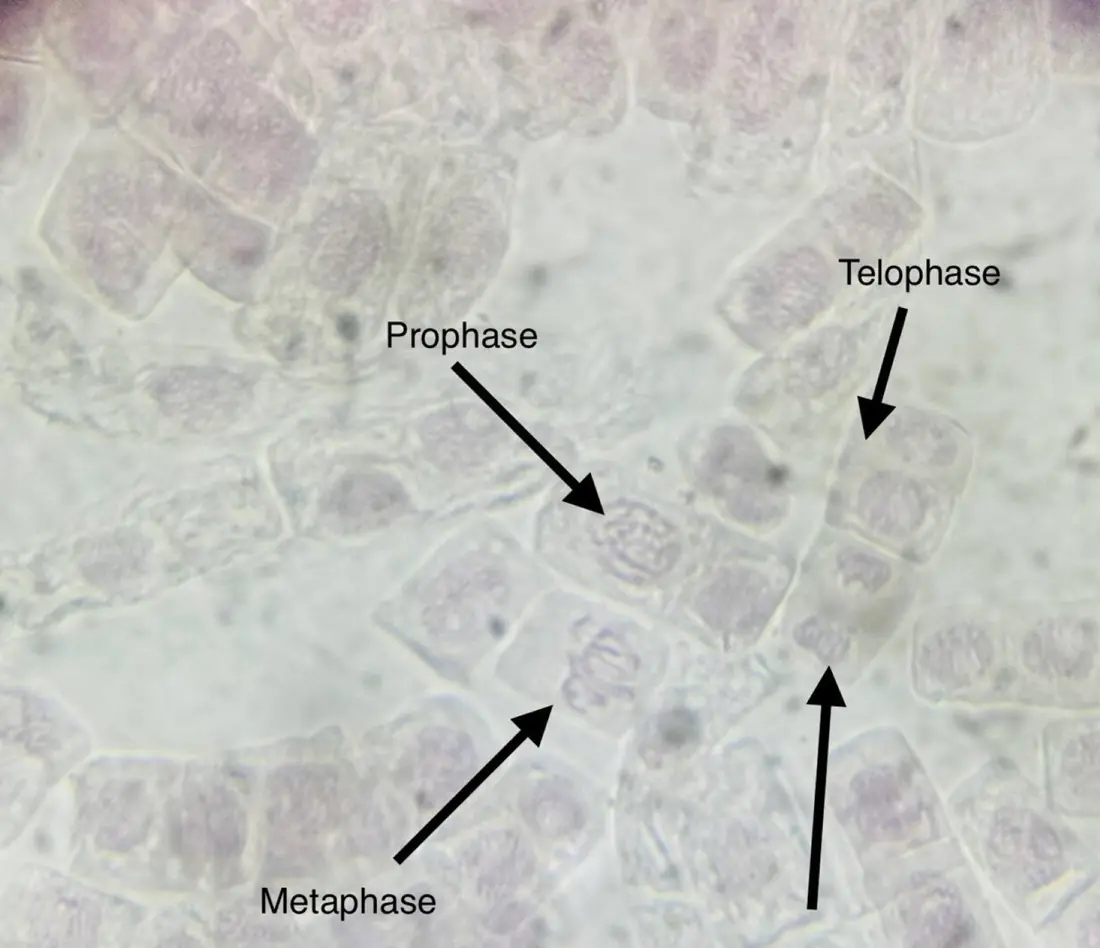
Questions 40 and 41 are the same cell dividing two different ways. Fix the two sentences in your head and never compute them again: mitosis — one cell, two daughters, 2n each, chromosomes identical to the parent. meiosis — one cell, four daughters, n each, chromosomes recombined. The number is halved once, in anaphase I, and nowhere else. Meiosis II does not halve anything; it separates sister chromatids exactly as mitosis does, which is why it is called the equational division.
Problem. A pollen mother cell of a plant contains 36 chromosomes. How many chromosomes will be present in (i) each pollen grain, (ii) each cell of the tapetum dividing mitotically, (iii) the endosperm?
Solution. The pollen mother cell is diploid, so 2n = 36 and n = 18.
(i) A pollen grain is formed by meiosis, so it is haploid: 18. (ii) The tapetum is ordinary somatic tissue dividing by mitosis, which keeps the number: 36. (iii) The endosperm of an angiosperm is triploid (one male nucleus plus two polar nuclei), so it has 3n = 3 \times 18 = 54.
The whole question is answered by knowing which cells are the products of which division. Never multiply or divide by 2 without first naming the division.
| High-yield facts — Biomolecules and Cell Biology | |
|---|---|
| Most abundant organic compound / protein | cellulose / collagen (animals), RuBisCO (Earth) |
| Storage polysaccharide | starch (plants), glycogen (animals, fungi), inulin (Dahlia) |
| Chargaff's rule | A = T, G = C; (A+G) = (T+C) |
| Enzyme models | lock-and-key — Fischer; induced fit — Koshland |
| First enzyme crystallised | urease, by J. B. Sumner (1926) |
| Cell theory | Schleiden and Schwann (1838–39); Virchow (1855) |
| Membrane model | fluid mosaic — Singer and Nicolson (1972) |
| Wall material | plant cellulose, fungal chitin, bacterial peptidoglycan, diatom silica |
| Ribosomes | 70S (50S + 30S) prokaryote, mitochondria, plastid; 80S (60S + 40S) eukaryote |
| Organelle nicknames | mitochondrion — powerhouse; lysosome — suicidal bag; ribosome — protein factory; Golgi — traffic police |
| Cell cycle | G₁ → S → G₂ → M; DNA doubles in S; interphase ≈ 90 % of cycle |
| Meiosis I prophase | leptotene, zygotene (synapsis), pachytene (crossing over), diplotene (chiasmata), diakinesis |
8.2 Floral Diversity
- The three-domain system of classification was proposed by [1]aR. H. WhittakerbCarl WoesecCarolus LinnaeusdErnst Haeckel
- The three domains of life are [1]aMonera, Protista, FungibBacteria, Archaea, EukaryacPlantae, Animalia, FungidProkaryota, Eukaryota, Virus
- Binomial nomenclature was introduced by [1]aTheophrastusbCarolus LinnaeuscBentham and HookerdA. P. de Candolle
- In the name Oryza sativa L., the word sativa is the [1]ageneric namebspecific epithetcfamily namedauthor citation
- According to the rules of nomenclature, a printed scientific name must be [1]aunderlinedbwritten in italicscwritten in capitalsdwritten in brackets
- The five-kingdom system of classification was given in 1969 by [1]aCarl WoesebR. H. WhittakercCopelanddLinnaeus
- The main criterion that separates Whittaker's five kingdoms is [1]ahabitatbcell structure, body organisation and mode of nutritioncreproduction onlydsize
- Which kingdom in the five-kingdom system contains only prokaryotes? [1]aProtistabMoneracFungidPlantae
- Nepal occupies about 0.1 per cent of the land area of the Earth but holds roughly what share of the world's flowering plants? [1]a0.1 %b2 %c10 %d25 %
- The reserve food of fungi is [1]astarchbglycogencinulindcellulose
- The cell wall of a typical fungus is made of [1]acellulosebchitincpeptidoglycandpectin
- A fungal mycelium in which the hyphae have no cross walls is described as [1]aseptatebcoenocyticcdikaryoticdpseudoparenchymatous
- The asexual spores produced inside a sporangium of Mucor are [1]aconidiabsporangiosporescascosporesdbasidiospores
- Penicillin, the first antibiotic, was obtained from [1]aPenicillium notatumbAspergillus nigercAgaricus bisporusdSaccharomyces cerevisiae
- Yeast (Saccharomyces) reproduces asexually mainly by [1]abuddingbbinary fissioncconidiadfragmentation
- A lichen is a symbiotic association between [1]aa fungus and a rootba fungus and an alga or cyanobacteriumctwo fungidan alga and a bacterium
- In a lichen the fungal partner is called the [1]aphycobiontbmycobiontcsymbiontdhaustorium
- Lichens are used as indicators of [1]asoil fertilitybair pollution, especially SO₂cwater pollutiondradioactivity
- The special asexual reproductive body of a lichen containing a few algal cells wrapped in hyphae is a [1]asorediumbconidiumcgemmadzoospore
- The pioneer community on a bare rock in a xerosere is [1]amossbcrustose lichencherbdfern
- The reserve food of green algae (Chlorophyceae) is [1]astarchblaminarincfloridean starchdglycogen
- The pigment that gives brown algae their colour is [1]aphycoerythrinbfucoxanthincphycocyanindchlorophyll b
- Ladder-like scalariform conjugation is characteristic of [1]aUlothrixbSpirogyracChlamydomonasdVolvox
- Agar-agar is obtained from [1]abrown algaebred algaecgreen algaeddiatoms
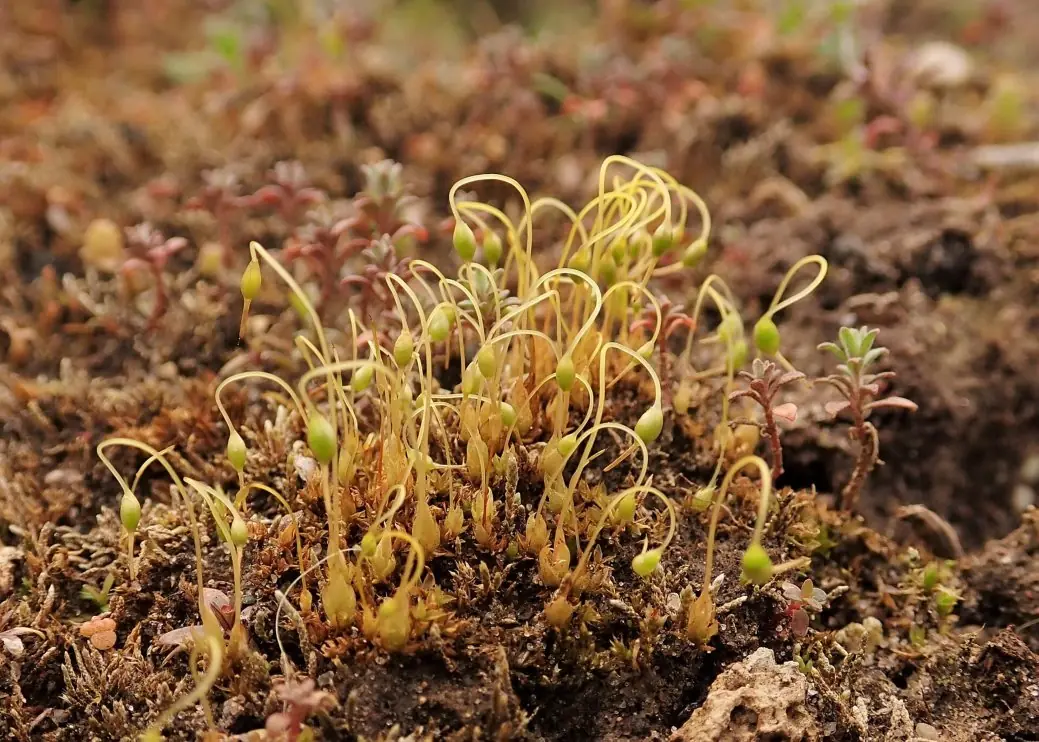
- Bryophytes are called the amphibians of the plant kingdom because [1]athey live in waterbthey live on land but need water for fertilisationcthey have gillsdthey are found in both poles
- The dominant phase in the life cycle of a bryophyte is the [1]asporophytebgametophyteczygotedprotonema
- The male sex organ of a bryophyte is the [1]aarchegoniumbantheridiumcantherdoogonium
- Gemma cups for vegetative reproduction are found in [1]aFunariabMarchantiacRicciadAnthoceros
- Bryophytes lack [1]achlorophyllbvascular tissuecsporesdrhizoids
- The first vascular plants (with xylem and phloem) among the groups below are the [1]aalgaebbryophytescpteridophytesdgymnosperms
- The dominant phase in the life cycle of a fern is the [1]agametophytebsporophytecprothallusdprotonema
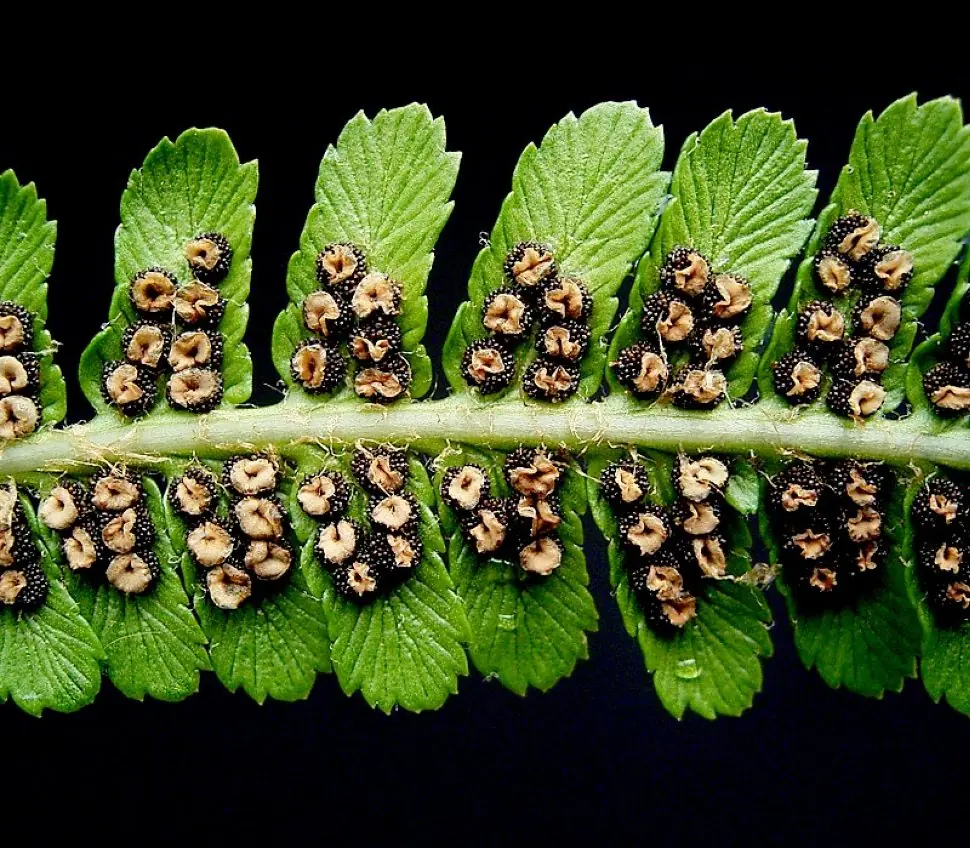
- A cluster of sporangia on the underside of a fern leaf is a [1]asorusbstrobiluscsporocarpdcapsule
- The heart-shaped free-living gametophyte of a fern is called the [1]aprotonemabprothalluscthallusdplumule
- A pteridophyte producing two kinds of spores is said to be [1]ahomosporousbheterosporouscapogamousddioecious
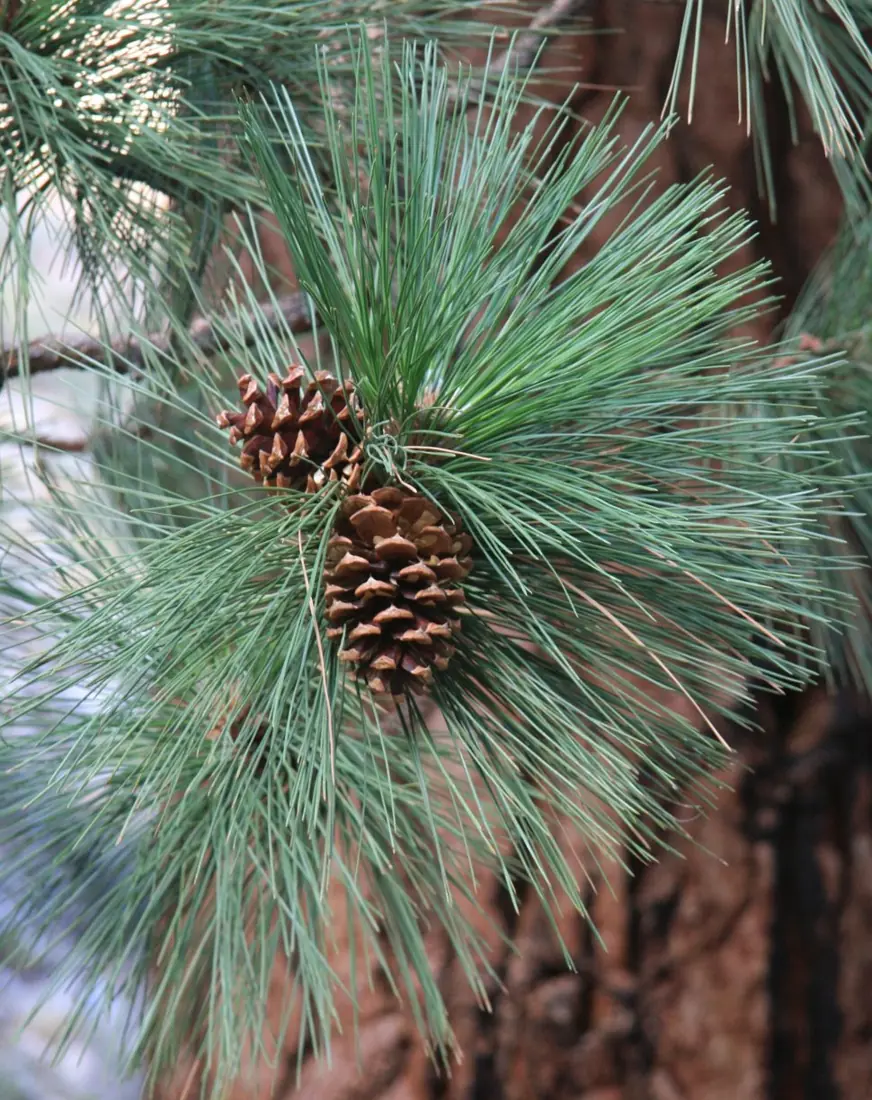
- Gymnosperms differ from angiosperms in having [1]anaked seeds not enclosed in a fruitbno seedscno vascular tissuedno pollen
- The xylem of a gymnosperm such as Pinus lacks [1]atracheidsbvesselscfibresdparenchyma
- In Pinus, the needle-like leaves are borne on a [1]along shootbdwarf shoot or spurcrhizomedscale leaf
- The male gametes of Pinus are [1]amotile and flagellatebnon-motile, carried in the pollen tubecabsentdproduced in archegonia
- The endosperm of a gymnosperm seed is [1]ahaploid, formed before fertilisationbtriploid, formed after fertilisationcdiploiddabsent
- Double fertilisation is a feature of [1]abryophytesbpteridophytescgymnospermsdangiosperms
- The correct sequence of the taxonomic hierarchy from the largest category downward is [1]akingdom, division, class, order, family, genus, speciesbkingdom, class, division, family, order, genus, speciescdivision, kingdom, order, class, family, genus, speciesdkingdom, division, order, class, family, genus, species
- A system of classification that uses one or a few arbitrarily chosen characters is called [1]anaturalbartificialcphylogeneticdnumerical
- The classification of Bentham and Hooker is an example of a [1]aartificial systembnatural systemcphylogenetic systemdcladistic system
- A phylogenetic system of classification is based on [1]ahabitbevolutionary relationship and common ancestryceconomic usedthe number of stamens
- The root of a mustard plant is [1]afibrousbtap rootcadventitiousdprop root
- A stem modified into a flat, green, leaf-like photosynthetic organ is a [1]aphyllodebphyllocladeccladodedstipule
- The arrangement of sepals and petals in a flower bud is called [1]aphyllotaxybaestivationcplacentationdvenation
- The floral formula of the family Brassicaceae is [1]aⒶ K2+2 C4 A2+4 G(2)b⊕ K5 C5 A5 G(2)c% K(5) C1+2+(2) A(9)+1 G1d⊕ P3+3 A3+3 G(3)
- Tetradynamous stamens — four long and two short — occur in [1]aFabaceaebBrassicaceaecSolanaceaedLiliaceae
- A papilionaceous corolla with one standard, two wings and two keel petals belongs to [1]aSolanaceaebFabaceaecLiliaceaedBrassicaceae
- Root nodules containing nitrogen-fixing Rhizobium are characteristic of [1]aBrassicaceaebFabaceaecSolanaceaedLiliaceae
- Axile placentation with an obliquely placed bicarpellary ovary is diagnostic of [1]aSolanaceaebFabaceaecLiliaceaedBrassicaceae
- Solanum tuberosum, Capsicum annuum and Nicotiana tabacum all belong to [1]aBrassicaceaebSolanaceaecFabaceaedLiliaceae
- The family Liliaceae is characterised by a perianth of [1]a5 sepals and 5 petalsb6 undifferentiated tepals in two whorls of 3c4 petals in a crossda single whorl of 5 tepals
- Marginal placentation in a monocarpellary superior ovary is found in [1]aLiliaceaebFabaceaecSolanaceaedBrassicaceae
Answer key — 8.2
1. (b) — Woese (1977, 1990), on the basis of 16S/18S rRNA sequences.
2. (b) — Bacteria, Archaea and Eukarya; Whittaker's five kingdoms sit inside these.
3. (b) — Linnaeus, in Species Plantarum (1753).
4. (b) — the second word is the specific epithet; the species name is the whole two-word phrase.
5. (b) — italics in print, underlined separately when handwritten. In an exam, underline both words with two separate lines.
6. (b) — Whittaker, 1969: Monera, Protista, Fungi, Plantae, Animalia.
7. (b) — three criteria, not one: cell type, body organisation (unicellular/multicellular) and nutrition.
8. (b) — Monera alone; Protista are unicellular but eukaryotic.
9. (b) — about 2 % of the world's flowering plants on 0.1 % of the land, which is why Nepal counts as a biodiversity hotspot.
10. (b) — glycogen, exactly as in animals; answering "starch" here is the standard slip.
11. (b) — chitin, a nitrogen-containing polysaccharide, again shared with animals (insect cuticle).
12. (b) — coenocytic (aseptate), as in Mucor and Rhizopus; a multinucleate tube with no cross walls.
13. (b) — sporangiospores are formed inside a sac; conidia are formed externally in chains (Penicillium).
14. (a) — Alexander Fleming, 1928, from Penicillium notatum.
15. (a) — budding; a small outgrowth pinches off with a nucleus.
16. (b) — mycobiont plus phycobiont, an obligate mutualism.
17. (b) — mycobiont; the alga is the phycobiont and makes the food.
18. (b) — lichens absorb through the whole thallus and have no cuticle, so SO₂ kills them first. Cities lose lichens before they lose trees.
19. (a) — a soredium; isidia are the other, stalked, type.
20. (b) — only crustose lichens can etch bare rock and start soil formation.
21. (a) — true starch inside the chloroplast; laminarin is brown, floridean starch red.
22. (b) — fucoxanthin, a xanthophyll; phycoerythrin is the red-algal pigment.
23. (b) — Spirogyra; the conjugation tubes between two parallel filaments look like a ladder.
24. (b) — from Gelidium and Gracilaria; carrageenan is also red-algal.
25. (b) — the antherozoid must swim to the archegonium in a film of water, so bryophytes cannot leave damp places.
26. (b) — the green plant body is the haploid gametophyte; the sporophyte stays attached and dependent on it.
27. (b) — antheridium produces antherozoids; archegonium is female. An anther belongs to a flowering plant.
28. (b) — Marchantia bears gemma cups on the upper surface of the thallus.
29. (b) — no xylem and no phloem, which limits their height to a few centimetres.
30. (c) — pteridophytes are the first true vascular plants (tracheophytes).
31. (b) — in ferns the conspicuous leafy plant is the diploid sporophyte, the reverse of bryophytes.
32. (a) — a sorus, often protected by an indusium.
33. (b) — the prothallus; a protonema is the juvenile filament of a moss.
34. (b) — heterosporous, producing microspores and megaspores, as in Selaginella and Marsilea. This is the evolutionary step towards the seed.
35. (a) — the ovules sit naked on an open megasporophyll, so there is no fruit.
36. (b) — vessels are absent in gymnosperm xylem and companion cells in the phloem; this is a favourite one-mark question.
37. (b) — the dwarf shoot or spur, which carries the needles in a bundle of 2, 3 or 5.
38. (b) — non-motile in Pinus; motile flagellate male gametes survive only in Cycas and Ginkgo.
39. (a) — the gymnosperm endosperm is the haploid female gametophyte, formed before fertilisation. Option (b) is the angiosperm answer and the trap.
40. (d) — one male gamete fuses with the egg and the other with the two polar nuclei; found only in angiosperms.
41. (a) — kingdom, division, class, order, family, genus, species. "Division" is used for plants where zoologists say "phylum".
42. (b) — artificial, e.g. Linnaeus' sexual system based on stamen number.
43. (b) — Bentham and Hooker's Genera Plantarum is the standard natural system, still used in herbaria.
44. (b) — it groups organisms by descent from a common ancestor, using fossils, embryology and now DNA.
45. (b) — mustard is a dicot, so a tap root; fibrous roots belong to monocots.
46. (b) — a phylloclade (Opuntia); a phyllode is a flattened petiole (Acacia), which is the distractor.
47. (b) — aestivation; phyllotaxy is the arrangement of leaves on the stem, placentation of ovules in the ovary.
48. (a) — Brassicaceae: actinomorphic, 2+2 sepals, 4 petals in a cross, 6 tetradynamous stamens, bicarpellary syncarpous ovary.
49. (b) — tetradynamous is the Brassicaceae signature; diadelphous (9)+1 is Fabaceae.
50. (b) — the papilionaceous corolla of the pea sub-family; vexillary (descending imbricate) aestivation.
51. (b) — Rhizobium in the root nodules of legumes is why pulses enrich the soil.
52. (a) — Solanaceae; the oblique ovary with a swollen axile placenta is the single best diagnostic character.
53. (b) — potato, chilli and tobacco are all Solanaceae, the family of both food and drugs.
54. (b) — 3 + 3 tepals, and the stamens are also 3 + 3; Liliaceae is the model monocot family.
55. (b) — one carpel, ovules along the fused margin, giving a legume (pod) that splits along two sutures.
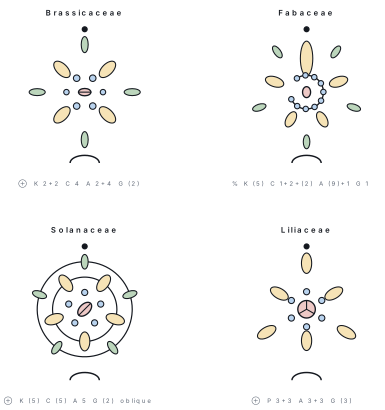
- Brassicaceae — four petals in a cross, six stamens 4 long + 2 short (tetradynamous), fruit a siliqua. Brassica, Raphanus.
- Fabaceae — butterfly corolla, stamens (9) + 1 (diadelphous), one carpel, fruit a pod, root nodules. Pisum, Cicer.
- Solanaceae — everything in fives, ovary bicarpellary and oblique, fruit a berry or capsule. Solanum, Capsicum.
- Liliaceae — everything in threes, sepals and petals alike (tepals), a monocot. Allium, Asparagus.
| High-yield facts — Floral Diversity | |
|---|---|
| Three domains | Bacteria, Archaea, Eukarya — Carl Woese |
| Five kingdoms | Whittaker 1969 — Monera, Protista, Fungi, Plantae, Animalia |
| Binomial nomenclature | Linnaeus, Species Plantarum 1753; genus capital, species small, both italic |
| Flora of Nepal | ≈ 2 % of world flowering plants on 0.1 % of world land; ≈ 6,500 flowering species, ≈ 300 endemic |
| Fungal wall / food | chitin / glycogen |
| Lichen | mycobiont + phycobiont; soredia and isidia; SO₂ indicator; pioneer on bare rock |
| Algal reserve food | green — starch; brown — laminarin; red — floridean starch |
| Bryophyte | gametophyte dominant; needs water for fertilisation; no vascular tissue |
| Pteridophyte | sporophyte dominant; first vascular plants; prothallus gametophyte; sorus |
| Gymnosperm | naked seeds; no vessels in xylem, no companion cells in phloem; endosperm haploid, pre-fertilisation |
| Angiosperm | double fertilisation; endosperm triploid, post-fertilisation |
| Hierarchy | kingdom → division → class → order → family → genus → species |
| Systems | artificial (Linnaeus) → natural (Bentham and Hooker) → phylogenetic (Engler and Prantl, Hutchinson) |
8.3 Introductory Microbiology
- Bacteria were first observed and described by [1]aLouis PasteurbRobert KochcAnton van LeeuwenhoekdEdward Jenner
- A spherical bacterium is called a [1]abacillusbcoccuscvibriodspirillum
- Eight cocci arranged in a cube of two layers form a [1]atetradbsarcinacstaphylococcusdstreptococcus
- A comma-shaped bacterium such as Vibrio cholerae belongs to the morphological type [1]acoccusbbacilluscvibriodspirochaete
- A bacterium with a single polar flagellum is described as [1]amonotrichousblophotrichouscamphitrichousdperitrichous
- The genetic material of a bacterium is [1]alinear DNA with histonesba circular double-stranded DNA without a nuclear membranecsingle-stranded RNAdabsent
- A small extra-chromosomal circular DNA of a bacterium is a [1]aplasmidbmesosomecnucleoiddpilus
- Gram-positive bacteria retain the crystal-violet stain because their wall has [1]aa thin peptidoglycan layer and an outer membraneba thick peptidoglycan layercno wallda lipid capsule
- Transfer of DNA from one bacterium to another through a bacteriophage is [1]atransformationbtransductioncconjugationdtranslation
- The commonest mode of asexual reproduction in bacteria is [1]abuddingbbinary fissioncconidia formationdfragmentation
- Nitrogen-fixing bacteria in the root nodules of legumes belong to the genus [1]aNitrosomonasbRhizobiumcClostridiumdPseudomonas
- The term virus, meaning poison, and the discovery of the tobacco mosaic agent are credited to [1]aIvanowsky and BeijerinckbPasteur and KochcStanley and SumnerdWoese and Fox
- The protein coat of a virus is called the [1]acapsidbcapsomereccapsuledenvelope
- Viruses are regarded as being on the borderline of living and non-living because they [1]ahave no DNAbcan be crystallised yet multiply inside a host cellcare very smalldcause disease
- A virus that infects a bacterium is a [1]abacteriophagebretroviruscpriondviroid
- The genetic material of the tobacco mosaic virus is [1]adouble-stranded DNAbsingle-stranded RNAcdouble-stranded RNAdsingle-stranded DNA
- Which of the following diseases is not caused by a virus? [1]arabiesbmeaslesctuberculosisdhepatitis B
- The enzyme that allows a retrovirus such as HIV to copy RNA into DNA is [1]aDNA polymerasebreverse transcriptasecrestriction endonucleasedligase
- Genetically engineered bacteria are today the commercial source of [1]ahuman insulinbpenicillincethyl alcoholdvinegar
- The enzymes that cut DNA at specific sequences and so make gene cloning possible are [1]aligasesbrestriction endonucleasescpolymerasesdproteases
- Bacillus thuringiensis is used in agriculture as a [1]abiofertiliserbbiopesticidecgrowth hormonedweedicide
- The technique used to amplify a small sample of DNA many million times is [1]aPCRbELISAcelectrophoresisdchromatography
Answer key — 8.3
1. (c) — Leeuwenhoek, 1676, with his own single-lens microscope; Pasteur and Koch came two centuries later.
2. (b) — coccus (plural cocci); bacillus is rod-shaped.
3. (b) — sarcina is the 8-celled cube; a tetrad is a flat group of four.
4. (c) — vibrio, a curved comma; a spirochaete is a long flexible spiral.
5. (a) — mono = one, trichous = hair; peritrichous means flagella all over the body.
6. (b) — a single circular DNA molecule lying naked in the cytoplasm as the nucleoid, with no histones.
7. (a) — plasmids carry genes for antibiotic resistance and are the vectors of genetic engineering.
8. (b) — a thick peptidoglycan layer traps the crystal-violet–iodine complex; Gram-negative walls are thin but have an extra outer membrane.
9. (b) — transduction is phage-mediated; transformation is uptake of naked DNA, conjugation is transfer through a pilus.
10. (b) — binary fission, which under ideal conditions can occur every twenty minutes.
11. (b) — Rhizobium; Nitrosomonas is a free-living nitrifier and belongs to a different step of the cycle.
12. (a) — Ivanowsky (1892) showed the agent passed a bacterial filter, Beijerinck (1898) named it contagium vivum fluidum.
13. (a) — the capsid is built of repeating protein subunits called capsomeres.
14. (b) — outside a host a virus is an inert chemical that can be crystallised; inside one it replicates and mutates.
15. (a) — bacteriophage, literally "bacteria eater"; T₄ phage of E. coli is the standard example.
16. (b) — TMV was the first virus discovered and contains single-stranded RNA.
17. (c) — tuberculosis is bacterial (Mycobacterium tuberculosis); the other three are viral.
18. (b) — reverse transcriptase makes DNA from an RNA template, reversing the usual flow of information.
19. (a) — recombinant human insulin (humulin) was the first genetically engineered medicine, 1982.
20. (b) — restriction endonucleases are the molecular scissors; ligase is the glue.
21. (b) — its Bt toxin kills insect larvae and is the basis of Bt cotton and Bt brinjal.
22. (a) — the polymerase chain reaction, invented by Kary Mullis.
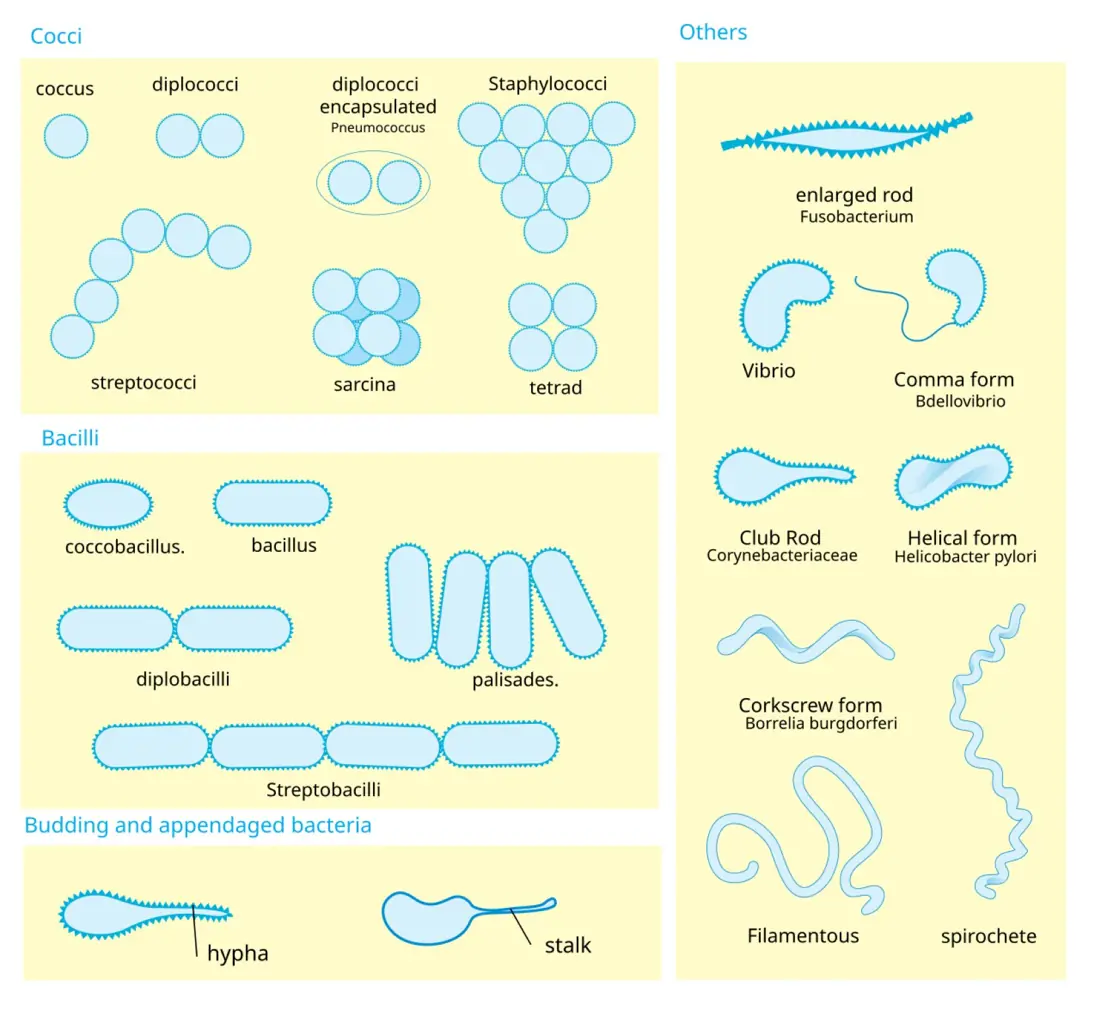
| High-yield facts — Introductory Microbiology | |
|---|---|
| Shapes | coccus (round), bacillus (rod), vibrio (comma), spirillum (spiral), spirochaete (flexible spiral) |
| Groupings | diplo- (2), strepto- (chain), staphylo- (grape bunch), tetrad (4), sarcina (cube of 8) |
| Flagella | monotrichous, amphitrichous, lophotrichous, peritrichous, atrichous |
| Gene transfer | transformation (naked DNA), transduction (phage), conjugation (pilus) |
| Useful bacteria | Rhizobium (N₂ fixation), Lactobacillus (curd), Acetobacter (vinegar), Streptomyces (antibiotics) |
| Virus | nucleic acid + capsid; obligate intracellular parasite; crystallisable |
| Firsts | TMV — first virus (Ivanowsky 1892); Stanley crystallised it 1935 |
| Viral diseases | polio, rabies, measles, mumps, influenza, hepatitis, AIDS, dengue, COVID-19 |
| Biotechnology tools | restriction endonuclease (cut), ligase (join), plasmid (vector), PCR (amplify) |
8.4 Ecology
- The term ecosystem was coined in 1935 by [1]aE. P. OdumbA. G. TansleycCharles EltondR. L. Lindeman
- The study of a single species in relation to its environment is [1]aautecologybsynecologycethologydpedology
- The functional unit of an ecosystem that is self-regulating and exchanges energy and matter is best described as [1]aa populationba communitycan ecosystemda biome
- Which of the following is an edaphic factor? [1]arainfallbsoil pHclight intensitydwind speed
- Green plants of an ecosystem are called [1]aproducersbprimary consumerscdecomposersdtransducers
- Decomposers are also known as [1]aautotrophsbsaprotrophscphagotrophsdchemotrophs
- A food chain that begins with dead organic matter is a [1]agrazing food chainbdetritus food chaincparasitic food chaindpredatory food chain
- In the chain grass → grasshopper → frog → snake → eagle, the frog occupies the trophic level [1]afirstbsecondcthirddfourth
- Food chains rarely exceed four or five links because [1]apredators are rarebso much energy is lost as heat at every transfercdecomposers interferedsunlight is limited
- The ten per cent law of energy transfer was given by [1]aTansleybLindemancOdumdElton
- If the producers of an ecosystem store 20,000 kJ, the energy available to the tertiary consumers under the ten per cent law is [1]a2,000 kJb200 kJc20 kJd2 kJ
- Gross primary productivity minus respiration of the producers equals [1]anet primary productivitybsecondary productivitycstanding cropdbiomass
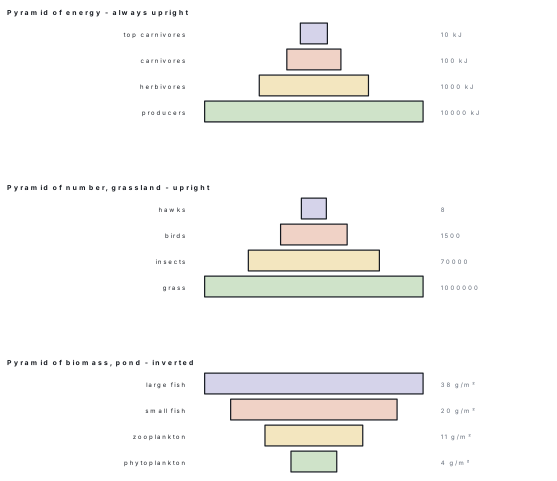
- The pyramid of energy in any ecosystem is [1]aalways uprightbalways invertedcsometimes inverteddspindle-shaped
- The pyramid of biomass in a pond ecosystem is inverted because [1]afish are heavybthe phytoplankton have a small standing crop but a very high turnover ratecthere are no decomposersdenergy flows in a cycle
- The pyramid of numbers in a single big tree with birds and their parasites is [1]auprightbinvertedcspindle-shapeddrectangular
- Energy flow in an ecosystem is [1]acyclicbunidirectionalcbidirectionaldreversible
- Conversion of atmospheric nitrogen into ammonia is [1]anitrificationbnitrogen fixationcammonificationddenitrification
- Nitrite is oxidised to nitrate in the soil by [1]aNitrosomonasbNitrobactercRhizobiumdAzotobacter
- Nitrate is reduced back to free nitrogen gas by [1]aNitrococcusbPseudomonas denitrificanscClostridiumdAnabaena
- Which of the following is a gaseous biogeochemical cycle? [1]aphosphorusbcalciumccarbondsulphur in rock
- The process by which a community changes in an orderly way over time until a stable community is reached is [1]asuccessionbmigrationcadaptationdspeciation
- The final stable community of a succession is the [1]apioneer communitybseral communitycclimax communitydsub-climax
- Aerenchyma, a tissue of large air spaces, is characteristic of [1]axerophytesbhydrophyteschalophytesdepiphytes
- Sunken stomata in hairy pits, as in Nerium, are an adaptation to [1]aincrease transpirationbreduce transpirationcincrease gaseous exchangedtrap insects
- Pneumatophores, the negatively geotropic breathing roots, are found in [1]adesert plantsbmangrove plantscepiphytesdparasites
- The greenhouse gas that contributes most to global warming by volume released is [1]aCO₂bCH₄cN₂OdCFC
- Ozone in the stratosphere is destroyed mainly by [1]acarbon dioxidebchlorofluorocarbonscsulphur dioxidedmethane
- Eutrophication of a lake is caused by [1]aexcess of nitrate and phosphatebshortage of lightcacid rain onlydsilt deposition only
- Mikania micrantha and Eichhornia crassipes are problems in Nepal because they are [1]aendangeredbinvasive alien speciescendemicdparasitic on humans
Answer key — 8.4
1. (b) — Tansley, 1935; Lindeman later quantified the energy flow.
2. (a) — autecology is one species, synecology a whole community.
3. (c) — a population is one species, a community all the species; only the ecosystem includes the abiotic part.
4. (b) — edaphic means soil-related; the other three are climatic.
5. (a) — producers, also called transducers of solar energy, but the standard CDC term is producers.
6. (b) — saprotrophs feed on dead organic matter by external digestion.
7. (b) — the detritus food chain; in a forest it actually carries more energy than the grazing chain.
8. (c) — grass 1st, grasshopper 2nd, frog 3rd. Counting the producer as zero is the usual error.
9. (b) — only about a tenth passes on, so the fifth level has too little energy to support a viable population.
10. (b) — Lindeman, 1942.
11. (c) — 20,000 → 2,000 (herbivore) → 200 (secondary) → 20 kJ (tertiary). Stopping one step early gives (b), the commonest wrong answer.
12. (a) — NPP = GPP − R; only NPP is available to the next level.
13. (a) — energy is a rate of flow and is always lost upward, so it cannot invert.
14. (b) — the tiny algae are eaten as fast as they grow, so at any instant their standing biomass is less than that of the fish they support.
15. (c) — one tree carries many birds, and each bird carries very many parasites, so the pyramid is narrow, wide, wider still at the top.
16. (b) — unidirectional, by the second law of thermodynamics; only nutrients are cycled.
17. (b) — nitrogen fixation, biological (Rhizobium, Azotobacter, Anabaena) or physical (lightning).
18. (b) — Nitrosomonas makes nitrite, Nitrobacter converts it to nitrate. Both steps together are nitrification.
19. (b) — Pseudomonas denitrificans and Thiobacillus denitrificans return N₂ to the air and lower soil fertility.
20. (c) — carbon, nitrogen and oxygen are gaseous (reservoir the atmosphere); phosphorus and sulphur are sedimentary (reservoir the rock).
21. (a) — ecological succession; a directional, predictable change, unlike a random fluctuation.
22. (c) — the climax community is in equilibrium with the climate and is self-perpetuating.
23. (b) — aerenchyma gives buoyancy and stores the oxygen needed by the submerged parts.
24. (b) — the pit holds a pocket of still, humid air over the stoma and cuts water loss.
25. (b) — mangroves such as Rhizophora and Avicennia grow in waterlogged saline mud where roots cannot get oxygen.
26. (a) — CO₂ contributes roughly 60 % of the enhanced greenhouse effect because of the sheer volume released, although methane is molecule-for-molecule far stronger.
27. (b) — a chlorine atom released from a CFC destroys many thousands of ozone molecules catalytically.
28. (a) — fertiliser and sewage nutrients cause an algal bloom, which decays and removes the dissolved oxygen.
29. (b) — both are invasive aliens; Mikania is smothering the sal forest of Chitwan and water hyacinth chokes Phewa and Begnas.
Problem. In a grassland the producers fix 9600\ \text{kJ m}^{-2}\ \text{yr}^{-1} of solar energy and use 6400\ \text{kJ m}^{-2}\ \text{yr}^{-1} of it in their own respiration. Find the net primary productivity, and the energy that reaches a snake feeding on frogs.
Solution. First the productivity:
Only the NPP is available to the next trophic level. Now apply the ten per cent law step by step, naming the level each time:
- grasshopper (2nd level): 0.10 \times 3200 = 320\ \text{kJ m}^{-2}\ \text{yr}^{-1}
- frog (3rd level): 0.10 \times 320 = 32\ \text{kJ m}^{-2}\ \text{yr}^{-1}
- snake (4th level): 0.10 \times 32 = 3.2\ \text{kJ m}^{-2}\ \text{yr}^{-1}
So the snake receives 3.2\ \text{kJ m}^{-2}\ \text{yr}^{-1}. Notice that the answer is taken from NPP, not from GPP — starting from 9600 would give 9.6 and lose the mark.
| High-yield facts — Ecology | |
|---|---|
| Ecosystem | term by Tansley 1935; abiotic (climatic, edaphic, inorganic, organic) + biotic |
| Biotic components | producers, consumers (I, II, III), decomposers |
| Trophic levels | producer = 1st; count upward from the plant |
| Ten per cent law | Lindeman 1942; 90 % lost as respiration, faeces and uneaten parts |
| Productivity | GPP − R = NPP; only NPP passes upward |
| Pyramids | energy always upright; number and biomass may invert (pond, single tree) |
| Nitrogen cycle | fixation → ammonification → nitrification (Nitrosomonas → Nitrobacter) → denitrification (Pseudomonas) |
| Cycle types | gaseous — C, N, O; sedimentary — P, S, Ca |
| Succession | pioneer → seral → climax; xerosere starts on rock, hydrosere in water |
| Xerophyte | thick cuticle, sunken stomata, deep roots, phylloclade, CAM |
| Hydrophyte | aerenchyma, reduced root, thin cuticle, epistomatous leaves |
| Imbalances | global warming (CO₂), ozone hole (CFC), acid rain (SO₂, NOₓ), eutrophication (NO₃⁻, PO₄³⁻) |
8.5 Vegetation
- The vegetation of Nepal is chiefly determined by [1]alongitudebaltitude and the rainfall that goes with itcsoil colourdpolitical boundaries
- Sal (Shorea robusta) forest is the characteristic vegetation of [1]athe Terai and Bhabar up to about 1000 mbthe alpine zonecthe trans-Himalayan zonedabove 3000 m
- The tropical vegetation zone of Nepal extends up to an altitude of about [1]a1000 mb2000 mc3000 md4000 m
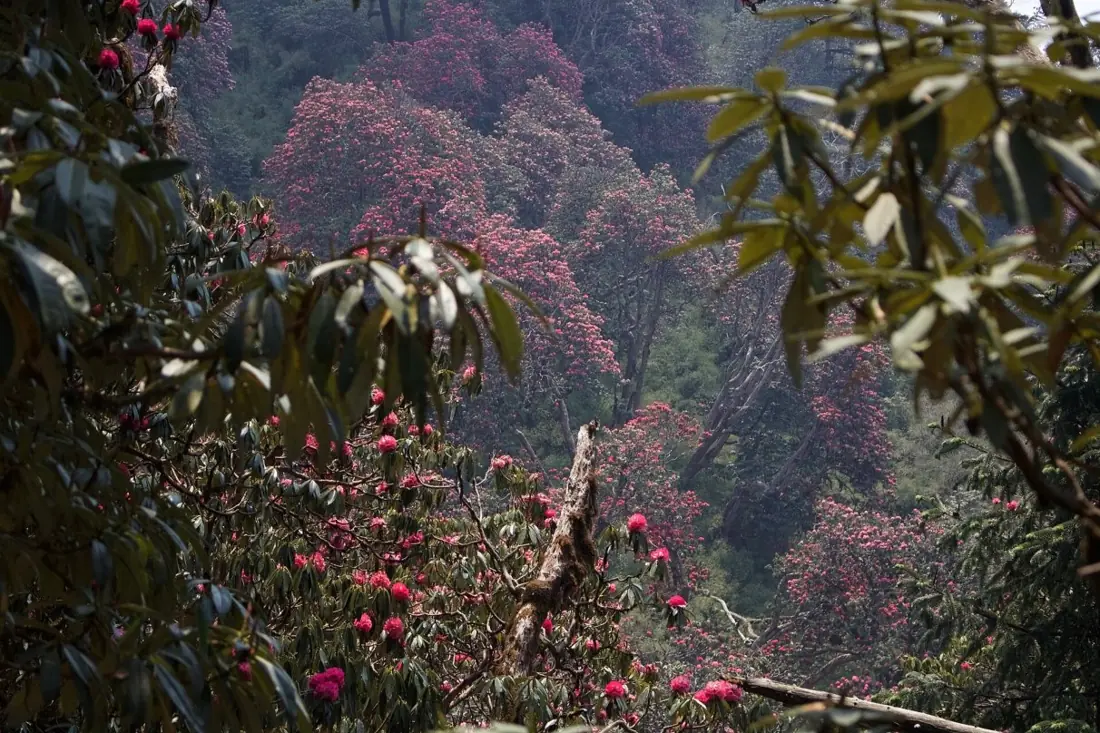
- Rhododendron arboreum, the national flower of Nepal, is typical of the [1]atropical zonebsub-tropical zonectemperate zonedtrans-Himalayan desert
- The zone above the tree line, dominated by low shrubs, herbs and cushion plants, is the [1]asub-alpine zonebalpine zonectemperate zonedsub-tropical zone
- Abies, Betula and Juniperus are characteristic genera of the [1]atropical forestbsub-tropical forestcsub-alpine forestdTerai grassland
- Conservation of a species inside its own natural habitat is called [1]ain-situ conservationbex-situ conservationccryopreservationdreintroduction
- Which of the following is an example of ex-situ conservation? [1]aChitwan National ParkbShivapuri–Nagarjun National Parkcthe Central Zoo at JawalakheldKoshi Tappu Wildlife Reserve
- A seed bank or gene bank is a method of [1]ain-situ conservationbex-situ conservationcbiological controldafforestation
- The largest national park of Nepal by area is [1]aChitwan National ParkbShey Phoksundo National ParkcSagarmatha National ParkdLangtang National Park
- Shifting cultivation, known in Nepal as khoriya, damages vegetation mainly by [1]aadding nutrientsbrepeated burning and clearing that prevents forest regenerationcraising the water tabledincreasing biodiversity
- The most important direct cause of deforestation in the hills of Nepal is [1]avolcanic activitybclearing for agriculture, fuelwood and foddercsea-level risedacid rain
- Community forestry in Nepal is significant because it [1]ahands over management of a patch of national forest to a local user groupbsells forest land to companiescbans all use of forest productsdreplaces forests with plantations of a single exotic species
Answer key — 8.5
1. (b) — Nepal rises from about 60 m to 8848 m in under 200 km, so altitude compresses all the vegetation belts of Asia into one country.
2. (a) — sal is the dominant hardwood of the Terai, Bhabar and lower Siwalik.
3. (a) — tropical up to about 1000 m, sub-tropical 1000–2000 m, temperate 2000–3000 m, sub-alpine 3000–4100 m, alpine above that.
4. (c) — Laligurans forms whole forests between about 2000 and 3500 m.
5. (b) — the alpine zone lies above the tree line, roughly above 4100 m.
6. (c) — fir, birch and juniper are the sub-alpine indicators.
7. (a) — in-situ: national parks, wildlife reserves, conservation areas, biosphere reserves.
8. (c) — a zoo keeps animals outside their habitat; the other three are protected areas, so in-situ.
9. (b) — the material is stored away from the habitat, which is the definition of ex-situ.
10. (b) — Shey Phoksundo, 3555 km², in Dolpa and Mugu; Chitwan is the oldest (1973) but smaller.
11. (b) — the fallow period is now too short for the soil and the forest to recover.
12. (b) — a rural household needs land, firewood and fodder, and takes all three from the forest.
13. (a) — a Community Forest User Group manages and harvests the forest and keeps the income; Nepal's programme is studied worldwide.
| High-yield facts — Vegetation | |
|---|---|
| Tropical (< 1000 m) | sal Shorea robusta, khair Acacia catechu, sissoo Dalbergia sissoo, simal |
| Sub-tropical (1000–2000 m) | chilaune Schima, katus Castanopsis, chir pine Pinus roxburghii |
| Temperate (2000–3000 m) | oak Quercus, Rhododendron, blue pine Pinus wallichiana |
| Sub-alpine (3000–4100 m) | Abies spectabilis, Betula utilis, Juniperus |
| Alpine (> 4100 m) | dwarf Rhododendron, Primula, cushion herbs, lichens |
| In-situ | national park, wildlife reserve, conservation area, hunting reserve, biosphere reserve |
| Ex-situ | zoo, botanical garden, gene bank, seed bank, tissue culture, cryopreservation |
| First national park | Chitwan, 1973 |
| Largest national park | Shey Phoksundo (3555 km²) |
| Forest cover of Nepal | about 44.7 % of the land including other wooded land |
8.6 Introduction to Biology
- The term biology was introduced independently in 1802 by [1]aLamarck and TreviranusbAristotle and TheophrastuscDarwin and WallacedLinnaeus and Cuvier
- Aristotle is called the [1]afather of botanybfather of zoologycfather of geneticsdfather of taxonomy
- The branch of biology that deals with the functions of the parts of an organism is [1]amorphologybanatomycphysiologydtaxonomy
- The study of the form and external structure of organisms is [1]amorphologybphysiologycecologydcytology
- The study of fossils is [1]apalaeontologybornithologycherpetologydembryology
- The study of birds is [1]aentomologybichthyologycornithologydherpetology
- The study of insects is [1]aentomologybetymologycethologydecology
- The study of animal behaviour is [1]aecologybethologycethnologydendocrinology
- The application of statistics to biological data is [1]abiophysicsbbiochemistrycbiometrydbiotechnology
- Which of the following is not a characteristic of all living things? [1]ametabolismbgrowth and reproductionclocomotion from place to placedresponse to stimuli
- Biology is related to chemistry most directly through the branch [1]abiophysicsbbiochemistrycbiogeographydbioinformatics
- Sensitivity, or irritability, is best defined as [1]athe ability to movebthe ability to detect and respond to a change in the surroundingscthe ability to growdthe ability to reproduce
Answer key — 8.6
1. (a) — Jean-Baptiste Lamarck and Gottfried Treviranus, both in 1802, from Greek bios (life) and logos (study).
2. (b) — Aristotle is the father of zoology and of biology as a whole; his pupil Theophrastus is the father of botany.
3. (c) — physiology is function; anatomy is internal structure revealed by dissection.
4. (a) — morphology; if you cut it open to see inside, it becomes anatomy.
5. (a) — palaeontology supplies the direct evidence of evolution.
6. (c) — ornithology; ichthyology is fish, herpetology reptiles and amphibians.
7. (a) — entomology. Note etymology, option (b), is the study of the origin of words — a deliberate trap.
8. (b) — ethology; ethnology, option (c), is the study of human races and cultures.
9. (c) — biometry, or biostatistics.
10. (c) — plants are living but do not move from place to place; all living things show the other three.
11. (b) — biochemistry studies the molecules and reactions of life.
12. (b) — detecting a stimulus and responding to it; a plant bending towards light counts.
| High-yield facts — Introduction to Biology | |
|---|---|
| Coined biology | Lamarck and Treviranus, 1802 |
| Father of biology and zoology | Aristotle |
| Father of botany | Theophrastus |
| Father of medicine | Hippocrates |
| Structure branches | morphology (external), anatomy (internal), histology (tissue), cytology (cell) |
| Function branches | physiology, biochemistry, genetics, ecology, ethology |
| Group branches | ornithology (birds), entomology (insects), ichthyology (fish), herpetology (reptiles and amphibians), mycology (fungi), phycology (algae) |
| Life processes | nutrition, respiration, excretion, growth, movement, reproduction, sensitivity, adaptation |
8.7 Evolutionary Biology
- The theory that life originated from non-living matter under the conditions of the early Earth is [1]aspecial creationbspontaneous generationcchemical evolutiondpanspermia
- The theory of chemical origin of life was proposed by [1]aOparin and HaldanebMiller and UreycPasteur and RedidDarwin and Wallace
- The experiment that produced amino acids from a mixture of methane, ammonia, hydrogen and water vapour was performed by [1]aOparinbStanley Miller and Harold UreycSpallanzanidFox
- The primitive atmosphere of the Earth is believed to have been [1]aoxidising, rich in O₂breducing, with no free oxygencinertdthe same as today
- The theory that life came to Earth as spores from outer space is [1]acosmozoic or panspermiababiogenesiscbiogenesisdcatastrophism
- Spontaneous generation was finally disproved by the swan-necked flask experiment of [1]aRedibSpallanzanicLouis PasteurdNeedham
- Organs of different animals that have the same basic structure and origin but different functions are [1]aanalogousbhomologouscvestigialdatavistic
- The wing of a bird and the wing of an insect are [1]ahomologousbanalogouscvestigialdidentical
- Homologous organs are evidence of [1]aconvergent evolutionbdivergent evolutioncparallel evolutiondno evolution
- The forelimbs of a whale, a bat, a horse and a human are a classic example of [1]aanalogous organsbhomologous organscvestigial organsdconnecting links
- The vermiform appendix in humans is an example of [1]aa homologous organban analogous organca vestigial organdan atavistic organ
- Archaeopteryx is important because it is a connecting link between [1]afish and amphibiansbamphibians and reptilescreptiles and birdsdreptiles and mammals
- Peripatus is regarded as a connecting link between [1]aAnnelida and ArthropodabMollusca and AnnelidacPorifera and CnidariadEchinodermata and Chordata
- A living fossil among the following is [1]aLatimeriabArchaeopteryxcAustralopithecusdDinosaur
- "Ontogeny repeats phylogeny" — the biogenetic law — was stated by [1]aErnst Haeckelbvon BaercLamarckdDarwin
- The evolution of the modern horse from Eohippus is evidence drawn from [1]aembryologybpalaeontologycbiochemistrydbiogeography
- Darwin's finches of the Galapagos Islands illustrate [1]aadaptive radiationbconvergent evolutioncvestigial organsdmimicry
- The theory of inheritance of acquired characters was proposed by [1]aLamarckbDarwincde VriesdWeismann
- Lamarck's theory was disproved by the experiment of [1]aWeismann, who cut off the tails of mice for twenty generationsbMendel, with pea plantscMiller, with a spark chamberdPasteur, with a swan-necked flask
- Darwin published On the Origin of Species in [1]a1809b1831c1859d1901
- The ship on which Darwin made his five-year voyage was the [1]aBeaglebChallengercEndeavourdDiscovery
- The central idea of Darwinism is [1]ause and disuse of organsbnatural selection acting on variations in a struggle for existencecsudden large mutationsdinheritance of acquired characters
- Which of the following is a drawback of Darwinism? [1]ait could not explain the origin and inheritance of variationbit denied the struggle for existencecit rejected fossilsdit assumed the Earth was young
- The mutation theory of evolution was proposed by [1]aHugo de VriesbLamarckcMendeldWallace
- De Vries worked on the plant [1]aPisum sativumbOenothera lamarckianacDrosophiladAntirrhinum
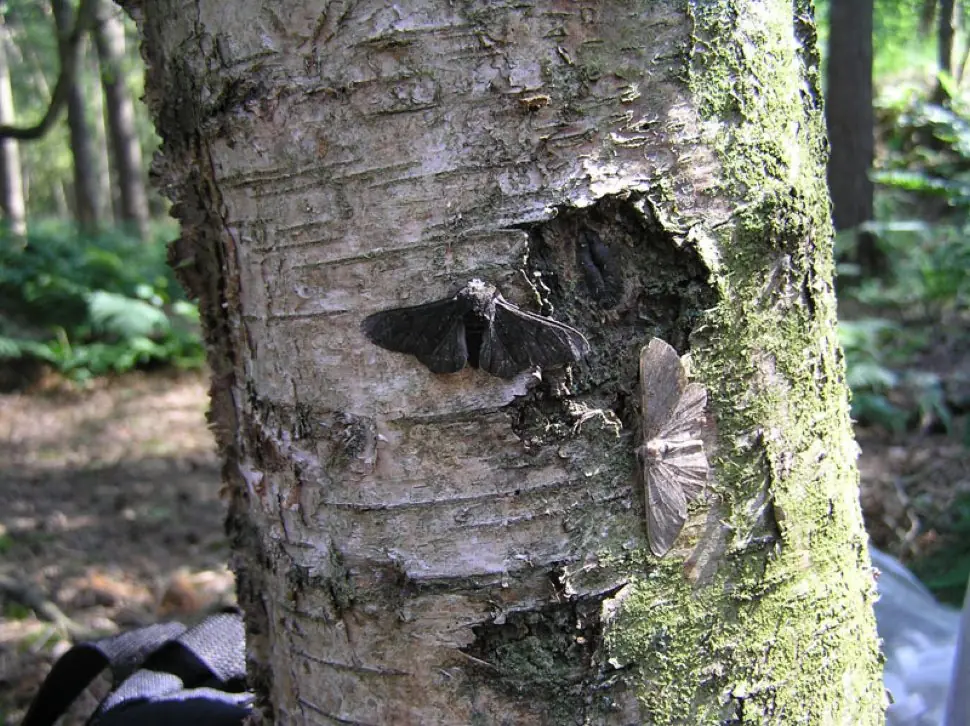
- Industrial melanism in the peppered moth Biston betularia is a documented example of [1]anatural selection in actionbinheritance of acquired characterscmutation pressure onlydgenetic drift
- The correct evolutionary sequence of human ancestors is [1](a) Australopithecus → Homo habilis → Homo erectus → Homo sapiens(b) Homo habilis → Australopithecus → Homo erectus → Homo sapiens(c) Homo erectus → Homo habilis → Australopithecus → Homo sapiens(d) Australopithecus → Homo erectus → Homo habilis → Homo sapiens
- Proconsul is regarded as [1]athe first true humanban early ape-like ancestor of both apes and humansca modern gorillada marine reptile
- Homo habilis is called "handy man" because it was the first to [1]awalk uprightbmake and use stone toolscuse firedbury its dead
- The first hominid to use fire and to migrate out of Africa was [1]aAustralopithecusbHomo habiliscHomo erectusdHomo neanderthalensis
- The cranial capacity of modern Homo sapiens is about [1]a450 ccb900 ccc1350 ccd2500 cc
- Which feature is not part of the human trend away from the apes? [1]aupright bipedal posturebopposable thumb with precision gripcincreasing brain sizedincreasing length of the arms relative to the legs
Answer key — 8.7
1. (c) — chemical or abiogenic evolution, the modern scientific account.
2. (a) — A. I. Oparin (1924) and J. B. S. Haldane (1929), independently; the "hot dilute soup".
3. (b) — Miller and Urey, 1953; they got glycine, alanine and aspartic acid in a week.
4. (b) — reducing; free oxygen would have oxidised the organic molecules as fast as they formed.
5. (a) — the cosmozoic or panspermia theory of Richter and Arrhenius. It only moves the problem elsewhere.
6. (c) — Pasteur, 1864; the broth stayed sterile because dust could not climb the bend.
7. (b) — homologous: same origin, different function, showing divergent evolution from a common ancestor.
8. (b) — analogous: same function (flight), completely different structure and origin.
9. (b) — divergent evolution, or adaptive radiation; analogous organs show convergent evolution. Swapping these two is the standard mistake.
10. (b) — the same bones — humerus, radius, ulna, carpals, metacarpals, phalanges — put to swimming, flying, running and grasping.
11. (c) — vestigial: reduced and functionless in humans, but a working cellulose-digesting caecum in a rabbit.
12. (c) — it had feathers and a wishbone like a bird, and teeth, a long bony tail and clawed fingers like a reptile.
13. (a) — it has the segmented body and nephridia of an annelid with the tracheae and claws of an arthropod.
14. (a) — Latimeria, the coelacanth, caught alive in 1938; the others are extinct fossils.
15. (a) — Haeckel's recapitulation theory: the embryo passes through the ancestral stages.
16. (b) — a complete fossil series, the best documented in palaeontology.
17. (a) — one ancestral stock radiating into many beak forms for many diets on different islands.
18. (a) — Lamarck, 1809: use and disuse plus inheritance of acquired characters.
19. (a) — Weismann's mice were still born with tails after 22 generations, because the germ plasm was never altered.
20. (c) — 24 November 1859.
21. (a) — HMS Beagle, 1831–36.
22. (b) — overproduction → struggle for existence → variation → survival of the fittest → natural selection.
23. (a) — Darwin had no theory of heredity, so he could not say where variations came from or why they persisted; Mendel's work was unknown to him.
24. (a) — de Vries, 1901: evolution proceeds by sudden large heritable changes, not by slow accumulation.
25. (b) — the evening primrose Oenothera lamarckiana.
26. (a) — as soot darkened the tree trunks the dark form went from rare to common in fifty years, and reversed after the Clean Air Act.
27. (a) — Australopithecus → Homo habilis → Homo erectus → Homo sapiens.
28. (b) — a Miocene ape from East Africa, close to the common ancestor of apes and humans.
29. (b) — the Oldowan pebble tools found with its fossils; cranial capacity about 650–800 cc.
30. (c) — Homo erectus (Java man, Peking man), the first to use fire and leave Africa.
31. (c) — about 1350–1450 cc; Australopithecus had about 450–500 cc.
32. (d) — the arms became relatively shorter and the legs longer as posture became upright.
Ask one question only: do the two organs have the same basic plan and the same embryonic origin? If yes they are homologous, whatever they are used for (a whale's flipper and your arm). If no they are analogous, however alike they look (a butterfly's wing and a bird's wing). Homology means divergence from a shared ancestor; analogy means convergence on a shared job.
| High-yield facts — Evolutionary Biology | |
|---|---|
| Origin of life | Oparin–Haldane (1924/1929); Miller–Urey experiment 1953 |
| Disproof of spontaneous generation | Redi (1668), Spallanzani, Pasteur (1864) |
| Morphological evidence | homologous (divergent), analogous (convergent), vestigial (appendix, nictitating membrane, ear muscles, coccyx) |
| Connecting links | Archaeopteryx (reptile–bird), Peripatus (annelid–arthropod), lungfish (fish–amphibian), Ornithorhynchus (reptile–mammal) |
| Living fossils | Latimeria, Limulus, Sphenodon, Ginkgo, Peripatus |
| Embryological evidence | Haeckel's biogenetic law: ontogeny recapitulates phylogeny |
| Lamarckism | use and disuse; inheritance of acquired characters; disproved by Weismann |
| Darwinism | 1859; overproduction, struggle, variation, natural selection, survival of the fittest |
| Mutation theory | de Vries, 1901, on Oenothera lamarckiana |
| Human line | Proconsul → Dryopithecus/Ramapithecus → Australopithecus (450 cc) → H. habilis (700 cc, tools) → H. erectus (900 cc, fire) → H. sapiens (1350 cc) |
8.8 Faunal Diversity
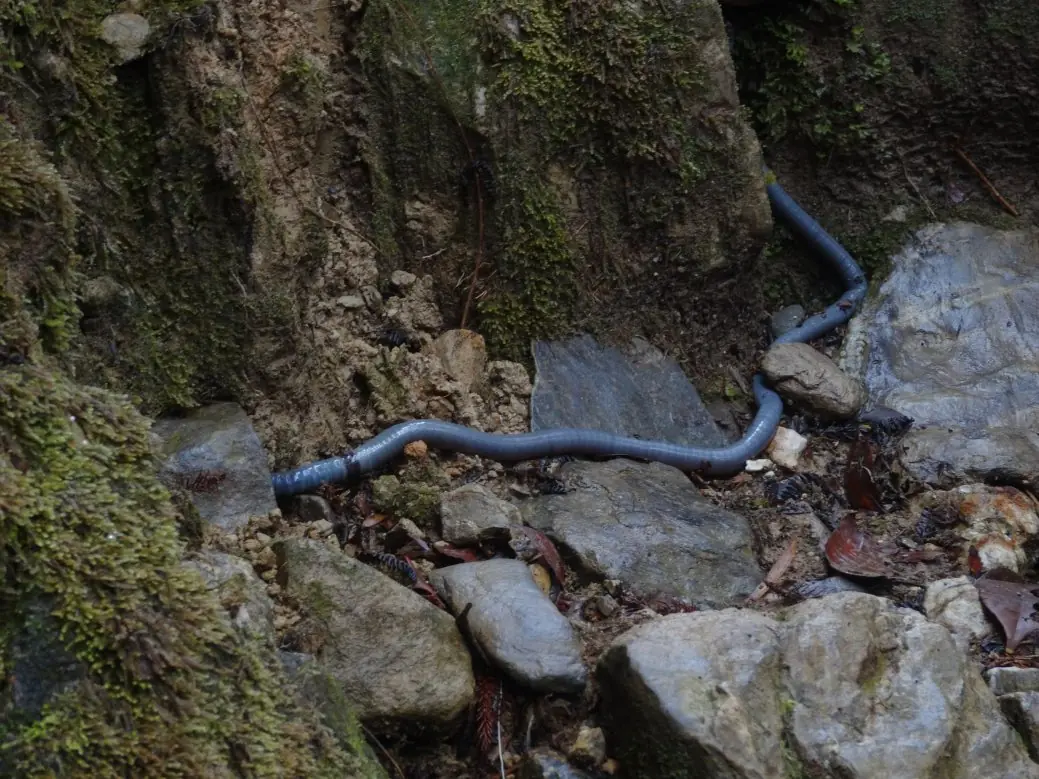
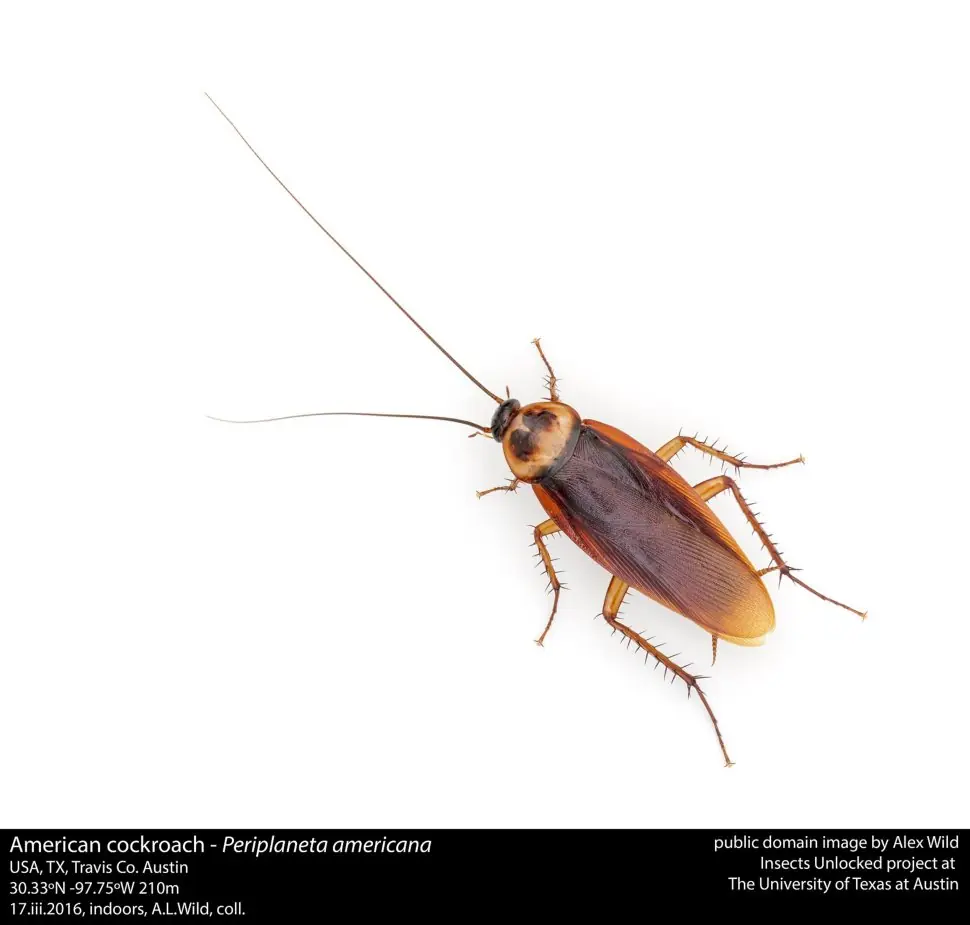
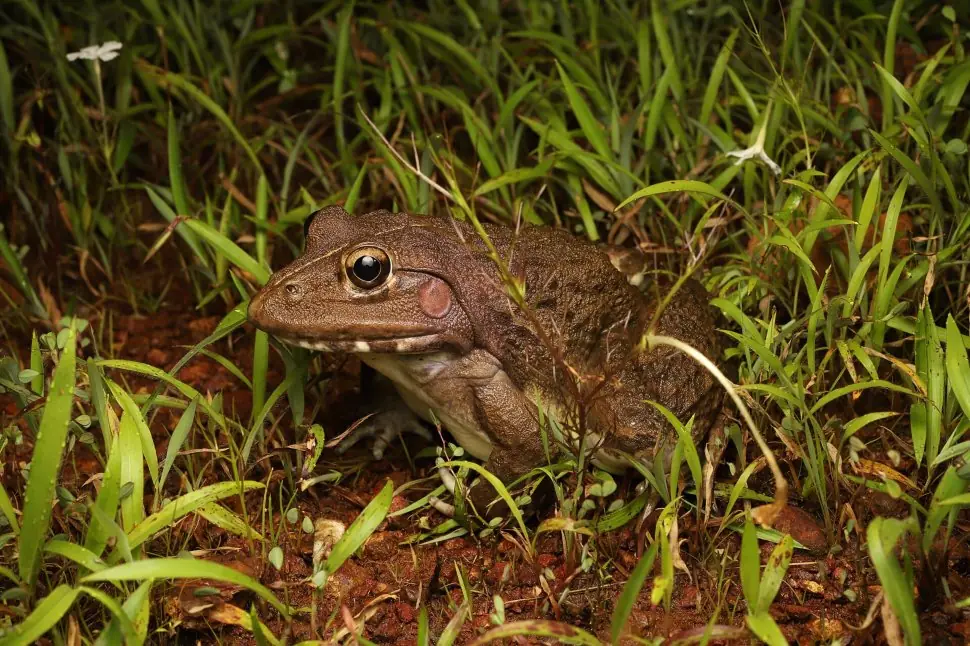
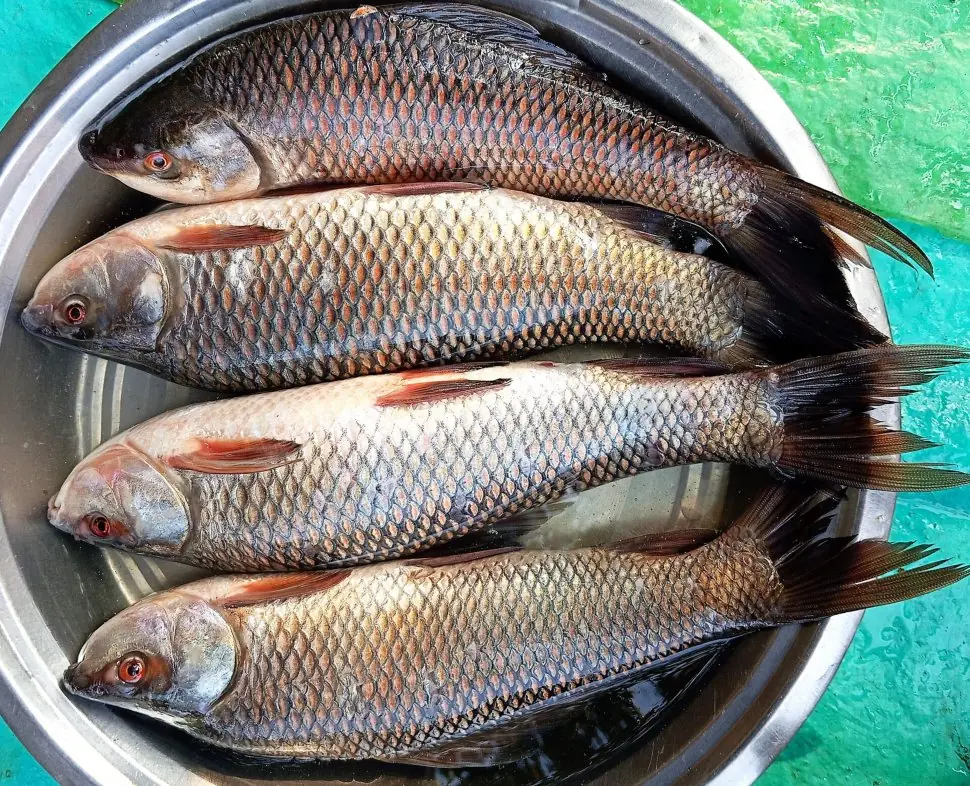
- Paramecium moves by means of [1]apseudopodiabciliaca flagellumdmuscles
- The locomotory organelle of Amoeba is the [1]aciliumbflagellumcpseudopodiumdmyoneme
- The osmoregulatory organelle of a freshwater protozoan is the [1]afood vacuolebcontractile vacuolecmicronucleusdtrichocyst
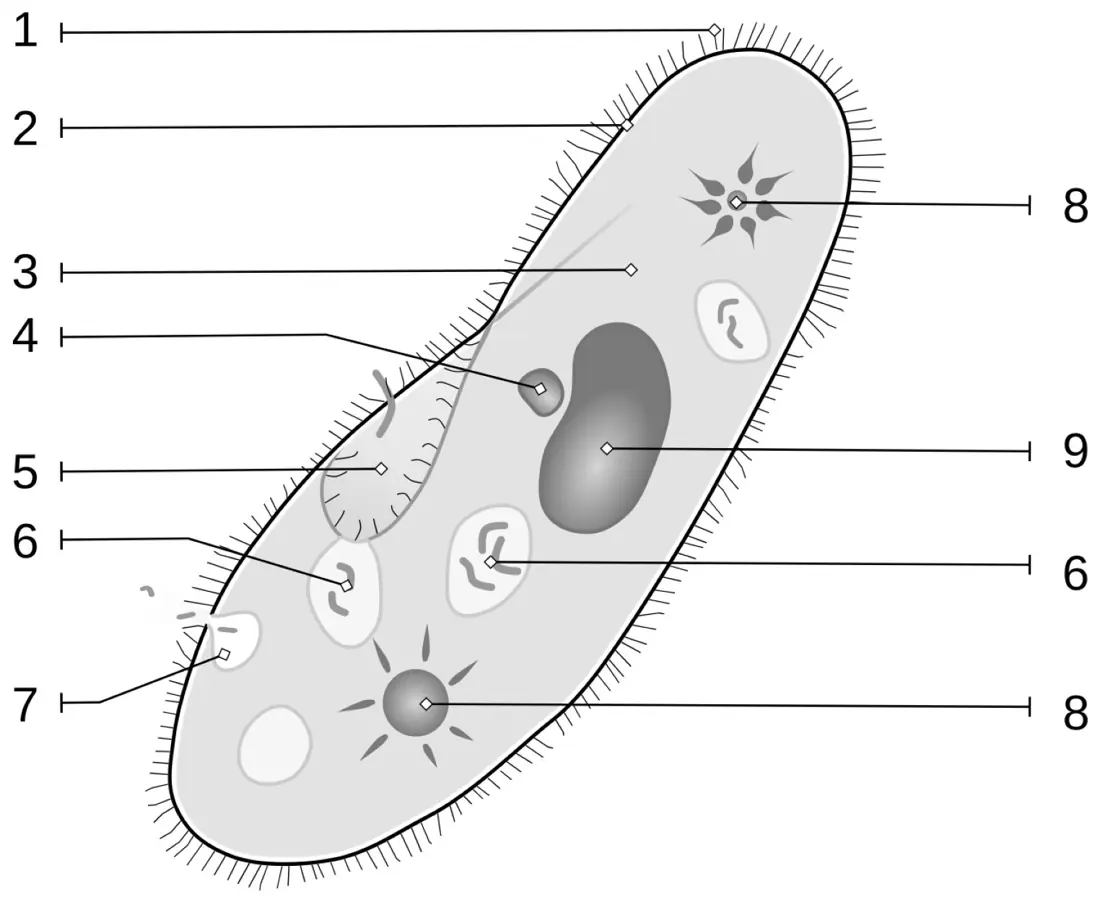
- Paramecium is unusual among protozoans in having [1]ano nucleusbtwo kinds of nuclei, a macronucleus and a micronucleusca cell walldchloroplasts
- The macronucleus of Paramecium controls [1]areproduction onlybthe vegetative or metabolic activities of the cellclocomotiondnothing
- Asexual reproduction in Paramecium is by [1]alongitudinal binary fissionbtransverse binary fissioncmultiple fissiondbudding only
- Conjugation in Paramecium is significant because it [1]aincreases the number of individualsbbrings about nuclear reorganisation and genetic recombinationcproduces sporesdforms a cyst
- The infective stage of Plasmodium injected into a human by the mosquito is the [1]amerozoitebsporozoitecgametocytedtrophozoite
- Malaria is transmitted by the bite of [1]aa male Anopheles mosquitoba female Anopheles mosquitoca female Culex mosquitoda female Aedes mosquito
- In the life cycle of Plasmodium, the human being is the [1]aprimary or definitive hostbsecondary or intermediate hostcreservoir hostdvector
- The most dangerous species of malarial parasite, causing malignant tertian malaria, is [1]aPlasmodium vivaxbPlasmodium malariaecPlasmodium falciparumdPlasmodium ovale
- The bursting of red blood cells that releases merozoites and toxins causes [1]athe periodic chill and fever of malariabjaundice onlycthe rash of dengueddiarrhoea
- Animals in which the cells are not organised into tissues show the [1]aprotoplasmic levelbcellular levelctissue leveldorgan-system level
- Radial symmetry is characteristic of [1]aPoriferabCnidariacAnnelidadArthropoda
- The body cavity lined on all sides by mesoderm is a [1]apseudocoelombtrue coelomchaemocoeldblastocoel
- Roundworms such as Ascaris are described as [1]aacoelomatebpseudocoelomateccoelomatedschizocoelomate
- Canal system with choanocytes and spicules is the identifying feature of phylum [1]aPoriferabCnidariacPlatyhelminthesdMollusca
- Stinging cells called cnidoblasts occur in [1]aPoriferabCnidariacAnnelidadEchinodermata
- Flame cells are the excretory structures of [1]aPlatyhelminthesbNematodacAnnelidadArthropoda
- Which phylum is characterised by a soft unsegmented body, a muscular foot and usually a calcareous shell? [1]aAnnelidabMolluscacArthropodadEchinodermata
- The largest phylum of the animal kingdom is [1]aMolluscabArthropodacChordatadAnnelida
- Jointed appendages and a chitinous exoskeleton belong to [1]aAnnelidabArthropodacNematodadEchinodermata
- The water vascular system with tube feet is unique to [1]aMolluscabEchinodermatacArthropodadHemichordata
- Echinoderms are unusual in being [1]aradially symmetrical as adults but bilaterally symmetrical as larvaebasymmetrical throughoutcbilateral throughoutdwithout a coelom
- The three fundamental chordate characters are [1]anotochord, dorsal tubular nerve cord and pharyngeal gill slitsbbackbone, skull and limbscexoskeleton, coelom and segmentationdscales, feathers and hair
- In earthworm and Chordata the nerve cord is respectively [1]adorsal and ventralbventral and dorsalcboth dorsaldboth ventral
- The scientific name of the common Nepali earthworm is [1]aLumbricus terrestrisbPheretima posthumacRana tigrinadAscaris lumbricoides
- The clitellum of Pheretima is found on segments [1]a9–11b14–16c20–22d5–7
- Locomotion in the earthworm is brought about by [1]aparapodiabsetae together with circular and longitudinal musclesctube feetda muscular foot
- The earthworm respires through [1]agillsbits moist vascular skinctracheaedlungs
- The excretory organs of the earthworm are [1]aflame cellsbnephridiacMalpighian tubulesdgreen glands
- Septal nephridia of Pheretima are located [1]aon the septa from segment 15 backwardsbin the body wall of all segmentscin the pharynx onlydin the clitellum only
- The blood of the earthworm is red because haemoglobin is [1]ainside the red blood cellsbdissolved in the plasmacabsentdreplaced by haemocyanin
- The earthworm is called the farmer's friend because it [1]aeats insect pestsbaerates and enriches the soil with its castings and burrowscfixes nitrogendpollinates crops
- The earthworm is hermaphrodite but cross-fertilising because [1]ait has no spermbthe sperms mature before the ova, so self-fertilisation is preventedcthe ova are steriledfertilisation is external only
- The scientific name of the Indian bullfrog studied in the CDC course is [1]aRana tigrinabBufo melanostictuscHyla arboreadXenopus laevis
- The frog is described as poikilothermic, which means it is [1]awarm-bloodedbcold-blooded, its body temperature varying with the surroundingscvenomousdnocturnal
- The winter sleep of a frog in a burrow is called [1]aaestivationbhibernationcmigrationddiapause
- The nictitating membrane of the frog serves to [1]ahear under waterbkeep the eye moist and protect it under water while allowing sightctastedbalance
- The frog's tongue is unusual in being [1]aabsentbbilobed and attached at the front, free and flicked out at the backcbonydattached all round
- A frog respires through all of the following except [1]askinbbuccal cavity liningclungsdgills in the adult
- The heart of an adult frog has [1]atwo chambersbthree chambers — two auricles and one ventriclecfour chambersdone chamber
- Because the frog's ventricle is single [1]athe blood is completely separatedboxygenated and deoxygenated blood mix to some extentcthere is no circulationdthe blood does not clot
- The kidney of an adult frog is of the type [1]apronephrosbmesonephroscmetanephrosdopisthonephros
- Fertilisation in the frog is [1]ainternalbexternal, in watercabsentdinternal in the male
- The tadpole of a frog respires by [1]alungsbgillscskin onlydtracheae
- The change of a tadpole into an adult frog is [1]aregenerationbmetamorphosiscparthenogenesisdalternation of generations
- The hormone controlling metamorphosis in the frog is [1]ainsulinbthyroxinecadrenalinedauxin
Answer key — 8.8
1. (b) — some 10,000–14,000 cilia over the whole pellicle, beating in metachronal waves.
2. (c) — temporary pseudopodia formed by sol–gel changes of the cytoplasm.
3. (b) — the contractile vacuole pumps out the water that constantly enters by osmosis.
4. (b) — nuclear dimorphism: a large kidney-shaped macronucleus and one or more micronuclei.
5. (b) — the macronucleus runs the everyday metabolism; the micronucleus is the reproductive or generative nucleus.
6. (b) — transverse binary fission in Paramecium; Euglena divides longitudinally. Examiners set this pair together deliberately.
7. (b) — no increase in number takes place; conjugation only reshuffles genes and rejuvenates the animal, which is why Paramecium is said never to grow old.
8. (b) — sporozoites from the mosquito's salivary gland; merozoites are produced later inside the human.
9. (b) — only the female takes a blood meal, which she needs for her eggs.
10. (b) — the mosquito is the primary host because the sexual cycle takes place in it; the human is secondary. This is inverted by most students.
11. (c) — P. falciparum causes cerebral malaria and most malarial deaths.
12. (a) — the synchronous rupture of the infected erythrocytes releases haemozoin, which triggers the chill-and-fever paroxysm.
13. (b) — the cellular level, as in Porifera, where the cells are loosely aggregated.
14. (b) — Cnidaria; Porifera are mostly asymmetrical, Annelida and Arthropoda bilateral.
15. (b) — a true coelom or eucoelom, lined entirely by mesodermal peritoneum.
16. (b) — pseudocoelomate: the cavity is a persistent blastocoel, not lined by mesoderm all round.
17. (a) — Porifera, the sponges; choanocytes (collar cells) drive the water current.
18. (b) — cnidoblasts containing nematocysts, used for capture and defence; they name the phylum.
19. (a) — flame cells (protonephridia) of flatworms; Malpighian tubules belong to insects and green glands to prawns.
20. (b) — Mollusca, the second largest phylum.
21. (b) — Arthropoda, more than three-quarters of all described animal species.
22. (b) — jointed appendages (arthros = joint, podos = foot) and moulting of the chitinous cuticle.
23. (b) — the water vascular system is found nowhere else in the animal kingdom.
24. (a) — the bilateral larva shows their true ancestry; the radial adult is secondary.
25. (a) — notochord, dorsal hollow nerve cord and pharyngeal gill slits, present at least in the embryo.
26. (b) — earthworm ventral and solid double; chordate dorsal, hollow and single.
27. (b) — Pheretima posthuma; Lumbricus terrestris is the European earthworm.
28. (b) — segments 14, 15 and 16; the girdle that secretes the cocoon.
29. (b) — S-shaped setae anchor the body while the muscles push it forward; parapodia belong to Nereis.
30. (b) — cutaneous respiration through a moist skin richly supplied with capillaries; it must stay damp or it suffocates.
31. (b) — nephridia of three kinds: septal, pharyngeal and integumentary.
32. (a) — on both faces of the intersegmental septa from segment 15 to the last, opening into the intestine (enteronephric).
33. (b) — haemoglobin dissolved in the plasma, and the corpuscles are colourless — the exact opposite of our own blood.
34. (b) — Darwin called it nature's plough; its burrows aerate and drain the soil and its castings are rich in NPK.
35. (b) — protandry: the male organs mature first, so two worms must exchange sperm.
36. (a) — Rana tigrina (now often Hoplobatrachus tigerinus), the Indian bullfrog.
37. (b) — poikilothermic or ectothermic; it must hibernate and aestivate to survive extremes.
38. (b) — hibernation is the winter sleep, aestivation the summer sleep. Both occur in the frog.
39. (b) — a transparent fold that draws over the cornea under water; in humans it survives only as the vestigial plica semilunaris.
40. (b) — attached in front, free and bifid behind, so it can be shot out to catch insects.
41. (d) — an adult frog has no gills; the tadpole does. The adult uses skin, buccal lining and lungs.
42. (b) — two auricles and one ventricle, with a sinus venosus and a conus arteriosus.
43. (b) — some mixing is unavoidable, though the spiral valve of the conus reduces it; this is why amphibians remain cold-blooded.
44. (b) — mesonephros in the adult amphibian; metanephros is the amniote (reptile, bird, mammal) kidney.
45. (b) — external fertilisation in water, during amplexus.
46. (b) — external then internal gills; the switch to lungs is part of metamorphosis.
47. (b) — metamorphosis, an indirect development.
48. (b) — thyroxine from the thyroid gland; a tadpole deprived of iodine never becomes a frog.
The primary (definitive) host is the one in which the parasite reproduces sexually. For Plasmodium the sexual cycle is completed in the mosquito, so the mosquito is the primary host and the human is the secondary (intermediate) host — even though the human is the one who is ill. Deciding by "which one matters more to us" is what makes this the single most-missed one-mark question in Zoology.
| High-yield facts — Faunal Diversity | |
|---|---|
| Paramecium | cilia; pellicle; two nuclei; transverse binary fission; conjugation = recombination only |
| Plasmodium | sporozoite infects human; mosquito = primary host; female Anopheles = vector; P. falciparum most fatal |
| Levels of organisation | protoplasmic → cellular → tissue → organ → organ-system |
| Symmetry | asymmetrical (Porifera), radial (Cnidaria, Echinodermata adult), bilateral (rest) |
| Coelom | acoelomate (Platyhelminthes), pseudocoelomate (Nematoda), coelomate (Annelida onward) |
| Phylum markers | Porifera — choanocytes; Cnidaria — cnidoblasts; Platyhelminthes — flame cells; Nematoda — pseudocoelom; Annelida — metameric segmentation, nephridia; Arthropoda — jointed legs, Malpighian tubules; Mollusca — muscular foot, mantle, radula; Echinodermata — water vascular system; Chordata — notochord, dorsal hollow nerve cord, gill slits |
| Earthworm | clitellum 14–16; setae; cutaneous respiration; haemoglobin in plasma; nephridia; protandrous hermaphrodite |
| Frog | poikilothermic; three-chambered heart; mesonephric kidney; external fertilisation; thyroxine drives metamorphosis |
8.9 Biota and Environment
- The change in an organism that fits it better to its surroundings is [1]aadaptationbacclimatisationcmutationdmigration
- Streamlined body, fins and a swim bladder in a fish are adaptations for [1]aaquatic lifebdesert lifecflightdburrowing
- Pneumatic (hollow) bones and air sacs are flight adaptations of [1]abatsbbirdscinsectsdflying fish
- The camel survives in the desert chiefly because it [1](a) stores water in its hump(b) tolerates a wide swing in body temperature and produces very concentrated urine(c) never drinks(d) has no sweat glands at all
- The blubber of a whale or a seal is an adaptation for [1]abuoyancy and heat insulationbrespirationcexcretiondreproduction
- Cryptic colouration, in which an animal matches its background, is an example of [1]amimicrybcamouflagecwarning colourationdmigration
- An innate, unlearned, stereotyped response of the whole animal to a stimulus is [1]ainstinctbconditioningcimprintingdinsight learning
- The waggle dance by which a honeybee tells the hive the direction and distance of food was decoded by [1]aKarl von FrischbKonrad LorenzcNiko TinbergendIvan Pavlov
- A duckling following the first moving object it sees after hatching shows [1]aimprintingbhabituationcconditioningdinsight
- Pavlov's dog salivating at the sound of a bell is an example of [1]aclassical conditioningboperant conditioningcimprintingdinstinct
- The seasonal, two-way movement of animals along a regular route is [1]amigrationbemigrationcdispersaldsuccession
- A fish that lives in the sea and migrates into rivers to breed, such as the salmon, is called [1]acatadromousbanadromouscpotamodromousdoceanodromous
- The eel Anguilla, which lives in fresh water and breeds in the sea, is [1]aanadromousbcatadromouscamphidromousdsedentary
- Birds migrate mainly because of [1]ashortage of food and unfavourable climate in the breeding groundbcuriositycmagnetic stormsdcompetition with fish
- Air pollution caused by sulphur dioxide and nitrogen oxides leads chiefly to [1]aacid rainbozone formation at the polesceutrophicationdsoil salinity
- The Bhopal gas tragedy of 1984 was caused by the leak of [1]amethyl isocyanatebcarbon monoxidecchlorinedsulphur dioxide
- Carbon monoxide is dangerous because it [1]abinds to haemoglobin about 200 times more strongly than oxygenbdissolves bonecdestroys ozonedcauses acid rain
- A noise level above which hearing damage begins with prolonged exposure is about [1]a30 dBb55 dBc85 dBd200 dB
- Biological magnification is the process by which [1]aa persistent pollutant becomes more concentrated at each higher trophic levelbbacteria multiply in waterca lake becomes nutrient richda population grows exponentially
- The pollutant most responsible for the thinning of the shells of fish-eating birds' eggs was [1]aDDTbleadcmercurydarsenic
- Minamata disease was caused by pollution of water with [1]amercurybcadmiumcleaddfluoride
- The chief source of water pollution in the Bagmati river is [1]auntreated domestic sewage and solid wasteboil spillscradioactive wastedthermal discharge
Answer key — 8.9
1. (a) — adaptation is heritable and evolutionary; acclimatisation is a reversible adjustment within one lifetime.
2. (a) — the streamlined shape cuts drag, the fins steer and the swim bladder holds the fish at any depth without effort.
3. (b) — birds; pneumatic bones cut weight and the air sacs give a one-way flow of air through the lungs.
4. (b) — the hump stores fat, not water; the real adaptations are the 6 °C swing in body temperature, very concentrated urine and dry faeces.
5. (a) — a thick subcutaneous fat layer that insulates in cold water and makes the animal buoyant.
6. (b) — camouflage; mimicry is resembling another organism, not the background.
7. (a) — instinct is inborn and needs no practice, unlike all forms of learning.
8. (a) — von Frisch, who shared the 1973 Nobel Prize with Lorenz and Tinbergen.
9. (a) — imprinting, described by Konrad Lorenz; it happens only in a short critical period and cannot be reversed.
10. (a) — classical conditioning: a neutral stimulus is paired with a natural one until it alone produces the response.
11. (a) — migration is periodic and two-way; emigration is one-way and permanent.
12. (b) — anadromous, "running up" the river to breed.
13. (b) — catadromous, "running down" to the sea; the European eel breeds in the Sargasso Sea.
14. (a) — the trigger is day length, but the cause is the seasonal collapse of food and temperature.
15. (a) — SO₂ and NOₓ dissolve to give sulphuric and nitric acid, taking the rain below pH 5.6.
16. (a) — methyl isocyanate from the Union Carbide plant, the worst industrial accident on record.
17. (a) — it forms stable carboxyhaemoglobin, so the blood can no longer carry oxygen.
18. (c) — about 85 dB over long periods; above 120 dB the damage is immediate.
19. (a) — biomagnification; DDT and mercury are not excreted, so they accumulate up the chain.
20. (a) — DDT interfered with calcium deposition, which is why it is now banned for agricultural use.
21. (a) — methylmercury discharged into Minamata Bay, Japan, and concentrated in fish.
22. (a) — sewage from the Kathmandu valley discharged without treatment, plus solid waste dumped on the banks.
| High-yield facts — Biota and Environment | |
|---|---|
| Aquatic adaptation | streamlined body, fins, swim bladder, gills, lateral line, mucus |
| Desert adaptation | nocturnal habit, concentrated urine, dry faeces, fat store, wide temperature tolerance |
| Volant (flight) adaptation | pneumatic bones, air sacs, feathers, keeled sternum, no urinary bladder |
| Behaviour types | instinct, reflex, taxis, habituation, imprinting, conditioning, insight |
| Nobel 1973 | von Frisch (bee dance), Lorenz (imprinting), Tinbergen (releasers) |
| Migration | anadromous — salmon, hilsa; catadromous — eel; birds — Arctic tern, demoiselle crane over Nepal |
| Air pollutants | CO, SO₂, NOₓ, SPM, CFC; acid rain below pH 5.6 |
| Water pollutants | sewage (BOD), fertiliser (eutrophication), heavy metals (Minamata, Itai-itai) |
| Biomagnification | DDT, mercury, PCB — highest in the top carnivore |
8.10 Conservation Biology
- Conservation biology is best defined as the scientific study of [1]ahow to harvest forests profitablybthe protection, restoration and sustainable management of biodiversitycfossil formationdanimal breeding for meat
- Biodiversity has three levels, namely [1]agenetic, species and ecosystem diversitybplant, animal and microbial diversitycalpha, beta and gamma raysdlocal, national and global
- The greatest single cause of the loss of biodiversity today is [1]ahabitat loss and fragmentationbvolcanoescnatural predationddisease
- IUCN stands for the [1]aInternational Union for Conservation of NaturebIndian Union for Control of NaturecInternational Union of Concerned NaturalistsdInstitute for the United Conservation of Nature
- The IUCN publication that lists the conservation status of species is the [1]aGreen BookbRed Data BookcBlue BookdWhite Paper
- The IUCN category for a species facing an extremely high risk of extinction in the wild is [1]avulnerablebendangeredccritically endangereddnear threatened
- A species that no longer occurs in the wild but survives only in cultivation or captivity is [1]aextinctbextinct in the wildccritically endangeredddata deficient
- The correct order of increasing risk among IUCN threatened categories is [1]avulnerable, endangered, critically endangeredbendangered, vulnerable, critically endangeredccritically endangered, endangered, vulnerabledvulnerable, critically endangered, endangered
- A species found naturally in one geographical area and nowhere else is [1]aendemicbexoticccosmopolitandinvasive
- Spiny babbler (Turdoides nipalensis), the only bird endemic to Nepal, is important because it [1]ais found in no other countrybmigrates to Siberiacis the national birddis extinct
- The national bird of Nepal is [1]aLophophorus impejanus, the danphebthe peacockcthe spiny babblerdthe sarus crane
- The one-horned rhinoceros of Nepal has the scientific name [1]aRhinoceros unicornisbRhinoceros sondaicuscDiceros bicornisdCeratotherium simum
- Which of the following is the first national park of Nepal? [1]aChitwan National Park, 1973bSagarmatha National Park, 1976cBardiya National Park, 1988dLangtang National Park, 1976
- Koshi Tappu Wildlife Reserve was established mainly to protect the [1]awild water buffalo (arna)bsnow leopardcred pandadgharial
- CITES is an international agreement that controls [1]atrade in endangered species of wild fauna and florabcarbon emissionscfishing quotas onlydthe ozone layer
- A Ramsar site is a wetland of international importance. The first Ramsar site of Nepal is [1]aKoshi TappubPhewa LakecGhodaghodi LakedGokyo
Answer key — 8.10
1. (b) — it is an applied, goal-driven science: describe biodiversity, find why it is being lost, and act.
2. (a) — genetic (within a species), species (number and abundance), ecosystem (variety of habitats).
3. (a) — habitat loss, then invasive species, pollution, over-exploitation and climate change. Remember them as HIPPO.
4. (a) — founded 1948, headquarters at Gland, Switzerland.
5. (b) — the Red Data Book, now the online Red List.
6. (c) — critically endangered (CR) is the highest risk short of extinction.
7. (b) — extinct in the wild (EW).
8. (a) — VU → EN → CR in order of increasing risk; the full ladder is LC, NT, VU, EN, CR, EW, EX.
9. (a) — endemic; an exotic species is one introduced from elsewhere, which is the usual confusion.
10. (a) — it is Nepal's only endemic bird, rediscovered by Dillon Ripley in 1948 after being thought lost.
11. (a) — the Himalayan monal or danphe, Lophophorus impejanus.
12. (a) — Rhinoceros unicornis, the greater one-horned rhinoceros of Chitwan and Bardiya.
13. (a) — Chitwan, gazetted in 1973, also Nepal's first World Heritage natural site.
14. (a) — the last population of wild water buffalo (Bubalus arnee) in Nepal.
15. (a) — the Convention on International Trade in Endangered Species, 1973; Appendix I bans commercial trade outright.
16. (a) — Koshi Tappu, listed in 1987; Nepal now has ten Ramsar sites.
| High-yield facts — Conservation Biology | |
|---|---|
| Levels of biodiversity | genetic, species, ecosystem |
| Causes of loss (HIPPO) | Habitat loss, Invasive species, Pollution, Population, Over-harvesting |
| IUCN | founded 1948; Red Data Book; categories EX, EW, CR, EN, VU, NT, LC, DD, NE |
| Endangered mammals of Nepal | one-horned rhino, Royal Bengal tiger, snow leopard, red panda, wild water buffalo, musk deer, gaur, pangolin |
| Endangered birds | spiny babbler (endemic), bengal florican, white-rumped vulture, sarus crane |
| National symbols | bird — danphe; flower — Rhododendron arboreum; tree — Ficus religiosa; animal — cow |
| Protected areas | 12 national parks, 1 wildlife reserve, 1 hunting reserve (Dhorpatan), 6 conservation areas, 13 buffer zones |
| Firsts | first national park — Chitwan 1973; first conservation area — Annapurna 1986; first Ramsar site — Koshi Tappu 1987 |
| Conventions | CITES 1973, Ramsar 1971, CBD 1992 |
Problem. The primary host of Plasmodium is (a) man (b) female Anopheles mosquito (c) female Culex mosquito (d) housefly. Answer it without recalling the definition.
Solution. Work by elimination, which is faster and safer than recall.
Step 1 — use the biology you are sure of. Malaria is spread by Anopheles, not Culex (which spreads filariasis) and not the housefly (which spreads typhoid and cholera mechanically). Options (c) and (d) go at once. Two options remain and the question is already worth half a mark in expectation.
Step 2 — find the discriminating rule. The remaining pair, man and mosquito, differ only in which cycle happens where. The rule is: the definitive host is where the sexual cycle occurs. Gametocytes are taken up by the mosquito, and fertilisation and zygote formation happen in its gut.
Step 3 — apply and check. Sexual cycle in the mosquito, therefore the mosquito is primary, therefore (b). Check the leftover: man harbours the asexual schizogony, so man is the secondary host — which is consistent, so the answer stands.
Notice that steps 1 and 3 used ordinary content knowledge and only step 2 used the definition. In a bank of 300 questions you will not recall every definition; you will almost always recall enough to delete two options, and a one-in-two guess across eleven MCQs is worth about five and a half marks.
Chapter summary
This chapter is the objective half of your Biology revision: close to three hundred one-mark questions arranged unit by unit against the CDC Grade 11 syllabus, each with an answer key that gives the reason rather than the letter.
- Group A of the NEB Biology paper carries eleven marks, five from Botany and six from Zoology, and is the only part of the paper where a wrong answer costs you the whole mark with no part credit. It is also the part most reliably won by practice.
- The marks follow the teaching hours. Floral Diversity (30 h) and Faunal Diversity (34 h) together account for half the syllabus, and the number of questions in sections 8.2 and 8.8 is in proportion.
- Most one-mark questions are decided by a single discriminating fact: 2n versus n, prokaryote versus eukaryote, homologous versus analogous, primary versus secondary host, endemic versus exotic, vulnerable versus endangered. The distractors in this bank are built from those exact confusions on purpose.
- Where the answer key says "this is the one everyone misses", stop and write the pair out in your own words. Those boxes mark the questions that separate an A from an A+.
- Use the bank as retrieval practice, not as reading. Cover the key, answer a whole section in one sitting against the clock (about thirty seconds a question), then mark it and read the reasons only for the ones you got wrong. Revisit those after two days and again after a week.
- A question in this book carries a year tag only where the paper it came from could be verified. Everything untagged is either an original question written to the CDC grid or a question from an undated official release.
Practice questions
Group A — Multiple choice (1 mark each)
- The only cell organelle that can synthesise some of its own proteins is the [1]alysosomebmitochondrioncgolgi bodydcentriole
- The number of chromosomes in each cell at the end of meiosis I in an organism with 2n = 24 is [1]a24b12c48d6
- The floral formula ⊕ K (5) C (5) A 5 G (2) with an oblique ovary belongs to [1]aBrassicaceaebFabaceaecSolanaceaedLiliaceae
- Tobacco mosaic virus contains [1]adouble-stranded DNAbsingle-stranded RNAcdouble-stranded RNAdsingle-stranded DNA
- In a food chain, the amount of energy passed to the next trophic level is about [1]a1 %b10 %c50 %d90 %
- Vertebrate forelimbs that differ in function but agree in structure are [1]aanalogousbhomologouscvestigialdatavistic
- Nuclear dimorphism is a feature of [1]aAmoebabParameciumcEuglenadPlasmodium
- The clitellum of Pheretima posthuma occupies segments [1]a9–11b14–16c17–19d26–28
- Oxygenated and deoxygenated blood mix in the frog because the heart has [1]aone auricleba single ventriclecno sinus venosusdfour chambers
- The insulating subcutaneous fat of aquatic mammals is called [1]aadipose padbblubbercmelanindchitin
- The first national park of Nepal, established in 1973, is [1]aSagarmathabLangtangcChitwandBardiya
Group B — Short answer (4 marks each)
- Distinguish between mitosis and meiosis under any four heads, and state where in a flowering plant each occurs. [4]
- Write the floral formula of Fabaceae and explain, with reference to the four whorls, how you would recognise a member of the family in the field. [4]
- Why can a pyramid of energy never be inverted although a pyramid of biomass can? Illustrate with a pond ecosystem. [4]
- Describe the mode of respiration of the earthworm and explain why it dies when the soil dries out. [4]
Group C — Long answer (8 marks each)
- Describe the structure of Paramecium caudatum with a labelled diagram and explain the process and significance of conjugation. [8]
- What is biodiversity? Describe its three levels, list the major causes of its loss, and explain the IUCN categories of threatened species with one example of each from Nepal. [8]
Answers to Group A
1. (b) — mitochondria have their own circular DNA and 70S ribosomes, which is the evidence for the endosymbiotic theory.
2. (b) — meiosis I is the reduction division, so each of the two cells already has n = 12; the halving happens in the first division, not the second. This is the classic trap.
3. (c) — Solanaceae; the obliquely placed bicarpellary ovary is unique to the family.
4. (b) — TMV is a single-stranded RNA virus, the first virus ever crystallised.
5. (b) — Lindeman's ten per cent law; the remaining ninety per cent is lost as heat and in respiration.
6. (b) — homologous organs, showing divergent evolution from a common ancestor.
7. (b) — Paramecium, with a vegetative macronucleus and a generative micronucleus.
8. (b) — segments 14, 15 and 16, the girdle that secretes the cocoon.
9. (b) — the single ventricle; the spiral valve of the conus arteriosus reduces but does not prevent the mixing.
10. (b) — blubber, which insulates and adds buoyancy.
11. (c) — Chitwan, 1973, also Nepal's first natural World Heritage Site.
Answering Group B and Group C
Model answers to the Group B and Group C questions above, and to eight more short and three more long questions for every unit of the syllabus, are given in the next chapter, Biology: Unit-wise Subjective Question Bank. Attempt them here first, in writing and against the clock — four marks is about six minutes and eight marks about twelve — and only then compare.