Unit 7 · Zoology · 15 teaching hours · 38 min read
Evolutionary Biology
What the syllabus asks for 4
- Life and its Origin
- Evidences of evolution
- Theories of evolution
- Human evolution
Evolution is the one idea that makes the whole of biology hang together. Every animal you meet in the next unit is a modified version of something older. This unit asks three questions in order: how did life begin, what is the evidence that species have changed, and by what mechanism did they change? It ends with our own case, the descent of Homo sapiens from a Miocene ape.
Four things recur almost every year: a difference table (Lamarckism vs Darwinism, homologous vs analogous organs, types of isolation); a labelled series (the horse, or the hominid line with dates and cranial capacities); a short explain-with-example question on one evidence of evolution; and a Hardy–Weinberg calculation, the only numerical question in the unit and the easiest four marks in the paper.
7.1 Life and its Origin
The Earth formed about 4.6 billion years ago; the oldest undisputed fossils, cyanobacterial mats preserved as stromatolites, are about 3.5 billion years old. Somewhere in that billion years, non-living chemistry became living chemistry.
Theories that do not work
Special creation holds that all forms of life were made at once and have not changed. It makes no testable prediction and is contradicted by the different faunas of different rock layers. Spontaneous generation (abiogenesis) held that life arises repeatedly from non-living matter — maggots from rotting meat. Three experiments killed it.
| Worker | Experiment | Conclusion |
|---|---|---|
| Redi (1668) | meat in open, sealed and gauze-covered jars | maggots only where flies can lay eggs |
| Spallanzani (1767) | boiled broth in sealed flasks stayed sterile | microbes come from the air |
| Pasteur (1864) | broth in a swan-necked flask stayed sterile until the neck was broken | air could enter, dust could not — biogenesis |
Biogenesis — omne vivum ex vivo — is therefore the rule now, but it cannot explain the first life, and panspermia (life arrived as spores from space) only moves the problem elsewhere. The surviving explanation is chemical evolution.
Chemical evolution — the Oparin–Haldane theory
A. I. Oparin (1924) and J. B. S. Haldane (1929) proposed independently that life arose by slow chemical change under conditions that no longer exist. The primitive atmosphere was reducing and had no free oxygen — methane (CH₄), ammonia (NH₃), hydrogen (H₂) and water vapour — with ultraviolet light, lightning and volcanic heat as energy sources and no ozone layer to block the UV.
The origin of life on Earth by a graded series of chemical steps, from simple inorganic molecules to self-replicating organic systems, under the physical conditions of the primitive Earth.
- Inorganic gases → monomers (amino acids, sugars, nitrogen bases, fatty acids) accumulating in the warm sea — Haldane's "hot dilute soup".
- Monomers → polymers: proteins, polysaccharides, nucleic acids.
- Polymers aggregated into membrane-bounded droplets — Oparin's coacervates, Fox's microspheres — the first protobionts.
- A self-copying nucleic acid appeared (the RNA world), giving heredity and the first true cell, an anaerobic heterotroph feeding on the soup.
- As the soup ran out, chemo- and then photoautotrophs evolved. Photosynthesis released O₂, which built the ozone layer and ended chemical evolution for ever.
- Free O₂ allowed aerobic respiration and so the larger eukaryotes and multicellular life.
The Miller–Urey experiment (1953)
Stanley Miller and Harold Urey tested step 1 in a sealed glass apparatus. A flask of boiling water fed vapour to an upper chamber charged with CH₄, NH₃ and H₂; tungsten electrodes sparked for a week at about 800 °C; a condenser returned the products to a U-trap. The trap collected amino acids — glycine, alanine, aspartic acid — with urea, simple sugars and fatty acids.
They made the monomers of life from inorganic gases, and nothing more — no protein, no nucleic acid, no cell. "Miller and Urey created life in the laboratory" is a standard wrong answer.
"I made polythene pipes" — the gases were methane, ammonia, hydrogen and water vapour, with no free oxygen. Writing "oxygen" collapses the whole answer: oxygen would have destroyed the organic molecules as fast as they formed.
The geological time scale
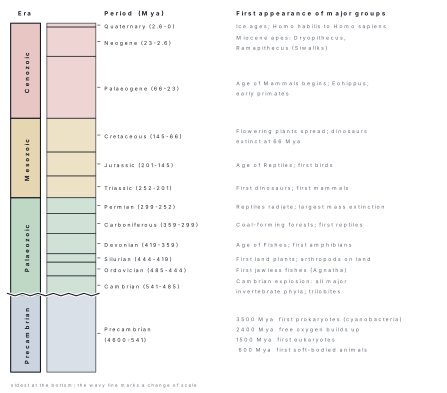
Geologists divide Earth history into eras, periods and epochs, with boundaries drawn where the fossil fauna changes sharply — often at a mass extinction. Learning the sequence is worth marks: almost every fossil you must name belongs to a named period.
7.2 Evidences of evolution
Darwin could not show evolution happening, so he built his case the way a lawyer does — from converging independent lines of evidence.
Evidence from morphology and anatomy
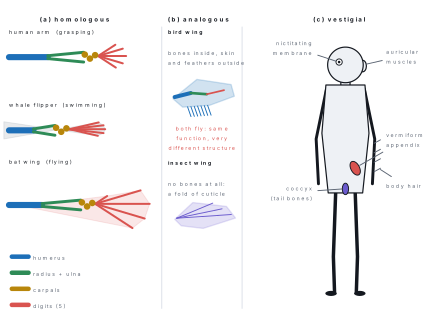
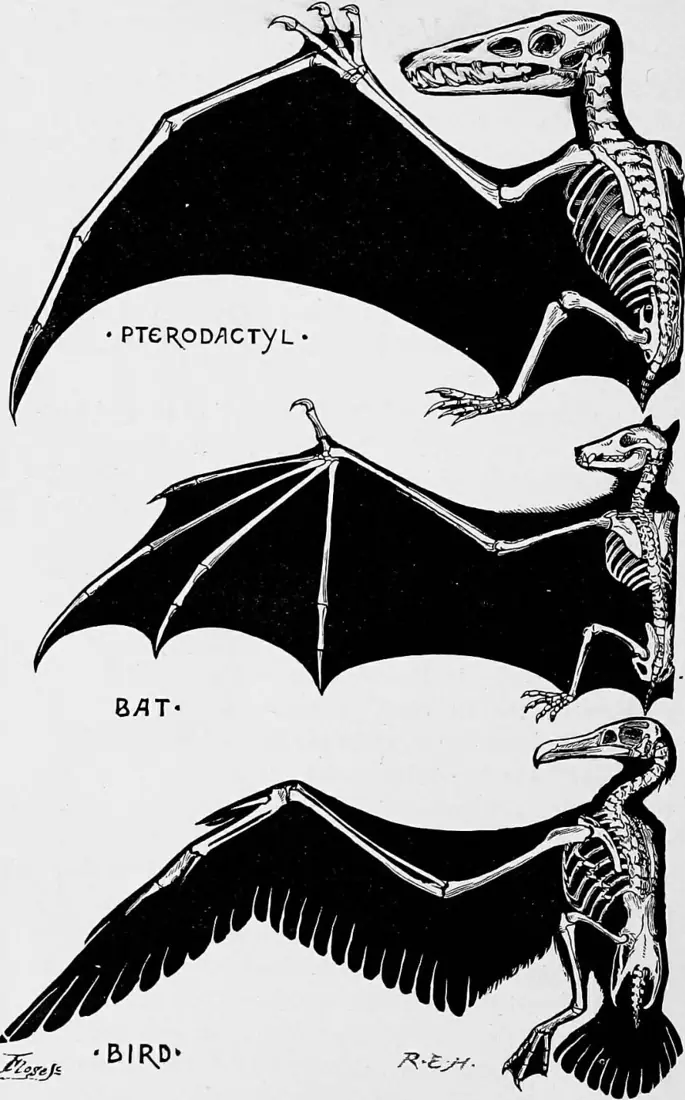
Compare the forelimb of a man, a whale, a bat and a horse. The jobs could hardly differ more — grasping, swimming, flying, running — yet the bones are the same bones in the same order: humerus, radius and ulna, carpals, metacarpals and phalanges. Only their relative lengths differ. Such organs are homologous: one ancestral pentadactyl limb remodelled for four ways of life, which is divergent evolution. A bird's wing and an insect's wing are the opposite case: both fly, but one is a bony forelimb with feathers and the other a double fold of cuticle with no bones. These are analogous — unrelated lines meeting the same problem the same way, or convergent evolution.
| Feature | Homologous organs | Analogous organs |
|---|---|---|
| Basic structure and embryonic origin | same | different |
| Function | different | same |
| Ancestry | common ancestor | unrelated ancestors |
| Process shown | divergent evolution | convergent evolution |
| Animal example | forelimbs of man, whale, bat, horse | wing of bird and wing of insect |
| Plant example | thorn of Bougainvillea, tendril of Cucurbita | sweet potato (root tuber), potato (stem tuber) |
| Meaning | proves common descent | proves adaptation, not relationship |
Vestigial organs are reduced, functionless remnants of organs that worked in an ancestor. Man has about 90: the vermiform appendix (a functional caecum in herbivores), the coccyx (four fused tail vertebrae), the plica semilunaris (a full third eyelid in frogs and birds), the auricular muscles that let a horse swivel its ear, body hair and the wisdom teeth. A designer would not fit a useless organ; an ancestor that used it explains it at once.
Evidence from embryology
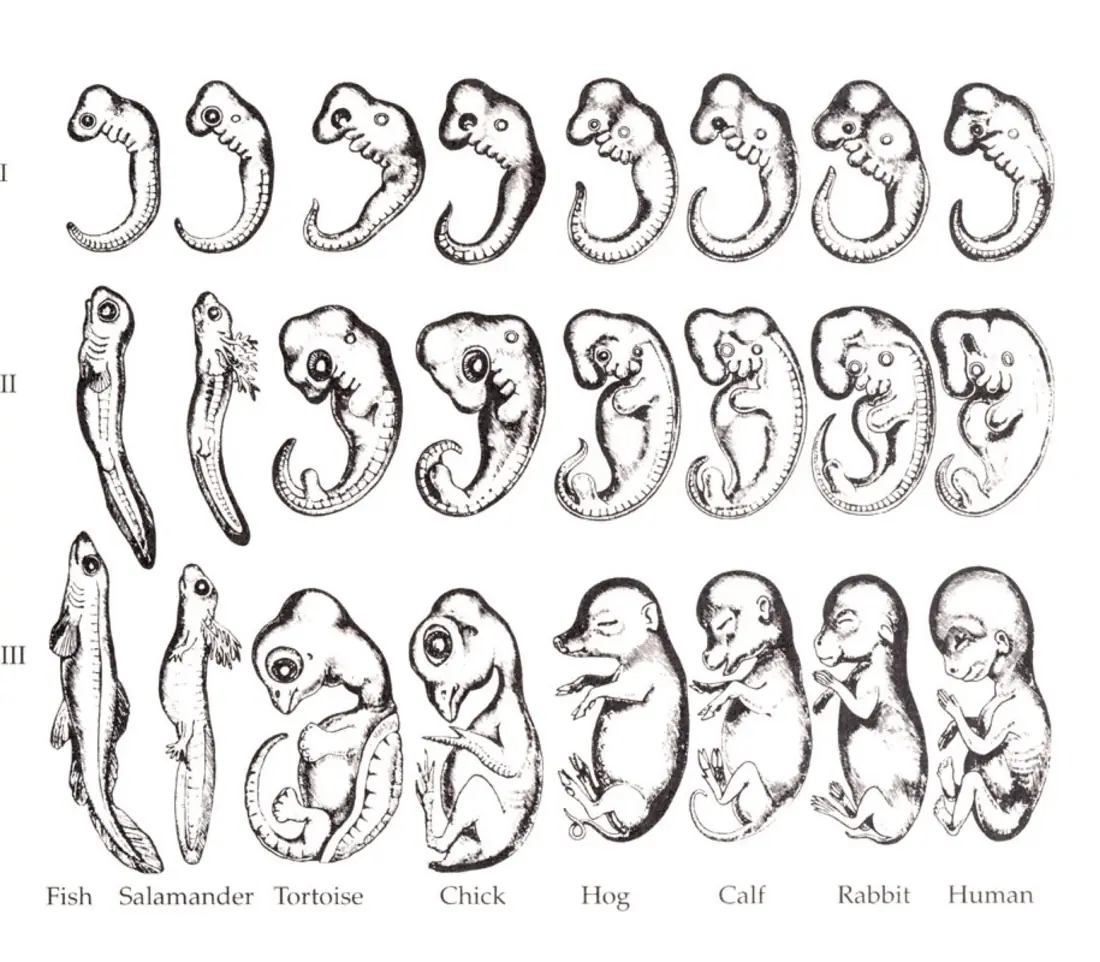
Von Baer's law: the general characters of a large group appear in the embryo before the special characters of the species. Early embryos of a fish, a chick and a human can be confused — each has pharyngeal (gill) slits, a notochord, a two-chambered heart and a post-anal tail — and the later the differences appear, the closer the relationship. Haeckel's stronger theory of recapitulation ("ontogeny repeats phylogeny", the embryo passing through the adult stages of its ancestors) is wrong. What is true is that related embryos inherit the same early developmental programme, so useless leftovers persist: gill slits in a human, teeth in a baleen-whale foetus, a tail at six weeks.
Evidence from palaeontology (fossils)
A fossil is any preserved trace of a past organism, and fossils are the only direct evidence of evolution, being the extinct organisms themselves. Age is read from the law of superposition (the lower stratum of undisturbed sedimentary rock is older) and measured by radiometric dating — carbon-14 below about 50,000 years, uranium–lead and potassium–argon for older rocks. Fossils occur in a definite sequence — invertebrates, fish, amphibians, reptiles, then birds and mammals — none out of order. Some are connecting links, carrying characters of two groups.
| Organism | Links | Mixed characters |
|---|---|---|
| Archaeopteryx (Jurassic) | reptiles ↔ birds | feathers, wings, beak; but teeth, clawed digits, long bony tail |
| Seymouria (Permian) | amphibians ↔ reptiles | amphibian skull; reptilian limb girdles |
| Lungfish (Protopterus) | fish ↔ amphibians | gills and lungs; fins with bones |
| Peripatus | annelids ↔ arthropods | annelid body wall; arthropod tracheae |
| Platypus (Ornithorhynchus) | reptiles ↔ mammals | lays eggs, cloaca; but hair and milk |
A living fossil is a species almost unchanged from its fossil ancestors — Latimeria, Limulus, Sphenodon, Ginkgo biloba, Cycas. The best-documented lineage is the horse, worked out by Marsh and Osborn from an almost unbroken North American series.
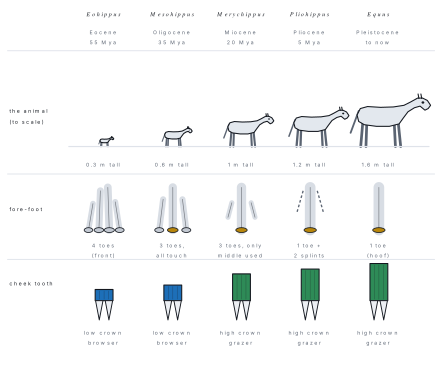
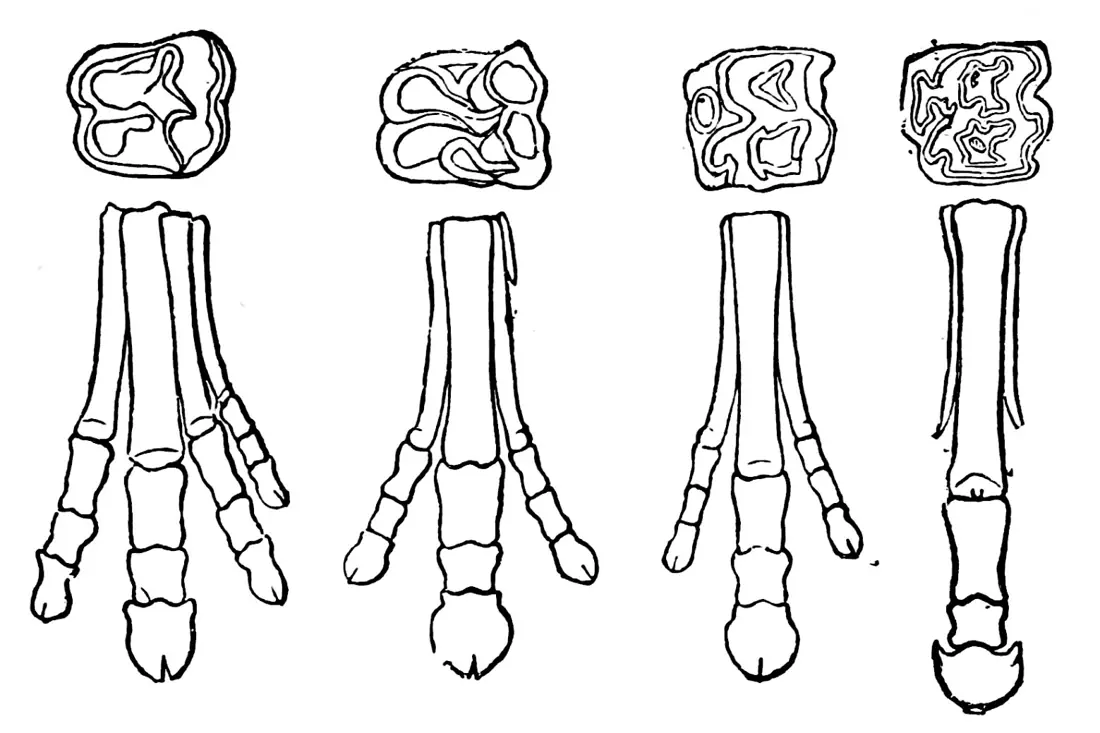
The trends are: increase in body size; lengthening of limbs, head and neck; reduction of the toes from four to one with the weight on the enlarged third digit; increase in tooth-crown height with cement filling the folds; and enlargement of the brain. All follow from one change — Miocene forest gave way to grassland, so a small hiding browser became a large running grazer, and grass silica wore teeth down fast enough to make tall crowns pay.
Evidence from biogeography
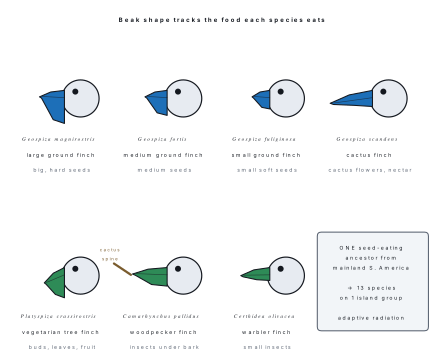
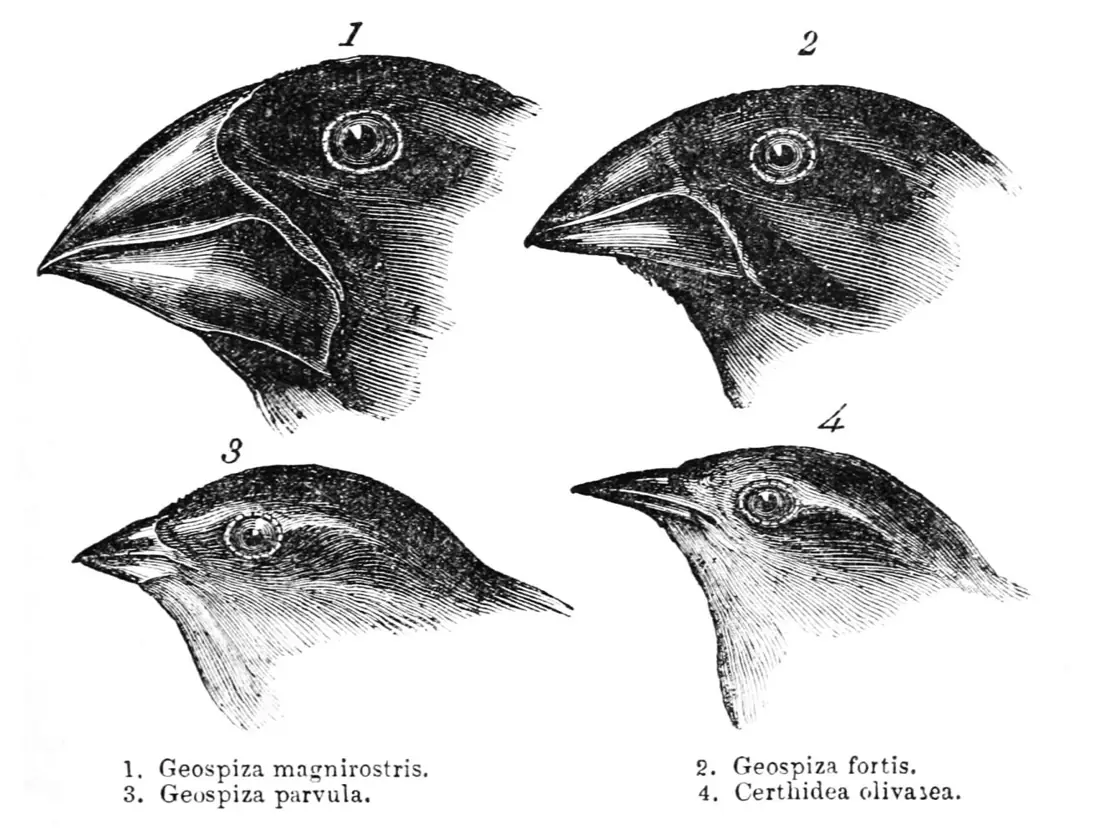
Animal distribution fits history, not climate. Australia has been isolated since the Mesozoic, so almost all its mammals are marsupials, radiated into grazers (kangaroo), burrowers (wombat), gliders (flying phalanger) and carnivores (Tasmanian wolf) — a marsupial version of each placental mammal elsewhere, with no placentals to compete. Darwin's decisive observation came from the Galápagos Islands in 1835: 13 finch species found nowhere else, all close relatives of one South American ground finch but differing chiefly in the beak, each beak matching a different food. One immigrant population spread to different islands and foods and diverged — adaptive radiation.
Evidence from taxonomy, biochemistry and artificial selection
Only common descent explains why living things can be arranged in nested groups at all. Biochemistry says the same at the molecular level: all organisms use nucleic acid as the genetic material, the same genetic code, ATP and largely the same 20 amino acids — and the degree of similarity measures relationship. Cytochrome c differs from the human protein by 1 amino acid in the rhesus monkey, about 12 in the horse and about 45 in yeast; human and chimpanzee DNA are 98–99 % identical.
Artificial selection makes the argument practical: if man can change a species in centuries, nature can do it in millions of years. From the one wild species Brassica oleracea breeders produced cabbage, cauliflower, kohlrabi, Brussels sprouts, broccoli and kale, and all dogs descend from the wolf.
Evolution happening now: industrial melanism
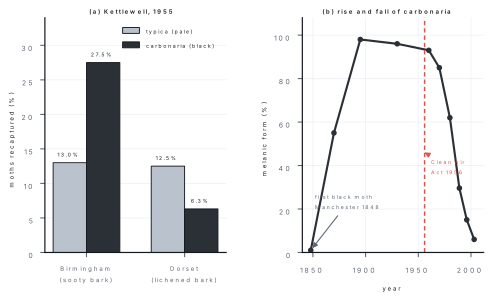
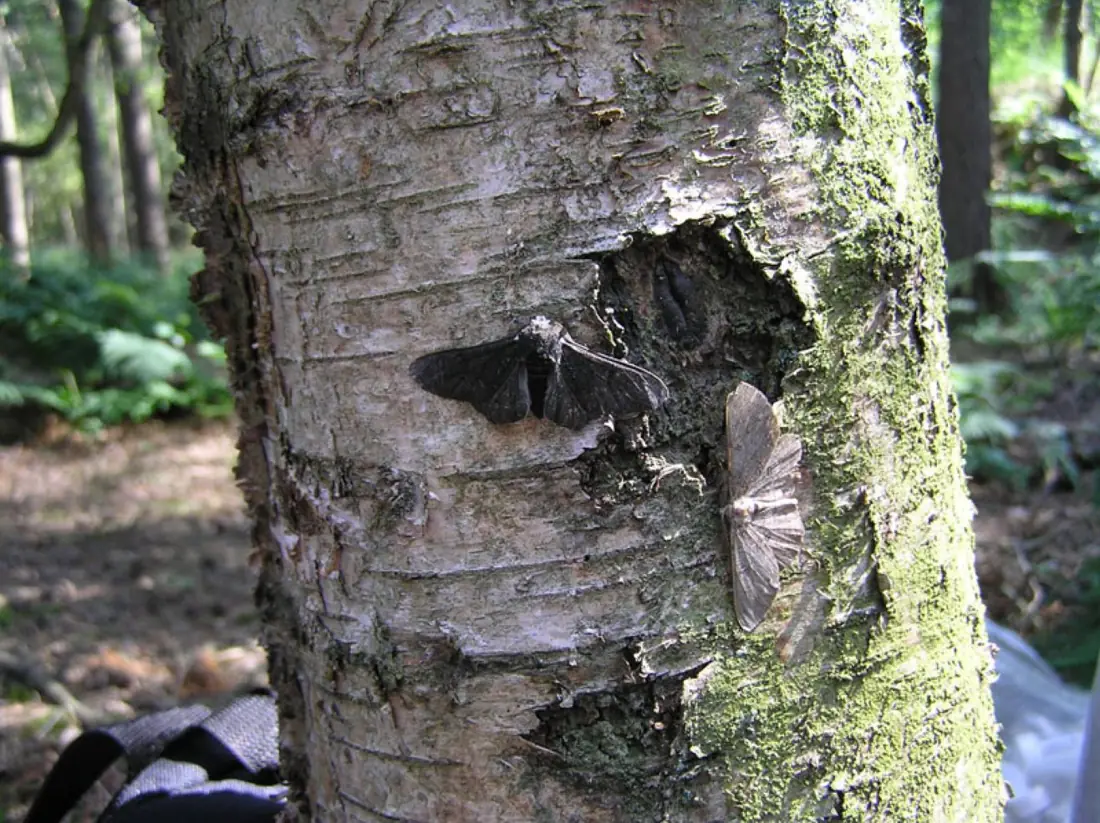
The peppered moth Biston betularia rests by day on tree trunks in England in two forms — speckled grey typica and black carbonaria. Before industrialisation the trunks were pale with lichen and carbonaria was almost unknown, first recorded in Manchester in 1848. Soot killed the lichens and blackened the bark, and within fifty years about 98 % of Manchester moths were black. Birds ate whichever form they could see, as Kettlewell proved by mark–release–recapture in 1955. After Britain's Clean Air Act of 1956 the lichens returned and the melanic form collapsed again — the same allele favoured and then disfavoured within 150 years.
The same process runs around us: Staphylococcus resistant to penicillin, Anopheles resistant to DDT in the Terai, Plasmodium falciparum resistant to chloroquine. Each time a rare pre-existing resistant variant was the only one to survive the new chemical, and so left all the offspring.
Bacteria do not "become" resistant because an antibiotic is present. The resistant mutant already existed by chance; the antibiotic merely removes its competitors. Saying the drug induced the mutation is Lamarckism, and it loses marks.
7.3 Theories of evolution
By 1859 everyone agreed that species had changed. The argument was about how. Three answers were given in turn; the third is the one now accepted.
Lamarckism — inheritance of acquired characters
Jean Baptiste Lamarck (Philosophie Zoologique, 1809) rested his theory on four propositions: (i) a changed environment creates new needs; (ii) an organ used more enlarges and one not used degenerates; (iii) characters acquired in life are inherited; (iv) such changes accumulate into a new species. His examples are still quoted — the giraffe stretching its neck for high foliage, snakes losing limbs by creeping, webbed feet in ducks, the blind cave salamander Proteus, the reduced wings of ostrich and kiwi.
The first two propositions are true; the third is false, and everything depends on it. August Weismann cut the tails off mice for five generations (901 mice) and every litter was born with a normal tail. His germplasm theory explains why: the body is somatoplasm, the gametes germplasm, and only germplasm is transmitted — a change in the body cannot write itself back into the DNA of the gametes.
Darwinism — natural selection
Charles Darwin sailed as naturalist on HMS Beagle (1831–36), read Malthus on population growth, and published On the Origin of Species on 24 November 1859 — after Alfred Russel Wallace reached the same theory independently and the two read a joint paper in 1858. The argument has six steps.
- Prodigality of reproduction. Every organism produces far more offspring than can survive — a pair of elephants would leave 19 million descendants in 750 years — yet populations stay roughly constant.
- Struggle for existence. Therefore most offspring die: intraspecific (severest, since needs are identical), interspecific and environmental.
- Variation. No two individuals of a species are exactly alike.
- Natural selection. Individuals whose variations fit the environment better survive and reproduce more — "survival of the fittest", where fittest means best able to leave offspring, not strongest.
- Inheritance of useful variations by the survivors.
- Origin of species by accumulation of these changes in different directions in different places.
Lamarck: every giraffe stretched its neck and passed the stretch on — the environment created the character. Darwin: giraffes with longer necks already existed by chance variation, fed better and left more offspring — the environment only selected among characters already there. That difference is the whole of this unit.
Darwin knew nothing of Mendel, so he could not explain how variations arise nor separate inherited from acquired ones; he could not account for over-specialisation (the antlers of the Irish elk); and a rare favourable variation seemed likely to be diluted by intercrossing (the swamping effect).
Mutation theory (Hugo de Vries, 1901)
Working on the evening primrose Oenothera lamarckiana, de Vries found individuals that differed sharply from the parents, bred true at once and had not arisen gradually. He called these mutations and argued that evolution proceeds by large, sudden, discontinuous, heritable changes which are random and pre-adaptive — they occur before, and independently of, any need for them. Mutation is indeed the ultimate source of the variation Darwin lacked, but most mutations are harmful and mutation alone has no direction.
Neo-Darwinism — the modern synthesis
Neo-Darwinism is Darwin's selection combined with Mendelian genetics, mutation theory and population mathematics, built in the 1930s and 40s by Fisher, Haldane, Wright, Dobzhansky, Huxley and Mayr.
Evolution is a change in the allele (gene) frequencies of a population across generations. The population, not the individual, is the unit of evolution: an individual cannot evolve, only be selected.
| Factor | What it does | Direction |
|---|---|---|
| Mutation | creates new alleles | random |
| Recombination | reshuffles existing alleles | random |
| Genetic drift | random change of frequency in small populations | random |
| Gene flow | moves alleles between populations | random |
| Natural selection | sorts variants by reproductive success | the only directional one |
| Isolation | stops gene pools re-mixing | fixes divergence |
| Point of comparison | Lamarckism (1809) | Darwinism (1859) | Neo-Darwinism (1940s) |
|---|---|---|---|
| Source of variation | environment, new needs | not explained | mutation, recombination |
| Nature of variation | acquired, directed | small, continuous, random | random, genetic |
| Role of environment | creates the character | selects among characters | selects among characters |
| Acquired characters inherited? | yes — central claim | no | no |
| Unit of evolution | the individual | the individual | the population |
| Mechanism | use and disuse | natural selection | selection, drift, gene flow, isolation |
| Present status | rejected | accepted but incomplete | accepted |
Types of natural selection
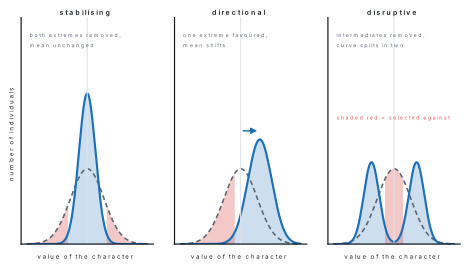
Selection acts on a continuously varying character — height, seed size, beak depth — and reshapes its distribution in one of three ways.
| Type | Which survive | Effect on the curve | Example |
|---|---|---|---|
| Stabilising | the intermediates | narrower, mean unchanged | human birth weight: 3–4 kg babies survive best |
| Directional | one extreme | mean shifts that way | industrial melanism; DDT resistance |
| Disruptive | both extremes | splits in two; can start speciation | seedcracker beaks: large crack hard seeds, small soft ones, intermediates neither |
The Hardy–Weinberg principle
If evolution is a change in allele frequency, we need a baseline for what frequencies do when nothing changes them. It was given independently in 1908 by G. H. Hardy and Wilhelm Weinberg.
In a large, randomly mating population the allele and genotype frequencies at a locus remain constant from generation to generation, provided no mutation, migration, selection or drift acts. Such a population is in genetic equilibrium.
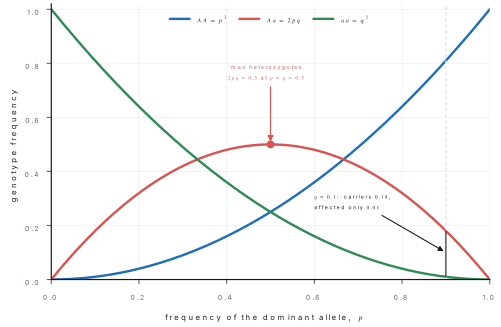
Let p be the frequency of the dominant allele A and q that of the recessive a. These are the only alleles, so p + q = 1, and random mating is equivalent to drawing two alleles at random from the gene pool, giving the terms of (p+q)^2:
with p^{2} the frequency of AA, 2pq of Aa and q^{2} of aa.
An AA parent gives only A gametes and an Aa parent half A gametes, so in the next gamete pool
The frequencies come out unchanged, so the next generation is again p^2 : 2pq : q^2. Equilibrium is reached after a single generation of random mating and holds for ever unless a condition breaks.
Each of the five conditions, when broken, names an agent of evolution: the population is very large (else drift); mating is random; there is no mutation, no migration and no natural selection.
No natural population meets all five conditions, so the principle is not a description of nature but a null hypothesis. If observed genotype frequencies differ significantly from p^2 : 2pq : q^2, a condition is being broken and the population is evolving. That deviation is how evolution is measured.
Problem. Tasting PTC is dominant (T) over inability (t). Of 1000 students in Pokhara, 160 are non-tasters. Assuming equilibrium, find both allele frequencies and the expected number of each genotype.
Solution. Only the recessive homozygote is recognisable by phenotype.
Expected numbers TT = 360, Tt = 480, tt = 160 (sum 1000 ✓). So 84 % are tasters, and more than half of those are heterozygous carriers.
Problem. Albinism is autosomal recessive and affects 1 person in 10,000. Find the allele frequency, the percentage of carriers and the number of carriers per affected person.
Solution.
So 1 person in 50 carries the allele unseen: 198 carriers per albino. A recessive allele can be common while the disorder stays rare, because almost every copy is hidden in a heterozygote — which is why marriage between close relatives raises the risk.
Problem. The MN blood group has two codominant alleles, so all three genotypes are visible. Of 1000 people, 490 are MM, 420 MN and 90 NN. Is the population in Hardy–Weinberg equilibrium?
Solution. Count alleles directly among the 2000 present:
Expected: MM = p^{2}N = 490, MN = 2pqN = 420, NN = q^{2}N = 90 — identical to the observed values, so the population is in equilibrium at this locus.
Two marks go here every year. (i) q is the square root of the frequency of the recessive phenotype, not of the number affected — divide by population size first. (ii) The recessive phenotype equals q^2 only under complete dominance; if the trait is codominant, count alleles directly as in example 7.3.
Genetic drift, founder effect and bottleneck
Genetic drift is random change in allele frequency caused by sampling error in a small population. Toss a coin ten times and you may get seven heads; toss it ten thousand times and you will not get 70 %. In a population of 20 an allele can be lost or fixed by chance alone, useful or not — hence the first Hardy–Weinberg condition. Two cases are named. In the founder effect a few colonists' small sample of alleles becomes the gene pool of the new population, as in the Galápagos finches. In the bottleneck effect a population is cut down by catastrophe and recovers from the few survivors, permanently losing variation: Nepal's greater one-horned rhinoceros fell below 100 animals in Chitwan in the late 1960s and has recovered to about 750, but carries only the alleles those hundred happened to have.
Isolation and speciation
A species is a group of actually or potentially interbreeding natural populations, reproductively isolated from other such groups (Mayr). Speciation is the origin of a new species; it requires gene flow between two populations to be stopped, since interbreeding keeps merging their gene pools. Isolation is any mechanism that prevents interbreeding.
| Category | Mechanism | Example |
|---|---|---|
| Geographical | mountain, river, sea or desert separates them | the Himalaya; Galápagos channels |
| Pre-zygotic — ecological | different habitat, so they never meet | Rana of ponds and of streams |
| Pre-zygotic — temporal | different breeding season or time of day | two pines shedding pollen a month apart |
| Pre-zygotic — ethological | different courtship, song or pheromone | fireflies with different flash patterns |
| Pre-zygotic — mechanical | genitalia or flower structure do not fit | flowers with different pollinators |
| Pre-zygotic — gametic | sperm cannot fertilise the egg | many marine invertebrates |
| Post-zygotic — hybrid inviability | the hybrid zygote dies early | sheep × goat |
| Post-zygotic — hybrid sterility | the hybrid lives but cannot breed | the mule (horse × donkey) |
| Post-zygotic — hybrid breakdown | F_1 fertile but F_2 weak | some cotton crosses |
| Allopatric speciation | Sympatric speciation | |
|---|---|---|
| Populations are | geographically separated | in the same area |
| First barrier | geographical isolation | reproductive, from the start |
| Speed | usually slow | can be immediate |
| Typical cause | mountain uplift, river change, islands | polyploidy, host shift, disruptive selection |
| Example | Darwin's finches; Grand Canyon squirrels | polyploid wheat; apple maggot flies |
| Frequency | the common route in animals | common in plants |
The Himalaya is a working example: the range rose through the Miocene and Pliocene, cutting one fauna into northern and southern halves and stacking habitats from Terai to alpine desert within 150 km. Nepal's diversity for its size — over 200 mammal species in 147,000 km² — is a result of that repeated allopatric isolation.
7.4 Human evolution
Our place among the primates
Man is classified: Animalia → Chordata → Mammalia → Order Primates → Family Hominidae → Homo → Homo sapiens. Three words are confused: hominoid = apes plus man; hominid = great apes plus man; hominin = man and his extinct bipedal ancestors.
With all primates we share grasping hands and feet with an opposable thumb, nails instead of claws, forward-facing eyes giving stereoscopic colour vision, a large brain for body size and prolonged parental care. What separates man from the apes: habitual bipedal gait with an S-shaped vertebral column, broad pelvis, arched foot and non-opposable big toe; the foramen magnum central in the skull base, so the head balances on the column; cranial capacity 1350–1450 cm³ with a vertical forehead and no brow ridge; a chin, small canines and an evenly arched tooth row; and a precision grip, speech and learned culture.
Man and the modern apes are cousins, not parents and children: they share a common Miocene ancestor and have been diverging ever since. "Man descended from monkeys" is wrong and is penalised.
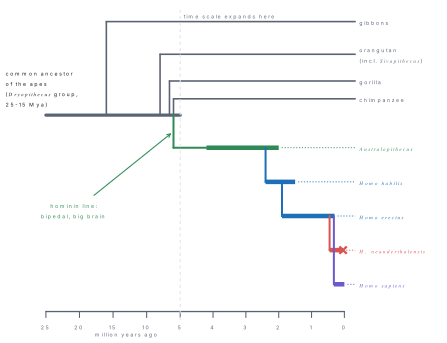
Dryopithecus and Ramapithecus — the Miocene apes
Dryopithecus ("oak ape") lived about 22 to 9 Mya in the forests of Africa, Europe and Asia: limbs of about equal length, semi-erect with knuckle-walking, a U-shaped jaw with large canines and roughly 400 cm³ of brain. It is regarded as ancestral to the great apes and possibly to the African ape–human line.
Ramapithecus ("Rama's ape") matters in Nepal. The first jaws came from the Siwalik (Churia) Hills in 1932, and the Nepali specimen — molars dated to about 9.0–9.5 million years — from Tinau Khola, Palpa district. It was smaller than Dryopithecus, with thickly enamelled molars, reduced canines and a short deep jaw: a ground-dwelling eater of hard seeds. For twenty years it was called our first direct ancestor, but more complete specimens found in 1975–76 showed this was a mistake; it is now referred to Sivapithecus and placed on the orangutan branch. Learn it as the best-known Miocene ape of South Asia, not as our ancestor.
Australopithecus — the first biped
Australopithecus ("southern ape") lived in eastern and southern Africa from about 4.2 to 2 Mya. A. africanus was described by Raymond Dart in 1924 from the Taung skull; A. afarensis is known from "Lucy", a 40 %-complete skeleton found at Hadar, Ethiopia, in 1974 and dated to 3.2 Mya. The pelvis and knee are decisive: it walked upright on two legs while its brain was still ape-sized, only 400–500 cm³, and the 3.6-million-year-old Laetoli footprints show the stride directly. It stood 1.0–1.5 m, had large molars and heavy brow ridges, and used broken stones but made no tools. Bipedalism came before the brain, and freeing the hands made everything afterwards possible.
Homo habilis, Homo erectus and the Neanderthals
Homo habilis ("handy man", 2.4–1.5 Mya) was found by Louis and Mary Leakey at Olduvai Gorge, Tanzania, in 1960. Cranial capacity rose to 650–800 cm³ and the jaws grew lighter, but the name carries its importance: it is the first hominin that certainly made stone tools, the flaked pebble choppers of the Oldowan industry.
Homo erectus appeared about 1.9 Mya and survived to roughly 300,000 years ago, the longest run of any Homo. Cranial capacity 800–1100 cm³ (average about 950), height 1.6–1.8 m, thick brow ridge, sloping forehead and no chin. Java man (Pithecanthropus erectus, Dubois, 1891) and Peking man (Sinanthropus pekinensis, 1927) are the same species under older names. H. erectus was the first to use fire, to make the Acheulian hand axe, to hunt large game cooperatively and to leave Africa.
Homo neanderthalensis lived in Europe, the Near East and Central Asia from about 400,000 to 40,000 years ago, the first skull coming from the Neander valley, Germany, in 1856. Cranial capacity 1300–1600 cm³ (average ~1450) was larger than the modern average. They were short and heavily built, with a receding forehead, heavy brow ridge and weak chin; they made fine Mousterian flake tools, wore skins and buried their dead with grave goods, the first evidence of ritual. They disappeared about 40,000 years ago after modern humans reached Europe, leaving 1–2 % of their DNA in living non-African populations.
The Neanderthal average of about 1450 cm³ equals or exceeds the modern 1350–1450 cm³. Brain organisation — especially the frontal and temporal lobes and the speech areas — matters more than bulk. Do not write that cranial capacity rose steadily right to the present; it peaked and then fell slightly.
Homo sapiens
Anatomically modern Homo sapiens arose in Africa about 300,000 years ago and spread worldwide from roughly 70,000 years ago. The best-known early European population is Cro-Magnon man, 40,000 to 10,000 years ago, about 1.8 m tall with a cranial capacity near 1600 cm³, a vertical forehead, no brow ridge and a well-marked chin; Cro-Magnons made blade and bone tools, sewed clothing and painted Altamira and Lascaux. With Homo sapiens sapiens (1350–1450 cm³) biological evolution was overtaken by cultural evolution: agriculture from about 10,000 years ago, then writing and science.
| Stage | Age | Cranial capacity | Where found | Key advance |
|---|---|---|---|---|
| Dryopithecus | 22–9 Mya | ~400 cm³ | Africa, Europe, Asia | Miocene ape, semi-erect |
| Ramapithecus (Sivapithecus) | 14–9 Mya | ~400 cm³ | Siwaliks, Nepal and India | thick molars; orangutan branch |
| Australopithecus | 4.2–2 Mya | 400–500 cm³ | East and South Africa | fully bipedal, no tools |
| Homo habilis | 2.4–1.5 Mya | 650–800 cm³ | Olduvai Gorge, Tanzania | first stone tools (Oldowan) |
| Homo erectus | 1.9–0.3 Mya | 800–1100 cm³ | Java, China, Africa, Europe | fire, hand axes, left Africa |
| Homo neanderthalensis | 0.4–0.04 Mya | 1300–1600 cm³ | Europe, West and Central Asia | burial of the dead, Mousterian |
| Homo sapiens (Cro-Magnon) | 40,000–10,000 yr | ~1600 cm³ | Europe | cave art, blade tools |
| Homo sapiens sapiens | 300,000 yr – now | 1350–1450 cm³ | worldwide | agriculture, language, culture |
- Erect posture and bipedalism — S-shaped spine, broad pelvis, arched foot, non-opposable big toe. This came first, in Australopithecus.
- Freeing of the hands, then the precision grip of an opposable thumb.
- Increase in cranial capacity: 400 → 450 → 700 → 950 → 1450 cm³.
- Shortening of the jaws and face, prognathous → orthognathous, canines reduced, a chin appears, brow ridges lost, forehead vertical.
- Forward shift of the foramen magnum to the centre of the skull base.
- Tool making → fire → speech → agriculture: culture replaces biology.
Chapter summary
- Life arose once, by chemical evolution under a reducing, oxygen-free atmosphere (Oparin 1924, Haldane 1929): gases → monomers → polymers → protobionts → anaerobic heterotroph → photoautotroph → aerobe. Miller and Urey (1953) obtained amino acids, not life. Pasteur's swan-necked flask had already established biogenesis.
- Homologous organs = same structure, different function → divergent evolution → common ancestry. Analogous = different structure, same function → convergent evolution → adaptation only. Vestigial organs are functionless remnants (appendix, coccyx, plica semilunaris, ear muscles). Early vertebrate embryos share gill slits, notochord and a post-anal tail (von Baer's law).
- Fossils are the only direct evidence and include connecting links — Archaeopteryx, lungfish, Peripatus, platypus, Seymouria. Horse series Eohippus → Mesohippus → Merychippus → Pliohippus → Equus: 0.3 → 1.6 m, toes 4 → 1, browsing → grazing teeth.
- Lamarckism (use, disuse, inheritance of acquired characters) was disproved by Weismann's germplasm theory. Darwinism = over-production → struggle → variation → natural selection → new species, but could not explain variation. Neo-Darwinism = mutation + recombination + selection + drift + gene flow + isolation, acting on a population.
- Selection is stabilising, directional or disruptive; industrial melanism in Biston betularia is directional selection recorded in real time.
- Hardy–Weinberg: p + q = 1 and p^{2} + 2pq + q^{2} = 1, with p^2 = AA, 2pq = Aa, q^2 = aa; it needs a large, randomly mating population with no mutation, migration or selection, and deviation from it is evolution. For a recessive trait q = \sqrt{q^{2}} from the phenotype frequency, and the carrier : affected ratio is 2p/q. Speciation needs isolation — geographical, pre-zygotic or post-zygotic; allopatric dominates in animals, sympatric in plants.
- Human line: Dryopithecus (400 cm³) → Australopithecus (450 cm³, first biped) → H. habilis (650–800 cm³, first tools) → H. erectus (950 cm³, fire) → H. neanderthalensis (1450 cm³, burial) → H. sapiens (1350–1450 cm³). Ramapithecus of the Nepali Siwaliks belongs to the orangutan branch.
Practice questions
Group A — Multiple choice (1 mark each)
- The theory of inheritance of acquired characters was proposed by [1]aCharles DarwinbJ. B. LamarckcHugo de VriesdAugust Weismann
- The wing of a bird and the wing of an insect are [1]ahomologous organsbanalogous organscvestigial organsdatavistic organs
- The connecting link between reptiles and birds is [1]aSeymouriabPeripatuscArchaeopteryxdOrnithorhynchus
- In a population in Hardy–Weinberg equilibrium the frequency of the recessive allele is 0.2. The frequency of heterozygotes is [1]a0.04b0.16c0.32d0.64
- The first hominin to make stone tools was [1]aAustralopithecusbHomo habiliscHomo erectusdRamapithecus
Answers to Group A
1. (b) — Lamarck, Philosophie Zoologique, 1809.
2. (b) — same function (flight), completely different structure and origin.
3. (c) — Archaeopteryx: feathers and wings, but reptilian teeth, claws and a long bony tail.
4. (c) — q = 0.2, p = 0.8, so 2pq = 2(0.8)(0.2) = 0.32.
5. (b) — Homo habilis, the "handy man", made the Oldowan pebble tools.
Group B — Short answer (4 marks each)
- Differentiate between homologous and analogous organs, giving one animal and one plant example of each. [4]
- Describe the Miller–Urey experiment and state precisely what it proved. [4]
- In a population of 2000 people, 320 cannot roll the tongue, a recessive character. Assuming Hardy–Weinberg equilibrium, calculate both allele frequencies and the expected number of heterozygotes. [4]
- What is industrial melanism, and how does it demonstrate natural selection? [4]
- State the Hardy–Weinberg principle and the conditions under which a population stays in genetic equilibrium. [4]
Answers to Group B
1. Homologous — same basic structure and embryonic origin, different function, by divergent evolution from a common ancestor: forelimbs of man, whale, bat and horse; thorn of Bougainvillea and tendril of Cucurbita. Analogous — different structure and origin, same function, by convergent evolution: wing of a bird and of an insect; sweet potato (root tuber) and potato (stem tuber). Homology proves relationship, analogy only adaptation.
2. Sealed glass system: boiling water feeds vapour into a chamber charged with CH₄, NH₃ and H₂, tungsten electrodes spark for a week at about 800 °C, a condenser returns the products to a U-trap. Result: amino acids (glycine, alanine, aspartic acid) with urea, sugars and fatty acids. It proved that the monomers of life form spontaneously from inorganic gases — it did not produce a cell, a protein or a nucleic acid.
3. q^{2} = 320/2000 = 0.16, so q = 0.4 and p = 0.6. Then 2pq = 2(0.6)(0.4) = 0.48, so heterozygotes = 0.48 \times 2000 = 960. (Check: p^2 \times 2000 = 720 homozygous rollers; 720 + 960 + 320 = 2000. ✓)
4. Industrial melanism is the rise in frequency of a dark form in a polluted area. In Biston betularia the melanic carbonaria was almost unknown before 1848; soot killed the lichens and by 1895 about 98 % of Manchester moths were black. Kettlewell's 1955 mark–recapture recovered 27.5 % of carbonaria against 13.0 % of typica in sooty Birmingham and the reverse in unpolluted Dorset: birds ate whichever form was conspicuous. After the Clean Air Act of 1956 the melanic form fell back. It is directional natural selection, because a pre-existing heritable variation changed in frequency through differential survival in a direction set by the environment.
5. In a large, randomly mating population the allele and genotype frequencies at a locus stay constant across generations, with p + q = 1 and p^{2} + 2pq + q^{2} = 1. Conditions: very large population, random mating, no mutation, no migration, no natural selection. Breaking any one makes the population evolve.
Group C — Long answer (8 marks each)
- Describe the evolution of the horse from Eohippus to Equus with the help of a labelled diagram, and state four evolutionary trends shown by the series. [8]
- (a) State the postulates of Darwin's theory of natural selection. [4](b) Explain the long neck of the giraffe first on Lamarck's theory and then on Darwin's, and say why only one explanation is accepted. [4]
- Give an account of human evolution from Dryopithecus to Homo sapiens sapiens with the approximate age and cranial capacity of each stage, and list four trends shown by the series. [8]
Answer outlines to Group C
1. Diagram as in the figure above. Eohippus (Eocene, 0.3 m, 4 toes in front and 3 behind, low-crowned browsing teeth, forest) → Mesohippus (Oligocene, 0.6 m, 3 toes) → Merychippus (Miocene, 1.0 m, 3 toes with the weight on the enlarged middle toe, first high-crowned grazing teeth with cement) → Pliohippus (Pliocene, 1.2 m, one functional toe with two splints) → Equus (Pleistocene to now, 1.5–1.6 m, single hoof). Trends: body size increases; toes reduce from four to one with the weight on the third digit; crown height increases with cement in the folds, browser → grazer; limbs, head and neck lengthen and the brain enlarges. Cause: Miocene forest gave way to grassland, favouring speed and abrasion-resistant teeth.
2. (a) Prodigality of reproduction; struggle for existence (intraspecific, interspecific, environmental); variation; natural selection, or survival of the fittest; inheritance of the useful variations; origin of new species by their accumulation. (b) Lamarck: the short-necked ancestor stretched its neck for high foliage, the stretch was acquired and passed on, and the offspring stretched further — the environment created the long neck. Darwin: the population already varied in neck length; when low foliage grew scarce the longer-necked individuals fed better and left more offspring, so mean neck length rose each generation — the environment only selected among existing variations. Darwin's version is accepted because acquired somatic characters are not inherited (Weismann), whereas heritable variation plus differential survival is directly observed, as in industrial melanism.
3. Stages, ages and cranial capacities as in the table of section 7.4, in that order, with the branching of the figure. Trends: erect posture and complete bipedalism, which came before the large brain; progressive increase in cranial capacity; shortening of the jaws and face with reduced canines, loss of the brow ridges and appearance of a chin; forward shift of the foramen magnum with an S-shaped spine, broad pelvis and arched foot; and tool making, fire and speech, so that cultural evolution replaces biological.
Practise more: Biology question bank