Unit 9 · Zoology · 10 teaching hours · 34 min read
Biota and Environment
What the syllabus asks for 3
- Animal adaptation
- Animal behavior
- Environmental Pollution
The biota of a place is every living thing in it — the gharials of the Narayani, the marmots of Mustang, the bacteria in a Kathmandu drain. None of them lives in a vacuum. Each is shaped by its surroundings, each behaves in ways that improve its chances, and each is now being pushed by an environment that people are changing fast. This unit therefore has three jobs: to show how animals are fitted to where they live (adaptation), what they do there (behaviour), and what happens when we foul the place (pollution).
Three reliable patterns. First, a list-with-reasons question: "describe four adaptations of a bird for flight" — one mark per adaptation plus its function, so never write the structure alone. Second, a compare-and-contrast table: innate vs learned behaviour, hibernation vs aestivation, BOD vs DO, bioaccumulation vs biomagnification. Third, an 8-mark pollution essay — sources, effects, control measures, in that order, with Nepali examples.
9.1 Animal adaptation
An adaptation is any inherited feature of an animal — in its shape, its chemistry or its behaviour — that raises its chance of surviving and breeding in its own habitat. Two words must be kept apart from the start. The habitat is the physical address where an animal lives (a Terai grassland, a cold Himalayan stream). The niche is its job description: what it eats, when it is active, what eats it, what it competes with. Two species can share a habitat, but no two can occupy exactly the same niche for long.
Adaptations arise by natural selection acting on inherited variation over many generations. They are not produced on demand by an individual: a chital does not decide to grow longer legs because it is being chased. What a single animal can do inside its own lifetime is acclimatisation — a reversible adjustment, like the extra red blood cells a trekker makes at Namche Bazaar.
Adaptation is the sum of the hereditary morphological, physiological and behavioural characters of an organism that fit it to its particular environment and enable it to survive and reproduce successfully in that environment.
Three kinds of adaptation
| Kind | What changes | Examples |
|---|---|---|
| Morphological (structural) | body form, organs, colour | streamlined fish body, webbed feet of a duck, hollow bones of a bird |
| Physiological (functional) | chemistry and organ working | concentrated urine of the kangaroo rat, extra haemoglobin of the yak, venom of a krait |
| Behavioural | what the animal does | migration of the bar-headed goose, hibernation of the Himalayan marmot, nocturnal habit of the porcupine |
A single problem is usually solved by all three at once. A camel resists drought structurally (fat hump, long legs), physiologically (concentrated urine, wide body temperature swing) and behaviourally (feeding at dawn and dusk, sitting with legs tucked in to reduce heat gain).
Aquatic adaptation
Water is 800 times denser than air, holds only about 1/30 as much oxygen per unit volume, and its salt concentration continuously pulls water into or out of an animal's body. Aquatic animals are graded by how long their ancestors have been in water:
- Primary aquatic animals never left the water — fishes, sponges, molluscs.
- Secondary aquatic animals had land-living ancestors and returned — whales, dolphins, seals, sea snakes, turtles.
- Tertiary (partial) aquatic animals divide their lives between land and water — frogs, otters, crocodiles.
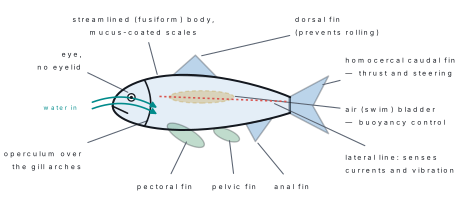
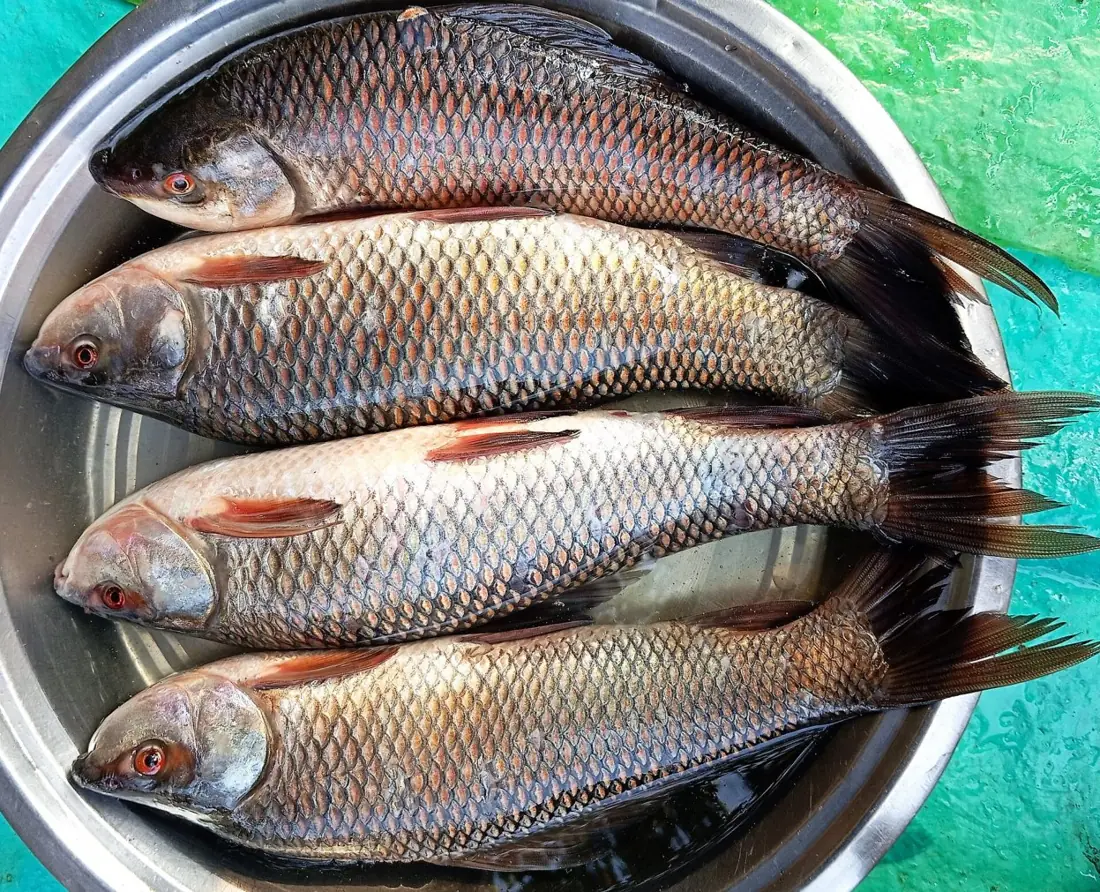
The teleost solves five problems at once:
- Drag. A fusiform (spindle) body, scales pointing backwards and a slippery mucus coat cut friction; the mucus also blocks bacteria and fungi.
- Propulsion and balance. The muscular tail and homocercal (equally lobed) caudal fin drive the fish forward; unpaired dorsal and anal fins stop it rolling; paired pectoral and pelvic fins act as brakes, rudders and hydrofoils.
- Gas exchange. Four pairs of gills with thousands of thin, highly vascular gill lamellae give a huge surface area. Water flows over them in the direction opposite to the blood — a counter-current — so a diffusion gradient is maintained all along the lamella.
- Buoyancy. The gas-filled air (swim) bladder is adjusted so the fish is almost weightless in water and need not swim to avoid sinking. Cartilaginous fishes lack it and compensate with a large oil-rich liver, a heterocercal tail and wing-like pectoral fins.
- Osmoregulation. A freshwater fish is hypertonic to its surroundings, so water floods in: it drinks nothing, passes large volumes of very dilute urine and actively pumps salts inward through the gills. A marine bony fish is hypotonic to seawater and loses water: it drinks seawater, excretes salt through chloride cells in the gills and passes a small volume of concentrated urine.
Gill lamellae work only when supported by water. Out of water they stick together, the surface area collapses and the fish suffocates in air — even though air holds thirty times more oxygen. The failure is mechanical, not chemical.
Adaptation to land: cursorial, arboreal, fossorial and volant habits
| Habit | Meaning | Key adaptations | Example |
|---|---|---|---|
| Cursorial | running | long slender limbs, reduced digits, deep chest, unguligrade stance | horse, chital, blackbuck |
| Arboreal | tree-living | prehensile tail, opposable digits, long forelimbs, binocular vision | langur, red panda |
| Fossorial | burrowing | spindle body, spade-like forelimbs, reduced eyes and ears, strong claws | mole, pangolin |
| Volant | flying | pneumatic bones, air sacs, keeled sternum, feathers | pigeon, bat (gliding membrane instead of feathers) |
| Desmocryptic | camouflage | colour and pattern matching background | tiger stripes, leaf insect |
Flight is the most demanding of these and is worth learning as a complete list, because it is asked almost every year. A bird is adapted for flight by:
- a streamlined, boat-shaped body with no external projections;
- feathers — light, strong, replaceable, giving both the aerofoil surface and insulation;
- forelimbs modified into wings, the hand bones fused and reduced;
- pneumatic bones: hollow, air-filled, with internal struts — strong but light;
- a keeled sternum (carina) giving a broad origin for the flight muscles;
- huge pectoralis major (pulls the wing down) and a smaller pectoralis minor (raises it), together up to a fifth of body mass;
- nine air sacs continuous with the lungs, giving one-way flow of air and a second oxygen extraction during exhalation, plus cooling;
- a four-chambered heart and fast double circulation with no mixing of blood;
- weight economy: no urinary bladder, uric acid excreted as a semi-solid paste, no teeth, one functional ovary in the female, short rectum.
Desert (xeric) adaptation
Deserts impose two problems — heat and water shortage — and animals solve them by never wasting water on cooling.
- The camel stores fat (not water) in the hump, tolerates its body temperature drifting from about 34 °C at dawn to 41 °C by afternoon before it begins to sweat, produces very concentrated urine and dry faeces, has oval red blood cells that resist bursting when it rehydrates, and can lose a quarter of its body water without collapsing.
- The kangaroo rat drinks no water at all. It gains metabolic water from the oxidation of dry seeds, has no sweat glands, stays in a humid burrow by day, and has extremely long loops of Henle that make urine several times more concentrated than its blood. A counter-current in the nasal passages recovers water from exhaled air.
Cold and high-altitude adaptation
Nepal's own species supply the best examples. Two rules of thumb apply to warm- blooded animals:
- Bergmann's rule — within a related group, individuals in colder regions tend to be larger, because a big body has a smaller surface-area-to-volume ratio and so loses heat more slowly.
- Allen's rule — extremities (ears, tail, limbs) tend to be shorter in colder regions, again cutting the surface for heat loss. Compare the small ears of a snow leopard with the enormous ears of a desert fox.
Additional Himalayan adaptations include thick fur with a dense woolly undercoat and subcutaneous fat (yak, blue sheep, snow leopard); counter-current heat exchange in the limbs, where warm arterial blood pre-warms cold venous blood returning from the feet; more red blood cells carrying haemoglobin with a higher oxygen affinity, plus larger lungs and heart (yak); wide splayed hooves for snow; an enlarged nasal chamber that warms inhaled air (snow leopard); and behavioural dormancy — the Himalayan marmot hibernates for six to eight months in a sealed burrow, its heart rate and metabolism falling dramatically.
| Dormancy | Season | Trigger | Example |
|---|---|---|---|
| Hibernation (winter sleep) | winter | cold and short days | Himalayan marmot, frogs, bats |
| Aestivation (summer sleep) | dry summer | heat and drought | African lungfish, land snails, some toads |
| Diapause | any | unfavourable season | insect eggs and pupae |
Life-history adaptation: r-strategists and K-strategists
Adaptation also shows in how an animal spends its reproductive effort. Two extreme strategies are recognised, and both are described by a growth equation.
An unlimited population grows exponentially. If N is the number of individuals and r the intrinsic rate of natural increase (births minus deaths per individual per unit time),
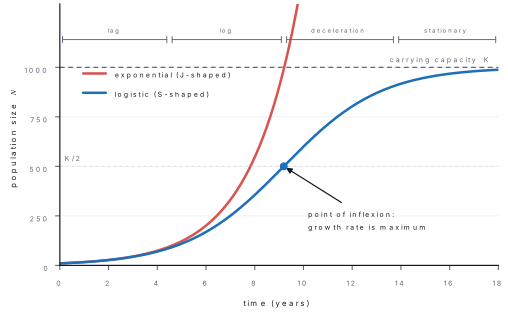
The graph is a J-shaped curve with no upper limit — real only for a short while, in a new or emptied habitat.
Resources are finite. Let K be the carrying capacity: the largest population the habitat can support indefinitely. The logistic equation adds a braking term (K-N)/K that falls to zero as N approaches K:
whose solution is the sigmoid (S-shaped) curve with a lag phase, a log phase, a phase of decreasing increase and a stationary phase at N = K.
| Feature | r-strategist | K-strategist |
|---|---|---|
| Body size | small | large |
| Life span | short | long |
| Offspring | very many, small | few, large |
| Parental care | none or little | prolonged |
| Mortality of young | very high | low |
| Growth curve | J-shaped, crashes | S-shaped, settles near K |
| Example | housefly, rat, carp | one-horned rhinoceros, tiger, elephant |
This is exactly why a rhinoceros is hard to conserve and a mosquito impossible to eradicate. A rhino cow first calves at about six years and then produces one calf every three years or so; a lost individual takes years to replace.
Problem. Nepal's national rhino count found 645 greater one-horned rhinoceroses in 2015 and 752 in 2021. Assuming exponential growth over these 6 years, calculate (a) the intrinsic rate of natural increase r, (b) the percentage annual growth rate, and (c) the doubling time of the population.
Solution.
(a) From N_t = N_0e^{rt}, taking natural logarithms,
(b) Percentage annual growth = 0.0256 \times 100 = 2.56\ \% per year.
(c) The doubling time is obtained by putting N_t = 2N_0:
So at this rate Nepal would hold about 1500 rhinos only in the late 2040s — and that is before any density-dependent braking is allowed for. Slow growth is the signature of a K-strategist.
Problem. A grassland block is estimated to have a carrying capacity of K = 1200 chital and an intrinsic rate of increase r = 0.20\ \text{yr}^{-1}. Using the logistic model, find the rate of increase of the herd when it numbers (a) 400 animals, (b) 600 animals, (c) 1200 animals. At what size does the herd grow fastest?
Solution. The logistic equation is \dfrac{dN}{dt} = rN\left(\dfrac{K-N}{K}\right).
(a) N = 400:
(b) N = 600:
(c) N = 1200 = K:
The product N(K-N) is largest when N = K/2 = 600, so growth is fastest at 600 animals, i.e. at half the carrying capacity. This is why wildlife managers aim to hold a harvested population near K/2 rather than near K.
9.2 Animal behavior
Behaviour is everything an animal does — every movement, posture, sound and chemical signal — and the way it changes with the situation. Its scientific study is ethology. The subject's founders, Konrad Lorenz, Nikolaas Tinbergen and Karl von Frisch, shared the Nobel Prize in Physiology or Medicine in 1973.
Behaviour is switched on by a stimulus and executed as a response, but the programme itself may come from the genes, from experience, or from both. That gives the basic division of the topic.
| Innate (instinctive) behaviour | Learned behaviour | |
|---|---|---|
| Origin | inherited, coded in the genes | acquired through experience |
| Needs practice? | no — correct at the first attempt | yes |
| Variation | almost identical in all members of a species | differs between individuals |
| Flexibility | rigid, hard to modify | flexible, can be unlearned |
| Nervous system | simple systems suffice | needs a well-developed brain |
| Example | a spider spinning its first web | a dog sitting on command |
Innate behaviour
- Taxis — a directed movement of the whole animal towards or away from a stimulus: positive phototaxis of a moth to a lamp, negative phototaxis of a cockroach, chemotaxis of a mosquito to carbon dioxide, rheotaxis of a fish facing the current, geotaxis of an earthworm moving down.
- Kinesis — an undirected change in the rate of movement or turning. A woodlouse simply moves faster in dry air and slows in damp air, and so accumulates where it is damp without ever steering.
- Reflex — a rapid, automatic response of a part of the body through a spinal reflex arc: knee jerk, blinking, withdrawal from a hot object.
- Fixed action pattern (FAP) — a stereotyped chain of movements that, once triggered by a sign stimulus (releaser), runs to completion. A herring gull chick pecks at the red spot on its parent's bill; a greylag goose rolls any egg-like object back into the nest.
- Instinct — a complex, unlearned, species-specific behaviour such as nest building, web spinning or the honeybee dance.
- Imprinting — a special, very rapid learning that occurs only during a short critical period just after hatching or birth and is then irreversible. Lorenz's newly hatched greylag goslings followed the first moving object they saw, including Lorenz himself. It is the bridge between innate and learned behaviour.
Learned behaviour
- Habituation — the simplest learning: the response to a repeated but harmless stimulus fades. Crows stop flying up at a scarecrow after a few days.
- Classical (associative) conditioning — Pavlov's dogs. Food (the unconditioned stimulus) causes salivation (the unconditioned response). A bell (a neutral stimulus) rung repeatedly just before feeding becomes a conditioned stimulus and by itself produces salivation, now a conditioned response.
- Operant (trial-and-error) conditioning — Skinner's rat learns to press a lever because pressing is followed by a food reward. Behaviour followed by reinforcement becomes commoner; behaviour followed by punishment becomes rarer.
- Insight learning — solving a new problem at once by reorganising past experience, without trial and error. Köhler's chimpanzee stacked boxes to reach a hanging banana.
- Latent (exploratory) learning — an animal builds a mental map of its territory with no immediate reward, and uses it later to escape a predator.
- Imitation — copying another individual, as when one langur's alarm call sets the whole troop moving.
Communication and the honeybee dance
Animals signal in four channels: chemical (pheromones — the alarm pheromone of a honeybee, the trail pheromone of ants, bombykol released by the female silk moth), visual (the peacock's display, the threat gape of a rhesus monkey), auditory (bird song, the alarm call of a chital) and tactile (grooming, antennal contact).
The most famous single piece of animal communication is the dance language of the honeybee, worked out by Karl von Frisch. A returning forager dances on the vertical surface of the comb in the dark hive:
- a round dance — a simple circle, reversed repeatedly — means food is close, within roughly 50–100 m, and gives no direction;
- a waggle (tail-wagging) dance — a figure-of-eight with a straight, abdomen- waggling run in the middle — is used for food farther away and encodes both distance and direction.
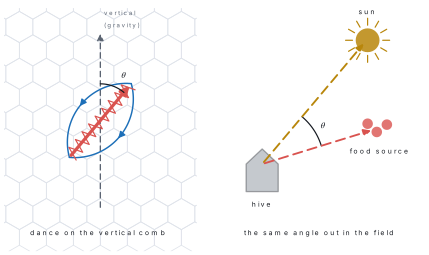
Two rules make the dance a genuine language. Direction: the angle the straight waggle run makes with the upward vertical on the comb is the same as the angle between the direction of the sun and the direction of the food, measured from the hive. A run straight up means "fly towards the sun". Distance: the farther the food, the longer each waggle run lasts — roughly one second of waggling for each kilometre of flight. Bees that watch the dance in the dark, feeling it with their antennae, then fly out and find the flowers.
Social behaviour
Living in a group costs food and risks disease but buys protection, easier hunting and shared care of young. Its main forms are:
- Aggregation — a temporary gathering with no organisation, e.g. moths at a light.
- Dominance hierarchy — a ranked order that settles disputes without fighting. The "pecking order" in hens is the classical case; in a wolf pack or a rhesus troop the alpha animal feeds and breeds first.
- Territoriality — the defence of an area by song, scent marking or display. A tiger patrols and scent-marks a territory of tens of square kilometres in Chitwan; a territory guarantees food and a mate rather than space for its own sake.
- Altruism — behaviour that lowers the actor's own reproductive success and raises another's: a worker bee stinging and dying, a sentinel langur giving an alarm call. It is favoured when the helped individuals are close relatives, so copies of the same genes are passed on (kin selection).
- Eusociality — the extreme case, with a reproductive division of labour, as in the honeybee colony: one fertile queen, a few hundred haploid drones whose only role is mating, and thousands of sterile female workers that forage, build, nurse and defend.
Rhythms, migration and courtship
Behaviour is timed. Biological rhythms are internally generated cycles kept in step by external cues: circadian rhythms of about 24 hours (sleep, activity), circalunar and circannual rhythms (breeding seasons, moulting).
Migration is the regular two-way movement of a population between breeding and non-breeding areas. The Arctic tern makes the longest journey of any animal; bar-headed geese cross the Himalaya over Nepal at heights above 7000 m; the demoiselle crane passes through Nepali valleys each autumn. Fish migrate too — salmon are anadromous (sea to river to breed), eels catadromous (river to sea). Navigation uses the sun, star patterns, the Earth's magnetic field, landmarks and smell.
Courtship is ritualised behaviour that identifies a partner of the right species, sex and readiness, suppresses aggression, and synchronises the release of gametes — the peacock's fanned train, the croaking chorus of Rana tigrina at the start of the monsoon, the firefly's coded flashes.
Interactions between species
Behaviour towards other species can be summarised in a table of signs: + for benefit, - for harm, 0 for no measurable effect.
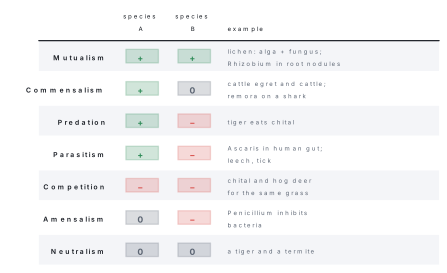
Predation and parasitism have the same sign pattern but differ in scale: a predator is usually bigger than its prey and kills it at once, while a parasite is smaller, lives on or in the host and weakens it slowly. Competition is the only interaction that harms both partners, and it is the engine of resource partitioning — the reason a chital grazes short grass while a sambar browses leaves in the same forest.
9.3 Environmental Pollution
Pollution is any undesirable change in the physical, chemical or biological properties of air, water or land that harms living organisms or damages property. The agent causing the change is a pollutant.
Pollutants are classified in three useful ways:
| Basis | Classes | Examples |
|---|---|---|
| Degradability | biodegradable / non-biodegradable | sewage, cow dung / DDT, plastics, mercury |
| Origin | primary (released as such) / secondary (formed in the environment) | CO, SO₂, NOₓ / ozone, PAN, H₂SO₄ in acid rain |
| Source pattern | point source / non-point (diffuse) source | a factory outfall, a chimney / farm run-off, vehicle exhaust |
Air pollution and the disturbed carbon cycle
Carbon moves endlessly between the atmosphere, living bodies and rocks. Green plants remove CO₂ by photosynthesis; respiration and decay return it; a tiny fraction is locked away as coal, petroleum and limestone. That store took hundreds of millions of years to build and we are burning it in two centuries, so the return arrow is now far bigger than the removal arrow.
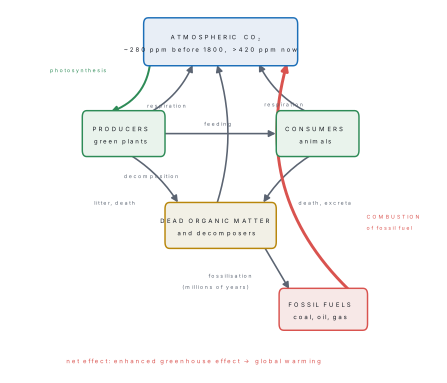
Major air pollutants and their effects
| Pollutant | Chief source | Main effect |
|---|---|---|
| Carbon monoxide, CO | incomplete combustion in engines | binds haemoglobin ~200 times more strongly than O₂ → headache, asphyxia |
| Sulphur dioxide, SO₂ | coal burning, brick kilns, smelters | bronchitis; forms H₂SO₄ → acid rain |
| Oxides of nitrogen, NOₓ | high-temperature combustion | forms HNO₃ and photochemical smog |
| Particulates PM₁₀, PM₂.₅ | dust, diesel, brick kilns, crop burning | PM₂.₅ reaches the alveoli → asthma, heart disease, lung cancer |
| Ozone and PAN (secondary) | NOₓ + hydrocarbons + sunlight | eye irritation, damage to leaves and crops |
| CFCs | old refrigerants, aerosols | destroy stratospheric ozone |
| CO₂, CH₄, N₂O | fossil fuel, paddy fields, livestock | greenhouse effect |
Three consequences deserve separate names.
- Acid rain. Normal rain is already slightly acidic, pH ≈ 5.6, because CO₂ dissolves in it. When SO₂ and NOₓ are converted to sulphuric and nitric acids the pH can fall below 4. The result is leaching of calcium and magnesium from soil, damage to leaves, death of fish in lakes, and corrosion of limestone and marble (stone leprosy).
- The enhanced greenhouse effect. CO₂, CH₄, N₂O, CFCs and water vapour let short-wave solar radiation in but absorb the long-wave infrared radiated back by the Earth, warming the lower atmosphere. Rising temperature means retreating Himalayan glaciers, growing glacial lakes and the risk of GLOF (glacial lake outburst floods), an immediate hazard for Nepal.
- Ozone depletion. Chlorine atoms freed from CFCs by ultraviolet light destroy ozone catalytically — a single chlorine atom can break down thousands of O₃ molecules — thinning the shield that absorbs UV-B. More UV-B means more skin cancer, cataract and reduced crop yield. The Montreal Protocol (1987) phased out CFCs and the layer is now slowly recovering.
They are different problems with different gases, different atmospheric layers and different effects. The greenhouse effect traps outgoing infrared in the troposphere; ozone depletion lets in incoming ultraviolet through the stratosphere. CFCs happen to do both — that is the only link.
Air pollution in Nepal. The Kathmandu Valley is a bowl. In winter a temperature inversion puts a lid on it, and smoke from vehicles, brick kilns, waste burning and household fuel has nowhere to go. Kathmandu's annual mean PM₂.₅ was 45.1 µg m⁻³ in 2024 — above Nepal's own national standard of 40 µg m⁻³ and about nine times the WHO guideline of 5 µg m⁻³. A 2025 World Bank assessment ranked air pollution as the single largest risk factor for death and disability in Nepal.
Water pollution and the disturbed nitrogen cycle
Nitrogen is needed for every protein and nucleic acid, yet the huge atmospheric supply is inert. Only a few prokaryotes — Rhizobium in legume root nodules, free-living Azotobacter and Clostridium, cyanobacteria such as Anabaena — together with lightning, can fix it. Industrial fertiliser has now roughly doubled the amount of reactive nitrogen entering the biosphere, and the surplus ends up in rivers and lakes.
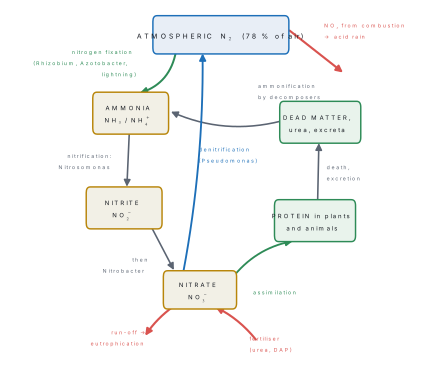
Sources of water pollution are domestic sewage, industrial effluent (dyes, tannery chromium, heavy metals), agricultural run-off (fertiliser and pesticide), oil spills, hot water from power stations (thermal pollution, which lowers dissolved oxygen) and radioactive waste.
Two measurements matter in every exam.
- Dissolved oxygen (DO) — the oxygen actually present in the water, in mg L⁻¹. Clean cold water holds 8–10 mg L⁻¹; below about 4 mg L⁻¹ most fish die.
- Biochemical oxygen demand (BOD) — the oxygen consumed by aerobic microbes while decomposing the organic matter in a sample, measured over 5 days at 20 °C. High BOD means heavy organic pollution. Clean river water has BOD under 3 mg L⁻¹; raw sewage exceeds 300 mg L⁻¹.
Eutrophication is the chain that follows nutrient enrichment: nitrate and phosphate from fertiliser, detergent and sewage enter a lake → algae and water-hyacinth multiply explosively (an algal bloom) → the surface mat cuts off light so submerged plants die → bacteria decompose the dead mass → BOD rises and DO collapses → fish and other aerobic life suffocate → the lake fills with sediment and eventually becomes a marsh. Phewa Tal and the lower Bagmati both show the early stages.
Other specific water-borne hazards:
| Pollutant | Disease / effect |
|---|---|
| Methyl mercury (industrial) | Minamata disease — nerve and brain damage |
| Cadmium | Itai-itai disease — brittle painful bones |
| Nitrate above about 45 mg L⁻¹ | methaemoglobinaemia ("blue baby syndrome") |
| Arsenic in Terai tube-wells | arsenicosis: skin lesions, cancer |
| Excess fluoride | dental and skeletal fluorosis |
| Faecal coliforms in sewage | cholera, typhoid, dysentery, hepatitis A |
Soil, noise and radioactive pollution
Soil pollution comes from over-use of fertiliser and pesticide, industrial sludge, mine tailings and unsegregated solid waste; it destroys soil micro-flora, lowers fertility and leaches into groundwater. Noise pollution is measured in decibels; continuous exposure above about 80 dB damages hearing, and noise also causes hypertension, sleeplessness and, in animals, abandonment of nests. Radioactive pollution from mining, nuclear testing, reactor accidents (Chernobyl 1986, Fukushima 2011) and careless disposal of medical isotopes causes mutation, cancer and genetic damage, and the isotopes remain dangerous for centuries.
Bioaccumulation and biomagnification
A persistent pollutant — one that is not biodegradable and is fat-soluble, such as DDT, dieldrin, PCBs or methyl mercury — is absorbed faster than it can be excreted.
- Bioaccumulation is the build-up of such a substance inside one individual over its lifetime.
- Biomagnification is the increase in its concentration from one trophic level to the next along a food chain, because each predator eats many prey and keeps nearly all the poison.
Problem. In a classic study of an estuarine food chain the concentration of DDT was found to be:
| Trophic level | DDT (ppm) |
|---|---|
| Water | 0.000003 |
| Zooplankton | 0.04 |
| Small fish | 0.5 |
| Large fish | 2.0 |
| Fish-eating bird | 25.0 |
Calculate (a) the magnification factor from water to zooplankton, (b) the factor from small fish to fish-eating bird, and (c) the overall magnification from water to the bird.
Solution.
(a) \dfrac{0.04}{0.000003} = 1.33\times 10^{4} — that is, about 13 300 times.
(b) \dfrac{25.0}{0.5} = 50 times.
(c) \dfrac{25.0}{0.000003} = 8.33\times 10^{6} — over eight million times.
Water containing DDT at three parts per billion is legally "almost clean", yet the top predator carries 25 ppm. This is why DDT thinned the eggshells of fish-eating birds and why persistent organochlorines are banned worldwide.
Control of pollution
| Type | Control measures |
|---|---|
| Air | electrostatic precipitators, cyclone separators and bag filters on chimneys; scrubbers for SO₂; catalytic converters and unleaded fuel in vehicles; electric public transport; zig-zag technology in brick kilns; afforestation; green belts |
| Water | primary, secondary and tertiary sewage treatment before discharge; effluent standards; constructed wetlands; ban on phosphate detergents; organic farming |
| Soil | segregation and recycling of solid waste; sanitary landfill; composting; integrated pest management; biofertilisers |
| Noise | sound barriers and silencers; ban on pressure horns; industrial zoning; tree belts |
| General | the 4 Rs — Refuse, Reduce, Reuse, Recycle; environmental impact assessment before any big project; environmental education |
In Nepal the legal framework is the Environment Protection Act, 2076 (2019), which makes a clean and healthy environment a right, requires an Initial Environmental Examination or an Environmental Impact Assessment before large projects, and empowers the government to fix national ambient standards and to recover compensation from polluters.
Chapter summary
- Adaptation is an inherited morphological, physiological or behavioural feature that fits an animal to its habitat; acclimatisation, by contrast, is a reversible change within one lifetime.
- A bony fish is adapted by a fusiform body, mucus and scales, paired and unpaired fins, counter-current gills, an air bladder for buoyancy, and osmoregulation that is opposite in fresh and salt water.
- Flight adaptations: streamlined body, feathers, wings, pneumatic bones, keeled sternum, huge pectoral muscles, nine air sacs, four-chambered heart and weight economy (no urinary bladder, uric acid, one ovary).
- Bergmann's rule — colder climate, larger body; Allen's rule — colder climate, shorter extremities.
- Unlimited growth is exponential, dN/dt = rN, N_t = N_0e^{rt}, a J-curve; limited growth is logistic, dN/dt = rN(K-N)/K, an S-curve, fastest at N=K/2 and levelling at the carrying capacity K. Doubling time t_d = \ln 2/r.
- Innate behaviour (taxis, kinesis, reflex, fixed action pattern, instinct, imprinting) is inherited and rigid; learned behaviour (habituation, classical and operant conditioning, insight, latent learning, imitation) needs experience.
- In the honeybee waggle dance, the angle of the waggle run to the vertical equals the angle of the food from the sun, and the duration of waggling indicates the distance; a round dance means food is close.
- Species interactions are classified by signs: mutualism (+,+), commensalism (+,0), predation and parasitism (+,-), competition (-,-), amensalism (0,-), neutralism (0,0).
- Pollutants are biodegradable or not, primary or secondary. Key effects: acid rain (pH below 5.6), enhanced greenhouse effect, ozone depletion, eutrophication (nutrients → bloom → high BOD → low DO → fish kill) and biomagnification of persistent, fat-soluble poisons.
Practice questions
Group A — Multiple choice (1 mark each)
- The air bladder of a bony fish mainly helps in [1]arespirationbbuoyancychearingdexcretion
- Following of the first moving object by a newly hatched gosling is [1]ahabituationbconditioningcimprintingdinsight learning
- A population growing in an environment with unlimited resources shows [1]aa sigmoid curveba J-shaped curveca zero growth rateda bell-shaped curve
- The relationship between a cattle egret and a grazing buffalo is [1]amutualismbparasitismccommensalismdamensalism
- A high BOD value of river water indicates [1]aplenty of dissolved oxygenbheavy organic pollutionchigh nitrate onlydthat the water is fit to drink
Answers to Group A
1. (b) — the gas-filled bladder makes the fish nearly weightless in water.
2. (c) — imprinting happens only in a short critical period and is irreversible.
3. (b) — with no limiting factor dN/dt = rN, giving exponential J-shaped growth.
4. (c) — the egret gains insects disturbed by the buffalo; the buffalo is unaffected (+,0).
5. (b) — BOD is the oxygen microbes need to decompose organic matter, so high BOD means much organic waste.
Group B — Short answer (4 marks each)
- Describe any four adaptations of a bird for aerial life, stating the function of each. [4]
- Differentiate between innate and learned behaviour, with two examples of each. [4]
- A herd of 500 blue sheep grows exponentially with an intrinsic rate of natural increase r = 0.08\ \text{yr}^{-1}. Calculate(a) the number after 10 years and(b) the doubling time of the herd. [4]
- What is eutrophication? Explain, step by step, how it kills the fish of a lake. [4]
- Distinguish between bioaccumulation and biomagnification, and give one example of a pollutant that shows both. [4]
Answers to Group B
1. Any four, each with its function: pneumatic bones — hollow and air-filled, reducing weight without losing strength; feathers — light, form the aerofoil and insulate; keeled sternum — gives a large surface for the origin of flight muscles; pectoralis major and minor — depress and raise the wing; nine air sacs — one-way airflow so oxygen is extracted during both inhalation and exhalation, and the body is cooled; no urinary bladder and uric acid excretion — saves weight.
2. Innate: inherited, present at birth, identical in all members, rigid, needs no practice (a spider spinning its first web; a herring gull chick pecking the red spot). Learned: acquired by experience, differs between individuals, flexible, can be forgotten (Pavlov's dog salivating at a bell; a monkey opening a latch by trial and error). Award one mark per contrasted pair and one for examples.
3. (a) N_t = N_0e^{rt} = 500\,e^{0.08\times 10} = 500\,e^{0.8} = 500 \times 2.2255 = 1113 animals (to the nearest animal). (b) t_d = \dfrac{\ln 2}{r} = \dfrac{0.693}{0.08} = 8.66\ \text{years}.
4. Eutrophication is the over-enrichment of a water body with nutrients, chiefly nitrate and phosphate. Sequence: fertiliser, detergent and sewage run in → algae and water hyacinth bloom → the surface mat blocks light so submerged plants die → aerobic bacteria decompose the huge dead mass → BOD rises sharply and dissolved oxygen falls below about 4 mg L⁻¹ → fish and other aerobic animals suffocate and die.
5. Bioaccumulation is the gradual build-up of a persistent pollutant within a single organism, because intake exceeds excretion. Biomagnification is the stepwise rise in its concentration from one trophic level to the next along a food chain, because each consumer eats many individuals of the level below and retains almost all of the poison. DDT (also methyl mercury, PCBs) shows both: about 0.000003 ppm in water but 25 ppm in a fish-eating bird.
Group C — Long answer (8 marks each)
- (a) Define adaptation and distinguish it from acclimatisation. [2](b) With the help of a labelled diagram, describe the adaptations of a bony fish for aquatic life. [4](c) State Bergmann's rule and Allen's rule, giving one Himalayan example of each. [2]
- (a) Explain the logistic model of population growth and sketch the curve, marking the carrying capacity. [4](b) A fish population in Phewa Tal has a carrying capacity K = 8000 and an intrinsic rate of increase r = 0.30\ \text{yr}^{-1}. Find dN/dt when N = 2000 and when N = 4000, and state the population size at which the growth rate is greatest. [4]
- Describe air pollution under the headings: major pollutants and their sources; three global effects; the particular situation of the Kathmandu Valley; and control measures. [8]
Answers to Group C
1. (a) Adaptation is an inherited, population-level feature produced by natural selection over generations; acclimatisation is a reversible physiological adjustment made by one individual within its own lifetime (extra red cells at high altitude). (b) Expect the labelled fish diagram plus streamlining and mucus, fins for propulsion and balance, counter-current gills, air bladder, and the opposite osmoregulatory strategies in fresh and sea water. (c) Bergmann — in colder regions bodies are larger, so the surface-to-volume ratio and heat loss are lower (the yak compared with lowland cattle). Allen — extremities are shorter in colder regions (the short ears and stubby muzzle of a snow leopard compared with a desert fox).
2. (a) The logistic model adds the braking factor (K-N)/K to exponential growth: dN/dt = rN(K-N)/K. When N is small the factor is nearly 1 and growth is almost exponential; as N \to K the factor \to 0 and growth stops. The curve is sigmoid with lag, log, deceleration and stationary phases, levelling off at N=K.
(b) When N = 2000:
When N = 4000:
N(K-N) is greatest at N = K/2 = 4000, so growth is fastest at 4000 fish.
3. Outline: pollutants and sources — CO from incomplete combustion, SO₂ from coal and brick kilns, NOₓ from engines, PM₂.₅ and PM₁₀ from diesel, dust and waste burning, CFCs from old refrigerants, secondary ozone and PAN from photochemical reaction. Global effects — acid rain (pH below 5.6, leached soils, dead lakes, stone leprosy); the enhanced greenhouse effect (CO₂, CH₄, N₂O trap infrared → warming → retreating Himalayan glaciers and GLOF risk); ozone depletion (chlorine from CFCs destroys O₃ catalytically → more UV-B → skin cancer and cataract; controlled by the Montreal Protocol, 1987). Kathmandu Valley — a bowl-shaped basin with winter temperature inversion; annual mean PM₂.₅ of 45.1 µg m⁻³ in 2024, above Nepal's standard of 40 and about nine times the WHO guideline of 5; air pollution is Nepal's largest single risk factor for death and disability. Control — precipitators, scrubbers and bag filters; catalytic converters and electric public transport; zig-zag brick kilns; green belts and afforestation; enforcement of the Environment Protection Act, 2076 (2019).
Practise more: Biology question bank