Unit 6 · Zoology · 1 teaching hours · 15 min read
Introduction to Biology
What the syllabus asks for 1
- Introduction to Biology
This is the opening chapter of the Zoology section, and it is the shortest unit in the course — one hour. Do not mistake shortness for unimportance. It asks what biology actually is, how it is divided, and how it leans on physics, chemistry and mathematics. Every unit that follows is a branch on the tree this chapter draws, and every career built on this subject — medicine, agriculture, forestry, veterinary science, biotechnology, conservation — starts from the map on these pages.
Short questions, reliably: define biology and name who coined the term; define any four or five branches (this is the commonest question in the whole unit); explain the relation of biology with physics / chemistry / mathematics; and state the scope or importance of biology. Definitions must be one clean sentence each — vagueness costs marks here.
6.1 Introduction to Biology
Biology is the branch of science that deals with the study of living organisms — their structure, function, origin, growth, reproduction, classification, behaviour, evolution and their relationship with the environment. The word comes from the Greek bios (life) and logos (study or discourse), and was brought into general use in 1802 independently by Gottfried Reinhold Treviranus and Jean-Baptiste Lamarck.
Aristotle (384–322 BC) is called the Father of Biology and also the Father of Zoology, for his Historia Animalium, in which he described and grouped about 500 kinds of animals. His pupil Theophrastus is the Father of Botany, for Historia Plantarum.
What makes something living
Biology's subject matter is defined by a short list of properties. A thing is treated as alive if it shows:
- cellular organisation — it is built of one or more cells;
- metabolism — an ordered set of chemical reactions, anabolic and catabolic;
- growth and development — irreversible increase in mass from inside;
- reproduction — it makes more of its own kind;
- irritability (response to stimuli) — it reacts to light, heat, touch, chemicals;
- homeostasis — it holds its internal conditions steady;
- adaptation and evolution — its populations change over generations;
- movement, respiration, excretion and a finite life span ending in death.
A crystal grows, but from the outside and reversibly; a virus reproduces, but only inside a host cell, and has no metabolism of its own. Both sit on the boundary — which is exactly why the boundary is interesting.
The branches of biology
Biology is divided in two different ways, and the exam expects you to know both.
By the group of organisms studied:
| Branch | What it studies |
|---|---|
| Botany | Plants |
| Zoology | Animals |
| Microbiology | Micro-organisms — bacteria, viruses, protists, microscopic fungi |
| Mycology | Fungi |
| Phycology | Algae |
| Bacteriology | Bacteria |
| Virology | Viruses |
| Entomology | Insects |
| Ichthyology | Fishes |
| Herpetology | Amphibians and reptiles |
| Ornithology | Birds |
| Parasitology | Parasites and their hosts |
By the aspect of life studied:
| Branch | What it studies |
|---|---|
| Morphology | External form and structure |
| Anatomy | Internal structure, as revealed by dissection |
| Histology | Tissues, using a microscope |
| Cytology (cell biology) | The structure and working of cells |
| Physiology | The functions and processes of living bodies |
| Biochemistry | The chemical substances and reactions in organisms |
| Molecular biology | Life at the level of DNA, RNA and protein |
| Genetics | Heredity and variation |
| Embryology | Development from zygote to a fully formed young |
| Taxonomy and systematics | Identification, naming and classification, and evolutionary relationships |
| Evolution | The origin of species and descent with modification |
| Palaeontology | Fossils — the life of past geological ages |
| Ecology | The relationship between organisms and their environment |
| Immunology | Immunity and defence against disease |
| Pathology | Diseases — their causes, course and effects |
| Biotechnology | The use of organisms or their parts to make useful products |
| Genetic engineering | Deliberate alteration of an organism's genetic material |
"Name four branches of biology based on the organisms studied" wants botany, zoology, microbiology, entomology. "Name four branches based on the aspect studied" wants morphology, physiology, genetics, ecology. Students who memorise one list and give it for both questions lose half the marks. Also note that microbiology is not a sub-branch of botany — it cuts across the plant, animal and non-plant-non-animal kingdoms alike.
The scope of biology
The reach of biology runs from the molecule to the biosphere. It gives medicine its foundation; it raises crop and livestock yields through agriculture, plant breeding and veterinary science; it manages forests, pastures, fisheries and wildlife; it produces antibiotics, vaccines, insulin and biofertilisers through biotechnology; it underlies environmental management and pollution control; and through conservation biology it is the reason there is still a rhinoceros in Chitwan. For a country whose economy rests on farming, forests, water and tourism, biology is the applied science of the national livelihood.
The tool that opened biology up
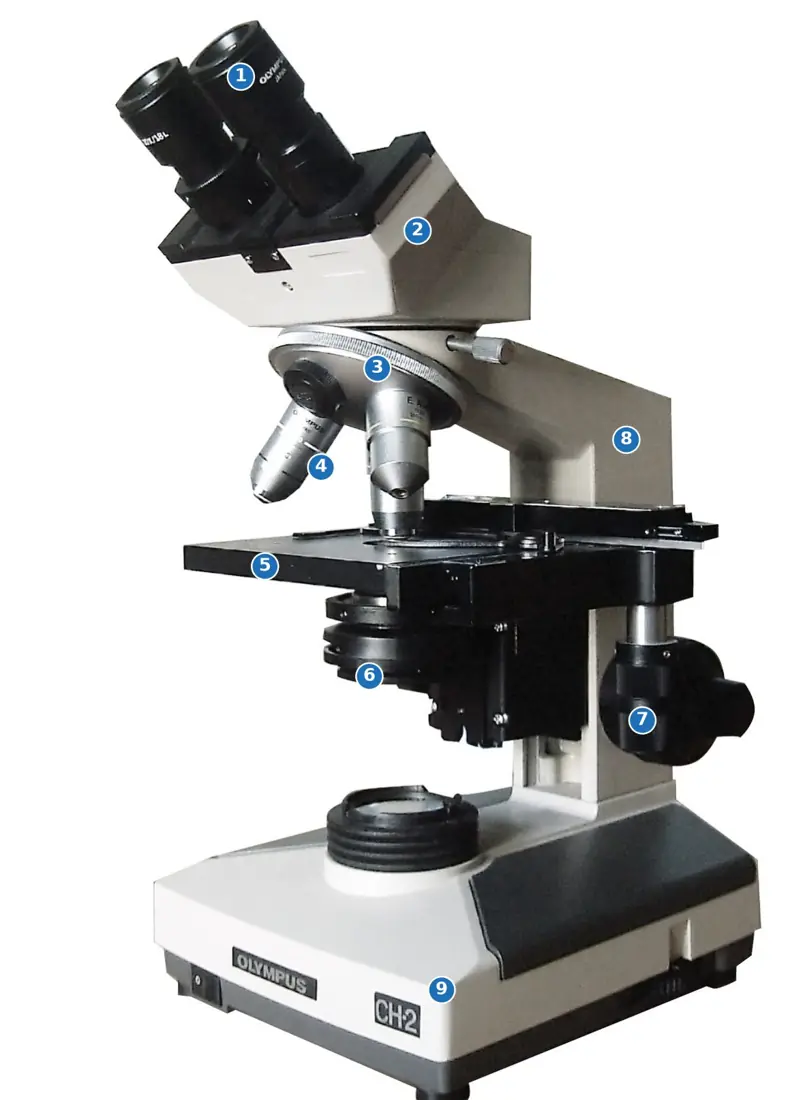
Problem. A compound microscope has a 10× eyepiece and objectives of 10×, 45× and 100×. (a) Find the total magnification with each objective. (b) A cell measured on a photomicrograph taken at ×600 is 30 mm across. Find its real diameter in micrometres.
Solution.
(a) Total magnification is the product of the two lenses:
(b) Real size is the measured size divided by the magnification:
The cell is 50 μm across — a typical plant cell.
Magnification is not resolution
Magnification makes an image bigger; resolution is the smallest separation at which two points still look like two points. A light microscope is limited to a resolution of about 0.2 μm by the wavelength of light, so magnifying beyond about 1500× gives a bigger but blurrier picture — empty magnification. Seeing a ribosome needs an electron microscope, not a stronger eyepiece.
Biology and the other sciences
Biology cannot be done alone. Every major advance in it has come from borrowing a method from a neighbouring science.
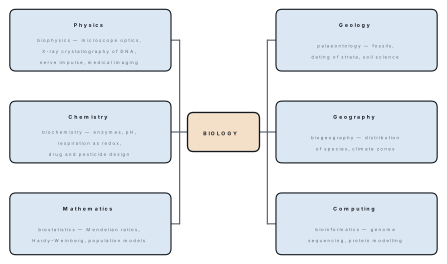
- Physics gave biology its instruments and much of its explanation. The compound and electron microscopes, the centrifuge and X-ray crystallography (the method that revealed the structure of DNA) are all physics. Nerve impulses are electrical, blood flow is fluid dynamics, the eye is an optical system, and X-ray, ultrasound and MRI imaging are physics applied to the body. The overlap is biophysics.
- Chemistry. Living matter is chemical: carbohydrates, lipids, proteins and nucleic acids. Respiration is a chain of oxidation–reduction reactions, photosynthesis a synthesis driven by light, enzymes are catalysts obeying ordinary kinetics, and blood pH is a buffer problem. The overlap is biochemistry.
- Mathematics. Mendel's ratios are arithmetic, gene frequencies obey the Hardy–Weinberg equation, populations grow exponentially and then logistically, and no experiment counts as evidence until its results have been tested statistically. The overlap is biostatistics and biomathematics.
- Geology supplies the fossil record, the dating of rock strata on which the whole history of life is hung, and the soils that vegetation grows in — palaeontology and soil science.
- Geography gives biogeography, the study of why species live where they do; computer science gives bioinformatics, without which no genome could be assembled.
Problem. An animal cell is about 20 μm across, a bacterium about 1 μm, and a virus about 100 nm. Express each in metres in standard form, and find how many times larger the animal cell is than the virus.
Solution. Using 1\ \mu\text{m} = 10^{-6}\ \text{m} and 1\ \text{nm} = 10^{-9}\ \text{m}:
The animal cell is 200 times wider than the virus and 20 times wider than the bacterium. Since the virus is well below the 0.2 μm resolution limit of a light microscope, it cannot be seen with one at all.
Problem. At a health camp in Chitwan, 18 of 250 schoolchildren screened were found to be anaemic. (a) Find the percentage prevalence. (b) If the district has 4,000 children of the same age group, estimate how many are anaemic.
Solution.
(a)
(b)
About 288 children in the district are likely to be anaemic. This is biostatistics doing its ordinary job — turning a small sample into a public health estimate. Note the assumption: the 250 screened must be representative of the 4,000, or the estimate is worthless.
Applied biology and careers in Nepal
| Field | What it applies biology to | Where it is studied in Nepal |
|---|---|---|
| Medicine and health | Human anatomy, physiology, pathology, microbiology, pharmacology | MBBS, BDS, B.Sc. Nursing, B. Pharm, BMLT — entry through the MECEE-BL entrance examination |
| Agriculture | Crop science, soil science, plant breeding, plant pathology, entomology | B.Sc. Ag at Agriculture and Forestry University, Rampur, and at IAAS and affiliated colleges |
| Forestry | Silviculture, forest ecology, watershed and NTFP management | B.Sc. Forestry at the Institute of Forestry, Pokhara and Hetauda |
| Veterinary science and livestock | Animal health, breeding, dairy and poultry production | B.V.Sc. & A.H. at AFU, Rampur |
| Fisheries and aquaculture | Fish biology, pond and cage culture in the Terai and in lakes | B.Sc. Fisheries / Aquaculture, AFU and TU |
| Biotechnology and microbiology | Tissue culture, fermentation, molecular diagnostics, vaccines | B.Sc. Microbiology and B.Tech. Biotechnology at TU and Kathmandu University |
| Environment and conservation | Ecology, wildlife biology, environmental impact assessment | B.Sc. Environmental Science; careers at NARC, DNPWC, DPR, NTNC, WWF Nepal, ICIMOD and in community forestry |
| Teaching and research | All of the above | B.Sc. and M.Sc. at TU, KU, Pokhara and Purbanchal Universities |
Answering "state the scope and importance of biology"
Give headed points, not a paragraph: health and medicine; food and agriculture; forestry and livestock; biotechnology and industry; environment and conservation; and for full marks close with a Nepali example — community forestry restoring the mid-hills, the rise of the one-horned rhino in Chitwan, or tissue-cultured banana plantlets raised at Khumaltar.
Chapter summary
- Biology is the science of living organisms; from Greek bios (life) and logos (study), brought into use in 1802 by Treviranus and Lamarck. Aristotle is the Father of Biology and of Zoology; Theophrastus the Father of Botany.
- Living things show cellular organisation, metabolism, growth, reproduction, irritability, homeostasis, adaptation and evolution, and a finite life span.
- Branches divide by the group studied — botany, zoology, microbiology, mycology, phycology, entomology, ichthyology, herpetology, ornithology, parasitology — and by the aspect studied — morphology, anatomy, histology, cytology, physiology, biochemistry, genetics, embryology, taxonomy, evolution, palaeontology, ecology, immunology, pathology, biotechnology.
- Biology overlaps physics (biophysics: microscopy, X-ray crystallography, nerve impulses, medical imaging), chemistry (biochemistry: enzymes, respiration, pH), mathematics (biostatistics: Mendelian ratios, Hardy–Weinberg, population models), geology (palaeontology, soils), geography (biogeography) and computing (bioinformatics).
- Total magnification of a compound microscope = eyepiece \times objective; real size = image size \div magnification. Light microscopes resolve to about 0.2 μm; beyond about 1500× the extra magnification is empty.
- Applied biology supports medicine, agriculture, forestry, veterinary science, fisheries, biotechnology and conservation — the sectors that carry Nepal's economy.
Practice questions
Group A — Multiple choice (1 mark each)
- The term "biology" is derived from the Greek words [1]abios and logosbbio and logiacbios and graphosdvita and logos
- Aristotle is regarded as the [1]aFather of BotanybFather of ZoologycFather of GeneticsdFather of Taxonomy
- The branch of biology that deals with the study of insects is [1]aichthyologybherpetologycentomologydornithology
- The study of fossils belongs to [1]aecologybembryologycpalaeontologydhistology
Answers to Group A
1. (a) — bios = life, logos = study or discourse.
2. (b) — Aristotle is the Father of Zoology (and of Biology as a whole); Theophrastus is the Father of Botany.
3. (c) — entomology; ichthyology is fishes, herpetology amphibians and reptiles, ornithology birds.
4. (c) — palaeontology, the branch that links biology to geology.
Group B — Short answer (4 marks each)
- Define biology, and name any four branches of biology based on the aspect of life studied, with one line on each. [4]
- Explain the relation of biology with physics and chemistry, with two examples of each. [4]
- A compound microscope has a 15× eyepiece and a 40× objective.(a) Find the total magnification.(b) A structure appears 24 mm long in the field of view at this magnification; find its real length in micrometres.(c) State one reason why this microscope cannot show a virus. [4]
- State any four applied fields of biology and name, for each, one course or institution in Nepal where it is studied. [4]
Answers to Group B
1. Biology is the science that deals with living organisms — their structure, function, origin, growth, reproduction, classification, behaviour, evolution and relation with the environment. Four aspect-based branches: morphology, the external form and structure of organisms; physiology, the functions and processes of the living body; genetics, heredity and variation; ecology, the relation between organisms and their environment. (Anatomy, cytology, embryology, taxonomy or biochemistry are equally acceptable.)
2. Physics supplies the instruments — the compound and electron microscopes, the centrifuge, the X-ray crystallography that revealed the structure of DNA — and explains the electrical nerve impulse, the fluid dynamics of blood flow and the optics of the eye; medical imaging is applied physics. The overlap is biophysics. Chemistry: living matter is carbohydrate, lipid, protein and nucleic acid; respiration is a series of oxidation–reduction reactions, enzymes are catalysts, and blood pH is held by buffers. The overlap is biochemistry.
3. (a) M = 15 \times 40 = 600\times. (b) Real length = 24\ \text{mm} / 600 = 0.04\ \text{mm} = 40\ \mu\text{m}. (c) A light microscope cannot resolve detail finer than about 0.2 μm because of the wavelength of light, and a virus is only about 0.1 μm across — so it lies below the resolution limit, no matter how much the image is magnified.
4. Any four: medicine — MBBS or B.Sc. Nursing, entered through the MECEE-BL examination; agriculture — B.Sc. Ag at Agriculture and Forestry University, Rampur; forestry — B.Sc. Forestry at the Institute of Forestry, Pokhara; veterinary science — B.V.Sc. & A.H. at AFU, Rampur; biotechnology / microbiology — B.Sc. Microbiology at TU or B.Tech. Biotechnology at Kathmandu University; fisheries — B.Sc. Aquaculture, AFU; conservation — Environmental Science, with employers such as DNPWC, NTNC and WWF Nepal.
Group C — Long answer (8 marks each)
- Define biology and classify its branches, with a table showing at least six branches based on the group of organisms studied and six based on the aspect of life studied, giving one line of definition for each. [8]
- (a) Describe the relation of biology with physics, chemistry, mathematics and geology, naming the interdisciplinary field created by each overlap. [5](b) Explain the scope and importance of biology in the context of Nepal. [3]
Answer outline to Group C question 1
Definition first: biology is the science of living organisms — structure, function, origin, growth, reproduction, classification, behaviour, evolution and relation with the environment; from Greek bios + logos, the term brought into use in 1802 by Treviranus and Lamarck.
Then a two-part table. By group studied: botany (plants), zoology (animals), microbiology (micro-organisms), mycology (fungi), phycology (algae), entomology (insects), ichthyology (fishes), ornithology (birds). By aspect studied: morphology (external form), anatomy (internal structure), cytology (cells), physiology (functions), genetics (heredity and variation), embryology (development from the zygote), taxonomy (identification, naming and classification), ecology (organism and environment), palaeontology (fossils), biotechnology (use of organisms to make useful products).
Close by noting that the two schemes cut across each other: the physiology of a plant is both botany and physiology, so a single study can sit in both lists.
Practise more: Biology question bank