Unit 8 · Zoology · 34 teaching hours · 51 min read
Faunal Diversity
What the syllabus asks for 4
- Protista
- Animalia [10]: level of organization; body plan; nine phyla
- Earthworm (Pheretima posthuma)
- Frog (Rana tigrina)
Between one and two million kinds of animal have been named, and the true number alive today is probably several times larger. Faced with that flood a zoologist sorts, but not arbitrarily: animals are grouped by shared inherited architecture — how many germ layers built the embryo, whether there is a body cavity, whether the body is segmented. Answer those few structural questions and almost any animal can be placed. This unit works through the sorting scheme, then slows down for three animals you will meet on the laboratory bench: the ciliate Paramecium, the earthworm Pheretima posthuma and the frog Rana tigrina.
What this unit asks of you. (i) Place a protist in its group from its locomotory organelle. (ii) Give the diagnostic characters and examples of the nine animal phyla, justifying each from level of organisation, symmetry, germ layers and coelom. (iii) Describe, with labelled diagrams, Paramecium and the organ systems of the earthworm and the frog. Diagrams carry a large share of the marks — practise drawing them, not just reading them.
8.1 Protista
Protista is the kingdom Whittaker (1969) created for the eukaryotes that are neither plants, animals nor fungi. They share only a negative character — they are what is left when the three higher kingdoms are removed — so Protista is a paraphyletic "rag-bag" kingdom; the CDC syllabus uses this five-kingdom treatment.
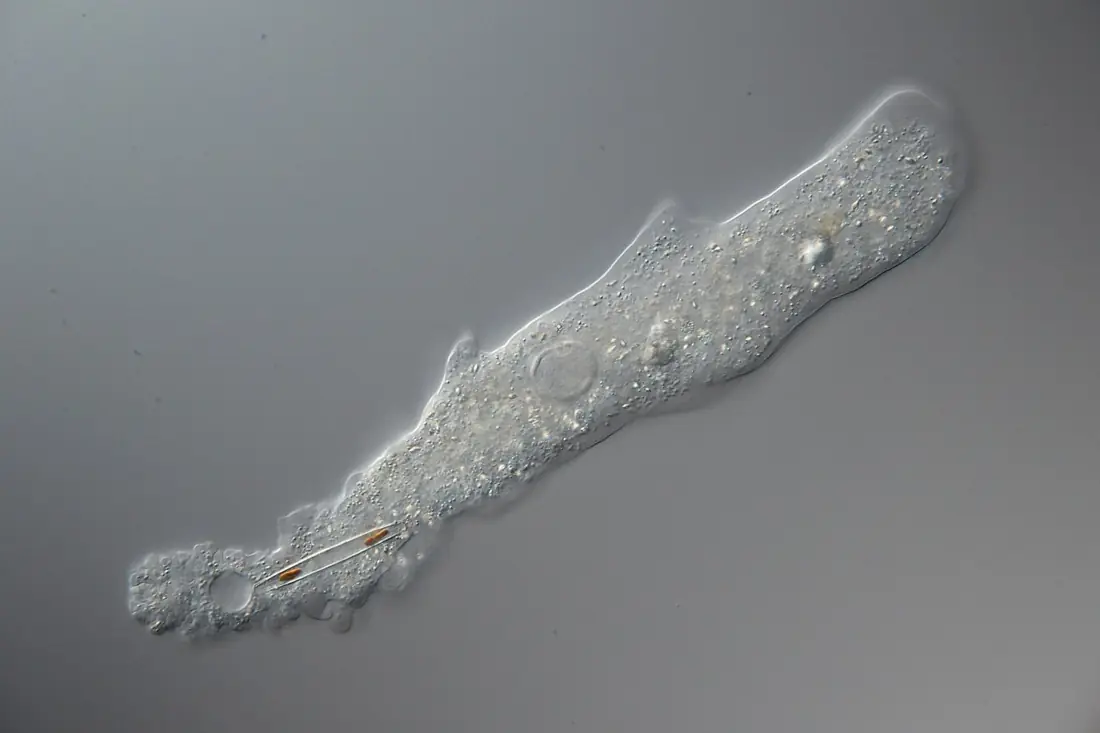
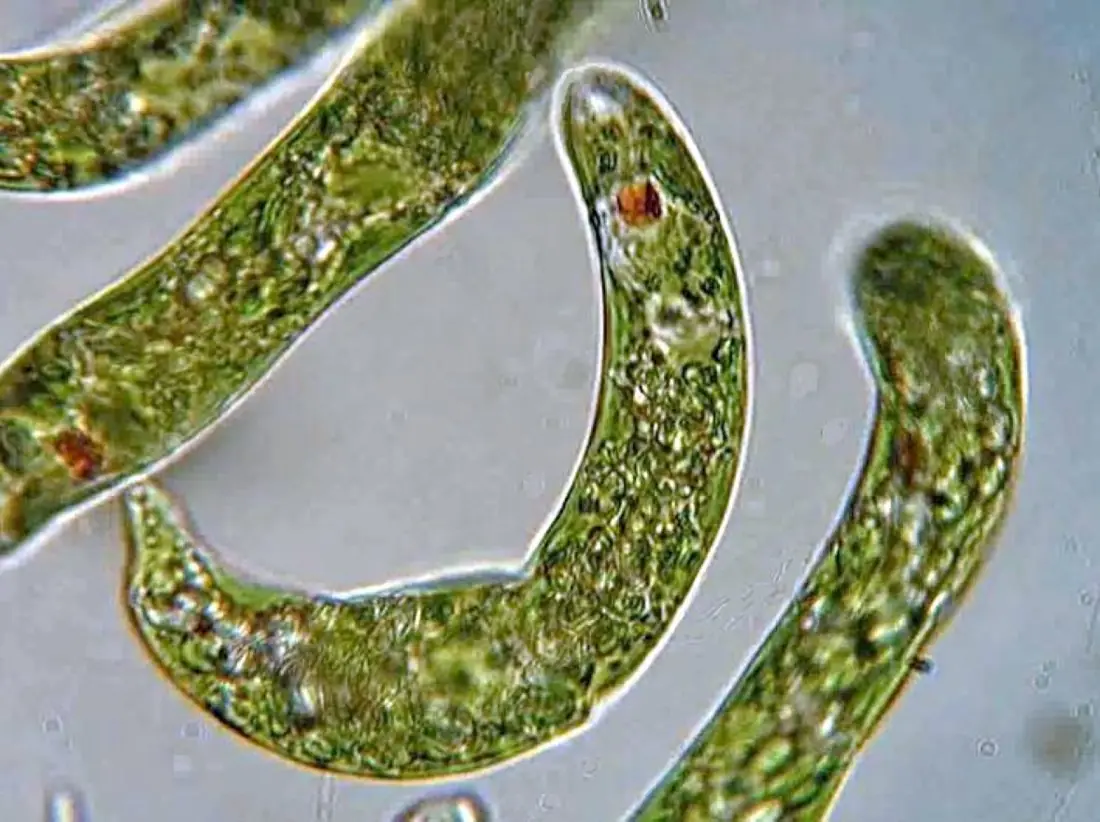
General characters. (i) Eukaryotic and mostly unicellular, so the level of organisation is protoplasmic — one cell does everything. (ii) Aquatic or in damp places, including a host's body fluids. (iii) Nutrition varied: holophytic (Euglena), holozoic (Amoeba, Paramecium), saprophytic or parasitic (Plasmodium). Euglena, both holophytic and saprophytic, fits neither Plantae nor Animalia. (iv) Locomotion by pseudopodia, flagella or cilia, or absent (Sporozoa). (v) Osmoregulation by contractile vacuoles; respiration and excretion by diffusion. (vi) Reproduction by fission, budding, syngamy or conjugation, with resistant cysts.
Classification of Protista
Protista is conventionally divided on nutrition into plant-like protists, animal-like protists (Protozoa) and fungus-like protists.
| Assemblage | Group | Key features | Examples |
|---|---|---|---|
| Plant-like | Chrysophyta (diatoms) | two-piece silica frustule; deposits form diatomite | Navicula, Cyclotella |
| Plant-like | Dinoflagellata | two flagella in grooves; cellulose plates; cause red tides | Gonyaulax, Noctiluca |
| Plant-like | Euglenophyta | pellicle instead of a wall; chlorophyll a and b; eyespot | Euglena |
| Animal-like | Protozoa | holozoic or parasitic; no cell wall | Amoeba, Paramecium |
| Fungus-like | Slime moulds | feeding plasmodium; spores in fruiting bodies | Physarum |
Within the Protozoa the classical division uses the organelle of locomotion.
| Class | Locomotory organelle | Habit | Examples and importance |
|---|---|---|---|
| Rhizopoda (Sarcodina) | pseudopodia | free-living or parasitic | Amoeba proteus; Entamoeba histolytica (amoebic dysentery); Elphidium |
| Mastigophora (Flagellata) | flagella | free-living or parasitic | Euglena; Trypanosoma (sleeping sickness); Leishmania donovani (kala-azar); Giardia |
| Sporozoa | none in the adult | all parasitic; spore-forming | Plasmodium vivax, P. falciparum (malaria); Monocystis |
| Ciliata | many short cilia | macro- and micronucleus present | Paramecium, Vorticella; Balantidium coli |
Do not write "Protozoa is a phylum of Kingdom Animalia". In the five-kingdom system used by the CDC syllabus, protozoans are protists; Protozoa is an assemblage within Protista, and Animalia begins with the sponges.
Paramecium caudatum: structure
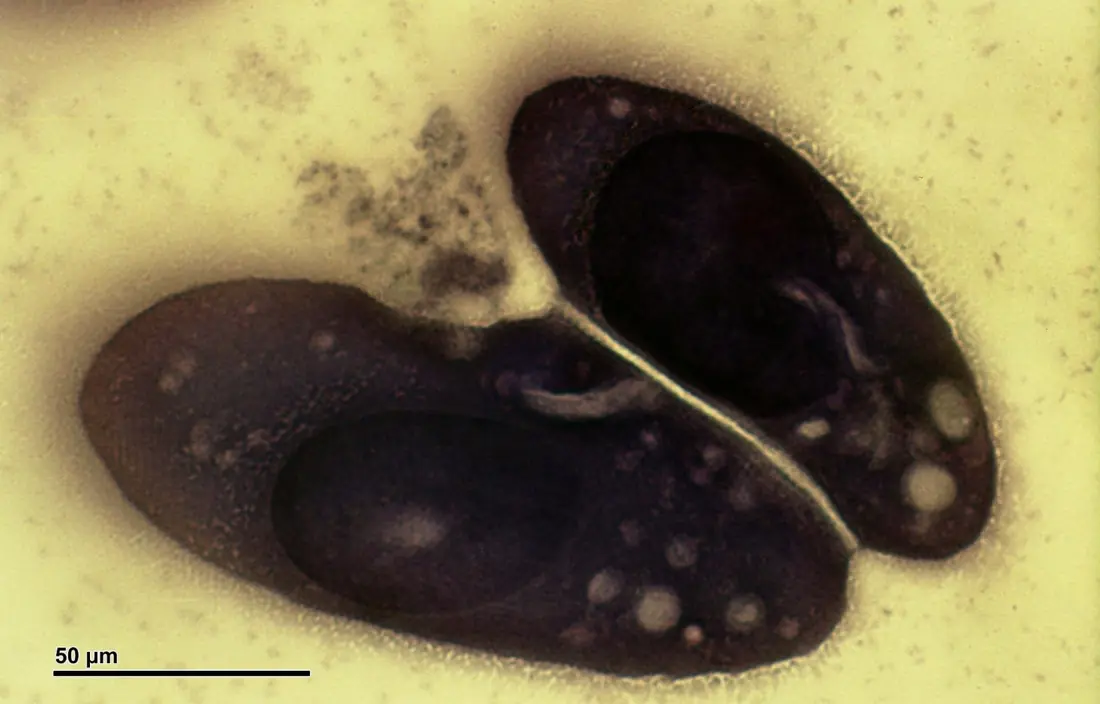
Paramecium is the standard ciliate type study — common in any pond or hay infusion and large enough (170–330 μm) to see under a school microscope. Its shape is constant, like a slipper: blunt in front, pointed behind, the posterior end carrying a tuft of longer caudal cilia — the caudatum of the name.
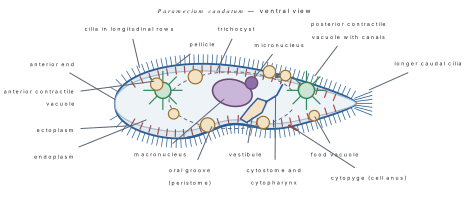
A thin, firm, elastic pellicle fixes the cell's shape; it is sculptured into hexagons with one cilium through the centre of each, so the cilia lie in neat longitudinal rows. Beneath it lie a clear outer ectoplasm and a granular inner endoplasm. Spindle-shaped trichocysts in the ectoplasm discharge a sticky thread for anchorage and defence.
A distinctive feature is nuclear dimorphism. P. caudatum has one large, kidney-shaped, polyploid macronucleus controlling all vegetative work, and one small diploid micronucleus in a depression of it, the genetic reserve used in sexual reproduction. (P. aurelia has two micronuclei — a favourite one-mark trap.)
On the ventral surface a shallow oral groove (peristome) runs obliquely back to about mid-body, deepening into a vestibule, then the cytostome and a short cytopharynx; a cytopyge (cell anus) lies just behind it.
Paramecium: locomotion, nutrition and osmoregulation
Locomotion. Each cilium makes a stiff effective stroke backwards and to the right, then a limp recovery stroke; successive cilia start a fraction of a beat later, so a wave travels along the body. This metachronal rhythm drives the animal forward at about 1500 μm per second while the oblique stroke rotates it, so the path is a wide spiral. Meeting an obstacle the cilia reverse, the animal backs off, swings its front end round and tries again — the avoiding reaction.
Nutrition is holozoic filter feeding. Longer cilia in the oral groove drive water carrying bacteria into the vestibule; at the base of the cytopharynx the food collects in a food vacuole which pinches off and circulates by cyclosis. Digestion is intracellular in two phases — the vacuole first turns acidic (about pH 4), killing the bacteria, then alkaline as proteases, amylases and lipases are added. Products diffuse into the cytoplasm; the residue leaves at the cytopyge.
Osmoregulation. Pond water is hypotonic, so water enters continuously. Two contractile vacuoles, anterior and posterior, each fed by radiating canals, collect it and discharge through a temporary pore, contracting alternately every 10–20 seconds. Their job is water balance, not excretion: ammonia and carbon dioxide diffuse out across the body surface and oxygen diffuses in.
Paramecium: reproduction
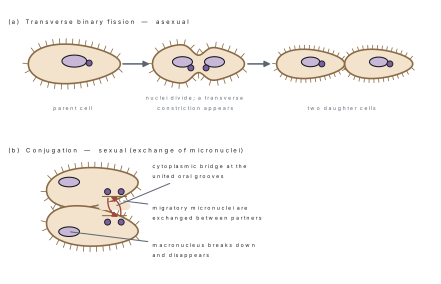
Transverse binary fission is the asexual method and occurs two or three times a day in good conditions. The micronucleus divides mitotically and the macronucleus amitotically; a new oral groove and contractile vacuoles form; and a transverse constriction separates an anterior proter from a posterior opisthe. Note the plane — fission is transverse in Paramecium but longitudinal in Euglena.
Conjugation is the sexual process. It does not increase numbers — two conjugants give two ex-conjugants — but it reshuffles genes and rejuvenates a clone that has divided asexually too long. Two individuals of different mating types unite by their oral surfaces. In each the macronucleus disintegrates and the micronucleus divides meiotically into four haploid nuclei, three of which degenerate; the survivor divides mitotically into a large stationary and a small migratory pronucleus. The migratory nuclei are exchanged across the cytoplasmic bridge, and each fuses with the partner's stationary nucleus to give a diploid synkaryon; the ex-conjugants separate and rebuild one macronucleus and one micronucleus each. Endomixis and autogamy are similar reorganisations without a partner.
Working out the real size of a protist. A drawing of Paramecium is 60 mm long and is labelled "×250". What is the animal's actual length in micrometres?
Magnification is the image size divided by the object size,
and 0.24\ \text{mm} \times 1000 = 240\ \mu\text{m}, comfortably inside the 170–330 μm range for P. caudatum. Two traps: magnification has no units, and you must multiply millimetres by 1000 to get micrometres, not divide.
Why being small suits a protist. For a spherical cell of radius r,
so that, dividing and cancelling every constant,
The exchange surface available per unit of living substance is inversely proportional to the radius. This one result explains why a protist needs no lungs, no blood and no kidneys, and why anything much larger must invent them.
Putting numbers on it. Compare a spherical protist of radius 50 μm with a frog treated as a sphere of radius 3.0 cm.
Protist: r = 5.0 \times 10^{-5}\ \text{m}, so S/V = 3/(5.0 \times 10^{-5}) = 6.0 \times 10^{4}\ \text{m}^{-1}.
Frog: r = 3.0 \times 10^{-2}\ \text{m}, so S/V = 3/(3.0 \times 10^{-2}) = 1.0 \times 10^{2}\ \text{m}^{-1}.
The protist has 600 times as much exchange surface per unit volume, and no point in it is more than 50 μm from the outside — well within the reach of diffusion. The frog, with one six-hundredth of the relative surface, must have lungs, a vascular skin, a heart and a closed circulation to do the same job.
Importance of protists
Protists matter out of all proportion to their size. They cause malaria (Plasmodium, carried by female Anopheles), amoebic dysentery, giardiasis, sleeping sickness and kala-azar, the last endemic in Nepal's eastern Terai. Diatoms and dinoflagellates are the dominant phytoplankton of the oceans, and ciliates graze bacteria in soil and in sewage-sludge tanks. Foraminiferan shells and diatom frustules accumulate as chalk and diatomite, and flagellates such as Trichonympha digest cellulose in the gut of termites.
8.2 Animalia
Kingdom Animalia contains the multicellular, eukaryotic, heterotrophic organisms whose cells lack a cell wall and plastids. Animals share collagen and cell junctions binding the cells; a diploid adult developed from a zygote through blastula and gastrula stages; glycogen as the store; movement at some stage; and nervous and muscular tissue, which no other kingdom has. About 35 phyla are recognised; the syllabus asks for nine, sorted on four structural questions.
Levels of organisation
| Level | What it means | Found in |
|---|---|---|
| Protoplasmic | one cell performs all functions using organelles | Protista |
| Cellular | cells loosely aggregated with some division of labour, no true tissues | Porifera |
| Cell–tissue | similar cells organised into definite tissues, e.g. the nerve net | Coelenterata |
| Tissue–organ | tissues combine into organs, but organ systems are incomplete | Platyhelminthes |
| Organ–system | organs grouped into systems, each with one job | Nemathelminthes to Chordata |
Body plan
- Cell-aggregate plan. A loose colony of cells round a central cavity with no mouth and no gut; water carrying food enters through pores and leaves by an osculum, and each cell feeds itself. Sponges only.
- Blind-sac plan. One cavity with a single opening serving as mouth and anus, so feeding is discontinuous. Coelenterata and Platyhelminthes.
- Tube-within-a-tube plan. A complete gut runs from mouth to anus inside the body-wall tube, so food passes one way through specialised regions and feeding, digestion and egestion go on at once. Nemathelminthes onwards — the plan of every higher animal.
Symmetry
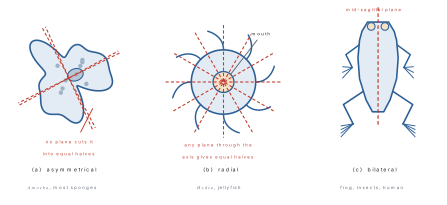
- Asymmetrical: no plane divides the body into equal halves — Amoeba, most sponges.
- Radial: any plane through the central axis gives equal halves, so the animal meets its world equally on all sides; typical of sessile or drifting animals such as Hydra. In adult echinoderms it is pentamerous radial symmetry, built on five rays.
- Bilateral: one mid-sagittal plane gives mirror-image right and left halves. This goes with directed forward movement and therefore with cephalisation, the gathering of sense organs, ganglia and mouth at the leading end to form a head.
Germ layers and the coelom
Diploblastic animals build the body from ectoderm and endoderm with a non-cellular jelly (mesogloea) between — Porifera and Coelenterata. Triploblastic animals insert mesoderm between the two, and mesoderm is what makes muscle, blood, skeleton, kidneys and gonads possible.
The coelom is a fluid-filled cavity lying within the mesoderm and lined throughout by mesodermal peritoneum. It frees the gut to move independently of the body wall, works as a hydrostatic skeleton and transport medium, and gives organs and gametes room to enlarge.
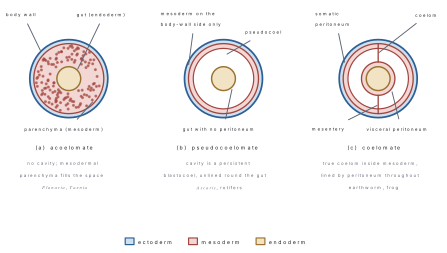
| Condition | Cavity | Lining | Example |
|---|---|---|---|
| Acoelomate | none; gut and body wall packed with mesodermal parenchyma | — | Planaria, Taenia |
| Pseudocoelomate | present, but a persistent blastocoel | mesoderm outside only, not round the gut | Ascaris, rotifers |
| Coelomate | a true coelom | peritoneum on both body wall and gut | earthworm, cockroach, frog |
Coelomates divide further by the fate of the blastopore. In protostomes (Annelida, Arthropoda, Mollusca) it becomes the mouth and the coelom is a split in solid mesoderm (schizocoely); in deuterostomes (Echinodermata, Chordata) it becomes the anus and the coelom buds from the archenteron (enterocoely).
Segmentation and the basis of classification
Metameric segmentation divides the body along its long axis into similar units, each repeating the same organs — nephridia, ganglia, vessels, muscle blocks — as in Annelida, Arthropoda and Chordata. A tapeworm's "segments" are budded reproductive sacs, not true metameres: pseudometamerism.
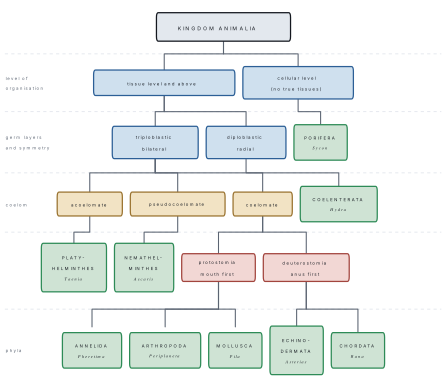
The nine phyla follow in the traditional order of increasing complexity.
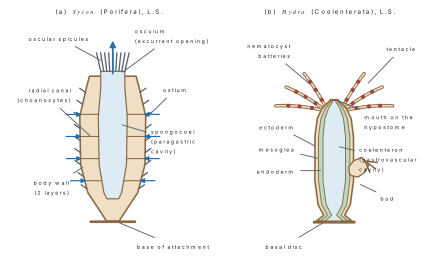
1. Phylum Porifera
The sponges — the simplest animals, at the cellular level of organisation.
- Aquatic, mostly marine, sessile as adults; asymmetrical or radial.
- Diploblastic: an outer pinacoderm, an inner choanoderm, and a gelatinous mesenchyme between them containing amoebocytes and skeletal cells.
- The body wall is pierced by microscopic ostia; water drawn through them enters the spongocoel and leaves by one large osculum. This one-way canal system, driven by flagella, brings food and oxygen and removes waste; its grades are ascon (Leucosolenia), sycon (Sycon) and leucon (Spongilla).
- Choanocytes (collar cells) line the canals, each straining bacteria with a collar of microvilli round a flagellum; digestion is intracellular.
- Support from an endoskeleton of calcareous or siliceous spicules or of the protein spongin. There is no mouth, gut, nervous system, muscle or organ.
- Reproduction asexual by budding, fragmentation and gemmules, and sexual — usually hermaphrodite, with a free-swimming larva. Regeneration is extraordinary.
- Examples: Sycon, Spongilla, Euspongia (bath sponge), Euplectella (Venus' flower basket), Hyalonema.
2. Phylum Coelenterata (Cnidaria)
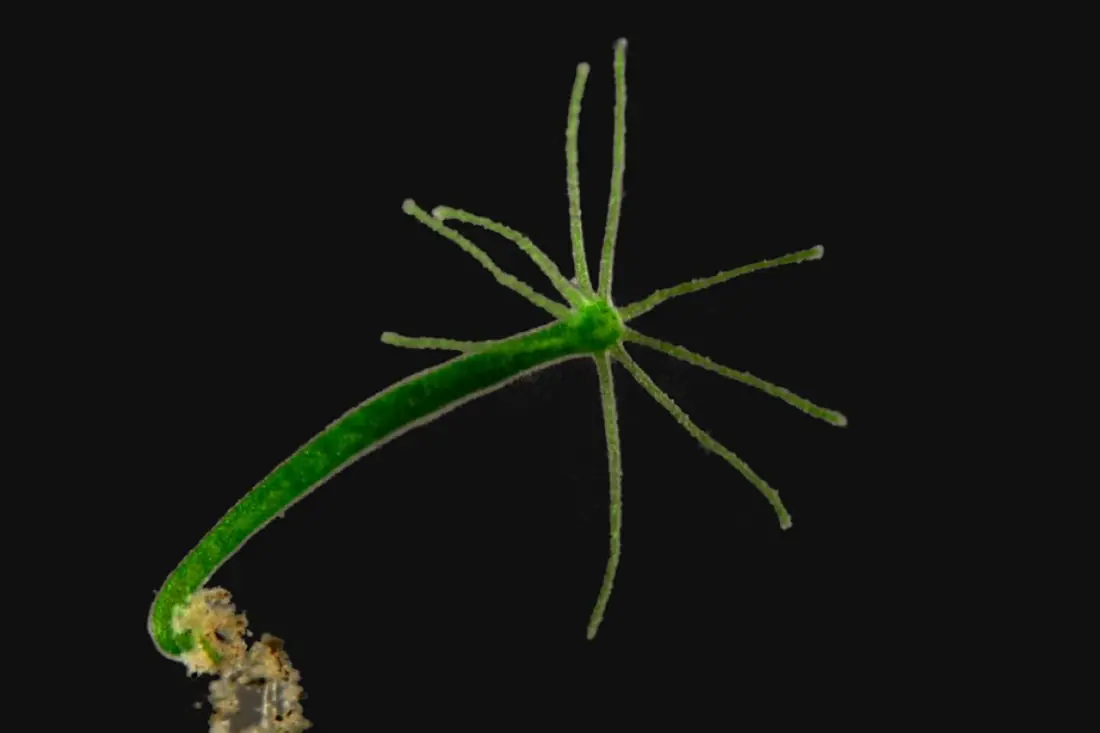
- Aquatic, mostly marine, a few fresh-water (Hydra); solitary or colonial.
- Radially symmetrical, diploblastic, at the cell–tissue level, with an acellular mesogloea between epidermis and gastrodermis.
- A single coelenteron (gastrovascular cavity) opens by a mouth ringed with tentacles; there is no anus, so the plan is blind-sac. Digestion is first extracellular in the cavity, then intracellular in the gastrodermis.
- The diagnostic character is the cnidoblast, a stinging cell holding a nematocyst — a coiled thread fired by the trigger-like cnidocil, used for capturing prey, defence and locomotion.
- Polymorphism is common: the sedentary polyp feeds, the free-swimming medusa reproduces sexually; in Obelia the two alternate (metagenesis).
- The nervous system is a diffuse nerve net with no brain; there are no respiratory, circulatory or excretory organs.
- Reproduction asexual by budding, sexual by gametes, with a ciliated planula larva.
- Examples: Hydra, Obelia, Aurelia (jellyfish), Physalia (Portuguese man-of-war), Metridium (sea anemone), Corallium (red coral).
3. Phylum Platyhelminthes
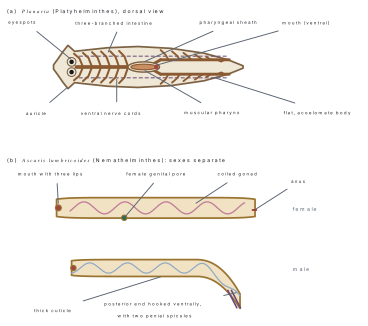
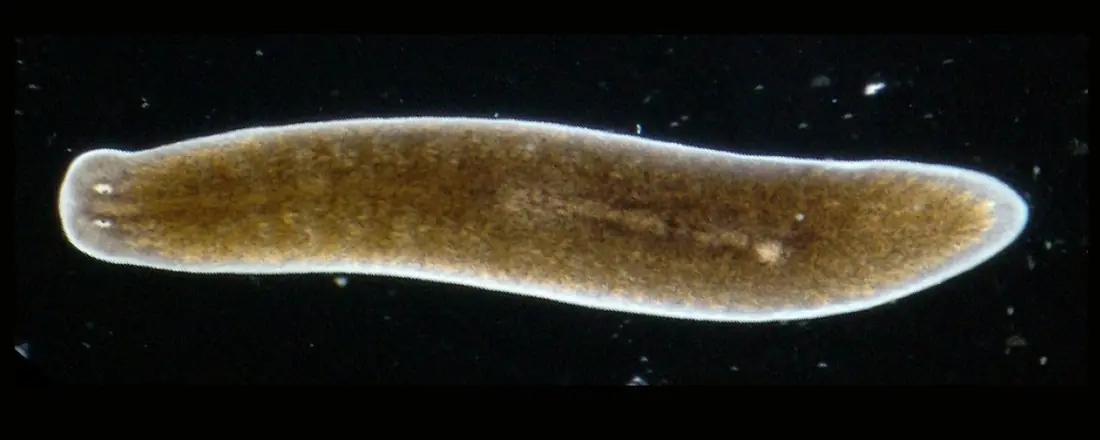
The flatworms — the first triploblastic, bilaterally symmetrical animals.
- Body dorsoventrally flattened and acoelomate, the space between the organs packed with mesodermal parenchyma; tissue–organ level; definite cephalisation.
- Free-living (Planaria) or, more often, parasitic, with hooks and suckers, a resistant tegument and reduced sense organs.
- The gut, when present, is incomplete — a mouth but no anus; in tapeworms it is absent and food is absorbed over the body surface.
- Excretion and osmoregulation by protonephridia ending in flame cells.
- Nervous system "ladder-like": paired cerebral ganglia, longitudinal cords and transverse commissures.
- Almost all hermaphrodite, with elaborate reproductive systems and life cycles running through several hosts and larvae (miracidium, sporocyst, redia, cercaria in Fasciola).
- Examples: Planaria, Fasciola hepatica (liver fluke), Taenia solium (pork tapeworm), Schistosoma (blood fluke), Echinococcus.
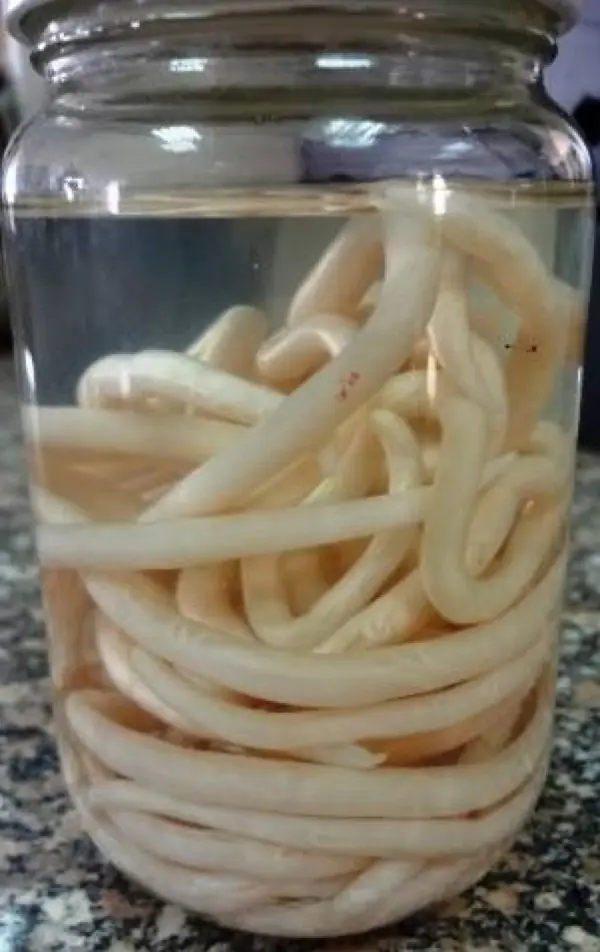
4. Phylum Nemathelminthes (Aschelminthes)
The roundworms.
- Body long, cylindrical, unsegmented, tapering at both ends, circular in section; triploblastic, bilateral, pseudocoelomate; organ–system level.
- Covered by a tough moulted cuticle; the body wall has only longitudinal muscles, so the worm can only thrash from side to side.
- The gut is complete, with mouth and anus — the first phylum with the tube-within-a-tube plan.
- No circulatory or respiratory organs; parasites respire anaerobically. Excretion by renette cells or by an H-shaped canal system.
- Sexes separate, with marked sexual dimorphism: the male Ascaris is shorter with a curved tail bearing penial setae, the female longer and straight.
- Examples: Ascaris lumbricoides, Ancylostoma duodenale (hookworm), Wuchereria bancrofti (filariasis), Enterobius (pinworm), Trichinella.
5. Phylum Annelida
The segmented worms — the first animals with a true coelom.
- Body metamerically segmented outside by annuli and inside by septa; bilateral, triploblastic.
- A true schizocoelic coelom, divided by septa into compartments of coelomic fluid that act as a hydrostatic skeleton.
- Locomotion by chitinous setae (earthworm), parapodia (Nereis) or suckers (leech), working against circular and longitudinal muscle layers.
- Closed blood vascular system; the respiratory pigment is dissolved in the plasma. Excretion by segmental nephridia; respiration through the moist skin or by gills.
- Nervous system: dorsal cerebral ganglia, circumpharyngeal connectives, and a double, ventral, solid, ganglionated nerve cord.
- Monoecious (earthworm, leech) or dioecious (Nereis); development direct, or through a trochophore larva in marine forms.
- Examples: Pheretima posthuma, Lumbricus, Hirudinaria (leech), Nereis (clam worm), Aphrodite (sea mouse).
6. Phylum Arthropoda
The largest phylum: about three of every four known animal species.
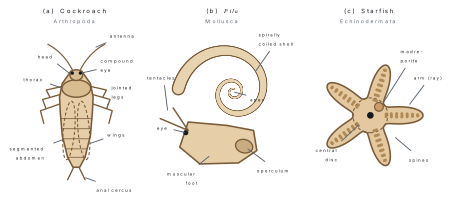
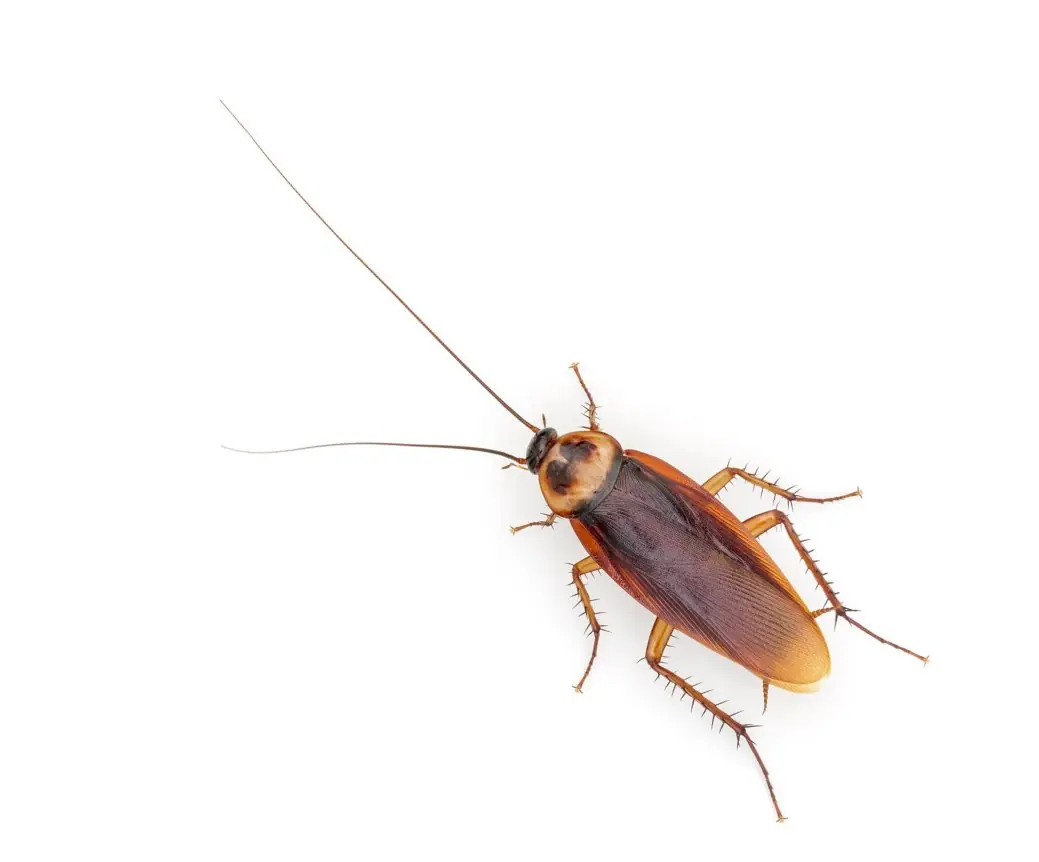
- Body segmented and divided into head, thorax and abdomen (or cephalothorax and abdomen); segmentation is heteronomous, different segments doing different jobs.
- The diagnostic character is jointed appendages, modified as antennae, mouthparts, walking legs, paddles and copulatory organs.
- A chitinous exoskeleton covers the body; because it cannot grow it is periodically shed — moulting (ecdysis).
- The body cavity is a blood-filled haemocoel and circulation is open, the dorsal heart pumping haemolymph into sinuses; the true coelom survives only in the gonads and excretory organs.
- Respiration by gills, book gills (Limulus), book lungs (scorpion) or tracheae with spiracles (insects); excretion by Malpighian tubules (insects), green glands (prawn) or coxal glands (scorpion).
- Compound eyes of many ommatidia, plus ocelli, antennae and statocysts. Usually dioecious, fertilisation internal, development often with metamorphosis.
- Examples: Periplaneta americana (cockroach), Apis indica (honey bee), Bombyx mori (silkworm), Palaemon (prawn), Palamnaeus (scorpion), Limulus, Scolopendra, Julus.
7. Phylum Mollusca
The second largest phylum — snails, mussels, squids and their relatives.
- Body soft and unsegmented, with a head, a muscular ventral foot for creeping, burrowing or swimming, and a dorsal visceral mass.
- The visceral mass is covered by the mantle, a fleshy fold that secretes the calcareous shell and encloses the mantle cavity holding the gills.
- Most have a rasping radula armed with rows of chitinous teeth; it is absent in the filter-feeding bivalves.
- Respiration by feather-like ctenidia, or by a pulmonary sac in land snails. Circulation open except in cephalopods; the pigment is usually haemocyanin, blue when oxygenated.
- Excretion by metanephridia, the organ of Bojanus.
- Usually dioecious, with trochophore and veliger larvae. Cephalopods have the best nervous system and eyes of any invertebrate.
- Examples: Pila globosa (apple snail), Lamellidens (fresh-water mussel), Sepia (cuttlefish), Loligo (squid), Octopus, Pinctada (pearl oyster).
8. Phylum Echinodermata
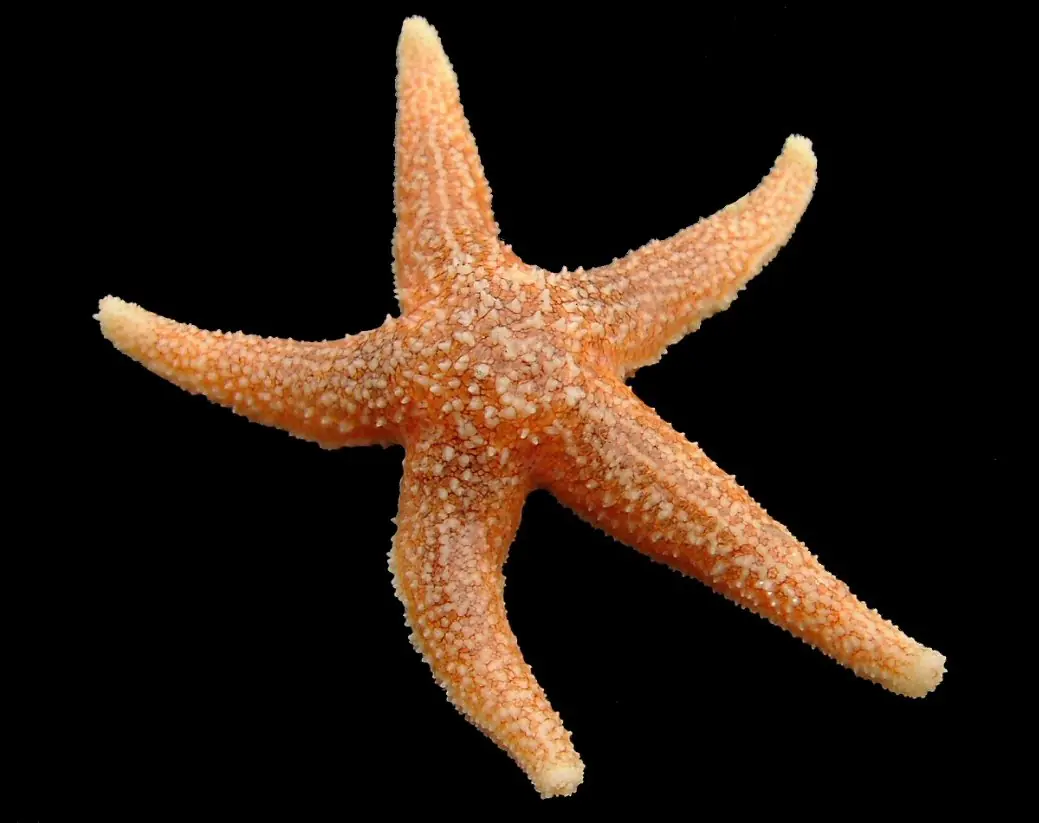
- Exclusively marine and mostly bottom-dwelling; the name means "spiny-skinned".
- Adults show pentamerous radial symmetry, but the larva (bipinnaria, echinopluteus) is bilaterally symmetrical — which is why echinoderms are grouped with the bilateral deuterostomes, not with the coelenterates.
- Triploblastic and coelomate, the coelom formed by enterocoely and the blastopore becoming the anus.
- The endoskeleton is of calcareous ossicles, usually spiny.
- The unique character is the water vascular (ambulacral) system: sea water enters the sieve-like madreporite, runs down the stone canal to a ring canal and out along five radial canals to hundreds of tube feet, each worked hydraulically by an ampulla and used for locomotion, gripping prey and gas exchange.
- No excretory organs; the nervous system is a nerve ring with radial nerves and no brain. Sexes usually separate, fertilisation external; regeneration and autotomy are famous — one arm with part of the disc can rebuild a starfish.
- Examples: Asterias (starfish), Echinus (sea urchin), Holothuria (sea cucumber), Antedon (feather star), Ophiura (brittle star).
9. Phylum Chordata
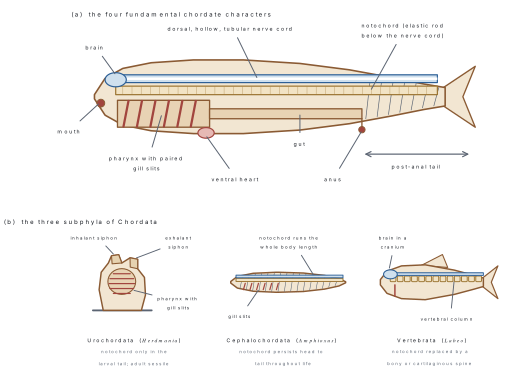
Four characters define a chordate; all four need be present only at some stage of the life cycle.
- A notochord — a flexible rod of vacuolated cells in a fibrous sheath, below the nerve cord and above the gut; the first skeleton, and the stiffening the swimming muscles work against.
- A dorsal, hollow (tubular) nerve cord, single and without ganglia — the exact opposite of the ventral, solid, double, ganglionated cord of annelids and arthropods. Its front end enlarges into the brain.
- Pharyngeal gill slits, paired openings from pharynx to exterior, used for filter feeding in protochordates and respiration in fishes; in land vertebrates they appear only in the embryo.
- A post-anal tail, a muscular extension behind the anus.
A chordate also has a ventral heart, closed circulation, an enterocoelic coelom and bilateral symmetry at the organ–system grade.
| Subphylum | Notochord | Features | Examples |
|---|---|---|---|
| Urochordata | in the larval tail only, lost at metamorphosis | marine, sessile adult with a tunic; retrogressive metamorphosis | Herdmania, Ascidia, Salpa |
| Cephalochordata | head to tail, throughout life | marine, fish-like burrowing filter feeders; no head, no heart | Branchiostoma (amphioxus) |
| Vertebrata | replaced in the adult by a vertebral column | cranium enclosing the brain; paired appendages; chambered heart; kidneys | fishes, amphibians, reptiles, birds, mammals |
Vertebrata divides into Agnatha (jawless) and Gnathostomata (jawed).
| Class | Diagnostic features | Heart | Examples |
|---|---|---|---|
| Cyclostomata | no jaws, scales or paired fins; cartilaginous | two-chambered | Petromyzon, Myxine |
| Chondrichthyes | cartilaginous; placoid scales; no operculum | two-chambered | Scoliodon, Torpedo |
| Osteichthyes | bony; cycloid scales; operculum; air bladder | two-chambered | Labeo, Hippocampus |
| Amphibia | moist scaleless skin; gills then lungs | three-chambered | Rana, Bufo |
| Reptilia | dry skin with scales; shelled amniotic egg | three-chambered | Calotes, Naja |
| Aves | feathers; pneumatic bones; air sacs; warm-blooded | four-chambered | Columba, Pavo |
| Mammalia | hair; mammary glands; diaphragm; warm-blooded | four-chambered | Homo, Panthera |
Finally, the nine phyla side by side. "Distinguish between" questions are answered from exactly these columns.
| Phylum | Symmetry | Germ layers | Coelom | Digestive tract | Circulation | Excretion | Example |
|---|---|---|---|---|---|---|---|
| Porifera | asymmetrical / radial | diploblastic | absent | absent (canal system) | absent | diffusion | Sycon |
| Coelenterata | radial | diploblastic | absent | blind sac | absent | diffusion | Hydra |
| Platyhelminthes | bilateral | triploblastic | acoelomate | incomplete or absent | absent | flame cells | Taenia |
| Nemathelminthes | bilateral | triploblastic | pseudocoelomate | complete | absent | renette cells | Ascaris |
| Annelida | bilateral | triploblastic | true (schizocoelic) | complete | closed | nephridia | Pheretima |
| Arthropoda | bilateral | triploblastic | haemocoel | complete | open | Malpighian tubules | Periplaneta |
| Mollusca | bilateral (often asymmetrical) | triploblastic | reduced true coelom | complete | open | organ of Bojanus | Pila |
| Echinodermata | radial adult, bilateral larva | triploblastic | true (enterocoelic) | complete | water vascular system | none | Asterias |
| Chordata | bilateral | triploblastic | true (enterocoelic) | complete | closed, ventral heart | kidneys | Rana |
8.3 Earthworm (Pheretima posthuma)
Darwin, who spent his last years studying earthworms, doubted "whether there are many other animals which have played so important a part in the history of the world". Pheretima posthuma is the common earthworm of the Nepalese plains and the standard annelid type study.
Habit and habitat
Pheretima lives in damp, humus-rich soil. It is nocturnal, fossorial (it burrows by eating its way through the soil) and detritivorous, coming up at night to feed on fallen leaves and deposit its castings. Heavy monsoon rain floods the burrows and drives it out, because cutaneous respiration fails under water; in the dry season it burrows deep and aestivates.
External features
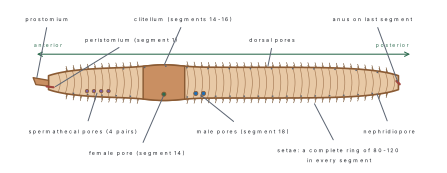
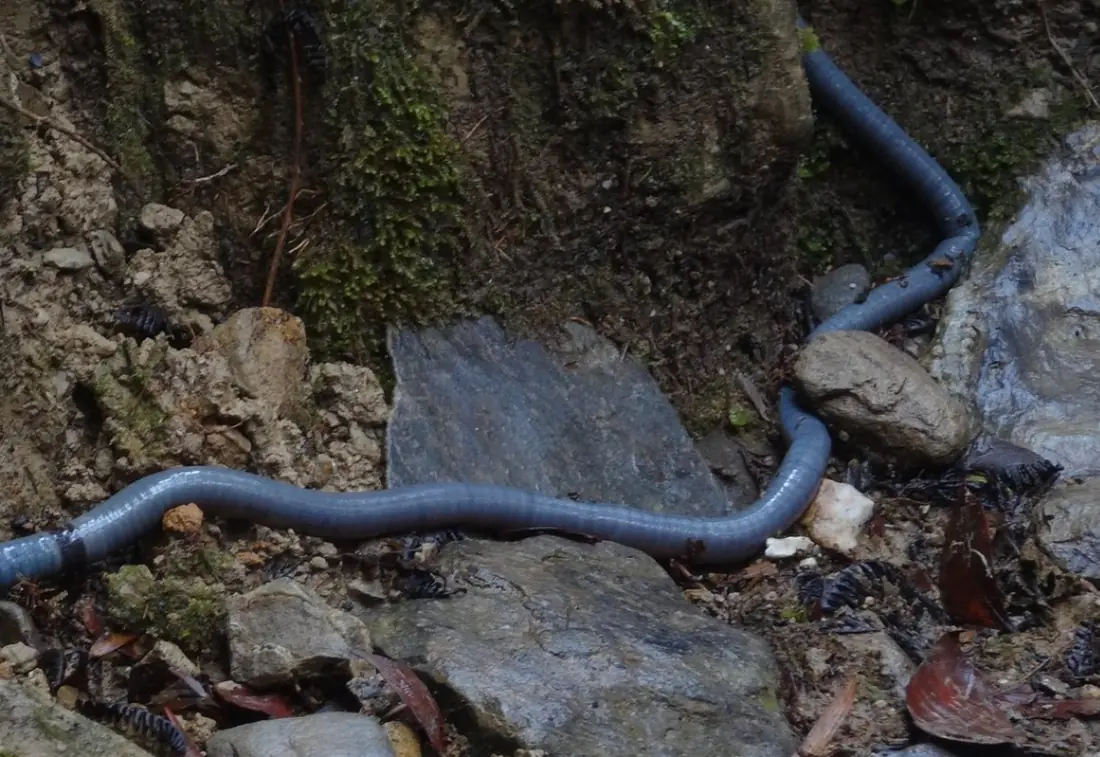
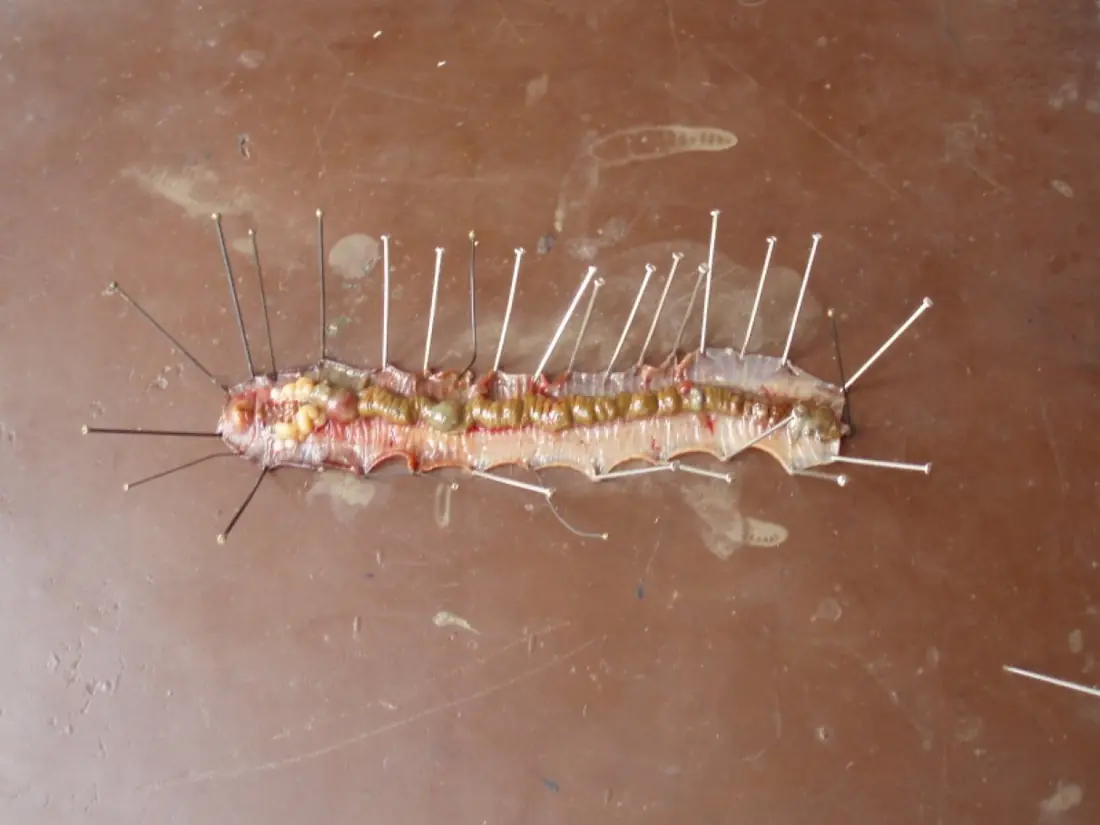
The body is long, narrow and cylindrical, about 150 mm long and 3–5 mm wide, dark brown above from the pigment porphyrin and paler below. It is divided into 100–140 ring-like segments (metameres) numbered from the front, with a fine dark mid-dorsal line marking the dorsal blood vessel beneath the skin.
A small fleshy lobe, the prostomium, overhangs the mouth; it is not a segment, and works as a sensory probe and a wedge for pushing soil apart. The peristomium is segment 1 and bears the crescentic mouth; the last segment carries the anus. Segments 14–16 are swollen into a glandular reddish girdle, the clitellum, which secretes the mucus binding worms during copulation and the albumen and cocoon in which the eggs develop.
Setae are small S-shaped chitinous bristles sunk in pits and moved by protractor and retractor muscles. In Pheretima they are perichaetine — a complete ring of 80 to 120 in every segment — and are absent only from the first segment, the last segment and the clitellum. (Lumbricus has only eight per segment in four pairs: the lumbricine arrangement.) The setae grip the soil so that the muscles have something to pull against.
| Aperture | Number | Position |
|---|---|---|
| Mouth | 1 | anterior, on the peristomium (segment 1) |
| Anus | 1 | terminal, on the last segment |
| Female genital pore | 1 | mid-ventral, on segment 14 |
| Male genital pores | 1 pair | ventro-lateral, on segment 18 |
| Spermathecal pores | 4 pairs | ventro-lateral, in grooves 5/6, 6/7, 7/8 and 8/9 |
| Nephridiopores | very many | scattered over all segments except the first two |
| Dorsal pores | 1 per segment | mid-dorsal, from groove 12/13 backwards; they release coelomic fluid that keeps the skin moist |
Body wall, coelom and locomotion
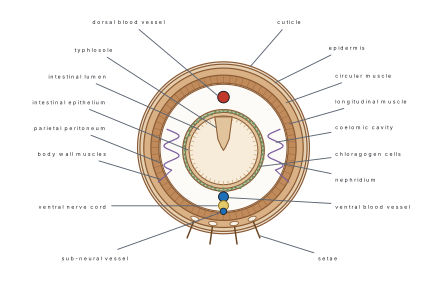
From outside inwards the body wall has five layers: a thin non-cellular cuticle; a single-layered epidermis of columnar supporting cells with glandular, basal and sensory cells among them; a thin circular muscle layer; a thick longitudinal muscle layer in bundles; and an inner coelomic epithelium.
The coelom is a true schizocoelic cavity partitioned by intersegmental septa. It holds a milky alkaline coelomic fluid with proteins, salts and free coelomocytes — the worm's hydrostatic skeleton and transport medium and, squeezed out through the dorsal pores, the source of the film of moisture the skin needs.
Locomotion follows directly. The coelomic fluid is incompressible and the septa stop it flowing far, so when the circular muscles of the front segments contract those segments become long and thin and are pushed forward; their setae anchor them, the longitudinal muscles contract, and the rest of the body is drawn up. A wave of this alternate contraction travels backwards and the worm creeps forward at about 25 cm a minute.
How many setae does an earthworm carry? A Pheretima posthuma has 120 segments. Setae are absent from segment 1, from the clitellum (14, 15, 16) and from the last segment. Taking an average of 100 setae per setigerous segment, estimate the total.
Setigerous segments = 120 - 1 - 3 - 1 = 115, so the total is
about eleven and a half thousand; the extremes of the range give 9200 and 13800, so "roughly ten thousand setae" is safe for any Pheretima. Lumbricus, with 8 setae in each of about 115 segments, has only about 920 — the perichaetine arrangement gives more than ten times as many anchor points.
Digestive system
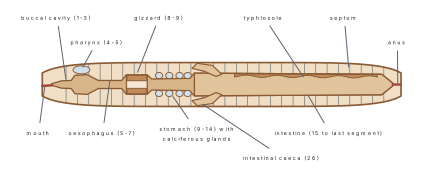
The alimentary canal is a straight tube from mouth to anus — the tube-within-a-tube plan at its clearest. Its regions and their segment numbers must be memorised.
| Region | Segments | Structure and function |
|---|---|---|
| Mouth and buccal cavity | 1–3 | thin-walled and eversible; takes in soil and leaf fragments |
| Pharynx | 4–5 | muscular and bulbous; pharyngeal (salivary) glands secrete mucus and a proteolytic enzyme; acts as a suction pump |
| Oesophagus | 5–7 | short, narrow conducting tube |
| Gizzard | 8–9 | thick, highly muscular, cuticle-lined; grinds the food to a paste |
| Stomach | 9–14 | glandular; calciferous glands in its wall secrete calcium carbonate, which neutralises the humic acid of the soil |
| Intestine | 15 to the last segment | main site of digestion and absorption; bears the typhlosole and the caeca |
| Anus | last segment | egests the castings |
A pair of conical intestinal caeca arises at segment 26 and projects forwards over segments 22–25, secreting amylase. A typhlosole, a deep glandular median infolding of the dorsal wall, runs from about segment 26 to within 25 segments of the hind end; it increases the absorptive surface without lengthening the gut — the trick the human ileum plays with villi.
Digestion is extracellular, using proteases, amylases, and cellulase and chitinase largely of bacterial origin; the undigested soil leaves as worm castings, richer in nitrogen, phosphorus, potassium and calcium than the soil around them.
Blood vascular system
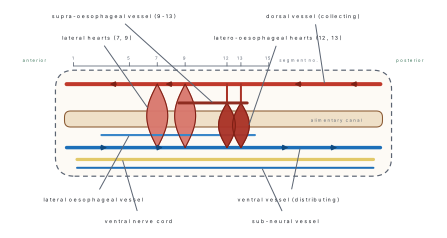
The system is closed — blood never leaves the vessels and never enters the coelom. The blood is red because haemoglobin is dissolved in the plasma rather than packed into cells, the reverse of the vertebrate arrangement; the only blood cells are colourless, nucleated amoebocytes.
The main longitudinal vessels are the dorsal vessel above the gut, the chief collecting vessel, contractile and valved, in which blood flows forwards; the ventral vessel below the gut, the chief distributing vessel, in which blood flows backwards and which supplies a pair of branches to every segment; the sub-neural vessel below the nerve cord; and the supra-oesophageal and paired lateral oesophageal vessels serving the anterior gut.
| Hearts | Segments | Connection |
|---|---|---|
| Lateral hearts | 7 and 9 | dorsal vessel to ventral vessel |
| Latero-oesophageal hearts | 12 and 13 | dorsal and supra-oesophageal vessels to the ventral vessel |
All four pairs are contractile, valved and vertical. Blood collected from the gut, body wall and nephridia enters the dorsal vessel, is driven forward, passes down through the hearts into the ventral vessel and is distributed backwards.
Respiratory system
There are no respiratory organs: respiration is entirely cutaneous. Oxygen dissolves in the film of mucus and coelomic fluid on the cuticle, diffuses through the thin epidermis into a dense subcuticular capillary network and binds to the plasma haemoglobin; carbon dioxide leaves by the reverse route. All of it depends on the skin staying wet — which is why the worm is nocturnal and suffocates if its skin dries.
Excretory system
Excretion is by thousands of nephridia. A typical nephridium is a coiled tubule beginning in a ciliated funnel, the nephrostome, opening into the coelom of the segment in front, then a narrow neck, a long twisted body and a terminal duct. Three kinds occur, and the distinction between exonephric and enteronephric types is characteristic of Pheretima.
| Type | Position | Opening |
|---|---|---|
| Septal nephridia | on both faces of the septa, from segment 15 backwards | into the intestine (enteronephric) |
| Integumentary nephridia | on the inner body wall from segment 3 back, most numerous in the clitellum | through nephridiopores (exonephric) |
| Pharyngeal nephridia | three paired tufts in segments 4, 5 and 6 | into the buccal cavity and pharynx (enteronephric) |
The waste is chiefly ammonia and urea: the worm is ammonotelic in wet soil and shifts towards ureotelism as it dries. Chloragogen cells round the gut and dorsal vessel store and excrete waste, like a vertebrate liver. Because the septal and pharyngeal nephridia empty into the gut, much of their water is reabsorbed.
Nervous system and sense organs
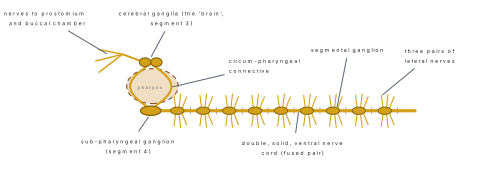
The central nervous system is a nerve ring round the pharynx plus a cord below the gut. A pair of cerebral ganglia (the "brain") lies on the pharynx in segment 3; two circumpharyngeal connectives pass round the pharynx to the sub-pharyngeal ganglia in segment 4; and from these the ventral nerve cord runs to the last segment. The cord is double but fused, solid and ventral, with a swollen ganglion in every segment giving off three pairs of lateral nerves — the exact opposite of the chordate plan, which is single, hollow and dorsal. An autonomic plexus lies in the wall of the gut.
Sense organs are simple: no eyes, but photoreceptor cells in the epidermis, crowded on the prostomium, so the worm withdraws from light, plus tactile, chemical and thermal receptors.
Reproductive system and development
Pheretima is hermaphrodite (monoecious) but protandrous, the sperm maturing before the ova, so self-fertilisation is impossible and cross-fertilisation is the rule.
Male organs. Two pairs of testes lie in segments 10 and 11 in fluid-filled testis sacs. Immature sperm pass to two pairs of seminal vesicles in segments 11 and 12 to mature, are collected by spermiducal funnels into the vasa deferentia, and leave by the male genital pores on segment 18. Two pairs of prostate glands in segments 16–21 secrete a fluid that activates the sperm.
Female organs. A single pair of ovaries hangs from the septum in segment 13. Ova are shed into the coelom, gathered by ciliated oviducal funnels and carried by short oviducts that unite to open at the single mid-ventral female genital pore on segment 14. Four pairs of spermathecae in segments 6, 7, 8 and 9 store the partner's sperm.
Copulation and development. On a warm damp night two worms meet head to tail, apply their ventral surfaces and are bound by a mucus sheath from the clitella, each charging the other's spermathecae. Days later the clitellum secretes a tough cocoon with a store of albumen; the worm wriggles backwards out of it, and as the cocoon slides forward it picks up ova at segment 14 and stored sperm at segments 6–9. Fertilisation is therefore external, inside the cocoon. One to four young worms emerge after two or three weeks. Development is direct.
Two marks are regularly thrown away here. A hermaphrodite is not necessarily self-fertilising: Pheretima is hermaphrodite and cross-fertilising. And although sperm pass from body to body, fertilisation happens outside both worms, in the cocoon — so write "external fertilisation", not "internal".
Economic importance
The burrows aerate and drain the soil, and a healthy field may hold over a million worms per hectare. The castings are rich in available nitrogen, phosphate, potash, calcium and humus, so the worm continuously manufactures topsoil — Darwin's reason for calling it the farmer's friend. Farmed worms turn kitchen and farm waste into vermicompost, now a small enterprise in Nepal's hill districts, and worm meal is used as poultry and fish feed. Against this, casts spoil lawns and earthworms host poultry parasites such as Syngamus.
8.4 Frog (Rana tigrina)
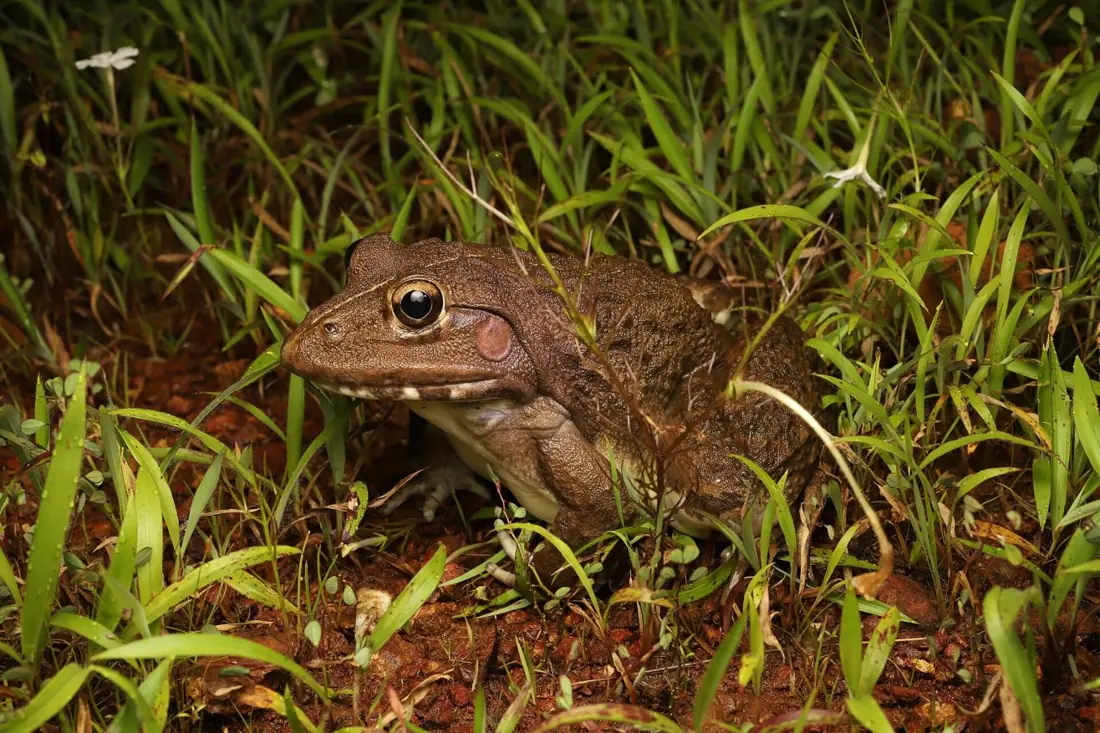
Rana tigrina, the Indian bull frog, is the commonest large frog of the Nepalese Terai and the standard vertebrate type study. It leads two lives: beginning as a gill-breathing herbivorous tadpole in water and ending as a lung-breathing carnivore largely on land.
Habit and habitat
The frog is amphibious, living in ponds, ditches and paddy fields; nocturnal; carnivorous, taking insects, worms, snails and small fish; and poikilothermic. Unable to regulate its temperature, it hibernates in winter and aestivates in the hot dry season, buried in mud, living on stored fat and respiring only through the skin. Its mottled olive-green back is protective camouflage.
External features
The body is divided into head and trunk; there is no neck and no tail in the adult. The skin is smooth, moist, slimy and scaleless, loosely attached and packed with mucous glands and blood capillaries — a respiratory organ as much as a covering.
The head bears a blunt snout, a wide mouth, a pair of valved external nares, two bulging eyes with a fixed upper eyelid, a movable lower eyelid and a transparent nictitating membrane that covers the eye under water, and behind each eye a circular tympanum flush with the skin — there is no external ear. The forelimbs are short and four-digited; the hindlimbs are long, muscular and five-toed with webbed feet for leaping and swimming. The single cloacal aperture passes faeces, urine and gametes alike.
Sexual dimorphism: the male is smaller, has a larger tympanum, a pair of vocal sacs at the angles of the jaws, and a rough dark nuptial pad on the first digit of each forelimb for gripping the female in amplexus.
Digestive system
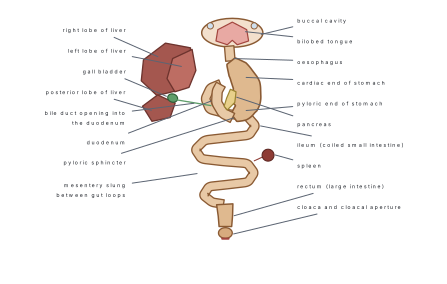
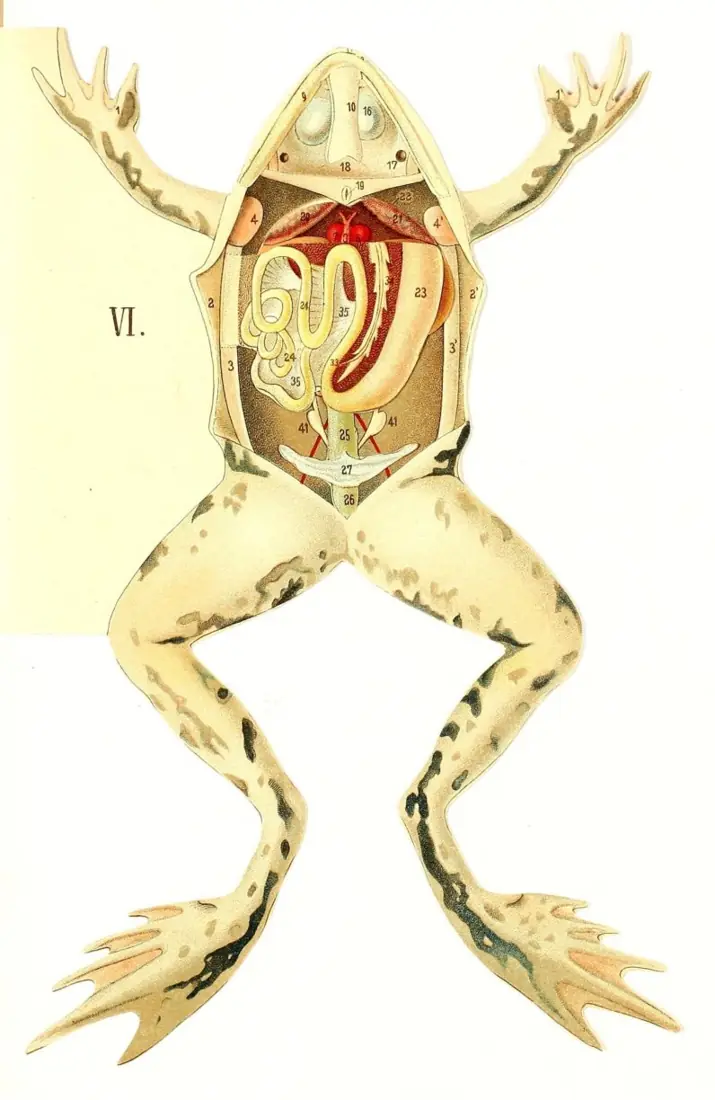
The alimentary canal is short, as in all carnivores. The buccal cavity has a row of fine maxillary teeth on the upper jaw and two patches of vomerine teeth on the palate, the lower jaw being toothless; the teeth do not chew but only stop struggling prey escaping. The tongue is large, sticky and bilobed, attached at the front of the floor and free behind, so it can be flicked far out to catch an insect and flicked back with it.
Behind the pharynx a short oesophagus leads to the stomach, a wide muscular bag with cardiac and pyloric regions that begins protein digestion. The small intestine follows: the short duodenum beside the stomach, then the long coiled ileum, lined with villi, where digestion is completed and absorption occurs. The wide rectum absorbs water and opens into the cloaca.
Two glands discharge into the duodenum: the dark-red liver, with a right and a bilobed left lobe and the green gall bladder between them, whose bile emulsifies fats and neutralises the acid chyme; and the yellowish pancreas, whose duct joins the bile duct to form the common bile duct.
Respiratory system
The frog breathes in three ways, and a full answer must name all three.
- Cutaneous, through the moist, thin, vascular skin. It works in water and in air, costs no muscular effort, and is the only method available during hibernation and aestivation; over the year it accounts for most of the total gas exchange and for almost all carbon-dioxide loss.
- Buccopharyngeal, across the moist lining of the buccal cavity, used at rest on land with the mouth shut and the throat visibly fluttering.
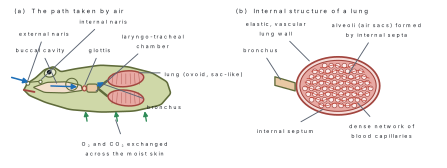
- Pulmonary, through the lungs, when the frog is active. Air passes: external nares → nasal chambers → internal nares → buccal cavity → glottis → laryngo-tracheal chamber → bronchi → lungs.
The lungs are a pair of thin-walled, elastic, pink, ovoid sacs whose inner surface is thrown into septa dividing it into alveoli, each covered by a capillary network. With no diaphragm and no movable ribs the frog cannot suck air in, so it uses a buccal force pump: with the glottis shut the buccal floor is lowered and air drawn in through the nares; the nares close, the glottis opens, and raising the buccal floor forces air into the lungs. Elastic recoil drives expiration.
Blood vascular system
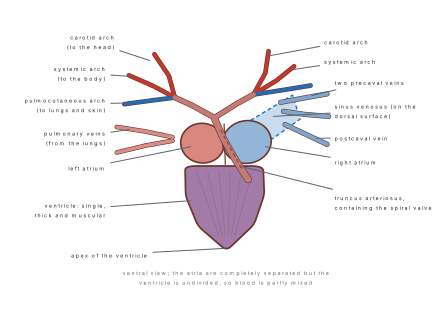
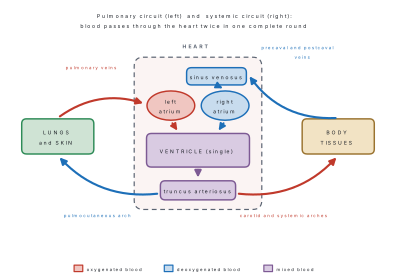
The system is closed, with a three-chambered heart — two atria and one undivided ventricle — in a pericardial cavity, plus two accessory chambers: the thin-walled sinus venosus on the dorsal surface, which receives the two precaval veins and the postcaval vein and delivers to the right atrium, and the truncus arteriosus leaving the ventricle, which contains a spiral valve.
Deoxygenated blood reaches the right atrium through the sinus venosus; oxygenated blood from the lungs reaches the left atrium through the pulmonary veins; both empty into the single ventricle. Complete mixing is avoided by the muscular trabeculae of the ventricle and by the spiral valve, which steers the most deoxygenated blood into the pulmocutaneous arch (to lungs and skin), mixed blood into the systemic arch (to the body) and the best-oxygenated blood into the carotid arch (to the brain). Mixing is reduced but not abolished, so the frog's double circulation is incomplete.
The blood has plasma and three kinds of corpuscle: nucleated, oval, biconvex red cells (unlike a mammal's enucleate discs), white cells and spindle cells. Both a hepatic portal and a renal portal system are present, and the lymphatic system has contractile lymph hearts.
How fast does the blood go round? A frog's heart beats 50 times a minute and ejects 0.20 mL at each beat; the total blood volume is 5.0 mL. How long does one complete turnover take?
The cardiac output is the stroke volume times the rate,
and the turnover time is the blood volume divided by that output,
Thirty seconds; a resting human takes about 60 s (5 L per minute against 5 L of blood). The frog's small size and low metabolic rate let it manage with a three-chambered heart; a bird or mammal running a warm body at ten times the metabolic rate needs a four-chambered heart that keeps the two circuits separate.
Excretory system and osmoregulation
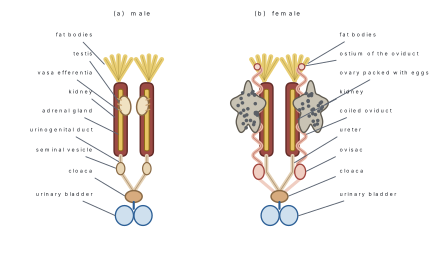
A pair of dark-red, flattened mesonephric kidneys lies against the dorsal body wall beside the vertebral column, each with a narrow yellow adrenal gland along its ventral surface and built of many uriniferous tubules beginning in Malpighian corpuscles.
Urine leaves by a ureter opening dorsally into the cloaca. In the male the same duct also carries sperm and is therefore the urinogenital duct — the reason the two systems are described together. A thin-walled bilobed urinary bladder opens ventrally into the cloaca, not into the ureters, so urine enters it from the cloaca and water can be reabsorbed on land.
The adult is ureotelic, excreting urea, far less toxic than ammonia and much cheaper in water; the aquatic tadpole is ammonotelic. The switch at metamorphosis is a neat case of excretion matching habitat.
Nervous system and sense organs
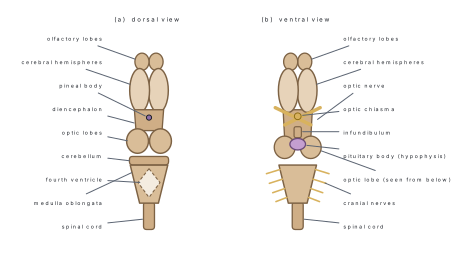
The nervous system has a central part (brain and spinal cord), a peripheral part (10 pairs of cranial nerves and 10 pairs of spinal nerves) and an autonomic part. The brain lies in the cranium in two meninges and has three regions.
- Forebrain: a pair of small olfactory lobes, a pair of elongated cerebral hemispheres, and the diencephalon, roofed by the pineal body and bearing on its floor the optic chiasma, the infundibulum and the pituitary body.
- Midbrain: a pair of large rounded optic lobes, the main visual centres — far more prominent than in a mammal, where sight has moved to the cortex.
- Hindbrain: a small transverse cerebellum for balance and coordination, small because the frog makes few complex movements; and the medulla oblongata, holding the centres for respiration, heartbeat and digestion, which narrows behind into the spinal cord.
Sense organs are well developed: eyes with a nictitating membrane; ears with a tympanum, a middle ear containing the rod-like columella, and an internal ear with semicircular canals; olfactory epithelium; taste buds; and skin receptors. The tadpole also has a lateral line system, lost at metamorphosis.
Reproductive system and life history
The frog is dioecious, with external fertilisation and indirect development.
Male. A pair of pale-yellow oval testes is attached to the ventral surface of the kidneys by the mesorchium. Ten to twelve vasa efferentia carry sperm into the kidney, where they join Bidder's canal and then the urinogenital duct; a dilation of the duct serves as a seminal vesicle. Yellow finger-like fat bodies store food for the breeding season.
Female. A pair of large lobed ovaries lies near the kidneys, attached by the mesovarium but not joined to them. Ova are shed into the coelom and picked up by the funnel-shaped ostium of a long coiled oviduct, whose hind end dilates into an ovisac opening separately into the cloaca. A mature female sheds 2500 to 3000 eggs at a time.
Breeding and development. Breeding follows the first heavy monsoon rain. The male grips the female behind the forelimbs with his nuptial pads — amplexus — which stimulates her to shed her eggs into the water; he sheds sperm over them at once, so fertilisation is external. The jelly-coated eggs hatch in a few days into a tadpole, utterly unlike its parent: herbivorous, with horny jaws, a long coiled gut, a finned tail, first external and then internal gills, a two-chambered heart, a lateral line and no limbs. Metamorphosis, controlled by thyroxine, converts it into a frog in about two months. Progressive changes: hindlimbs then forelimbs, lungs, eyelids and tympanum, a three-chambered heart, and a shortened gut. Retrogressive changes: tail, gills, horny jaws and lateral line are digested away by lysosomal enzymes.
Amplexus is not copulation. The male never introduces sperm into the female; he merely clasps her so that eggs and sperm are shed into the same small volume of water at the same moment. Calling amplexus "internal fertilisation", or the frog's development "direct", loses the mark.
Economic importance
Frogs eat enormous numbers of insects, including paddy pests and the mosquitoes that carry malaria and dengue, and are among the best agents of biological pest control in Nepalese farmland. Export as frog legs is now restricted, because over-collection caused insect outbreaks and heavier pesticide use. They remain a standard laboratory animal, and because their permeable skin absorbs whatever is in the water they are sensitive bio-indicators of pollution.
Chapter summary
- Protista holds the eukaryotes that are neither plant, animal nor fungus; the Protozoa are classified by locomotory organelle into Rhizopoda, Mastigophora, Sporozoa and Ciliata.
- Paramecium caudatum is a slipper-shaped ciliate with a pellicle, trichocysts, two contractile vacuoles, a macronucleus and a micronucleus; it swims by a metachronal wave, filter feeds, divides by transverse binary fission and reorganises its nuclei by conjugation.
- Animals are classified by level of organisation, body plan, symmetry, germ layers, coelom and segmentation: Porifera cellular, Coelenterata diploblastic and radial, Platyhelminthes acoelomate, Nemathelminthes pseudocoelomate, Annelida onwards truly coelomate. Chordata is defined by a notochord, a dorsal hollow nerve cord, pharyngeal gill slits and a post-anal tail.
- Pheretima posthuma has a clitellum on segments 14–16, perichaetine setae, a gizzard, calciferous glands, caeca at segment 26 and a typhlosole, four pairs of hearts in a closed circulation, three kinds of nephridia and a solid ventral nerve cord. It is hermaphrodite but cross-fertilising, with external fertilisation inside the cocoon.
- Rana tigrina breathes cutaneously, buccopharyngeally and through lungs worked by a buccal force pump; its three-chambered heart with a spiral valve gives a double but incomplete circulation. It is ureotelic, with mesonephric kidneys and a shared urinogenital duct in the male; fertilisation is external after amplexus, and thyroxine-driven metamorphosis reverses almost every larval character.
Practice questions
Group A — Multiple choice (1 mark each)
-
The locomotory organelle of an adult sporozoan is [1]aciliabflagellacpseudopodiadnone
-
Paramecium caudatum possesses [1]aone micronucleusbtwo micronucleicmany micronucleidno micronucleus
-
Flame cells are the excretory structures of [1]aAnnelidabPlatyhelminthescMolluscadEchinodermata
-
The pseudocoelomate phylum among the following is [1]aPlatyhelminthesbNemathelminthescAnnelidadArthropoda
-
The water vascular system with tube feet is characteristic of [1]aMolluscabArthropodacEchinodermatadChordata
-
In Pheretima posthuma the setae of one segment number about [1]a4b8c80–120d800
-
The number of pairs of hearts in the earthworm is [1]atwobthreecfourdfive
-
The spiral valve of the frog lies in the [1]asinus venosusbtruncus arteriosuscventricledleft atrium
Answers to Group A
1. (d) — adult sporozoans glide.
2. (a) — P. aurelia has two.
3. (b) — flame cells terminate the protonephridia of flatworms.
4. (b) — the cavity of Ascaris is a persistent blastocoel, unlined on the gut side.
5. (c).
6. (c) — Pheretima is perichaetine.
7. (c) — lateral hearts in 7 and 9, latero-oesophageal in 12 and 13.
8. (b) — it steers blood into the three aortic arches.
Group B — Short answer questions (4 marks each)
-
Distinguish between acoelomate, pseudocoelomate and coelomate animals, giving one example of each. [4]
-
How does Paramecium keep its water content constant in pond water? [4]
-
State four diagnostic characters of phylum Arthropoda and name two examples. [4]
-
List the external apertures of Pheretima posthuma with their positions. [4]
-
Describe the three types of nephridia found in the earthworm. [4]
-
The earthworm is hermaphrodite, yet it cannot fertilise itself, and its fertilisation is external. Explain. [4]
-
Explain the three modes of respiration in the frog and state when each is used. [4]
-
Summarise the progressive and retrogressive changes that occur during the metamorphosis of a tadpole. [4]
Answers to Group B
1. Acoelomate — no body cavity, the space packed with mesodermal parenchyma (Planaria). Pseudocoelomate — a cavity present but a persistent blastocoel, lined by mesoderm on the body-wall side only (Ascaris). Coelomate — a true coelom within the mesoderm, lined by peritoneum on both body wall and gut (Pheretima).
2. Pond water is hypotonic, so water enters by osmosis. Two contractile vacuoles, each fed by radiating canals, collect it and discharge through a temporary pore, contracting alternately every 10–20 s. Their role is osmoregulation, not excretion: ammonia leaves by diffusion.
3. (i) Jointed appendages. (ii) A chitinous exoskeleton that is moulted (ecdysis). (iii) A haemocoel with an open circulation. (iv) Segmented body, typically head, thorax and abdomen, with compound eyes. Examples: Periplaneta americana, Palaemon.
4. Mouth on the peristomium (segment 1); anus on the last segment; female genital pore mid-ventral on segment 14; one pair of male genital pores on segment 18; four pairs of spermathecal pores in grooves 5/6, 6/7, 7/8 and 8/9; many nephridiopores; mid-dorsal pores from groove 12/13 backwards.
5. Septal nephridia, on both faces of the septa from segment 15 backwards, open into the intestine (enteronephric). Integumentary nephridia, on the inner body wall from segment 3 back and most numerous in the clitellum, open on the skin (exonephric). Pharyngeal nephridia form three paired tufts in segments 4–6, lack nephrostomes and open into the buccal cavity and pharynx.
6. Both sets of gonads occur in one worm, but it is protandrous — sperm mature before the ova of the same animal — so cross-fertilisation is obligatory. During copulation each worm charges the other's spermathecae. Later the clitellum secretes a cocoon; as the worm backs out, the cocoon collects ova at segment 14 and stored sperm at segments 6–9, so the gametes meet inside the cocoon, outside both parents.
7. Cutaneous respiration through the moist vascular skin works in water and air, is the only method during hibernation and aestivation, and accounts for most of the year's gas exchange. Buccopharyngeal respiration across the buccal lining is used at rest on land. Pulmonary respiration serves the active animal, air being driven in by a buccal force pump.
8. Progressive: hindlimbs then forelimbs; lungs replace gills; eyelids and a tympanum appear; the heart becomes three-chambered; the gut shortens; excretion shifts from ammonotelic to ureotelic. Retrogressive: tail, gills, horny jaws and lateral line are digested away by lysosomal enzymes. Thyroxine triggers the change, which takes about two months.
Group C — Long answer questions (8 marks each)
-
Describe the structure of Paramecium caudatum with a labelled diagram, and explain how it obtains and digests its food. [8]
-
On what characters is Kingdom Animalia classified? Name the nine phyla in order of increasing complexity and give two diagnostic characters and one example of each. [8]
-
Describe the digestive system of Pheretima posthuma with a labelled diagram, and add a note on the typhlosole and the intestinal caeca. [8]
-
Describe the structure of the frog's heart with a labelled diagram, trace the course of blood through it, and explain why the frog's double circulation is said to be incomplete. [8]
Answers to Group C
1. Structure — slipper-shaped ciliate, 170–330 μm; pellicle sculptured into hexagons with one cilium each and longer caudal cilia behind; ectoplasm with trichocysts; granular endoplasm; oral groove leading to vestibule, cytostome and cytopharynx, with a cytopyge behind; two contractile vacuoles with radiating canals; a vegetative macronucleus and a reproductive micronucleus. Draw and label these. Nutrition — holozoic filter feeding: oral-groove cilia sweep bacteria into the vestibule; a food vacuole forms at the base of the cytopharynx and circulates by cyclosis; digestion is intracellular, the vacuole first acidic (about pH 4) then alkaline as proteases, amylases and lipases act; the residue is egested at the cytopyge.
2. Characters used: level of organisation; body plan; symmetry; germ layers; coelom; segmentation and cephalisation. Phyla: Porifera — cellular level, canal system with choanocytes and spicules (Sycon); Coelenterata — radial, diploblastic, cnidoblasts, blind-sac gut (Hydra); Platyhelminthes — flattened, acoelomate, flame cells (Taenia); Nemathelminthes — cylindrical, pseudocoelomate, complete gut (Ascaris); Annelida — metameric segmentation, true coelom, nephridia (Pheretima); Arthropoda — jointed appendages, chitinous exoskeleton, haemocoel (Periplaneta); Mollusca — soft unsegmented body with foot, mantle and shell, radula (Pila); Echinodermata — marine, pentamerous radial adult, water vascular system (Asterias); Chordata — notochord, dorsal hollow nerve cord, gill slits, post-anal tail (Rana).
3. A straight tube from mouth to anus: buccal cavity 1–3; pharynx 4–5, with salivary glands secreting mucus and a protease, acting as a suction pump; oesophagus 5–7; gizzard 8–9, thick, muscular and cuticle-lined, grinding the food; stomach 9–14, whose calciferous glands neutralise the humic acid of the soil; intestine from 15 to the last segment; terminal anus. Digestion is extracellular and the residue leaves as castings. Note — the typhlosole is a deep median infolding of the dorsal intestinal wall from about segment 26, multiplying the absorptive surface without lengthening the gut; a pair of conical caeca arises at segment 26, projects forward over segments 22–25 and secretes amylase. A labelled longitudinal section is required.
4. Structure — three chambers (two atria, one undivided ventricle) in a pericardium, plus the thin-walled sinus venosus dorsally, receiving the two precaval and one postcaval veins, and the truncus arteriosus, which leaves the ventricle, contains a spiral valve and divides into two aortic trunks giving carotid, systemic and pulmocutaneous arches. Course of blood — deoxygenated blood from the body enters the sinus venosus and right atrium; oxygenated blood returns by the pulmonary veins to the left atrium; both empty into the single ventricle, where trabeculae limit mixing; the spiral valve then directs the most deoxygenated blood into the pulmocutaneous arch, mixed blood into the systemic arch and the best-oxygenated blood into the carotid arch. Why incomplete — blood passes through the heart twice in one circuit, so the circulation is double, but with one ventricle the streams are not kept wholly apart and the systemic arch carries mixed blood. Only birds and mammals, with a four-chambered heart, separate them completely.
Practise more: Biology question bank