Unit 2 · Botany · 30 teaching hours · 64 min read
Floral Diversity
What the syllabus asks for 8
- Introduction [1]: three domains of life; binomial nomenclature; five-kingdom classification; flora status of Nepal
- Fungi
- Lichen
- Algae
- Bryophyta
- Pteridophyta
- Gymnosperm
- Angiosperm [16]: morphology; taxonomic hierarchy; artificial, natural and phylogenetic systems; Brassicaceae; Fabaceae; Solanaceae; Liliaceae
Nepal occupies about one tenth of one per cent of the land surface of the Earth, yet more than three per cent of all known plant species grow inside its borders. Walk from the Terai at 60 m to the Kanchenjunga snowline at 8,586 m and you pass through sal forest, subtropical Schima–Castanopsis forest, oak and rhododendron, blue pine, birch, juniper scrub and finally cushion plants on bare moraine — the whole latitudinal sweep of the northern hemisphere compressed into 200 km. This unit is the catalogue of that diversity. It is the largest unit in the Grade 11 course (30 of the 64 Botany hours) and it carries the largest share of the Botany marks, so it rewards steady work rather than last-week cramming.
The plan is simple and it is the plan evolution itself followed. We begin with how biologists name and sort organisms, then climb the plant kingdom step by step: fungi (not plants at all, but traditionally studied here), lichens, algae, bryophytes, pteridophytes, gymnosperms and finally the angiosperms, where four named families are studied in detail. At every step ask the same three questions — what is the plant body like, how does it reproduce, and what is it used for?
The Botany section of the paper draws four short answers and one long answer, and this unit supplies most of them. Expect: a comparison table (bryophyta vs pteridophyta, gymnosperm vs angiosperm, monocot vs dicot, algae vs fungi); a labelled diagram of Rhizopus, Spirogyra, Funaria, a fern sorus, a Pinus shoot or an L.S. of a flower; a life cycle with ploidy levels marked; economic importance of a group with named examples; and for 8 marks the full account of one family with floral formula and floral diagram. The four families are the single most reliable long question in the whole paper.
2.1 Introduction
Three domains of life
For a century all living things were sorted into two groups, plants and animals. The electron microscope destroyed that scheme by revealing a far deeper divide than the one between an oak and an ox: the divide between cells that keep their DNA in a nucleus and cells that do not. Then in 1977 Carl Woese compared the base sequences of 16S ribosomal RNA across hundreds of organisms and found that the prokaryotes were not one group but two, as different from each other as either is from us. He proposed the three domains — the highest rank in modern classification, above kingdom.

| Feature | Archaea | Bacteria | Eukarya |
|---|---|---|---|
| Nucleus | absent | absent | present |
| Cell wall | pseudopeptidoglycan or protein | peptidoglycan (murein) | cellulose, chitin or none |
| Membrane lipids | branched, ether-linked | unbranched, ester-linked | unbranched, ester-linked |
| Ribosome | 70S | 70S | 80S (cytoplasmic) |
| Introns in genes | present in some | absent | present |
| Sensitive to streptomycin | no | yes | no |
| Histone proteins | present | absent | present |
| Habitat | often extreme (hot springs, brine, gut) | everywhere | everywhere |
| Examples | Methanobacterium, Halobacterium, Sulfolobus | Escherichia coli, Rhizobium, Nostoc | Spirogyra, Agaricus, mango, human |
Archaea are the extremophiles: the methanogens that make marsh gas and biogas, the halophiles of salt pans, and the thermoacidophiles of the hot springs at Tatopani, some of which grow happily above 100 °C. Their tough, ether-linked lipids are what let them do it.
The highest taxonomic rank, above kingdom, based chiefly on ribosomal RNA sequence and cell architecture. The three domains are Archaea, Bacteria and Eukarya; the first two together were formerly the single kingdom Monera.
Binomial nomenclature
Common names are useless for science. "Chyau" means any mushroom; the plant a Kathmandu shopkeeper calls tulsi is not the plant a Bengali calls tulsi; and the marigold of Nepal, Mexico and Africa are three different species. The cure is binomial nomenclature, formalised by the Swedish naturalist Carl Linnaeus in Species Plantarum (1753), which is taken as the starting point of all modern plant names.
The system of giving every species a two-word Latin name, in which the first word is the genus (generic name) and the second is the species epithet (specific epithet). Together the two words, and only the two together, name the species.
The rules are laid down in the International Code of Nomenclature for algae, fungi, and plants (ICN), revised at each International Botanical Congress. The ones you must be able to state are:
- The name is written in Latin or latinised form, whatever the language of origin.
- It has exactly two parts. The genus begins with a capital letter, the species epithet with a small letter, even when it honours a person — Pinus wallichiana, not Pinus Wallichiana.
- The whole binomial is italicised in print and underlined separately (each word underlined on its own) in handwriting.
- The author's name may be added, unitalicised and abbreviated, after the binomial: Oryza sativa L. means the species was first validly described by Linnaeus.
- Names must be published with a description and a preserved type specimen lodged in a herbarium. For Nepal the National Herbarium and Plant Laboratories (KATH) at Godawari holds that role.
- The principle of priority applies: where two names exist for one species, the earliest validly published name wins, the later one becoming a synonym.
- A tautonym (the same word twice, as in Bison bison) is allowed in zoology but not in botany.
| Plant | Binomial | Family |
|---|---|---|
| Rice (dhan) | Oryza sativa | Poaceae |
| Sal | Shorea robusta | Dipterocarpaceae |
| Lali gurans (national flower) | Rhododendron arboreum | Ericaceae |
| Mustard (tori) | Brassica campestris | Brassicaceae |
| Potato (alu) | Solanum tuberosum | Solanaceae |
| Onion (pyaj) | Allium cepa | Liliaceae (sensu lato) |
| Chilaune | Schima wallichii | Theaceae |
| Yew (loth salla) | Taxus wallichiana | Taxaceae |
Five-kingdom classification
Robert H. Whittaker proposed the five-kingdom system in 1969, using three criteria that Linnaeus could not have used: cell structure (prokaryotic or eukaryotic), body organisation (unicellular, colonial, multicellular with or without tissues) and mode of nutrition (autotrophic, saprophytic by absorption, or heterotrophic by ingestion). That last criterion is what finally pulled fungi out of the plant kingdom, where they had sat for two centuries.
| Kingdom | Cell type | Wall | Nutrition | Body | Examples |
|---|---|---|---|---|---|
| Monera | prokaryotic | peptidoglycan | autotrophic or heterotrophic | unicellular | bacteria, Nostoc, mycoplasma |
| Protista | eukaryotic | variable or absent | photosynthetic or heterotrophic | unicellular or colonial | Chlamydomonas, diatoms, Amoeba, Plasmodium |
| Fungi | eukaryotic | chitin | saprophytic or parasitic, absorptive | mycelial (coenocytic or septate) | Rhizopus, Agaricus, yeast |
| Plantae | eukaryotic | cellulose | autotrophic (photosynthetic) | multicellular with tissues | mosses, ferns, Pinus, mango |
| Animalia | eukaryotic | absent | heterotrophic by ingestion | multicellular with tissues and organs | Hydra, earthworm, frog, human |
Monera deserves a paragraph because everything else in the unit is eukaryotic. Its members are prokaryotes: no nucleus, no membrane-bound organelle, a single circular DNA molecule, 70S ribosomes and a wall of peptidoglycan. They may be autotrophic (photoautotrophic cyanobacteria such as Nostoc and Anabaena, which fix both carbon and nitrogen; chemoautotrophic Nitrosomonas and Nitrobacter, which run the nitrogen cycle) or heterotrophic (saprophytic decomposers, symbiotic Rhizobium in root nodules, and pathogens such as Xanthomonas oryzae of rice). Cyanobacteria used to be called blue-green algae, and some books still place them with the algae; on the five-kingdom scheme they are Monera, because the cell is prokaryotic. Viruses are excluded from all five kingdoms altogether — they are acellular, obligate intracellular parasites, and they are dealt with with the bacteria in Unit 3.
Whittaker's scheme is a teaching scheme, not the last word. Protista is a dustbin: it holds photosynthetic Chlamydomonas, animal-like Amoeba and fungus-like slime moulds together only because they are all "simple eukaryotes". Monera lumps the two prokaryotic domains that Woese later showed are profoundly different. Modern classification has moved on, but the NEB syllabus asks for the five kingdoms, so learn them — and be able to say why they are imperfect.
Flora status of Nepal
Nepal covers 147,181 km², about 0.1 % of the Earth's land, and squeezes an altitudinal range of more than 8,500 m into an average north–south width of 193 km. That vertical compression, plus its position at the meeting point of the Palaearctic and Oriental realms, gives the country a flora out of all proportion to its size: over 3 % of the world's known plants. The figures below follow Nepal's National Biodiversity Strategy and Action Plan (2014) and the Department of Plant Resources; they are revised upward almost every year as new collections are described, so quote them as approximations.
| Group | Species recorded in Nepal | Share of world total |
|---|---|---|
| Angiosperms (flowering plants) | about 6,500 (NBSAP lists 6,973) | about 2.7 % |
| Gymnosperms | 28 (about 20 indigenous) | about 2.8 % |
| Pteridophytes (ferns and allies) | 534 | about 5 % |
| Bryophytes | 1,150 | about 6 % |
| Lichens | 771 | about 4 % |
| Fungi | about 2,000 | under 2 % |
| Algae | about 800 | about 2 % |
Nepal recognises 118 ecosystems, 75 vegetation types and 35 forest types. About 300 flowering plants are endemic — found nowhere else on Earth (published estimates range from 284 to over 400 depending on the treatment of doubtful taxa), most of them in the high Himalaya where isolation by ridge and valley is greatest. Forest covers roughly 45 % of the country if shrubland is included. Against that richness stand real threats: over-collection of medicinal plants such as Nardostachys jatamansi (jatamansi), Neopicrorhiza scrophulariiflora (kutki) and Ophiocordyceps sinensis (yarsagumba), the clearing of Terai forest for settlement, invasive species such as Mikania micrantha and Lantana camara, and the upslope creep of vegetation belts under a warming climate.
Nepal's land area is 147,181 km²; the world's land area is about 148,940,000 km². Nepal has about 6,500 flowering plants; the world has about 250,000. Show that Nepal's flora is disproportionately rich, and express that disproportion as a single number.
Share of land area
(147,181 ÷ 148,940,000) × 100 = 0.0988 % ≈ 0.1 %
Share of flowering plants
(6,500 ÷ 250,000) × 100 = 2.6 %
The disproportion is the ratio of these two shares:
2.6 ÷ 0.0988 ≈ 26
So a square kilometre of Nepal carries, on average, about 26 times as many species of flowering plant as an average square kilometre of the Earth's land surface. This single figure is the quantitative statement of "Nepal is a biodiversity hotspot", and the cause is the altitudinal range: climbing 1,000 m is climatically equivalent to travelling roughly 1,000 km towards the pole, so a single Nepali hillside stacks many climates one above another.
2.2 Fungi
Fungi are eukaryotic, achlorophyllous, heterotrophic organisms with a body of thread-like hyphae and a cell wall of chitin. They cannot make their own food and they cannot swallow it either, so they do the only thing left: they secrete digestive enzymes onto the substrate and absorb the soluble products. That single habit — absorptive heterotrophy — explains almost everything else about them. It explains the hypha, which is the ideal shape for penetrating a substrate and maximising surface area; it explains why fungi are the chief decomposers of the biosphere; and it explains why so many are parasites. The study of fungi is mycology.
The plant body. Except in the unicellular yeasts, the fungal body is a mycelium, a network of hyphae. A hypha is a tube of cytoplasm bounded by a chitinous wall, growing only at its tip. Hyphae are of two kinds: coenocytic (aseptate) hyphae have no cross-walls, so the whole mycelium is one long multinucleate cell, as in Rhizopus and Mucor; septate hyphae are divided by cross-walls into uninucleate, binucleate or multinucleate compartments, as in Penicillium and Agaricus. Reserve food is stored as glycogen and oil, never as starch. In the higher fungi the hyphae may be packed into hard, tissue-like masses called plectenchyma that form the stalk and cap of a mushroom.
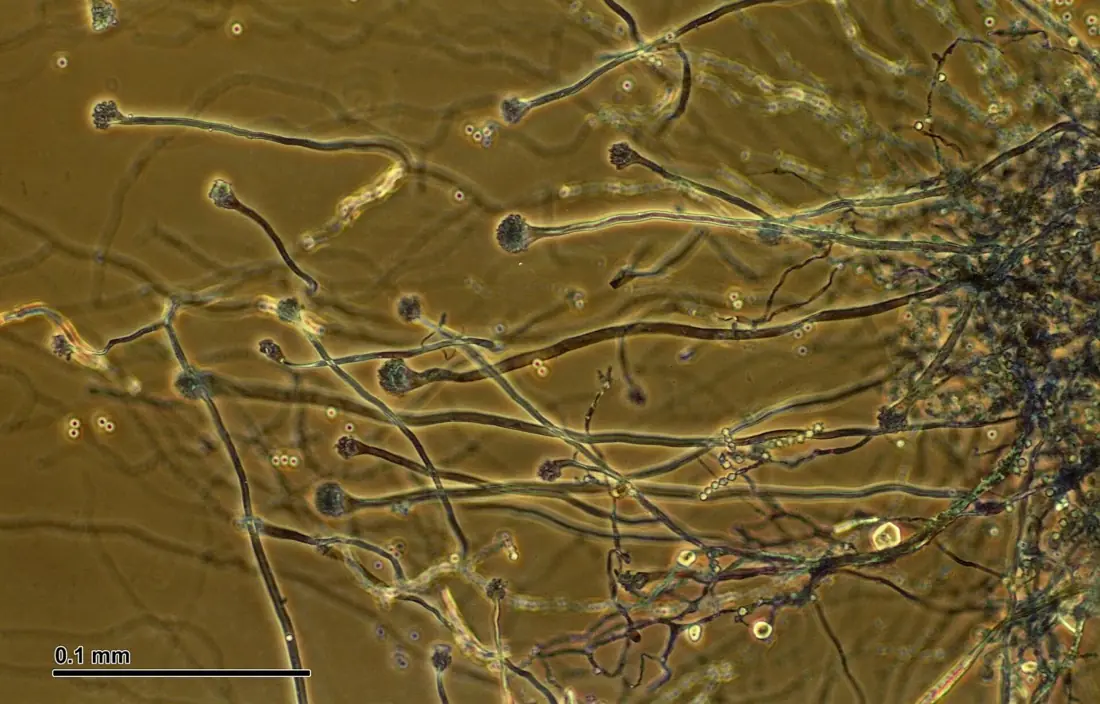
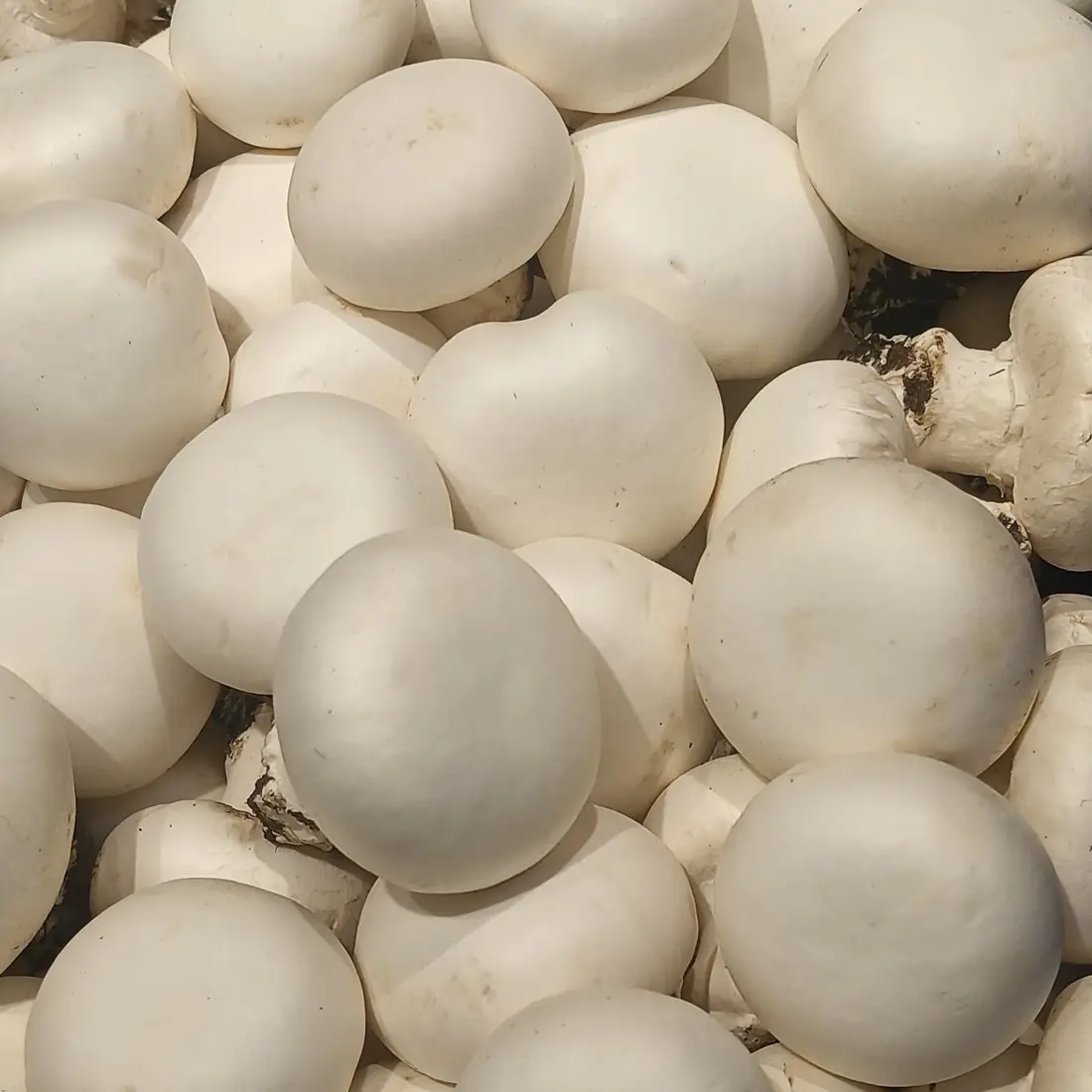
Nutrition. Saprophytes (Mucor, Agaricus) live on dead organic matter; parasites live on living hosts and may be obligate (Puccinia, which grows only on a living host) or facultative; symbionts live in mutually beneficial partnership, as in lichens and in the mycorrhiza of pine and orchid roots, where the fungus supplies water and phosphate and receives sugars.
Reproduction occurs by all three routes. Vegetative reproduction is by fragmentation, budding (yeast) or fission. Asexual reproduction is by spores: motile zoospores in aquatic forms, non-motile sporangiospores formed inside a sporangium (Rhizopus), conidia cut off from the tip of a conidiophore (Penicillium, Aspergillus), chlamydospores and oidia. Sexual reproduction runs through three steps that are worth memorising as a sequence, because the fungal classes are defined by what happens between them:
- Plasmogamy — fusion of the protoplasts of two compatible gametes or hyphae, bringing two nuclei into one cell.
- Karyogamy — fusion of the two nuclei to give a diploid nucleus.
- Meiosis — restoring the haploid condition and producing spores.
In the lower fungi steps 1 and 2 follow immediately. In Ascomycetes and Basidiomycetes they are separated by a long-lived dikaryotic (n + n) phase in which the two nuclei divide side by side without fusing — a stage unique to fungi.
| Class | Hyphae | Asexual spores | Sexual spores (in) | Common name | Examples |
|---|---|---|---|---|---|
| Phycomycetes (Zygomycetes) | coenocytic | zoospores, sporangiospores | zygospore | algal fungi | Rhizopus, Mucor, Albugo |
| Ascomycetes | septate | conidia | 8 ascospores in an ascus | sac fungi | Saccharomyces, Penicillium, Morchella, Claviceps |
| Basidiomycetes | septate, dikaryotic | usually none | 4 basidiospores on a basidium | club fungi | Agaricus, Puccinia, Ustilago, Polyporus |
| Deuteromycetes | septate | conidia only | not known | fungi imperfecti | Alternaria, Colletotrichum, Fusarium |
Zygo–Asco–Basidio, then the class with none: Deuteromycetes. Remember the spore counts as 8 in a sac, 4 on a club — eight ascospores inside an ascus, four basidiospores outside on a basidium. Deuteromycetes is a holding pen: once a sexual stage is discovered, the fungus is moved to its proper class.
Three fungi to know by name. Rhizopus stolonifer, the black bread mould, is a coenocytic saprophyte that spreads by aerial stolons anchored by rhizoids; erect sporangiophores bear a black sporangium with a domed columella inside, releasing thousands of sporangiospores. Sexual reproduction is by conjugation of two morphologically identical but physiologically different (+ and −) hyphae, producing a thick-walled resting zygospore. Agaricus, the cultivated mushroom, spends most of its life as an underground mycelium; the part we eat is the basidiocarp, with a pileus (cap) bearing radiating gills on its underside, a ring or annulus, and a stipe (stalk). The basidia line the gills and each shoots off four basidiospores. Saccharomyces cerevisiae, yeast, is unicellular, reproduces by budding, and ferments sugar to ethanol and carbon dioxide.
| Field | Economic importance of fungi |
|---|---|
| Food | Agaricus bisporus, Volvariella volvacea and the prized Morchella esculenta (guchchi chyau) are eaten; yeast is a protein and vitamin-B source |
| Baking and brewing | Saccharomyces cerevisiae raises bread and ferments beer, wine and jaand |
| Antibiotics | penicillin from Penicillium notatum (Alexander Fleming, 1928); griseofulvin from P. griseofulvum |
| Other industry | citric acid from Aspergillus niger; enzymes; cheese ripened by Penicillium roqueforti and P. camemberti; gibberellin from Gibberella |
| Soil fertility | the chief decomposers of cellulose and lignin; mycorrhizae improve phosphate uptake in forest trees |
| Crop diseases | Puccinia graminis (black stem rust of wheat), Ustilago (smuts), Phytophthora infestans (late blight of potato — the 1845 Irish famine), Albugo candida (white rust of crucifers) |
| Human disease | ringworm and athlete's foot (Trichophyton), candidiasis (Candida albicans), aspergillosis |
| Toxins | Amanita phalloides (death cap) and ergot of rye (Claviceps purpurea) are deadly; aflatoxin from Aspergillus flavus contaminates stored maize and groundnut |
Every year Nepal records deaths from wild mushroom poisoning, because the edible Amanita relatives and the lethal Amanita phalloides look alike to the untrained eye, and no cooking destroys the amatoxins. In the examination, if you are asked for poisonous fungi, Amanita phalloides and Claviceps purpurea are the two safe answers.
2.3 Lichen
A lichen is not one organism but two living as one: a fungus and a photosynthetic partner in such intimate and permanent association that the composite has its own shape, its own chemistry and its own scientific name. The study of lichens is lichenology.
A stable, self-supporting symbiotic association between a fungus (the mycobiont, usually an Ascomycete) and a photosynthetic alga or cyanobacterium (the phycobiont or photobiont, usually Trebouxia or Nostoc), forming a thallus quite unlike either partner grown alone.
The fungus contributes the body: it makes up 90–95 % of the thallus, absorbs and retains water and mineral salts, and shelters the alga from drying and strong light. The alga contributes the food, fixing carbon dioxide into sugars; if the partner is a cyanobacterium it fixes atmospheric nitrogen as well. Because the fungus takes more than it gives and can keep the alga on short rations, the relationship is sometimes described as helotism (controlled parasitism) rather than true mutualism.
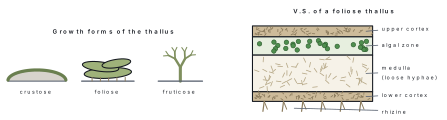
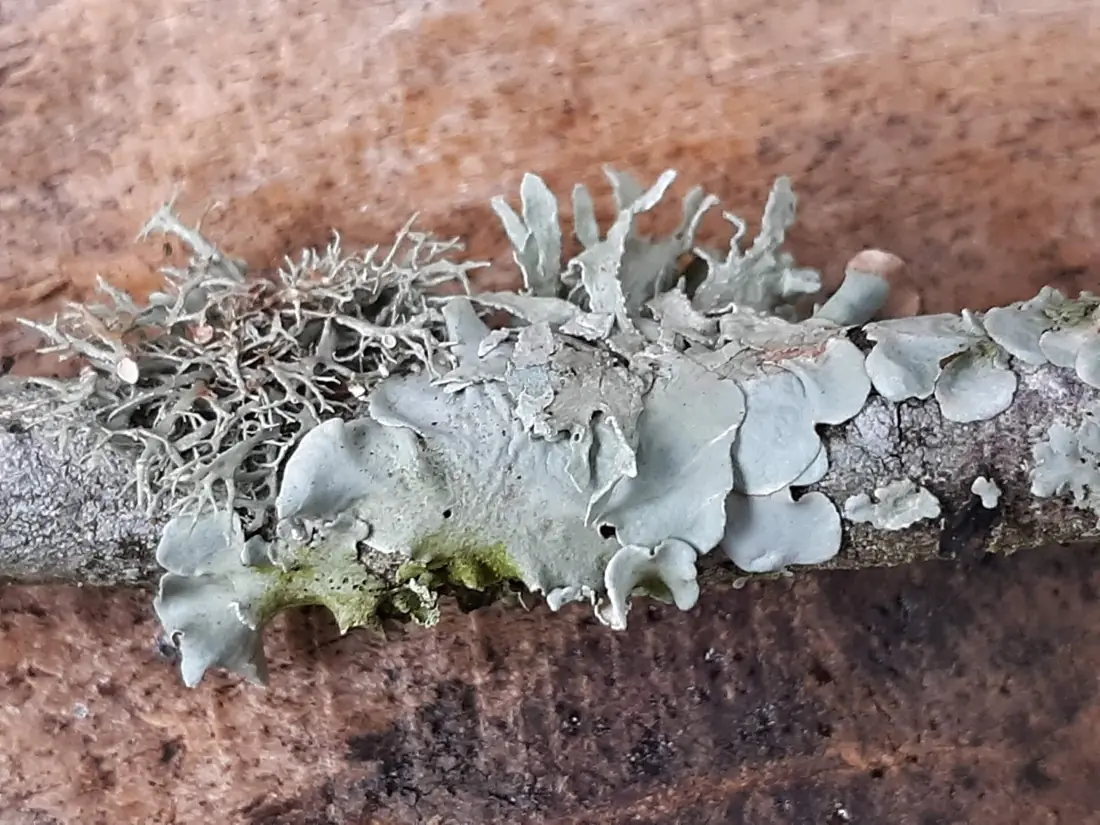
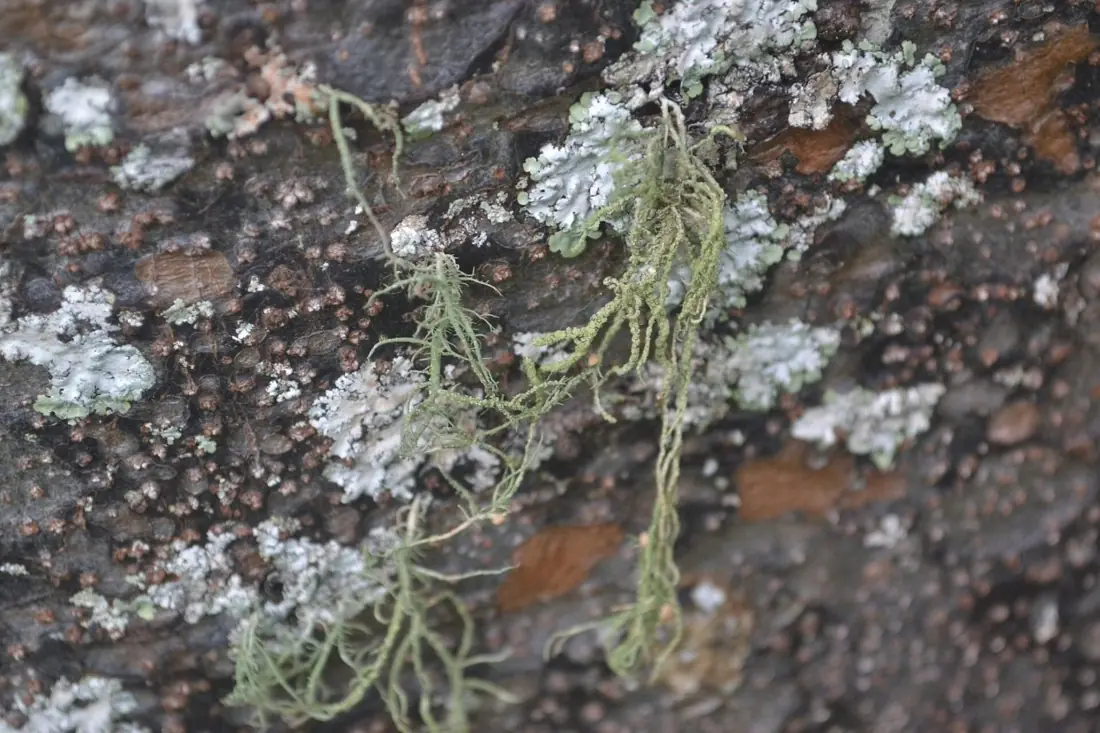
Growth forms. Three are recognised and are easy marks in a diagram question. Crustose lichens form a thin crust fused to rock or bark and cannot be removed intact (Graphis, Lecanora). Foliose lichens are leaf-like, lobed, and attached loosely by root-like rhizines (Parmelia, Peltigera). Fruticose lichens are shrubby or beard-like and hang free, attached at one point only (Cladonia, Usnea, the "old man's beard" of hill oak forests).
Internal structure. A vertical section of a foliose thallus is stratified into four layers: an upper cortex of compacted fungal hyphae; an algal zone just beneath it, where the photobiont cells lie in the light; a loose medulla of hyphae with air spaces, which stores water; and a lower cortex from which the rhizines arise. Such a lichen is heteromerous. If the algal cells are scattered throughout instead of forming a layer, the thallus is homoiomerous (Collema).
Reproduction. Vegetative reproduction dominates, because both partners must travel together: by fragmentation of the thallus; by soredia, minute powdery outgrowths each containing a few algal cells wrapped in hyphae; and by isidia, small firm coral-like projections of the upper surface. The fungus alone reproduces sexually, forming an apothecium (a disc, as in Parmelia) or a perithecium (a flask, as in Graphis) containing ascospores; a germinating ascospore must find a suitable alga or die.
Economic and ecological importance. Lichens are the classic pioneers of xerophytic succession: they colonise bare rock, secrete carbonic and oxalic acids that etch the surface, and their dead thalli add the first humus, so that mosses and then higher plants can follow. They are highly sensitive to sulphur dioxide and are used worldwide as bio-indicators of air pollution — the absence of Usnea from a valley is a measurement of its air. They are also used as food (Cetraria islandica, Iceland moss; Lecanora as "manna"), as fodder (reindeer moss, Cladonia rangiferina), in dyeing and in the manufacture of litmus from Roccella tinctoria, in perfumery (Evernia, Ramalina, the jhyau traded from the Nepali hills and used in garam masala), and in medicine — usnic acid is a genuine antibiotic. Lichens accumulate radioisotopes and heavy metals, which is why Chernobyl fallout concentrated in lichen-eating reindeer.
2.4 Algae
Algae are simple, chlorophyll-bearing, thalloid plants with no true roots, stems, leaves or vascular tissue, whose sex organs are unicellular and whose zygote never develops into a multicellular embryo inside the female organ. Most are aquatic. The study of algae is phycology, and the classification below is that of F. E. Fritsch (1935), which the NEB syllabus follows.
Range of form. Algae span almost every level of organisation below the true plant: unicellular motile (Chlamydomonas), unicellular non-motile (Chlorella), colonial (Volvox), filamentous unbranched (Spirogyra, Ulothrix), filamentous branched (Cladophora), heterotrichous (Draparnaldia), siphonaceous and multinucleate (Vaucheria), and finally massive parenchymatous thalli up to 60 m long (Macrocystis, the giant kelp).

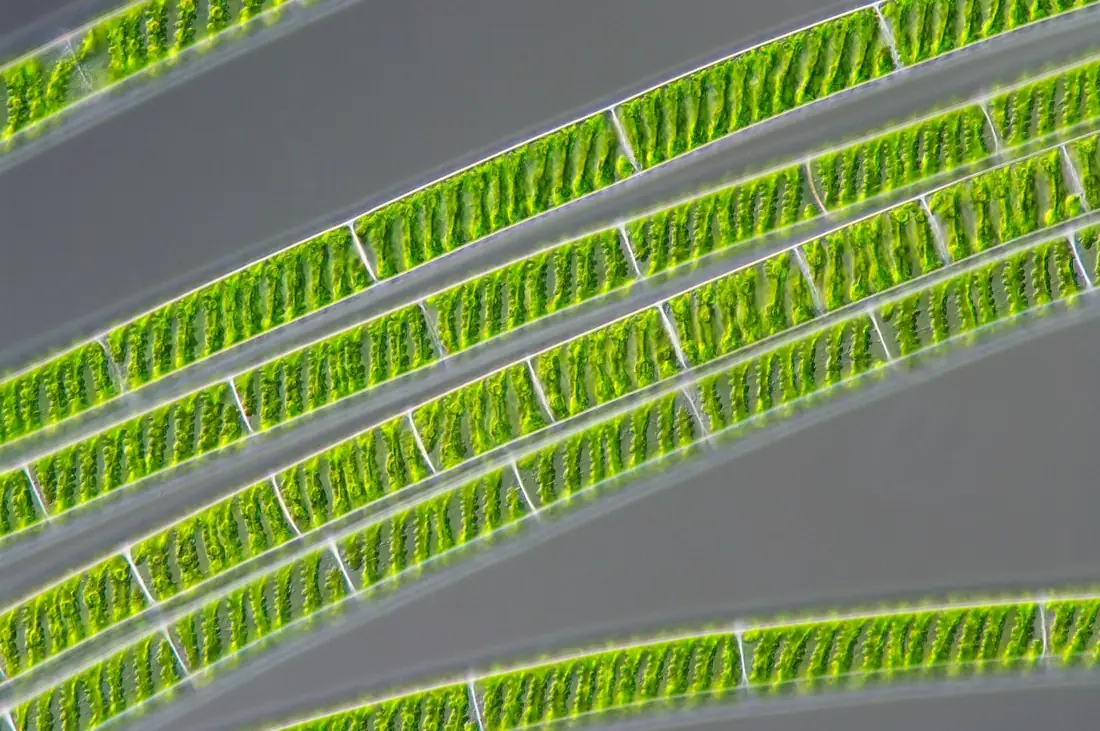
Spirogyra, the commonest pond alga of Nepal and the standard laboratory specimen, is an unbranched filament of cylindrical cells in a slippery mucilage sheath — hence "pond silk". Each cell holds one to several spiral ribbon chloroplasts studded with pyrenoids (protein-plus-starch bodies), a large central vacuole and a nucleus suspended in the middle by cytoplasmic strands. It grows by ordinary cell division, reproduces vegetatively by fragmentation, and reproduces sexually by conjugation: two filaments lie side by side, papillae grow out and meet to form a conjugation tube, and the whole protoplast of one cell passes over and fuses with the other, giving a thick-walled zygospore that germinates after the dry season. Conjugation is scalariform (ladder-like, between two filaments) or lateral (between adjacent cells of one filament). Chlamydomonas is the other required drawing: a single pear-shaped cell with two equal apical flagella, one cup-shaped chloroplast with a pyrenoid, two contractile vacuoles, a nucleus and a red eyespot (stigma) for phototaxis.
| Class | Pigments | Reserve food | Wall | Flagella | Habitat | Examples |
|---|---|---|---|---|---|---|
| Chlorophyceae (green algae) | chlorophyll a, b | starch | cellulose | 2, equal, apical | mostly fresh water | Chlamydomonas, Volvox, Spirogyra, Chara |
| Xanthophyceae (yellow-green) | chlorophyll a, e; xanthophylls | oil, chrysolaminarin | cellulose and pectin | 2, unequal | fresh water, damp soil | Vaucheria, Botrydium |
| Bacillariophyceae (diatoms) | chlorophyll a, c; fucoxanthin | oil, chrysolaminarin | silica frustule | 1 in male gametes | fresh and marine | Navicula, Pinnularia |
| Phaeophyceae (brown algae) | chlorophyll a, c; fucoxanthin | laminarin, mannitol | cellulose and algin | 2, unequal, lateral | almost all marine | Laminaria, Fucus, Sargassum, Macrocystis |
| Rhodophyceae (red algae) | chlorophyll a, d; r-phycoerythrin | floridean starch | cellulose and pectin, often with agar | absent | mostly marine | Polysiphonia, Gelidium, Gracilaria, Batrachospermum |
Green stores starch, brown stores laminarin, red stores floridean starch. For pigments: the dominant accessory pigment gives the colour — fucoxanthin makes brown algae brown, phycoerythrin makes red algae red. And only the red algae are completely flagella-free, which is why their male gametes must drift passively to the female.
Reproduction. Vegetative reproduction is by fragmentation, hormogonia or cell division. Asexual reproduction is by zoospores (motile, flagellate), aplanospores (non-motile), hypnospores (thick-walled) or akinetes. Sexual reproduction ranges through three grades of gamete: isogamy (both gametes motile and alike, Ulothrix), anisogamy (both motile, one larger, Chlamydomonas braunii) and oogamy (a large non-motile egg and a small motile sperm, Volvox, Fucus), plus the special case of conjugation in Spirogyra. This isogamy–anisogamy–oogamy series is one of the classic evolutionary progressions in botany and is worth quoting whenever a question asks about advancement in the algae.
| Field | Economic importance of algae |
|---|---|
| Oxygen and food chains | marine phytoplankton, mostly diatoms, produce a large share of the world's oxygen and start almost every aquatic food chain |
| Human food | Porphyra (nori), Laminaria (kombu), Ulva, Sargassum; Chlorella and Spirulina as single-cell protein |
| Agar | from the red algae Gelidium and Gracilaria; the standard culture medium of microbiology, also used in ice cream and jellies |
| Algin (alginic acid) | from brown algae; thickener in ice cream, paint, toothpaste and textile printing |
| Carrageenan | from Chondrus crispus; emulsifier in chocolate milk and cosmetics |
| Diatomite | fossil diatom frustules, used for filtration, insulation, polishing and as the absorbent in dynamite |
| Iodine and potash | extracted from kelps such as Laminaria |
| Fertiliser and fodder | seaweed manure, rich in potash; Nostoc and Anabaena fix nitrogen in rice fields |
| Harm | algal blooms and eutrophication deoxygenate water and kill fish; red tides (Gonyaulax) are toxic; Cephaleuros parasitises tea leaves |
2.5 Bryophyta
Bryophytes are the simplest land plants: green, embryo-forming, but with no vascular tissue and no true roots. They are called the amphibians of the plant kingdom because although they live on land, they cannot complete their life cycle without water — the sperm must swim. They are also the group in which alternation of generations first becomes obvious, with the gametophyte dominant and the sporophyte permanently attached to and dependent on it. That reversal — gametophyte big, sporophyte small — is unique to this division, and almost every examination question on bryophytes turns on it.
General characters.
- The plant body is a gametophyte (n): either a flat, dorsiventral thallus (Riccia, Marchantia) or an erect, leafy axis with spirally arranged leaves (Funaria, Sphagnum). There are no roots; anchorage and absorption are by unicellular or multicellular rhizoids.
- There is no xylem or phloem; water travels by capillarity over the surface and by diffusion, which is why bryophytes are small and confined to damp, shaded places.
- Sex organs are multicellular and jacketed — the male antheridium, a club-shaped body producing biflagellate antherozoids, and the female archegonium, a flask-shaped body with a neck and a swollen venter holding a single egg. The sterile jacket of cells is the advance on the algae.
- Fertilisation requires external water. Antherozoids swim down the mucilage-filled neck of the archegonium, attracted chemotactically by sucrose and potassium salts.
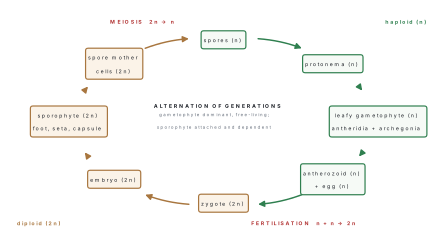
- The zygote divides in situ to form a multicellular embryo, which grows into the sporophyte (2n) — typically a foot, seta and capsule — that remains attached to the gametophyte and draws nutrition from it.
- Inside the capsule, spore mother cells (2n) undergo meiosis to give haploid spores. The spore germinates into a green filamentous protonema, which buds to produce the leafy plant, closing the cycle.
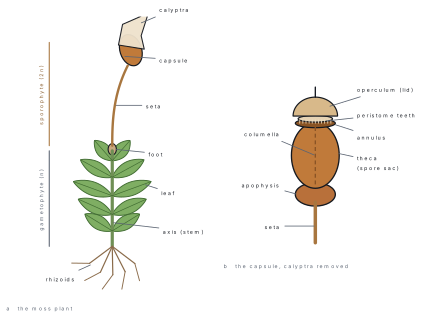
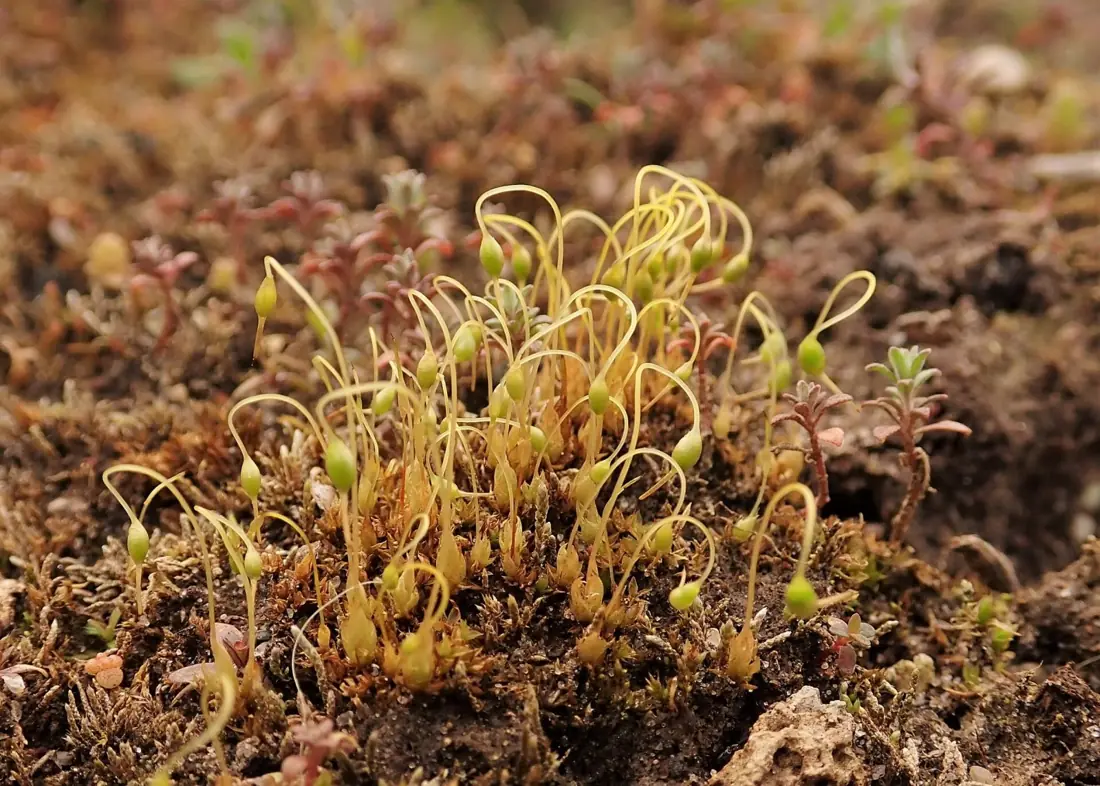
Funaria hygrometrica, the cord moss, is the prescribed type. Its leafy shoot bears antheridia in a terminal cluster surrounded by orange perigonial leaves (the male "flower") and archegonia on a separate branch. After fertilisation the sporophyte grows out as a long reddish seta carrying a pear-shaped capsule capped by the calyptra, the torn-off remains of the archegonial neck. The capsule itself is worth learning in detail: the sterile apophysis at its base, the spore-bearing theca with its central sterile columella, and at the top the operculum (lid) which falls away to expose a double ring of hygroscopic peristome teeth that flex with humidity and flick the spores out on dry days — the specific name hygrometrica records exactly this.
| Class | Body | Sporophyte | Examples |
|---|---|---|---|
| Hepaticopsida (liverworts) | thalloid or leafy, dorsiventral; rhizoids unicellular | simple; often only foot and capsule, no true columella | Riccia, Marchantia, Pellia |
| Anthocerotopsida (hornworts) | simple thallus; one large chloroplast with a pyrenoid per cell | long horn-like capsule with stomata and columella, growing from a basal meristem | Anthoceros, Notothylas |
| Bryopsida (mosses) | leafy axis with spirally set leaves; rhizoids multicellular | foot, seta and capsule with operculum and peristome | Funaria, Polytrichum, Sphagnum |
A moss has a haploid chromosome number of n = 14. State the chromosome number of (i) a spore, (ii) the protonema, (iii) a leaf cell of the green plant, (iv) an antherozoid, (v) the egg, (vi) the zygote, (vii) a cell of the seta, (viii) a spore mother cell, and (ix) the spores it produces. Then find how many spores 10 spore mother cells yield.
Method. Draw one line through the cycle and mark the only two events that change ploidy: fertilisation doubles it, meiosis halves it. Everything between those two events has the same number.
Fertilisation happens when egg meets antherozoid; meiosis happens in the spore mother cells inside the capsule. So everything from the spore up to the gametes is haploid, and everything from the zygote to the spore mother cell is diploid.
| Stage | Ploidy | Chromosome number |
|---|---|---|
| (i) spore | n | 14 |
| (ii) protonema | n | 14 |
| (iii) leaf cell of the gametophyte | n | 14 |
| (iv) antherozoid | n | 14 |
| (v) egg | n | 14 |
| (vi) zygote | 2n | 28 |
| (vii) seta (part of the sporophyte) | 2n | 28 |
| (viii) spore mother cell | 2n | 28 |
| (ix) spores produced from it | n | 14 |
Spore count. Meiosis of one spore mother cell gives four spores, so
10 × 4 = 40 spores.
Note the trap in (vii): the seta looks like part of the moss plant and is attached to it, but it belongs to the sporophyte and is therefore diploid. The same logic answers every ploidy question in this unit — including the fern, where the answers come out the other way round because the sporophyte is the big plant there.
2.6 Pteridophyta
Pteridophytes are the first vascular plants — the first to possess xylem and phloem — and the first in which the sporophyte is the dominant, independent generation. They still reproduce by spores and still need water for fertilisation, so they are called vascular cryptogams: cryptogams because they are seedless and flowerless, vascular because they have conducting tissue. In the Carboniferous they formed the forests whose remains are our coal.
General characters.
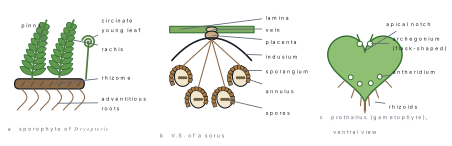
- The plant body is the sporophyte (2n), differentiated into true root, stem and leaf. In Dryopteris the stem is an underground rhizome bearing adventitious roots below and large pinnately compound fronds above; young fronds show circinate vernation, unrolling from a coiled "crozier" or fiddlehead.
- Vascular tissue is present: xylem of tracheids only (no vessels, except in Selaginella, Equisetum and Pteridium) and phloem of sieve cells without companion cells. There is no cambium, so no secondary growth.
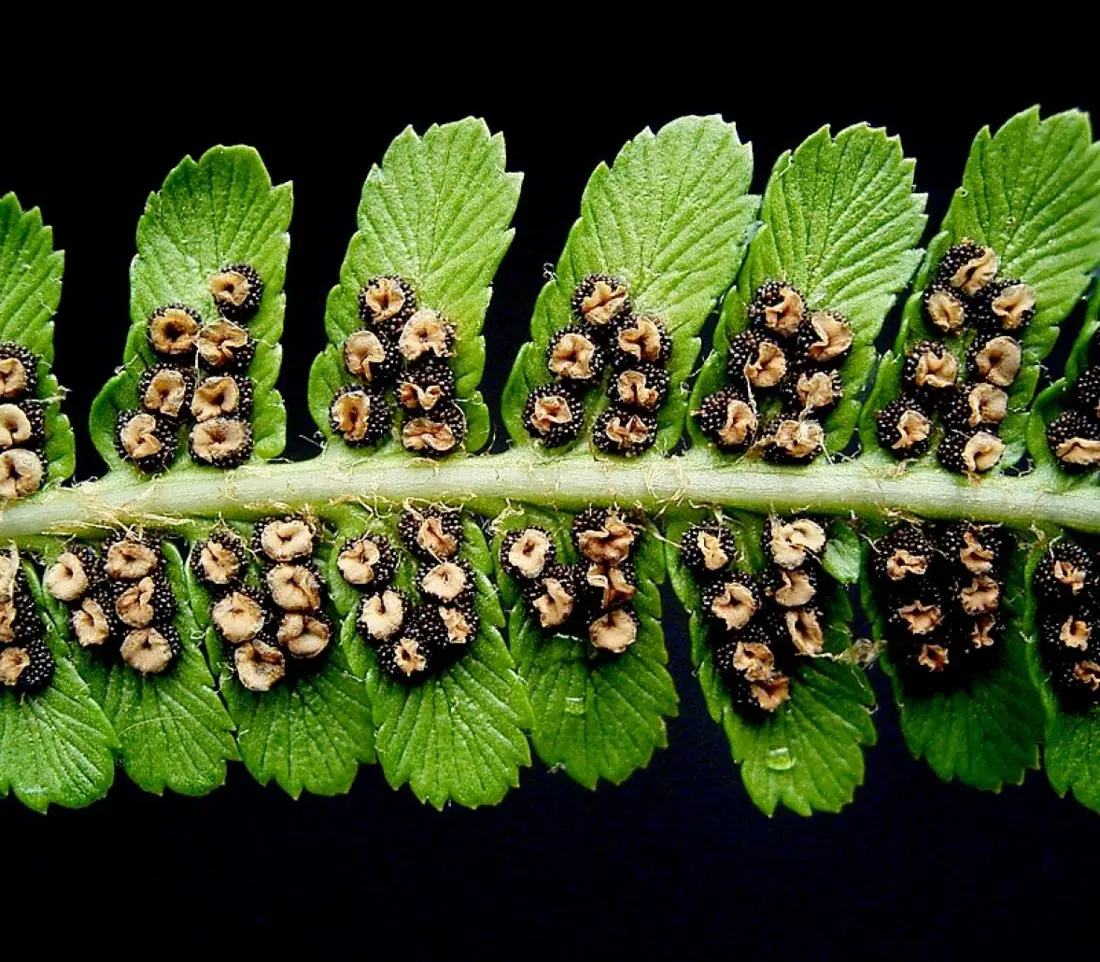
- Sporangia are borne on specialised leaves called sporophylls. In ferns they are grouped into sori on the underside of the frond, each sorus protected by a flap, the indusium, and each sporangium possessing a row of thick-walled cells, the annulus, which dries, springs back and catapults the spores out.
- Spores germinate into a small, green, independent prothallus — the gametophyte (n) — heart-shaped in Dryopteris, bearing rhizoids, antheridia among the rhizoids and archegonia near the notch.
- Fertilisation needs water; multiflagellate antherozoids swim to the egg. The zygote grows into a new sporophyte, which at first is parasitic on the prothallus and then becomes independent as the prothallus withers.
Homospory and heterospory. Most pteridophytes are homosporous: they produce one kind of spore, which gives a bisexual prothallus. A few are heterosporous, producing large megaspores that give a female gametophyte and small microspores that give a male gametophyte — Selaginella, Salvinia, Marsilea and Isoetes. Heterospory matters far beyond this unit, because it is the evolutionary threshold to the seed: in Selaginella the megaspore is already retained on the parent plant, and the seed habit of gymnosperms is the next step.

| Class | Stem | Leaves | Spores | Examples |
|---|---|---|---|---|
| Psilopsida | dichotomously branched, rootless | absent or minute scales | homosporous | Psilotum, Rhynia (fossil) |
| Lycopsida | herbaceous or arborescent | small, simple microphylls | homo- or heterosporous | Lycopodium, Selaginella |
| Sphenopsida | jointed, ribbed, silica-rich | small, whorled, scale-like | homosporous | Equisetum (horsetail) |
| Pteropsida | rhizome or erect trunk | large, pinnate megaphylls (fronds) | mostly homosporous | Dryopteris, Pteris, Adiantum, Marsilea, Cyathea |
| Character | Bryophyta | Pteridophyta |
|---|---|---|
| Dominant generation | gametophyte (n) | sporophyte (2n) |
| Plant body | thallus or leafy axis, no true organs | true root, stem and leaf |
| Vascular tissue | absent | present (xylem and phloem) |
| Roots | absent; rhizoids only | true roots present |
| Sporophyte | attached and dependent on gametophyte | independent and free-living |
| Gametophyte | large, long-lived, green | small, short-lived prothallus |
| Water for fertilisation | essential | essential |
| Examples | Riccia, Marchantia, Funaria | Selaginella, Equisetum, Dryopteris |
Economic importance. Young fronds of Diplazium esculentum (niuro) are a familiar Nepali vegetable, and the rhizome starch of Marsilea and Cyathea is eaten in times of scarcity. Azolla, a tiny floating fern, harbours the nitrogen-fixing cyanobacterium Anabaena azollae in its leaf cavities and is used as a biofertiliser in rice paddies. Dryopteris yields the vermifuge filicin; Lycopodium spores are used as a dusting powder and in fireworks; Equisetum was once used as a scouring rush because of its silica; tree ferns (Cyathea) and Adiantum (maidenhair) are grown as ornamentals; and the coal we burn is the fossilised remains of Carboniferous lycopods and horsetails.
2.7 Gymnosperm
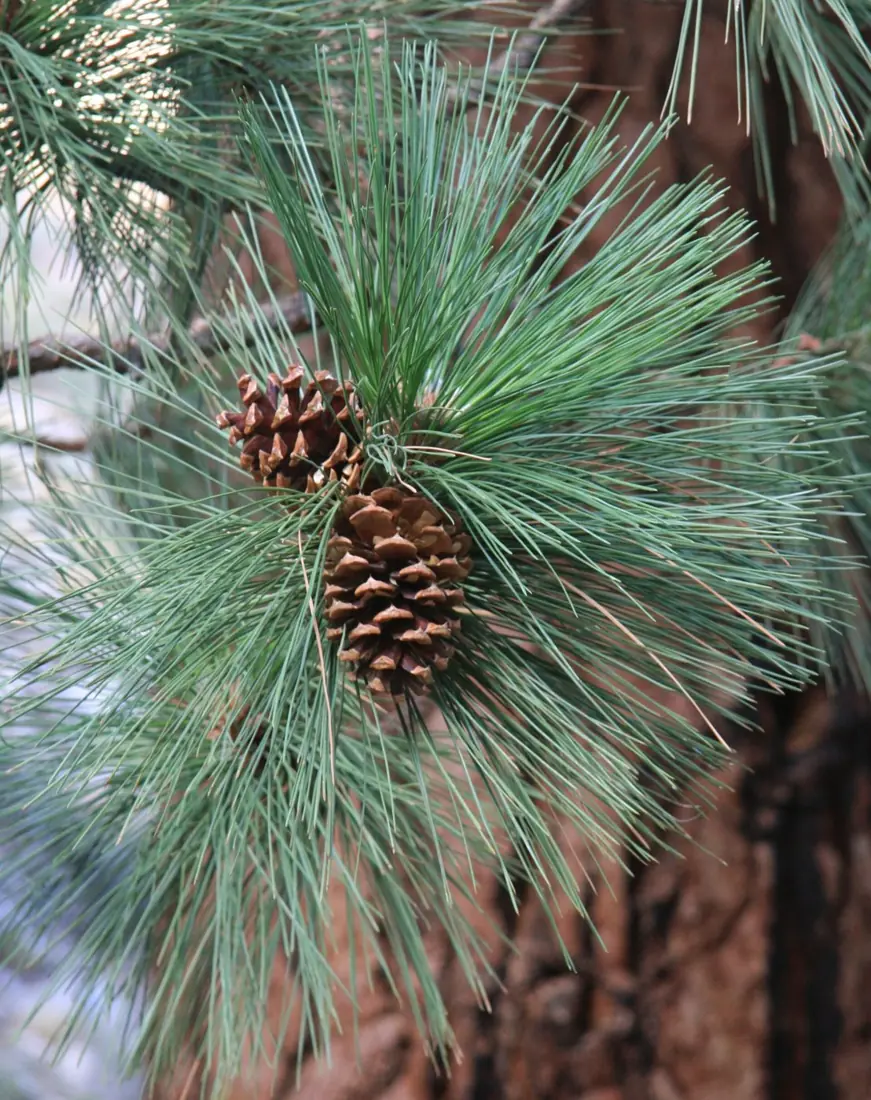
Gymnosperms are seed plants in which the ovule sits naked on the surface of an open megasporophyll, with no ovary wall around it — Greek gymnos, naked, sperma, seed. Because there is no ovary there can be no fruit, and because there is no flower in the angiosperm sense the reproductive structures are cones (strobili). They are the plants of cold and dry places, and in Nepal they form the great conifer belts of the temperate and subalpine zones.
General characters.
- Mostly evergreen woody trees or shrubs, never herbs; often with a distinct tap root bearing mycorrhiza (Pinus) or coralloid roots with cyanobacteria (Cycas).
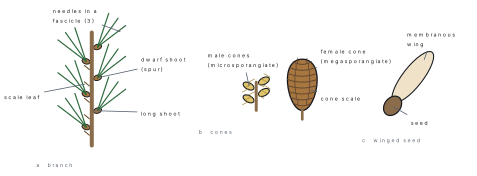
- The stem is usually branched, and in Pinus is dimorphic: unlimited long shoots bearing scale leaves, and limited dwarf shoots (spurs) each carrying a fascicle of needle leaves.
- Leaves are of two kinds — green needles adapted to drought (thick cuticle, sunken stomata, hypodermis of sclerenchyma) and brown scale leaves.
- Xylem has tracheids but no vessels, and phloem has sieve cells but no companion cells (the exception is the order Gnetales, which does have vessels). Secondary growth is present and produces the timber.
- They are heterosporous, with microspores (pollen) in male cones and megaspores in ovules on the scales of female cones. In Pinus the male cones are small and clustered at the base of long shoots; the female cones are large, woody and take two to three years to mature.
- Pollination is by wind (anemophily) and is direct: the pollen grain, usually with two air bladders, is carried straight to the micropyle of the ovule, not to a stigma.
- The female gametophyte forms endosperm before fertilisation, and it is therefore haploid (n) — the single most examined difference from angiosperms, where a triploid endosperm forms only after double fertilisation.
- Polyembryony is common — several embryos begin in one seed, though usually only one survives. The seed is naked on the cone scale and often winged for dispersal. Double fertilisation and fruit formation do not occur.
| Character | Gymnosperm | Angiosperm |
|---|---|---|
| Ovule | naked, on an open megasporophyll | enclosed in an ovary |
| Reproductive structure | cone (strobilus) | flower |
| Fruit | absent | present, from the ovary wall |
| Xylem vessels | absent (except Gnetales) | present |
| Phloem companion cells | absent | present |
| Pollination | wind, direct to the micropyle | wind, insect, bird, water; on to a stigma |
| Fertilisation | single | double |
| Endosperm | haploid, formed before fertilisation | triploid, formed after fertilisation |
| Polyembryony | common | rare |
| Habit | woody trees and shrubs only | herbs, shrubs, trees, climbers |
| Number of living species | about 1,000 | about 250,000 |
Gymnosperms of Nepal, and their uses. Pinus roxburghii (khote salla, the chir pine, three needles per fascicle) covers the drier hills from 800 to 2,000 m and yields resin, turpentine and rosin; Pinus wallichiana (gobre salla, blue pine, five needles) takes over higher up. Abies, Picea, Tsuga, Cedrus deodara and Juniperus (dhupi, burned as incense) build the subalpine forests. Taxus wallichiana, the Himalayan yew (loth salla), is the source of taxol (paclitaxel), an anticancer drug, and is now a protected species because of over-harvesting. Ephedra gerardiana yields ephedrine, used for asthma. Cycas is grown ornamentally and its pith gives sago, and Ginkgo biloba, a living fossil, is a well-known memory tonic. Beyond these, conifers supply the world's softwood timber, plywood, resin, and the pulp for most of its paper.
2.8 Angiosperm
Angiosperms are the flowering plants: seed plants in which the ovules are enclosed in an ovary, which after fertilisation ripens into a fruit (Greek angeion, a vessel). They are the dominant vegetation of the modern world, about 250,000 species, and they include almost every plant we eat. Three features explain their success: the flower, which makes precise animal pollination possible; double fertilisation, which provides the embryo with a triploid food tissue only when it is actually needed; and the fruit, which protects and disperses the seed. This section takes sixteen of the thirty hours of the unit, and the four families at the end of it are the most dependable long question in the Botany paper.
Morphology
Morphology is the study of external form. A typical angiosperm has an underground root system and an aerial shoot system of stem, leaves, flowers and fruits. The great value of morphology in this unit is that modifications are the evidence for adaptation, and examiners ask for them by name.
Root. The primary root of a dicot persists as a tap root with lateral branches; in monocots it dies and is replaced by a cluster of fibrous adventitious roots. Roots are modified for storage (fusiform in radish, conical in carrot, napiform in turnip, tuberous in sweet potato), for support (prop roots of banyan, stilt roots of maize and sugarcane, clinging roots of betel), for respiration (pneumatophores of Rhizophora), for assimilation (Tinospora), for parasitism (haustoria of Cuscuta), and for symbiosis (nodulated roots of legumes, mycorrhizal roots of pine).
Stem. The stem bears nodes and internodes with axillary buds — the test that distinguishes a stem from a root. Underground modifications store food and survive the dry season: rhizome (ginger, turmeric), tuber (potato, with "eyes" that are axillary buds), bulb (onion, garlic) and corm (Colocasia, Crocus). Sub-aerial modifications propagate the plant: runner (grass, Oxalis), stolon (strawberry), sucker (mint, chrysanthemum) and offset (water hyacinth). Aerial modifications include stem tendrils (grapevine, Passiflora), stem thorns (Bougainvillea, Citrus), phylloclades (Opuntia, Euphorbia — flattened green stems doing the work of leaves) and bulbils (Dioscorea, Agave).
Leaf. A leaf has a leaf base, petiole and lamina. Venation is reticulate in dicots and parallel in monocots. A simple leaf has an undivided lamina; a compound leaf is cut right down to the midrib or petiole and is pinnately compound (neem, Cassia) or palmately compound (silk cotton, Trifolium). Phyllotaxy is alternate (mustard), opposite (Calotropis) or whorled (Nerium). Leaves are modified into tendrils (pea, where the upper leaflets become tendrils), spines (Opuntia, Argemone), storage organs (onion scales), pitchers (Nepenthes) and phyllodes (Australian acacia).
Inflorescence. The arrangement of flowers on the floral axis. In a racemose inflorescence the main axis keeps growing and the oldest flowers are at the base — raceme (radish), spike (Achyranthes), catkin (mulberry), spadix (Colocasia), corymb (candytuft), umbel (coriander) and capitulum or head (sunflower, marigold), where many tiny sessile florets sit on a flat receptacle and mimic one flower. In a cymose inflorescence the main axis ends in a flower, so the oldest flower is at the top — uniparous or helicoid (Heliotropium), biparous or dichasial (jasmine), and multiparous (Calotropis). Special types include the verticillaster (Ocimum), cyathium (Euphorbia) and hypanthodium (fig, Ficus).
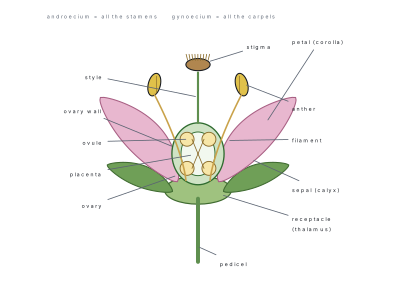
Flower. A flower is a condensed shoot with four whorls on a swollen receptacle: calyx of sepals, corolla of petals, androecium of stamens (each a filament plus a two-lobed anther) and gynoecium of one or more carpels (each an ovary with ovules, a style and a stigma). Learn these descriptive terms, because family descriptions are written entirely in them.
- Symmetry: actinomorphic (radially symmetrical, mustard, Datura) or zygomorphic (bilaterally symmetrical, pea, Ocimum).
- Sex: bisexual (both whorls) or unisexual (staminate or pistillate).
- Bracts: a flower with a bract is bracteate, without one ebracteate.
- Position of the ovary: hypogynous (ovary superior, other whorls below — mustard, Datura), perigynous (ovary half-sunk in a cup-shaped receptacle — rose, plum) and epigynous (ovary inferior, whorls arising above it — sunflower, cucumber, guava).
- Cohesion of stamens: monadelphous (all united in one bundle by their filaments — Hibiscus), diadelphous (two bundles — pea), polyadelphous (many bundles — Citrus); epipetalous when attached to the petals (Datura), epiphyllous when attached to the perianth (Allium).
- Placentation: how ovules are attached inside the ovary — marginal (pea), axile (Datura, tomato, Allium), parietal (mustard, Argemone), free central (Dianthus, Primula), basal (sunflower, marigold) and superficial (water lily).
- Aestivation: how sepals or petals overlap in bud — valvate, twisted, imbricate and vexillary (the pea, where the standard covers the wings and the wings cover the keel).
Fruit and seed. The fruit develops from the ovary and the seed from the ovule. Simple fruits come from one ovary and are dry (dehiscent — legume of pea, siliqua of mustard, capsule of Datura; indehiscent — achene, caryopsis of rice and wheat, cypsela of sunflower, nut of cashew; schizocarpic — lomentum, cremocarp of coriander) or fleshy (drupe of mango with its stony endocarp, berry of tomato and grape, pome of apple, hesperidium of orange, pepo of cucumber). Aggregate fruits come from a multicarpellary apocarpous ovary of a single flower (Polyalthia, strawberry) and composite or multiple fruits from a whole inflorescence (sorosis of jackfruit and pineapple, syconus of fig). A false fruit develops partly from the receptacle (apple, cashew, strawberry). A seed consists of a seed coat (testa and tegmen), a hilum, and the embryo of radicle, plumule and one or two cotyledons; the food may be stored in the cotyledons (non-endospermic, pea, gram) or in the endosperm (endospermic, maize, castor, coconut).
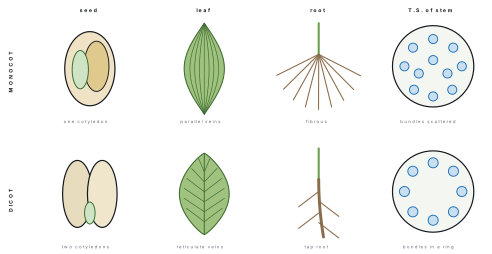
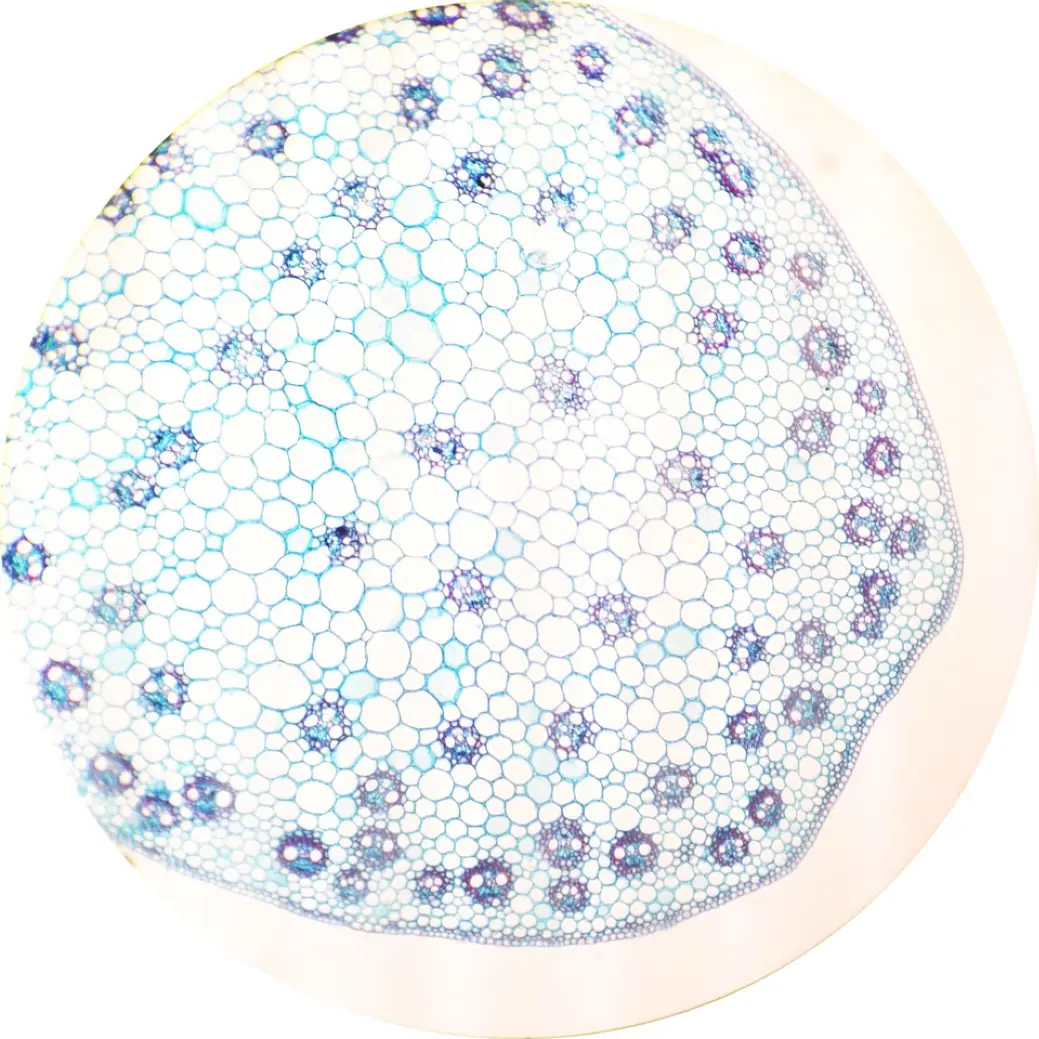
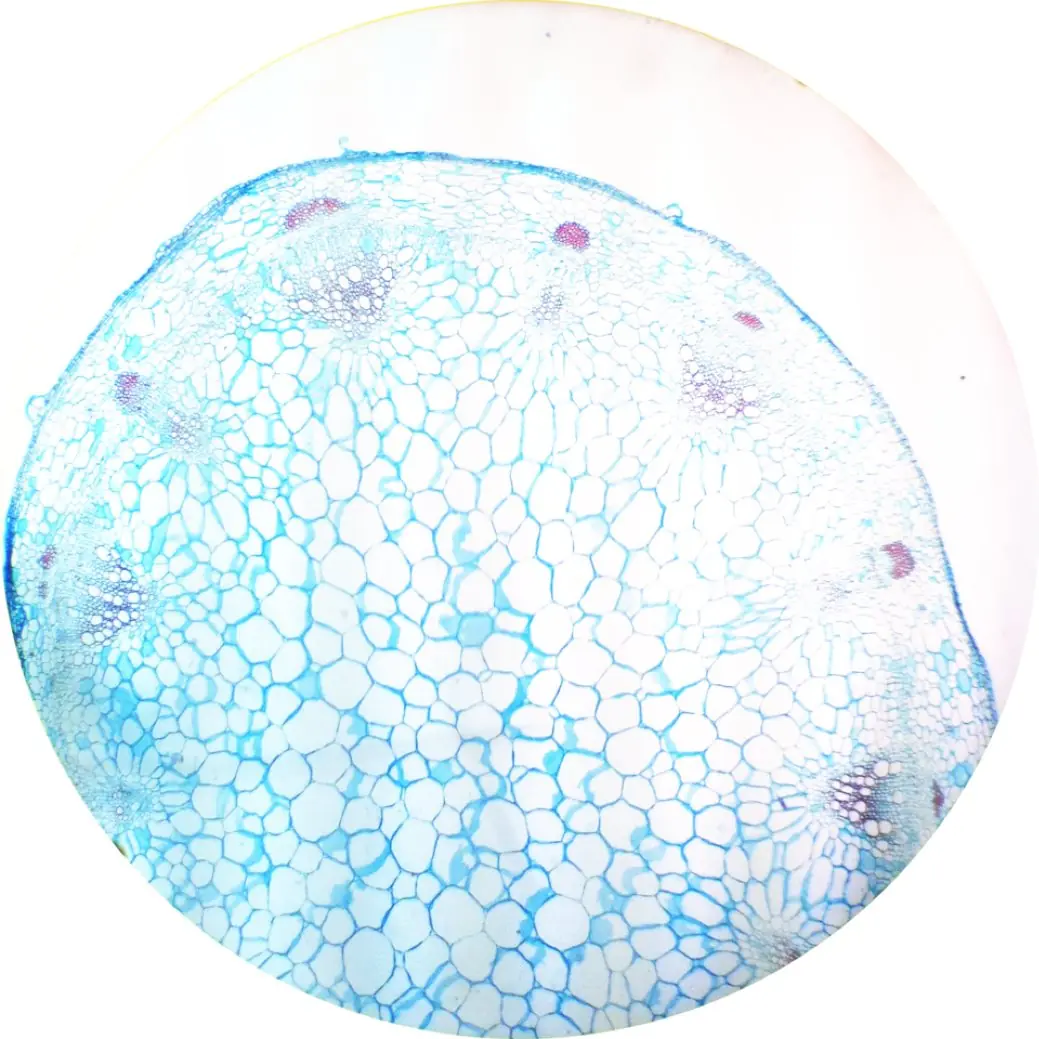
| Character | Monocotyledon | Dicotyledon |
|---|---|---|
| Cotyledons in the seed | one | two |
| Root system | fibrous, adventitious | tap root |
| Leaf venation | parallel | reticulate |
| Leaf base | usually sheathing | not sheathing |
| Vascular bundles in the stem | many, scattered, closed (no cambium) | few, in a ring, open (with cambium) |
| Secondary growth | absent | usually present |
| Flower | usually trimerous (in threes) | tetra- or pentamerous |
| Perianth | usually undifferentiated (tepals) | calyx and corolla distinct |
| Pollen grain | monosulcate | trisulcate or tricolpate |
| Examples | rice, maize, onion, banana, palm | mustard, pea, Datura, mango |
Taxonomic hierarchy
Taxonomy sorts organisms into a nested series of ranks, each a taxon. As you climb the hierarchy the number of shared characters falls and the number of organisms included rises; as you descend, the reverse. The obligatory ranks for plants are:
Kingdom → Division (Phylum) → Class → Order → Family → Genus → Species
Intermediate ranks may be inserted with the prefixes sub- and super- (subclass, subfamily, subspecies), and family names in botany end in -aceae while order names end in -ales.
King David Came Over For Good Soup — Kingdom, Division, Class, Order, Family, Genus, Species. (If you were taught the zoological version, replace Division with Phylum: King Philip Came Over...) Remember also that the species is the only taxon that exists in nature; every rank above it is a human judgement about how to group species.
A group of individuals that resemble one another in all essential morphological and reproductive characters, can interbreed freely among themselves to produce fertile offspring, and are reproductively isolated from other such groups. It is the basic unit of classification.
| Rank | Mustard | Onion |
|---|---|---|
| Kingdom | Plantae | Plantae |
| Division | Angiospermae (Magnoliophyta) | Angiospermae (Magnoliophyta) |
| Class | Dicotyledonae | Monocotyledonae |
| Order | Brassicales | Liliales |
| Family | Brassicaceae | Liliaceae |
| Genus | Brassica | Allium |
| Species | campestris | cepa |
A key is a branching set of paired statements (couplets); at each couplet you choose the half that fits your specimen and follow the number at its end. Use the key below to identify four specimens: A a small green plant, 2 cm tall, with no roots and a stalked capsule; B a plant with an underground rhizome and coiled young leaves bearing brown patches beneath the mature ones; C a tree with needle leaves in threes and a woody cone; D a herb with yellow four-petalled flowers and a long pod.
1a. Vascular tissue absent; no true roots ................................... 2
1b. Vascular tissue present; true roots present ............................. 3
2a. Plant a flat thallus .......................................... Liverwort
2b. Plant a leafy axis with a stalked capsule .......................... Moss
3a. Seeds absent; reproduction by spores ............................... Fern
3b. Seeds present ........................................................... 4
4a. Seeds naked on a cone scale; leaves needle-like ............... Gymnosperm
4b. Seeds enclosed in a fruit; flowers present .................... Angiosperm
A. No roots, so take 1a, then 2. It has a leafy axis and a stalked capsule, so 2b → moss (a bryophyte such as Funaria). The stalked capsule is the sporophyte.
B. It has roots and vascular tissue, so 1b → 3. There are no seeds; the brown patches are sori of sporangia, so 3a → fern (a pteridophyte such as Dryopteris). Circinate vernation confirms it.
C. 1b → 3, seeds present → 4, needles and a woody cone → 4a → gymnosperm (Pinus roxburghii, since the needles are in threes).
D. 1b → 3 → 4; flowers and a fruit are present → 4b → angiosperm. Four petals and a long pod make it a crucifer — Brassica campestris.
The two points to notice are that a key uses only contrasting, easily observed characters, and that each couplet must be mutually exclusive and exhaustive, so that exactly one path is possible for any specimen.
Artificial, natural and phylogenetic systems
Classification systems are of three kinds, and they appeared in that order.
An artificial system uses one or a few arbitrarily chosen characters for convenience, ignoring overall relationship. Linnaeus (1753) classified flowering plants by the number and union of stamens and carpels alone — a sexual system — which is quick to use but puts unrelated plants together and separates close relatives. Theophrastus, who in about 300 BC sorted plants into herbs, shrubs, undershrubs and trees, had done the same thing with habit.
A natural system uses as many characters as possible, chiefly morphological, so that groups reflect real overall resemblance. The great natural system is that of George Bentham and Joseph Dalton Hooker, published as Genera Plantarum (1862–1883) from Kew, which treated 97,205 species in 202 orders. It remains the most-used system in Indian and Nepali herbaria for practical identification because its descriptions were made from actual specimens. Bentham and Hooker divided Dicotyledons into Polypetalae (petals free), Gamopetalae (petals united) and Monochlamydeae (one whorl of perianth), and then placed the Gymnosperms between the Dicotyledons and the Monocotyledons — its most-criticised feature, and an examination favourite.
A phylogenetic system groups plants according to evolutionary descent, so that each taxon contains one ancestor and all its descendants; it uses morphology, anatomy, embryology, cytology, palynology, chemistry and now DNA sequence. The first was Engler and Prantl's Die natürlichen Pflanzenfamilien (1887–1915), which treated naked, unisexual, wind-pollinated flowers as primitive. Later systems include Hutchinson (1926–34, who separated woody and herbaceous dicot lines), Takhtajan, Cronquist, and today the Angiosperm Phylogeny Group (APG) classification, built directly from gene sequences.
| Basis | Artificial | Natural | Phylogenetic |
|---|---|---|---|
| Characters used | one or a few, arbitrary | as many as possible | all, including molecular |
| Aim | convenience of identification | true overall resemblance | evolutionary relationship |
| Relationships shown | none | affinity, but not descent | descent, as a family tree |
| Chief worker | Linnaeus (1753) | Bentham and Hooker (1862–83) | Engler and Prantl (1887–1915) |
| Chief drawback | unrelated plants grouped together | does not show evolution | needs data Linnaeus never had |
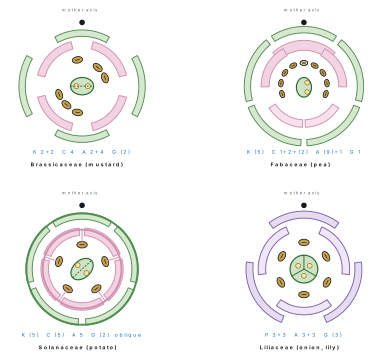
The NEB syllabus teaches Liliaceae in the broad sense of Bentham and Hooker, which includes onion and garlic. Molecular work has since split that family up: APG places Allium in Amaryllidaceae and Aloe in Asphodelaceae, and restricts Liliaceae to Lilium, Tulipa and their close relatives. Similarly Brassicaceae was once Cruciferae, Fabaceae was Leguminosae, and Poaceae was Gramineae. Write the name your syllabus uses, but if you know the modern one, add it in brackets — it never loses marks and it shows you understand that classification is a moving target.
Brassicaceae
Brassicaceae (formerly Cruciferae, the mustard family) has about 350 genera and 3,000 species, mostly herbs of the north temperate zone; Nepal grows several as staple oilseeds and vegetables.
- Habit: annual or biennial herbs, rarely undershrubs, often with pungent watery juice.
- Root: tap root, sometimes swollen (radish, turnip).
- Stem: herbaceous, erect, cylindrical, often hairy.
- Leaves: alternate, simple, exstipulate, often with a sheathing base; radical leaves usually form a rosette and are lyrate or pinnatifid.
- Inflorescence: racemose — a raceme or corymbose raceme.
- Flower: ebracteate, pedicellate, complete, bisexual, actinomorphic, hypogynous, tetramerous.
- Calyx: 4 sepals in two whorls of 2, free (polysepalous), imbricate.
- Corolla: 4 petals, free (polypetalous), arranged in the form of a cross — the cruciform corolla that named the old family — valvate, with a clawed base.
- Androecium: 6 stamens in two whorls, the outer 2 short and the inner 4 long — the condition called tetradynamous; anthers dithecous, basifixed, introrse.
- Gynoecium: bicarpellary, syncarpous; ovary superior, at first unilocular but divided into two chambers by a false septum, the replum; parietal placentation; style short, stigma bilobed.
- Fruit: a siliqua (long, as in mustard) or silicula (short, as in Capsella), dehiscing from below upward and leaving the replum with the seeds.
- Seed: non-endospermic, with a curved embryo.
- Floral formula: Bisexual, actinomorphic — K2+2 C4 A2+4 G(2)
- Economic importance: oilseeds (Brassica campestris, tori; B. juncea, rayo; B. napus); vegetables (B. oleracea var. capitata cabbage, var. botrytis cauliflower, var. gongylodes knol-khol; Raphanus sativus, radish); condiments (Brassica nigra, black mustard); medicine (Iberis amara); ornamentals (Iberis, Matthiola, Cheiranthus, wallflower); and the weed Capsella bursa-pastoris (shepherd's purse).
Fabaceae
Fabaceae (Leguminosae, the pea family), taken here in the sense of the subfamily Papilionoideae, is the third largest family of flowering plants and by far the most important for soil fertility, because its roots carry nitrogen-fixing Rhizobium.
- Habit: herbs, shrubs, trees and climbers (pea, Lathyrus, Butea, Dalbergia).
- Root: tap root with nodules containing Rhizobium leguminosarum, which fixes atmospheric nitrogen.
- Stem: erect or twining; sometimes winged or modified into tendrils.
- Leaves: alternate, stipulate, usually pinnately compound with pulvinate leaf base; the terminal leaflets of pea are tendrils; in Lathyrus aphaca the whole leaf is a tendril and the stipules photosynthesise.
- Inflorescence: racemose — raceme or, in Trifolium, a head.
- Flower: bracteate, bisexual, zygomorphic, hypogynous, pentamerous.
- Calyx: 5 sepals, gamosepalous, campanulate, imbricate or valvate.
- Corolla: 5 petals, polypetalous but papilionaceous — one large posterior standard (vexillum), two lateral wings (alae) and two anterior petals fused to form the keel (carina) that encloses the stamens and style; aestivation vexillary.
- Androecium: 10 stamens, diadelphous (9) + 1 — nine united by their filaments into a sheath and the tenth, opposite the standard, free; anthers dithecous, basifixed.
- Gynoecium: monocarpellary; ovary superior, unilocular, with marginal placentation; style bent, with a hairy tip below a simple stigma.
- Fruit: a legume or pod, dehiscing along both sutures.
- Seed: one to many, non-endospermic, with a large hilum.
- Floral formula: Bisexual, zygomorphic — K(5) C1+2+(2) A(9)+1 G1
- Economic importance: pulses, the chief vegetable protein of Nepal (Cicer arietinum chana, Lens culinaris musuro, Cajanus cajan rahar, Pisum sativum pea, Glycine max soyabean, Phaseolus and Vigna beans); oils (groundnut Arachis hypogaea, soyabean); fodder (Medicago sativa lucerne, Trifolium clover); timber and fuel (Dalbergia sissoo sisau, Pterocarpus); dyes (indigo from Indigofera tinctoria); gum (Astragalus); fish poison and insecticide (Derris, rotenone); ornamentals (Lupinus, Clitoria, Butea monosperma palas); and above all green manure and crop rotation, because a legume leaves the soil richer in nitrogen than it found it.
Solanaceae
Solanaceae, the potato or nightshade family, has about 90 genera and 2,800 species and includes both our most valuable vegetables and some of our most dangerous poisons, since the family is rich in alkaloids.
- Habit: mostly herbs and shrubs, rarely small trees; often with a disagreeable smell.
- Root: tap root; stem tubers in potato.
- Stem: herbaceous or woody, erect, branched, sometimes prickly (Solanum xanthocarpum); underground stem tuber in Solanum tuberosum.
- Leaves: alternate, simple, exstipulate, entire or lobed, with bicollateral vascular bundles in the petiole.
- Inflorescence: usually a cymose inflorescence — a helicoid or scorpioid cyme, solitary axillary in Datura.
- Flower: ebracteate, pedicellate, bisexual, actinomorphic, hypogynous, pentamerous.
- Calyx: 5 sepals, gamosepalous, valvate, persistent and often enlarging around the fruit (the papery bladder of Physalis).
- Corolla: 5 petals, gamopetalous, rotate, campanulate or infundibuliform, valvate or twisted.
- Androecium: 5 stamens, epipetalous, inserted on the corolla tube and alternating with the petals; anthers dithecous, basifixed, often connivent around the style and in Solanum opening by apical pores.
- Gynoecium: bicarpellary, syncarpous; ovary superior, bilocular, the two chambers set obliquely to the median plane because of a false septum; axile placentation on a swollen axis, with many ovules; style simple, stigma bilobed.
- Fruit: a berry (tomato, brinjal) or a capsule (Datura, spiny and four-valved).
- Seed: endospermic, with a curved embryo.
- Floral formula: Bisexual, actinomorphic — K(5) C(5) A5 G(2), ovary obliquely placed.
- Economic importance: food (Solanum tuberosum potato — the world's fourth staple, S. melongena brinjal, Lycopersicon esculentum tomato, Capsicum annuum chilli and capsicum); drugs (belladonna and atropine from Atropa belladonna, used to dilate the pupil; hyoscine from Hyoscyamus niger; Datura stramonium for asthma; Withania somnifera, ashwagandha); narcotic (nicotine from Nicotiana tabacum, tobacco, the family's most destructive gift); ornamentals (Petunia, Cestrum nocturnum raat ki rani, Solanum pseudocapsicum); and poisons — the green parts of potato and the seeds of Datura contain solanine and hyoscyamine and have caused deaths.
Liliaceae
Liliaceae, the lily family, is the representative monocot family of the syllabus, taken in the broad Bentham and Hooker sense that includes Allium. It has about 250 genera and 4,000 species and is the monocot equivalent of a textbook family: perfectly trimerous throughout.
- Habit: perennial herbs with underground perennating organs, rarely shrubs (Yucca) or climbers (Smilax, Gloriosa).
- Root: adventitious, fibrous, often fleshy or contractile.
- Stem: underground bulb (Allium, Lilium, Tulipa), rhizome (Asparagus, Aloe) or corm; aerial stem sometimes modified into a phylloclade or cladode (Asparagus, where the apparent leaves are stems and the true leaves are scales).
- Leaves: mostly radical, alternate or whorled, simple, exstipulate, sessile with a sheathing base, parallel-veined, often fleshy (Aloe).
- Inflorescence: racemose — a raceme, or a scapigerous umbel enclosed at first by papery bracts (Allium), or solitary (Tulipa).
- Flower: bracteate, pedicellate, bisexual, actinomorphic, hypogynous, trimerous.
- Perianth: 6 tepals in two whorls of 3, the calyx and corolla not distinguishable, hence perianth (P) in the formula; usually petaloid, free or united into a tube, valvate.
- Androecium: 6 stamens in two whorls of 3, epiphyllous (attached to the tepals) and opposite them; anthers dithecous, introrse, dehiscing longitudinally.
- Gynoecium: tricarpellary, syncarpous; ovary superior, trilocular, with axile placentation and usually many ovules; style one, stigma trilobed.
- Fruit: a capsule (Lilium, Allium), rarely a berry (Asparagus, Smilax).
- Seed: endospermic, with a straight embryo.
- Floral formula: Bisexual, actinomorphic — P3+3 A3+3 G(3)
- Economic importance: food and condiment (Allium cepa onion, A. sativum garlic, Asparagus officinalis); medicine (Aloe barbadensis ghiukumari, for burns and cosmetics; Colchicum autumnale, the source of colchicine, used to induce polyploidy and to treat gout; Smilax, sarsaparilla; Urginea, a cardiac stimulant); fibre (Yucca, Phormium); ornamentals (Lilium, Tulipa, Gloriosa superba, Hyacinthus, Dracaena); and the poisonous Colchicum and Gloriosa, whose tubers kill.
| Character | Brassicaceae | Fabaceae | Solanaceae | Liliaceae |
|---|---|---|---|---|
| Class | Dicot | Dicot | Dicot | Monocot |
| Habit | herbs | herbs to trees, climbers | herbs, shrubs | herbs with bulb or rhizome |
| Inflorescence | raceme | raceme | cyme | umbel or raceme |
| Symmetry | actinomorphic | zygomorphic | actinomorphic | actinomorphic |
| Perianth | K4 C4, cruciform | K(5) C papilionaceous | K(5) C(5) | P3+3 |
| Androecium | 6, tetradynamous | 10, diadelphous | 5, epipetalous | 6, epiphyllous |
| Gynoecium | bicarpellary, parietal, replum | monocarpellary, marginal | bicarpellary, axile, oblique | tricarpellary, axile |
| Fruit | siliqua or silicula | legume | berry or capsule | capsule or berry |
| Floral formula | K2+2 C4 A2+4 G(2) | K(5) C1+2+(2) A(9)+1 G1 | K(5) C(5) A5 G(2) | P3+3 A3+3 G(3) |
| Type plant | Brassica campestris | Pisum sativum | Solanum nigrum | Allium cepa |
"The flower is subtended by a bract. It is bisexual and can be divided into two equal halves in one plane only. There are five united sepals, five free petals of which one is large and posterior, two are lateral and two are fused below, ten stamens of which nine are joined by their filaments and one is free, and a single carpel whose ovary lies above the other whorls." Write the floral formula, name the family and predict the fruit.
Step 1 — decode each phrase into a symbol.
| Phrase in the description | Meaning | Symbol |
|---|---|---|
| subtended by a bract | bracteate | Br |
| divisible into two equal halves in one plane only | zygomorphic | % (or state in words) |
| five united sepals | gamosepalous calyx of 5 | K(5) |
| one posterior + two lateral + two fused | papilionaceous corolla | C1+2+(2) |
| nine joined, one free | diadelphous androecium of 10 | A(9)+1 |
| single carpel | monocarpellary gynoecium | G1 |
| ovary above the other whorls | hypogynous, superior ovary | underline G |
Step 2 — assemble. Brackets mean united, a plus sign separates whorls or groups, and a bar under the G means the ovary is superior:
Bisexual, zygomorphic — K(5) C1+2+(2) A(9)+1 G1
Step 3 — identify. A zygomorphic papilionaceous corolla with a diadelphous (9)+1 androecium and a monocarpellary superior ovary is diagnostic of Fabaceae (Papilionoideae) — for example Pisum sativum.
Step 4 — predict the fruit. A single carpel with marginal placentation dehiscing along both sutures gives a legume (pod), and the seeds will be non-endospermic with food stored in the two fleshy cotyledons.
Work the same three steps backwards to answer the commoner version of this question: "given the formula K(5) C(5) A5 G(2), describe the flower" — five united sepals, five united petals, five epipetalous stamens, a bicarpellary syncarpous superior ovary, actinomorphic and bisexual, so Solanaceae, and the fruit is a berry or a capsule.
Chapter summary
- Three domains — Archaea, Bacteria, Eukarya — were proposed by Woese (1977) from 16S rRNA sequences. Archaea and Bacteria are prokaryotic; only Archaea have branched, ether-linked membrane lipids.
- Binomial nomenclature (Linnaeus, Species Plantarum, 1753) gives every species a two-word Latin name: capitalised genus, lower-case species epithet, italicised in print, underlined separately in handwriting, governed by the ICN and the principle of priority.
- Whittaker's five kingdoms (1969) — Monera, Protista, Fungi, Plantae, Animalia — separate organisms by cell type, body organisation and mode of nutrition. Viruses fall outside the scheme entirely.
- Nepal holds over 3 % of the world's known plants on 0.1 % of its land: about 6,500 angiosperms, 28 gymnosperms, 534 pteridophytes, 1,150 bryophytes, 771 lichens, with about 300 endemic flowering plants.
- Fungi are achlorophyllous absorptive heterotrophs with chitin walls, glycogen reserve and a mycelium of coenocytic or septate hyphae. Sexual reproduction runs plasmogamy → karyogamy → meiosis, with a dikaryotic stage in the higher classes. Four classes: Phycomycetes (zygospore), Ascomycetes (8 ascospores in an ascus), Basidiomycetes (4 basidiospores on a basidium), Deuteromycetes (sexual stage unknown).
- Lichens are fungus + alga: the mycobiont gives the body and absorbs water, the photobiont gives the food. Crustose, foliose and fruticose growth forms; reproduction chiefly by soredia and isidia. They are pioneers of rock succession, indicators of SO₂ pollution and the source of litmus.
- Algae are thalloid autotrophs with unicellular sex organs and no embryo. Fritsch's classes are recognised by pigment and reserve food: green (starch), brown (laminarin, fucoxanthin), red (floridean starch, phycoerythrin, no flagella). Sexual reproduction advances through isogamy → anisogamy → oogamy.
- Bryophytes are the amphibians of the plant kingdom: gametophyte dominant, no vascular tissue, rhizoids instead of roots, jacketed antheridia and archegonia, water needed for fertilisation, and a dependent sporophyte of foot, seta and capsule.
- Pteridophytes are vascular cryptogams: sporophyte dominant with true root, stem and leaf, xylem of tracheids, sporangia in sori with an annulus and indusium, and a small independent prothallus. Heterospory (Selaginella, Marsilea, Salvinia) is the evolutionary step towards the seed.
- Gymnosperms bear naked seeds on open megasporophylls in cones, lack vessels (except Gnetales), are wind-pollinated directly on to the micropyle, form haploid endosperm before fertilisation, show polyembryony, and never form fruit.
- Angiosperms enclose the ovule in an ovary, undergo double fertilisation and form fruit; they divide into monocots (one cotyledon, fibrous roots, parallel venation, scattered closed bundles, trimerous flowers) and dicots.
- The taxonomic hierarchy is Kingdom → Division → Class → Order → Family → Genus → Species; only the species is a natural unit.
- Classification systems are artificial (Linnaeus, a few characters), natural (Bentham and Hooker, Genera Plantarum 1862–83, many characters, gymnosperms wrongly placed between dicots and monocots) and phylogenetic (Engler and Prantl, and today APG, based on descent).
- The four families reduce to four formulae: Brassicaceae K2+2 C4 A2+4 G(2), Fabaceae K(5) C1+2+(2) A(9)+1 G1, Solanaceae K(5) C(5) A5 G(2), Liliaceae P3+3 A3+3 G(3).
Practice questions
Group A — Multiple choice (1 mark each)
- Which one of the following is not a criterion of Whittaker's five-kingdom classification? [1]acell structurebmode of nutritioncbody organisationdchromosome number
- The reserve food of brown algae is [1]astarchblaminarincfloridean starchdglycogen
- In bryophytes the dominant phase of the life cycle is the [1]adiploid sporophytebhaploid gametophytecdikaryotic myceliumdprothallus
- The endosperm of a gymnosperm seed is [1]ahaploid and formed before fertilisationbtriploid and formed after fertilisationcdiploid and formed before fertilisationdabsent
- The androecium described as tetradynamous, with two short and four long stamens, is characteristic of [1]aFabaceaebSolanaceaecBrassicaceaedLiliaceae
Answers to Group A
1. (d) — Whittaker used cell structure, body organisation, mode of nutrition, reproduction and phylogeny, not chromosome number.
2. (b) — laminarin and mannitol; the brown colour is due to fucoxanthin.
3. (b) — the leafy moss plant is the gametophyte; the sporophyte is attached to it and dependent on it.
4. (a) — the female gametophyte tissue forms before fertilisation, so it is haploid; there is no double fertilisation.
5. (c) — 6 stamens in whorls of 2 (short) and 4 (long), written A2+4.
Group B — Short answer questions (4 marks each)
- Give any four general characters of Bryophyta and explain why bryophytes are called the amphibians of the plant kingdom. [4]
- Tabulate any four differences between gymnosperms and angiosperms. [4]
- What is a lichen? Name its two components, state the contribution of each, and give two uses of lichens. [4]
- Draw a labelled floral diagram of Pisum sativum and write its floral formula, explaining what each symbol in the formula means. [4]
Answers to Group B
1. Any four of: the plant body is a haploid gametophyte, thalloid or leafy, with no true roots (only rhizoids) and no vascular tissue; sex organs are multicellular and jacketed (antheridium and archegonium); fertilisation needs external water; the zygote forms an embryo and then a sporophyte of foot, seta and capsule which stays attached to and dependent on the gametophyte; spores formed by meiosis germinate into a protonema. They are called amphibians because, like frogs, they live on land but must return to water to reproduce — the biflagellate antherozoids can only reach the egg by swimming through a film of water, so bryophytes are confined to moist, shaded habitats.
2. Ovule naked on an open megasporophyll / enclosed in an ovary; no fruit / fruit present; xylem without vessels (except Gnetales) / with vessels; single fertilisation / double fertilisation; endosperm haploid and formed before fertilisation / triploid and formed after; reproductive structure a cone / a flower; polyembryony common / rare; woody habit only / all habits. (Any four, properly tabulated with both columns filled.)
3. A lichen is a stable symbiotic association of a fungus and a photosynthetic partner forming a thallus unlike either alone. The mycobiont (usually an Ascomycete, 90–95 % of the thallus) forms the body, absorbs and retains water and minerals, and protects the alga from desiccation and intense light; the phycobiont (a green alga such as Trebouxia, or a cyanobacterium such as Nostoc) photosynthesises and, if a cyanobacterium, also fixes nitrogen. Uses (any two): source of litmus from Roccella tinctoria; bio-indicators of SO₂ air pollution; food and fodder (Cetraria, Cladonia rangiferina); perfumery (Evernia); the antibiotic usnic acid; pioneers of xerophytic succession on bare rock.
4. Floral formula: Bisexual, zygomorphic — K(5) C1+2+(2) A(9)+1 G1. In the diagram show the mother axis at the top, the bract below, then five united sepals, the papilionaceous corolla with the posterior standard outermost, two lateral wings and two fused keel petals, the nine fused stamens with the tenth free opposite the standard, and at the centre a single carpel with marginal placentation. Meaning of the symbols: K = calyx and the bracket means the sepals are fused; C1+2+(2) = five petals in three groups, of which two are fused; A(9)+1 = ten stamens, nine united by their filaments (diadelphous) and one free; G1 = one carpel; the bar under G shows the ovary is superior (hypogynous); the flower is zygomorphic, so it can be halved in only one plane.
Group C — Long answer questions (8 marks each)
- Describe the family Solanaceae under the headings habit, leaf, inflorescence, flower (calyx, corolla, androecium and gynoecium), fruit and floral formula, and give four points of economic importance with named examples. [8]
- With the help of a labelled diagram, describe the life cycle of a moss such as Funaria, marking the ploidy of each stage, and explain how alternation of generations in a fern differs from it. [8]
Answers to Group C
1. Habit: mostly annual or perennial herbs and shrubs, rarely small trees, with a tap root; potato has an underground stem tuber and Solanum xanthocarpum is prickly. Leaf: alternate, simple, exstipulate, entire or lobed, with bicollateral vascular bundles. Inflorescence: usually a cymose inflorescence (helicoid or scorpioid cyme), solitary and axillary in Datura. Flower: ebracteate, pedicellate, complete, bisexual, actinomorphic, hypogynous, pentamerous. Calyx: 5 sepals, gamosepalous, valvate, persistent and enlarging in fruit. Corolla: 5 petals, gamopetalous, rotate or infundibuliform, valvate or twisted. Androecium: 5 stamens, epipetalous, inserted on the corolla tube and alternating with the petals; anthers dithecous, basifixed, often connivent and in Solanum opening by apical pores. Gynoecium: bicarpellary, syncarpous; ovary superior, bilocular with the locules set obliquely, axile placentation on a swollen placenta, many ovules; style simple, stigma bilobed. Fruit: a berry (tomato, brinjal) or a capsule (Datura). Seed: endospermic. Floral formula: bisexual, actinomorphic — K(5) C(5) A5 G(2). Economic importance: food — Solanum tuberosum (potato), S. melongena (brinjal), Lycopersicon esculentum (tomato), Capsicum annuum (chilli); medicine — atropine from Atropa belladonna, hyoscine from Hyoscyamus niger, Withania somnifera (ashwagandha); narcotic — nicotine from Nicotiana tabacum; ornamental — Petunia, Cestrum nocturnum. Credit is also given for noting that the family is rich in alkaloids, so that Datura seeds and the green parts of potato are poisonous.
2. Diagram: a circular flow diagram with the haploid half and the diploid half distinguished, as in the figure in section 2.5. Description: the spore (n) germinates on damp soil into a green, branched, filamentous protonema (n), which buds to produce the erect leafy gametophyte (n) anchored by multicellular rhizoids. At its apex the gametophyte bears clusters of antheridia (producing biflagellate antherozoids) and, on another branch, flask-shaped archegonia each with one egg. Water is essential: the antherozoids swim down the mucilage-filled neck and one fuses with the egg — fertilisation, the point at which ploidy doubles — giving a zygote (2n). The zygote divides in situ into an embryo and then the sporophyte (2n) of foot (embedded in the gametophyte, absorbing food), seta and capsule. Inside the capsule the spore mother cells (2n) undergo meiosis, the point at which ploidy halves, giving haploid spores that are flicked out by the hygroscopic peristome teeth when the operculum falls. The cycle is therefore a heteromorphic alternation of generations with the gametophyte dominant. Difference in the fern: the two generations swap importance. In Dryopteris the sporophyte is the large, long-lived, independent plant with true roots, stem and leaves and with vascular tissue, while the gametophyte is reduced to a small, short-lived, heart-shaped prothallus that is quite independent of the sporophyte. Spores are produced in sporangia grouped in sori on the underside of the frond, protected by an indusium and thrown out by the annulus, not by peristome teeth; and the young fern sporophyte is at first nourished by the prothallus but soon becomes free-living, whereas the moss sporophyte never becomes independent. Water is still needed for fertilisation in both.
Practise more: Biology question bank