Unit 4 · Botany · 11 teaching hours · 24 min read
Ecology
What the syllabus asks for 3
- Ecosystem ecology
- Ecological Adaptation
- Ecological Imbalances
Ecology is the study of the relationship between organisms and their surroundings. At eleven hours this is the largest Botany unit after Floral Diversity, and it is the one that connects biology to daily life in Nepal — why a Chitwan grassland supports so many deer, why the Chure hills slip after every monsoon, why Mikania is choking the sal forest. The unit works outward from the single ecosystem to the ways plants fit themselves into harsh places, and finally to what happens when the fit is broken.
Two long questions come from here almost every year: energy flow with the ten per cent law, or a biogeochemical cycle (nitrogen or carbon) with a labelled flow diagram. Short questions favour the ecological pyramids, xerophytic and hydrophytic adaptations, and named causes and effects of ecological imbalance. Always give a named Nepali example — it is worth a mark on its own.
4.1 Ecosystem ecology
An ecosystem is a self-regulating unit of nature in which the living organisms of an area interact among themselves and with their non-living surroundings, exchanging materials in cycles and energy in one direction. The term was coined by A. G. Tansley in 1935.
An ecosystem has no fixed size. A rain-filled hoof print, a paddy field in Bhaktapur, Phewa Lake, the Chitwan sal forest and the whole biosphere are all ecosystems. They are grouped as:
| Class | Sub-class | Nepali examples |
|---|---|---|
| Natural — terrestrial | forest, grassland, desert | sal forest of the Terai; phanta grassland of Shuklaphanta; trans-Himalayan desert of Mustang |
| Natural — aquatic | freshwater lentic (still), freshwater lotic (running), marine | Rara Lake; the Karnali river; none in Nepal (landlocked) |
| Artificial | crop field, orchard, aquarium, garden | paddy field, tea garden of Ilam, fish pond |
Components of an ecosystem
Abiotic components are the non-living ones:
- Climatic factors — light, temperature, rainfall, humidity, wind, atmospheric pressure.
- Edaphic factors — soil texture, soil water, soil air, pH, topography.
- Inorganic substances — CO₂, O₂, N₂, water, and the mineral salts of nitrogen, phosphorus, potassium, calcium and sulphur, which move in cycles.
- Organic substances — proteins, carbohydrates, lipids and humus, which link the living to the non-living.
Biotic components are grouped by how they obtain food:
- Producers (autotrophs) — green plants, algae, cyanobacteria and photosynthetic bacteria. They alone convert solar energy into chemical energy and bring it into the ecosystem.
- Consumers (heterotrophs / phagotrophs) — primary consumers (herbivores: chital deer, grasshopper, rabbit), secondary consumers (primary carnivores: frog, jackal, snake), tertiary consumers (top carnivores: tiger, crested serpent eagle) and omnivores (humans, bear, crow).
- Decomposers (saprotrophs) — bacteria and fungi, which break dead bodies and excreta into simple minerals and return them to the abiotic pool. Without them every nutrient cycle stops.
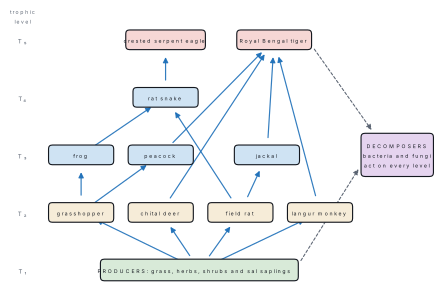
Decomposers are not a fourth trophic level at the bottom of the chain. They draw on every level — dead grass, dead deer and dead tiger alike — which is why they are drawn to one side of a food web, not underneath it.
Food chain, food web and trophic levels
A food chain is a straight-line sequence along which food energy passes from one organism to the next by eating. Each step is a trophic (feeding) level. There are two kinds:
- Grazing food chain (GFC) — starts from living green plants. Grass → grasshopper → frog → snake → eagle (Terai grassland); phytoplankton → zooplankton → small fish → large fish (Phewa Lake).
- Detritus food chain (DFC) — starts from dead organic matter. Leaf litter → earthworm → frog → snake. In a forest the DFC actually carries more of the energy than the GFC, because most leaves are never eaten alive.
Food chains rarely have more than four or five links, because so much energy is lost at each step. In nature the chains cross into a food web, which makes the ecosystem stable: if the deer population crashes, the tiger can switch to wild boar.
Energy flow and the ten per cent law
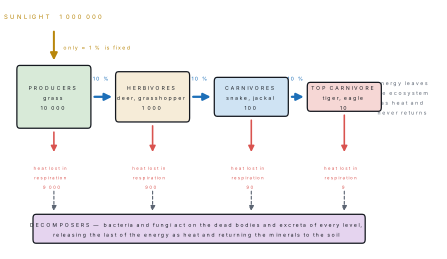
Energy enters an ecosystem only as sunlight and leaves it only as heat. Two laws of thermodynamics govern the journey. By the first law, energy is neither created nor destroyed — it is only converted from light to chemical to heat. By the second law, every conversion wastes some energy as heat, so the flow is one-way (unidirectional) and never cyclic.
Of the sunlight falling on a green leaf, only about 50 % is photosynthetically active radiation, and green plants fix only about 1 % of that as gross primary production. Thereafter, Lindeman's ten per cent law (R. L. Lindeman, 1942) applies.
Only about 10 % of the energy stored at one trophic level is passed on to the next; the other 90 % is lost as respiratory heat, in undigested matter and in the parts that are never eaten. This is why food chains are short and why top carnivores are always few.
Productivity measures how fast energy is stored.
Gross primary productivity (GPP) is the total organic matter fixed by producers per unit area per unit time. Part of it is burnt in the plant's own respiration (R). What is left is net primary productivity (NPP), the food actually available to consumers:
Secondary productivity is the rate at which consumers store energy. Productivity is measured in g m⁻² yr⁻¹ or kJ m⁻² yr⁻¹, whereas standing crop is the biomass present at one moment, in g m⁻².
Problem. The producers of a grassland fix 20{,}000\ \text{kJ m}^{-2}\ \text{yr}^{-1}. Using the ten per cent law, find the energy available to the herbivores, to the carnivores and to the top carnivores, and the total energy lost as heat between the producer and the top-carnivore levels.
Solution. Each level receives one tenth of the previous one:
Energy lost as heat is the difference between what enters a level and what leaves it:
That is 99.9 % of the producers' energy — the tiger lives on the last 0.1 %.
Problem. In one year a hectare of sal forest fixes a gross primary production of 12{,}000\ \text{kJ m}^{-2} and uses 7500\ \text{kJ m}^{-2} in its own respiration. Calculate the net primary productivity and express it as a percentage of GPP.
Solution.
Only 37.5 % of what the forest fixes is available to every animal and decomposer in it; a forest spends more on respiration than a crop field does because it carries a large mass of non-photosynthetic wood.
Ecological pyramids
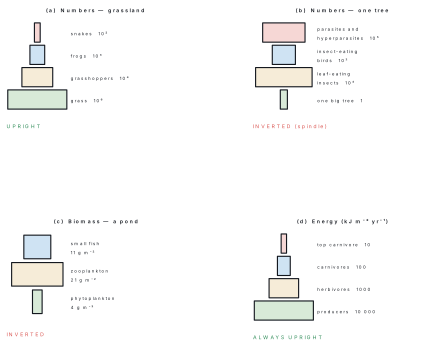
An ecological pyramid (Charles Elton, 1927) is a graphical model in which each trophic level is drawn as a horizontal bar whose length is proportional to the number, the biomass or the energy at that level. Producers form the base.
| Pyramid | What the bar measures | Grassland | Pond | Single tree |
|---|---|---|---|---|
| Number | individuals per unit area | upright | upright | inverted (spindle) |
| Biomass | dry weight per unit area | upright | inverted | upright |
| Energy | energy fixed per unit area per unit time | upright | upright | upright |
The phytoplankton of a pond weigh less at any one moment than the zooplankton feeding on them — but they reproduce far faster, so over a year they produce far more. A pyramid of biomass is a snapshot; a pyramid of energy is a rate, and a rate can never be inverted without breaking the second law of thermodynamics.
Population attributes
A population is a group of individuals of one species living in a defined area. Its measurable attributes are density (individuals per unit area), natality (birth rate), mortality (death rate), immigration, emigration and age structure.
When resources are unlimited a population grows exponentially, giving a J-shaped curve:
where r is the intrinsic rate of natural increase. In the real world food and space run out, and growth becomes logistic, giving an S-shaped (sigmoid) curve that levels off at the carrying capacity K:
Problem. A student lays 20 quadrats, each 1\ \text{m}^{2}, in a Shivapuri grassland. Imperata cylindrica occurs in 15 of them, and 240 shoots are counted altogether. Calculate its density, frequency and abundance.
Solution.
Problem. A protected population of 1000 chital deer grows exponentially with r = 0.20\ \text{yr}^{-1}. What will the population be after 5 years? Take e = 2.718.
Solution.
The population has nearly trebled in five years — which is why a fenced reserve must either expand or cull, since K is fixed.
Biogeochemical cycles
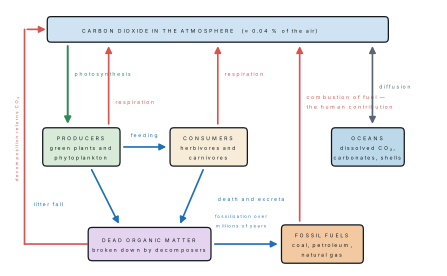
Energy flows through an ecosystem and is lost; matter moves in circles and is reused. The circular path of a chemical element from the abiotic pool through the living world and back is a biogeochemical cycle. Cycles whose reservoir is the atmosphere (carbon, nitrogen, oxygen) are gaseous cycles; those whose reservoir is rock (phosphorus, sulphur, calcium) are sedimentary cycles.
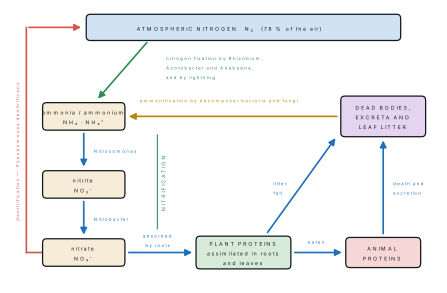
The four steps of the nitrogen cycle are worth learning as a sequence:
- Nitrogen fixation — N₂ → NH₃. Done biologically by free-living Azotobacter and Clostridium, symbiotic Rhizobium leguminosarum in the root nodules of lentil, soybean and gram, and Anabaena in the leaf cavities of Azolla; physically by lightning; industrially by the Haber process.
- Ammonification — decomposer bacteria and fungi convert the nitrogen of dead bodies and urea back into ammonia.
- Nitrification — NH₄⁺ → NO₂⁻ by Nitrosomonas, then NO₂⁻ → NO₃⁻ by Nitrobacter. Only now is the nitrogen in the form roots absorb.
- Denitrification — NO₃⁻ → N₂ by Pseudomonas denitrificans and Thiobacillus denitrificans in waterlogged soil. This is the only route back to the atmosphere, and it is why paddy soils lose fertiliser nitrogen.
Ecological succession
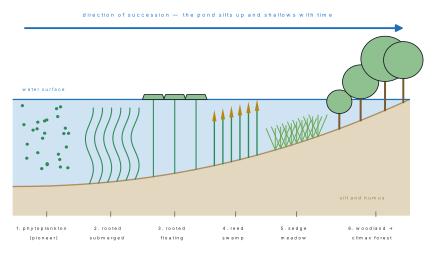
Ecological succession is the orderly, progressive and predictable replacement of one community by another at the same site, until a stable, self-perpetuating climax community in equilibrium with the climate is reached.
The first community to arrive is the pioneer community; each intermediate community is a seral stage and the whole series is a sere. Succession is primary when it begins on a bare surface that never carried life (a new landslide scar in Sindhupalchok, cooled lava, a fresh sandbar of the Koshi), and secondary when it restarts on a site that was stripped of its community but still has soil (an abandoned bari field, a burnt forest). Secondary succession is far faster, because the soil and its seed bank already exist.
A succession that begins in water is a hydrosere; one that begins on bare rock is a xerosere. Both converge on the same mesic forest climax.
| Sere | Starts on | Pioneer | Order of seral stages | Climax |
|---|---|---|---|---|
| Hydrosere | open water | phytoplankton | submerged → rooted floating → reed swamp → sedge meadow → woodland | mesic forest |
| Xerosere | bare rock | crustose lichen | foliose lichen → moss → herb → shrub → woodland | mesic forest |
Crusty Foliage Makes Her Shoes Filthy — Crustose lichen, Foliose lichen, Moss, Herb, Shrub, Forest (climax).
4.2 Ecological adaptation
Adaptation is any inherited change in the form, structure, physiology or behaviour of an organism that fits it to survive and reproduce in a particular habitat. Adaptations are the result of natural selection acting over many generations, not of an individual's effort within its lifetime.
Plants are grouped by the water available in their habitat.
Hydrophytes — plants of water
| Sub-type | Position | Examples |
|---|---|---|
| Free floating | float on the surface, roots hang free | Eichhornia crassipes, Pistia stratiotes, Lemna, Wolffia |
| Rooted floating | rooted in mud, leaves on the surface | Nelumbo nucifera (lotus), Nymphaea, Trapa |
| Rooted submerged | wholly under water | Hydrilla verticillata, Vallisneria |
| Free submerged | under water, not rooted | Ceratophyllum, Utricularia |
| Amphibious | part in, part out of water | Typha, Ranunculus, paddy |
Their problem is not water but oxygen, support and anchorage, so:
- roots are poorly developed or absent, with no root hairs and only a root pocket instead of a root cap;
- stems and petioles are soft, flexible and spongy, so the current bends them instead of breaking them;
- the cortex contains large air chambers, aerenchyma, which store oxygen and give buoyancy;
- the cuticle is very thin or absent, and the epidermis itself contains chloroplasts and absorbs water and minerals directly;
- stomata are absent in submerged leaves, and confined to the upper surface (epistomatic) in floating leaves such as the lotus;
- submerged leaves are thin, ribbon-like or finely dissected, which increases the surface for gas exchange and reduces drag;
- mechanical and vascular tissue is much reduced, since water supports the plant;
- reproduction is largely vegetative, by runners, offsets and turions.
Xerophytes — plants of dry places
| Sub-type | Strategy | Examples |
|---|---|---|
| Ephemerals ("drought escapers") | complete the whole life cycle in a few weeks of rain | Argemone, Tribulus |
| Succulents | store water in swollen stems or leaves | Opuntia, Euphorbia royleana (siundi), Aloe vera |
| Non-succulent perennials | endure drought by cutting losses | Casuarina, Nerium oleander, Calotropis, Acacia catechu (khayar) |
Adaptations run in two directions — get more water, lose less:
- roots are long, much branched and deep, often reaching the water table;
- stems are woody, covered with wax or hair; in Opuntia the flattened green stem is a phylloclade that does the photosynthesis;
- leaves are small, leathery, or reduced to spines and scales, cutting the transpiring surface; in Acacia the petiole flattens into a phyllode;
- the cuticle is very thick, and the epidermis is multilayered with a sclerenchymatous hypodermis;
- stomata are few, sunken in pits lined with hairs, so that a still, humid layer of air sits over the pore;
- many succulents use CAM photosynthesis — the stomata open at night to take in CO₂ as an organic acid, and stay shut through the hot day.
Other ecological groups
- Mesophytes — ordinary land plants of moderate water, such as mango, maize and rose; they have well-developed roots, broad thin leaves, normal cuticle and stomata on both surfaces.
- Halophytes — plants of saline soil and tidal mud, such as Rhizophora and Avicennia. They have breathing roots (pneumatophores) with lenticel-like pores, stilt roots, salt-secreting glands, succulent leaves, and viviparous germination, in which the seed germinates while still on the parent.
- Epiphytes — plants that perch on another plant for support only, such as the orchids Vanda and Dendrobium common on Nepal's mid-hill trees. Clinging roots grip the bark and hanging aerial roots carry a spongy sheath of dead cells, the velamen, which soaks up rain and dew.
- High-altitude plants of Nepal's alpine zone — Saussurea gossypiphora, the snowball plant, wraps itself in dense white wool that traps heat and blocks ultraviolet light; cushion plants such as Arenaria grow as tight hemispheres that hold a warm still layer of air near the ground.
Answer structure for an adaptation question
Answer under three fixed headings — morphological (root, stem, leaf), anatomical (cuticle, epidermis, stomata, aerenchyma or sclerenchyma) and physiological (CAM, osmotic concentration, vegetative reproduction). Give a scientific name for each point. Examiners tick headings, not prose.
4.3 Ecological imbalances
Ecological imbalance is a disturbance of the natural equilibrium between the biotic and abiotic components of an ecosystem, in which the rate of destruction of a resource exceeds the rate at which the ecosystem can replace it.
Causes
- Population growth. Nepal's population has roughly trebled since 1961, and every extra household needs fuelwood, fodder and land.
- Deforestation. Clearing for cultivation, settlement, timber and fuelwood. The Terai lost much of its forest to resettlement after malaria was controlled in the 1960s.
- Overgrazing on the mid-hill and alpine pastures removes the ground cover that holds the soil.
- Unplanned urbanisation and industrialisation, which replace farmland with concrete and put untreated effluent into rivers such as the Bagmati.
- Pollution of air, water and soil, including pesticide residues.
- Quarrying of the Chure (Siwalik) hills for boulders, sand and gravel. The Chure is young, loose sedimentary rock; stripping it lowers the Terai water table and sends floods and debris onto farmland below.
- Invasive alien species. Mikania micrantha (lahare banmara) is smothering the sal forest and grassland of Chitwan; Lantana camara, Parthenium hysterophorus and the water hyacinth Eichhornia crassipes, which blankets Phewa Lake, do the same on land and water.
- Overexploitation — poaching of rhinoceros and tiger, and uncontrolled collection of medicinal herbs such as yarsagumba (Ophiocordyceps sinensis) and Nardostachys jatamansi.
Consequences
| Problem | Chief cause | Effect |
|---|---|---|
| Greenhouse effect and global warming | CO₂, CH₄, N₂O and CFCs trap outgoing infrared radiation | rising temperature, retreating glaciers, glacial lake outburst floods |
| Ozone layer depletion | chlorofluorocarbons release Cl atoms that destroy O₃ | more ultraviolet-B reaches the ground; skin cancer, cataract, reduced crop yield |
| Acid rain | SO₂ and NOₓ dissolve to give H₂SO₄ and HNO₃; rain pH falls below 5.6 | leaches soil nutrients, kills fish, corrodes buildings |
| Eutrophication | fertiliser and sewage enrich water with nitrate and phosphate | algal bloom → decomposition → oxygen falls → fish die |
| Biomagnification | non-degradable pesticides such as DDT | concentration multiplies at each trophic level; eggshells of fish-eating birds thin |
| Soil erosion and landslides | loss of vegetation cover on steep slopes | loss of topsoil, silting of rivers and reservoirs |
| Loss of biodiversity | habitat destruction, poaching, invasive species | species extinction and narrower gene pools |
Nepal shows all of these. Himalayan glaciers are retreating; the 1985 outburst of Dig Tsho above Thame destroyed the almost-finished Namche hydropower plant, and Imja Tsho and Tsho Rolpa are now monitored and partly drained for the same reason. The June 2021 Melamchi flood carried away bridges and intake works after debris built up in the upper catchment. Kathmandu's winter air regularly exceeds the WHO guideline for fine particulate matter.
Control measures
- Afforestation and reforestation, especially on degraded Chure slopes.
- Community forestry. More than 22,000 community forest user groups now manage a large share of Nepal's hill forest, and forest cover has risen again to about 45 % of the country (forest plus other wooded land, Forest Resource Assessment 2015).
- Soil conservation — terracing, contour bunding, check dams, gully plugging and agroforestry.
- Pollution control — treatment of sewage and industrial effluent, Euro-standard vehicle emission norms, promotion of electric vehicles, biogas and improved cooking stoves in place of firewood.
- Legal and institutional measures — the Environment Protection Act, the Forest Act, compulsory Environmental Impact Assessment for large projects, and the national protected-area network described in Unit 5.
- Education and public awareness, so that conservation is done by the people who live with the resource.
Global warming is caused by greenhouse gases trapping heat in the troposphere. Ozone depletion is caused by chlorofluorocarbons destroying O₃ in the stratosphere and lets in ultraviolet light. They have different gases, different layers and different effects. Mixing them up is the commonest error in this unit.
Chapter summary
- An ecosystem (Tansley, 1935) has abiotic components (climatic, edaphic, inorganic, organic) and biotic components (producers, consumers, decomposers).
- Food chains are grazing or detritus type; crossing chains form a food web, which gives the ecosystem stability.
- Energy flow is unidirectional: about 1 % of incident light is fixed, and only ~10 % passes from each trophic level to the next (Lindeman's ten per cent law). Matter, in contrast, moves in cycles.
- \text{NPP} = \text{GPP} - R; standing crop is a mass, productivity is a rate.
- Pyramids of number and of biomass may be inverted; the pyramid of energy is always upright.
- Population density D = N/A; unlimited growth is exponential, N_t = N_0 e^{rt} (J-shaped); limited growth is logistic, dN/dt = rN(K-N)/K (S-shaped), levelling at the carrying capacity K.
- Nitrogen cycle: fixation → ammonification → nitrification (Nitrosomonas, then Nitrobacter) → assimilation → denitrification (Pseudomonas denitrificans).
- Carbon cycle: photosynthesis takes CO₂ in; respiration, decomposition and combustion of fossil fuels put it back.
- Succession runs pioneer → seral stages → climax; hydrosere begins in water, xerosere on bare rock, and both end in the same mesic forest.
- Hydrophytes have aerenchyma, thin cuticle and reduced roots; xerophytes have deep roots, thick cuticle, sunken stomata and often CAM.
- Ecological imbalance in Nepal shows as Chure degradation, invasive Mikania and Eichhornia, retreating glaciers and glacial lake outburst floods; the answers are afforestation, community forestry, soil conservation, pollution control and law.
Practice questions
Group A — Multiple choice (1 mark each)
- The term ecosystem was coined by [1]aE. P. OdumbA. G. TansleycC. EltondR. L. Lindeman
- The pyramid that is always upright is the pyramid of [1]anumberbbiomasscenergydstanding crop
- Conversion of nitrite into nitrate in the soil is carried out by [1]aNitrosomonasbNitrobactercRhizobiumdPseudomonas denitrificans
- Aerenchyma is a characteristic tissue of [1]axerophytesbhydrophytescepiphytesdmesophytes
- If the producers of an ecosystem store 5000 kJ, the energy available to the secondary consumers by the ten per cent law is [1]a500 kJb50 kJc5 kJd0.5 kJ
- The pioneer community of a xerosere is [1]amossbcrustose lichencherbdphytoplankton
Answers to Group A
1. (b) — Tansley proposed the term in 1935; Lindeman gave the ten per cent law.
2. (c) — energy is a rate and is always lost upward, so it cannot invert.
3. (b) — Nitrosomonas makes nitrite, Nitrobacter oxidises it to nitrate.
4. (b) — the air chambers give buoyancy and store oxygen.
5. (b) — herbivores get 500 kJ, secondary consumers one tenth of that, 50 kJ.
6. (b) — crustose lichens alone can colonise bare rock and begin soil formation.
Group B — Short answer (4 marks each)
- Define an ecosystem and describe its biotic components with one example of each. [4]
- What is an ecological pyramid? Explain, with a reason, why the pyramid of biomass in a pond ecosystem is inverted. [4]
- The producers of a pond fix 8000\ \text{kJ m}^{-2}\ \text{yr}^{-1}, of which they respire 5600\ \text{kJ m}^{-2}\ \text{yr}^{-1}. Calculate the net primary productivity, and the energy that would reach a fish at the third trophic level under the ten per cent law. [4]
- List any four morphological and anatomical adaptations of xerophytes, naming a plant that shows each. [4]
Answers to Group B
1. Definition as in the text. Producers — autotrophs that fix solar energy, e.g. grass, Hydrilla. Consumers — heterotrophs: primary (herbivore, e.g. chital deer), secondary (primary carnivore, e.g. frog), tertiary (top carnivore, e.g. Royal Bengal tiger). Decomposers — saprotrophic bacteria and fungi that mineralise dead matter and return nutrients to the soil.
3. \text{NPP} = \text{GPP} - R = 8000 - 5600 = 2400\ \text{kJ m}^{-2}\ \text{yr}^{-1}. The energy passed on is taken from the NPP, so the second trophic level receives 0.10 \times 2400 = 240\ \text{kJ m}^{-2}\ \text{yr}^{-1} and the third trophic level receives 0.10 \times 240 = 24\ \text{kJ m}^{-2}\ \text{yr}^{-1}.
4. (i) Long, deeply penetrating branched roots — Acacia catechu. (ii) Leaves reduced to spines with a photosynthetic phylloclade — Opuntia. (iii) Very thick cuticle and multilayered epidermis with sclerenchymatous hypodermis — Nerium oleander. (iv) Stomata few and sunken in hairy pits — Nerium, Casuarina. A fifth, physiological, point: CAM photosynthesis with stomata open only at night — Aloe vera.
Group C — Long answer (8 marks each)
- Describe the flow of energy through an ecosystem with the help of a labelled diagram. State the ten per cent law and explain why food chains rarely have more than four or five links. [8]
- (a) Draw a labelled diagram of the nitrogen cycle. [4](b) Explain nitrogen fixation, nitrification and denitrification, naming the bacteria responsible for each, and state what happens to soil fertility if denitrifying bacteria become very active. [4]
Answer outline to Group C question 1
Diagram: sun → producers → herbivores → carnivores → top carnivores, with a respiratory heat-loss arrow at every level and a decomposer box receiving from all levels, as in the energy-flow figure.
Points to make: (i) the sun is the only source, and only about 1 % of the photosynthetically active radiation reaching a leaf becomes gross primary production; (ii) by the first law of thermodynamics the energy is converted, not destroyed; (iii) by the second law each conversion releases heat, so the flow is unidirectional and energy can never be recycled the way nutrients are; (iv) Lindeman's ten per cent law — only about a tenth of the energy at one trophic level is stored at the next, the rest going in respiration, in undigested faeces and in parts never eaten; (v) hence with producers at 10,000 kJ the fifth level would hold only 1 kJ, too little to support a viable population, so chains stop at four or five links and top carnivores are large, few and vulnerable to extinction.
Practise more: Biology question bank