Unit 1 · 23 min read
Relation and Function
What the syllabus asks for 5
- Ordered pairs and equal ordered pairs
- Cartesian product of two sets
- Relation: meaning, representation (ordered pairs, table, arrow diagram, graph), domain and range, inverse relation
- Function: meaning and notation, domain, co-domain and range, image and pre-image
- Representation of a function and the vertical line test
A class register pairs every roll number with a name. A price list pairs every item with its price. A map pairs every place with a position. Mathematics needs a careful language for such pairings, because the order of the two things matters: roll number 7 with 45 marks is not the same record as roll number 45 with 7 marks. This chapter builds that language step by step. We start with ordered pairs, combine two sets into their Cartesian product, pick out the pairs that obey a rule to make a relation, and finally meet the most important kind of relation in all of mathematics, the function, in which every input has exactly one output.
Expect these question types: (i) find x and y from two equal ordered pairs; (ii) write A\times B and B\times A and find n(A\times B); (iii) list a relation from a rule, show it in an arrow diagram, and state its domain, range and inverse; (iv) decide whether an arrow diagram or a set of ordered pairs is a function, with a reason; (v) find f(a), a pre-image, or the constants a and b in f(x)=ax+b; (vi) use the vertical line test on a graph. A reason written in words ("2 has two images") is part of the answer.
1.1 Ordered pairs and equal ordered pairs
Suppose Sita has roll number 7 and scored 45 marks in a test. We can record this as (7,45). The pair (45,7) would tell a different story: roll number 45 with 7 marks. When two objects are written together and the order matters, we call them an ordered pair.
Two objects a and b written in a definite order inside small brackets, (a,b), form an ordered pair. The object a is the first component (first element) and b is the second component (second element). The pairs (a,b) and (b,a) are different unless a=b.
You have used ordered pairs for years without the name: the coordinates of a point. The point (2,3) is 2 units along the x-axis and 3 units up; the point (3,2) is 3 units along and 2 units up. The figure below shows that they are two different points.

An ordered pair is not the same thing as a set of two members. The table shows the differences.
| Feature | Set \{2,3\} | Ordered pair (2,3) |
|---|---|---|
| Brackets | curly brackets \{\ \} | small brackets (\ ) |
| Does order matter? | no: \{2,3\}=\{3,2\} | yes: (2,3)\neq(3,2) |
| Can a member repeat? | \{2,2\} is just \{2\}, one member | (2,2) is a proper pair, like the point (2,2) |
| What it records | which objects belong | which object comes first and which second |
Equal ordered pairs
Two ordered pairs are equal when their first components are equal and their second components are equal:
So one statement about equal ordered pairs gives two equations: first component = first component, second component = second component. This is the most common one-mark and two-mark question of the chapter.
Problem. Find x and y if (x+3,\ 7)=(8,\ 2y-1).
Solution. Equate the first components and then the second components.
First components: x+3=8, so x=8-3=5.
Second components: 7=2y-1, so 2y=8 and y=4.
Check. (5+3,\ 7)=(8,7) and (8,\ 2\times4-1)=(8,7). ✓
Problem. If (2x-y,\ x+y)=(7,\ 8), find x and y.
Solution. The two equations are
Adding (i) and (ii): 3x=15, so x=5. From (ii): y=8-5=3.
Check. 2(5)-3=7 ✓ and 5+3=8 ✓. So x=5, y=3.
Problem. Find x and y if (3x-2,\ y+5)=(x+6,\ 2y-1).
Solution. First components: 3x-2=x+6, so 2x=8 and x=4.
Second components: y+5=2y-1, so 5+1=2y-y and y=6.
Check. Left pair (3\times4-2,\ 6+5)=(10,11); right pair (4+6,\ 2\times6-1)=(10,11). ✓
A student who writes x+3=2y-1 for the first example has joined a first component to a second component. That equation is not given by the question. Draw two short arrows in your rough work, first to first and second to second, before you write any equation.
1.2 Cartesian product of two sets
A tea shop in Butwal sells two drinks, D=\{\text{tea},\ \text{coffee}\}, and three snacks, S=\{\text{samosa},\ \text{sel roti},\ \text{biscuit}\}. A customer who chooses one drink and then one snack can make these orders:
(tea, samosa), (tea, sel roti), (tea, biscuit), (coffee, samosa), (coffee, sel roti), (coffee, biscuit).
There are 2\times3=6 possible orders. The set of all of them is the Cartesian product D\times S, named after the French mathematician René Descartes, who also gave us coordinates.
The Cartesian product of two non-empty sets A and B, written A\times B and read "A cross B", is the set of all ordered pairs whose first component is from A and whose second component is from B:
Problem. If A=\{1,2,3\} and B=\{x,y\}, find A\times B and B\times A. Are they equal?
Solution. Take each member of A in turn and pair it with every member of B:
Now take each member of B first:
Both have 6 members, but (1,x)\in A\times B while (1,x)\notin B\times A. So A\times B\neq B\times A.
Ways of showing a Cartesian product
The same product can be shown in five ways. For A=\{1,2,3\} and B=\{4,5\}:
| Method | What you draw or write |
|---|---|
| Listing | A\times B=\{(1,4),(1,5),(2,4),(2,5),(3,4),(3,5)\} |
| Tree diagram | three branches 1, 2, 3; from each, two branches 4 and 5; read each path as a pair |
| Table | rows labelled 1, 2, 3, columns labelled 4, 5; each cell holds a pair |
| Arrow diagram | two ovals; an arrow from every member of A to every member of B |
| Graph | the six points (1,4),\ldots,(3,5) plotted as a lattice of dots |
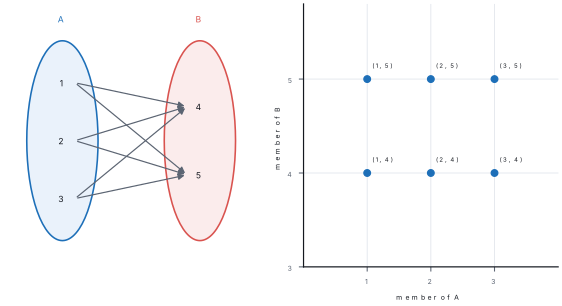
- n(A\times B)=n(A)\times n(B): every member of A is paired with every member of B.
- A\times B\neq B\times A in general, although n(A\times B)=n(B\times A). They are equal only when A=B.
- A\times A is also written A^2. For example \{0,1\}^2=\{(0,0),(0,1),(1,0),(1,1)\}.
Problem. If A\times B=\{(a,1),(a,2),(a,3),(b,1),(b,2),(b,3)\}, find A, B and check that n(A\times B)=n(A)\times n(B).
Solution. A is the set of first components and B is the set of second components:
Then n(A)\times n(B)=2\times3=6, and A\times B has 6 pairs. ✓
Problem. (i) If n(A)=4 and n(A\times B)=20, find n(B). (ii) If P=\{2,3\}, list P\times P.
Solution. (i) n(A\times B)=n(A)\times n(B) gives 20=4\times n(B), so n(B)=5.
(ii) P\times P=\{(2,2),(2,3),(3,2),(3,3)\}. It has 2\times2=4 pairs. Notice that (2,3) and (3,2) are both present and are different pairs.
1.3 Relation: meaning, representation (ordered pairs, table, arrow diagram, graph), domain and range, inverse relation
A Cartesian product contains every possible pair. Usually we are interested in only some of them, the ones that obey a rule. Take A=\{1,2,3,4\} and B=\{2,3,4,5,6\}. The product A\times B has 4\times5=20 pairs. The rule "y is 2 more than x" picks out just four of them:
This set of chosen pairs is a relation.
A relation R from a set A to a set B is any subset of A\times B. If (a,b)\in R we say "a is related to b" and may write a\,R\,b. A relation from A to A itself is called a relation on A.
Because a relation is a subset of A\times B, the empty set and A\times B itself are also relations, although not interesting ones.
Representing a relation
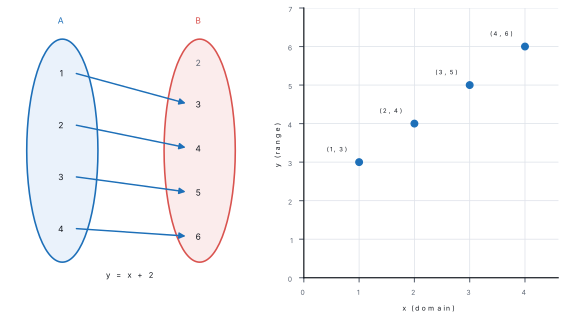
The relation "y=x+2" from A=\{1,2,3,4\} to B=\{2,3,4,5,6\} can be shown in five ways. All five carry the same information.
| Form | The relation y=x+2 |
|---|---|
| Ordered pairs (roster) | R=\{(1,3),(2,4),(3,5),(4,6)\} |
| Set-builder | R=\{(x,y): y=x+2,\ x\in A,\ y\in B\} |
| Table | x: 1, 2, 3, 4 and below it y: 3, 4, 5, 6 |
| Arrow diagram | arrows 1\rightarrow3, 2\rightarrow4, 3\rightarrow5, 4\rightarrow6 between two ovals |
| Graph | the four points (1,3), (2,4), (3,5), (4,6) |
Domain and range
The domain of a relation is the set of all first components of its ordered pairs. The range is the set of all second components.
For R=\{(1,3),(2,4),(3,5),(4,6)\} the domain is \{1,2,3,4\} and the range is \{3,4,5,6\}. The member 2 of B is not in the range, because no arrow reaches it in the arrow diagram above.
Problem. Let A=\{2,3,5\} and B=\{6,7,10,15\}. Write the relation R=\{(x,y): x \text{ is a factor of } y\} from A to B as a set of ordered pairs, and find its domain and range.
Solution. Test every member of A against every member of B:
- 2 is a factor of 6 and 10, but not of 7 or 15.
- 3 is a factor of 6 and 15, but not of 7 or 10.
- 5 is a factor of 10 and 15, but not of 6 or 7.
Domain =\{2,3,5\}. Range =\{6,10,15\}. The number 7 is in B but not in the range, because none of 2, 3, 5 divides 7.
Problem. On the set A=\{1,2,3,4\}, write the relation "x is less than y" as ordered pairs and find its domain and range.
Solution. We need all pairs (x,y) from A\times A with x<y:
Domain =\{1,2,3\} (4 is not less than any member of A). Range =\{2,3,4\} (nothing in A is less than 1).
Inverse relation
If Ram is the brother of Gita, then Gita is the sister of Ram: the same link read backwards. Reading every pair of a relation backwards gives its inverse.
The inverse of a relation R from A to B is the relation R^{-1} from B to A obtained by interchanging the components of every ordered pair of R:
The domain of R^{-1} is the range of R, and the range of R^{-1} is the domain of R.
In an arrow diagram, the inverse is drawn by reversing every arrow.
Problem. Let A=\{1,2,3\} and B=\{1,4,9,16\}, and R=\{(x,y): y=x^2,\ x\in A,\ y\in B\}. List R and R^{-1} and state the domain and range of each.
Solution. Squaring each member of A: 1^2=1, 2^2=4, 3^2=9.
| Domain | Range | |
|---|---|---|
| R | \{1,2,3\} | \{1,4,9\} |
| R^{-1} | \{1,4,9\} | \{1,2,3\} |
The rule of R is "square x"; the rule of R^{-1} is "take the positive square root of x". 16 is in B but has no partner, because 4 is not in A.
A relation from A to B is a subset of A\times B, and a set with k members has 2^k subsets. So if n(A\times B)=k, there are 2^k relations from A to B. For A=\{1,2\} and B=\{a\}, A\times B=\{(1,a),(2,a)\} has 2 members, so there are 2^2=4 relations: \{\ \}, \{(1,a)\}, \{(2,a)\} and \{(1,a),(2,a)\}.
1.4 Function: meaning and notation, domain, co-domain and range, image and pre-image
Three friends in Dhangadhi, Aayush, Binita and Chiran, were asked which games they like. Aayush likes football and chess, Binita likes cricket, and Chiran likes football. The relation "likes" is
Now ask instead for each friend's date of birth. Every friend has one date of birth, never two. A relation like "has the date of birth", in which every member of the first set has exactly one partner, is a function. The relation "likes" is not a function, because Aayush has two partners.
A function f from a set A to a set B is a relation from A to B in which every member of A is related to exactly one member of B. We write
read "f maps A to B" and "y equals f of x".
So a relation is a function when both of these hold:
- No member of A is left out: every member of A has an arrow.
- No member of A has two arrows: no member of A has two different partners.
Members of B are free: some may receive no arrow and some may receive several.
The words used with a function
| Word | Meaning | For f(x)=2x+1 on A=\{0,1,2,3\} |
|---|---|---|
| Domain | the set A of inputs | \{0,1,2,3\} |
| Co-domain | the set B in which outputs are allowed to lie | B=\{1,2,3,4,5,6,7,8\} |
| Image of x | the output f(x) paired with x | the image of 2 is f(2)=5 |
| Pre-image of y | the input whose image is y | the pre-image of 7 is 3 |
| Range | the set of all images, a subset of the co-domain | \{1,3,5,7\} |
Think of a function as a machine. You feed in x; the machine applies its rule; out comes one value f(x). A machine that sometimes gave two different answers for the same input would be broken, and so would a relation that gives one input two images.

Problem. A function f: A\rightarrow B is defined by f(x)=2x+1, where A=\{0,1,2,3\} and B=\{1,2,3,4,5,6,7,8\}. Find the image of each member of A, the range of f, and the pre-image of 5. Which members of B have no pre-image?
Solution. Substitute each member of the domain into the rule:
Range =\{1,3,5,7\}, which is a subset of the co-domain B.
The pre-image of 5 is the x with 2x+1=5, that is x=2.
The members 2, 4, 6 and 8 of B receive no arrow, so they have no pre-image. This is allowed: only the members of the domain must all be used.
Problem. If f(x)=x^2-3x+2, find f(0), f(1), f(-2) and f(3). Then find the pre-images of 0.
Solution.
For the pre-images of 0, solve x^2-3x+2=0, i.e. (x-1)(x-2)=0, so x=1 or x=2.
Notice that f(0)=f(3)=2: two inputs share one image. That is allowed in a function (it is many-to-one). What is never allowed is one input with two images.
Problem. A function is defined by f(x)=ax+b. If f(1)=5 and f(3)=11, find a and b. Hence find f(5).
Solution. Put x=1 and x=3 in the rule:
Subtract (i) from (ii): 2a=6, so a=3. From (i): b=5-3=2. So f(x)=3x+2 and f(5)=3(5)+2=17.
Check. f(1)=3+2=5 ✓ and f(3)=9+2=11 ✓.
The co-domain is the whole set B named in f: A\rightarrow B. The range is only the part of B that is actually hit by arrows. In the first example above the co-domain has 8 members but the range has only 4. When a question asks for the range, list the images, not the whole of B.
1.5 Representation of a function and the vertical line test
A function can be given in any of the forms used for a relation. Here is f(x)=2x-1 with domain \{-1,0,1,2,3\} in each form.
| Form | f(x)=2x-1 on \{-1,0,1,2,3\} |
|---|---|
| Formula | f(x)=2x-1, or y=2x-1 |
| Table | x: -1, 0, 1, 2, 3 and y: -3, -1, 1, 3, 5 |
| Ordered pairs | \{(-1,-3),(0,-1),(1,1),(2,3),(3,5)\} |
| Arrow diagram | -1\rightarrow-3, 0\rightarrow-1, 1\rightarrow1, 2\rightarrow3, 3\rightarrow5 |
| Graph | the five points plotted; they lie on one straight line |
In the ordered-pair form a function is easy to recognise: no first component appears twice. The set \{(1,2),(2,3),(1,5)\} is not a function, because 1 appears as a first component with two different second components.
The vertical line test
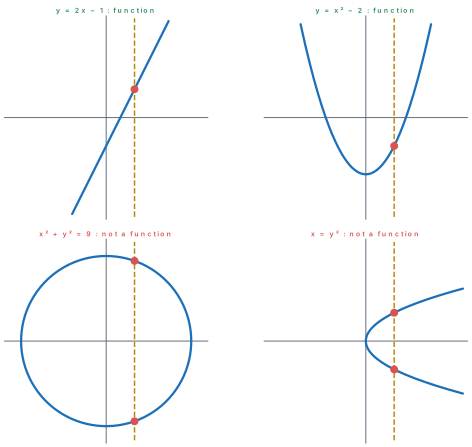
On a graph, all points with the same first component lie on one vertical line. If a vertical line cuts a graph twice, the input at that line has two outputs, and the graph is not a function.
A graph is the graph of a function of x if no vertical line meets it at more than one point. If even one vertical line meets the graph twice or more, the graph is not a function.
Problem. Which of these relations are functions? Give a reason for each. (i) R_1=\{(-1,1),(0,0),(1,1),(2,4)\} (ii) R_2=\{(1,1),(1,-1),(4,2),(4,-2)\}
Solution. (i) The first components -1, 0, 1, 2 are all different, so each input has exactly one output. R_1 is a function (its rule is y=x^2). Two inputs, -1 and 1, share the output 1, which is allowed.
(ii) The first component 1 appears with 1 and with -1, so the input 1 has two outputs. R_2 is not a function. On a graph, the vertical line x=1 would pass through both (1,1) and (1,-1).
Problem. For f(x)=2x-1 with domain \{-1,0,1,2,3\}, make a table, list the range and say why the graph passes the vertical line test.
Solution.
| x | -1 | 0 | 1 | 2 | 3 |
|---|---|---|---|---|---|
| f(x)=2x-1 | -3 | -1 | 1 | 3 | 5 |
Range =\{-3,-1,1,3,5\}. The graph is five points, each with a different x-coordinate, so every vertical line meets the graph at most once. It is the graph of a function.
A bare "yes" or "no" rarely earns the full mark. Write the reason in the language of the definition: "It is a function because every member of A has exactly one image", or "It is not a function because 2 has two images, 6 and 7", or "It is not a function because 3 has no image".
Make a table of six classmates and the month in which each was born. (1) Draw the arrow diagram from the set of students to the set of twelve months. Is it a function? (It must be: nobody has two birth months.) (2) Which months form the range? Which members of the co-domain have no pre-image? (3) Now reverse the arrows to get the inverse relation, from months to students. Is the inverse a function? It fails if two friends share a month, or if some month has no friend. (4) Finally, hold a ruler upright and slide it across the four graphs of the vertical line test to see the vertical line test for yourself.
Chapter summary
- An ordered pair (a,b) has a first and a second component; (a,b)=(c,d) exactly when a=c and b=d.
- The Cartesian product A\times B=\{(a,b): a\in A,\ b\in B\}; n(A\times B)=n(A)\times n(B); A\times B\neq B\times A unless A=B.
- A relation from A to B is a subset of A\times B; it can be shown by ordered pairs, set-builder form, a table, an arrow diagram or a graph.
- Domain = set of first components; range = set of second components.
- The inverse R^{-1}=\{(y,x): (x,y)\in R\} swaps the domain and the range.
- A function f: A\rightarrow B is a relation in which every member of A has exactly one image; members of B may have none or several pre-images.
- For y=f(x): y is the image of x, x is the pre-image of y; the range is a subset of the co-domain.
- Vertical line test: a graph is a function of x if no vertical line meets it more than once.
Practice questions
Group A — Objective (1 mark each)
- If (x-2,\ 5)=(3,\ y+1), then (x,y) is [1]a(1,4)b(5,4)c(5,6)d(1,6)
- If n(A)=3 and n(B)=4, then n(A\times B) is [1]a7b12c64d81
- If A=\{1,2\} and B=\{3\}, then A\times B is [1]a\{(1,3),(2,3)\}b\{(3,1),(3,2)\}c\{1,2,3\}d\{(1,2),(2,3)\}
- A relation from a set A to a set B is always [1]aa subset of A\times Bba subset of Acequal to A\times Bda subset of B
- The domain of R=\{(1,4),(2,5),(3,4)\} is [1]a\{4,5\}b\{1,2,3\}c\{1,2,3,4,5\}d\{1,4\}
- The inverse of R=\{(2,5),(3,7)\} is [1]a\{(5,2),(7,3)\}b\{(2,7),(3,5)\}c\{(-2,-5),(-3,-7)\}d\{(5,7),(2,3)\}
- Which of these relations is a function? [1]a\{(1,2),(1,3)\}b\{(1,2),(2,2),(3,2)\}c\{(2,1),(2,3),(4,5)\}d\{(1,1),(1,-1)\}
- If f(x)=3x-5, then f(4) is [1]a7b12c17d-7
- If f(x)=2x+3 and f(a) =11, then a is [1] (a) 4(b) 7(c) 25(d) 3
- For a function f: A\rightarrow B, the set B is called the [1]adomainbrangecco-domaindpre-image
- A graph represents a function of x if every vertical line meets it [1]aat least twicebat most oncecexactly twicednever
- If A\times B=\{(a,1),(a,2),(b,1),(b,2)\}, then B is [1]a\{a,b\}b\{1,2\}c\{a,1\}d\{(1,2)\}
Answers to Group A
1. (b) — x-2=3 gives x=5; 5=y+1 gives y=4.
2. (b) — n(A\times B)=3\times4=12.
3. (a) — first components from A, second from B.
4. (a) — a relation is any subset of A\times B.
5. (b) — the domain is the set of first components.
6. (a) — interchange the components of each pair.
7. (b) — each first component appears once; the others repeat a first component.
8. (a) — 3(4)-5=12-5=7.
9. (a) — 2a+3=11, so 2a=8 and a=4.
10. (c) — B is the co-domain; the range is the part of B that is used.
11. (b) — two meeting points would give one input two outputs.
12. (b) — B is the set of second components.
Group B — Short answer (2 marks each)
- Find x and y if (2x+1,\ y-3)=(7,\ 2). [2]
- If A=\{a,b\} and B=\{1,2,3\}, find A\times B and n(A\times B). [2]
- If A=\{2,4\} and B=\{1,3\}, find B\times A and show that A\times B\neq B\times A. [2]
- If n(A\times B)=6 and n(B)=3, find n(A) and the number of relations from A to B. [2]
- If A=\{1,2,3\}, B=\{2,3,4,5,6\} and R=\{(x,y): y=2x\} from A to B, list R and find its domain and range. [2]
- Find the inverse of R=\{(1,2),(2,4),(3,6)\} and state its domain and range. [2]
- If f(x)=x^2+1, find f(-2) and f(3). [2]
- If f(x)=4x-3, find the pre-image of 9. [2]
- State, with a reason, whether \{(1,5),(2,6),(2,7),(3,8)\} is a function. [2]
- A function f: A\rightarrow B is defined by f(x)=x+3, where A=\{-1,0,1,2\}. Find its range. [2]
Answers to Group B
1. First components: 2x+1=7, so x=3. Second components: y-3=2, so y=5.
2. A\times B=\{(a,1),(a,2),(a,3),(b,1),(b,2),(b,3)\}; n(A\times B)=2\times3=6.
3. B\times A=\{(1,2),(1,4),(3,2),(3,4)\} and A\times B=\{(2,1),(2,3),(4,1),(4,3)\}. The pair (1,2) is in B\times A but not in A\times B, so the sets are not equal.
4. n(A)\times3=6, so n(A)=2. A relation is a subset of A\times B, which has 6 members, so there are 2^6=64 relations.
5. R=\{(1,2),(2,4),(3,6)\}; domain =\{1,2,3\}; range =\{2,4,6\}.
6. R^{-1}=\{(2,1),(4,2),(6,3)\}; domain of R^{-1}=\{2,4,6\}; range of R^{-1}=\{1,2,3\}.
7. f(-2)=(-2)^2+1=5 and f(3)=3^2+1=10.
8. 4x-3=9, so 4x=12 and x=3. The pre-image of 9 is 3.
9. It is not a function, because the first component 2 has two images, 6 and 7.
10. f(-1)=2, f(0)=3, f(1)=4, f(2)=5, so the range is \{2,3,4,5\}.
Group C — Long answer (4 marks each)
- If (x+y,\ 3)=(7,\ x-y), find x and y. Taking A=\{x,y\} and B=\{1,2\}, find A\times B and B\times A, and verify that n(A\times B)=n(B\times A). [4]
- Let A=\{1,2,3,4\} and B=\{1,3,5,7,9\}, and let R=\{(x,y): y=2x-1,\ x\in A,\ y\in B\}. (i) List R. (ii) Show it in an arrow diagram. (iii) Find its domain and range. (iv) Find R^{-1}. Is R a function from A to B? [4]
- A function is defined by f(x)=ax+b. If f(1)=1 and f(3)=7, find a and b. Then find f(5) and the pre-image of 10. [4]
- For f(x)=2x-1 with domain \{-1,0,1,2,3\}: (i) make a table of values, (ii) write f as a set of ordered pairs, (iii) find the range, (iv) plot the points and explain why they pass the vertical line test. [4]
- Let A=\{1,2,3\} and B=\{4,5,6\}. For each relation below, draw an arrow diagram and say whether it is a function from A to B, giving a reason: R_1=\{(1,4),(2,5),(3,6)\}, R_2=\{(1,4),(2,4),(3,4)\}, R_3=\{(1,4),(1,5),(2,6),(3,6)\}, R_4=\{(1,5),(2,6)\}. [4]
Answers to Group C
1. Equating components: x+y=7 and x-y=3. Adding, 2x=10, so x=5 and y=2. Then A=\{2,5\} and B=\{1,2\}. A\times B=\{(2,1),(2,2),(5,1),(5,2)\} and B\times A=\{(1,2),(1,5),(2,2),(2,5)\}. Each has 4 members, so n(A\times B)=n(B\times A)=4=2\times2, although the two sets are different.
2. (i) y=2x-1 gives 1\rightarrow1, 2\rightarrow3, 3\rightarrow5, 4\rightarrow7, so R=\{(1,1),(2,3),(3,5),(4,7)\}. (ii) Two ovals with 1, 2, 3, 4 on the left and 1, 3, 5, 7, 9 on the right, with the four arrows above; 9 receives no arrow. (iii) Domain =\{1,2,3,4\}; range =\{1,3,5,7\}. (iv) R^{-1}=\{(1,1),(3,2),(5,3),(7,4)\}. R is a function, because every member of A has exactly one image.
3. f(1)=a+b=1 and f(3)=3a+b=7. Subtracting, 2a=6, so a=3 and b=1-3=-2. Thus f(x)=3x-2, so f(5)=15-2=13. For the pre-image of 10: 3x-2=10, so 3x=12 and x=4. Check: f(1)=1 ✓, f(3)=7 ✓.
4. (i) x: -1, 0, 1, 2, 3 give f(x): -3, -1, 1, 3, 5. (ii) f=\{(-1,-3),(0,-1),(1,1),(2,3),(3,5)\}. (iii) Range =\{-3,-1,1,3,5\}. (iv) The five points lie on a straight line rising 2 units for every 1 unit to the right. Their x-coordinates are all different, so any vertical line passes through at most one of them: the graph passes the test, as a function must.
5. R_1: function, one-to-one; each of 1, 2, 3 has exactly one image. R_2: function, many-to-one; each member of A has exactly one image, all equal to 4 (a constant function). R_3: not a function; 1 has two images, 4 and 5. R_4: not a function; 3 has no image.
Practise more: Optional Mathematics question bank