Unit 3 · 20 min read
Sequence and Series
What the syllabus asks for 3
- Sequence: meaning, terms and the general term
- Finding terms and the rule of a sequence
- Series and the sigma (Σ) notation
The Saturdays of a month fall on dates such as 3, 10, 17, 24 and 31. A child who saves Rs 10 more every week saves Rs 10, 20, 30, 40, … . A sheet of paper folded again and again has 1, 2, 4, 8, 16, … layers. Each of these is a list of numbers made by a rule, and the rule lets us find any number in the list without writing out all the numbers before it. Such a list is a sequence, and the sum of its numbers is a series. In this chapter you will learn what a sequence is, how to find its terms from a rule and its rule from its terms, and how to write long sums in a short form with the sigma sign \Sigma.
Expect: (i) write the first few terms from a general term t_n; (ii) find the next terms and the general term of a given sequence, by differences or ratios; (iii) find a particular term, such as t_{20}, or decide which term a number is, or whether it is a term at all; (iv) a pattern problem (matchsticks, seats, savings) turned into a sequence; (v) expand a sigma expression and find its value; (vi) write a given series in sigma notation. Show the rule you found and check it against the given terms.
3.1 Sequence: meaning, terms and the general term
A sequence is a list of numbers written in a definite order, according to a rule. Each number in the list is a term. The terms are named by their positions:
where t_1 is the first term, t_2 the second term, and t_n (read "t sub n") the nth term.
In the sequence 5, 10, 15, 20, \ldots we have t_1=5, t_2=10, t_3=15 and t_4=20. The number written small below t is the position of the term; the term itself is the value at that position. Keep the two apart: in this sequence the 4th term is 20.
Finite and infinite sequences
A sequence that stops is finite; one that goes on for ever is infinite. Three dots at the end, "…", show that the sequence continues.
| Sequence | Type | Reason |
|---|---|---|
| 3, 10, 17, 24, 31 (Saturdays of a month) | finite | it has exactly 5 terms |
| 5, 10, 15, 20, … (multiples of 5) | infinite | there is no last multiple of 5 |
| 1, 2, 4, 8, …, 1024 | finite | it stops at 1024 |
| 1, \frac{1}{2}, \frac{1}{3}, \frac{1}{4}, … | infinite | the dots show it never ends |
The general term
The general term (or nth term) t_n is a formula in n that gives the term in any position. For the multiples of 5, t_n=5n: the 1st term is 5\times1=5, the 7th term is 5\times7=35, and the 100th term is 500. Once we know t_n, we never need to count along the list.
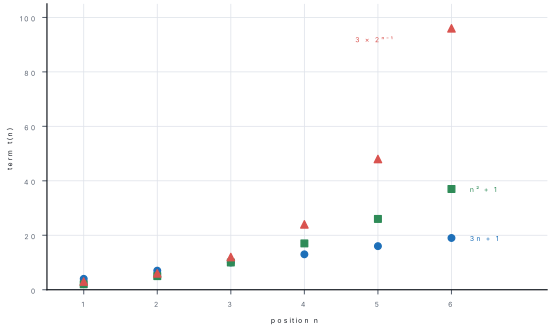
A sequence is really a function whose domain is the set of natural numbers \{1,2,3,\ldots\}: it sends each position n to the term t_n. This is why the graph of a sequence is a set of separate dots, one above each whole number, and not a joined-up line.
Many sequences come from patterns of dots. Counting the dots in each picture of a growing pattern gives a sequence, and the shape of the pattern often shows the rule.
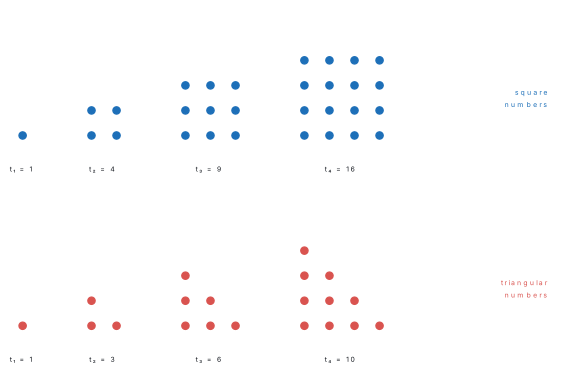
Problem. Write the first four terms of the sequence whose general term is t_n=3n-1. Find also the 25th term.
Solution. Put n=1, 2, 3, 4:
The sequence is 2, 5, 8, 11, \ldots and t_{25}=3(25)-1=74.
3.2 Finding terms and the rule of a sequence
From the rule to the terms
Any formula in n produces a sequence. The table shows some common shapes of general term and the sequences they make.
| General term t_n | t_1 | t_2 | t_3 | t_4 | What happens |
|---|---|---|---|---|---|
| 3n+1 | 4 | 7 | 10 | 13 | goes up by 3 each time |
| n^2+1 | 2 | 5 | 10 | 17 | gaps grow: 3, 5, 7 |
| 2^n | 2 | 4 | 8 | 16 | doubles each time |
| \frac{n}{n+1} | \frac{1}{2} | \frac{2}{3} | \frac{3}{4} | \frac{4}{5} | creeps up towards 1 |
| (-1)^n\,2n | -2 | 4 | -6 | 8 | signs alternate |
The factor (-1)^n is -1 when n is odd and +1 when n is even, so it makes the signs alternate. Use (-1)^{n+1} instead if the first term is to be positive.
Two kinds of rule
A sequence can be described in two ways.
| Kind of rule | What it says | Example for 2, 5, 8, 11, \ldots |
|---|---|---|
| Term-to-term rule | how to get the next term from the one before | "start at 2 and add 3 each time": t_1=2, t_{n+1}=t_n+3 |
| Position-to-term rule (general term) | how to get a term straight from its position | t_n=3n-1 |
The term-to-term rule is easy to see but slow to use: to reach the 100th term you must take 99 steps. The general term jumps there at once: t_{100}=299. That is why examinations ask for t_n.
Some famous sequences are known mainly by a term-to-term rule. In the Fibonacci sequence 1, 1, 2, 3, 5, 8, 13, \ldots every term after the second is the sum of the two terms before it: t_{n+2}=t_{n+1}+t_n. The numbers of spirals on a sunflower head or a pine cone are usually Fibonacci numbers.
Problem. A sequence is defined by t_1=2 and t_{n+1}=3t_n-1. Write its first six terms.
Solution. Each term is "three times the previous term, minus 1":
The sequence is 2, 5, 14, 41, 122, 365, \ldots.
Problem. If t_n=2n^2-3, find t_1, t_2, t_3 and t_{10}.
Solution. t_1=2-3=-1, t_2=8-3=5, t_3=18-3=15 and t_{10}=2(100)-3=197. We reached the 10th term without writing the 4th to the 9th.
From the terms to the rule: the method of differences
To find the rule, subtract each term from the next. The pattern of these differences tells you the kind of rule.
1. The first differences are all equal. If the gap is always d, the sequence is called an arithmetic sequence, and its general term has the form t_n=dn+c. To find c, compare with the multiples of d.
For 4, 7, 10, 13, \ldots the gap is 3, so compare with the multiples of 3:
| n | 1 | 2 | 3 | 4 |
|---|---|---|---|---|
| 3n | 3 | 6 | 9 | 12 |
| term | 4 | 7 | 10 | 13 |
Each term is 1 more than 3n, so t_n=3n+1. The same idea gives the formula t_n=a+(n-1)d, where a is the first term: here 4+(n-1)3=3n+1.
2. The ratios are all equal. If each term is the previous one multiplied by the same number r, the sequence is a geometric sequence and t_n=a\times r^{n-1}. For 3, 6, 12, 24, \ldots we have a=3 and r=2, so t_n=3\times2^{n-1}.
3. The first differences change but the second differences are equal. Then the rule contains n^2. If the second difference is 2, compare the terms with n^2; if it is 2a, compare them with an^2.
Problem. Find the general term of 2, 5, 10, 17, 26, \ldots and its 12th term.
Solution. First differences: 3, 5, 7, 9. Second differences: 2, 2, 2. Equal second differences of 2 mean that the rule starts with n^2. Compare:
| n | 1 | 2 | 3 | 4 | 5 |
|---|---|---|---|---|---|
| n^2 | 1 | 4 | 9 | 16 | 25 |
| term | 2 | 5 | 10 | 17 | 26 |
Every term is n^2+1. So t_n=n^2+1 and t_{12}=144+1=145.
Problem. Find the general term of 3, 8, 15, 24, 35, \ldots.
Solution. First differences 5, 7, 9, 11; second differences all 2, so compare with n^2:
| n | 1 | 2 | 3 | 4 | 5 |
|---|---|---|---|---|---|
| term -\ n^2 | 3-1=2 | 8-4=4 | 15-9=6 | 24-16=8 | 35-25=10 |
The leftover 2, 4, 6, 8, 10 is 2n. So t_n=n^2+2n. Check: t_4=16+8=24 ✓.
Problem. Find the general term of (i) 1, -\frac{1}{2}, \frac{1}{3}, -\frac{1}{4}, \ldots (ii) \frac{1}{3}, \frac{1}{9}, \frac{1}{27}, \frac{1}{81}, \ldots (iii) \frac{2}{3}, \frac{4}{5}, \frac{6}{7}, \frac{8}{9}, \ldots
Solution. Look at the sign, the numerator and the denominator separately.
(i) The numerators are all 1, the denominators are 1, 2, 3, 4, i.e. n, and the signs go +, -, +, -, which is (-1)^{n+1}. So t_n=\frac{(-1)^{n+1}}{n}.
(ii) The denominators 3, 9, 27, 81 are 3^1, 3^2, 3^3, 3^4. So t_n=\frac{1}{3^n}.
(iii) The numerators 2, 4, 6, 8 are 2n and the denominators 3, 5, 7, 9 are 2n+1. So t_n=\frac{2n}{2n+1}. Check: t_4=\frac{8}{9} ✓.
Is a number a term, and which term is it?
Once t_n is known, set t_n equal to the number and solve for n. If n comes out as a natural number, the number is a term and n is its position. If n is a fraction or negative, the number is not a term.
Problem. For the sequence 4, 7, 10, 13, \ldots: (i) which term is 100? (ii) Is 150 a term?
Solution. We found t_n=3n+1.
(i) 3n+1=100 gives 3n=99 and n=33. So 100 is the 33rd term.
(ii) 3n+1=150 gives 3n=149 and n=49\frac{2}{3}. There is no 49\frac{2}{3}th position, so 150 is not a term. (The 49th term is 148 and the 50th is 151; 150 falls between them.)
In "which term is 100?", 100 is a value and the answer, 33, is a position. Writing "t_{100}" for this question computes the 100th term, 301, which answers a different question. Read the question twice: "find t_{20}" gives a value; "which term is 62?" gives a position.
Patterns that turn into sequences

Problem. Using the pattern above, find (i) the number of sticks for 25 squares, (ii) the number of squares that can be made with exactly 100 sticks.
Solution. The sticks form 4, 7, 10, \ldots, with t_n=3n+1.
(i) t_{25}=3(25)+1=76 sticks.
(ii) 3n+1=100 gives n=33. So 100 sticks make 33 squares.
Problem. The first row of a school hall in Biratnagar has 20 seats, and every row has 2 more seats than the row in front of it. Find the general term and the number of seats in the 15th row.
Solution. The rows have 20, 22, 24, \ldots seats; the difference is 2. Comparing with 2n (2, 4, 6, \ldots), every term is 18 more, so t_n=2n+18. In the 15th row there are t_{15}=30+18=48 seats.
Having found t_n, test it on all the terms you were given, not just the first. The rule t_n=2n fits the first two terms of 2, 4, 8, 16 but fails at the third (2\times3=6\neq8); the right rule is t_n=2^n. Writing the check line also earns the marker's confidence.
3.3 Series and the sigma (Σ) notation
When the terms of a sequence are added, we get a series. The sequence 2, 4, 6, 8, 10 gives the series 2+4+6+8+10, whose value is 30. A series made from a finite sequence is a finite series; one made from an infinite sequence, such as 1+\frac{1}{2}+\frac{1}{4}+\cdots, is an infinite series.
A series is the sum of the terms of a sequence. The sum of the first n terms is written S_n:
An infinite series cannot be added term by term to the end, because there is no end. But its partial sums S_1, S_2, S_3, \ldots can still be worked out. For \frac{1}{2}+\frac{1}{4}+\frac{1}{8}+\frac{1}{16}+\cdots they are
Each partial sum is closer to 1, but none of them goes past 1. Saying exactly what such a sum "approaches" is the idea of a limit, the subject of the next chapter.
The sigma notation
Writing 1+4+9+16+\cdots+400 in full is slow. Mathematicians use the Greek capital letter sigma, \Sigma (the Greek "S", for "sum"), to write such a sum in one short line:
In \sum_{k=1}^{n}t_k: - k is the index; it takes the whole-number values from the bottom number to the top number, one at a time; - k=1 (below) is the lower limit and n (above) is the upper limit; - t_k is the general term; work it out for every value of k and add the results.
The number of terms is upper limit - lower limit +1. The letter used for the index does not matter: \sum_{k=1}^{5}k^2 and \sum_{r=1}^{5}r^2 are the same sum.
Problem. Expand and evaluate: (i) \sum_{k=1}^{4}(2k+1) (ii) \sum_{k=1}^{5}k^2 (iii) \sum_{r=2}^{5}(r^2-r) (iv) \sum_{k=1}^{6}(-1)^k\,k.
Solution.
(i) k=1,2,3,4 give 3, 5, 7, 9, so the sum is 3+5+7+9=24.
(ii) 1+4+9+16+25=55.
(iii) Here r starts at 2: r=2,3,4,5 give 2, 6, 12, 20, so the sum is 40. There are 5-2+1=4 terms.
(iv) -1+2-3+4-5+6=3. The factor (-1)^k makes the odd-numbered terms negative.
Writing a series in sigma notation
Three steps: (1) find the general term t_k; (2) find the value of k for the first term (usually 1); (3) find the value of k for the last term by solving t_k= last term.
Problem. Write in sigma notation: (i) 3+7+11+\cdots+39 (ii) \frac{1}{2}+\frac{2}{3}+\frac{3}{4}+\cdots+\frac{9}{10} (iii) 1+8+27+64+125.
Solution. (i) The difference is 4, so t_k=4k-1 (check: t_1=3 ✓). For the last term, 4k-1=39 gives k=10. So the series is \sum_{k=1}^{10}(4k-1).
(ii) The kth term is \frac{k}{k+1}, and the last term \frac{9}{10} has k=9: \sum_{k=1}^{9}\frac{k}{k+1}.
(iii) These are cubes 1^3, 2^3, \ldots, 5^3: \sum_{k=1}^{5}k^3.
Rules for working with sigma
Because \Sigma only means "add", the ordinary rules of addition give three useful rules:
| Rule | Example |
|---|---|
| \sum_{k=1}^{n}c=nc (a constant added n times) | \sum_{k=1}^{10}2=20 |
| \sum_{k=1}^{n}c\,t_k=c\sum_{k=1}^{n}t_k | \sum_{k=1}^{10}3k=3\sum_{k=1}^{10}k |
| \sum_{k=1}^{n}(a_k+b_k)=\sum_{k=1}^{n}a_k+\sum_{k=1}^{n}b_k | \sum(3k+2)=\sum3k+\sum2 |
Two famous sums
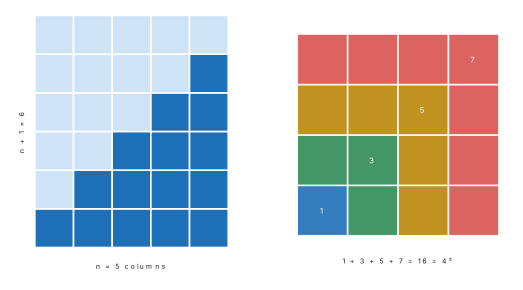
When the young Carl Friedrich Gauss was asked to add the numbers from 1 to 100, he paired the first with the last, the second with the second-last, and so on: 1+100, 2+99, 3+98, … . Each pair makes 101, and there are 50 pairs, so the sum is 50\times101=5050. The picture below shows the same idea for any n.
Problem. Find (i) \sum_{k=1}^{20}k (ii) \sum_{k=1}^{10}(2k-1) (iii) \sum_{k=1}^{10}(3k+2).
Solution. (i) \frac{20\times21}{2}=210.
(ii) This is the sum of the first 10 odd numbers, 10^2=100.
(iii) Split the sum:
Check. The terms are 5, 8, 11, \ldots, 32; pairing first and last, 5+32=37, five pairs: 5\times37=185 ✓.
From the sums back to the terms
If we know the sum S_n of the first n terms for every n, we can recover each term: the nth term is what the nth step adds,
Problem. The sum of the first n terms of a series is S_n=n^2+2n. Find the first three terms and the general term.
Solution. S_1=3, S_2=8, S_3=15. So t_1=3, t_2=8-3=5, t_3=15-8=7. The terms go up by 2, so t_n=2n+1. Check: S_3=3+5+7=15 ✓.
\sum_{r=3}^{10}t_r has 10-3+1=8 terms, not 10 and not 7. Students who start counting at the wrong value of the index get every later term wrong. Write out the first two and the last term before you add.
Plan to save Rs 5 in the first week, Rs 10 in the second, Rs 15 in the third and so on. (1) Write the sequence of weekly savings and its general term. (2) How much will you put aside in the 20th week? (3) Write the total for 20 weeks in sigma notation and find it with \sum_{k=1}^{n}k=\frac{n(n+1)}{2}. (4) Keep a real record for four weeks in your notebook and compare it with the plan. (Answers to check yourself: t_n=5n; Rs 100; \sum_{k=1}^{20}5k=5\times210= Rs 1,050.)
Chapter summary
- A sequence is an ordered list made by a rule; its terms are t_1, t_2, \ldots, t_n. It is finite or infinite.
- The general term t_n gives the term in position n; a sequence is a function on the natural numbers.
- Equal first differences d: arithmetic, t_n=a+(n-1)d. Equal ratios r: geometric, t_n=ar^{n-1}. Equal second differences: the rule contains n^2.
- To test whether a number is a term, solve t_n= number; it is a term only if n is a natural number.
- A series is the sum of the terms; S_n=t_1+t_2+\cdots+t_n and t_n=S_n-S_{n-1}.
- \sum_{k=1}^{n}t_k means "add t_k for k=1, 2, \ldots, n"; the number of terms is upper - lower +1.
- \sum_{k=1}^{n}c=nc, \sum c\,t_k=c\sum t_k, \sum(a_k+b_k)=\sum a_k+\sum b_k.
- 1+2+\cdots+n=\frac{n(n+1)}{2} and 1+3+5+\cdots+(2n-1)=n^2.
Practice questions
Group A — Objective (1 mark each)
- The 5th term of the sequence with t_n=2n+3 is [1]a10b13c11d8
- The general term of 3, 6, 9, 12, \ldots is [1]an+3b3nc3n+3dn^3
- The next term of 1, 4, 9, 16, \ldots is [1]a20b25c24d32
- The sequence of even numbers 2, 4, 6, \ldots is [1]afinitebinfiniteca seriesdconstant
- The common difference of 20, 16, 12, 8, \ldots is [1]a4b-4c8d12
- The next term of 2, 6, 18, 54, \ldots is [1]a108b162c72d216
- \sum_{k=1}^{4}k equals [1]a4b10c24d16
- 2+4+6+8+10 in sigma notation is [1]a\sum_{k=1}^{5}2kb\sum_{k=2}^{10}kc\sum_{k=1}^{10}2kd\sum_{k=1}^{5}(k+2)
- The number of terms in \sum_{r=3}^{10}t_r is [1]a7b8c10d13
- If t_n=(-1)^n, then t_3 is [1]a1b-1c3d-3
- The sum of the first 10 natural numbers is [1]a45b55c100d110
- Which term of 5, 10, 15, \ldots is 60? [1]a10thb11thc12thd13th
Answers to Group A
1. (b) — t_5=2(5)+3=13.
2. (b) — the multiples of 3: t_n=3n.
3. (b) — square numbers; the next is 5^2=25.
4. (b) — there is no last even number.
5. (b) — each term is 4 less: 16-20=-4.
6. (b) — each term is 3 times the one before: 54\times3=162.
7. (b) — 1+2+3+4=10.
8. (a) — the kth term is 2k and there are 5 terms.
9. (b) — 10-3+1=8.
10. (b) — (-1)^3=-1.
11. (b) — \frac{10\times11}{2}=55.
12. (c) — 5n=60 gives n=12.
Group B — Short answer (2 marks each)
- Write the first four terms of the sequence whose general term is t_n=n^2-1. [2]
- Find the general term of 7, 11, 15, 19, \ldots. [2]
- Find the 20th term of 2, 5, 8, 11, \ldots. [2]
- Find the next two terms of 1, 3, 6, 10, 15, \ldots and state the rule. [2]
- Is 75 a term of 4, 9, 14, 19, \ldots? Give a reason. [2]
- Expand and evaluate \sum_{k=1}^{4}(3k-1). [2]
- Write 1+8+27+64+125 in sigma notation. [2]
- Find the value of \sum_{n=2}^{5}n^2. [2]
- If t_n=\frac{n}{n+2}, find t_1, t_2, t_3 and t_{10}. [2]
- Write \frac{1}{2}+\frac{1}{4}+\frac{1}{8}+\frac{1}{16} in sigma notation and find its value. [2]
Answers to Group B
1. t_1=0, t_2=3, t_3=8, t_4=15.
2. The difference is 4. Comparing with 4n (4, 8, 12, 16), each term is 3 more, so t_n=4n+3.
3. t_n=3n-1, so t_{20}=60-1=59.
4. The differences are 2, 3, 4, 5, so the next differences are 6 and 7: the next terms are 21 and 28. These are the triangular numbers, t_n=\frac{n(n+1)}{2}.
5. t_n=5n-1. Setting 5n-1=75 gives n=\frac{76}{5}=15.2, which is not a natural number. So 75 is not a term (the 15th term is 74 and the 16th is 79).
6. 2+5+8+11=26.
7. The terms are 1^3, 2^3, \ldots, 5^3, so the series is \sum_{k=1}^{5}k^3.
8. 4+9+16+25=54.
9. t_1=\frac{1}{3}, t_2=\frac{2}{4}=\frac{1}{2}, t_3=\frac{3}{5}, t_{10}=\frac{10}{12}=\frac{5}{6}.
10. The kth term is \frac{1}{2^k}, so the series is \sum_{k=1}^{4}\frac{1}{2^k}. Its value is \frac{8+4+2+1}{16}=\frac{15}{16}.
Group C — Long answer (4 marks each)
- A row of n squares made of matchsticks uses 4, 7, 10, \ldots sticks for n=1, 2, 3, \ldots. (i) Find the general term. (ii) How many sticks are needed for 30 squares? (iii) How many squares can be made with 151 sticks? [4]
- Find the general term of 2, 6, 12, 20, 30, \ldots by the method of differences, find its 15th term, and find \sum_{k=1}^{5}t_k. [4]
- (i) Expand \sum_{k=1}^{6}(2k-1) and find its value. (ii) Show that the sum of the first n odd numbers is n^2 for n=1 to 6, and draw the square-and-L picture for n=4. [4]
- The first row of a hall has 20 seats and each row has 3 more seats than the row in front. (i) Write the sequence and its general term. (ii) How many seats are in the 12th row? (iii) Which row has 62 seats? (iv) Write the number of seats in the first 5 rows in sigma notation and find it. [4]
- The general term of a sequence is t_n=2^n-1. (i) Write its first five terms. (ii) Write the series of these five terms in sigma notation and find S_5. (iii) Is 255 a term? If so, which one? [4]
Answers to Group C
1. (i) The difference is 3; comparing with 3n, each term is 1 more, so t_n=3n+1. (ii) t_{30}=91 sticks. (iii) 3n+1=151 gives 3n=150, so n=50 squares.
2. First differences 4, 6, 8, 10; second differences 2, so compare with n^2: the leftovers 2-1=1, 6-4=2, 12-9=3, 20-16=4, 30-25=5 are n. So t_n=n^2+n. Then t_{15}=225+15=240, and \sum_{k=1}^{5}t_k=2+6+12+20+30=70.
3. (i) 1+3+5+7+9+11=36. (ii) Partial sums: 1=1^2, 1+3=4=2^2, 4+5=9=3^2, 9+7=16=4^2, 16+9=25=5^2, 25+11=36=6^2. For n=4 draw a 4\times4 square of dots split into L-shaped layers of 1, 3, 5 and 7 dots: each new odd number wraps one L around the square before it, making the next square.
4. (i) 20, 23, 26, 29, \ldots; the difference is 3, so t_n=3n+17. (ii) t_{12}=36+17=53 seats. (iii) 3n+17=62 gives 3n=45, so the 15th row. (iv) \sum_{k=1}^{5}(3k+17)=20+23+26+29+32=130 seats.
5. (i) 1, 3, 7, 15, 31. (ii) \sum_{n=1}^{5}(2^n-1)=1+3+7+15+31, so S_5=57. (iii) 2^n-1=255 gives 2^n=256=2^8, so n=8: 255 is the 8th term.
Practise more: Optional Mathematics question bank