Unit 5 · 20 min read
Matrix
What the syllabus asks for 4
- Matrix: elements, rows, columns and order
- Types of matrices: row, column, zero, rectangular, square, diagonal, scalar, unit, equal, symmetric and triangular
- Addition and subtraction of matrices and the properties of matrix addition
- Multiplication of a matrix by a scalar
A class teacher records the marks of three students in four subjects in a table of 3 rows and 4 columns. A shopkeeper with two shops records the pens, copies and bags sold in each shop in a table of 2 rows and 3 columns. When we keep only the numbers of such a table and put them in brackets, we get a matrix (plural: matrices). A matrix lets us treat a whole table of numbers as one object: we can compare two tables, add them, subtract them, or scale a whole table up or down in one step. Matrices are used in computer graphics, in economics and in solving equations, as you will see in grade 9 and 10. This chapter introduces the language of matrices, the main types of matrix, and the three operations of addition, subtraction and multiplication by a number.
Expect: (i) the order of a matrix and the position of an element such as a_{23}; (ii) constructing a matrix from a rule such as a_{ij}=i+2j; (iii) naming the type of a matrix (row, column, square, diagonal, scalar, unit, symmetric, triangular) with a reason; (iv) finding unknowns from equal matrices; (v) adding and subtracting matrices, and verifying a property such as A+B=B+A; (vi) finding kA, 2A+3B or a matrix X from an equation such as X+A=B or 2X-A=B; (vii) a word problem about sales or marks set out as matrices.
5.1 Matrix: elements, rows, columns and order
Here are the marks of three students of a school in Hetauda.
| Student | Maths | Science | English | Opt. Maths |
|---|---|---|---|---|
| Anish | 78 | 65 | 70 | 82 |
| Bipana | 85 | 90 | 72 | 88 |
| Chandra | 60 | 74 | 81 | 69 |
Keeping only the numbers, in the same places, gives the matrix M drawn below.
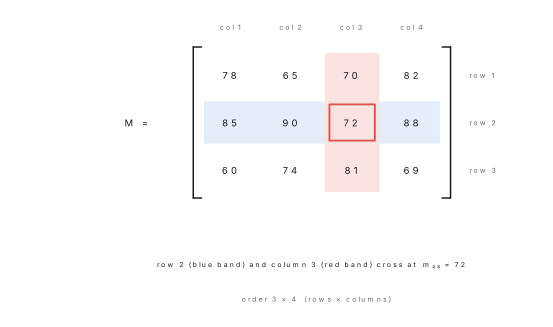
A matrix is a rectangular arrangement of numbers in rows (horizontal lines) and columns (vertical lines), enclosed in square brackets [\ ] or round brackets (\ ). Each number in it is an element (or entry). A matrix with m rows and n columns has order m\times n, read "m by n"; it has m\times n elements.
Matrices are named with capital letters A, B, M, \ldots and their elements with the matching small letter and two little numbers. The element in the ith row and jth column of A is written a_{ij}: row first, column second. In the marks matrix, m_{23}=72 and m_{34}=69. A matrix of order 2\times3 looks, in general, like this:
| column 1 | column 2 | column 3 | |
|---|---|---|---|
| row 1 | a_{11} | a_{12} | a_{13} |
| row 2 | a_{21} | a_{22} | a_{23} |
We write it briefly as A=[a_{ij}]_{2\times3}.
Matrices are everywhere once you look for them. A black-and-white photograph on a phone is stored as a matrix: the screen is divided into tiny squares called pixels, and each element of the matrix is the brightness of one pixel, from 0 (black) to 255 (white). A photo 1200 pixels wide and 800 pixels high is a matrix of order 800\times1200 with 960,000 elements. Brightening the photo adds the same number to every element; making a "negative" replaces each element a by 255-a. The operations of this chapter are exactly what photo-editing apps do.
Writing a matrix inside a line of text. A matrix needs a rectangle of space, and a line of print has none. So in running text this book sometimes lists the rows in order, each row in round brackets: [(3,5,7),(4,6,8)] means the 2\times3 matrix whose first row is 3, 5, 7 and whose second row is 4, 6, 8. In your own work, always draw the full rectangular array, as in the figures.
Problem. For the marks matrix M: (i) write its order and the number of its elements; (ii) find m_{23} and m_{34} and say what they mean; (iii) what does the second row stand for?
Solution. (i) M has 3 rows and 4 columns, so its order is 3\times4 and it has 3\times4=12 elements.
(ii) m_{23} is in row 2, column 3: m_{23}=72, Bipana's English mark. m_{34} is in row 3, column 4: m_{34}=69, Chandra's Optional Maths mark.
(iii) Row 2 is 85, 90, 72, 88: all four marks of Bipana.
Problem. A matrix has 12 elements. What orders can it have? What if it has 7 elements?
Solution. The order m\times n must have m\times n=12, so the possible orders are
Six orders in all. Note that 3\times4 and 4\times3 are different orders. A matrix with 7 elements can only be 1\times7 or 7\times1, because 7 is prime.
Problem. Construct (i) the 2\times3 matrix A=[a_{ij}] with a_{ij}=i+2j; (ii) the 3\times2 matrix B=[b_{ij}] with b_{ij}=2i-j.
Solution. (i) Work out each element from its row number i and column number j:
So A=[(3,5,7),(4,6,8)].
(ii) b_{11}=2-1=1, b_{12}=2-2=0, b_{21}=4-1=3, b_{22}=2, b_{31}=5, b_{32}=4. So B=[(1,0),(3,2),(5,4)], three rows and two columns.
The order 3\times4 means 3 rows and 4 columns, not the other way round, and a_{23} means row 2, column 3. Think of a cinema ticket: it gives the row first and then the seat number along that row. Matrices follow the same order, Row before Column.
5.2 Types of matrices: row, column, zero, rectangular, square, diagonal, scalar, unit, equal, symmetric and triangular
Matrices are named by their shape and by the pattern of their elements. The figure shows one example of each type; the table below it gives the definitions.
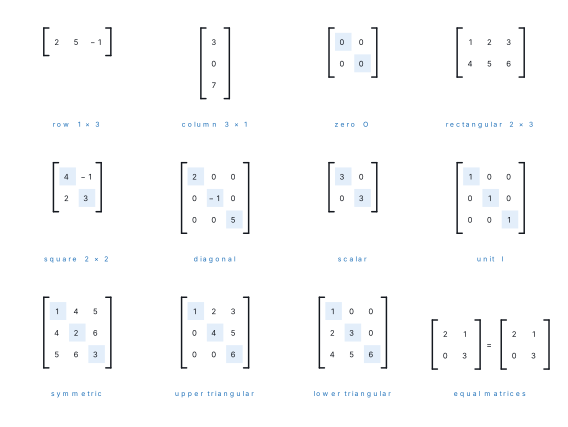
| Type | Definition | Example |
|---|---|---|
| Row matrix | only one row; order 1\times n | [(2,5,-1)] |
| Column matrix | only one column; order m\times1 | [(3),(0),(7)] |
| Zero (null) matrix O | every element is 0; any order | [(0,0),(0,0)] |
| Rectangular matrix | number of rows \neq number of columns | order 2\times3 |
| Square matrix | number of rows = number of columns; order n\times n, or "order n" | order 2\times2 |
| Diagonal matrix | a square matrix whose elements off the leading diagonal are all 0 | [(2,0,0),(0,-1,0),(0,0,5)] |
| Scalar matrix | a diagonal matrix whose diagonal elements are all equal | [(3,0),(0,3)] |
| Unit (identity) matrix I | a scalar matrix whose diagonal elements are all 1 | [(1,0),(0,1)] |
| Symmetric matrix | a square matrix with a_{ij}=a_{ji} for every i and j | [(1,4,5),(4,2,6),(5,6,3)] |
| Upper triangular matrix | a square matrix whose elements below the leading diagonal are all 0 | [(1,2,3),(0,4,5),(0,0,6)] |
| Lower triangular matrix | a square matrix whose elements above the leading diagonal are all 0 | [(1,0,0),(2,3,0),(4,5,6)] |
The leading (principal) diagonal of a square matrix runs from the top-left corner to the bottom-right corner: the elements a_{11}, a_{22}, a_{33}, \ldots. Only square matrices have one, which is why the last six types in the table are all square.
Symmetric matrices and the transpose
In a symmetric matrix the leading diagonal acts like a mirror: the element in row 1, column 2 equals the element in row 2, column 1, and so on. Interchanging the rows and columns of a matrix A (row 1 becomes column 1, row 2 becomes column 2, …) gives its transpose, written A^T or A'. A matrix is symmetric exactly when it equals its own transpose, A^T=A.
A family of special square matrices
Some types sit inside others:
- every unit matrix is a scalar matrix (all its diagonal elements are equal to 1);
- every scalar matrix is a diagonal matrix;
- every diagonal matrix is both upper and lower triangular, and it is also symmetric.
So I deserves all five names. But a symmetric matrix need not be diagonal, and a triangular matrix need not be symmetric.
Equal matrices
Two matrices A and B are equal, A=B, when (i) they have the same order, and (ii) their corresponding elements are equal: a_{ij}=b_{ij} for every i and j.
Matrices of different orders are never equal, even if they contain the same numbers: the row matrix [(1,2)] is not equal to the column matrix [(1),(2)].
Problem. Find x and y if [(x+2,\ 3),(5,\ y-1)]=[(7,\ 3),(5,\ 4)]. Then find a and b if [(a+b,\ 2),(4,\ a-b)]=[(9,\ 2),(4,\ 1)].
Solution. Both pairs of matrices are 2\times2, so we may equate corresponding elements.
First pair: x+2=7 gives x=5; y-1=4 gives y=5.
Second pair: a+b=9 and a-b=1. Adding, 2a=10, so a=5 and b=4.
Problem. Find x and y so that A=[(1,\ x,\ 4),(3,\ 2,\ y),(4,\ 6,\ 5)] is symmetric.
Solution. For symmetry, a_{ij}=a_{ji}. Compare the elements on either side of the leading diagonal:
a_{12}=a_{21}: x=3. \quad a_{23}=a_{32}: y=6. \quad a_{13}=a_{31}: 4=4 ✓.
So x=3 and y=6, and A=[(1,3,4),(3,2,6),(4,6,5)].
Problem. If [(a-2,\ 0),(0,\ b+1)] is the unit matrix of order 2, find a and b. Name all the types that describe [(5,0,0),(0,5,0),(0,0,5)].
Solution. The unit matrix has 1 on the diagonal: a-2=1 gives a=3, and b+1=1 gives b=0.
[(5,0,0),(0,5,0),(0,0,5)] is square, diagonal, scalar (all diagonal elements are 5), symmetric, and both upper and lower triangular. It is not a unit matrix, because its diagonal elements are 5, not 1.
5.3 Addition and subtraction of matrices and the properties of matrix addition
Addition and subtraction
Two matrices can be added or subtracted only if they have the same order. Then we add (or subtract) the elements that are in the same position.
If A=[a_{ij}] and B=[b_{ij}] have the same order, then
The result has the same order as A and B.
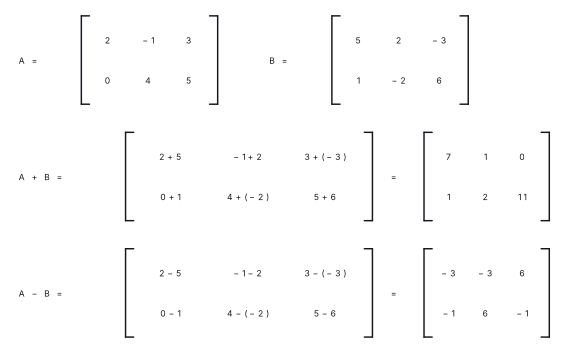
Problem. If A=[(2,-1,3),(0,4,5)] and B=[(5,2,-3),(1,-2,6)], find A+B, A-B and B-A. How are A-B and B-A related?
Solution. Both are 2\times3, so the operations are possible. Element by element (see the figure above):
Every element of B-A is the negative of the matching element of A-B, so B-A=-(A-B). Subtraction of matrices, like subtraction of numbers, depends on the order.
Problem. Ram has stationery shops in Butwal and Pokhara. The numbers of pens and copies sold are given by the matrices below (rows: Butwal, Pokhara; columns: pens, copies).
Baisakh: B=[(120,80),(95,60)]. Jestha: J=[(140,70),(110,75)].
Find the total sales of the two months and the change from Baisakh to Jestha.
Solution. Total: B+J=[(120+140,\ 80+70),(95+110,\ 60+75)]=[(260,150),(205,135)].
Change: J-B=[(140-120,\ 70-80),(110-95,\ 75-60)]=[(20,-10),(15,15)].
So Butwal sold 20 more pens but 10 fewer copies (the negative element), and Pokhara sold 15 more of each.
[(1,2),(3,4)]+[(1,2,3)] has no meaning: a 2\times2 matrix and a 1\times3 matrix have no elements in matching positions. Before adding or subtracting, write the two orders side by side and check that they are the same. If they are not, the answer is "not possible", and that is a correct answer.
Properties of matrix addition
Let A, B and C be matrices of the same order, and O the zero matrix of that order.
| Property | Statement |
|---|---|
| Closure | A+B is again a matrix of the same order |
| Commutative | A+B=B+A |
| Associative | (A+B)+C=A+(B+C) |
| Additive identity | A+O=O+A=A; the zero matrix changes nothing |
| Additive inverse | A+(-A)=O, where -A has every element of A with its sign changed |
These hold because each element of a sum is an ordinary sum of numbers, and numbers obey the same laws. Matrix subtraction is not commutative: in general A-B\neq B-A.
The additive inverse also explains subtraction: A-B=A+(-B). To subtract B, change the sign of every element of B and add. This is the same rule you used for subtracting polynomials, and it is the safest way to avoid sign errors when an element of B is negative, as with 3-(-3)=3+3=6 in the figure above.
Problem. If A=[(1,2),(3,4)], B=[(5,-1),(0,2)] and C=[(-2,3),(4,1)], verify that (A+B)+C=A+(B+C) and that A+B=B+A.
Solution. A+B=[(6,1),(3,6)], and B+A=[(5+1,\ -1+2),(0+3,\ 2+4)]=[(6,1),(3,6)], so A+B=B+A.
Left side: (A+B)+C=[(6-2,\ 1+3),(3+4,\ 6+1)]=[(4,4),(7,7)].
Right side: B+C=[(3,2),(4,3)], so A+(B+C)=[(1+3,\ 2+2),(3+4,\ 4+3)]=[(4,4),(7,7)].
Both sides are [(4,4),(7,7)], so the property is verified.
Problem. (i) Find the matrix X such that X+A=B, where A=[(3,-2),(1,4)] and B=[(5,0),(-2,7)]. (ii) Find x and y if [(x,3),(2,y)]+[(4,-1),(y,5)]=[(9,2),(8,11)].
Solution. (i) Add -A to both sides: X=B-A=[(5-3,\ 0+2),(-2-1,\ 7-4)]=[(2,2),(-3,3)].
Check: X+A=[(2+3,\ 2-2),(-3+1,\ 3+4)]=[(5,0),(-2,7)]=B ✓.
(ii) Add the left side element by element: [(x+4,\ 2),(2+y,\ y+5)]=[(9,2),(8,11)]. So x+4=9 gives x=5; 2+y=8 gives y=6; and y+5=11 gives y=6 again, which agrees.
5.4 Multiplication of a matrix by a scalar
In matrix work an ordinary number is called a scalar. If every price in a list goes up by 10%, every element is multiplied by the same number 1.1. This is scalar multiplication.
If A=[a_{ij}] and k is a scalar (a number), then kA is the matrix obtained by multiplying every element of A by k:
kA has the same order as A. In particular (-1)A=-A, the negative of A.

Problem. If A=[(2,-1),(0,3)], find 3A, -A and \frac{1}{2}A.
Solution. Multiply every element by the scalar:
Notice that A+(-A)=[(0,0),(0,0)]=O, the additive inverse property.
Properties of scalar multiplication
For matrices A, B of the same order and scalars k, l:
| Property | Statement |
|---|---|
| Distributive over matrix addition | k(A+B)=kA+kB |
| Distributive over scalar addition | (k+l)A=kA+lA |
| Associative | k(lA)=(kl)A |
| Multiplying by 1 and by 0 | 1A=A and 0A=O |
Problem. If A=[(1,2),(3,4)] and B=[(2,0),(-1,3)], find 2A+3B and 3A-2B, and verify that 2(A+B)=2A+2B.
Solution. 2A=[(2,4),(6,8)], 3B=[(6,0),(-3,9)], so
3A=[(3,6),(9,12)] and 2B=[(4,0),(-2,6)], so
For the property: A+B=[(3,2),(2,7)], so 2(A+B)=[(6,4),(4,14)]. Also 2A+2B=[(2+4,\ 4+0),(6-2,\ 8+6)]=[(6,4),(4,14)]. They are equal ✓.
Problem. Find X if 2X-A=B, where A=[(1,2),(3,4)] and B=[(5,0),(-1,6)].
Solution. Add A to both sides, then multiply both sides by \frac{1}{2}:
Check: 2X-A=[(6,2),(2,10)]-[(1,2),(3,4)]=[(5,0),(-1,6)]=B ✓.
Problem. Find x and y if 2[(x,3),(1,y)]+[(1,-2),(4,3)]=[(7,4),(6,9)].
Solution. 2[(x,3),(1,y)]=[(2x,6),(2,2y)]. Adding, [(2x+1,\ 4),(6,\ 2y+3)]=[(7,4),(6,9)].
So 2x+1=7, giving x=3, and 2y+3=9, giving y=3. The other two elements, 4=4 and 6=6, agree.
Problem. A stationery shop sells a pen for Rs 40, a copy for Rs 25 and a geometry box for Rs 120. Write the prices as a row matrix P and find the new price matrix after a 10% increase.
Solution. P=[(40,25,120)], a 1\times3 row matrix. A 10% increase multiplies every price by 1.1:
The new prices are Rs 44, Rs 27.50 and Rs 132.
3A multiplies all the elements of A by 3. A common slip is to multiply only the first row, or only the first element, as you might when taking a factor out of a single number. Also, kA is not the same as A+k: adding a number to a matrix is not defined at all.
After a long calculation such as 3A-2B, pick one position, say row 2, column 1, and compute it again on its own: 3a_{21}-2b_{21}. If it matches your answer, the method is right; if not, you will find the slip in seconds.
With two friends, record for one week how many cups of tea, plates of chowmein and bottles of water the school canteen sells each day before and after the lunch break. (1) Write the morning sales as a matrix M and the afternoon sales as a matrix N (rows: days; columns: items). What is the order? (2) Find M+N, the total sales, and N-M; explain the negative entries. (3) If the canteen expects to sell 20% more next week, find 1.2(M+N). (4) Which type of matrix would you get if nothing was sold at all?
The matrices used in the practice questions
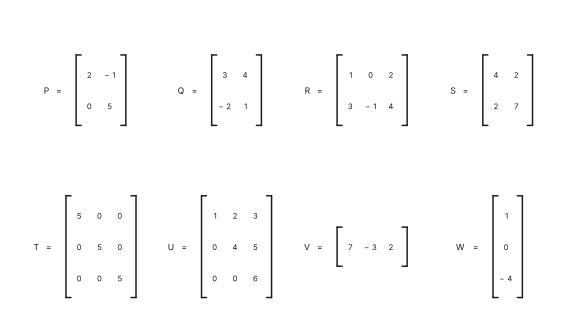
Some practice questions below refer to the matrices in this figure.
Chapter summary
- A matrix is a rectangular array of numbers in rows and columns; a matrix with m rows and n columns has order m\times n and mn elements; a_{ij} is the element in row i, column j.
- Row 1\times n, column m\times1, zero (all 0), rectangular (m\neq n), square (m=n).
- In a square matrix: diagonal (zero off the leading diagonal), scalar (diagonal with equal diagonal elements), unit I (scalar with 1s), symmetric (a_{ij}=a_{ji}), upper/lower triangular (zeros below/above the leading diagonal).
- Equal matrices have the same order and equal corresponding elements.
- A\pm B=[a_{ij}\pm b_{ij}], possible only for the same order.
- Addition is closed, commutative and associative, with identity O and inverse -A; subtraction is not commutative.
- kA=[k\,a_{ij}]; k(A+B)=kA+kB, (k+l)A=kA+lA, k(lA)=(kl)A, 1A=A, 0A=O.
Practice questions
The matrices P, Q, R, S, T, U, V and W are those in the figure above.
Group A — Objective (1 mark each)
- A matrix with 3 rows and 2 columns has order [1]a2\times3b3\times2c6d3+2
- The number of elements in a matrix of order 4\times3 is [1]a7b12c43d1
- In the matrix R, the element r_{23} is [1]a2b4c-1d3
- The matrix V is a [1]acolumn matrixbrow matrixcsquare matrixdzero matrix
- The best name for the matrix T is [1]aunit matrixbscalar matrixcrow matrixdzero matrix
- The matrix S is [1]asymmetricba unit matrixca row matrixdlower triangular
- The matrix U is [1]alower triangularbupper triangularcdiagonaldscalar
- If [(x,2),(3,4)]=[(5,2),(3,4)], then x is [1]a2b3c4d5
- P+Q equals [1]a[(5,3),(-2,6)]b[(-1,-5),(2,4)]c[(6,-4),(0,5)]d[(5,4),(-2,6)]
- 2P equals [1]a[(4,-2),(0,10)]b[(4,-1),(0,5)]c[(2,-1),(0,5)]d[(4,1),(0,10)]
- Which pair of matrices can be added? [1]aP and RbP and QcV and WdR and S
- The additive inverse of P is [1]a[(-2,1),(0,-5)]b[(2,1),(0,5)]c[(-2,-1),(0,-5)]d[(\frac{1}{2},-1),(0,\frac{1}{5})]
Answers to Group A
1. (b) — rows first, then columns.
2. (b) — 4\times3=12 elements.
3. (b) — row 2, column 3 of R is 4.
4. (b) — V has one row and three columns.
5. (b) — a diagonal matrix with every diagonal element equal to 5 (not 1, so not the unit matrix).
6. (a) — s_{12}=s_{21}=2.
7. (b) — all the elements below the leading diagonal are 0.
8. (d) — corresponding elements: x=5.
9. (a) — [(2+3,\ -1+4),(0-2,\ 5+1)].
10. (a) — every element is doubled.
11. (b) — only P and Q have the same order, 2\times2.
12. (a) — change the sign of every element: -P.
Group B — Short answer (2 marks each)
- Write the order of R and its elements r_{12} and r_{21}. [2]
- Construct the 2\times2 matrix A=[a_{ij}] with a_{ij}=2i+j. [2]
- Find x and y if [(x+3,\ 4),(6,\ 2y)]=[(8,\ 4),(6,\ 10)]. [2]
- Find P-Q and Q-P. [2]
- Find 3Q-2P. [2]
- If [(a,\ 3),(b,\ 5)] is symmetric and a+b=7, find a and b. [2]
- Find the matrix X such that X+P=Q. [2]
- Write the unit matrix of order 3 and the scalar matrix of order 2 whose diagonal elements are -3. [2]
- Verify that P+Q=Q+P. [2]
- If A=[(4,-6),(2,8)], find \frac{1}{2}A and -A. [2]
Answers to Group B
1. R has 2 rows and 3 columns, so its order is 2\times3; r_{12}=0 and r_{21}=3.
2. a_{11}=3, a_{12}=4, a_{21}=5, a_{22}=6, so A=[(3,4),(5,6)].
3. x+3=8 gives x=5; 2y=10 gives y=5.
4. P-Q=[(2-3,\ -1-4),(0+2,\ 5-1)]=[(-1,-5),(2,4)] and Q-P=[(1,5),(-2,-4)]=-(P-Q).
5. 3Q=[(9,12),(-6,3)] and 2P=[(4,-2),(0,10)], so 3Q-2P=[(5,14),(-6,-7)].
6. Symmetric means a_{12}=a_{21}, so b=3; then a=7-3=4.
7. X=Q-P=[(1,5),(-2,-4)]. Check: X+P=[(3,4),(-2,1)]=Q ✓.
8. I=[(1,0,0),(0,1,0),(0,0,1)] and [(-3,0),(0,-3)].
9. P+Q=[(5,3),(-2,6)] and Q+P=[(3+2,\ 4-1),(-2+0,\ 1+5)]=[(5,3),(-2,6)]; they are equal.
10. \frac{1}{2}A=[(2,-3),(1,4)] and -A=[(-4,6),(-2,-8)].
Group C — Long answer (4 marks each)
- If A=[(1,2),(3,4)], B=[(5,-1),(0,2)] and C=[(-2,3),(4,1)], verify that (A+B)+C=A+(B+C). [4]
- Find x, y and z if [(x+y,\ 4),(z,\ x-y)]+[(1,\ -2),(3,\ 2)]=[(9,\ 2),(5,\ 4)]. [4]
- Two shops sell pens, copies and bags. In Baisakh their sales were B=[(120,80,15),(95,60,20)] and in Jestha J=[(140,70,18),(110,75,12)] (rows: shops; columns: pens, copies, bags). (i) Find the total sales of the two months. (ii) Find the change from Baisakh to Jestha and explain the negative entries. (iii) If the target for Asar is double the Jestha sales, find the target matrix. [4]
- If A=[(2,0),(-1,3)] and B=[(2,4),(3,-1)], verify that 3(A+B)=3A+3B and find the matrix X such that 2X-A=B. [4]
- Classify each of the matrices P, Q, R, S, T, U, V, W by every type that applies to it. Then find T-5I, where I is the unit matrix of order 3, and comment on the result. [4]
Answers to Group C
1. A+B=[(6,1),(3,6)], so (A+B)+C=[(4,4),(7,7)]. B+C=[(3,2),(4,3)], so A+(B+C)=[(1+3,\ 2+2),(3+4,\ 4+3)]=[(4,4),(7,7)]. The two sides are equal, so addition is associative here.
2. The left side is [(x+y+1,\ 2),(z+3,\ x-y+2)]. Equating: x+y+1=9, so x+y=8; x-y+2=4, so x-y=2; z+3=5, so z=2. Adding the first two, 2x=10, so x=5 and y=3. The element 2=2 agrees.
3. (i) B+J=[(260,150,33),(205,135,32)]. (ii) J-B=[(20,-10,3),(15,15,-8)]: the first shop sold 10 fewer copies and the second shop 8 fewer bags in Jestha; every other entry rose. (iii) 2J=[(280,140,36),(220,150,24)].
4. A+B=[(4,4),(2,2)], so 3(A+B)=[(12,12),(6,6)]. 3A=[(6,0),(-3,9)] and 3B=[(6,12),(9,-3)], so 3A+3B=[(12,12),(6,6)]; verified. From 2X-A=B: 2X=A+B=[(4,4),(2,2)], so X=[(2,2),(1,1)]. Check: 2X-A=[(4-2,\ 4-0),(2+1,\ 2-3)]=[(2,4),(3,-1)]=B ✓.
5. P: square, upper triangular (its element below the diagonal is 0). Q: square. R: rectangular, 2\times3. S: square, symmetric. T: square, diagonal, scalar, symmetric, upper and lower triangular. U: square, upper triangular. V: row, rectangular. W: column, rectangular. T-5I=[(5,0,0),(0,5,0),(0,0,5)]-[(5,0,0),(0,5,0),(0,0,5)]=O, the zero matrix; so T=5I: every scalar matrix is a scalar multiple of the unit matrix.
Practise more: Optional Mathematics question bank