Unit 6 · 21 min read
Coordinate Geometry
What the syllabus asks for 4
- Distance formula and its applications
- Section formula: dividing a line segment in a given ratio; mid-point
- Slope of a line; lines parallel to the axes; slope-intercept form y = mx + c
- Area of a triangle and a quadrilateral from the coordinates of the vertices
In grade 7 you learned to locate a point by its coordinates. Coordinate geometry goes one step further: it uses the coordinates to measure. From the coordinates of two points we can find the distance between them without a ruler, find the point that cuts the line between them in any ratio, measure how steep the line is, write the line as an equation, and find the area of a triangle or a field from the coordinates of its corners. Surveyors marking land plots, engineers laying a road from Butwal to Narayangadh, and the map app on a phone all do exactly these calculations. This chapter develops four formulas, each from a picture, and shows how to use them.
Expect: (i) the distance between two points, and using it to show that a triangle is isosceles, equilateral or right-angled, that three points are collinear, or that four points form a square, rhombus or rectangle; (ii) finding an unknown coordinate from a given distance; (iii) the point dividing a segment in a given ratio, the mid-point, the points of trisection, or a missing end point; (iv) the slope of a line through two points, and the equation of a line in the form y=mx+c; (v) lines parallel to the axes; (vi) the area of a triangle or quadrilateral from its vertices. Draw a quick sketch: it shows whether your answer is reasonable.
6.1 Distance formula and its applications
Deriving the formula
Let P(x_1,y_1) and Q(x_2,y_2) be two points. Through P draw a horizontal line and through Q a vertical line; they meet at R(x_2,y_1). Triangle PRQ has a right angle at R.
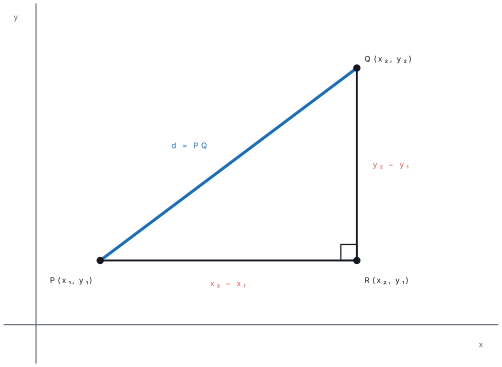
We start from the right-angled triangle PRQ and are heading for a formula for PQ.
Step 1 — the two shorter sides. PR is horizontal, so its length is the difference of the x-coordinates: PR=x_2-x_1. RQ is vertical, so RQ=y_2-y_1.
Step 2 — Pythagoras' theorem in triangle PRQ.
Step 3 — take the square root.
What it means. Subtract the x-coordinates, subtract the y-coordinates, square both, add, and take the square root. Because the differences are squared, it does not matter which point is called P: (x_1-x_2)^2=(x_2-x_1)^2.
The distance of P(x,y) from the origin O is
If the two points have the same y-coordinate the distance is |x_2-x_1|; if they have the same x-coordinate it is |y_2-y_1|.
Problem. Find the distance between (i) A(2,3) and B(8,11) (ii) P(-3,4) and Q(2,-8).
Solution. (i) AB=\sqrt{(8-2)^2+(11-3)^2}=\sqrt{36+64}=\sqrt{100}=10 units.
(ii) PQ=\sqrt{(2-(-3))^2+(-8-4)^2}=\sqrt{5^2+(-12)^2}=\sqrt{25+144}=\sqrt{169}=13 units.
Use brackets for negative coordinates: 2-(-3)=5, not -1.
Applications
The distance formula turns questions about shapes into arithmetic.
| To show that … | find … and check that … |
|---|---|
| a triangle is isosceles | the three sides; two are equal |
| a triangle is equilateral | the three sides; all are equal |
| a triangle is right-angled | the three sides; the square of the longest equals the sum of the squares of the other two |
| three points A, B, C are collinear | AB, BC, AC; the two shorter ones add up to the longest |
| ABCD is a rhombus | all four sides are equal |
| ABCD is a square | all four sides are equal and the diagonals are equal |
| ABCD is a rectangle | opposite sides are equal and the diagonals are equal |
| ABCD is a parallelogram | both pairs of opposite sides are equal |
Problem. Show that A(1,2), B(5,5) and C(9,2) are the vertices of an isosceles triangle, and find its perimeter.
Solution.
Since AB=BC, the triangle is isosceles. Its perimeter is 5+5+8=18 units.
Problem. Show that A(2,1), B(5,3) and C(1,9) form a right-angled triangle. At which vertex is the right angle?
Solution. Work with the squares of the sides, to avoid square roots:
AB^2+BC^2=13+52=65=AC^2. By the converse of Pythagoras' theorem the triangle is right-angled, and the right angle is at B, the vertex opposite the longest side AC.
Problem. Show that A(1,2), B(3,6) and C(4,8) lie on one straight line.
Solution.
AB+BC=2\sqrt{5}+\sqrt{5}=3\sqrt{5}=AC. The path from A to C through B is no longer than the direct path, so B lies on AC: the points are collinear.
Problem. (i) Find k if the distance between (k,3) and (2,-1) is 5 units. (ii) Find the point on the x-axis that is equidistant from A(1,4) and B(5,2).
Solution. (i) (k-2)^2+(3+1)^2=5^2, so (k-2)^2=25-16=9 and k-2=\pm3. Hence k=5 or k=-1. Both points, (5,3) and (-1,3), are 5 units from (2,-1).
(ii) A point on the x-axis is P(x,0). Equal distances means PA^2=PB^2:
So x=1.5 and the point is P(1.5,0). Check: PA^2=0.25+16=16.25 and PB^2=12.25+4=16.25 ✓.
Problem. Show that A(0,0), B(4,1), C(5,5) and D(1,4) are the vertices of a rhombus. Is it a square?
Solution. AB^2=16+1=17, BC^2=1+16=17, CD^2=16+1=17, DA^2=1+16=17. All four sides are \sqrt{17}, so ABCD is a rhombus.
Diagonals: AC^2=25+25=50 and BD^2=9+9=18. The diagonals are not equal, so it is not a square.
\sqrt{36+64} is \sqrt{100}=10, not \sqrt{36}+\sqrt{64}=14. Add the squares first, then take the square root. When you compare sides, compare their squares, which avoids roots altogether.
6.2 Section formula: dividing a line segment in a given ratio; mid-point
A point P on the segment AB divides it internally in the ratio m_1:m_2 when AP:PB=m_1:m_2. For example, if AB is 10 cm and AP:PB=2:3, then AP=4 cm and PB=6 cm.
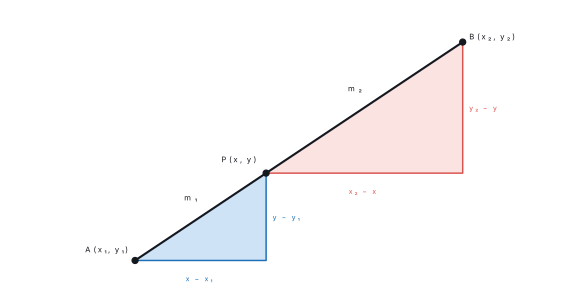
We start from P(x,y) on AB with AP:PB=m_1:m_2, and are heading for x and y.
Step 1 — similar triangles. The shaded triangles in the figure have parallel sides, so they are similar. Corresponding sides are in the ratio AP:PB=m_1:m_2.
Step 2 — compare horizontal sides.
Step 3 — cross-multiply and solve for x.
Step 4 — the same with vertical sides gives (m_1+m_2)y=m_1y_2+m_2y_1.
Result.
If P divides the join of A(x_1,y_1) and B(x_2,y_2) internally in the ratio m_1:m_2:
For the mid-point (m_1=m_2): M=\left(\frac{x_1+x_2}{2},\ \frac{y_1+y_2}{2}\right).
Memory aid: m_1 goes with the far end B, and m_2 with the near end A: "cross the ratio over".
Problem. Find the point that divides the join of (i) A(2,3) and B(7,8) in the ratio 2:3; (ii) A(-1,4) and B(5,-2) in the ratio 1:2.
Solution. (i) m_1=2, m_2=3:
The point is (4,5). Check with distances: AP=\sqrt{4+4}=2\sqrt{2} and PB=\sqrt{9+9}=3\sqrt{2}, ratio 2:3 ✓.
(ii) x=\frac{1(5)+2(-1)}{3}=\frac{3}{3}=1 and y=\frac{1(-2)+2(4)}{3}=\frac{6}{3}=2. The point is (1,2).
Problem. (i) Find the mid-point of (3,-2) and (-5,6). (ii) M(2,3) is the mid-point of AB, where A is (-1,5). Find B.
Solution. (i) \left(\frac{3-5}{2},\ \frac{-2+6}{2}\right)=(-1,2).
(ii) Let B=(x,y). Then \frac{-1+x}{2}=2, so x=5; and \frac{5+y}{2}=3, so y=1. So B is (5,1).
Problem. Find the two points that divide the join of A(1,2) and B(7,11) into three equal parts.
Solution. The first point P is one-third of the way from A, so AP:PB=1:2:
The second point Q has AQ:QB=2:1:
The x-coordinates go 1, 3, 5, 7 in equal steps, as they should.
Problem. In what ratio does the point (3,4) divide the join of A(1,2) and B(6,7)?
Solution. Let the ratio be k:1. From the x-coordinates:
So the ratio is \frac{2}{3}:1=2:3. Check with y: \frac{7\cdot\frac{2}{3}+2}{\frac{2}{3}+1}=\frac{\frac{20}{3}}{\frac{5}{3}}=4 ✓.
Two useful applications
Centroid of a triangle. The centroid G is the point where the medians meet; it divides each median in the ratio 2:1 from the vertex. For A(1,2), B(5,4), C(3,9): the mid-point of BC is D(4,\ 6.5), and dividing AD in the ratio 2:1 gives G=\left(\frac{2(4)+1(1)}{3},\ \frac{2(6.5)+1(2)}{3}\right)=(3,5). The same answer comes from the short rule G=\left(\frac{x_1+x_2+x_3}{3},\ \frac{y_1+y_2+y_3}{3}\right)=\left(\frac{9}{3},\frac{15}{3}\right)=(3,5).
Fourth vertex of a parallelogram. The diagonals of a parallelogram bisect each other, so they have the same mid-point. If A(1,1), B(5,2) and C(7,5) are three vertices of the parallelogram ABCD, then the mid-point of AC, (4,3), is also the mid-point of BD. So D=(2\times4-5,\ 2\times3-2)=(3,4).
6.3 Slope of a line; lines parallel to the axes; slope-intercept form y = mx + c
Slope
The road up to Nagarkot climbs; the road along the Terai plain is flat. The slope (or gradient) of a line measures how steep it is: how much it rises for each unit it runs to the right.
The slope of the line through A(x_1,y_1) and B(x_2,y_2), with x_1\neq x_2, is
If the line makes an angle \theta with the positive direction of the x-axis (its inclination), then m=\tan\theta.
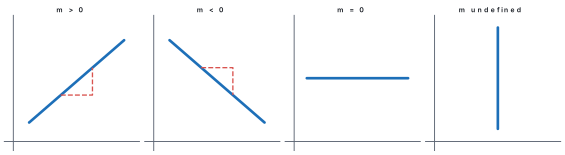
Problem. Find the slope of the line through (i) (2,3) and (6,11) (ii) (-1,4) and (3,-2) (iii) (1,5) and (7,5) (iv) (4,1) and (4,9).
Solution. (i) m=\frac{11-3}{6-2}=\frac{8}{4}=2; the line rises 2 units for each unit to the right.
(ii) m=\frac{-2-4}{3-(-1)}=\frac{-6}{4}=-\frac{3}{2}; the line falls.
(iii) m=\frac{5-5}{7-1}=\frac{0}{6}=0; the line is horizontal.
(iv) m=\frac{9-1}{4-4}=\frac{8}{0}, which is not defined; the line is vertical.
When the inclination is one of the standard angles of the next chapter, the slope is a known number: \tan0^\circ=0, \tan30^\circ=\frac{1}{\sqrt{3}}, \tan45^\circ=1 and \tan60^\circ=\sqrt{3}. So a line inclined at 45^\circ has slope 1, and a line of slope \sqrt{3} is inclined at 60^\circ.
Using slopes: parallel lines and collinear points
Two non-vertical lines are parallel exactly when they have the same slope: they rise at the same rate, so they never meet. And three points A, B, C are collinear when the slope of AB equals the slope of BC, because then the two segments have the same direction and share the point B.
Problem. (i) Use slopes to show that A(1,2), B(3,6) and C(4,8) are collinear. (ii) Show that the line through P(1,1) and Q(4,7) is parallel to the line through R(0,3) and S(2,7).
Solution. (i) Slope of AB=\frac{6-2}{3-1}=2 and slope of BC=\frac{8-6}{4-3}=2. The slopes are equal and B is common, so the points are collinear (agreeing with the distance method in 6.1).
(ii) Slope of PQ=\frac{7-1}{4-1}=2 and slope of RS=\frac{7-3}{2-0}=2. Equal slopes, so PQ\parallel RS. (They are not the same line: R(0,3) is not on PQ, which crosses the y-axis at -1.)
Lines parallel to the axes
Every point on a vertical line has the same x-coordinate; every point on a horizontal line has the same y-coordinate. That fact is the whole equation of the line.
| Line | Equation | Slope |
|---|---|---|
| parallel to the y-axis, through (a,b) | x=a | not defined |
| parallel to the x-axis, through (a,b) | y=b | 0 |
| the x-axis itself | y=0 | 0 |
| the y-axis itself | x=0 | not defined |
So the line through (3,-2) parallel to the x-axis is y=-2, and the line through the same point parallel to the y-axis is x=3.
The slope-intercept form y = mx + c
A non-vertical line crosses the y-axis at some point (0,c). The number c is the y-intercept.
We start from a line of slope m through (0,c) and are heading for its equation.
Step 1 — take any point on the line. Let (x,y) be any point of the line other than (0,c).
Step 2 — the slope from (0,c) to (x,y) is m.
Step 3 — multiply by x and rearrange. y-c=mx, so
What it means. In y=mx+c, the coefficient of x is the slope and the constant is the y-intercept. Every point (x,y) on the line satisfies the equation, and every point satisfying it is on the line.
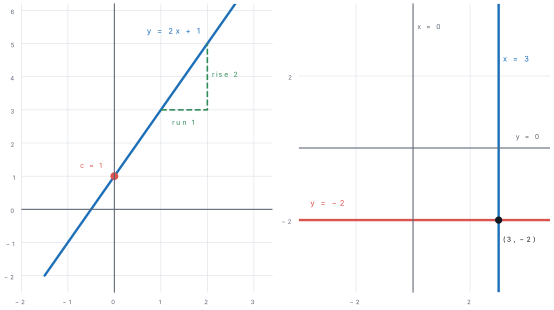
Problem. (i) Write the equation of the line with slope 3 and y-intercept -2. (ii) Find the slope and y-intercept of 2x+3y=12.
Solution. (i) y=3x-2.
(ii) Make y the subject: 3y=-2x+12, so y=-\frac{2}{3}x+4. Comparing with y=mx+c: slope m=-\frac{2}{3}, y-intercept c=4.
Problem. (i) Find the equation of the line of slope 2 through (3,5). (ii) Find the equation of the line through (1,2) and (3,8). (iii) Does (4,7) lie on the line in (i)?
Solution. (i) y=2x+c passes through (3,5), so 5=2(3)+c and c=-1: the line is y=2x-1.
(ii) The slope is m=\frac{8-2}{3-1}=3. Then y=3x+c through (1,2) gives 2=3+c, so c=-1 and the line is y=3x-1. Check with (3,8): 3(3)-1=8 ✓.
(iii) Put x=4 in y=2x-1: y=7. So (4,7) does lie on the line.
In 2x+3y=12 the slope is not 2 and the intercept is not 12. The numbers can be read off only when the equation is written as y=mx+c. Divide every term by the coefficient of y, including the constant.
6.4 Area of a triangle and a quadrilateral from the coordinates of the vertices
Deriving the area of a triangle
Let the vertices be A(x_1,y_1), B(x_2,y_2) and C(x_3,y_3), and drop perpendiculars AL, BM, CN to the x-axis. The triangle is what is left of two trapeziums when a third is taken away.
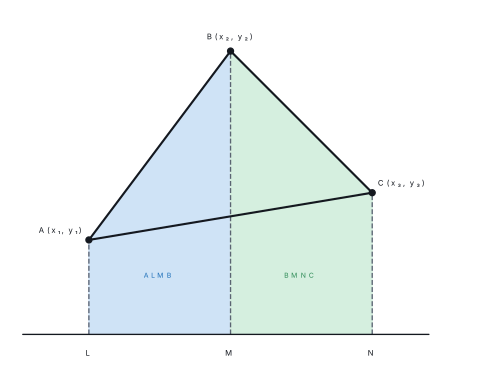
We start from the trapeziums in the figure and are heading for a formula in the coordinates.
Step 1 — area of a trapezium =\frac{1}{2}\times(sum of the parallel sides)\times(distance between them):
Step 2 — combine. \triangle ABC=ALMB+BMNC-ALNC:
Step 3 — expand and cancel. The terms x_1y_1, x_2y_2 and x_3y_3 cancel, leaving
Step 4 — group by x_1, x_2, x_3. This is -\frac{1}{2}\left[x_1(y_2-y_3)+x_2(y_3-y_1)+x_3(y_1-y_2)\right]. The sign depends only on the order in which the vertices were named, so we take the absolute value.
Result.
The cross-multiplication (arrow) method
The same formula can be laid out in a pattern that is easy to remember and extends to any polygon. Write the coordinates in two rows, repeat the first vertex at the end, multiply along the arrows and subtract.
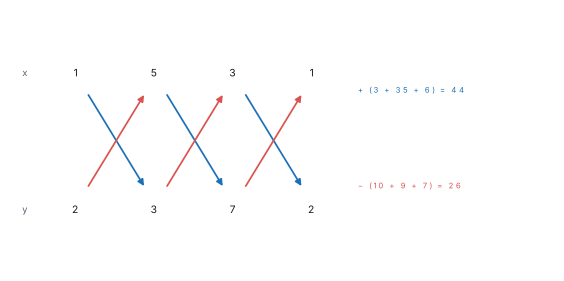
Triangle: \text{Area}=\frac{1}{2}\left|x_1(y_2-y_3)+x_2(y_3-y_1)+x_3(y_1-y_2)\right|, or by the arrow method
Quadrilateral ABCD: take the vertices in order round the figure and use four cross terms, or split it into two triangles by a diagonal. Three points are collinear exactly when the "triangle" they form has area 0.
Problem. Find the area of the triangle with vertices A(1,2), B(5,3) and C(3,7).
Solution.
Check by the box method. The rectangle enclosing the triangle runs from x=1 to 5 and from y=2 to 7, area 4\times5=20. The three right triangles outside ABC have areas \frac{1}{2}(4)(1)=2, \frac{1}{2}(2)(4)=4 and \frac{1}{2}(2)(5)=5. So the area is 20-11=9 ✓.
Problem. (i) Use area to show that (1,2), (3,6) and (4,8) are collinear. (ii) Find k if the area of the triangle with vertices (k,0), (4,0) and (0,2) is 4 square units.
Solution. (i) \frac{1}{2}\left|1(6-8)+3(8-2)+4(2-6)\right|=\frac{1}{2}\left|-2+18-16\right|=0. Zero area: the points are collinear.
(ii) \frac{1}{2}\left|k(0-2)+4(2-0)+0(0-0)\right|=4, so |8-2k|=8. Then 8-2k=8 gives k=0, or 8-2k=-8 gives k=8. Both (0,0) and (8,0) work: each makes a base of 4 along the x-axis with height 2.
Problem. Find the area of the quadrilateral with vertices A(1,1), B(6,2), C(5,6), D(2,5), (i) by splitting it along AC, (ii) by the arrow method.
Solution. (i) \triangle ABC=\frac{1}{2}\left|1(2-6)+6(6-1)+5(1-2)\right|=\frac{1}{2}\left|-4+30-5\right|=\frac{21}{2}.
\triangle ACD=\frac{1}{2}\left|1(6-5)+5(5-1)+2(1-6)\right|=\frac{1}{2}\left|1+20-10\right|=\frac{11}{2}.
Area =\frac{21}{2}+\frac{11}{2}=16 square units.
(ii) Rows x: 1, 6, 5, 2, 1 and y: 1, 2, 6, 5, 1. The cross terms are
Area =\frac{1}{2}\times32=16 square units, the same.
Problem. A field in Chitwan is drawn on a grid in which 1 unit is 10 m. Its corners are at (0,0), (8,0), (10,6) and (2,7). Find its area in square metres.
Solution. By the arrow method:
Area =\frac{1}{2}\times106=53 square units. One square unit is 10\text{ m}\times10\text{ m}=100 m², so the field is 53\times100=5300 m².
For a quadrilateral, list the vertices in order round the boundary, either clockwise or anticlockwise. If you jump across (for example A, C, B, D), the arrows trace a crossed figure and the answer is wrong. A quick sketch on the grid shows the correct order at once.
Mark the four corners of a flower bed or a corner of the school ground with pegs. Choose one corner as the origin, lay a measuring tape along one edge as the x-axis, and measure the x and y distances of the other corners in metres. (1) Plot the corners on squared paper. (2) Find the length of each side and each diagonal with the distance formula, and check one of them with the tape. (3) Find the area with the arrow method. (4) Find the mid-point of the longest side and mark it with a peg. How close is it to the real middle?
Chapter summary
- Distance: PQ=\sqrt{(x_2-x_1)^2+(y_2-y_1)^2}; from the origin \sqrt{x^2+y^2}. Compare squared lengths to classify triangles and quadrilaterals; AB+BC=AC means collinear.
- Section formula (internal, m_1:m_2): \left(\frac{m_1x_2+m_2x_1}{m_1+m_2},\ \frac{m_1y_2+m_2y_1}{m_1+m_2}\right).
- Mid-point: \left(\frac{x_1+x_2}{2},\ \frac{y_1+y_2}{2}\right); centroid \left(\frac{x_1+x_2+x_3}{3},\ \frac{y_1+y_2+y_3}{3}\right).
- Slope: m=\frac{y_2-y_1}{x_2-x_1}=\tan\theta; horizontal lines have slope 0, vertical lines have no defined slope; parallel lines have equal slopes.
- Lines parallel to the axes: x=a and y=b; the axes are y=0 and x=0.
- Slope-intercept form: y=mx+c, with slope m and y-intercept c; make y the subject before reading them.
- Area of a triangle: \frac{1}{2}\left|x_1(y_2-y_3)+x_2(y_3-y_1)+x_3(y_1-y_2)\right|; for a quadrilateral, use the arrow method with the vertices in order, or split into two triangles. Zero area means collinear.
Practice questions
Group A — Objective (1 mark each)
- The distance between (0,0) and (6,8) is [1]a14b10c48d100
- The distance between (2,3) and (2,9) is [1]a6b12c4d36
- The mid-point of (4,-2) and (-2,6) is [1]a(1,2)b(2,4)c(3,-4)d(1,4)
- The point dividing the join of (0,0) and (6,9) in the ratio 1:2 is [1]a(2,3)b(4,6)c(3,4.5)d(1,2)
- The slope of the line through (1,2) and (4,8) is [1]a2b\frac{1}{2}c6d3
- The slope of a line parallel to the x-axis is [1]a1b0cnot definedd-1
- The line through (3,-5) parallel to the y-axis is [1]ay=-5bx=3cy=3dx=-5
- The slope and y-intercept of y=4x-7 are [1]a4 and 7b-7 and 4c4 and -7d-4 and 7
- The y-intercept of 2x+y=6 is [1]a2b-2c6d3
- The area of the triangle with vertices (0,0), (4,0) and (0,3) is [1]a12b6c7d5
- Three points are collinear if the area of the triangle they form is [1]a1b0cnegatived180
- A line of slope 1 has inclination [1]a0^\circb30^\circc45^\circd90^\circ
Answers to Group A
1. (b) — \sqrt{36+64}=10.
2. (a) — same x-coordinate, so the distance is 9-3=6.
3. (a) — \left(\frac{4-2}{2},\frac{-2+6}{2}\right)=(1,2).
4. (a) — \left(\frac{1(6)+2(0)}{3},\frac{1(9)+2(0)}{3}\right)=(2,3).
5. (a) — \frac{8-2}{4-1}=2.
6. (b) — a horizontal line has zero rise.
7. (b) — every point on it has x=3.
8. (c) — compare with y=mx+c.
9. (c) — y=-2x+6, so c=6.
10. (b) — a right triangle with legs 4 and 3: \frac{1}{2}\times4\times3=6.
11. (b) — the points then lie on one line.
12. (c) — \tan45^\circ=1.
Group B — Short answer (2 marks each)
- Find the distance between P(-3,4) and Q(2,-8). [2]
- Find the point that divides the join of A(2,3) and B(7,8) internally in the ratio 2:3. [2]
- M(2,3) is the mid-point of AB, where A is (-1,5). Find B. [2]
- Find the slope of the line through (-1,4) and (3,-2), and say whether the line rises or falls to the right. [2]
- Write the equation of the line whose slope is -2 and whose y-intercept is 5. [2]
- Find the slope and the y-intercept of 3x-4y=12. [2]
- Find k if the distance between (k,3) and (2,-1) is 5 units. [2]
- Find the area of the triangle with vertices (1,2), (5,3) and (3,7). [2]
- Use slopes to show that (1,2), (3,6) and (4,8) are collinear. [2]
- Write the equations of the lines through (-2,4) parallel to the x-axis and to the y-axis. [2]
Answers to Group B
1. PQ=\sqrt{(2+3)^2+(-8-4)^2}=\sqrt{25+144}=\sqrt{169}=13 units.
2. \left(\frac{2(7)+3(2)}{5},\ \frac{2(8)+3(3)}{5}\right)=\left(\frac{20}{5},\frac{25}{5}\right)=(4,5).
3. \frac{-1+x}{2}=2 gives x=5; \frac{5+y}{2}=3 gives y=1. So B=(5,1).
4. m=\frac{-2-4}{3+1}=-\frac{6}{4}=-\frac{3}{2}. The slope is negative, so the line falls to the right.
5. y=-2x+5.
6. -4y=-3x+12, so y=\frac{3}{4}x-3: slope \frac{3}{4}, y-intercept -3.
7. (k-2)^2+16=25, so (k-2)^2=9 and k-2=\pm3: k=5 or k=-1.
8. \frac{1}{2}\left|1(3-7)+5(7-2)+3(2-3)\right|=\frac{1}{2}\left|-4+25-3\right|=9 square units.
9. Slope of the first two points =\frac{6-2}{3-1}=2; slope of the last two =\frac{8-6}{4-3}=2. Equal slopes through the common point (3,6): collinear.
10. Parallel to the x-axis: y=4. Parallel to the y-axis: x=-2.
Group C — Long answer (4 marks each)
- Show that A(2,1), B(5,3) and C(1,9) are the vertices of a right-angled triangle, and find its area in two ways. [4]
- Find the points of trisection of the segment joining A(1,2) and B(7,11), and the mid-point of AB. [4]
- Find the equation of the line through (1,2) and (3,8) in the form y=mx+c. State its slope and y-intercept, and check whether (-1,-4) lies on it. [4]
- Show that A(0,0), B(4,1), C(5,5) and D(1,4) are the vertices of a rhombus but not of a square, and find its area. [4]
- Find the area of the quadrilateral with vertices A(1,1), B(6,2), C(5,6) and D(2,5) (i) by dividing it into two triangles along AC, (ii) by the arrow method. [4]
Answers to Group C
1. AB^2=9+4=13, BC^2=16+36=52, AC^2=1+64=65. Since 13+52=65, AB^2+BC^2=AC^2 and the triangle is right-angled at B. Area (i) =\frac{1}{2}\times AB\times BC=\frac{1}{2}\sqrt{13}\sqrt{52}=\frac{1}{2}\sqrt{676}=\frac{1}{2}\times26=13 square units. (ii) By the formula: \frac{1}{2}\left|2(3-9)+5(9-1)+1(1-3)\right|=\frac{1}{2}\left|-12+40-2\right|=13 ✓.
2. P (ratio 1:2) =\left(\frac{7+2}{3},\frac{11+4}{3}\right)=(3,5); Q (ratio 2:1) =\left(\frac{14+1}{3},\frac{22+2}{3}\right)=(5,8). Mid-point =\left(\frac{1+7}{2},\frac{2+11}{2}\right)=(4,\ 6.5), which lies between P and Q, as it should.
3. m=\frac{8-2}{3-1}=3; 2=3(1)+c gives c=-1. The line is y=3x-1, with slope 3 and y-intercept -1. At x=-1: y=-3-1=-4, so (-1,-4) does lie on the line.
4. AB^2=17, BC^2=17, CD^2=17, DA^2=17: all sides are \sqrt{17}, so it is a rhombus. Diagonals: AC^2=50, BD^2=18; they are unequal, so it is not a square. Area by the arrow method: (0-0)+(20-5)+(20-5)+(0-0)=30, so the area is \frac{1}{2}\times30=15 square units. (Check: for a rhombus, area =\frac{1}{2}d_1d_2=\frac{1}{2}\sqrt{50}\sqrt{18}=\frac{1}{2}\sqrt{900}=15 ✓.)
5. (i) \triangle ABC=\frac{1}{2}\left|1(2-6)+6(6-1)+5(1-2)\right|=\frac{21}{2} and \triangle ACD=\frac{1}{2}\left|1(6-5)+5(5-1)+2(1-6)\right|=\frac{11}{2}, total 16 square units. (ii) Cross terms (2-6)+(36-10)+(25-12)+(2-5)=-4+26+13-3=32, area =\frac{1}{2}\times32=16 square units.
Practise more: Optional Mathematics question bank