Unit 8 · 19 min read
Vector
What the syllabus asks for 4
- Vector and scalar quantities; magnitude and direction of a vector
- Types of vectors: row, column, position, unit, null, equal and negative vectors; like and unlike vectors
- Multiplication of a vector by a scalar; condition for parallel vectors
- Addition and subtraction of vectors
"The bus stop is 500 m away" is useful, but "the bus stop is 500 m away, due north" is what you need to actually get there. Some quantities, such as mass, time and temperature, are described completely by a number with a unit. Others, such as a displacement, a velocity or a force, need a direction as well. Quantities of the second kind are vectors. A pilot flying from Kathmandu to Pokhara, an engineer working out the pull on the cables of a suspension bridge in Dolakha, and a footballer passing the ball all deal with vectors. In this chapter you will learn to represent vectors by arrows and by columns of numbers, find their magnitude and direction, recognise the different types of vector, and multiply, add and subtract them.
Expect: (i) separating scalar and vector quantities, with examples; (ii) writing \overrightarrow{AB} from the coordinates of A and B, and finding its magnitude and direction; (iii) naming the type of a vector (position, unit, null, equal, negative, like, unlike) and finding a unit vector; (iv) finding unknowns from equal vectors; (v) multiplying a vector by a scalar and using the condition for parallel vectors; (vi) adding and subtracting vectors by components and by the triangle and parallelogram laws, often in a displacement or force problem. Always draw the arrows: a sketch shows the direction of the answer.
8.1 Vector and scalar quantities; magnitude and direction of a vector
Scalars and vectors
A scalar quantity has magnitude only: it is fully described by a number and a unit. A vector quantity has both magnitude and direction.
| Scalar quantities | Vector quantities |
|---|---|
| mass (50 kg) | displacement (3 km to the east) |
| length, distance (7 km) | velocity (60 km/h towards Pokhara) |
| time (2 hours) | acceleration (9.8 m/s² downwards) |
| temperature (25^\circC) | force (20 N pulling to the left) |
| speed (60 km/h) | weight (500 N, downwards) |
| area, volume, money | momentum |
Notice the pairs: distance is a scalar but displacement is a vector; speed is a scalar but velocity is a vector.
A quick test tells the two kinds apart: ask "in which direction?". For a force, a push or a journey the question makes sense and matters, so the quantity is a vector. For a mass, a price or a temperature the question has no meaning, so the quantity is a scalar. Weight is a vector (it always acts downwards, towards the centre of the earth), but mass is a scalar: a 50 kg bag of rice has the same mass in Kathmandu and on the Moon, although its weight is much smaller on the Moon.
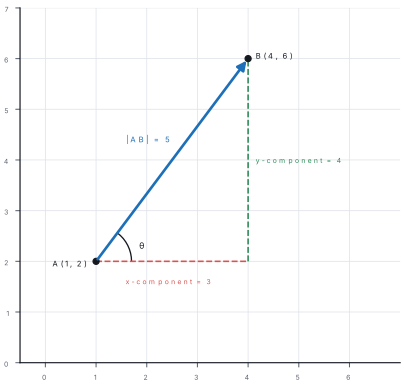
Ram walks 3 km east and then 4 km north. The distance he has walked is 3+4=7 km. But his displacement, the straight-line change in position from start to finish, is only \sqrt{3^2+4^2}=5 km, in a direction between east and north. Two walks of 7 km can end in completely different places; their displacements tell them apart.
Representing a vector
A vector is drawn as an arrow (a directed line segment). The length of the arrow shows the magnitude and the arrowhead shows the direction. The arrow from A to B is written \overrightarrow{AB}; A is its initial point (tail) and B its terminal point (head). A single small letter with an arrow, \vec{a}, is also used.
On a grid, a vector is described by how far it goes across and how far it goes up: its x-component and y-component. These are written in a column:
If A is (x_1,y_1) and B is (x_2,y_2), then to go from A to B we move x_2-x_1 across and y_2-y_1 up:
Magnitude and direction
For \vec{a}=\binom{x}{y}:
The magnitude |\vec{a}| (also called the modulus or length) comes from Pythagoras' theorem. The direction \theta is the angle the vector makes with the positive x-direction, measured anticlockwise. Find the quadrant from the signs of x and y first, then the angle.
The direction needs care, because \tan\theta has the same value in two opposite quadrants. Use the signs of the components:
| Signs of x, y | Quadrant | Direction \theta (with \alpha the acute angle with \tan\alpha=\left|\frac{y}{x}\right|) |
|---|---|---|
| +, + | I | \theta=\alpha |
| -, + | II | \theta=180^\circ-\alpha |
| -, - | III | \theta=180^\circ+\alpha |
| +, - | IV | \theta=360^\circ-\alpha |
Problem. Find \overrightarrow{AB}, its magnitude and its direction for A(1,2) and B(4,6).
Solution. Head minus tail:
Both components are positive, so the vector points into the first quadrant, with \tan\theta=\frac{4}{3}. A calculator gives \theta\approx53.13^\circ. This is also Ram's walk: 3 km east and 4 km north is a displacement of 5 km at about 53^\circ north of east.
Problem. Find the magnitude and direction of (i) \vec{a}=\binom{2}{2} (ii) \vec{b}=\binom{-\sqrt{3}}{1} (iii) \vec{c}=\binom{1}{-\sqrt{3}} (iv) \vec{d}=\binom{0}{-3}.
Solution. (i) |\vec{a}|=\sqrt{4+4}=2\sqrt{2}. Quadrant I, \tan\theta=1, so \theta=45^\circ.
(ii) |\vec{b}|=\sqrt{3+1}=2. x<0, y>0: quadrant II. The acute angle has \tan\alpha=\frac{1}{\sqrt{3}}, so \alpha=30^\circ and \theta=180^\circ-30^\circ=150^\circ.
(iii) |\vec{c}|=\sqrt{1+3}=2. x>0, y<0: quadrant IV, with \tan\alpha=\sqrt{3}, \alpha=60^\circ. So \theta=360^\circ-60^\circ=300^\circ (or -60^\circ, measured clockwise).
(iv) |\vec{d}|=3, pointing straight down: \theta=270^\circ.
Directions and compass bearings
In geography and in map work (see "Bearing and Scale Drawing" in your compulsory mathematics book) a direction is given as a bearing: an angle measured clockwise from north, written with three figures. In vector work the direction is measured anticlockwise from the positive x-direction (east). The two are easily changed into each other when you draw the arrow: for a direction in the first quadrant, the vector angle is 90^\circ minus the bearing.
Problem. A helicopter flies 10 km from Lukla on a bearing of 060^\circ. Write its displacement as a column vector, taking east and north as the x- and y-directions.
Solution. A bearing of 060^\circ is 60^\circ clockwise from north, which is 90^\circ-60^\circ=30^\circ anticlockwise from east. The components are the base and perpendicular of a right triangle with hypotenuse 10 km and angle 30^\circ:
So the displacement is about \binom{8.66}{5} km: 8.66 km east and 5 km north. Check: \sqrt{75+25}=10 ✓.
\overrightarrow{AB} is "head minus tail", B-A. Working out A-B gives \overrightarrow{BA}, which has the same length but points the opposite way. Every component then has the wrong sign, and so does the direction.
8.2 Types of vectors: row, column, position, unit, null, equal and negative vectors; like and unlike vectors
Row and column vectors
The two components can be written in a column, \binom{3}{4}, called a column vector, or in a row, (3,\ 4), called a row vector. Both describe the same displacement: 3 across and 4 up. Books on vectors usually use column vectors, so that a vector is not confused with the coordinates of a point; this book does the same.
Position vector
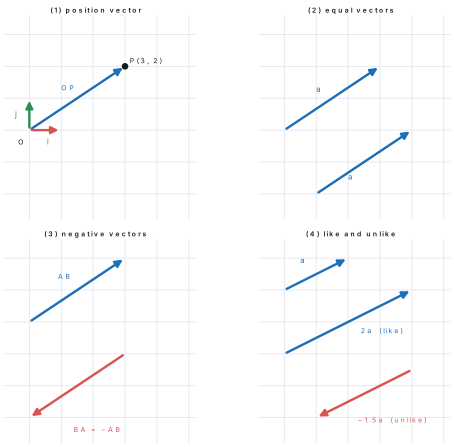
The position vector of a point P(x,y) is the vector \overrightarrow{OP} from the origin O to P:
The components of a position vector are just the coordinates of the point. For A and B with position vectors \vec{a}=\overrightarrow{OA} and \vec{b}=\overrightarrow{OB}, the rule "head minus tail" becomes \overrightarrow{AB}=\vec{b}-\vec{a}.
Unit vector and null vector
A unit vector is a vector of magnitude 1. The unit vector in the direction of \vec{a} is written \hat{a} ("a hat"); it is found by dividing \vec{a} by its own magnitude:
The unit vectors along the axes are \hat{i}=\binom{1}{0} and \hat{j}=\binom{0}{1}; every vector \binom{x}{y} can be written as x\hat{i}+y\hat{j}.
A null (zero) vector \vec{0}=\binom{0}{0} has magnitude 0 and no definite direction. \overrightarrow{AA}, the "journey" from a point to itself, is a null vector.
Equal and negative vectors
Two vectors are equal if they have the same magnitude and the same direction; then their components are equal. The negative of \vec{a}, written -\vec{a}, has the same magnitude as \vec{a} but the opposite direction: if \vec{a}=\binom{x}{y}, then -\vec{a}=\binom{-x}{-y}. In particular \overrightarrow{BA}=-\overrightarrow{AB}.
Equal vectors need not start at the same point. A vector says how far and which way, not where.
Like and unlike vectors
Vectors that are parallel and point the same way are like vectors; parallel vectors that point in opposite ways are unlike vectors. Their lengths may differ. \binom{2}{1} and \binom{4}{2} are like vectors; \binom{2}{1} and \binom{-6}{-3} are unlike vectors.
Problem. Find the unit vector in the direction of \vec{a}=\binom{3}{-4}, and check that its magnitude is 1.
Solution. |\vec{a}|=\sqrt{9+16}=5, so
Check: \sqrt{\left(\frac{3}{5}\right)^2+\left(-\frac{4}{5}\right)^2}=\sqrt{\frac{9+16}{25}}=1 ✓.
Problem. (i) Find x and y if \binom{x+1}{5}=\binom{4}{y-2}. (ii) Show that for A(1,1), B(4,3), C(2,5) and D(5,7), \overrightarrow{AB}=\overrightarrow{CD}. What kind of figure is ABDC?
Solution. (i) Equal vectors have equal components: x+1=4, so x=3; 5=y-2, so y=7.
(ii) \overrightarrow{AB}=\binom{4-1}{3-1}=\binom{3}{2} and \overrightarrow{CD}=\binom{5-2}{7-5}=\binom{3}{2}. So \overrightarrow{AB}=\overrightarrow{CD}: the segments AB and CD are equal in length and parallel. A quadrilateral with one pair of opposite sides equal and parallel is a parallelogram, so ABDC is a parallelogram.
Problem. For \vec{p}=\binom{2}{1}, \vec{q}=\binom{-4}{-2}, \vec{r}=\binom{6}{3}, \vec{s}=\binom{0}{1} and \vec{t}=\binom{0}{0}, say which vectors are like, which are unlike, which are unit vectors and which is null.
Solution. \vec{r}=3\vec{p}, so \vec{p} and \vec{r} are like. \vec{q}=-2\vec{p}, so \vec{q} is unlike \vec{p} (and unlike \vec{r}). |\vec{s}|=1, so \vec{s} is a unit vector (\hat{j}). \vec{t} is the null vector.
8.3 Multiplication of a vector by a scalar; condition for parallel vectors
Scalar multiples
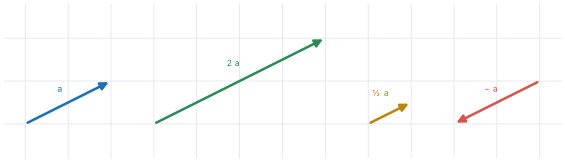
Multiplying a vector by a number (a scalar) stretches or shrinks it, and a negative number also turns it round.
If \vec{a}=\binom{x}{y} and k is a scalar, then
If k>0, k\vec{a} has the same direction as \vec{a}; if k<0, the opposite direction; if k=0, k\vec{a} is the null vector.
Problem. If \vec{a}=\binom{2}{-1}, find 3\vec{a}, -2\vec{a}, \frac{1}{2}\vec{a} and |3\vec{a}|.
Solution.
|\vec{a}|=\sqrt{4+1}=\sqrt{5}, so |3\vec{a}|=3\sqrt{5}. Check directly: \sqrt{36+9}=\sqrt{45}=3\sqrt{5} ✓.
The condition for parallel vectors
Two non-zero vectors are parallel when one is a scalar multiple of the other.
\vec{a}=\binom{x_1}{y_1} and \vec{b}=\binom{x_2}{y_2} are parallel if \vec{a}=k\vec{b} for some scalar k, that is, when
If k>0 they are like vectors; if k<0 they are unlike.
Problem. (i) Show that \binom{2}{-3} and \binom{-4}{6} are parallel. Are they like or unlike? (ii) Find k if \binom{2}{k} is parallel to \binom{6}{9}. (iii) Find p if \binom{p}{4} and \binom{3}{6} are parallel.
Solution. (i) \binom{-4}{6}=-2\binom{2}{-3}. The scalar is negative, so they are parallel and unlike. (Check: 2\times6-(-4)\times(-3)=12-12=0.)
(ii) 2\times9-6\times k=0 gives 18=6k, so k=3. Check: \binom{6}{9}=3\binom{2}{3} ✓.
(iii) p\times6-3\times4=0 gives p=2.
Problem. Show that A(1,2), B(3,6) and C(4,8) are collinear.
Solution. \overrightarrow{AB}=\binom{2}{4} and \overrightarrow{BC}=\binom{1}{2}. Since \overrightarrow{AB}=2\overrightarrow{BC}, the two vectors are parallel. They also share the point B, so A, B and C lie on one straight line. (You proved the same fact with distances and slopes in chapter 6.)
8.4 Addition and subtraction of vectors
Adding by components
To add vectors, add the corresponding components:
This makes sense as journeys: going x_1 across and y_1 up, then x_2 across and y_2 up, is the same as going x_1+x_2 across and y_1+y_2 up. The sum is called the resultant.
The triangle law and the parallelogram law
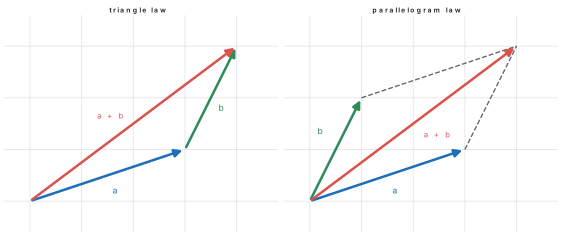
Triangle law. If two vectors are represented by two sides of a triangle taken in order (\overrightarrow{AB} and \overrightarrow{BC}), their sum is represented by the third side taken from the start to the end:
Parallelogram law. If two vectors are represented by two adjacent sides of a parallelogram drawn from the same point, their sum is represented by the diagonal through that point.
Subtraction
Subtracting a vector is adding its negative:
This gives a short proof of "head minus tail": by the triangle law \overrightarrow{OA}+\overrightarrow{AB}=\overrightarrow{OB}, so \overrightarrow{AB}=\overrightarrow{OB}-\overrightarrow{OA}=\vec{b}-\vec{a}.
Subtraction can be drawn too. Draw \vec{a} and \vec{b} from the same point. Then \vec{a}-\vec{b} is the vector from the head of \vec{b} to the head of \vec{a}, because going along \vec{b} and then along that vector lands at the head of \vec{a}: \vec{b}+(\vec{a}-\vec{b})=\vec{a}. In the parallelogram of the figure above, one diagonal is \vec{a}+\vec{b} and the other diagonal is \vec{a}-\vec{b}. For \vec{a}=\binom{3}{1} and \vec{b}=\binom{1}{2}, the heads are at (3,1) and (1,2), and the vector from (1,2) to (3,1) is \binom{2}{-1}=\vec{a}-\vec{b} ✓.
Properties of vector addition
| Property | Statement |
|---|---|
| Commutative | \vec{a}+\vec{b}=\vec{b}+\vec{a} (the two routes round a parallelogram) |
| Associative | (\vec{a}+\vec{b})+\vec{c}=\vec{a}+(\vec{b}+\vec{c}) |
| Identity | \vec{a}+\vec{0}=\vec{a} |
| Inverse | \vec{a}+(-\vec{a})=\vec{0} |
Problem. If \vec{a}=\binom{3}{1} and \vec{b}=\binom{1}{2}, find \vec{a}+\vec{b}, |\vec{a}+\vec{b}|, \vec{a}-\vec{b} and 2\vec{a}+3\vec{b}. Compare |\vec{a}+\vec{b}| with |\vec{a}|+|\vec{b}|.
Solution.
|\vec{a}|+|\vec{b}|=\sqrt{10}+\sqrt{5}\approx3.16+2.24=5.40, which is more than |\vec{a}+\vec{b}|=5. Two sides of a triangle are together longer than the third, so magnitudes do not simply add (unless the vectors are like).
Problem. For A(2,1), B(5,3) and C(4,7), verify that \overrightarrow{AB}+\overrightarrow{BC}=\overrightarrow{AC}.
Solution. \overrightarrow{AB}=\binom{3}{2}, \overrightarrow{BC}=\binom{-1}{4} and \overrightarrow{AC}=\binom{2}{6}. Then \overrightarrow{AB}+\overrightarrow{BC}=\binom{3-1}{2+4}=\binom{2}{6}=\overrightarrow{AC} ✓.
Problem. (i) A trekker in Mustang walks 6 km east and then 8 km north. Find the magnitude and direction of her displacement. (ii) Two forces \binom{3}{4} N and \binom{5}{-2} N act on a box. Find the resultant force and its magnitude.
Solution. (i) The displacement is \binom{6}{0}+\binom{0}{8}=\binom{6}{8}, with magnitude \sqrt{36+64}=10 km. Its direction has \tan\theta=\frac{8}{6}=\frac{4}{3}, so \theta\approx53.13^\circ north of east. She has walked 14 km but is only 10 km from her start.
(ii) Resultant =\binom{3+5}{4-2}=\binom{8}{2} N, with magnitude \sqrt{64+4}=\sqrt{68}=2\sqrt{17}\approx8.25 N.
Problem. If \vec{a}=\binom{2}{5} and \vec{b}=\binom{-1}{3}, find the vector \vec{x} such that \vec{a}+\vec{x}=\vec{b}, and the vector \vec{y} such that 2\vec{y}-\vec{a}=\vec{b}.
Solution. \vec{x}=\vec{b}-\vec{a}=\binom{-1-2}{3-5}=\binom{-3}{-2}.
2\vec{y}=\vec{a}+\vec{b}=\binom{1}{8}, so \vec{y}=\binom{\frac{1}{2}}{4}. Check: 2\vec{y}-\vec{a}=\binom{1-2}{8-5}=\binom{-1}{3}=\vec{b} ✓.
\binom{3}{1}+\binom{1}{2} is \binom{4}{3}, with magnitude 5, not \sqrt{10}+\sqrt{5}. Find the resultant vector first, then its magnitude. Adding lengths gives the right answer only when the vectors point the same way.
A quick sketch on squared paper shows roughly where the resultant points and how long it is. If your calculated answer points into a different quadrant, or is longer than the two arrows put end to end, look for a sign error.
In the school ground, mark a starting peg O and let east and north be the x- and y-directions, with 1 step as the unit. Write a route as a list of vectors, for example \binom{5}{0}, \binom{0}{3}, \binom{-2}{4}, \binom{4}{-1}, and hide a "treasure" at the end. (1) A partner walks the route step by step. (2) Add the vectors to find the single vector from O to the treasure, and its magnitude. (3) Walk the single vector directly. Do both routes end at the same place? (They should: the resultant here is \binom{7}{6}, about 9.2 steps.)
Chapter summary
- A scalar has magnitude only (mass, distance, speed); a vector has magnitude and direction (displacement, velocity, force).
- \overrightarrow{AB}=\binom{x_2-x_1}{y_2-y_1} (head minus tail); |\vec{a}|=\sqrt{x^2+y^2}; direction \tan\theta=\frac{y}{x}, with the quadrant fixed by the signs.
- Position vector \overrightarrow{OP}=\binom{x}{y}; unit vector \hat{a}=\frac{\vec{a}}{|\vec{a}|}; null vector \binom{0}{0}; \hat{i}=\binom{1}{0}, \hat{j}=\binom{0}{1}.
- Equal vectors: same magnitude and direction (equal components); negative -\vec{a}: same magnitude, opposite direction; \overrightarrow{BA}=-\overrightarrow{AB}.
- k\vec{a}=\binom{kx}{ky}, |k\vec{a}|=|k||\vec{a}|; parallel: \vec{a}=k\vec{b}, i.e. x_1y_2-x_2y_1=0; like if k>0, unlike if k<0.
- \vec{a}\pm\vec{b}=\binom{x_1\pm x_2}{y_1\pm y_2}; triangle law \overrightarrow{AB}+\overrightarrow{BC}=\overrightarrow{AC}; parallelogram law; \overrightarrow{AB}=\vec{b}-\vec{a}.
- Addition is commutative and associative, with identity \vec{0} and inverse -\vec{a}; magnitudes do not add unless the vectors are like.
Practice questions
Group A — Objective (1 mark each)
- Which of these is a vector quantity? [1]amassbtemperaturecdisplacementdtime
- Which of these is a scalar quantity? [1]aforcebvelocitycspeeddacceleration
- The magnitude of \binom{3}{4} is [1]a7b5c25d1
- If A is (1,2) and B is (4,6), then \overrightarrow{AB} is [1]a\binom{3}{4}b\binom{5}{8}c\binom{-3}{-4}d\binom{4}{3}
- The position vector of the point P(-2,5) is [1]a\binom{-2}{5}b\binom{2}{-5}c\binom{5}{-2}d\binom{-5}{2}
- A unit vector has magnitude [1]a0b1c2dany number
- The negative of \binom{2}{-3} is [1]a\binom{-2}{3}b\binom{2}{3}c\binom{-2}{-3}d\binom{3}{-2}
- If \binom{x}{4}=\binom{3}{y}, then x+y is [1]a7b1c12d-1
- 3\binom{2}{-1} is equal to [1]a\binom{6}{-3}b\binom{5}{2}c\binom{6}{-1}d\binom{2}{-3}
- The vectors \binom{2}{k} and \binom{4}{6} are parallel when k is [1]a2b3c4d12
- \binom{1}{2}+\binom{3}{-5} is equal to [1]a\binom{4}{-3}b\binom{4}{7}c\binom{-2}{7}d\binom{3}{-10}
- \overrightarrow{AB}+\overrightarrow{BC} is equal to [1]a\overrightarrow{CA}b\overrightarrow{AC}c\overrightarrow{BA}d\vec{0}
Answers to Group A
1. (c) — displacement has a direction; the others do not.
2. (c) — speed is the size of velocity without its direction.
3. (b) — \sqrt{9+16}=5.
4. (a) — head minus tail: \binom{4-1}{6-2}.
5. (a) — the components of a position vector are the coordinates of the point.
6. (b) — by definition.
7. (a) — change the sign of both components.
8. (a) — x=3, y=4, so x+y=7.
9. (a) — multiply both components by 3.
10. (b) — 2\times6-4k=0, so k=3.
11. (a) — \binom{1+3}{2-5}.
12. (b) — the triangle law.
Group B — Short answer (2 marks each)
- Write two differences between scalar and vector quantities, with one example of each. [2]
- If A is (-1,3) and B is (2,7), find \overrightarrow{AB} and |\overrightarrow{AB}|. [2]
- Find the magnitude and direction of \vec{a}=\binom{2}{2}. [2]
- Find the unit vector in the direction of \binom{3}{-4}. [2]
- Find x and y if \binom{2x-1}{5}=\binom{7}{y+2}. [2]
- If \vec{a}=\binom{2}{-1}, find 3\vec{a}, -2\vec{a} and |3\vec{a}|. [2]
- Show that \binom{2}{-3} and \binom{-4}{6} are parallel, and say whether they are like or unlike. [2]
- Find k if \binom{k}{4} and \binom{3}{6} are parallel. [2]
- If \vec{a}=\binom{3}{1} and \vec{b}=\binom{1}{2}, find \vec{a}+\vec{b} and |\vec{a}+\vec{b}|. [2]
- If \vec{p}=\binom{5}{-2} and \vec{q}=\binom{2}{3}, find 2\vec{p}-\vec{q}. [2]
Answers to Group B
1. A scalar has magnitude only, a vector has magnitude and direction; two scalars are added as ordinary numbers, but vectors are added by the triangle law (by components). Examples: mass 5 kg (scalar); a force of 10 N upwards (vector).
2. \overrightarrow{AB}=\binom{2+1}{7-3}=\binom{3}{4} and |\overrightarrow{AB}|=\sqrt{9+16}=5 units.
3. |\vec{a}|=\sqrt{4+4}=2\sqrt{2}. Both components are positive and \tan\theta=\frac{2}{2}=1, so \theta=45^\circ.
4. |\vec{a}|=5, so \hat{a}=\binom{\frac{3}{5}}{-\frac{4}{5}}.
5. 2x-1=7 gives x=4; 5=y+2 gives y=3.
6. 3\vec{a}=\binom{6}{-3}, -2\vec{a}=\binom{-4}{2}, and |3\vec{a}|=3\sqrt{5} (since |\vec{a}|=\sqrt{5}).
7. \binom{-4}{6}=-2\binom{2}{-3}: parallel, and unlike because the scalar -2 is negative.
8. k\times6-3\times4=0, so k=2.
9. \vec{a}+\vec{b}=\binom{4}{3} and |\vec{a}+\vec{b}|=\sqrt{16+9}=5.
10. 2\vec{p}=\binom{10}{-4}, so 2\vec{p}-\vec{q}=\binom{10-2}{-4-3}=\binom{8}{-7}.
Group C — Long answer (4 marks each)
- A trekker walks 6 km east and then 8 km north. (i) Write the two walks as column vectors and draw their sum by the triangle law. (ii) Find the distance walked and the magnitude of the displacement. (iii) Find the direction of the displacement. [4]
- If \vec{a}=\binom{3}{1}, \vec{b}=\binom{1}{2} and \vec{c}=\binom{-2}{4}: (i) verify that \vec{a}+\vec{b}=\vec{b}+\vec{a}; (ii) verify that (\vec{a}+\vec{b})+\vec{c}=\vec{a}+(\vec{b}+\vec{c}); (iii) find |\vec{a}+\vec{b}+\vec{c}|. [4]
- The points A(1,1), B(4,3), C(5,6) and D(2,4) are given. (i) Show that \overrightarrow{AB}=\overrightarrow{DC} and say what this tells you about ABCD. (ii) Verify the parallelogram law \overrightarrow{AB}+\overrightarrow{AD}=\overrightarrow{AC}. (iii) Find \overrightarrow{BD} and show that it equals \overrightarrow{AD}-\overrightarrow{AB}. [4]
- Find the magnitude and direction of (i) \binom{\sqrt{3}}{1} (ii) \binom{-1}{\sqrt{3}} (iii) \binom{0}{-5}, and draw each on a grid. [4]
- (i) Using vectors, show that A(1,2), B(3,6) and C(4,8) are collinear. (ii) Find p if P(2,3), Q(5,9) and R(p,13) are collinear. [4]
Answers to Group C
1. (i) \binom{6}{0} and \binom{0}{8}; drawn head to tail, the resultant runs from the start to the end: \binom{6}{0}+\binom{0}{8}=\binom{6}{8}. (ii) Distance walked =6+8=14 km; displacement =\sqrt{36+64}=10 km. (iii) \tan\theta=\frac{8}{6}=\frac{4}{3}, so \theta\approx53.13^\circ north of east.
2. (i) \vec{a}+\vec{b}=\binom{4}{3} and \vec{b}+\vec{a}=\binom{1+3}{2+1}=\binom{4}{3}; equal. (ii) (\vec{a}+\vec{b})+\vec{c}=\binom{4-2}{3+4}=\binom{2}{7}; \vec{b}+\vec{c}=\binom{-1}{6}, so \vec{a}+(\vec{b}+\vec{c})=\binom{3-1}{1+6}=\binom{2}{7}; equal. (iii) |\vec{a}+\vec{b}+\vec{c}|=\sqrt{4+49}=\sqrt{53}\approx7.28.
3. (i) \overrightarrow{AB}=\binom{3}{2} and \overrightarrow{DC}=\binom{5-2}{6-4}=\binom{3}{2}. They are equal, so AB and DC are equal and parallel: ABCD is a parallelogram. (ii) \overrightarrow{AD}=\binom{1}{3}, so \overrightarrow{AB}+\overrightarrow{AD}=\binom{4}{5}; and \overrightarrow{AC}=\binom{5-1}{6-1}=\binom{4}{5} ✓. (iii) \overrightarrow{BD}=\binom{2-4}{4-3}=\binom{-2}{1} and \overrightarrow{AD}-\overrightarrow{AB}=\binom{1-3}{3-2}=\binom{-2}{1} ✓.
4. (i) \sqrt{3+1}=2; quadrant I with \tan\theta=\frac{1}{\sqrt{3}}, so \theta=30^\circ. (ii) \sqrt{1+3}=2; x<0, y>0, quadrant II, acute angle 60^\circ (since \tan\alpha=\sqrt{3}), so \theta=180^\circ-60^\circ=120^\circ. (iii) Magnitude 5, pointing straight down: \theta=270^\circ. On the grid: (i) 1.73 right and 1 up; (ii) 1 left and 1.73 up; (iii) 5 down.
5. (i) \overrightarrow{AB}=\binom{2}{4} and \overrightarrow{BC}=\binom{1}{2}, so \overrightarrow{AB}=2\overrightarrow{BC}: parallel with the common point B, hence collinear. (ii) \overrightarrow{PQ}=\binom{3}{6} and \overrightarrow{PR}=\binom{p-2}{10} must be parallel: 3\times10-6(p-2)=0, so 30=6p-12 and p=7. Check: \overrightarrow{PR}=\binom{5}{10}=\frac{5}{3}\overrightarrow{PQ} ✓.
Practise more: Optional Mathematics question bank