Unit 7 · 25 min read
Trigonometry
What the syllabus asks for 6
- Measurement of angles: sexagesimal, centesimal and circular (radian) systems
- Trigonometric ratios of an acute angle
- Trigonometric identities and their conversions
- Values of trigonometric ratios of 0°, 30°, 45°, 60° and 90°
- Trigonometric ratios of (90° ± θ), (180° ± θ) and (−θ)
- Height and distance with one angle of elevation or depression
How tall is the Dharahara, a tree in the school ground, or a hill across the river? You cannot climb up with a measuring tape, but you can stand some distance away, measure that distance along the ground, and measure the angle up to the top. Trigonometry (from Greek trigonon, triangle, and metron, measure) is the mathematics that turns such an angle and a distance into a height. It rests on a simple fact: in right-angled triangles with the same angle, the ratios of the sides are always the same. This chapter first explains three ways of measuring angles, then defines the six trigonometric ratios, proves the identities that connect them, finds their exact values for the standard angles, extends them to angles such as 120^\circ and -30^\circ, and finally uses them to find heights and distances.
Expect: (i) converting an angle between degrees, grades and radians, often for the angles of a triangle; (ii) finding all six trigonometric ratios from one ratio or from the sides of a right triangle; (iii) proving an identity such as \tan\theta+\cot\theta=\sec\theta\,\mathrm{cosec}\,\theta; (iv) evaluating expressions with the values at 0^\circ, 30^\circ, 45^\circ, 60^\circ, 90^\circ, or finding an acute angle from an equation; (v) ratios of angles such as 120^\circ, 135^\circ, 210^\circ, -60^\circ using allied angles; (vi) one height and distance problem with a single angle of elevation or depression, with a labelled figure. Marks are given for the figure, the ratio chosen, the substitution and the answer with its unit.
7.1 Measurement of angles: sexagesimal, centesimal and circular (radian) systems
An angle is formed when a ray turns about its end point from a starting position (the initial side) to a final position (the terminal side). The amount of turning is the size of the angle. Turning anticlockwise gives a positive angle; turning clockwise gives a negative angle. One complete turn brings the ray back to where it started, and a quarter of a complete turn is a right angle.
There are three systems of measuring angles. They differ only in how they divide the right angle.
Sexagesimal (British) system
The right angle is divided into 90 equal parts called degrees (^\circ), each degree into 60 minutes (') and each minute into 60 seconds (''). The name comes from the Latin for sixty.
Centesimal (French) system
The right angle is divided into 100 equal parts called grades (^g), each grade into 100 centesimal minutes (^c) and each of these into 100 centesimal seconds (^{cc}). The name comes from the Latin for hundred.
Circular system and the radian
A radian is the angle subtended at the centre of a circle by an arc whose length is equal to the radius. It is written 1^c (or 1 rad).
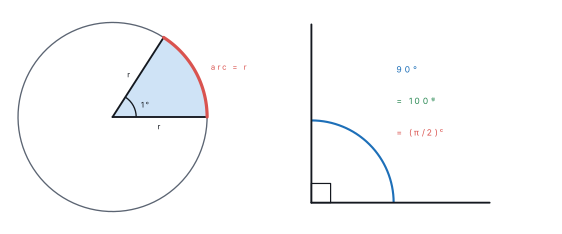
The circumference of a circle is 2\pi r, so it contains 2\pi arcs of length r. A complete turn is therefore 2\pi radians, a half turn is \pi radians, and a right angle is \frac{\pi}{2} radians:
A radian is the same size for every circle, because doubling the radius doubles the arc as well. That is why scientists prefer it.
All three systems agree that a right angle is 90^\circ=100^g=\frac{\pi}{2} radians. So if an angle is D degrees, G grades and R radians,
In practice: 1^\circ=\frac{10}{9} grades, 1^g=\frac{9}{10} degree =0.9^\circ, and \pi^c=180^\circ=200^g.
Problem. Convert (i) 24^\circ18' into grades; (ii) 75^g into degrees and minutes; (iii) 50^g25^c into degrees, minutes and seconds.
Solution. (i) First make the minutes a decimal: 18'=\frac{18}{60}=0.3^\circ, so 24^\circ18'=24.3^\circ. Then G=\frac{10}{9}\times24.3=27^g.
(ii) D=\frac{9}{10}\times75=67.5^\circ, and 0.5^\circ=30'. So 75^g=67^\circ30'.
(iii) 25^c=\frac{25}{100}=0.25^g, so the angle is 50.25^g. Then D=0.9\times50.25=45.225^\circ. The decimal part 0.225^\circ=0.225\times60'=13.5'=13'30''. So 50^g25^c=45^\circ13'30''.
Problem. Convert (i) 135^\circ into radians; (ii) \left(\frac{3\pi}{5}\right)^c into degrees and grades.
Solution. (i) Multiply by \frac{\pi}{180}: 135\times\frac{\pi}{180}=\frac{3\pi}{4} radians.
(ii) Replace \pi by 180^\circ: \frac{3\times180^\circ}{5}=108^\circ. Since \pi^c=200^g, the same angle is \frac{3\times200}{5}=120^g.
Problem. Two angles of a triangle are 60^\circ and 50^g. Find the third angle in degrees and in radians.
Solution. Change everything to degrees first: 50^g=0.9\times50=45^\circ. The angles of a triangle add to 180^\circ, so the third angle is 180^\circ-60^\circ-45^\circ=75^\circ. In radians, 75\times\frac{\pi}{180}=\frac{5\pi}{12}.
Length of an arc
The definition of a radian gives a quick formula: an angle of \theta radians at the centre cuts off an arc \theta times as long as the radius,
A bicycle wheel of radius 35 cm that turns through 2 radians rolls 35\times2=70 cm along the road. A pendulum 50 cm long whose bob moves along an arc of 10 cm swings through \theta=\frac{10}{50}=0.2 radian, about 11.5^\circ.
24^\circ18' is 24.3^\circ, not 24.18^\circ, because a degree has 60 minutes, not 100. Only centesimal minutes are hundredths: 50^g25^c really is 50.25^g. Mixing the two is the commonest error in conversion questions.
7.2 Trigonometric ratios of an acute angle
Take a right-angled triangle and fix one of its acute angles, \theta. The three sides are named by their position relative to \theta:
- the hypotenuse h is the longest side, opposite the right angle;
- the perpendicular p is the side opposite \theta;
- the base b is the side next to \theta (other than the hypotenuse).
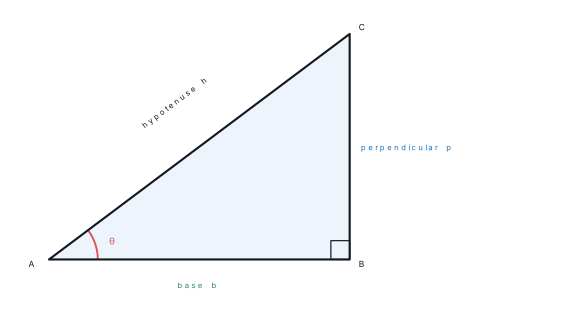
For an acute angle \theta of a right-angled triangle with perpendicular p, base b and hypotenuse h:
They are read sine, cosine, tangent, cosecant, secant and cotangent of \theta.
Some People Have: \sin=\frac{p}{h}. Curly Brown Hair: \cos=\frac{b}{h}. Through Proper Brushing: \tan=\frac{p}{b}. The other three are the same fractions turned upside down.
Why the ratios depend only on the angle
Any two right-angled triangles with the same acute angle \theta are similar (their angles are 90^\circ, \theta and 90^\circ-\theta). In similar triangles corresponding sides are in proportion, so \frac{p}{h}, \frac{b}{h} and \frac{p}{b} come out the same however large the triangle is drawn. The ratios belong to the angle, not to the particular triangle. That is what makes it possible to measure a tall tower with a small triangle drawn in a notebook.
Reciprocal and quotient relations
Straight from the definitions:
(For example, \frac{\sin\theta}{\cos\theta}=\frac{p/h}{b/h}=\frac{p}{b}=\tan\theta.)
Problem. In triangle ABC, \angle B=90^\circ, AB=5 cm, BC=12 cm and AC=13 cm. Find the six trigonometric ratios of \angle A, and \sin C, \cos C, \tan C.
Solution. For \angle A: the side opposite is p=BC=12, the side next to it is b=AB=5, and h=AC=13.
For \angle C the roles change: p=AB=5 and b=BC=12. So \sin C=\frac{5}{13}, \cos C=\frac{12}{13} and \tan C=\frac{5}{12}. Notice that \sin C=\cos A: the two acute angles add to 90^\circ.
Problem. If \sin\theta=\frac{3}{5}, find the other five ratios of the acute angle \theta.
Solution. \sin\theta=\frac{p}{h}=\frac{3}{5}, so take p=3 and h=5. By Pythagoras' theorem,
So \cos\theta=\frac{4}{5}, \tan\theta=\frac{3}{4}, \mathrm{cosec}\,\theta=\frac{5}{3}, \sec\theta=\frac{5}{4} and \cot\theta=\frac{4}{3}.
Problem. If \tan\theta=\frac{8}{15}, find \sin\theta and \cos\theta. If the hypotenuse of a right triangle is 10 cm and \cos\theta=0.8, find its other two sides.
Solution. \tan\theta=\frac{p}{b}=\frac{8}{15}; then h=\sqrt{64+225}=\sqrt{289}=17. So \sin\theta=\frac{8}{17} and \cos\theta=\frac{15}{17}.
For the second part, \cos\theta=\frac{b}{h} gives b=10\times0.8=8 cm, and then p=\sqrt{100-64}=6 cm.
"Perpendicular" here does not mean "the vertical side in the picture". It means the side opposite the chosen angle. In the example above, BC is the perpendicular for \angle A but the base for \angle C. Mark the angle first, then name p, b and h.
7.3 Trigonometric identities and their conversions
An identity is an equation that is true for every value of the angle, like (a+b)^2=a^2+2ab+b^2 in algebra. Three identities follow from Pythagoras' theorem p^2+b^2=h^2.
We start from p^2+b^2=h^2 in a right triangle with acute angle \theta.
Step 1 — divide every term by h^2.
Step 2 — divide p^2+b^2=h^2 by b^2 instead.
Step 3 — divide by p^2.
What it means. \sin^2\theta means (\sin\theta)^2. These three identities, with their rearrangements, are the main tools for proving every other identity in this chapter.
| Identity | Useful rearrangements |
|---|---|
| \sin^2\theta+\cos^2\theta=1 | \sin^2\theta=1-\cos^2\theta, \ \cos^2\theta=1-\sin^2\theta |
| 1+\tan^2\theta=\sec^2\theta | \sec^2\theta-\tan^2\theta=1, \ (\sec\theta-\tan\theta)(\sec\theta+\tan\theta)=1 |
| 1+\cot^2\theta=\mathrm{cosec}^2\theta | \mathrm{cosec}^2\theta-\cot^2\theta=1 |
| \tan\theta=\frac{\sin\theta}{\cos\theta}, \cot\theta=\frac{\cos\theta}{\sin\theta} | \mathrm{cosec}\,\theta=\frac{1}{\sin\theta}, \sec\theta=\frac{1}{\cos\theta}, \cot\theta=\frac{1}{\tan\theta} |
Conversions: one ratio in terms of another
Every ratio can be written in terms of any one of the others. The easy way is to draw a triangle. To write everything in terms of \sin\theta, take p=\sin\theta and h=1; then b=\sqrt{1-\sin^2\theta}. To write everything in terms of \tan\theta, take p=\tan\theta and b=1; then h=\sqrt{1+\tan^2\theta}.
| Ratio | in terms of \sin\theta | in terms of \tan\theta |
|---|---|---|
| \sin\theta | \sin\theta | \frac{\tan\theta}{\sqrt{1+\tan^2\theta}} |
| \cos\theta | \sqrt{1-\sin^2\theta} | \frac{1}{\sqrt{1+\tan^2\theta}} |
| \tan\theta | \frac{\sin\theta}{\sqrt{1-\sin^2\theta}} | \tan\theta |
| \mathrm{cosec}\,\theta | \frac{1}{\sin\theta} | \frac{\sqrt{1+\tan^2\theta}}{\tan\theta} |
| \sec\theta | \frac{1}{\sqrt{1-\sin^2\theta}} | \sqrt{1+\tan^2\theta} |
| \cot\theta | \frac{\sqrt{1-\sin^2\theta}}{\sin\theta} | \frac{1}{\tan\theta} |
Proving identities
To prove an identity, start from one side (usually the more complicated one) and change it, step by step, into the other side. Never move terms across the equals sign as if solving an equation: you are showing that two expressions are the same, not finding \theta. Useful moves are: change everything into \sin and \cos; use \sin^2\theta+\cos^2\theta=1; factorise; and add fractions over a common denominator.
Problem. Prove that (i) (1-\sin^2\theta)\sec^2\theta=1 (ii) \sin\theta\cot\theta=\cos\theta (iii) (1+\tan^2\theta)\cos^2\theta=1.
Solution. (i) LHS =(1-\sin^2\theta)\sec^2\theta=\cos^2\theta\times\frac{1}{\cos^2\theta}=1= RHS.
(ii) LHS =\sin\theta\times\frac{\cos\theta}{\sin\theta}=\cos\theta= RHS.
(iii) LHS =\sec^2\theta\times\cos^2\theta=\frac{1}{\cos^2\theta}\times\cos^2\theta=1= RHS.
Problem. Prove that \tan\theta+\cot\theta=\sec\theta\,\mathrm{cosec}\,\theta.
Solution.
Problem. Prove that (i) \sin^4\theta-\cos^4\theta=\sin^2\theta-\cos^2\theta (ii) \frac{1}{1+\sin\theta}+\frac{1}{1-\sin\theta}=2\sec^2\theta (iii) (1-\cos\theta)(1+\cos\theta)(1+\cot^2\theta)=1.
Solution. (i) Use a^2-b^2=(a+b)(a-b) with a=\sin^2\theta, b=\cos^2\theta:
(ii) Add the fractions:
(iii) (1-\cos\theta)(1+\cos\theta)=1-\cos^2\theta=\sin^2\theta and 1+\cot^2\theta=\mathrm{cosec}^2\theta, so
(1) "LHS =" written at the start, so the marker knows which side you began from; (2) one change per line, with the identity used visible; (3) "= RHS" at the end. A proof that works on both sides at once and meets in the middle is accepted, but it must be set out as two separate chains.
7.4 Values of trigonometric ratios of 0°, 30°, 45°, 60° and 90°
For most angles the ratios are long decimals found with a calculator. For five special angles we can find them exactly from simple triangles.
45°
Cut a square of side 1 along a diagonal. Each half is a right triangle with two angles of 45^\circ, legs 1 and 1, and hypotenuse \sqrt{1^2+1^2}=\sqrt{2}.
30° and 60°
Take an equilateral triangle of side 2 and drop a perpendicular from the top vertex. It bisects the base and the top angle, giving a right triangle with angles 30^\circ, 60^\circ, 90^\circ, hypotenuse 2, short side 1, and height \sqrt{2^2-1^2}=\sqrt{3}.
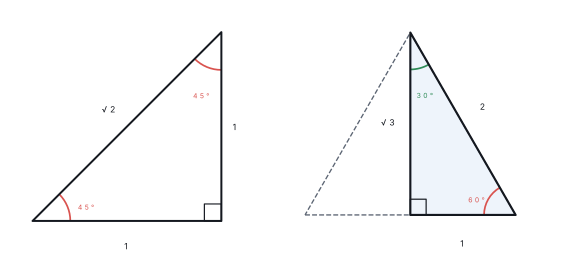
For the 30^\circ angle at the top, p=1, b=\sqrt{3}, h=2; for the 60^\circ angle at the base, p=\sqrt{3}, b=1, h=2:
0° and 90°
Imagine a right triangle with hypotenuse 1 and let its angle \theta shrink towards 0^\circ: the perpendicular shrinks to 0 and the base grows to 1. So \sin0^\circ=0, \cos0^\circ=1 and \tan0^\circ=0. Now let \theta grow towards 90^\circ: the perpendicular grows to 1 and the base shrinks to 0. So \sin90^\circ=1 and \cos90^\circ=0, while \tan90^\circ=\frac{1}{0} is not defined. (This is the limit idea of chapter 4 at work.)
| \theta | 0^\circ | 30^\circ | 45^\circ | 60^\circ | 90^\circ |
|---|---|---|---|---|---|
| \sin\theta | 0 | \frac{1}{2} | \frac{1}{\sqrt{2}} | \frac{\sqrt{3}}{2} | 1 |
| \cos\theta | 1 | \frac{\sqrt{3}}{2} | \frac{1}{\sqrt{2}} | \frac{1}{2} | 0 |
| \tan\theta | 0 | \frac{1}{\sqrt{3}} | 1 | \sqrt{3} | not defined |
| \mathrm{cosec}\,\theta | not defined | 2 | \sqrt{2} | \frac{2}{\sqrt{3}} | 1 |
| \sec\theta | 1 | \frac{2}{\sqrt{3}} | \sqrt{2} | 2 | not defined |
| \cot\theta | not defined | \sqrt{3} | 1 | \frac{1}{\sqrt{3}} | 0 |
Write \sqrt{0}, \sqrt{1}, \sqrt{2}, \sqrt{3}, \sqrt{4} and divide each by 2: you get \sin0^\circ, \sin30^\circ, \sin45^\circ, \sin60^\circ, \sin90^\circ, that is 0, \frac{1}{2}, \frac{1}{\sqrt{2}}, \frac{\sqrt{3}}{2}, 1. The cosines are the same list backwards. Then \tan=\frac{\sin}{\cos}.
Problem. Find the value of (i) \sin30^\circ\cos60^\circ+\cos30^\circ\sin60^\circ (ii) \tan^260^\circ+2\tan^245^\circ (iii) \frac{1-\tan^230^\circ}{1+\tan^230^\circ} (iv) 4\sin^230^\circ+3\tan^230^\circ-8\sin45^\circ\cos45^\circ.
Solution. (i) \frac{1}{2}\cdot\frac{1}{2}+\frac{\sqrt{3}}{2}\cdot\frac{\sqrt{3}}{2}=\frac{1}{4}+\frac{3}{4}=1.
(ii) (\sqrt{3})^2+2(1)^2=3+2=5.
(iii) \tan^230^\circ=\frac{1}{3}, so the value is \frac{1-\frac{1}{3}}{1+\frac{1}{3}}=\frac{\frac{2}{3}}{\frac{4}{3}}=\frac{1}{2}, which equals \cos60^\circ.
(iv) 4\cdot\frac{1}{4}+3\cdot\frac{1}{3}-8\cdot\frac{1}{\sqrt{2}}\cdot\frac{1}{\sqrt{2}}=1+1-4=-2.
Problem. Find the acute angle \theta if (i) 2\sin\theta=\sqrt{3} (ii) \sqrt{3}\tan\theta=1 (iii) 2\cos^2\theta=1.
Solution. (i) \sin\theta=\frac{\sqrt{3}}{2}=\sin60^\circ, so \theta=60^\circ.
(ii) \tan\theta=\frac{1}{\sqrt{3}}=\tan30^\circ, so \theta=30^\circ.
(iii) \cos^2\theta=\frac{1}{2}, so \cos\theta=\frac{1}{\sqrt{2}} (positive, as \theta is acute) and \theta=45^\circ.
\sin^230^\circ means (\sin30^\circ)^2=\frac{1}{4}. It does not mean \sin900^\circ or \sin(30^\circ)\times2. And \sin(30^\circ+60^\circ)=\sin90^\circ=1 is not \sin30^\circ+\sin60^\circ=\frac{1+\sqrt{3}}{2}: a trigonometric ratio does not split over addition.
7.5 Trigonometric ratios of (90° ± θ), (180° ± θ) and (−θ)
Ratios of any angle
A right triangle can only hold acute angles. To give 120^\circ or -30^\circ a sine, we use coordinates. Let the terminal side of an angle \theta (measured from the positive x-axis) pass through a point P(x,y), and let r=OP=\sqrt{x^2+y^2}. Define
and the other three as their reciprocals. For an acute angle, y is the perpendicular, x the base and r the hypotenuse, so these agree with section 7.2. For larger angles, x or y may be negative, and the ratios take the signs of x and y.
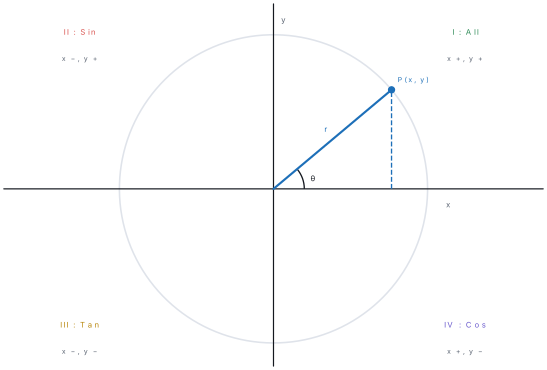
Going anticlockwise from the first quadrant: All ratios are positive in the first, Sine in the second, Tangent in the third and Cosine in the fourth (each with its reciprocal). "All Silver Tea Cups" (ASTC).
How the allied angles arise
Let \theta be acute and P(x,y) a point on its terminal side, so \sin\theta=\frac{y}{r} and \cos\theta=\frac{x}{r}. Each allied angle comes from moving P by a reflection or a rotation that keeps its distance r from O (you will meet these transformations again in chapter 9).
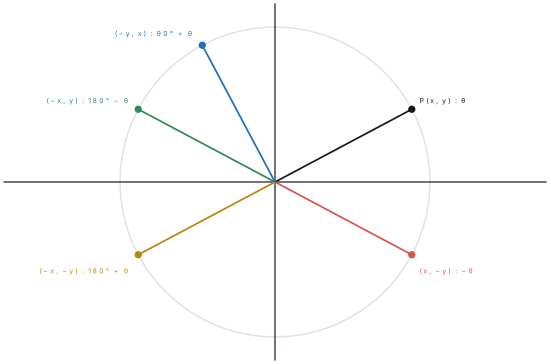
Reading the ratios from the new coordinates (with the same r) gives every rule at once:
| Angle | New point | sin | cos | tan |
|---|---|---|---|---|
| -\theta | (x,-y) | -\sin\theta | \cos\theta | -\tan\theta |
| 90^\circ-\theta | (y,x) | \cos\theta | \sin\theta | \cot\theta |
| 90^\circ+\theta | (-y,x) | \cos\theta | -\sin\theta | -\cot\theta |
| 180^\circ-\theta | (-x,y) | \sin\theta | -\cos\theta | -\tan\theta |
| 180^\circ+\theta | (-x,-y) | -\sin\theta | -\cos\theta | \tan\theta |
For example, for 90^\circ+\theta the new point is (-y,x), so \sin(90^\circ+\theta)=\frac{x}{r}=\cos\theta and \cos(90^\circ+\theta)=\frac{-y}{r}=-\sin\theta. For 90^\circ-\theta, the two acute angles of one right triangle are \theta and 90^\circ-\theta, so the perpendicular of one is the base of the other: the sine of one is the cosine of the other.
Step 1 — the name. With 90^\circ\pm\theta the ratio changes to its partner (\sin\leftrightarrow\cos, \tan\leftrightarrow\cot, \mathrm{cosec}\leftrightarrow\sec). With 180^\circ\pm\theta or -\theta the name stays the same.
Step 2 — the sign. Treat \theta as a small acute angle, find the quadrant of the whole angle, and use ASTC to decide whether the original ratio is positive or negative there.
Example: \cos(90^\circ+\theta). The name changes to \sin; 90^\circ+\theta is in quadrant II, where cosine is negative. So \cos(90^\circ+\theta)=-\sin\theta.
Problem. Find the values of \sin120^\circ, \cos135^\circ, \tan150^\circ, \sin210^\circ, \cos240^\circ and \tan225^\circ.
Solution. Write each angle as 180^\circ\pm (a standard angle):
\sin120^\circ=\sin(180^\circ-60^\circ)=\sin60^\circ=\frac{\sqrt{3}}{2} (quadrant II, sine positive).
\cos135^\circ=\cos(180^\circ-45^\circ)=-\cos45^\circ=-\frac{1}{\sqrt{2}}.
\tan150^\circ=\tan(180^\circ-30^\circ)=-\tan30^\circ=-\frac{1}{\sqrt{3}}.
\sin210^\circ=\sin(180^\circ+30^\circ)=-\sin30^\circ=-\frac{1}{2} (quadrant III, sine negative).
\cos240^\circ=\cos(180^\circ+60^\circ)=-\cos60^\circ=-\frac{1}{2}.
\tan225^\circ=\tan(180^\circ+45^\circ)=\tan45^\circ=1 (quadrant III, tangent positive).
Check one another way. \sin120^\circ=\sin(90^\circ+30^\circ)=\cos30^\circ=\frac{\sqrt{3}}{2}, the same.
Problem. Find \cos(-60^\circ), \sin(-45^\circ) and \tan(-30^\circ).
Solution. \cos(-60^\circ)=\cos60^\circ=\frac{1}{2}; \sin(-45^\circ)=-\sin45^\circ=-\frac{1}{\sqrt{2}}; \tan(-30^\circ)=-\tan30^\circ=-\frac{1}{\sqrt{3}}. Turning clockwise into quadrant IV, only the cosine stays positive.
Problem. (i) Evaluate \sin150^\circ+\cos120^\circ-\tan135^\circ. (ii) Show that \sin(90^\circ+\theta)\cos(180^\circ-\theta)+\cos(90^\circ+\theta)\sin(180^\circ-\theta)=-1.
Solution. (i) \sin150^\circ=\sin30^\circ=\frac{1}{2}, \cos120^\circ=-\cos60^\circ=-\frac{1}{2}, \tan135^\circ=-\tan45^\circ=-1. So the value is \frac{1}{2}-\frac{1}{2}-(-1)=1.
(ii) Replace each ratio:
7.6 Height and distance with one angle of elevation or depression
Angles of elevation and depression
When you look at an object, the straight line from your eye to the object is the line of sight. The angle is always measured from the horizontal line through your eye.
If the object is above the horizontal through the eye, the angle between the line of sight and the horizontal is the angle of elevation. If the object is below it, the angle between the horizontal and the line of sight is the angle of depression.
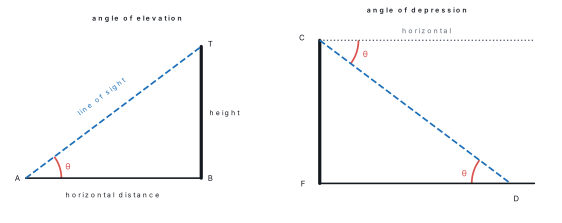
The method
- Draw a neat figure: the object, the observer, the horizontal line, the line of sight, the right angle, and the given angle.
- Name the unknown side (usually h for height or x for distance).
- Choose the ratio that connects the known side and the unknown side with the given angle: \tan when both are the legs (height and horizontal distance), \sin or \cos when the hypotenuse (a ladder, a string, a line of sight) is involved.
- Substitute the standard value and solve. Use \sqrt{3}\approx1.732 and \sqrt{2}\approx1.414 for a decimal answer, and write the unit.
Problem. The angle of elevation of the top of a tower from a point 30 m from its foot is 60^\circ. Find the height of the tower.
Solution. Let the height be h m. In the right triangle, the height is opposite the 60^\circ angle and the 30 m distance is next to it, so use \tan:
Problem. (i) A ladder 10 m long rests against a wall and makes an angle of 60^\circ with the ground. How high up the wall does it reach, and how far is its foot from the wall? (ii) A kite is flying on a string 100 m long that makes an angle of 30^\circ with the ground. How high is the kite?
Solution. (i) The ladder is the hypotenuse. Height: \sin60^\circ=\frac{h}{10}, so h=10\times\frac{\sqrt{3}}{2}=5\sqrt{3}\approx8.66 m. Distance of the foot: \cos60^\circ=\frac{d}{10}, so d=10\times\frac{1}{2}=5 m.
(ii) The string is the hypotenuse and the height is opposite 30^\circ: h=100\sin30^\circ=100\times\frac{1}{2}=50 m.
Problem. A vertical pole 12 m high casts a shadow 12\sqrt{3} m long on level ground. Find the angle of elevation of the sun.
Solution. The pole and its shadow are the two legs of a right triangle, with the sun's rays as the hypotenuse:
When the shadow is exactly as long as the pole, \tan\theta=1 and the sun is at 45^\circ.
Problem. From the top of a cliff 45 m high, the angle of depression of a boat on the lake is 30^\circ. Find the distance of the boat from the foot of the cliff, and the length of the line of sight.
Solution. The angle of depression at the top equals the angle of elevation at the boat (alternate angles), so the angle at the boat is 30^\circ. Let the distance be x m:
Line of sight: \sin30^\circ=\frac{45}{l}, so l=\frac{45}{\frac{1}{2}}=90 m.
Problem. A boy whose eyes are 1.5 m above the ground stands 20 m from a flagpole. The angle of elevation of the top of the pole from his eyes is 45^\circ. Find the height of the pole.
Solution. The angle is measured from the horizontal through his eyes, 1.5 m above the ground. The part of the pole above eye level is h_1, with \tan45^\circ=\frac{h_1}{20}, so h_1=20 m. The height of the pole is 20+1.5=21.5 m.
The angle of depression is the angle between the horizontal line and the line of sight. It is not the angle between the cliff and the line of sight. In a depression problem, put the given angle at the observer against the horizontal, then transfer it to the object on the ground as an alternate angle. A wrong placement turns 30^\circ into 60^\circ and gives the wrong side.
A clinometer measures angles of elevation. Tape a drinking straw along the straight edge of a protractor, and hang a small stone on a thread from the centre of the protractor. Look at the top of the school building (or a tall tree) through the straw. The thread hangs vertically; the angle between the thread and the 90^\circ mark is the angle of elevation. (1) Measure your distance from the foot of the building with a tape, and your eye height. (2) Draw the figure and find the height with \tan. (3) Repeat from a second distance. Do your two answers agree? Which errors could explain the difference? (Never look at the sun through the straw.)
Chapter summary
- Right angle =90^\circ=100^g=\left(\frac{\pi}{2}\right)^c; 1^\circ=60', 1'=60''; 1^g=100^c, 1^c=100^{cc}; \pi^c=180^\circ=200^g; \frac{D}{90}=\frac{G}{100}=\frac{2R}{\pi}; arc l=r\theta.
- \sin\theta=\frac{p}{h}, \cos\theta=\frac{b}{h}, \tan\theta=\frac{p}{b}; cosec, sec and cot are their reciprocals; \tan\theta=\frac{\sin\theta}{\cos\theta}.
- \sin^2\theta+\cos^2\theta=1, 1+\tan^2\theta=\sec^2\theta, 1+\cot^2\theta=\mathrm{cosec}^2\theta; prove identities from one side, one change per line.
- \sin0^\circ, \sin30^\circ, \sin45^\circ, \sin60^\circ, \sin90^\circ=0, \frac{1}{2}, \frac{1}{\sqrt{2}}, \frac{\sqrt{3}}{2}, 1; cosines in reverse order; \tan45^\circ=1, \tan60^\circ=\sqrt{3}, \tan90^\circ not defined.
- Signs by quadrant: All, Sin, Tan, Cos.
- \sin(-\theta)=-\sin\theta, \cos(-\theta)=\cos\theta; with 90^\circ\pm\theta the ratio changes to its partner, with 180^\circ\pm\theta it keeps its name; the sign comes from the quadrant.
- Elevation and depression are measured from the horizontal; the depression from A to B equals the elevation from B to A. Use \tan for height and distance, \sin or \cos with a hypotenuse, and add the observer's eye height.
Practice questions
Group A — Objective (1 mark each)
- One right angle in the centesimal system is [1]a90^gb100^gc60^gd180^g
- \pi^c is equal to [1]a90^\circb180^\circc360^\circd57.3^\circ
- 45^\circ expressed in grades is [1]a40^gb45^gc50^gd60^g
- In a right-angled triangle, \sin\theta is [1]a\frac{b}{h}b\frac{p}{h}c\frac{p}{b}d\frac{h}{p}
- If \tan\theta=\frac{3}{4}, then \cot\theta is [1]a\frac{4}{3}b\frac{3}{5}c\frac{4}{5}d\frac{5}{3}
- \sin^2\theta+\cos^2\theta is equal to [1]a0b1c2d\tan^2\theta
- \sec^2\theta-\tan^2\theta is equal to [1]a0b-1c1d\cot^2\theta
- The value of \sin30^\circ+\cos60^\circ is [1]a\frac{1}{2}b1c\sqrt{3}d0
- \tan45^\circ is equal to [1]a0b\frac{1}{\sqrt{3}}c1d\sqrt{3}
- \sin(90^\circ-\theta) is equal to [1]a\sin\thetab-\cos\thetac\cos\thetad-\sin\theta
- \cos(180^\circ-\theta) is equal to [1]a\cos\thetab-\cos\thetac\sin\thetad-\sin\theta
- When the shadow of a pole is equal to its height, the angle of elevation of the sun is [1]a30^\circb45^\circc60^\circd90^\circ
Answers to Group A
1. (b) — the centesimal system divides the right angle into 100 grades.
2. (b) — half a turn is \pi radians and 180^\circ.
3. (c) — 45\times\frac{10}{9}=50^g.
4. (b) — perpendicular over hypotenuse.
5. (a) — \cot\theta=\frac{1}{\tan\theta}.
6. (b) — the fundamental identity.
7. (c) — from 1+\tan^2\theta=\sec^2\theta.
8. (b) — \frac{1}{2}+\frac{1}{2}=1.
9. (c) — in the half-square triangle the legs are equal.
10. (c) — complementary angles: sine of one is cosine of the other.
11. (b) — 180^\circ-\theta is in quadrant II, where cosine is negative.
12. (b) — \tan\theta=1, so \theta=45^\circ.
Group B — Short answer (2 marks each)
- Convert 67^\circ30' into grades. [2]
- Convert \left(\frac{3\pi}{5}\right)^c into degrees and into grades. [2]
- Two angles of a triangle are 60^\circ and 50^g. Find the third angle in radians. [2]
- If \sin\theta=\frac{5}{13} and \theta is acute, find \cos\theta and \tan\theta. [2]
- Prove that (1-\sin^2\theta)\sec^2\theta=1. [2]
- Prove that \tan\theta+\cot\theta=\sec\theta\,\mathrm{cosec}\,\theta. [2]
- Find the value of \tan^260^\circ+2\tan^245^\circ. [2]
- Find the values of \sin120^\circ and \cos135^\circ. [2]
- Find the acute angle \theta if 2\cos\theta=1. [2]
- A ladder 10 m long makes an angle of 60^\circ with the ground. How high up the wall does it reach? [2]
Answers to Group B
1. 30'=0.5^\circ, so the angle is 67.5^\circ, and 67.5\times\frac{10}{9}=75^g.
2. \frac{3\times180^\circ}{5}=108^\circ and \frac{3\times200^g}{5}=120^g.
3. 50^g=45^\circ, so the third angle is 180^\circ-60^\circ-45^\circ=75^\circ=75\times\frac{\pi}{180}=\frac{5\pi}{12} radians.
4. p=5, h=13, b=\sqrt{169-25}=12. So \cos\theta=\frac{12}{13} and \tan\theta=\frac{5}{12}.
5. LHS =\cos^2\theta\times\frac{1}{\cos^2\theta}=1= RHS.
6. LHS =\frac{\sin\theta}{\cos\theta}+\frac{\cos\theta}{\sin\theta}=\frac{\sin^2\theta+\cos^2\theta}{\sin\theta\cos\theta}=\frac{1}{\sin\theta\cos\theta}=\sec\theta\,\mathrm{cosec}\,\theta= RHS.
7. (\sqrt{3})^2+2(1)^2=3+2=5.
8. \sin120^\circ=\sin(180^\circ-60^\circ)=\sin60^\circ=\frac{\sqrt{3}}{2}; \cos135^\circ=\cos(180^\circ-45^\circ)=-\cos45^\circ=-\frac{1}{\sqrt{2}}.
9. \cos\theta=\frac{1}{2}=\cos60^\circ, so \theta=60^\circ.
10. \sin60^\circ=\frac{h}{10}, so h=10\times\frac{\sqrt{3}}{2}=5\sqrt{3}\approx8.66 m.
Group C — Long answer (4 marks each)
- (i) Define one radian. (ii) Show that \pi^c=180^\circ. (iii) Express 1^c in degrees, minutes and seconds (to the nearest second). (iv) The angles of a triangle are in the ratio 2:3:5. Find them in degrees, in grades and in radians. [4]
- If \tan\theta=\frac{8}{15}, find the other trigonometric ratios of the acute angle \theta and verify that \sin^2\theta+\cos^2\theta=1 and \sec^2\theta-\tan^2\theta=1. [4]
- Prove that (i) \frac{1}{1+\sin\theta}+\frac{1}{1-\sin\theta}=2\sec^2\theta (ii) (\sec\theta-\tan\theta)(\sec\theta+\tan\theta)=1. [4]
- (i) Evaluate 4\sin^230^\circ+3\tan^230^\circ-8\sin45^\circ\cos45^\circ. (ii) Evaluate \sin150^\circ+\cos120^\circ-\tan135^\circ. (iii) Show that \sin(90^\circ+\theta)\cos(180^\circ-\theta)+\cos(90^\circ+\theta)\sin(180^\circ-\theta)=-1. [4]
- From the top of a cliff 45 m high, the angle of depression of a boat is 30^\circ. (i) Draw a labelled figure. (ii) Find the distance of the boat from the foot of the cliff. (iii) Find the length of the line of sight from the top of the cliff to the boat. [4]
Answers to Group C
1. (i) One radian is the angle subtended at the centre of a circle by an arc equal in length to the radius. (ii) The circumference 2\pi r contains 2\pi arcs of length r, so a full turn is 2\pi radians; a full turn is also 360^\circ, so 2\pi^c=360^\circ and \pi^c=180^\circ. (iii) 1^c=\frac{180^\circ}{\pi}\approx57.2958^\circ; 0.2958^\circ\times60=17.75' and 0.75'\times60=45'', so 1^c\approx57^\circ17'45''. (iv) The parts are 2+3+5=10, so the angles are \frac{2}{10}\times180^\circ=36^\circ, 54^\circ and 90^\circ; in grades 40^g, 60^g, 100^g; in radians \frac{\pi}{5}, \frac{3\pi}{10}, \frac{\pi}{2}.
2. p=8, b=15, h=\sqrt{64+225}=17. So \sin\theta=\frac{8}{17}, \cos\theta=\frac{15}{17}, \mathrm{cosec}\,\theta=\frac{17}{8}, \sec\theta=\frac{17}{15}, \cot\theta=\frac{15}{8}. Check: \sin^2\theta+\cos^2\theta=\frac{64}{289}+\frac{225}{289}=\frac{289}{289}=1 ✓; \sec^2\theta-\tan^2\theta=\frac{289}{225}-\frac{64}{225}=\frac{225}{225}=1 ✓.
3. (i) LHS =\frac{(1-\sin\theta)+(1+\sin\theta)}{(1+\sin\theta)(1-\sin\theta)}=\frac{2}{1-\sin^2\theta}=\frac{2}{\cos^2\theta}=2\sec^2\theta= RHS. (ii) LHS =\sec^2\theta-\tan^2\theta (difference of two squares) =1= RHS, using 1+\tan^2\theta=\sec^2\theta.
4. (i) 4\left(\frac{1}{2}\right)^2+3\left(\frac{1}{\sqrt{3}}\right)^2-8\cdot\frac{1}{\sqrt{2}}\cdot\frac{1}{\sqrt{2}}=1+1-4=-2. (ii) \frac{1}{2}+\left(-\frac{1}{2}\right)-(-1)=1. (iii) LHS =\cos\theta(-\cos\theta)+(-\sin\theta)(\sin\theta)=-(\cos^2\theta+\sin^2\theta)=-1= RHS.
5. (i) A vertical line CF of 45 m for the cliff, a horizontal line through C, the boat D on the ground level with F, and the line of sight CD; the 30^\circ angle between the horizontal and CD at C, and an equal 30^\circ at D (alternate angles). (ii) \tan30^\circ=\frac{45}{FD}, so FD=45\sqrt{3}\approx77.94 m. (iii) \sin30^\circ=\frac{45}{CD}, so CD=90 m. Check: 45^2+77.94^2\approx2025+6075=8100=90^2 ✓.
Practise more: Optional Mathematics question bank