Unit 9 · 20 min read
Transformation
What the syllabus asks for 4
- Transformation: meaning; isometric and non-isometric transformations
- Reflection in the x-axis and the y-axis
- Rotation about the origin through 90°, 180°, 270° and 360°
- Translation by a vector
Look in a mirror and your right hand becomes a left hand. Turn a page of a book through a right angle and every word on it turns too. Slide a chessboard piece three squares forward and it lands, unchanged, in a new place. Each of these is a transformation: a rule that sends every point of a figure to a new position. In grade 8 compulsory mathematics you drew reflections, rotations and translations. In optional mathematics we study them with coordinates and rules: we prove why the rules work, separate the transformations that keep size and shape from those that do not, find the object when only the image is known, and combine two transformations into one. These ideas lead on to transformations by matrices in grade 10, and they are the mathematics behind the "flip", "rotate" and "move" tools in every drawing and photo app.
Expect: (i) the meaning of transformation, object and image, and the difference between isometric and non-isometric transformations, with examples; (ii) the image of a point or a triangle under reflection in the x-axis or the y-axis; (iii) the image under rotation about the origin through \pm90^\circ, 180^\circ, 270^\circ or 360^\circ, or the angle and direction of a rotation from a point and its image; (iv) the image under translation by a vector, or the vector from a point and its image; (v) finding the object from the image; (vi) a 4-mark question that draws a triangle and its image on graph paper, often with two transformations one after the other. Plot every figure: the graph earns marks and catches sign mistakes.
9.1 Transformation: meaning; isometric and non-isometric transformations
A transformation is a rule that changes the position (and sometimes the size or shape) of a figure by moving every point of it to a new point. The original figure is the object and the new figure is the image. If a point P is sent to P', we write P\rightarrow P' and read "P maps to P dash".
An object triangle ABC has the image triangle A'B'C': each vertex goes to the vertex with the same letter. Because a transformation acts on every point, it is enough to transform the vertices of a polygon and join the images in the same order.
Transformations are easy to find around you. The two halves of a butterfly, or of the eyes painted on the stupa at Swayambhunath, are reflections of each other in a vertical line. The pattern on a dhaka topi or a mandala repeats when it is turned about its centre, a rotation. A row of identical carved windows on a Newar house, or the bricks in a wall, repeat by sliding along, a translation. A photocopy at 150% is an enlargement. Artists and engineers use exactly these four moves to build patterns.
Isometric and non-isometric transformations
The word isometric comes from Greek isos, equal, and metron, measure.
A transformation is isometric if it keeps the distance between every pair of points unchanged. Then lengths, angles, area, shape and size are all unchanged, and the image is congruent to the object. Reflection, rotation and translation are isometric.
A transformation that changes distances is non-isometric. An enlargement with scale factor other than 1 or -1 is non-isometric: the image is similar to the object (same shape) but of a different size.
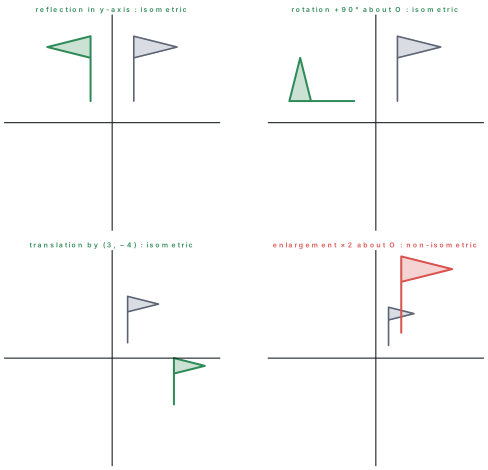
| Transformation | Lengths | Angles | Orientation (order of labels round the figure) | Image |
|---|---|---|---|---|
| Reflection | unchanged | unchanged | reversed (clockwise becomes anticlockwise) | congruent |
| Rotation | unchanged | unchanged | kept | congruent |
| Translation | unchanged | unchanged | kept | congruent |
| Enlargement (k\neq\pm1) | multiplied by k | unchanged | kept for k>0 | similar |
A point that a transformation does not move is an invariant point. In a reflection every point of the mirror line is invariant; in a rotation only the centre is invariant; a translation (other than by the null vector) has no invariant point at all.
Problem. The triangle A(1,1), B(3,1), C(1,2) has two images: P(-1,1), Q(-3,1), R(-1,2), and X(2,2), Y(6,2), Z(2,4). Which image comes from an isometric transformation?
Solution. Compare the lengths of corresponding sides.
Object: AB=3-1=2, AC=2-1=1. First image: PQ=|-3-(-1)|=2, PR=1. Second image: XY=6-2=4, XZ=4-2=2.
The first image keeps every length, so it comes from an isometric transformation (each x has changed sign: a reflection in the y-axis). The second doubles every length, so it is non-isometric (an enlargement with scale factor 2 about the origin). Its area is \frac{1}{2}\times4\times2=4 square units, four times the object's area of 1.
9.2 Reflection in the x-axis and the y-axis
A reflection flips a figure over a straight line called the mirror line (or axis of reflection), as a mirror does. For every point P and its image P':
- P and P' are the same distance from the mirror line, on opposite sides;
- the segment PP' is perpendicular to the mirror line, and the mirror line bisects it.
In other words, the mirror line is the perpendicular bisector of PP'.
Reflection in the x-axis
If P(x,y) is reflected in the x-axis, it stays at the same horizontal position but goes to the other side of the axis, the same distance away. So the x-coordinate is unchanged and the y-coordinate changes sign:
Reflection in the y-axis
Reflecting in the y-axis keeps the height and changes the side, so the x-coordinate changes sign:
Why reflection keeps distances
Take any two points A(x_1,y_1) and B(x_2,y_2). Their images in the x-axis are A'(x_1,-y_1) and B'(x_2,-y_2). By the distance formula,
because (-y_2+y_1)^2=(y_2-y_1)^2. So A'B'=AB for every pair of points: reflection in the x-axis is isometric. The same argument, with the signs of the x-coordinates changed instead, works for the y-axis. In the same way, a rotation through +90^\circ sends A and B to (-y_1,x_1) and (-y_2,x_2), and the squared distance between these is (y_2-y_1)^2+(x_2-x_1)^2, again AB^2.
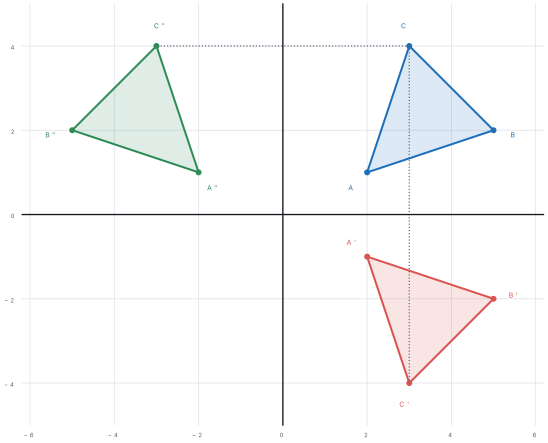
Problem. Find the images of the triangle A(2,1), B(5,2), C(3,4) after reflection (i) in the x-axis, (ii) in the y-axis. Show that AB=A'B'.
Solution. (i) Change the sign of y: A'(2,-1), B'(5,-2), C'(3,-4).
(ii) Change the sign of x: A''(-2,1), B''(-5,2), C''(-3,4).
AB=\sqrt{(5-2)^2+(2-1)^2}=\sqrt{10} and A'B'=\sqrt{(5-2)^2+(-2+1)^2}=\sqrt{10}, so AB=A'B', as an isometric transformation requires. The figure above shows all three triangles. Notice that A, B, C run anticlockwise, while A', B', C' run clockwise: a reflection reverses orientation.
Problem. (i) After reflection in the x-axis, the image of a point is (-3,4). Find the point. (ii) Which of the points (4,0), (0,4), (4,4) is unchanged by reflection in the x-axis?
Solution. (i) Reflecting twice in the same mirror brings a point back, so reflect the image: the object is (-3,-4). Check: (-3,-4)\rightarrow(-3,4) ✓.
(ii) (4,0)\rightarrow(4,-0)=(4,0): it lies on the mirror line, so it is invariant. The other two move to (0,-4) and (4,-4).
Problem. The point P(3,5) is reflected in the x-axis to P_1, and P_1 is reflected in the y-axis to P_2. Find P_1 and P_2, and describe the single transformation from P to P_2.
Solution. P_1=(3,-5) and P_2=(-3,-5). Both coordinates have changed sign: (x,y)\rightarrow(-x,-y). This is the rule for a rotation through 180^\circ about the origin (section 9.3). Two reflections in perpendicular lines make a half turn, and the orientation, reversed twice, is back to the original.
Reflection in the x-axis changes the y-coordinate, not the x-coordinate. It is easy to mix up. Think of the x-axis as a horizontal mirror on the floor: your image is below you (the height changes), while your position along the floor stays the same.
9.3 Rotation about the origin through 90°, 180°, 270° and 360°
A rotation turns a figure about a fixed point, the centre of rotation, through a given angle in a given direction. Anticlockwise rotation is taken as positive and clockwise rotation as negative. Every point stays the same distance from the centre, so a rotation is isometric. In this chapter the centre is always the origin O.
Why the rule for +90° works
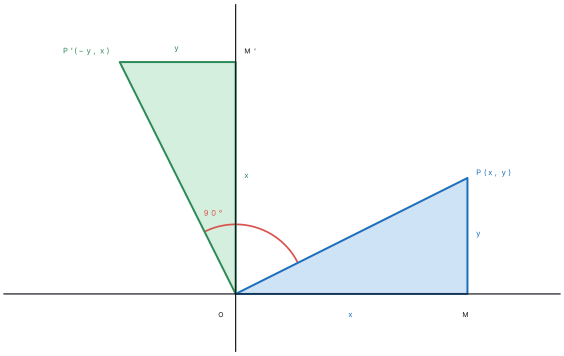
Take P(x,y) in the first quadrant and drop the perpendicular PM to the x-axis, so OM=x and MP=y. A quarter turn anticlockwise sends the x-axis onto the y-axis, so M goes to M'(0,x), and the segment MP, which pointed up, now points to the left. So P goes to the point y units to the left of M', which is P'(-y,x). Turning through +90^\circ twice gives (x,y)\rightarrow(-y,x)\rightarrow(-x,-y), the rule for 180^\circ; three times gives (y,-x), the rule for 270^\circ; and four times brings the point back.
| Rotation about O | Image of P(x,y) | Same as |
|---|---|---|
| +90^\circ (anticlockwise) | (-y,\ x) | -270^\circ |
| 180^\circ (either direction) | (-x,\ -y) | -180^\circ |
| +270^\circ (anticlockwise) | (y,\ -x) | -90^\circ (clockwise) |
| 360^\circ | (x,\ y) | no change |
Problem. Find the image of P(4,2) under rotation about the origin through (i) +90^\circ (ii) 180^\circ (iii) +270^\circ (iv) -90^\circ (v) 360^\circ. Check that OP does not change.
Solution. (i) (-y,x)=(-2,4). (ii) (-x,-y)=(-4,-2). (iii) (y,-x)=(2,-4). (iv) -90^\circ is the same as +270^\circ: (2,-4). (v) (4,2).
OP=\sqrt{16+4}=\sqrt{20}, and every image, such as (-2,4) or (2,-4), is also \sqrt{4+16}=\sqrt{20} from O ✓.
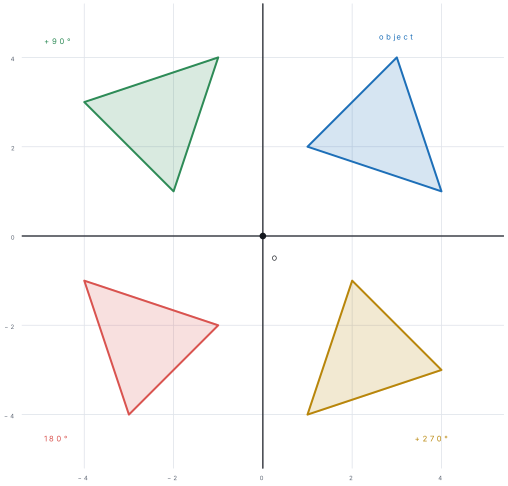
Problem. Rotate the triangle A(1,2), B(4,1), C(3,4) about the origin through +90^\circ, 180^\circ and -90^\circ.
Solution.
| Vertex | +90^\circ: (-y,x) | 180^\circ: (-x,-y) | -90^\circ: (y,-x) |
|---|---|---|---|
| A(1,2) | (-2,1) | (-1,-2) | (2,-1) |
| B(4,1) | (-1,4) | (-4,-1) | (1,-4) |
| C(3,4) | (-4,3) | (-3,-4) | (4,-3) |
The figure above shows the three images. Check: OA=\sqrt{1+4}=\sqrt{5} and the image (-2,1) is also \sqrt{4+1}=\sqrt{5} from O ✓.
Problem. Find the angle and direction of the rotation about O that maps (i) P(3,-2) to (-3,2); (ii) Q(2,5) to (5,-2); (iii) R(5,-1) to (1,5).
Solution. Compare the image with each rule.
(i) Both signs changed: (-x,-y), a rotation through 180^\circ.
(ii) (5,-2)=(y,-x) for Q(2,5): a rotation through +270^\circ, i.e. 90^\circ clockwise.
(iii) For R(5,-1), (-y,x)=(1,5): a rotation through +90^\circ (anticlockwise).
+90^\circ gives (-y,x) and -90^\circ gives (y,-x): in both the coordinates swap, but the minus sign goes in different places. Check the quadrant: turning (4,2) in quadrant I anticlockwise by a quarter turn must land in quadrant II, where x is negative and y positive, so (-2,4) is right and (2,-4) is wrong.
9.4 Translation by a vector
A translation slides every point of a figure the same distance in the same direction. Nothing turns and nothing flips, so a translation is isometric and keeps orientation. A translation is described by a vector T=\binom{a}{b}: move a units horizontally (right if a>0, left if a<0) and b units vertically (up if b>0, down if b<0).
The vector \overrightarrow{PP'} is the same, \binom{a}{b}, for every point of the figure. This is why a translation is the transformation most closely tied to vectors.
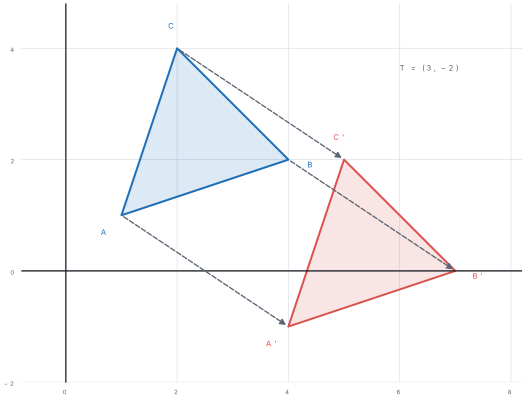
Problem. Translate the triangle A(1,1), B(4,2), C(2,4) by T=\binom{3}{-2}, and show that AB and A'B' are equal and parallel.
Solution. Add 3 to every x and -2 to every y: A'(4,-1), B'(7,0), C'(5,2).
\overrightarrow{AB}=\binom{3}{1} and \overrightarrow{A'B'}=\binom{7-4}{0+1}=\binom{3}{1}. The vectors are equal, so AB and A'B' are equal in length and parallel.
Problem. A translation maps P(2,-1) to P'(5,3). Find the translation vector and the image of Q(-1,2) under the same translation.
Solution. T=\overrightarrow{PP'}=\binom{5-2}{3+1}=\binom{3}{4}. Then Q'=(-1+3,\ 2+4)=(2,6).
Problem. (i) The image of a point under translation by \binom{-2}{5} is (4,-3). Find the point. (ii) A figure is translated by \binom{2}{1} and then by \binom{-5}{3}. Find the single translation that does the same job, and the translation that brings the figure back.
Solution. (i) Undo the translation by subtracting the vector: (4+2,\ -3-5)=(6,-8). Check: (6-2,\ -8+5)=(4,-3) ✓.
(ii) Two slides add like vectors: \binom{2}{1}+\binom{-5}{3}=\binom{-3}{4}. The translation back is the negative vector \binom{3}{-4}.
Undoing a transformation
To find an object when its image is known, apply the inverse transformation, the one that undoes the first.
| Transformation | Its inverse |
|---|---|
| Reflection in the x-axis (or the y-axis) | the same reflection: reflecting twice gives back the object |
| Rotation through +90^\circ about O | rotation through -90^\circ (that is, +270^\circ) |
| Rotation through 180^\circ about O | the same rotation |
| Translation by \binom{a}{b} | translation by \binom{-a}{-b} |
For example, if a rotation through +90^\circ about O gives the image (-1,6), the object is found with the -90^\circ rule (y,-x): it is (6,1). Check: (6,1)\rightarrow(-1,6) under (-y,x) ✓.
All the rules together
| Transformation | Image of P(x,y) | Isometric? |
|---|---|---|
| Reflection in the x-axis | (x,-y) | yes |
| Reflection in the y-axis | (-x,y) | yes |
| Rotation +90^\circ about O | (-y,x) | yes |
| Rotation 180^\circ about O | (-x,-y) | yes |
| Rotation +270^\circ (=-90^\circ) about O | (y,-x) | yes |
| Rotation 360^\circ about O | (x,y) | yes |
| Translation by \binom{a}{b} | (x+a,\ y+b) | yes |
| Enlargement, scale factor k, centre O | (kx,\ ky) | no, unless k=\pm1 |
Problem. The point P(3,2) is reflected in the y-axis to P_1; P_1 is rotated through +90^\circ about O to P_2; and P_2 is translated by \binom{1}{-4} to P_3. Find P_1, P_2, P_3 and the distance PP_3.
Solution. P_1=(-3,2). P_2: apply (-y,x) to (-3,2), giving (-2,-3). P_3=(-2+1,\ -3-4)=(-1,-7).
The order matters: doing the same three steps in a different order generally ends at a different point.
In a graph question, write the rule at the top, transform each vertex in a small table, plot the image with the dashed labels A', B', C', and finally check one vertex by eye: is it the right distance from the mirror, the right quarter turn, the right slide? A single wrong sign shows up immediately on the graph.
Work in pairs on graph paper. Player 1 draws a scalene triangle in the first quadrant and secretly chooses one transformation from this chapter (a reflection in an axis, a rotation about O, or a translation). Player 1 draws only the image. Player 2 must name the transformation exactly (for example "rotation through -90^\circ about O" or "translation by \binom{-4}{1}") and justify it from the coordinates. Swap roles. After four rounds, try a chain of two transformations and see whether your partner can find a single transformation that does the same job.
Chapter summary
- A transformation maps every point P of an object to a point P' of the image.
- Isometric transformations keep all lengths: reflection, rotation and translation give congruent images. Non-isometric ones, such as enlargement, change lengths and give similar images.
- Reflection reverses orientation; rotation and translation keep it. Points on the mirror line, and the centre of a rotation, are invariant.
- Reflection in the x-axis: (x,y)\rightarrow(x,-y); in the y-axis: (x,y)\rightarrow(-x,y). Two reflections, one in each axis, make a rotation of 180^\circ.
- Rotation about O: +90^\circ\rightarrow(-y,x), 180^\circ\rightarrow(-x,-y), +270^\circ (or -90^\circ) \rightarrow(y,-x), 360^\circ\rightarrow(x,y); distances from O are unchanged.
- Translation by \binom{a}{b}: (x,y)\rightarrow(x+a,y+b); the vector \overrightarrow{PP'} is the same for every point; two translations add as vectors.
- To find an object from its image, apply the reverse transformation.
Practice questions
Group A — Objective (1 mark each)
- Which of these transformations is non-isometric? [1]areflectionbrotationctranslationdenlargement
- The image of (3,-5) after reflection in the x-axis is [1]a(3,5)b(-3,-5)c(-3,5)d(-5,3)
- The image of (-2,7) after reflection in the y-axis is [1]a(2,7)b(-2,-7)c(2,-7)d(7,-2)
- Under a rotation of +90^\circ about the origin, (x,y) maps to [1]a(y,-x)b(-y,x)c(-x,-y)d(y,x)
- The image of (4,1) under rotation through 180^\circ about the origin is [1]a(-4,-1)b(1,4)c(-1,4)d(4,-1)
- A rotation of 270^\circ anticlockwise is the same as a rotation of [1]a90^\circ anticlockwiseb90^\circ clockwisec180^\circd360^\circ
- The image of (2,3) under rotation through 360^\circ about the origin is [1]a(-2,-3)b(3,2)c(2,3)d(-3,2)
- Translation by \binom{2}{-3} maps (1,4) to [1]a(3,1)b(-1,7)c(3,7)d(2,-12)
- If P(2,5) is translated to P'(6,3), the translation vector is [1]a\binom{4}{-2}b\binom{-4}{2}c\binom{8}{8}d\binom{4}{2}
- Which point is unchanged by reflection in the x-axis? [1]a(0,3)b(3,0)c(3,3)d(-3,3)
- Reflection in the x-axis followed by reflection in the y-axis is the same as [1]arotation through 90^\circbrotation through 180^\circca translationdreflection in the x-axis
- Under an isometric transformation the image is always [1]alarger than the objectbsmaller than the objectccongruent to the objectda single point
Answers to Group A
1. (d) — enlargement changes lengths.
2. (a) — the sign of y changes.
3. (a) — the sign of x changes.
4. (b) — the coordinates swap and the new x is negative.
5. (a) — both signs change.
6. (b) — 270^\circ anticlockwise leaves the figure where 90^\circ clockwise would.
7. (c) — a full turn changes nothing.
8. (a) — (1+2,\ 4-3).
9. (a) — \binom{6-2}{3-5}.
10. (b) — it lies on the mirror line.
11. (b) — (x,y)\rightarrow(x,-y)\rightarrow(-x,-y).
12. (c) — distances are kept, so shape and size are kept.
Group B — Short answer (2 marks each)
- Define isometric and non-isometric transformations, with one example of each. [2]
- Find the image of the triangle A(1,2), B(3,5), C(4,1) after reflection in the x-axis. [2]
- After reflection in the y-axis, the image of a point is (-4,6). Find the point. [2]
- Find the image of P(-3,2) under rotation about the origin through +90^\circ and through -90^\circ. [2]
- A rotation about the origin maps P(5,-1) to P'(1,5). Find the angle and direction of the rotation. [2]
- Find the image of (2,-3) under translation by \binom{-4}{6}. [2]
- Find the translation vector that maps A(3,1) to A'(-1,4). [2]
- Find the image of (-2,-5) under rotation through 180^\circ about the origin, and show that the same image comes from reflection in the x-axis followed by reflection in the y-axis. [2]
- A translation maps (1,2) to (4,-1). Find the image of (-3,5) under the same translation. [2]
- Show that reflection in the y-axis keeps the length of AB, where A(1,3) and B(4,7). [2]
Answers to Group B
1. An isometric transformation keeps the distance between every two points, so the image is congruent to the object; example: rotation. A non-isometric transformation changes distances, so the image differs in size; example: enlargement with scale factor 2.
2. (x,y)\rightarrow(x,-y): A'(1,-2), B'(3,-5), C'(4,-1).
3. Reflect the image back in the y-axis: the point is (4,6).
4. +90^\circ: (-y,x)=(-2,-3). -90^\circ: (y,-x)=(2,3).
5. For P(5,-1), (-y,x)=(1,5), which is the image. So it is a rotation through +90^\circ, anticlockwise.
6. (2-4,\ -3+6)=(-2,3).
7. \binom{-1-3}{4-1}=\binom{-4}{3}.
8. 180^\circ: (2,5). In the x-axis: (-2,5); then in the y-axis: (2,5). The same image.
9. T=\binom{3}{-3}, so (-3+3,\ 5-3)=(0,2).
10. AB=\sqrt{9+16}=5. The images are A'(-1,3) and B'(-4,7), and A'B'=\sqrt{(-4+1)^2+(7-3)^2}=\sqrt{9+16}=5. The length is unchanged.
Group C — Long answer (4 marks each)
- The triangle ABC has vertices A(2,1), B(5,2) and C(3,4). (i) Find its image after reflection in the x-axis. (ii) Find its image after reflection in the y-axis. (iii) Draw all three triangles on one graph. (iv) Show that AB=A'B'. [4]
- Rotate the triangle P(1,2), Q(4,1), R(3,4) about the origin through (i) +90^\circ (ii) 180^\circ (iii) -90^\circ. Write the images and verify that OP=OP' for the rotation in (i). [4]
- The triangle A(1,1), B(4,2), C(2,4) is translated by \binom{3}{-2}. (i) Find the image. (ii) Plot both triangles. (iii) Show that AB and A'B' are equal and parallel. (iv) Which single translation brings the image back to the object? [4]
- The point P(3,2) is reflected in the y-axis to P_1; P_1 is rotated through +90^\circ about the origin to P_2; P_2 is translated by \binom{1}{-4} to P_3. Find P_1, P_2, P_3 and the distance PP_3. [4]
- A triangle with vertices (1,1), (3,1), (1,2) has the image (2,2), (6,2), (2,4). (i) Compare the lengths of corresponding sides and the areas. (ii) Is the transformation isometric? (iii) Name it and write its rule. [4]
Answers to Group C
1. (i) A'(2,-1), B'(5,-2), C'(3,-4). (ii) A''(-2,1), B''(-5,2), C''(-3,4). (iii) The object is in quadrant I, the first image in quadrant IV and the second in quadrant II, as in the reflection figure of section 9.2. (iv) AB=\sqrt{3^2+1^2}=\sqrt{10} and A'B'=\sqrt{3^2+(-1)^2}=\sqrt{10}, so AB=A'B'.
2. (i) (-y,x): P'(-2,1), Q'(-1,4), R'(-4,3). (ii) (-x,-y): (-1,-2), (-4,-1), (-3,-4). (iii) (y,-x): (2,-1), (1,-4), (4,-3). OP=\sqrt{1+4}=\sqrt{5} and OP'=\sqrt{4+1}=\sqrt{5}, so OP=OP'.
3. (i) A'(4,-1), B'(7,0), C'(5,2). (ii) Plot both triangles and join each vertex to its image with an arrow; the three arrows are parallel and equal. (iii) \overrightarrow{AB}=\binom{3}{1} and \overrightarrow{A'B'}=\binom{3}{1}: equal vectors, so AB and A'B' are equal and parallel. (iv) The translation by \binom{-3}{2}.
4. P_1=(-3,2); P_2=(-2,-3) (applying (-y,x)); P_3=(-1,-7). PP_3=\sqrt{4^2+9^2}=\sqrt{97}\approx9.85 units.
5. (i) Object: base 3-1=2 and height 2-1=1, area \frac{1}{2}\times2\times1=1. Image: base 6-2=4 and height 4-2=2, area \frac{1}{2}\times4\times2=4. Every length is doubled and the area is multiplied by 4. (ii) No: lengths change, so it is non-isometric; the image is similar but not congruent. (iii) An enlargement with centre O and scale factor 2: (x,y)\rightarrow(2x,2y).
Practise more: Optional Mathematics question bank