Question bank · 17 min read
Science and Technology: Unit-wise Objective Question Bank
Group A of the Science paper is ten one-mark items, and they are the fastest ten marks in the whole examination. They test a definition, a unit, a name, a one-step substitution or a misconception planted as a distractor. This chapter drills all eleven units of the Grade 8 textbook in order. Each section opens with a facts line — what the one-mark items keep returning to — then gives eight items, then a key in which every answer carries its reason.
Do one section immediately after you read that chapter in the notes, and again in the last week. Cover the key with a sheet of paper. Mark yourself honestly: a half-remembered answer is a wrong answer in the hall.
Every item is an original practice question written to the CDC pattern. Values of constants are stated in the stem where a calculation needs them.
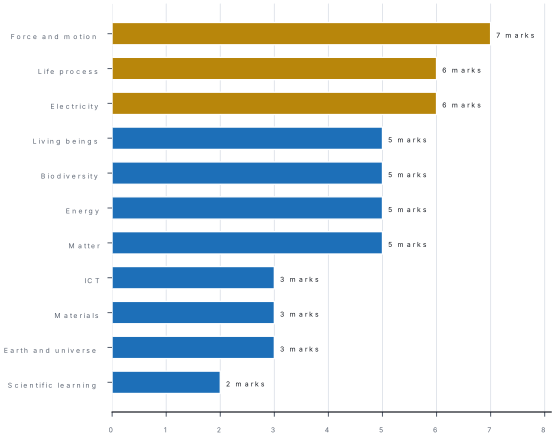
2.1 Scientific Learning
Facts. Steps of the scientific method: observation → problem → hypothesis → experiment → analysis → conclusion. A hypothesis is a testable guess. SI base units: metre (length), kilogram (mass), second (time), kelvin (temperature), ampere (current). Volume of an irregular solid is found by water displacement.
- A tentative, testable explanation of an observation is called a [1]alawbtheorychypothesisdconclusion
- The SI base unit of temperature is the [1]adegree Celsiusbkelvincfahrenheitdjoule
- The variable the experimenter deliberately changes is the [1]adependent variablebindependent variableccontrolled variabledconstant
- Which instrument is used to find the volume of a small irregular stone? [1]aspring balancebmeasuring cylindercbeam balancedvernier scale
- A length of 3.5 km in metres is [1]a35 mb350 mc3500 md35000 m
- In an experiment on plant growth with light, the amount of water given to every pot is kept the same. Water here is a [1]adependent variablebindependent variableccontrolled variabledhypothesis
- The last step of the scientific method is [1]ahypothesisbexperimentcanalysis of datadconclusion
- Which of the following is not a quality of a good scientist? [1]acuriositybhonesty in recording datacaccepting claims without evidencedpatience
Answers
1. (c) — a hypothesis can be tested; a theory is already well tested.
2. (b) — the kelvin is the SI base unit; the degree Celsius is derived.
3. (b) — the independent variable is changed by the experimenter.
4. (b) — the rise in water level gives the displaced volume.
5. (c) — 3.5\times1000=3500 m.
6. (c) — a quantity deliberately held constant is a controlled variable.
7. (d) — the conclusion judges the hypothesis against the data.
8. (c) — science accepts a claim only with evidence.
2.2 Information and Communication Technology
Facts. Hardware is physical, software is the set of instructions. Input: keyboard, mouse, scanner, microphone. Output: monitor, printer, speaker. The CPU has the ALU and the control unit. RAM is volatile, ROM is not. 1 KB = 1024 bytes. A search engine (Google) finds pages; a browser (Chrome, Firefox) displays them. A strong password is long and mixed.
- Which of the following is an input device? [1]aprinterbmonitorcscannerdspeaker
- The memory whose contents are lost when the power goes off is [1]aROMbRAMchard diskdpen drive
- One kilobyte equals [1]a1000 bitsb1024 bytesc100 bytesd1024 bits
- The part of the CPU that performs calculations is the [1]acontrol unitbarithmetic and logic unitcregisterdcache
- Which one is a web browser? [1]aGooglebFirefoxcWindowsdExcel
- A collection of related data stored so it can be searched is a [1]adatabasebspreadsheetcbrowserdprotocol
- The safest of these passwords is [1]a123456byour own namecSa#9rLm2!qddpassword
- Sharing another person's photograph online without permission is [1]agood digital citizenshipba violation of privacycnecessary for a projectdharmless
Answers
1. (c) — a scanner feeds data in; the other three put data out.
2. (b) — RAM is volatile; ROM and storage keep their contents.
3. (b) — 1 KB = 2^{10} = 1024 bytes.
4. (b) — the ALU does arithmetic and logic; the control unit directs.
5. (b) — Firefox is a browser; Google is a search engine.
6. (a) — a database is organised for storage and retrieval.
7. (c) — long, mixed-case, with digits and symbols, and not guessable.
8. (b) — consent is required; this is a privacy violation.
2.3 Living Beings and Their Structure
Facts. Cell: discovered by Robert Hooke (1665) in cork. Plant cells have a cell wall, large vacuole and chloroplasts; animal cells do not have a cell wall. Mitochondrion is the powerhouse; ribosome makes protein; nucleus controls activity. Tissue → organ → organ system. Five kingdoms (Whittaker, 1969): Monera, Protista, Fungi, Plantae, Animalia. Binomial nomenclature: Linnaeus.
- The cell was discovered by [1]aRobert HookebLeeuwenhoekcSchwanndWhittaker
- Which structure is present in a plant cell but absent in an animal cell? [1]anucleusbcell wallccytoplasmdmitochondrion
- The powerhouse of the cell is the [1]aribosomebnucleuscmitochondriondvacuole
- Organisms whose cells have no true nucleus belong to the kingdom [1]aProtistabMoneracFungidPlantae
- The cell wall of a fungus is made of [1]acellulosebchitinclignindpeptidoglycan
- In Oryza sativa, the word sativa denotes the [1]agenusbfamilycspeciesdorder
- A group of similar cells performing the same function is a [1]atissueborgancsystemdorganism
- Which one is a unicellular eukaryote? [1]abacteriumbAmoebacmushroomdfern
Answers
1. (a) — Hooke saw empty cork cells in 1665.
2. (b) — the rigid cellulose cell wall is a plant feature.
3. (c) — respiration releasing energy occurs in mitochondria.
4. (b) — Monera are prokaryotes.
5. (b) — chitin; cellulose belongs to plants.
6. (c) — the second word of a binomial is the species.
7. (a) — similar cells with one function form a tissue.
8. (b) — Amoeba is a single-celled protist with a true nucleus.
2.4 Biodiversity and Environment
Facts. Biodiversity = variety of life. Nepal occupies about 0.1 % of the world's land but has about 3.2 % of its known plant species and about 1.1 % of its animal species. Ecosystem = biotic + abiotic components. Food chain: producer → herbivore → carnivore. Energy flows one way; only about 10 % passes to the next level. Causes of biodiversity loss: habitat destruction, poaching, pollution, invasive species, climate change.
- In a food chain, green plants are [1]aconsumersbproducerscdecomposersdparasites
- Which of these is an abiotic component of an ecosystem? [1]aearthwormbfunguscsunlightdgrass
- The approximate share of energy that passes from one trophic level to the next is [1]a1 %b10 %c50 %d90 %
- Organisms that break down dead bodies and return nutrients to the soil are [1]aproducersbherbivorescdecomposersdcarnivores
- Which is not a direct cause of biodiversity loss? [1]ahabitat destructionbpoachingcafforestationdinvasive species
- A one-horned rhinoceros is best conserved in [1]aChitwan National ParkbShey Phoksundo National ParkcSagarmatha National ParkdRara National Park
- In the chain grass → grasshopper → frog → snake, the frog is a [1]aproducerbprimary consumercsecondary consumerddecomposer
- Mikania (lahare banmara) spreading in Nepal's forests is an example of [1]aan endemic speciesban invasive speciesca keystone speciesda producer at risk
Answers
1. (b) — they make food by photosynthesis.
2. (c) — sunlight is non-living.
3. (b) — roughly 10 %; the rest is lost mainly as heat.
4. (c) — decomposers recycle nutrients.
5. (c) — afforestation restores habitat.
6. (a) — Chitwan holds Nepal's largest rhinoceros population.
7. (c) — it eats the primary consumer, the grasshopper.
8. (b) — an introduced species spreading at the cost of native ones.
2.5 Life Process
Facts. Photosynthesis needs carbon dioxide, water, chlorophyll and sunlight; it makes glucose and oxygen. Respiration releases energy from food; aerobic respiration needs oxygen, anaerobic does not. Transpiration is loss of water as vapour, mainly through stomata. Digestion in humans: mouth → oesophagus → stomach → small intestine → large intestine. Bile from the liver emulsifies fat. Blood: red cells carry oxygen (haemoglobin), white cells defend, platelets clot.
- The raw materials of photosynthesis are [1]aglucose and oxygenbcarbon dioxide and watercoxygen and waterdglucose and carbon dioxide
- Loss of water as vapour from the aerial parts of a plant is [1]arespirationbtranspirationcguttationdtranslocation
- Most absorption of digested food takes place in the [1]astomachbsmall intestineclarge intestinedoesophagus
- The pigment that carries oxygen in blood is [1]achlorophyllbmelaninchaemoglobindinsulin
- Anaerobic respiration in yeast produces carbon dioxide and [1]alactic acidbethanolcglucosedwater only
- Bile is produced by the [1]apancreasblivercgall bladderdstomach
- The pores on a leaf through which gases are exchanged are [1]alenticelsbstomatachydathodesdveins
- During heavy exercise, muscle cramp is caused by the build-up of [1]aethanolblactic acidcglucosedurea
Answers
1. (b) — glucose and oxygen are the products, not the raw materials.
2. (b) — transpiration, mainly through stomata.
3. (b) — the villi of the small intestine absorb nutrients.
4. (c) — haemoglobin in red blood cells.
5. (b) — yeast makes ethanol and carbon dioxide (fermentation).
6. (b) — the liver makes bile; the gall bladder stores it.
7. (b) — stomata, guarded by guard cells.
8. (b) — anaerobic respiration in muscle forms lactic acid.
2.6 Force and Motion
Facts. Speed = distance ÷ time; velocity is speed with direction; acceleration = change in velocity ÷ time. Newton's first law: a body keeps its state unless a net force acts (inertia). Second law: F = ma. Third law: equal and opposite reaction. Weight W = mg; g = 9.8 m/s² (often taken as 10 m/s²). Mass is in kilograms and does not change with place; weight is a force in newtons and does.
- The SI unit of force is the [1]akilogrambnewtoncjouledpascal
- A body of mass 5 kg is acted on by a force of 20 N. Its acceleration is [1]a100 m/s²b25 m/s²c4 m/s²d0.25 m/s²
- The weight of a 10 kg body where g = 9.8 m/s² is [1]a10 Nb98 Nc9.8 Nd980 N
- A passenger falls forward when a moving bus stops suddenly because of [1]ainertia of motionbinertia of restcfrictiondgravity
- A car covers 150 km in 3 hours. Its average speed is [1]a30 km/hb45 km/hc50 km/hd450 km/h
- A rocket moves forward because the exhaust gases are pushed backward. This illustrates [1]athe first lawbthe second lawcthe third lawdthe law of gravitation
- Which quantity does not change when a body is taken from the earth to the moon? [1]aweightbmasscacceleration due to gravitydgravitational force on it
- A body moving with uniform velocity has acceleration [1]auniform and positivebzerocincreasingdnegative
Answers
1. (b) — the newton.
2. (c) — a = F/m = 20/5 = 4 m/s².
3. (b) — W = mg = 10\times9.8 = 98 N.
4. (a) — the body tends to continue in motion.
5. (c) — 150/3 = 50 km/h.
6. (c) — action and reaction are equal and opposite.
7. (b) — mass is a constant quantity of matter.
8. (b) — uniform velocity means no change in velocity.
2.7 Energy in Daily Life
Facts. Energy forms: mechanical (kinetic and potential), heat, light, sound, electrical, chemical, nuclear. Renewable: solar, hydro, wind, biogas; non-renewable: coal, petroleum, natural gas. Energy is neither created nor destroyed (conservation). Nepal's economically feasible hydropower is about 42,000 MW. Biogas is mainly methane. Heat travels by conduction, convection and radiation.
- The energy stored in a stretched rubber band is [1]akineticbpotentialcheatdchemical
- Which of these is a renewable source of energy? [1]acoalbpetroleumcbiogasdnatural gas
- The main constituent of biogas is [1]acarbon dioxidebmethanechydrogendbutane
- Heat transfer through empty space happens by [1]aconductionbconvectioncradiationdall three
- In a hydropower plant, the energy change is [1]aelectrical → mechanical → potentialbpotential → kinetic → electricalcchemical → heat → electricaldkinetic → chemical → electrical
- Economically feasible hydropower potential of Nepal is about [1]a4,200 MWb42,000 MWc83,000 MWd100,000 MW
- The energy conversion in a torch cell lighting a bulb is [1]achemical → electrical → lightblight → electrical → chemicalcelectrical → chemical → heatdheat → light → electrical
- Which is not a way of conserving energy at home? [1]ausing LED lampsbswitching off idle appliancescleaving the refrigerator door opendcooking in a pressure cooker
Answers
1. (b) — elastic potential energy.
2. (c) — biogas is produced continuously from waste.
3. (b) — methane, about 50–70 %.
4. (c) — radiation needs no medium.
5. (b) — stored water → flowing water → generator.
6. (b) — about 42,000 MW of roughly 83,000 MW theoretical.
7. (a) — the cell's chemical energy becomes electrical, then light.
8. (c) — it wastes energy by letting cold air out.
2.8 Electricity and Magnetism
Facts. Like charges repel, unlike attract. Current is the flow of charge, in amperes; I = Q/t. Ohm's law: V = IR. In series, current is the same and resistances add; in parallel, voltage is the same. Power P = VI; energy in units (kWh) = kW × hours. A magnet has two poles; like poles repel. An electromagnet is a coil with a soft-iron core; its strength grows with current and number of turns. Earthing protects from shock; a fuse protects from overload.
- The SI unit of electric current is the [1]avoltbamperecohmdwatt
- By Ohm's law, the current through a 20 Ω resistor across 100 V is [1]a2 Ab5 Ac20 Ad0.2 A
- Two 6 Ω resistors joined in series give a total resistance of [1]a3 Ωb6 Ωc12 Ωd36 Ω
- A 100 W bulb burning for 10 hours consumes [1]a0.1 unitb1 unitc10 unitsd100 units
- The strength of an electromagnet can be increased by [1]adecreasing the currentbincreasing the number of turnscusing a steel core instead of soft irondshortening the wire
- A fuse is connected in a circuit to [1]aincrease the currentbbreak the circuit on overloadcstore chargedmeasure voltage
- The magnetic field of a bar magnet is strongest [1]aat the middlebat the polesceverywhere equaldoutside the field lines
- Earthing a metal appliance body is done to [1]asave electricitybcarry leakage current safely to the groundcincrease the voltagedreduce the resistance
Answers
1. (b) — the ampere.
2. (b) — I = V/R = 100/20 = 5 A.
3. (c) — in series, R = 6+6 = 12 Ω.
4. (b) — 0.1\ \text{kW}\times10\ \text{h} = 1 kWh = 1 unit.
5. (b) — more turns (and more current, soft-iron core) strengthen it.
6. (b) — the fuse wire melts and breaks the circuit.
7. (b) — field lines are most concentrated at the poles.
8. (b) — earthing gives leakage current a safe path.
2.9 Matter
Facts. Matter exists as solid, liquid and gas; change of state is physical. Atom: protons and neutrons in the nucleus, electrons outside. Atomic number = number of protons; mass number = protons + neutrons. Element → one kind of atom; compound → fixed ratio, chemical bond; mixture → any ratio, separable physically. Acids turn blue litmus red; bases turn red litmus blue; pH below 7 is acidic, 7 neutral, above 7 basic. Metals conduct; non-metals (except graphite) do not.
- The particle that carries no charge is the [1]aprotonbelectroncneutrondion
- An atom has 11 protons and 12 neutrons. Its mass number is [1]a11b12c23d1
- Which of these is a compound? [1]aairbwatercbrassdsoil
- A solution of pH 3 is [1]astrongly basicbweakly basiccacidicdneutral
- A base turns red litmus [1]abluebcolourlesscyellowdno change
- Which non-metal conducts electricity? [1]asulphurbgraphitecphosphorusdiodine
- Sublimation is the change from [1]asolid to liquidbliquid to gascsolid directly to gasdgas to liquid
- Common salt can be recovered from salt water by [1]afiltrationbevaporationcdecantationdmagnetic separation
Answers
1. (c) — the neutron is neutral.
2. (c) — 11 + 12 = 23.
3. (b) — water has a fixed 2:1 ratio of hydrogen to oxygen, chemically bonded.
4. (c) — pH below 7 is acidic.
5. (a) — bases turn red litmus blue.
6. (b) — graphite, because of its free electrons.
7. (c) — solid to gas without melting, as in camphor.
8. (b) — the water evaporates and leaves the salt.
2.10 Materials Used in Daily Life
Facts. Metals: lustrous, malleable, ductile, good conductors. Alloys: brass (copper + zinc), bronze (copper + tin), steel (iron + carbon), stainless steel (iron, chromium, nickel). Rusting needs oxygen and moisture; prevented by painting, oiling, galvanising. Soap and detergent remove dirt because one end of the molecule holds water and the other holds oil. Plastics are polymers; most are non-biodegradable. Cement, bricks, glass, paper and fertiliser are all manufactured materials.
- Brass is an alloy of copper and [1]atinbzinccnickeldcarbon
- Rusting of iron requires [1]aoxygen onlybmoisture onlycboth oxygen and moisturedcarbon dioxide and moisture
- Coating iron with zinc to prevent rusting is called [1]agalvanisingbelectroplating with tincannealingdtempering
- Which property makes copper suitable for electric wires? [1]abrittlenessblow densitychigh electrical conductivitydmagnetism
- Most plastics are harmful to the environment because they are [1]aexpensivebnon-biodegradablecheavydgood conductors
- The main raw material of cement is [1]alimestonebbauxitecgypsum onlydsilica sand only
- Stainless steel resists rusting because of the presence of [1]acarbonbchromiumcleaddzinc
- Detergent cleans greasy cloth because its molecule has [1]aonly a water-loving endbonly an oil-loving endca water-loving and an oil-loving enddneither end
Answers
1. (b) — copper and zinc.
2. (c) — both are needed; dry air alone does not rust iron.
3. (a) — galvanising is a zinc coating.
4. (c) — copper conducts electricity very well and is ductile.
5. (b) — they persist in soil and water for centuries.
6. (a) — limestone, with clay and gypsum.
7. (b) — chromium forms a protective oxide layer.
8. (c) — one end holds water, the other holds grease.
2.11 The Earth and Universe
Facts. The solar system has eight planets; Mercury is nearest the sun, Jupiter is the largest. The earth rotates in about 24 hours (day and night) and revolves in about 365¼ days (seasons). The earth's axis is tilted about 23.5°. The moon is the earth's natural satellite; a solar eclipse happens at new moon when the moon comes between the sun and the earth, and a lunar eclipse at full moon when the earth comes between them. Layers of the earth: crust, mantle, core. Nepal lies in a seismically active zone where the Indian plate pushes under the Eurasian plate.
- The largest planet of the solar system is [1]aEarthbSaturncJupiterdNeptune
- Day and night are caused by the earth's [1]arevolutionbrotationctiltdorbit shape
- The tilt of the earth's axis is about [1]a0°b15°c23.5°d45°
- A solar eclipse occurs when [1]athe earth is between the sun and the moonbthe moon is between the sun and the earthcthe sun is between the earth and the moondthe moon is full
- The outermost layer of the earth is the [1]acorebmantleccrustdatmosphere
- Earthquakes are frequent in Nepal because [1]ait is landlockedbthe Indian plate pushes under the Eurasian platecit has many riversdit has high rainfall
- A natural satellite of the earth is [1]athe sunbthe mooncMarsda communication satellite
- Seasons on the earth are caused mainly by [1]arotationbthe axial tilt together with revolutioncdistance from the moondchanging size of the sun
Answers
1. (c) — Jupiter.
2. (b) — rotation about its own axis, in about 24 hours.
3. (c) — about 23.5° to the orbital plane.
4. (b) — the moon blocks sunlight, at new moon.
5. (c) — the crust; the atmosphere is not a layer of the solid earth.
6. (b) — the collision of the two plates builds up strain.
7. (b) — the moon.
8. (b) — the tilt changes how steeply sunlight falls through the year.
Across the eleven units above there are 88 items. If you can finish them in 45 minutes with 80 or more correct, Group A of your Science paper is secure. Below that, mark the units where you lost marks and re-read only those chapters — not the whole book.