Unit 7 · Science and Technology · 29 min read
Energy in Daily Life
What the syllabus asks for 7
- heat and temperature; thermometers and their scales
- thermal expansion of solids, liquids and gases
- transfer of heat: conduction, convection and radiation
- specific heat capacity and its daily applications
- light: reflection and refraction
- lenses and images; dispersion of light; the human eye and optical instruments
- energy sources, transformation and conservation
We read, write, carry loads and work in the fields with the energy from our food. Vehicles run on petrol or diesel, and electrical appliances run on electricity. Energy is the capacity to do work. Its SI unit is the joule (J); the calorie is an older unit, and 1 calorie ≈ 4.2 J. Energy exists in many forms — mechanical, heat, light, sound, magnetic, electrical, chemical and nuclear — and changes from one form to another. This unit, following the CDC textbook, studies heat and its transfer, light and spherical mirrors, and sound, together with the other topics of the syllabus (thermometers, expansion, specific heat capacity, refraction, lenses and energy sources).
Explain conduction, convection and radiation with examples and applications; tell mechanical from electromagnetic waves; describe a thermos flask and the greenhouse effect; define the terms of spherical mirrors, give the rules of reflection and the images formed by a concave mirror; define frequency, wavelength, period and amplitude, use v=f\lambda and I=\frac{P}{A}; classify sound as infrasonic, audible or ultrasonic; and explain the causes, effects and control of noise pollution.
7.1 Heat and temperature; thermometers and their scales
Heat is a form of energy that gives us the feeling of warmth. It always flows from a body at a higher temperature to a body at a lower temperature. When we touch hot water, heat flows into our skin and we feel hot; when we touch ice, heat flows out of our skin and we feel cold.
Temperature is the degree of hotness or coldness of a body. It is measured with a thermometer. Heat is energy (joule); temperature is a measure of how hot a body is (°C, °F or kelvin). A bucket of warm water has much more heat than a red-hot pin, although the pin's temperature is higher.
| Scale | Ice point | Steam point | Normal body temperature |
|---|---|---|---|
| Celsius (°C) | 0 °C | 100 °C | 37 °C |
| Fahrenheit (°F) | 32 °F | 212 °F | 98.6 °F |
| Kelvin (K), SI | 273 K | 373 K | 310 K |
Conversions: F=\frac{9}{5}C+32 and K=C+273. A clinical thermometer reads 35–42 °C and has a kink that stops the mercury falling back; a laboratory thermometer reads about −10 °C to 110 °C.
Problem. Convert 37 °C into °F and K.
Solution. F=\frac{9}{5}\times37+32=66.6+32=98.6 °F. K=37+273=310 K.
7.2 Thermal expansion of solids, liquids and gases
Most substances expand when heated and contract when cooled, because their particles vibrate faster and move a little farther apart. Gases expand most, liquids less, solids least.
| State | Examples of expansion |
|---|---|
| Solid | gaps are left between rails and in bridges; electric wires sag in summer; a tight metal lid is loosened by putting it in hot water |
| Liquid | mercury or alcohol rises in a thermometer; a bottle filled to the brim with oil overflows in the sun |
| Gas | a balloon or football left in the sun becomes tight; tyres are not pumped too hard in summer |
Water contracts when warmed from 0 °C to 4 °C and expands when cooled from 4 °C to 0 °C, so it is densest at 4 °C. That is why ice floats and a pond freezes only at the top, leaving water below in which fish survive.
7.3 Transfer of heat: conduction, convection and radiation
The process by which heat moves from one place or body to another is called the transmission (transfer) of heat. It happens in three ways.
7.3.1 Conduction
In Activity 7.1, pins stuck with wax on a metal rod fall one after another, starting from the heated end. The particles of the solid do not move from their places; each one vibrates more and passes heat to its neighbour, like students passing a brick along a line.
Conduction is the transfer of heat through a solid from particle to particle without the actual movement of the particles.
Good conductors let heat pass easily: iron, copper, aluminium, silver, gold. Insulators (bad conductors) do not: wood, plastic, rubber, cotton, wool, air, porcelain. Most metals are good conductors; diamond and graphite are unusual non-metals that conduct heat well.
Applications of conduction and insulation
- Cooking pots and kettles are made of metal to pass heat to the food quickly, while their handles are made of wood or plastic, which are insulators.
- Woollen clothes and blankets keep us warm: wool and the air trapped between its fibres are poor conductors, so body heat does not escape.
- Tea cups are made of porcelain, a poor conductor, so the tea stays hot and the cup can be held.
- Mud houses are cool in summer and warm in winter because mud is a poor conductor.
- Birds fluff up their feathers on cold days to trap a layer of insulating air.
7.3.2 Convection
Drop a little colour into a beaker of water and heat it from below (Activity 7.3). The coloured warm water rises, and cold water from the top comes down to take its place. Heated water becomes less dense and rises; denser cold water sinks. This circular flow is a convection current.
Convection is the transfer of heat in liquids and gases by the actual movement of the heated particles from one place to another.
Wind is caused by convection: the ground heated by the sun warms the air above it; the warm, light air rises; cooler air from nearby moves in to take its place.
Sea breeze and land breeze. Water has a higher specific heat capacity than land, so land heats and cools faster than the sea.
| Sea breeze | Land breeze |
|---|---|
| blows in the daytime | blows at night |
| land is hotter than the sea; air over land rises (low pressure) | land cools faster; the sea is warmer; air over the sea rises |
| cool air flows from sea to land | cool air flows from land to sea |
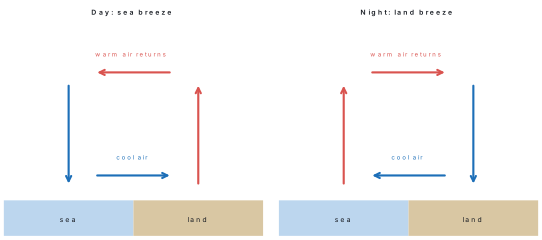
Natural (free) convection happens by itself because of density differences: boiling water, sea and land breezes, cloud formation and rain. Forced convection uses outside energy such as a fan or pump: electric fans, water heaters (geysers), air conditioners. Convection also helps to carry heat in the blood of warm-blooded animals, works in refrigerators and room heaters, and causes clouds, thunderstorms and lightning. Ventilators are made in the upper part of walls because warm, used air rises and goes out, while fresh cool air comes in through doors and windows.
7.3.3 Radiation
Space between the sun and the earth has no medium, so the sun's heat cannot come by conduction or convection. It comes by radiation.
Radiation is the transfer of heat in the form of (electromagnetic) waves without any material medium. It can take place even through a vacuum, at the speed of light.
Colour and radiation (Activity 7.6). Three boxes — black, white and golden — kept in the sun with thermometers: the black box becomes hottest. Dark, dull surfaces are good absorbers and good emitters of heat radiation; white and shiny surfaces are poor absorbers and emitters. So white clothes are worn in summer, houses in the Terai are painted white, and the inside of a solar cooker and the bottom of cooking pots are black.
Applications: we feel warm near a fire; the sun heats the earth; the black grill at the back of a refrigerator radiates heat into the room; hot tea cools by radiating heat.
7.3.4 Waves: mechanical and electromagnetic
A stone thrown into a pond makes ripples that spread out while the water particles only move up and down. A wave carries energy from one place to another without carrying the medium with it.
| Mechanical wave | Electromagnetic wave |
|---|---|
| needs a material medium | needs no medium; travels through a vacuum |
| cannot travel through a vacuum | travels at 3\times10^8 m/s in a vacuum |
| loses energy in the medium; travels limited distance | travels very long distances |
| e.g. sound, water waves, waves on a rope | e.g. light, radio waves, X-rays, infrared, gamma rays |
Speed of sound: about 332 m/s in air, 1481 m/s in water and 5120 m/s in iron. Light from the sun takes about 8 minutes 20 seconds to reach the earth. Heat radiation is carried mainly by infrared waves, which our eyes cannot see.
7.3.5 The thermos flask
A thermos (vacuum) flask keeps hot liquids hot and cold liquids cold for a long time, because it stops all three ways of heat transfer.
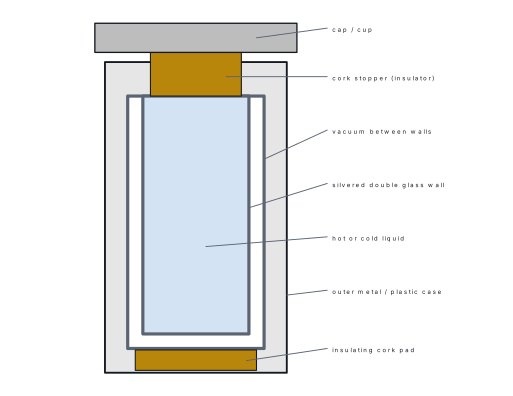
| Part | How it reduces heat transfer |
|---|---|
| double glass wall with vacuum between | vacuum has no particles, so no conduction or convection |
| silvered surfaces facing the vacuum | shiny surfaces reflect radiation back |
| cork stopper and cork pad | poor conductors; stopper also stops convection out of the mouth |
| outer case | protects the fragile glass |
7.3.6 The greenhouse and the greenhouse effect
An artificial greenhouse (plastic tunnel) is a house of glass or transparent plastic on a frame. It is used to grow off-season vegetables and nursery plants. The glass lets in the sun's short-wave radiation, but the soil and plants give out long-wave (infrared) radiation, which cannot pass out easily. The trapped heat keeps the inside warm. The roof is sloping so that more sunlight enters.
The earth's atmosphere acts in the same way. Gases such as carbon dioxide, methane, water vapour, nitrous oxide and CFCs (greenhouse gases) absorb the heat radiated by the earth and send part of it back. This warming of the earth is the greenhouse effect.
The greenhouse effect is the warming of the earth's surface because greenhouse gases in the atmosphere trap part of the heat radiated by the earth instead of letting it escape into space.
Without it, the earth's average temperature would be about −18 °C instead of about 15 °C (59 °F), and life would hardly be possible. But factories, vehicles and deforestation are adding more greenhouse gases, which trap extra heat and cause global warming.
Harmful effects of an increased greenhouse effect: rise in average temperature; changes in rainfall and the water cycle; health problems; lower farm production; melting of Himalayan snow and danger of glacial lake outburst floods (GLOF); sea-level rise that may drown low coastal land; loss of biodiversity; desertification; imbalance of ecosystems.
Uses: the natural greenhouse effect keeps the earth warm enough for life; artificial greenhouses let farmers grow off-season vegetables and protect plants from cold.
Clouds (water vapour) absorb the heat radiated by the ground and send it back, so the ground cools less than on a clear night.
7.4 Specific heat capacity and its daily applications
Different substances need different amounts of heat to warm up by the same amount.
The specific heat capacity of a substance is the amount of heat needed to raise the temperature of 1 kg of it by 1 °C (or 1 K). Its SI unit is J/kg °C. The heat needed is Q=m\,s\,\Delta t, where m is mass, s specific heat capacity and \Delta t the rise in temperature.
| Substance | Specific heat capacity (J/kg °C, approximate) |
|---|---|
| Water | 4200 |
| Ice | 2100 |
| Aluminium | 900 |
| Iron | 460 |
| Copper | 390 |
Water has a very high specific heat capacity, so it heats and cools slowly. This is why the sea is cooler than land by day and warmer by night (sea and land breezes), why hot water bags are filled with water, and why water is used in car radiators.
Problem. How much heat is needed to raise the temperature of 2 kg of water from 20 °C to 70 °C? (s=4200 J/kg °C)
Solution. \Delta t=70-20=50 °C. Q=m\,s\,\Delta t=2\times4200\times50=420\,000 J =420 kJ.
7.5 Light: reflection by plane and spherical mirrors, and refraction
Light is a form of energy that gives us the sensation of vision. When light falls on an object, part of it is absorbed, part is reflected and part may pass through.
Reflection of light is the returning of light into the same medium after it strikes a surface. Smooth, polished surfaces reflect most of the light and look shiny; rough surfaces scatter light and look dull.
A mirror reflects light and forms an image. Mirrors are plane or spherical. A spherical mirror is part of a hollow glass sphere.
7.5.1 Concave and convex mirrors
Look into a steel spoon: the inner side is concave (depressed in the middle), the back is convex (bulging out in the middle).
| Concave mirror | Convex mirror |
|---|---|
| reflecting surface curved inward (caved in) | reflecting surface bulging outward |
| converging mirror: brings parallel rays together | diverging mirror: spreads parallel rays out |
| focus is real, in front of the mirror | focus is virtual, behind the mirror |
| forms real, inverted images (and a virtual, magnified image when the object is very close) | always forms a virtual, erect, diminished image |
| torch, headlight, shaving mirror, solar cooker | rear-view mirror of vehicles, street lamps |
Terms of a spherical mirror
| Term | Meaning |
|---|---|
| Pole (P) | the centre of the reflecting surface; distances are measured from it |
| Centre of curvature (C) | centre of the sphere of which the mirror is a part |
| Radius of curvature (R) | distance from P to C |
| Principal axis | the straight line through P and C |
| Principal focus (F) | the point where rays parallel to the principal axis meet (concave) or seem to come from (convex) after reflection; F is midway between P and C |
| Focal length (f) | distance from P to F; f=\frac{R}{2} |
Rules for drawing ray diagrams (concave mirror)
- A ray parallel to the principal axis passes through F after reflection.
- A ray through F becomes parallel to the principal axis after reflection.
- A ray through C is reflected back along the same path.
For a convex mirror: a parallel ray seems to come from F behind the mirror; a ray directed towards F becomes parallel; a ray directed towards C returns along its path.
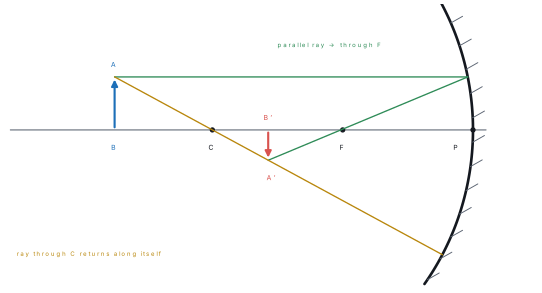
Images formed by a concave mirror
| Position of object | Position of image | Nature and size of image |
|---|---|---|
| at infinity | at F | real, inverted, highly diminished (point) |
| beyond C | between F and C | real, inverted, diminished |
| at C | at C | real, inverted, same size |
| between C and F | beyond C | real, inverted, magnified |
| at F | at infinity | real, inverted, highly magnified |
| between F and P | behind the mirror | virtual, erect, magnified |
A convex mirror always forms a virtual, erect and diminished image behind the mirror, between P and F; for an object at infinity the image is a point at F.
| Real image | Virtual image |
|---|---|
| formed where reflected rays actually meet | formed where reflected rays only appear to meet |
| can be obtained on a screen | cannot be obtained on a screen |
| formed in front of the mirror | formed behind the mirror |
| always inverted | always erect |
Uses of a concave mirror: reflector in torches, searchlights and vehicle headlights (the bulb is at F so the reflected beam is parallel and goes far); doctors' mirror for ear, nose and throat; shaving and make-up mirror (enlarged erect image when the face is within F); astronomical telescopes; solar cookers (it converges the sun's rays). Uses of a convex mirror: rear-view (side) mirror of vehicles, because it gives an erect, diminished image and a wide field of view; reflector in street lamps to spread light over a wide area.
Point a concave mirror at a distant window and move a white card in front of it until a sharp, inverted image of the window forms. The distance from mirror to card is roughly the focal length (about 20–30 cm for a school mirror). Try the same with a convex or plane mirror: no image forms on the card, because their images are virtual.
7.5.2 Refraction of light
Refraction is the bending of light when it passes obliquely from one transparent medium to another, because its speed changes. Light going from air into water or glass (a denser medium) bends towards the normal; from water to air it bends away from the normal. That is why a pencil in water looks bent and a pond looks shallower than it is.
7.6 Lenses and images; dispersion; the eye and optical instruments
A lens is a piece of transparent glass bounded by curved surfaces. A convex (converging) lens is thicker in the middle and brings parallel rays to a real focus; it can form real inverted images or (for a near object) a magnified virtual image — a magnifying glass. A concave (diverging) lens is thinner in the middle, spreads light out and always forms a virtual, erect, diminished image.
Dispersion. When white light passes through a glass prism it splits into seven colours — violet, indigo, blue, green, yellow, orange, red (VIBGYOR) — because each colour bends by a different amount. A rainbow forms in the same way in raindrops.
The human eye works like a camera: the cornea and lens form a real, inverted image on the retina, the iris controls the size of the pupil, and the optic nerve carries the message to the brain. Optical instruments — magnifying glass, microscope, telescope, camera and spectacles — use lenses (and mirrors) to see small or distant objects clearly.
7.7 Sound
Sound is produced by vibrating objects. Strike a tuning fork on a rubber pad and touch it: it vibrates and hums. The particles of the medium vibrate back and forth in the direction in which the sound travels, so sound is a longitudinal and mechanical wave: it needs a medium (solid, liquid or gas) and cannot travel through a vacuum.
7.7.1 Characteristics of a wave
| Quantity | Meaning | Unit |
|---|---|---|
| Frequency (f) | number of waves produced in one second | hertz (Hz); kHz, MHz |
| Time period (T) | time taken to make one complete wave; T=\frac{1}{f} | second (s) |
| Wavelength (λ) | distance between two successive crests (or compressions) | metre (m) |
| Amplitude (A) | maximum displacement of a particle from its mean position | metre (m) |
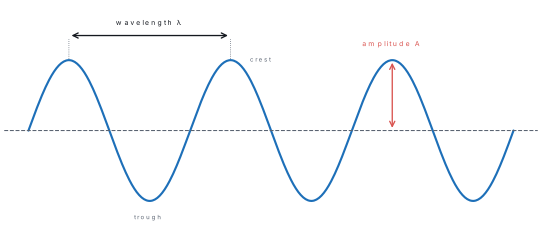
The distance travelled by sound in one second is its speed: v=f\lambda (speed = frequency × wavelength), in m/s. In a given medium the speed is constant, so a higher frequency means a shorter wavelength.
Problem (a). Find the speed of a sound of frequency 66 Hz and wavelength 5 m. Solution. v=f\lambda=66\times5=330 m/s.
Problem (b). The speed of sound at 0 °C is 332 m/s and its frequency is 40 Hz. Find the wavelength. Solution. \lambda=\frac{v}{f}=\frac{332}{40}=8.3 m.
7.7.2 Infrasonic, audible and ultrasonic sound
Human ears can hear frequencies from 20 Hz to 20 000 Hz (20 kHz). Children's and women's voices have a higher frequency (sharper) than men's.
| Type | Frequency | Examples |
|---|---|---|
| Infrasonic (infrasound) | below 20 Hz | earthquakes, volcanoes; produced by elephants, rhinos, whales |
| Audible | 20 Hz – 20 kHz | speech, songs, musical instruments |
| Ultrasonic (ultrasound) | above 20 kHz | produced and heard by bats, dolphins, some insects; dogs can hear it |
Uses of ultrasound: ultrasonography (USG) to see a baby in the womb and to find tumours and stones; bloodless operations; killing bacteria; SONAR to measure the depth of the sea (depth =\frac{\text{speed}\times\text{time}}{2}, because the sound goes down and comes back).
7.7.3 Intensity of sound
The intensity of sound is the sound energy passing per second through unit area perpendicular to its direction: I=\frac{P}{A}, unit W/m². The loudness we hear is measured in decibels (dB).
| Sound | Typical level |
|---|---|
| whisper | about 20–30 dB |
| quiet library | about 30–40 dB |
| normal conversation | about 50–60 dB |
| busy traffic | about 70–90 dB |
| threshold of pain | about 120–140 dB |
According to the textbook, a person who cannot hear sounds of 45–60 dB has partial hearing loss, and one who cannot hear even 80 dB is deaf.
Factors affecting intensity: amplitude (I\propto A^2); distance from the source (intensity falls as you move away, which is why a sound gets fainter); density of the medium (greater in denser, cold air); area of the vibrating body (a big temple bell or drum is louder); frequency (shriller sounds have more intensity).
Problem (a). Children whistle with a sound power of 2\times10^{-4} W spread over 5 m². Find the intensity. Solution. I=\frac{P}{A}=\frac{2\times10^{-4}}{5}=4\times10^{-5} W/m².
Problem (b). Sound of intensity 2\times10^{-5} W/m² falls on 6 m² for 1 s. Find the energy carried. Solution. Power P=I\times A=2\times10^{-5}\times6=1.2\times10^{-4} W; energy =P\times t=1.2\times10^{-4} J.
7.7.4 Sound (noise) pollution
Noise is unwanted, unpleasant or too loud sound; sound pollution is excessive noise that harms people, animals and the environment.
Causes: heavy traffic and horns, factories and machines, construction, loudspeakers, loud television and music, crowded markets. Effects: weakening or loss of hearing, rupture of the eardrum, high blood pressure, digestive problems, stress and poor sleep, difficulty in concentrating on study and work. Control: plant trees along roads and around industries; use silencers in vehicles and avoid unnecessary horns; keep TV and music low; build industries away from settlements; run public awareness programmes.
7.8 Energy sources, transformation and conservation
Sources from which we get energy are energy sources.
| Renewable sources | Non-renewable sources |
|---|---|
| are replaced naturally and do not run out | cannot be replaced quickly once used up |
| sun, wind, flowing water (hydropower), tides, biogas, firewood (if forests are replanted) | coal, petroleum (petrol, diesel, kerosene, LPG), natural gas, nuclear fuel |
| mostly clean | cause pollution and greenhouse gases (except nuclear) |
Energy changes from one form to another: a hydropower plant changes the kinetic energy of water into electrical energy; a bulb changes electrical energy into light and heat; our body changes the chemical energy of food into mechanical energy and heat. The law of conservation of energy states that energy can neither be created nor destroyed; it only changes from one form to another. Nepal's rivers make hydroelectricity its main clean energy source; solar panels and biogas plants are common in villages.
Chapter summary
- Energy is the capacity to do work (J); 1 calorie ≈ 4.2 J.
- Heat flows from higher to lower temperature. F=\frac{9}{5}C+32, K=C+273.
- Conduction (solids, no movement of particles), convection (liquids and gases, movement of particles), radiation (no medium, electromagnetic waves).
- Dark surfaces absorb and emit radiation well; white and shiny surfaces do not.
- Thermos flask: vacuum (no conduction/convection), silvering (no radiation), cork.
- Greenhouse effect: greenhouse gases trap heat; more gases → global warming.
- Q=ms\Delta t; water has a high specific heat capacity (4200 J/kg °C).
- Concave mirror converges (real images, except object within F); convex mirror diverges (virtual, erect, diminished image). f=\frac{R}{2}.
- Sound is a longitudinal mechanical wave; v=f\lambda, T=\frac{1}{f}; audible range 20 Hz – 20 kHz; I=\frac{P}{A} (W/m²), loudness in dB.
Practice questions
Group A — Multiple choice (1 mark each) (Textbook exercises.)
- Transfer of heat by the actual movement of particles is [1]aconductionbconvectioncradiationdtemperature
- Heat travels in liquids and gases by [1]aconductionbconvectioncradiationdevaporation
- Heat travels through a vacuum by [1]aconductionbconvectioncradiationdtranspiration
- In which case is heat transferred by radiation? [1]aa spoon kept in sunlight gets hotba spoon in hot tea gets hotca spoon held above a spirit lamp gets hotdcold water warms when a hot iron rod is put in it
- The average temperature of the earth's surface is about [1]a70 °Fb59 °Fc40 °Fd125 °F
- Which is a mechanical wave? [1]aradio wavebgamma raycsound wavedX-ray
- Which mirror do we use daily to look at our face? [1]aplanebconcavecconvexdspherical
- Which mirror can form a real image? [1]aplanebconcavecconvexdnone
- A real image is one that [1]acannot be obtained on a screenbcan be obtained on a screencis always erectdis always magnified
- A concave mirror is also called a [1]aplane mirrorbdiverging mirrorcconverging mirrordsimple mirror
- A ray through the centre of curvature of a concave mirror [1]apasses through Fbis reflected back along the same pathcbecomes parallel to the axisddiverges
- Frequency is the number of waves produced in [1]a1 secondb2 secondsc3 secondsd4 seconds
- The frequency range of audible sound is [1]a2 Hz – 20 Hzb20 Hz – 20 kHzc20 kHz – 200 kHzd2 Hz – 200 Hz
- A sound with greater amplitude has [1]amore intensitybless intensitycthe same intensitydno intensity
- According to the textbook, a person who cannot hear even this level is deaf: [1]a90 dBb80 dBc60 dBd55 dB
- Which animal can produce and hear ultrasound? [1]aelephantbbatccrocodiledrhino
Answers to Group A
1. (b).
2. (b).
3. (c).
4. (a) — the sun's heat crosses empty space.
5. (b) — about 15 °C.
6. (c).
7. (a).
8. (b).
9. (b).
10. (c).
11. (b).
12. (a).
13. (b).
14. (a) — I\propto A^2.
15. (b).
16. (b).
Group B — Short answer (2 marks each)
- Differentiate:(a) conductor and insulator of heat(b) mechanical and electromagnetic waves(c) sea breeze and land breeze. [3]
- Give reasons:(a) Mud houses are cool in summer and warm in winter.(b) Tea cups are made of porcelain.(c) Light-coloured clothes are worn in summer.(d) Ventilators are made in the upper part of walls.(e) Transparent plastic covers an artificial greenhouse. [5]
- What is convection? How does wind blow? Write two applications of convection. [2]
- What is radiation? Write two applications. What is an electromagnetic wave? Give three examples. [3]
- Draw a labelled diagram of a thermos flask and explain how it works. [3]
- What is the greenhouse effect? Write its importance and two harmful effects. [3]
- Differentiate:(a) concave and convex mirror(b) real and virtual image. Define principal axis, focus, centre of curvature and focal length. [4]
- Give reasons:(a) A concave mirror is used in a solar cooker.(b) A convex mirror is used as a rear-view mirror.(c) Convex and plane mirrors cannot form real images.(d) A concave mirror is used for shaving. [4]
- Differentiate:(a) wavelength and amplitude(b) infrasound and ultrasound. Write three uses of ultrasound. [3]
- Why does the speed of sound stay the same when frequency changes? Why does sound become fainter as we move away from the source? [2]
Answers to Group B
1. (a) A conductor lets heat pass easily (copper, iron); an insulator does not (wood, plastic, wool). (b) See the table in 7.3.4. (c) See the table in 7.3.2.
2. (a) Mud is a poor conductor, so heat does not easily pass in or out through the walls. (b) Porcelain is a poor conductor, so the tea stays hot and the cup is safe to hold. (c) Light colours absorb less heat radiation. (d) Warm used air is lighter and rises; it goes out through the upper ventilator while fresh air enters below (convection). (e) It lets the sun's short-wave radiation in but traps the long-wave heat given out by the soil and plants.
3. Transfer of heat in liquids and gases by the movement of heated particles. Wind: the sun heats the ground; the air above becomes warm and light and rises; cooler air from nearby flows in to take its place — this moving air is wind. Applications: boiling water, sea and land breezes, fans and air conditioners, refrigerators.
4. Transfer of heat without a medium in the form of waves. Applications: sun heats the earth; warming near a fire; white clothes in summer; black solar cookers. An electromagnetic wave needs no medium and travels at 3\times10^8 m/s in a vacuum: light, radio waves, X-rays (also infrared, gamma rays).
5. Draw as in the figure in 7.3.5. Vacuum between the double walls stops conduction and convection; silvered surfaces reflect heat radiation; cork stopper and pad are poor conductors. So heat neither enters nor leaves easily, and the liquid stays hot or cold.
6. The warming of the earth because greenhouse gases trap the heat radiated by it. Importance: keeps the average temperature about 15 °C instead of −18 °C so life can exist; greenhouses grow off-season vegetables. Harmful effects of its increase: global warming, melting glaciers and GLOF, sea-level rise, changed rainfall, lower crop yield.
7. See the tables in 7.5.1. Principal axis: the line through the pole and centre of curvature. Focus: the point on the axis where parallel rays meet (or seem to come from) after reflection. Centre of curvature: the centre of the sphere of which the mirror is part. Focal length: the distance from the pole to the focus.
8. (a) It is a converging mirror; it collects the sun's rays at its focus and produces great heat. (b) It always gives an erect, diminished image and a wide field of view of the traffic behind. (c) Their reflected rays never actually meet; they only appear to meet behind the mirror. (d) When the face is within F, a concave mirror gives an erect, enlarged image.
9. (a) Wavelength is the distance between two successive crests; amplitude is the maximum displacement of a particle from the mean position. (b) Infrasound is below 20 Hz (earthquakes, elephants); ultrasound is above 20 kHz (bats). Uses of ultrasound: USG of the womb, SONAR, killing bacteria, bloodless operations.
10. The speed depends only on the medium; since v=f\lambda is fixed, a higher frequency gives a proportionally shorter wavelength. The energy spreads over a larger area and part is absorbed by the air, so intensity falls with distance.
Group C — Numerical and long answer (4 marks each)
- The speed of sound in air is 332 m/s and its frequency is 10 Hz. Find the wavelength. [2]
- A sound has a wavelength of 22 m and frequency 10 Hz. Find its speed. [2]
- If the speed of sound in air is 332 m/s, find the wavelengths of the shortest and longest sound waves that humans can hear. [3]
- Sound of intensity 2\times10^{-5} W/m² spreads over 6 m² in 1 s. Find the energy carried. [2]
- Draw ray diagrams for a concave mirror when the object is (i) beyond C (ii) at infinity (iii) between C and F, and write the nature of each image. [4]
- How much heat is needed to raise 500 g of water from 25 °C to 85 °C? (s=4200 J/kg °C) [2]
- Write the causes, two effects and two ways to control sound pollution. [4]
Answers to Group C
1. \lambda=\frac{v}{f}=\frac{332}{10}=33.2 m. (The textbook prints 33.3 m; the exact value is 33.2 m.)
2. v=f\lambda=10\times22=220 m/s. (The textbook's printed answer, 330 m/s, does not match the data; with 22 m and 10 Hz the speed is 220 m/s.)
3. Shortest wavelength at the highest audible frequency, 20 000 Hz: \lambda=\frac{332}{20000}=0.0166 m. Longest at 20 Hz: \lambda=\frac{332}{20}=16.6 m.
4. E=I\times A\times t=2\times10^{-5}\times6\times1=1.2\times10^{-4} J.
5. Use the three rules of 7.5.1. (i) Beyond C: image between F and C, real, inverted, diminished (figure in 7.5.1). (ii) At infinity: parallel rays meet at F — image at F, real, inverted, point-sized. (iii) Between C and F: image beyond C, real, inverted, magnified.
6. m=500 g =0.5 kg, \Delta t=85-25=60 °C. Q=0.5\times4200\times60=126\,000 J =126 kJ.
7. Causes: traffic and horns, factories, construction, loudspeakers and loud music. Effects: hearing loss and eardrum damage; high blood pressure, stress and sleeplessness; loss of concentration. Control: trees along roads, silencers and fewer horns, low-volume music and TV, industries away from settlements, awareness programmes.
Practise more: Science and Technology question bank