Unit 4 · Science and Technology · 19 min read
Biodiversity and Environment
What the syllabus asks for 5
- biodiversity: meaning, levels and importance
- threats to biodiversity and its conservation
- ecosystem, food chain and food web
- sustainable development: meaning, principles and practices
- environment protection and local initiatives
Every kind of living being is different from the others, yet all of them depend on one another and on their surroundings. People get fodder, firewood, fruit, medicine, timber and water from forests; these benefits are called ecosystem services. If we use them too much, their sources are destroyed. So every social, economic and development activity must use nature wisely and conserve it. This unit explains biodiversity, its importance, why it is declining, how it is conserved, and how development can be made sustainable.
Define biodiversity and its three types; give its importance; describe the present status of Nepal's biodiversity; list the causes of its degradation; compare in-situ and ex-situ conservation and name Nepal's protected areas; explain food chains and food webs; define sustainable development and explain its three aspects (pillars) and principles; and describe the SDGs and Nepal's efforts.
4.1 Biodiversity: meaning, levels and importance
Organisms living in water, deserts, cold places and hot, moist places have different body structures. Even plants of the same species in one field differ in height, number of leaves and size of cobs.
Biodiversity is the variety of living beings — plants, animals and microorganisms — found in different habitats of the earth, including the differences within a species, between species and between ecosystems. It shows the species richness of a place.
The Earth Summit held in Rio de Janeiro, Brazil, in 1992 defined biodiversity as the variation among organisms of the same or different kinds in their genes, species and ecosystems. The Convention on Biological Diversity (CBD) describes it as the variety among all land and water organisms.
The variety of plants in a place is floral diversity; the variety of animals is faunal diversity.
4.1.1 Types (levels) of biodiversity
| Type | Meaning | Example |
|---|---|---|
| Genetic diversity | differences among individuals of the same species, caused by differences in their genes | all humans are Homo sapiens, but hair, skin and eye colour, height and nose shape differ; many varieties of rice |
| Species diversity | the number and kinds of species living in a place | producers, herbivores and carnivores of a forest; the frog genus Rana has more than ten species |
| Ecosystem diversity | the variety of ecosystems (land and water; tropical to alpine) with their physical conditions and organisms | Terai grassland, sal forest, alpine meadow, lake, river |
Mark a 1 m × 1 m square (a quadrat) on grassland with a measuring tape, four nails and a cord. Collect and count every kind of plant and animal inside it, keep them in separate bags and fill a table: name of plant / number, name of animal / number. The more kinds you find, the higher the species diversity. Return living animals to the grass afterwards.
Problem. In a 1 m² quadrat a class found 36 grass plants, 4 clover plants and 3 grasshoppers. Estimate the number of clover plants in a grassy field of 250 m², assuming the quadrat is typical. How many kinds of organisms were found? Solution. Clover per m² = 4. In 250 m²: 4\times250=1000 clover plants (an estimate). Kinds found = 3 (grass, clover, grasshopper) — this is the species count of the sample. More quadrats at different spots give a better estimate.
4.1.2 Importance of biodiversity
- It provides food, shelter and livelihood (nutrition and income) for every organism.
- It keeps the environment balanced and increases the productivity of ecosystems.
- It allows the sustainable use of biological resources (timber, medicine, fibre).
- It helps in environmental conservation and sustainable development.
- It promotes ecotourism and strengthens the national economy.
- A rich variety helps living beings adapt to difficult conditions such as climate change.
4.1.3 Present status of biodiversity in Nepal
Nepal covers only about 0.1 % of the world's land, yet it is very rich in biodiversity because its altitude rises from about 59 m (Kechana Kalan, Jhapa) to 8848.86 m (Sagarmatha) within a short distance, giving tropical to alpine climates, fertile soils and monsoon rain.
- Nepal ranks about 27th in the world, 10th in Asia and 2nd in South Asia in biodiversity.
- It has about 3.2 % of the world's plant species and 1.1 % of its animal species.
- There are more than 118 types of ecosystems and more than 15 types of forest.
- The spiny babbler is found only in Nepal (endemic). The one-horned rhinoceros, Bengal tiger and wild yak are rare animals found here.
- Nepal has about 32 species of rhododendron, and Jumla's Marshi rice grows at about 3050 m, one of the highest rice fields in the world.
4.2 Threats to biodiversity and its conservation
Biodiversity degradation is the decline in the number and kinds of plants and animals caused by natural disasters and human activities. Some species are close to extinction; the snow leopard of Nepal is threatened, and the pygmy hog is no longer found in Nepal's wild.
Causes of biodiversity degradation
- Overgrazing in forests damages seeds and seedlings, so new plants cannot grow.
- Industrial pollution of air, water and soil.
- Unplanned mining and blasting cause noise, landslides and soil erosion.
- Unplanned construction of roads, buildings, dams and bridges destroys habitats.
- Excess collection of fodder and firewood leads to deforestation and dries water sources.
- Clearing forests for farmland and houses as the population grows.
- Forest fires kill plants and animals.
- Floods and landslides.
- Global warming caused by climate change.
- Poaching and illegal trade of wild animals and their parts.
- Invasive plants: banmara (Mikania, Lantana) on land and water hyacinth in water crowd out native plants.
- Illegal extraction of sand, gravel and stones from rivers causes bank cutting and dries nearby farms.
4.2.1 Conservation of biodiversity
| In-situ conservation | Ex-situ conservation |
|---|---|
| conserving organisms in their natural habitat | conserving organisms outside their natural habitat, in a small, controlled area |
| animals interact freely with nature | animals live in cages or enclosures; diet and conditions must be managed |
| large area; all species protected, endangered or not | small area; best for endangered species |
| cheaper and natural | costly and laborious |
| hard to control poaching, fire and disease | easy to look after, treat and study |
| national parks, wildlife reserves, hunting reserve, conservation areas | zoo, botanical garden, nursery, safari park, aquarium, seed bank, gene bank |
Protected areas of Nepal (as listed in the textbook): 12 national parks (Chitwan, Sagarmatha, Bardiya, Rara, Khaptad, Langtang, Makalu-Barun, Shey-Phoksundo, Shivapuri-Nagarjun, Parsa, Banke, Shuklaphanta), 1 wildlife reserve (Koshi Tappu), 1 hunting reserve (Dhorpatan) and 6 conservation areas (Annapurna, Kanchenjunga, Manaslu, Krishnasar, Gaurishankar, Api-Nampa). Examples of ex-situ conservation are the Central Zoo (Jawalakhel) and the National Botanical Garden (Godawari).
Other measures: control poaching and illegal trade; make more protected areas; control overgrazing, fire, pollution and unplanned urbanisation; make and enforce strong laws; and educate people about the value of biodiversity. Nepal's community forest programme has increased forest cover by handing forests to local user groups.
Question. Give a reason: it is difficult to conserve a native species by the ex-situ method.
Answer. In ex-situ conservation the organism is kept away from its natural habitat in a small area. Its natural food, climate and companions must be supplied artificially, which is costly and laborious; wild animals dislike the prison-like life and may not breed. So it is used mainly for endangered species, while in-situ conservation is better for most native species.
4.3 Ecosystem, food chain and food web
An ecosystem is a community of living beings together with the non-living surroundings (soil, water, air, light, temperature) with which they interact.
A food chain is the series of organisms through which food (energy) passes, each one eating the one before it. Every chain starts with a green plant (producer).
Grass → grasshopper → frog → snake → eagle
| Level | Name | Examples |
|---|---|---|
| makes its own food | producer | grass, rice, sal tree |
| eats plants | primary consumer (herbivore) | grasshopper, deer, goat |
| eats herbivores | secondary consumer | frog, jackal |
| eats other carnivores | tertiary consumer | snake, eagle, tiger |
| breaks down dead bodies | decomposer | bacteria, fungi |
In a real ecosystem many food chains are joined because one animal eats many kinds of food. This network of food chains is a food web. If one species is lost, many others are affected — this is why biodiversity keeps an ecosystem stable.
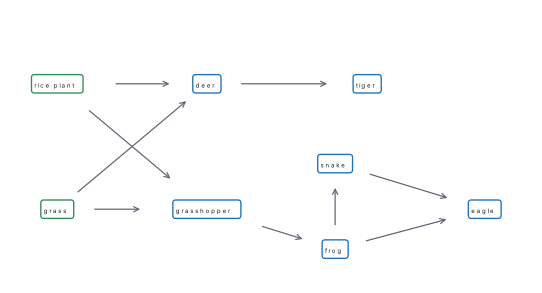
The arrow in a food chain points from the food to the eater ("is eaten by"): grass → deer, not deer → grass.
4.4 Sustainable development: meaning, aspects and principles
According to the Brundtland Commission (1987), sustainable development is "development that meets the needs of the present generation without compromising the ability of future generations to meet their own needs." In practice it means considering the economic, social, cultural and environmental sides of every project so that its benefits last a long time.
Example. A bridge or road built at a landslide-prone place lasts only if landslide control (retaining walls, drainage, planting grass and trees on the slope) is done at the same time. Then many generations benefit. In the textbook story, Norbu's father could not repair a broken paddy-field ridge with mud alone while water was flowing; diverting the water first, and binding the mud with leafy twigs and grass, makes the repair last.
| Development | Sustainable development |
|---|---|
| aims at quick progress now | aims at progress now and in the future |
| may ignore the environment and society | balances economy, society and environment |
| may exhaust resources | uses resources wisely and conserves them |
| benefits may be short-lived | benefits last for generations |
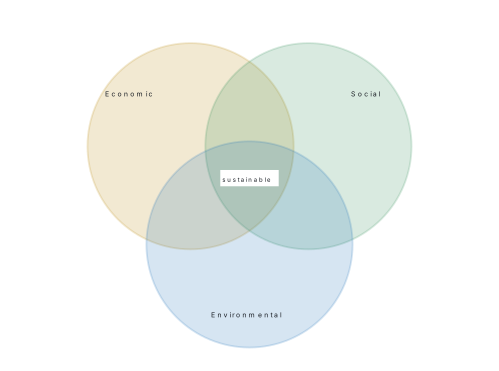
4.4.1 Aspects (three pillars) of sustainable development
- Economic aspect — steady, balanced economic growth of people and the nation through fair distribution and use of resources, without exploitation.
- Social aspect — fair progress of the whole community: ending poverty, equal access to resources, empowerment of women and marginalised groups, people's participation, preservation of culture, peace and social justice.
- Environmental aspect — conserving the fertility of land, water, air, minerals, climate and biodiversity; development projects must not destroy habitats or cause landslides and river-bank erosion.
4.4.2 Principles of sustainable development
- Principle of ecosystem and biodiversity conservation — keep in mind the carrying capacity of the earth; conserve natural resources, use renewable energy, search for alternatives, control pollution, conserve biodiversity.
- Principle of population control and human resource management — humans use far more resources than any other organism, so population must be kept within a limit, and people's knowledge and skills must be developed by education and training.
- Principle of cultural conservation and public participation — conserve cultural heritage and involve people; when villagers build their own irrigation canal they feel ownership and look after it, so it lasts long.
Importance: it balances the environment and controls pollution; conserves resources and teaches their wise use; guides the building of big projects; reduces inequality and brings social justice and harmony; and gives economic opportunity to everyone fairly.
Skilled people build safe roads, hydropower and industries — the foundation of development. The same skills, used only for profit (careless blasting, cutting forests, polluting rivers), can destroy the environment. So skills must be used with responsibility.
4.5 Sustainable development goals, environment protection and local initiatives
The Sustainable Development Goals (SDGs) were adopted by the 70th General Assembly of the United Nations with 193 countries in 2015 for the period 2016–2030. They have 17 goals, 169 targets and 232 indicators. Goal 15 (Life on land) deals with terrestrial ecosystems, forests, desertification and biodiversity. Other goals cover food security, quality education, drinking water and sanitation, infrastructure, employment, climate action (goal 13) and life below water (goal 14). Nepal has prepared its own roadmap and indicators.
Nepal's efforts
- A Climate Change Council (since 2009) runs programmes on water resources, watersheds and biodiversity. To draw world attention to climate change, Nepal's cabinet met at Kalapatthar near Everest base camp in 2009.
- The water level of the glacial lake Tsho Rolpa (Rolwaling, Dolakha) has been lowered through a channel to reduce the risk of a glacial lake outburst flood.
- The community forest programme, strengthened by the Forest Act of 1993, has increased forest area and density by giving management to local people.
- Periodic plans focus on poverty reduction, vocational education, employment and a "neat, clean and green" environment.
- The National Environment Policy, 2076 and the Environment Protection Act, 2076 give people the right to a clean environment, make polluters pay compensation and aim to reduce the effects of climate change.
Local initiatives a school or ward can take: tree planting and caring for the saplings, eco-clubs, separating and composting waste, banning plastic bags, protecting springs and ponds, building terraces and planting grass on slopes, using improved cooking stoves and biogas, and building roads with drains and retaining walls.
Question. A road is being built in your village. Give three suggestions to the construction company.
Answer. (1) Do an environmental study first and avoid steep, landslide-prone slopes and water sources. (2) Build side drains, culverts and retaining walls, and plant grass and trees on the cut slopes. (3) Dump the excavated soil at a safe place (not into rivers or fields), avoid uncontrolled blasting, and employ local people so that they take ownership of the road.
Chapter summary
- Biodiversity = variety of organisms; types: genetic, species and ecosystem diversity (Earth Summit, Rio de Janeiro, 1992).
- Importance: food and livelihood, balanced environment, sustainable resources, ecotourism, adaptation to climate change.
- Nepal: 0.1 % of world area, altitude 59 m – 8848.86 m, 3.2 % of plant and 1.1 % of animal species, 118 ecosystems; spiny babbler is endemic.
- Degradation: overgrazing, pollution, mining, unplanned construction, deforestation, fire, floods, global warming, poaching, invasive species.
- In-situ (national parks, reserves, conservation areas) and ex-situ (zoo, botanical garden, seed bank) conservation.
- Food chains start with producers; joined food chains form a food web.
- Sustainable development (Brundtland, 1987) has economic, social and environmental pillars, and principles of conservation, population control and public participation.
- SDGs: 2016–2030, 17 goals, 169 targets, 232 indicators; goal 15 is about life on land and biodiversity.
Practice questions
Group A — Multiple choice (1 mark each) (Textbook exercises.)
- Where was the 1992 Earth Summit on biodiversity held? [1]aChinabBrazilcAfricadJapan
- Faunal diversity is related to [1]aanimalsbplantscanimals and plantsdonly mammals
- Riya wants to conserve an endangered plant. Which action is ex-situ conservation? [1]aplanting it in the community forestbplanting it in the forest where it was foundcplanting it in her kitchen gardendplanting it on a riverbank
- Which represents the significance of biodiversity? [1]afodder and firewood are obtained from forestsbforests keep greeneryctourists visit forests for fundthere is fear of wild animals
- What percentage of the world's plant species is found in Nepal? [1]a1.1 %b3.2 %c10 %d0.1 %
- The report of which commission defined sustainable development clearly? [1]aKyotobAgenda-30cUNOdBrundtland
- Which aspect of sustainable development emphasises social justice? [1]aeconomicbsocialcenvironmentaldcultural
- Which point shows the importance of sustainable development for biodiversity? [1]airrigation in bare landbroads to remote placescpoverty eliminationdbalancing the surrounding ecosystem
- Which SDG is about biodiversity on land? [1]a13b14c15d16
- With declining Himalayan snow, the main challenge to farming in the region is [1]adesertificationbfloods and landslidescdrying of land due to less snowdfalling soil fertility
- Which strategy best gives every citizen fair access to natural resources? [1]aincome-generating projects, community forests and awareness programmesbenvironmental conservation onlycdegradation and promotion programmesdsocial harmony and waste management
Answers to Group A
1. (b) — Rio de Janeiro, Brazil.
2. (a).
3. (c) — the plant is moved out of its natural habitat.
4. (a) — biodiversity provides livelihood and nutrition.
5. (b).
6. (d) — Brundtland Commission, 1987.
7. (b).
8. (d).
9. (c).
10. (c) — less snow means less melt-water for the fields.
11. (a) — community forests and income projects share resources among all users.
Group B — Short answer (2 marks each)
- Differentiate:(a) in-situ and ex-situ conservation(b) genetic and species diversity. [4]
- Give reasons:(a) There is variation among individuals of the same species.(b) Forest fire devastates biodiversity.(c) Nepal is rich in biodiversity. [3]
- What is biodiversity? Give examples. What is the role of species richness? [2]
- Explain the present status of biodiversity in Nepal. [2]
- Differentiate:(a) development and sustainable development(b) social and environmental aspects of sustainable development. [4]
- Give reasons:(a) The environment must be considered in development work.(b) Sustainable development helps to establish social harmony.(c) Degradation of biodiversity affects sustainable development. [3]
- What is sustainable development? Give an example. [2]
- Write a food chain of four links and say what happens to it if the frog is removed. [2]
Answers to Group B
1. (a) See the table in 4.2.1. (b) Genetic diversity is the variation among individuals of the same species due to genes (e.g. human skin colour, rice varieties); species diversity is the number and kinds of species in a place (e.g. deer, tiger, rhino and many birds in Chitwan).
2. (a) Their genes differ slightly, and the environment also affects them. (b) Fire kills plants, seedlings, eggs and slow animals, destroys habitats and food, and leaves soil bare to erosion. (c) Its altitude changes from 59 m to 8848.86 m in a short distance, giving many climates (tropical to alpine), fertile soils and monsoon rain, so many habitats exist.
3. Biodiversity is the variety of living beings in different habitats, including variety within species, between species and between ecosystems; e.g. rhinos and tigers in Chitwan, rhododendrons in the hills, yaks in the Himalaya. Species richness (many species) keeps food webs complex and the ecosystem stable and productive.
4. Nepal has 0.1 % of the world's land but about 3.2 % of plant and 1.1 % of animal species, more than 118 ecosystems and 15 forest types; it ranks about 27th in the world. Endemic spiny babbler, rare rhino, tiger and wild yak, 32 rhododendron species and Marshi rice of Jumla show its richness.
5. (a) See the table in 4.4. (b) The social aspect concerns people — ending poverty, equality, participation, culture, peace and justice; the environmental aspect concerns nature — conserving land, water, air, climate and biodiversity during development.
6. (a) Development that destroys forests, rivers and slopes causes landslides and pollution, so the project itself does not last. (b) It shares resources and opportunities fairly, empowers women and marginalised groups and respects culture, so conflict decreases. (c) Food, water, medicine, tourism and soil fertility depend on biodiversity; when it is lost, the base for long-term development is lost.
7. Development that meets present needs without reducing the ability of future generations to meet theirs; e.g. building a road with drains, retaining walls and slope planting so that it lasts for many years.
8. Grass → grasshopper → frog → snake. If frogs are removed, grasshoppers increase and damage the grass and crops, while snakes lose food and decline or move away.
Group C — Long answer (4 marks each)
- What are the methods of conserving biodiversity? Explain one, and write other measures of conservation. [4]
- Explain the causes of degradation of biodiversity in points. [4]
- What are the principles of sustainable development? Describe any one. [4]
- What are the SDGs? Illustrate Nepal's efforts to achieve them. [4]
- Suggest what your local government should do to achieve the SDG related to biodiversity. [4]
Answers to Group C
1. In-situ and ex-situ conservation. In-situ: organisms are protected in their natural habitat, e.g. national parks (Chitwan), wildlife reserve (Koshi Tappu), hunting reserve (Dhorpatan) and conservation areas (Annapurna); it is natural and cheap and protects all species, but poaching and fire are hard to control. Other measures: control poaching and illegal trade, create more protected areas, control overgrazing, fire and pollution, enforce strict laws, and educate people.
2. Any eight from the list in 4.2, each with a short reason (e.g. overgrazing destroys seedlings; invasive banmara displaces native plants).
3. Ecosystem and biodiversity conservation; population control and human resource management; cultural conservation and public participation. Public participation: when people take part in a project and their culture is respected, they own and protect it — e.g. a village-built irrigation canal is maintained by the villagers and lasts long.
4. SDGs are 17 global goals with 169 targets and 232 indicators, adopted by 193 UN members in 2015 for 2016–2030. Nepal's efforts: Climate Change Council and cabinet meeting at Kalapatthar (2009); lowering Tsho Rolpa; community forests; periodic plans for poverty reduction, education and employment; National Environment Policy 2076 and Environment Protection Act 2076.
5. Protect local forests, wetlands and springs and declare community conservation areas; control forest fire, overgrazing and illegal sand mining; remove invasive plants; promote tree planting and nurseries of native species; support eco-clubs and awareness programmes; manage waste and ban plastic bags; plan roads with environmental study.
Practise more: Science and Technology question bank