Unit 9 · Science and Technology · 21 min read
Matter
What the syllabus asks for 7
- states of matter and the kinetic idea of particles
- element, compound and mixture; atom and molecule
- physical and chemical change
- solution, solute, solvent; saturated and unsaturated solution
- separation of mixtures: filtration, distillation, sublimation, chromatography
- acids, bases and salts; indicators and pH in daily life
- metals and non-metals; alloys
Books, desks, water and air all have mass and occupy space (volume); heat, light and shadows do not. Anything that has mass and volume is matter. Matter is made of atoms of the same or different kinds. It is classified into pure substances (elements and compounds) and impure substances (mixtures), and it is found as solid, liquid or gas. The CDC textbook for this unit concentrates on the structure of the atom, valency and molecular formulae, atomic and molecular weight, the modern periodic table and chemical equations; these are taught in full below, together with the other topics of the syllabus.
Describe the proton, neutron and electron; use the 2n^2 rule to write the electronic configuration of the first 20 elements; find valency; write molecular formulae by the criss-cross method; calculate atomic and molecular weights; state the modern periodic law and the trends in groups and periods; and write and balance chemical equations. Also: states of matter, element–compound–mixture, physical and chemical change, solutions, separation methods, acids–bases–salts and metals–non-metals.
9.1 States of matter and the kinetic idea of particles
Matter is made of tiny particles that are always moving. How closely they are packed and how freely they move decides the state.
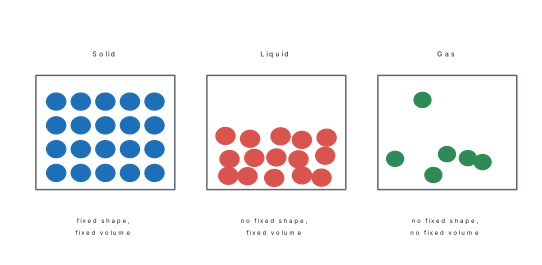
| Property | Solid | Liquid | Gas |
|---|---|---|---|
| arrangement of particles | close, regular | close, irregular | far apart |
| movement | vibrate in place | slide past each other | move fast in all directions |
| shape / volume | fixed / fixed | shape of container / fixed | fills container / not fixed |
| compression | almost none | very little | easily compressed |
Changes of state: melting (solid → liquid), freezing, evaporation and boiling (liquid → gas), condensation (gas → liquid), and sublimation (solid → gas directly, e.g. camphor, naphthalene, iodine). Heating gives particles more energy.
9.2 Element, compound and mixture; atom and molecule
| Element | Compound | Mixture | |
|---|---|---|---|
| made of | one kind of atom | two or more elements chemically combined in a fixed ratio | two or more substances mixed in any ratio |
| separation | cannot be split by chemical means | split only by chemical means | separated by physical means |
| properties | its own | different from its elements | each part keeps its properties |
| examples | H, O, Fe, Cu, Au | water (H₂O), salt (NaCl), CO₂ | air, soil, sea water, brass |
A molecule is the smallest particle of an element or compound that can exist freely; it may have one atom (He), two (O₂) or more (H₂O).
9.2.1 The atom and its structure
An atom is the smallest particle of an element that can take part in a chemical reaction. It is far too small to be seen. Atoms of one element are alike and are different from atoms of other elements.
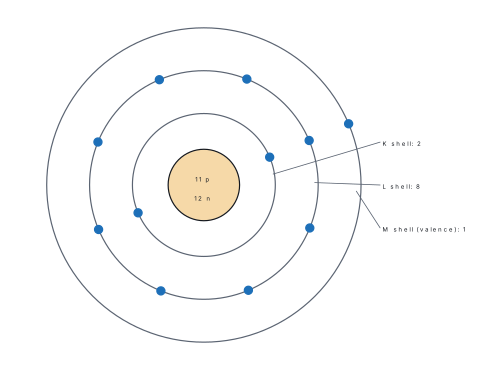
An atom has a central nucleus containing protons and neutrons; electrons revolve around the nucleus in fixed paths called shells (orbits or energy levels).
| Particle | Symbol | Location | Charge | Mass |
|---|---|---|---|---|
| Proton | p⁺ | nucleus | positive (+1) | 1 amu (≈ mass of an H atom) |
| Neutron | n⁰ | nucleus | none | 1 amu |
| Electron | e⁻ | shells | negative (−1) | \frac{1}{1837} amu |
The atomic number is the number of protons (= number of electrons in a neutral atom). An atom is electrically neutral because it has equal numbers of protons and electrons, so the positive and negative charges cancel.
9.2.2 The 2n² rule and electronic configuration
The shells, from the nucleus outwards, are K, L, M, N (n = 1, 2, 3, 4). By the Bohr–Bury rule, the maximum number of electrons in a shell is 2n^2: K = 2\times1^2=2, L = 2\times2^2=8, M = 2\times3^2=18, N = 2\times4^2=32. (For the first 20 elements the outermost shell holds no more than 8.)
| Element (Z) | Configuration | Element (Z) | Configuration |
|---|---|---|---|
| H (1) | 1 | Na (11) | 2, 8, 1 |
| He (2) | 2 | Mg (12) | 2, 8, 2 |
| Li (3) | 2, 1 | Al (13) | 2, 8, 3 |
| Be (4) | 2, 2 | Si (14) | 2, 8, 4 |
| B (5) | 2, 3 | P (15) | 2, 8, 5 |
| C (6) | 2, 4 | S (16) | 2, 8, 6 |
| N (7) | 2, 5 | Cl (17) | 2, 8, 7 |
| O (8) | 2, 6 | Ar (18) | 2, 8, 8 |
| F (9) | 2, 7 | K (19) | 2, 8, 8, 1 |
| Ne (10) | 2, 8 | Ca (20) | 2, 8, 8, 2 |
9.2.3 Valence shell, valence electrons and valency
The outermost shell is the valence shell, and its electrons are the valence electrons. Atoms become stable with 2 electrons (for very small atoms) or 8 in the valence shell. To do this:
- atoms with 1–3 valence electrons lose them (metals: Na, Mg, Al);
- atoms with 4 valence electrons share them (C, Si);
- atoms with 5–7 valence electrons gain electrons (N, O, Cl).
Valency is the number of electrons an atom loses, gains or shares to become stable (combining capacity). It depends on the number of valence electrons.
| Valence electrons | 1 | 2 | 3 | 4 | 5 | 6 | 7 | 8 (or 2 for He) |
|---|---|---|---|---|---|---|---|---|
| Valency | 1 | 2 | 3 | 4 | 3 | 2 | 1 | 0 |
| Examples | H, Li, Na, K | Be, Mg, Ca | B, Al | C, Si | N, P | O, S | F, Cl | He, Ne, Ar |
A valency of zero means the atom already has a stable (full) valence shell; it does not lose, gain or share electrons, so these inert (noble) gases do not normally react. Chlorine (2, 8, 7) has valency 1 because it needs to gain just one electron to complete its octet.
Problem. An element has atomic number 13. Write its electronic configuration, valency, and whether it is a metal or non-metal. Solution. 13 electrons: K = 2, L = 8, M = 3 → 2, 8, 3. It has 3 valence electrons, which it loses, so its valency is 3 and it is a metal (aluminium). It has 3 shells, so it is in period 3; with 3 valence electrons it is in group 13.
9.2.4 Molecular formula by the criss-cross method
A molecular formula shows the symbols and number of atoms in one molecule (H₂O, CO₂). To write it we must know the elements (symbols) and their valencies.
Steps (magnesium oxide): (1) write the name; (2) write the symbols Mg and O; (3) write the valencies above them, Mg 2 and O 2; (4) cross over the valencies; (5) write them as subscripts, Mg₂O₂; (6) divide by the common factor 2 → MgO. A subscript 1 is not written.
| Compound | Symbols and valencies | Formula |
|---|---|---|
| potassium chloride | K (1), Cl (1) | KCl |
| calcium chloride | Ca (2), Cl (1) | CaCl₂ |
| sodium chloride | Na (1), Cl (1) | NaCl |
| potassium oxide | K (1), O (2) | K₂O |
| aluminium chloride | Al (3), Cl (1) | AlCl₃ |
| ammonia | N (3), H (1) | NH₃ |
| water | H (1), O (2) | H₂O |
| carbon dioxide | C (4), O (2) → C₂O₄ ÷ 2 | CO₂ |
| calcium oxide | Ca (2), O (2) → Ca₂O₂ ÷ 2 | CaO |
9.2.5 Atomic weight and molecular weight
Atomic weight (mass number) = number of protons + number of neutrons. Electrons are not counted because their mass (\frac{1}{1837} amu each) is negligible.
Molecular weight = sum of the atomic weights of all atoms in a molecule.
Useful atomic weights: H 1, C 12, N 14, O 16, Na 23, Mg 24, Al 27, S 32, Cl 35.5, K 39, Ar 40, Ca 40.
(a) Calcium has 20 protons and 20 neutrons. Atomic weight =20+20=40 amu.
(b) Water, H₂O: 2\times1+16=18 amu.
(c) Calcium carbonate, CaCO₃: 40+12+3\times16=40+12+48=100 amu.
(d) Magnesium chloride, MgCl₂: 24+2\times35.5=95 amu. (The textbook rounds Cl to 35 and gets 94 amu; either is accepted if the value used for Cl is shown.)
(e) Calcium chloride, CaCl₂: 40+2\times35.5=111 amu (110 amu with Cl = 35).
(f) Sulphuric acid, H₂SO₄, has 2 H, 1 S and 4 O atoms: 2\times1+32+4\times16=98 amu.
9.3 Physical and chemical change; chemical reactions and equations
| Physical change | Chemical change |
|---|---|
| no new substance forms; composition unchanged | new substance(s) with new properties form |
| usually reversible | usually not easily reversible |
| e.g. melting of ice, dissolving salt, breaking glass | e.g. burning paper, rusting of iron, cooking, digestion |
A chemical reaction is a chemical change in which atoms combine, separate or exchange to form new substances. The substances that react are reactants (written on the left); the new substances formed are products (on the right).
A chemical equation is the short representation of a chemical reaction using words or symbols and formulae. A word equation uses names; a formula equation uses formulae. An unbalanced formula equation is a skeletal equation. In a balanced equation the number of atoms of each element is equal on both sides; we balance it by putting numbers (coefficients) in front of formulae — never by changing the subscripts.
(a) Sodium + chlorine → sodium chloride. Skeletal: Na + Cl₂ → NaCl (2 Cl on the left, 1 on the right). Put 2 before NaCl: Na + Cl₂ → 2NaCl (now 2 Na on the right); put 2 before Na: 2Na + Cl₂ → 2NaCl.
(b) Nitrogen + hydrogen → ammonia: N₂ + 3H₂ → 2NH₃ (2 N and 6 H on each side).
(c) Calcium carbonate → calcium oxide + carbon dioxide: CaCO₃ → CaO + CO₂ (already balanced).
(d) Zinc + hydrochloric acid → zinc chloride + hydrogen: Zn + 2HCl → ZnCl₂ + H₂. With sulphuric acid instead: Zn + H₂SO₄ → ZnSO₄ + H₂.
9.4 Solution, solute and solvent; saturated and unsaturated solution
A solution is a uniform mixture of a solute (the substance that dissolves, e.g. salt) in a solvent (the substance in which it dissolves, e.g. water). Water dissolves so many substances that it is called the universal solvent. A solution that can dissolve more solute at that temperature is unsaturated; one that cannot dissolve any more is saturated. Heating usually lets more solid dissolve, and stirring and powdering make it dissolve faster. On cooling a hot saturated solution, the extra solute separates as crystals.
9.5 Separation of mixtures
| Method | Used to separate | Example |
|---|---|---|
| Filtration | an insoluble solid from a liquid | sand from water, tea leaves from tea |
| Evaporation | a dissolved solid from its solvent | salt from salt water |
| Distillation | a pure liquid from a solution (boil, then condense the vapour) | pure water from salt water |
| Sublimation | a solid that sublimes from one that does not | camphor or naphthalene from sand or salt |
| Chromatography | different dissolved colours that move at different speeds on paper | dyes in ink |
| Magnetic separation | iron from non-magnetic material | iron filings from sulphur |
| Sedimentation and decantation | heavy solid from liquid | muddy water left to settle |
9.6 Acids, bases and salts; indicators and pH
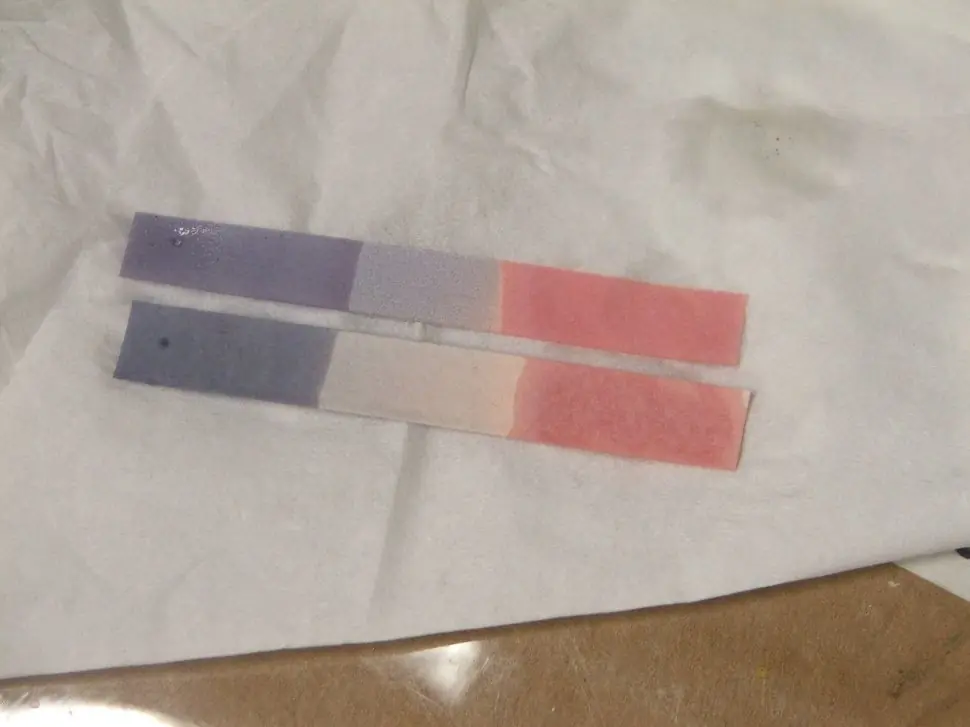
Acids taste sour, turn blue litmus red, and give hydrogen ions in water (lemon juice, vinegar, HCl, H₂SO₄). Bases taste bitter and feel soapy; soluble bases are alkalis and turn red litmus blue (soap, lime water, NaOH). An acid and a base neutralise each other to form a salt and water: HCl + NaOH → NaCl + H₂O.
| Indicator | In acid | In base |
|---|---|---|
| blue litmus | red | blue |
| red litmus | red | blue |
| methyl orange | red | yellow |
| phenolphthalein | colourless | pink |
| turmeric | yellow | reddish-brown |
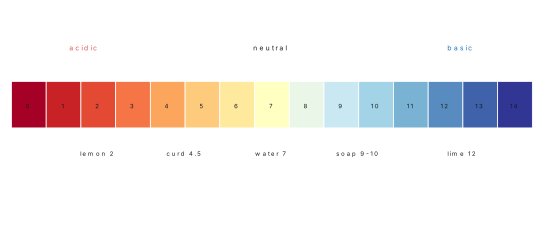
The pH scale runs from 0 to 14: below 7 acidic, 7 neutral (pure water), above 7 basic.
9.7 Metals and non-metals; alloys
| Property | Metals | Non-metals |
|---|---|---|
| electrons in reactions | donate (lose) electrons; 1–3 valence electrons | gain electrons; 5–7 valence electrons |
| lustre | shiny | dull (except iodine, graphite) |
| conduction | good conductors of heat and electricity | poor (except graphite) |
| malleable / ductile | yes | brittle |
| state at room temperature | solid, except mercury (liquid) | solid, liquid (bromine) or gas |
| examples | Na, Mg, Al, Fe, Cu, Zn | C, N, O, S, Cl |
An alloy is a mixture of a metal with other metals or non-metals, made to improve its properties: brass (copper + zinc), bronze (copper + tin), steel (iron + a little carbon), stainless steel (iron + chromium + nickel), solder (lead + tin).
9.8 Classification of elements: the modern periodic table
As more elements were discovered, it became hard to study them one by one, so they were arranged in a table of rows and columns — the periodic table. The modern periodic table is based on the work of Henry Moseley (1913), who showed that the properties of elements depend on their atomic number.
The physical and chemical properties of elements are a periodic function of their atomic numbers.
The modern periodic table has 18 groups (vertical columns) and 7 periods (horizontal rows). Elements in a group have similar properties.
| Position | Elements | Features |
|---|---|---|
| Group 1 (except H) | Li, Na, K — alkali metals | 1 valence electron, valency 1, very reactive metals |
| Group 2 | Be, Mg, Ca — alkaline earth metals | 2 valence electrons, valency 2 |
| Groups 3–12 | Fe, Cu, Zn … — transition metals | metals |
| Groups 13–16 | B, Al, C, N, O, S … | Al is a metal; groups 15–16 are mostly non-metals |
| Group 17 | F, Cl, Br, I — halogens | 7 valence electrons, valency 1, very reactive non-metals |
| Group 18 | He, Ne, Ar — inert (noble) gases | full valence shell, valency 0, unreactive |
Hydrogen has one valence electron, so it is placed in group 1, but it is a non-metal. Metals lie on the left and middle; non-metals on the right.
| Trends in a group (top → bottom) | Trends in a period (left → right) |
|---|---|
| number of shells increases by one each step | number of shells stays the same |
| valence electrons — and valency — stay the same | valence electrons increase from 1 to 8; valency changes |
| atomic size increases | atomic size decreases (except the noble gas) |
| metallic character (electron-losing) increases; non-metallic character decreases | metallic character decreases; non-metallic character increases |
| similar chemical properties | properties change gradually |
Sodium (2, 8, 1) loses one electron; chlorine (2, 8, 7) gains one electron. Both change by one electron to reach an octet, so both have valency 1, although Na is in group 1 and Cl in group 17.
Chapter summary
- Matter has mass and volume; it exists as solid, liquid and gas.
- Atom: nucleus (protons +1, 1 amu; neutrons 0, 1 amu) and electrons (−1, 1/1837 amu) in shells K, L, M, N with at most 2n^2 electrons.
- Valency = electrons lost, gained or shared to become stable; noble gases have valency 0.
- Criss-cross method gives formulae (MgO, CaCl₂, AlCl₃, NH₃, K₂O).
- Atomic weight = protons + neutrons; molecular weight = sum of atomic weights.
- Chemical equation: reactants → products; balance by coefficients (2Na + Cl₂ → 2NaCl).
- Modern periodic law (Moseley): properties depend on atomic number; 18 groups, 7 periods. Down a group size and metallic character increase; across a period they decrease.
- pH < 7 acid, 7 neutral, > 7 base; acid + base → salt + water.
Practice questions
Group A — Multiple choice (1 mark each) (Textbook exercises.)
- Which element has zero valency? [1]ahydrogenbsodiumcneondcalcium
- The atomic weight of argon is [1]a40 amub42 amuc44 amud46 amu
- The mass of an electron is [1]a1/1834 amub1/1835 amuc1/1836 amud1/1837 amu
- The particles in the nucleus are [1]aproton and electronbelectron and neutroncneutron and protondall three
- The formula of calcium oxide is [1]aCaObCaO₂cCa₂OdCaCO₃
- Of potassium (19 p, 20 n), carbon (6 p, 6 n), oxygen (8 p, 8 n) and argon (18 p, 22 n), which has the highest atomic weight? [1]apotassiumbcarboncoxygendargon
- The modern periodic table was given by [1]aMendeleevbMoseleycDaltondBohr
- Elements in the modern periodic table are arranged by [1]aatomic weightbatomic masscmolecular massdatomic number
- Which statement about a group is true? [1]aits elements have different propertiesbatomic size decreases downwardscits elements have the same valencydnon-metallic character increases downwards
- Which metal is liquid at room temperature? [1]asodiumbmagnesiumcaluminiumdmercury
- Which element is in group 18? [1]asodiumbmagnesiumcphosphorusdargon
- A similarity between argon and chlorine is that both [1]aare inert gasesbare in the same periodcare equally reactivedare in the same group
Answers to Group A
1. (c) — its valence shell is full (2, 8).
2. (a) — 18 + 22.
3. (d).
4. (c).
5. (a) — Ca₂O₂ ÷ 2.
6. (d) — Ar 40, K 39, O 16, C 12.
7. (b).
8. (d).
9. (c).
10. (d).
11. (d).
12. (b) — both have three shells (period 3).
Group B — Short answer (2 marks each)
- Differentiate:(a) proton and electron(b) K shell and M shell(c) valence shell and valence electron(d) atomic weight and molecular weight. [4]
- Give reasons:(a) An atom is electrically neutral.(b) The valency of chlorine is 1.(c) Electrons are not counted in atomic weight. [3]
- Write the formulae by the criss-cross method: magnesium oxide, sodium chloride, potassium oxide, aluminium chloride, ammonia. [3]
- What is the 2n^2 rule used for? Find the maximum electrons in the L and M shells. [2]
- What will be the valency of an element with configuration 2, 8, 8, 1? Why? [2]
- Complete for O, C, Cl, K, Ar: symbol, atomic number, atomic mass, protons, neutrons, electrons. [3]
- A nucleus has 19 protons and 20 neutrons. Name the element, find its atomic weight and draw its electron arrangement. [2]
- Can an atom exist without electrons? Give reasons. [2]
- Differentiate:(a) group and period(b) metals and non-metals(c) group 1 and group 17 elements(d) word equation and formula equation(e) reactants and products. [5]
- Give reasons:(a) Classification of elements is necessary.(b) Products are different from reactants.(c) Metals and non-metals are kept separately in the periodic table. [3]
Answers to Group B
1. (a) A proton is positive, 1 amu, in the nucleus; an electron is negative, 1/1837 amu, in the shells. (b) K is the first shell (n = 1) holding at most 2 electrons; M is the third shell (n = 3) holding at most 18. (c) The valence shell is the outermost shell; valence electrons are the electrons in it. (d) Atomic weight is the protons + neutrons of one atom (Na = 23); molecular weight is the sum of atomic weights in one molecule (H₂O = 18).
2. (a) It has equal numbers of protons (+) and electrons (−), so the charges cancel. (b) Chlorine is 2, 8, 7; it gains one electron to complete its octet. (c) The mass of an electron is only 1/1837 of a proton, which is negligible.
3. MgO, NaCl, K₂O, AlCl₃, NH₃.
4. It gives the maximum number of electrons in a shell. L: 2\times2^2=8; M: 2\times3^2=18.
5. 1. It has one valence electron, which it loses to get a stable octet (it is potassium).
6. O: O, 8, 16, 8, 8, 8. C: C, 6, 12, 6, 6, 6. Cl: Cl, 17, 35 (35.5), 17, 18, 17. K: K, 19, 39, 19, 20, 19. Ar: Ar, 18, 40, 18, 22, 18.
7. Potassium (Z = 19). Atomic weight =19+20=39 amu. Electrons 2, 8, 8, 1 (K, L, M, N shells).
8. A neutral atom must have electrons equal to its protons. If all electrons are removed, only a positively charged nucleus (an ion) is left — it is no longer a neutral atom (e.g. H⁺ is just a proton).
9. (a) A group is a vertical column of elements with the same valence electrons and similar properties; a period is a horizontal row with the same number of shells. (b) See the table in 9.7. (c) Group 1: alkali metals, 1 valence electron, lose it; group 17: halogens, 7 valence electrons, gain one; both have valency 1. (d) A word equation uses names; a formula equation uses symbols and formulae. (e) Reactants take part in a reaction (left side); products are formed by it (right side).
10. (a) More than a hundred elements exist; grouping elements with similar properties makes them easy to study and remember. (b) In a chemical reaction atoms rearrange to form new substances with new properties. (c) Metals lose electrons and non-metals gain them; their properties are opposite, so they fall in different groups.
Group C — Long answer (4 marks each)
- Calculate the molecular weights of CaCl₂, MgCl₂ and CaCO₃ (Ca = 40, Mg = 24, C = 12, O = 16, Cl = 35.5). [3]
- Write balanced equations: (i) magnesium oxide + hydrogen → magnesium + water (ii) calcium carbonate + hydrochloric acid → calcium chloride + water + carbon dioxide (iii) potassium + chlorine → potassium chloride (iv) sodium + oxygen → sodium oxide (v) hydrogen + oxygen → water. [5]
- Explain how metallic character changes down a group and across a period of the modern periodic table. [4]
- Be, Mg and Ca form a group. Write four characteristics of this group. [4]
- Write the electronic configuration and valency of the elements from hydrogen to calcium. [4]
Answers to Group C
1. CaCl₂ =40+2\times35.5=111 amu; MgCl₂ =24+2\times35.5=95 amu; CaCO₃ =40+12+3\times16=100 amu.
2. (i) MgO + H₂ → Mg + H₂O (already balanced). (ii) CaCO₃ + 2HCl → CaCl₂ + H₂O + CO₂. (iii) 2K + Cl₂ → 2KCl. (iv) 4Na + O₂ → 2Na₂O. (v) 2H₂ + O₂ → 2H₂O.
3. Down a group a new shell is added at each step, so the atom gets bigger and the valence electrons are farther from the nucleus and held less tightly; they are lost more easily, so metallic character increases. Across a period the number of shells is the same but protons and valence electrons increase, so electrons are held more tightly and the atom becomes smaller; losing electrons gets harder and gaining easier, so metallic character decreases and non-metallic character increases.
4. Group 2 (alkaline earth metals): (i) each has 2 valence electrons (Be 2,2; Mg 2,8,2; Ca 2,8,8,2) and valency 2; (ii) all are metals that lose 2 electrons; (iii) atomic size increases from Be to Ca as shells increase; (iv) metallic character and reactivity increase downwards; their chemical properties are similar.
5. See the table in 9.2.2 and the valency table in 9.2.3: H 1 (1); He 2 (0); Li 2,1 (1); Be 2,2 (2); B 2,3 (3); C 2,4 (4); N 2,5 (3); O 2,6 (2); F 2,7 (1); Ne 2,8 (0); Na 2,8,1 (1); Mg 2,8,2 (2); Al 2,8,3 (3); Si 2,8,4 (4); P 2,8,5 (3); S 2,8,6 (2); Cl 2,8,7 (1); Ar 2,8,8 (0); K 2,8,8,1 (1); Ca 2,8,8,2 (2).
Practise more: Science and Technology question bank