Unit 8 · Science and Technology · 21 min read
Electricity and Magnetism
What the syllabus asks for 8
- magnets, magnetic substances and the magnetic field
- terrestrial magnetism and the magnetic compass
- static electricity and electric charge
- electric circuit, current, potential difference and resistance
- Ohm's law and its verification
- household electrification: wiring, fuse, earthing and safety
- electric meter, unit (kWh) and the electricity bill
- magnetic effect of current; electric bell
Sumnima dropped a bar magnet in the laboratory and it broke into pieces. Each piece still attracted and repelled the others — every piece was a complete magnet. Just then the lights went off; the teacher said the MCB had tripped because of a fault in the circuit. This unit explains both events: what makes a substance a magnet, how the earth itself behaves as a magnet, and how electricity is brought safely into our homes, measured and paid for.
State the properties of magnets; tell natural from artificial magnets; explain the molecular theory of magnetism, demagnetisation and how to keep a magnet; describe terrestrial magnetism, its evidence and uses, declination and dip; explain static electricity, current, potential difference, resistance and Ohm's law; describe the devices of household wiring (main switch, meter, distribution board, MCB, fuse, switch, plug and socket, bulb) and the live, neutral and earth wires; wire a plug; and calculate electrical energy and the electricity bill with E=P\times N\times t.
8.1 Magnets, magnetic substances and the magnetic field
A magnet is a substance that attracts iron, cobalt and nickel, and has a north pole (N) and a south pole (S). Substances attracted by a magnet are magnetic substances (iron, cobalt, nickel, steel); others such as wood, plastic, copper and aluminium are non-magnetic.
Properties of a magnet (Activity 8.1, with a freely suspended bar magnet): (1) it attracts magnetic substances, most strongly at its poles; (2) a freely suspended magnet always comes to rest in the north–south direction; (3) like poles repel, unlike poles attract; (4) poles always exist in pairs — a broken magnet gives smaller complete magnets.
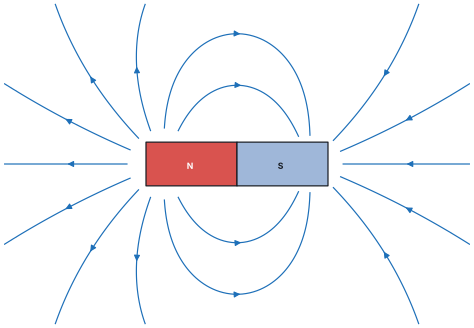
The space around a magnet in which its force can be felt is the magnetic field. It is shown by magnetic lines of force, which run from the N-pole to the S-pole outside the magnet. They are crowded near the poles, where the field is strongest.
8.1.1 Natural and artificial magnets
| Natural magnet | Artificial magnet |
|---|---|
| has magnetic properties naturally; found in the earth's crust | magnetic properties are given by people as needed |
| lodestone (magnetite, an iron ore) | bar, horseshoe, needle, ring magnets; electromagnets |
| irregular shape; strength cannot be changed | any shape; strength can be changed |
| weak | can be made strong; temporary or permanent |
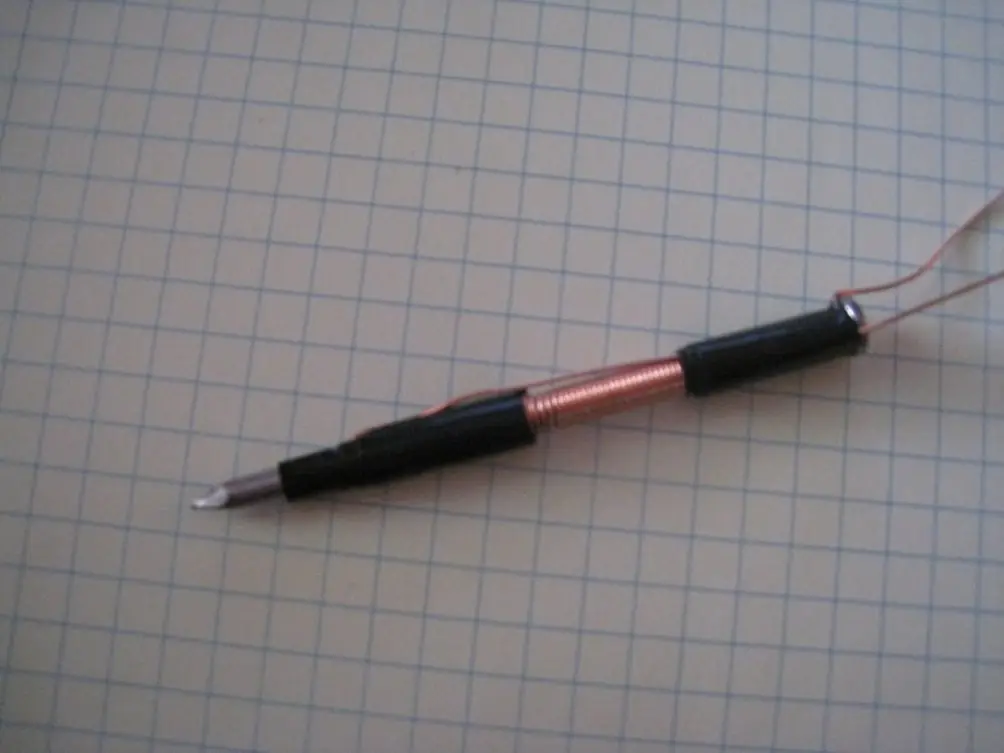
An electromagnet is an artificial magnet made by passing electric current through a coil (solenoid) of insulated wire wound on a soft-iron core (Activity 8.2: wind enamelled copper wire on an iron nail and connect it to a 1.5 V cell through a switch; the nail picks up pins only while the switch is ON).
Uses of magnets: in radios, televisions, fans, refrigerators, induction cookers, electric bells, generators and motors; in computers, hard disks, headphones and sensors; in MRI machines in hospitals; electromagnets lift iron plates in factories and ports; magnetic compass for direction; magnetic locks on doors.
8.1.2 Molecular theory of magnetism
Proposed by the German scientist Weber and developed by J. A. Ewing:
- Every magnetic substance is made of tiny molecular magnets, each with its own N and S poles.
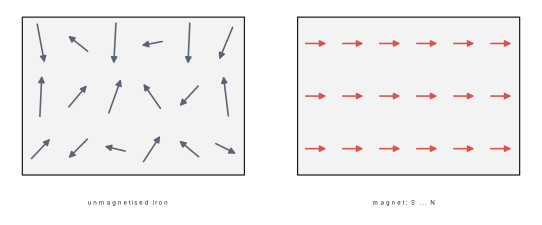
- In an unmagnetised substance the molecular magnets point in random directions and form closed chains, so their effects cancel.
- When the substance is magnetised, the molecular magnets line up in one direction in open chains; free N-poles collect at one end and free S-poles at the other.
- When all molecular magnets are aligned, the magnet cannot become any stronger — this is magnetic saturation.
8.1.3 Demagnetisation and keeping a magnet
Demagnetisation is the loss of the magnetic property of a magnet. It happens when the aligned molecular magnets are thrown back into random directions (closed chains).
| Cause | What it does |
|---|---|
| heating | molecules vibrate strongly and lose their alignment |
| hammering or dropping | jolts disturb the alignment |
| passing alternating current (a.c.) through a coil around it | the current keeps reversing and shakes the molecules out of line (Activity 8.3) |
| keeping like poles together for a long time | repulsion disturbs the alignment |
| natural loss | an old magnet kept without a keeper slowly weakens |
To keep a magnet strong: do not heat, hammer or drop it; keep it away from wires carrying current; store bar magnets in pairs with unlike poles side by side and soft- iron keepers across the ends.
8.2 Terrestrial magnetism and the magnetic compass
The earth behaves like a huge magnet. Its magnetism is called terrestrial magnetism (geomagnetism). It is produced by the movement (convection currents) of molten iron and nickel in the earth's outer core. The earth's magnetic poles are near — but not at — the geographic poles, and they shift slowly. The pole of the earth-magnet that lies near the geographic north is actually a magnetic south pole; that is why it attracts the N- pole of a compass needle.
Evidence: (1) a freely suspended magnet always rests north–south; (2) an iron rod buried north–south for a long time becomes slightly magnetised; (3) neutral points are found where the fields of a magnet and the earth cancel; (4) natural magnets (lodestone) exist in the earth.
Applications: the earth's magnetic field turns aside harmful charged particles of the solar wind towards the poles (where they cause auroras), protecting life; magnetism in igneous rocks helps to estimate their age and to find new ores; the magnetic compass — a small magnetised needle pivoted freely — shows direction to travellers, ships, submarines and aeroplanes (Activity 8.4). Many mobile phones also contain a compass sensor.
Elements of terrestrial magnetism
| Element | Meaning |
|---|---|
| Geographic meridian | vertical plane through the geographic north and south poles |
| Magnetic meridian | vertical plane in which a freely suspended magnet rests |
| Magnetic declination | the angle between the geographic meridian and the magnetic meridian at a place; it is used to correct compass readings in navigation and differs from place to place |
| Angle of dip (inclination) | the angle made by a freely suspended magnetic needle with the horizontal; measured with a dip circle. It is 0° at the magnetic equator, 90° at the magnetic poles, and about 42° in Kathmandu |
Declination is a horizontal angle (between true north and magnetic north). Dip is a vertical angle (between the needle and the horizontal). It is the dip that is 0° at the magnetic equator and 90° at the magnetic poles, because there the needle points straight down into the earth.
8.3 Static electricity and electric charge
Rub a plastic comb with dry hair and it picks up small bits of paper. Rubbing transfers tiny negatively charged particles (electrons) from one body to the other: the body that gains electrons becomes negatively charged, the one that loses them positively charged. Charge that stays on a body without flowing is static electricity. Like charges repel; unlike charges attract. Lightning is a huge discharge of static charge between clouds and the earth; tall buildings are protected by lightning conductors.
8.4 Electric circuit, current, potential difference and resistance
An electric circuit is a closed path of conductors through which current flows from the positive terminal of a source (cell) through a load (bulb) back to the negative terminal. A switch opens or closes the circuit.
| Quantity | Meaning | Unit | Measured by |
|---|---|---|---|
| Electric current (I) | rate of flow of charge | ampere (A) | ammeter, in series |
| Potential difference (V) | the "push" that drives charge between two points | volt (V) | voltmeter, in parallel |
| Resistance (R) | opposition to the flow of current | ohm (Ω) | from R=\frac{V}{I} |
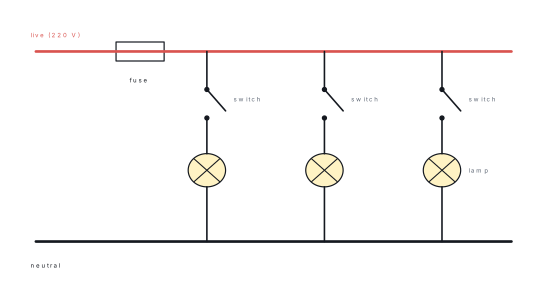
Loads may be joined in series (one path; the same current through each; one bulb fails, all go off) or in parallel (separate paths; each gets the full voltage and can be switched separately). House lights are in parallel; decorative disco lights are in series.
8.5 Ohm's law and its verification
At constant temperature, the current flowing through a conductor is directly proportional to the potential difference across its ends: V\propto I, or V=IR.
Verification: connect a cell (or several cells), an ammeter, a resistance wire and a switch in series, with a voltmeter across the wire. Increase the number of cells and record V and I each time. The ratio \frac{V}{I} stays the same, and a graph of V against I is a straight line through the origin.
Problem. A current of 0.5 A flows through a bulb connected to 220 V. Find its resistance.
Solution. R=\frac{V}{I}=\frac{220\ \text{V}}{0.5\ \text{A}}=440\ \Omega.
8.6 Household electrification: wiring, fuse, earthing and safety
Bringing electricity from the power house to homes through transmission lines is household electrification. High-voltage electricity from the national grid is stepped down by a substation transformer and supplied to houses at 220 V. Wiring inside a house with all safety measures is domestic wiring; copper cables are used.
Order of devices: service line → electric meter → main switch → distribution board with MCBs / fuses → switches → sockets and lamps.
| Device | Work |
|---|---|
| Main (master) switch | turns the supply of the whole house on or off; allows 15 A or 30 A; in series with all loads |
| Electric meter | records the electrical energy used, in units (kWh); kept in a meter box in series with the main switch |
| Distribution board | divides the supply into separate circuits for different rooms and appliances |
| MCB (miniature circuit breaker) | automatic switch that trips (opens) when too much current flows (overload or short circuit); it can be switched on again without replacing anything |
| Fuse | a short thin wire of tin and lead alloy with low melting point (and high resistance) in a ceramic holder; it melts when excess current flows, breaking the circuit; 5 A–30 A fuses are used in houses; connected in series in the live wire |
| Switch | makes or breaks the circuit of an appliance; connected in series in the live wire |
| Plug and socket | connect appliances to the supply; 2-pin or 3-pin |
| Bulb | changes electrical energy into light; filament (tungsten), fluorescent, CFL, LED; connected in parallel |
8.6.1 Live, neutral and earth wires
| Wire | Description | Colour (textbook) |
|---|---|---|
| Live (phase) | carries current at high potential (220 V); touching it gives a shock; switch and fuse are put in it | red (brown in new cables) |
| Neutral | at zero potential; completes the circuit back to the supply | black or blue |
| Earth | connects the metal body of each appliance to a metal plate buried deep in moist ground; safety wire | green or green-yellow |
Earthing is connecting the metal body of an appliance to the ground through a wire of low resistance, so that any leaking current flows instantly into the earth instead of through a person. It prevents electric shock and fires. The earth pin of a 3-pin plug is the top, thickest pin.
Different colours are used so that the live, neutral and earth wires are not mixed up and faults are easy to find and repair. The switch and fuse are put in the live wire so that when the switch is off or the fuse has melted, the appliance is completely cut off from the high potential and is safe to touch.
8.6.2 Wiring a three-pin plug
- Switch off the main switch first (an adult must be present).
- Unscrew and open the cover of the plug.
- Remove about 1.5 cm of the outer insulation of the cable and expose the three wires; strip a little insulation from each.
- Twist the bare strands of each wire.
- Connect the live (red/brown) wire to the right-hand pin (the one with the fuse), the neutral (black/blue) wire to the left-hand pin, and the earth (green/yellow) wire to the top pin; tighten each screw.
- Clamp the cable firmly with the cord grip so that it cannot pull out.
- Replace and screw the cover; test with a tester before use.
Never touch switches with wet hands; never put fingers or metal into a socket; do not overload a socket with many plugs; replace damaged wires; use the correct fuse and earthed 3-pin plugs for metal appliances; switch off the main switch before any repair.
8.7 The electric meter, the unit (kWh) and the electricity bill
The commercial unit of electrical energy is the kilowatt-hour (kWh), called one unit. One unit is the energy used by an appliance of power 1000 W (1 kW) working for 1 hour. (1\ \text{kWh}=1000\ \text{W}\times3600\ \text{s}=3.6\times10^6 J.)
where E is energy in kWh, P the power of one appliance in kW, N the number of appliances and t the time in hours. Bill = units × rate. (If the meter shows 40 units and the rate is Rs 8 per unit, the bill is 40\times8= Rs 320.)
Problem. Four 60 W bulbs are used for 3.5 h a day. Find the monthly (30-day) bill at Rs 8.50 per unit.
Solution. P=60 W =0.06 kW, N=4, t=3.5 h. Energy per day =0.06\times4\times3.5=0.84 kWh. Energy per month =0.84\times30=25.2 units. Bill =25.2\times8.50= Rs 214.20.
Problem. A house uses five 20 W LED bulbs for 6 h a day, one 1000 W rice cooker for 1 h a day and one 100 W television for 4 h a day. Find the units used in 30 days and the bill at Rs 10 per unit. Solution. LED bulbs: 0.02\times5\times6=0.6 kWh. Cooker: 1\times1\times1=1.0 kWh. TV: 0.1\times1\times4=0.4 kWh. Per day =0.6+1.0+0.4=2.0 kWh. In 30 days =2.0\times30=60 units. Bill =60\times10= Rs 600.
Divide the power in watts by 1000 before multiplying by hours; and change minutes into hours (40 min =\frac{40}{60} h). Most wrong answers come from skipping one of these steps.
8.8 Magnetic effect of current; the electric bell
A wire carrying current produces a magnetic field around it (Oersted's discovery: a compass needle near a current-carrying wire turns). A coil of wire on a soft-iron core becomes a strong electromagnet while current flows and loses its magnetism when the current stops. Its strength increases with more turns of wire and more current.
Electric bell. When the switch is pressed, current flows through the coils of an electromagnet; it attracts a soft-iron armature, so the hammer strikes the gong. As the armature moves, the circuit breaks at the contact screw; the electromagnet stops working and a spring pulls the armature back, which closes the circuit again. This repeats quickly, so the bell rings continuously while the switch is pressed.
Electromagnets are also used in cranes, motors, loudspeakers, relays, MRI machines and magnetic door locks. The link between electricity and magnetism also works the other way: moving a magnet in a coil produces current, which is how generators in hydropower plants work.
Chapter summary
- Magnets attract iron, cobalt and nickel; like poles repel, unlike poles attract; a suspended magnet points north–south.
- Natural magnet: lodestone. Artificial: bar, horseshoe, electromagnet.
- Molecular theory (Weber, Ewing): aligned molecular magnets = magnet; random = unmagnetised; all aligned = saturation. Heating, hammering, a.c. and like-pole storage demagnetise.
- Earth is a magnet (molten iron in the outer core). Declination: angle between geographic and magnetic meridians. Dip: angle with the horizontal (0° at magnetic equator, 90° at poles).
- V=IR (Ohm's law); current in A, p.d. in V, resistance in Ω.
- House supply 220 V: meter → main switch → distribution board (MCB/fuse) → switches → loads in parallel. Fuse and switch in the live wire; earth wire protects from shock.
- 1 unit = 1 kWh; E=P\times N\times t; bill = units × rate.
Practice questions
Group A — Multiple choice (1 mark each)
- Which of the following is a natural magnet? [1]alimestonebnickelclodestonedelectromagnet
- In household wiring, the switch is connected in the [1]aneutral wirebearth wirecfuse wiredlive wire
- How is earthing done in household wiring? [1]aany wire is buried in the earthba green wire is buried in the earthca wire from the plug is joined to the earthdan earth wire from every appliance is connected to a plate buried in the earth
- The angle of dip at the magnetic equator is [1]a0°b42°c60°d90°
- The fuse wire is made of an alloy of [1]acopper and zincbtin and leadciron and nickeldtungsten
- One unit of electricity equals [1]a1 W hb1 kW hc1 kW sd1000 kW h
Answers to Group A
1. (c).
2. (d).
3. (d).
4. (a) — the needle lies horizontal.
5. (b) — low melting point.
6. (b).
Group B — Short answer (2 marks each) (Textbook exercise 2–4.)
- Differentiate:(a) natural and artificial magnet(b) plug and socket(c) live and neutral wire. [3]
- Give reasons:(a) A magnet is demagnetised by hammering.(b) The angle of dip at the magnetic poles is 90°.(c) Different coloured wires are used in house wiring.(d) The fuse is connected in the live wire. [4]
- What are the causes of demagnetisation? Explain one. [2]
- Explain the molecular theory of magnetism with a diagram. [2]
- Write three uses of magnets. [2]
- What is terrestrial magnetism? Write three applications. [2]
- "Magnetisation of magnetic materials in nature is the effect of terrestrial magnetism." Justify. [2]
- What is earthing? Why is it necessary? [2]
- According to the molecular theory, can a magnetic substance become a magnet and a magnet lose its magnetism? Justify. [2]
- Is there a connection between magnetism and electricity? Explain with an activity. [2]
Answers to Group B
1. (a) See the table in 8.1.1. (b) A plug is fitted at the end of an appliance's cable and has pins; a socket is fixed on the wall, connected to the supply, and has holes into which the plug fits. (c) The live wire carries current at high potential (220 V), gives a shock, and has the switch and fuse; the neutral wire is at zero potential and completes the circuit.
2. (a) The jolts disturb the aligned molecular magnets into random closed chains. (b) At the magnetic poles the earth's field is vertical, so a freely suspended needle points straight down, at 90° to the horizontal. (c) So that live, neutral and earth wires are not confused, and faults can be found and repaired safely. (d) When the fuse melts, the appliance is cut off from the high potential and becomes safe; a fuse in the neutral would leave the appliance live.
3. Heating, hammering or dropping, passing a.c. through a coil around it, keeping like poles together, natural ageing. Heating: heat makes the molecular magnets vibrate so strongly that they lose their parallel alignment and form closed chains.
4. See 8.1.2 and its figure: random closed chains in unmagnetised iron; aligned open chains in a magnet; all aligned at saturation.
5. Electric motors, generators and bells; compass for direction; MRI in hospitals; electromagnetic cranes; speakers and hard disks.
6. The magnetic property of the earth, produced by molten iron and nickel moving in the outer core. Applications: compass navigation; shielding the earth from charged particles of the solar wind; estimating the age of rocks and finding ores.
7. Iron ores lying in the earth's field for ages become magnetised, forming lodestone; an iron rod buried north–south for a long time becomes a weak magnet. Both are magnetised by the earth's field.
8. Connecting the metal body of an appliance to the ground through a low-resistance wire. If the live wire touches the body, the current flows into the ground at once (and the fuse/MCB trips) instead of through a person, preventing shock and fire.
9. Yes. Magnetism depends only on the arrangement of the molecular magnets. If the random molecules of iron are aligned (by rubbing with a magnet or by current), the iron becomes a magnet; if the aligned molecules of a magnet are disturbed (by heating, hammering or a.c.), it loses its magnetism. Non-magnetic substances like wood have no molecular magnets and cannot be magnetised.
10. Yes. Wind insulated wire round an iron nail and connect it to a cell through a switch: the nail attracts pins only while current flows — current produces magnetism. Conversely, moving a magnet in a coil produces current (generator).
Group C — Numerical and long answer (4 marks each)
- Bhawana's meter records 15 units in 15 days. Find the average monthly bill at Rs 9.50 per unit. [2]
- Eight 25 W bulbs are used for 4 h 40 min daily. Find the energy used per day in units. [2]
- Sharmila's sub-meter records 8.5 units in a month (30 days) for one 65 W bulb. Find the average daily time the bulb is used. [2]
- A municipality runs 14 street lights of 1500 W each for 6.5 h daily. Find the monthly (30-day) bill at Rs 12.50 per unit. [3]
- What is household electrification? Name the devices from the meter to the lamp, and write the features of the live and neutral wires. [4]
- Write the steps of wiring a three-pin plug. [4]
Answers to Group C
1. Units per day =\frac{15}{15}=1; per month =1\times30=30 units. Bill =30\times9.50= Rs 285. (The textbook prints Rs 1425; that would need 150 units a month, i.e. 75 units in 15 days. With the data as given, the bill is Rs 285.)
2. P=25 W =0.025 kW, N=8, t=4\frac{40}{60}=4.667 h. E=0.025\times8\times4.667=0.933 units. (The textbook prints 0.0932; the correct value is about 0.933 units.)
3. Units per day =\frac{8.5}{30}=0.2833 kWh. t=\frac{E}{P}=\frac{0.2833}{0.065}=4.36 h (about 4 h 22 min).
4. E per day =1.5\times14\times6.5=136.5 units; per month =136.5\times30=4095 units. Bill =4095\times12.50= Rs 51,187.50.
5. Bringing electricity from the power house to homes through transmission lines and wiring the house safely. Devices: service line → electric meter → main switch → distribution board with MCBs/fuses → switches → lamps and sockets. Live wire: high potential (220 V), gives shock, red/brown, has switch and fuse. Neutral wire: zero potential, completes the circuit, black/blue.
6. See the seven steps in 8.6.2 (switch off; open cover; strip insulation; twist strands; live to right pin with fuse, neutral to left, earth to top; clamp the cord; close and test).
Practise more: Science and Technology question bank