Unit 10 · Science and Technology · 22 min read
Materials Used in Daily Life
What the syllabus asks for 7
- water: sources, hardness, purification and water-borne disease
- water pollution and its control
- cement, glass and ceramics
- plastics and polymers: uses and environmental harm
- soap, detergent and fertiliser
- fibre: natural and synthetic
- fuel and combustion; fire safety
Fruits, vegetables, soaps, shampoos, sanitisers and cleaning agents all contain acids, bases or salts. The water we drink may be soft or hard, and the vessels and tools we use are often made of alloys rather than pure metals. This unit studies the materials of daily life: water (its hardness, purification and pollution, including acid rain), building and household materials (cement, glass, plastics, soap, fertiliser, fibres and fuels), and — the main lessons of the CDC textbook — acids, bases and salts, acid rain, hardness of water and alloys.
Define acid, base, alkali and salt; tell organic from inorganic and strong from weak acids; give the colours of litmus, methyl orange and phenolphthalein; write the reactions of acids with metals, carbonates and bases, and of bases with ammonium salts; classify salts as neutral, acidic or basic; explain the causes, effects and prevention of acid rain; define hard and soft water and the methods of removing temporary and permanent hardness; and state the composition and uses of steel, stainless steel, brass and bronze.
10.1 Water: sources, hardness, purification and water-borne disease
Our water comes from rain, springs, rivers, lakes, wells (kuwa), stone spouts (dhara) and tube wells. Surface water (rain, rivers) is usually soft; groundwater (wells, tube wells) is often hard, because it dissolves salts from rocks.
10.1.1 Soft and hard water
Add two drops of liquid soap to water samples from different sources and stir (Activity 10.13): some give plenty of lather, some very little.
Soft water is water that contains no dissolved salts of calcium and magnesium; it lathers easily with soap (rain water, boiled water, most river water). Hard water contains dissolved salts (bicarbonates, sulphates, chlorides) of calcium and magnesium; it gives little lather with soap. Hardness of water is the property of water by which it does not form lather easily with soap, because of these dissolved salts.
Problems of hard water: much soap is wasted; clothes washed in it become dull and greyish because the soap forms a sticky scum; a white scale collects in kettles, pipes and boilers, wasting fuel and blocking pipes.
| Temporary hardness | Permanent hardness |
|---|---|
| caused by bicarbonates of calcium and magnesium — Ca(HCO₃)₂, Mg(HCO₃)₂ | caused by sulphates and chlorides of calcium and magnesium — CaSO₄, MgCl₂ |
| removed by boiling or by Clark's method (adding lime, Ca(OH)₂) | not removed by boiling; removed by washing soda or the permutit (zeolite) method |
Removing temporary hardness
- Boiling: the soluble bicarbonate changes into insoluble carbonate, which settles: Ca(HCO₃)₂ --heat--> CaCO₃↓ + H₂O + CO₂↑
- Clark's method: a calculated amount of slaked lime is added; the insoluble carbonate is filtered off: Ca(HCO₃)₂ + Ca(OH)₂ → 2CaCO₃↓ + 2H₂O
Removing permanent hardness
- Washing soda (sodium carbonate): CaSO₄ + Na₂CO₃ → CaCO₃↓ + Na₂SO₄ (the precipitate is filtered off).
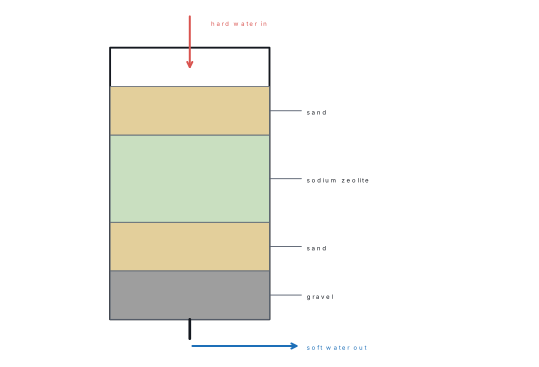
- Permutit method: hard water is passed through a column of sodium zeolite (sodium aluminium silicate) packed between layers of sand and gravel. The calcium and magnesium ions are held by the zeolite and sodium ions go into the water, which comes out soft: Na₂Z + CaSO₄ → CaZ + Na₂SO₄. The used zeolite is renewed by washing it with strong salt solution.
Roshan gets little lather with well water. Advice: boil the water first (removes temporary hardness) or add a little washing soda, and let the precipitate settle; alternatively use rain water or a detergent, which works even in hard water.
Riya's white clothes turn dull with tube-well water. Reason: the calcium and magnesium salts form an insoluble scum with soap that sticks to the cloth. Advice: soften the water with washing soda (or boiling), or use detergent, and rinse well.
10.1.2 Purification of water
| Method | What it removes |
|---|---|
| sedimentation (with alum) and decantation | mud and suspended particles |
| filtration (sand, ceramic candle filter, cloth) | suspended dirt and many germs |
| boiling for several minutes | germs (not dissolved salts) |
| chlorination (bleaching powder, chlorine tablets) | germs |
| SODIS — clear bottles in strong sun for about six hours | germs, where fuel is scarce |
| distillation | dissolved salts and germs — gives pure water |
10.1.3 Water-borne diseases
Cholera, typhoid, diarrhoea, dysentery, jaundice (hepatitis A) and worm infections spread through water and food contaminated by faeces. Prevention: drink boiled or filtered water; wash hands with soap before eating and after using the toilet; use toilets and keep water sources away from them; cover stored water.
10.2 Water pollution and its control; acid rain
Sources of water pollution: untreated sewage, industrial waste, chemical fertilisers and pesticides washed from fields, dumping of solid waste and plastic in rivers, washing clothes and animals in rivers, and acid rain. Excess fertiliser makes algae grow fast; when the algae die and decay they use up the dissolved oxygen and fish die. Control: treat sewage and factory waste before release; never dump waste in rivers; use fertilisers and pesticides carefully; plant trees along river banks; build toilets.
10.2.1 Acid rain
Acid rain is rain that has become acidic because acids formed in the atmosphere (mainly sulphuric acid and nitric acid) have mixed with it.
Normal rain is slightly acidic (about pH 5.6–6) because carbon dioxide dissolves in it to form weak carbonic acid; this is not very harmful. Rain with strong acids has a lower pH and is harmful.
How the acids form. Natural sources: volcanic eruptions and decay of plants and animals give oxides of sulphur and nitrogen. Human sources (the main cause): burning coal, petrol and diesel in vehicles, factories and brick kilns. These oxides react with water vapour in the air: sulphur dioxide → sulphuric acid; nitrogen oxides → nitric acid.
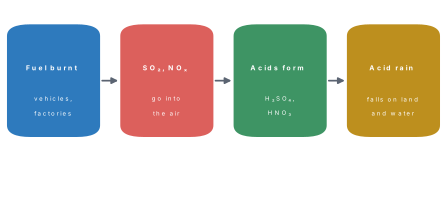
Effects: rivers, lakes and ponds become acidic, harming fish and water life; leaves are damaged and soil fertility falls, so crop production declines; forests may be destroyed; temples, monuments and statues of marble and metal corrode (the Taj Mahal in India is a famous example of marble damage). Prevention: use less fossil fuel; use renewable energy (hydroelectricity, solar); control vehicle and factory smoke; set up industries away from settlements. For farmland already affected: add lime or wood ash (both are bases) to neutralise the soil acidity, use compost, and grow crops that tolerate acidic soil.
10.3 Cement, glass and ceramics
| Material | Raw materials | Useful property and use |
|---|---|---|
| Cement | limestone and clay heated in a kiln, ground with a little gypsum | sets hard with water (a chemical change); binds sand and gravel into concrete for buildings, bridges, dams |
| Glass | sand (silica), soda ash and limestone melted together | transparent, hard, does not rust; windows, bottles, lenses |
| Ceramics | clay shaped and baked in a kiln | hard, heat resistant, does not react with food; bricks, tiles, pottery, cups |
Cement does not simply dry; it reacts with water. Fresh concrete is kept wet (cured) for several days — if it dries too quickly it becomes weak.
10.4 Plastics and polymers: uses and environmental harm
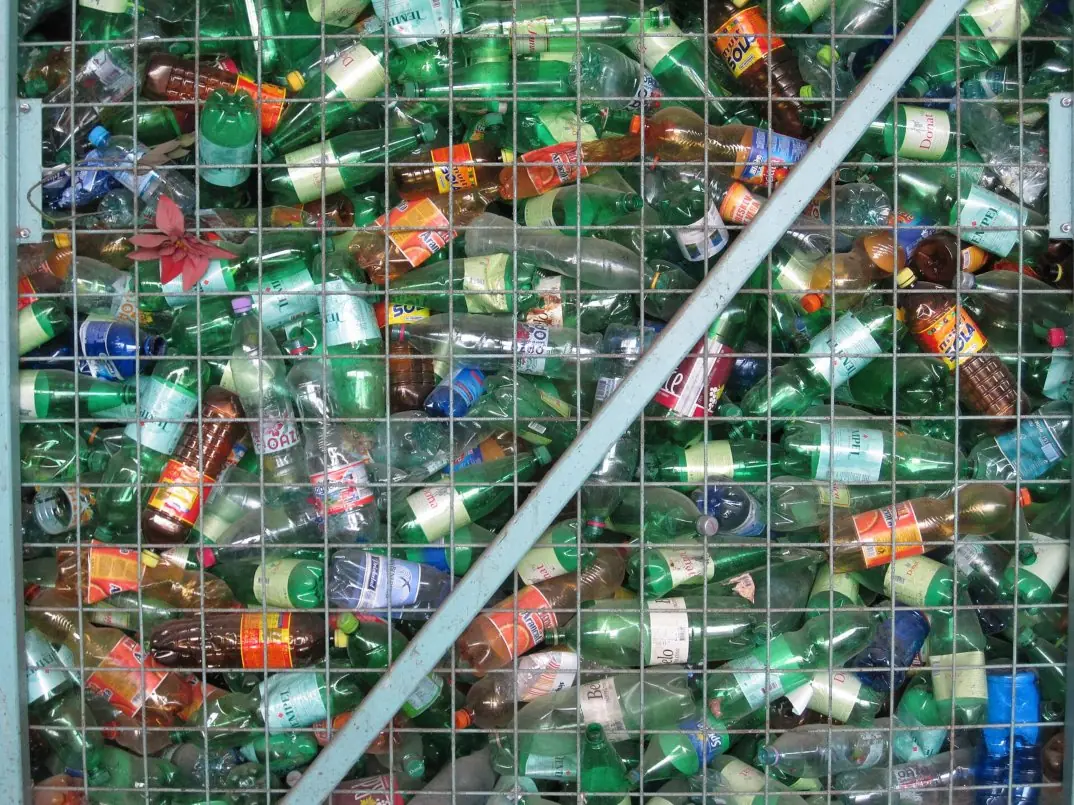
A polymer is a giant molecule made by joining many small units. Plastics are synthetic polymers made mainly from petroleum. Thermoplastics (polythene, PVC, nylon) soften on heating and can be reshaped; thermosetting plastics (bakelite, melamine) set permanently and are used for switches and pan handles. Harm: plastics are non-biodegradable — they stay in soil and water for many years; they block drains, choke animals that swallow them, form microplastics in rivers, and give poisonous gases when burnt. What to do: reduce (use cloth bags), reuse, recycle, and separate waste at home.
10.5 Soap, detergent and fertiliser
Soap is made by boiling oil or fat with an alkali (sodium hydroxide). A soap molecule has a long tail that holds grease and a head that holds water, so it lifts oily dirt off cloth. Detergents are made from petroleum products; they work well even in hard water, but some are slow to break down in rivers.
Fertilisers supply nitrogen (N, for leaves), phosphorus (P, for roots, flowers, seeds) and potassium (K, for strength). Chemical fertilisers (urea, DAP, potash) act quickly; compost and farmyard manure release nutrients slowly and improve the soil. Overuse of chemical fertiliser harms soil and pollutes water.
10.6 Fibre: natural and synthetic
| Natural fibres | Synthetic fibres |
|---|---|
| from plants or animals: cotton, jute, allo (Himalayan nettle), silk, wool | made from petroleum chemicals: nylon, polyester, acrylic |
| absorb sweat, comfortable | strong, cheap, quick drying, do not absorb sweat |
| biodegradable | non-biodegradable; melt and stick to skin in fire |
10.7 Fuel and combustion; fire safety
A fuel burns in air to give heat (wood, kerosene, LPG, petrol, diesel, coal, biogas). Combustion needs three things together — fuel, oxygen and heat (the fire triangle). Removing any one puts out the fire: water removes heat; sand, a fire blanket or a damp cloth cuts off oxygen; closing the gas valve removes the fuel. Fire safety: never leave a stove burning unattended; turn off the LPG regulator at the cylinder; if gas leaks, do not light a match or switch on a light — open doors and windows; never pour water on burning oil or an electrical fire; keep a bucket of sand near the kitchen. Fire extinguishers often use sodium bicarbonate, which releases carbon dioxide.
10.8 Acids, bases and salts in daily life
10.8.1 Acids
An acid is a substance that gives hydrogen ions (H⁺) when dissolved in water. HCl → H⁺ + Cl⁻
| Organic acids | Inorganic (mineral) acids |
|---|---|
| found naturally in plants and animals | prepared in the laboratory from minerals |
| usually weak and many are edible | usually strong, corrosive, not edible |
| citric acid (lemon), acetic acid (vinegar), lactic acid (curd, milk), oxalic acid (tomato), tartaric acid (tamarind, grapes), formic acid (ant sting, nettle) | hydrochloric acid (HCl), sulphuric acid (H₂SO₄), nitric acid (HNO₃), carbonic acid |
A strong acid gives many H⁺ ions in water (HCl, H₂SO₄, HNO₃); a weak acid gives few (citric, acetic). That is why sulphuric acid burns cloth but lemon juice does not. The hydrochloric acid in our stomach is an inorganic acid, though it is made by the body.
Physical properties: sour taste; soluble in water; turn blue litmus red (red litmus stays red); turn methyl orange red; phenolphthalein stays colourless.
Chemical properties
- With metals — give a salt and hydrogen (the gas burns with a 'pop'): Mg + 2HCl → MgCl₂ + H₂↑ (zinc also gives bubbles of hydrogen in dilute acid).
- With metal carbonates — give a salt, water and carbon dioxide (turns lime water milky): CaCO₃ + 2HCl → CaCl₂ + H₂O + CO₂↑
- With bases — give a salt and water (neutralisation): HCl + NaOH → NaCl + H₂O; H₂SO₄ + 2KOH → K₂SO₄ + 2H₂O
| Acid | Uses |
|---|---|
| citric acid | preserving food, giving a sour taste |
| ascorbic acid | vitamin C in medicines |
| acetic acid (vinegar) | pickles (Activity 10.7: radish in vinegar stays fresh) |
| tartaric acid | baking powder |
| hydrochloric acid | digestion in the stomach; cleaning toilets; making PVC |
| nitric acid | nitrogen fertilisers, explosives |
| sulphuric acid | car batteries, fertilisers, dyes, detergents, artificial silk |
10.8.2 Bases and alkalis
A base is a metal oxide or hydroxide (Na₂O, NaOH, KOH, MgO, Ca(OH)₂). A base that dissolves in water is an alkali; alkalis give hydroxide ions (OH⁻) in water: NaOH → Na⁺ + OH⁻.
All alkalis are bases, but not all bases are alkalis (e.g. copper oxide does not dissolve). Strong bases (NaOH, KOH) give many OH⁻ ions; weak bases (ammonium hydroxide) give few.
Physical properties (Activity 10.8 with ash water): bitter taste; soapy, slippery feel; turn red litmus blue; turn methyl orange yellow; turn phenolphthalein pink.
Chemical properties: with acids they form salt and water (neutralisation); with ammonium salts they give ammonia gas (which turns moist red litmus blue): (NH₄)₂SO₄ + 2NaOH → Na₂SO₄ + 2NH₃↑ + 2H₂O
| Base | Uses |
|---|---|
| calcium hydroxide (slaked lime) | whitewashing, bleaching powder, reducing soil acidity |
| magnesium hydroxide | antacid (milk of magnesia) for hyperacidity (gastritis) |
| sodium hydroxide (caustic soda) | soap, paper, cloth, refining petroleum |
| ammonium hydroxide | laboratory reagent, fertilisers, rayon, plastics, dyes |
Ash contains alkaline compounds of potassium and calcium, so farmers spread ash to reduce soil acidity. A gastritis patient takes magnesium hydroxide because this base neutralises the excess hydrochloric acid in the stomach.
10.8.3 Salts
A salt is the compound formed, together with water, when an acid reacts with a base.
| Type | Formed from | Example |
|---|---|---|
| Neutral salt | strong acid + strong base (or weak + weak) | sodium chloride, NaCl |
| Acidic salt | strong acid + weak base | ammonium chloride, NH₄Cl (from HCl + NH₄OH) |
| Basic salt | strong base + weak acid | sodium carbonate, Na₂CO₃ (from NaOH + H₂CO₃) |
Properties: most are tasteless (table salt is salty, some are bitter); most dissolve in water; white or colourless, some coloured (copper sulphate is blue); high melting and boiling points; neutral salts do not change indicators. In water they split into ions: NaCl → Na⁺ + Cl⁻.
Reactions: with acids — H₂SO₄ + 2NaCl → Na₂SO₄ + 2HCl; with bases — 2NH₄Cl + Ca(OH)₂ → CaCl₂ + 2NH₃ + 2H₂O; displacement — a more reactive metal pushes a less reactive metal out of its salt (Activity 10.11: iron in blue copper sulphate solution turns reddish-brown with copper, and the solution turns pale green): Fe + CuSO₄ → FeSO₄ + Cu
| Salt | Uses |
|---|---|
| sodium chloride (common salt) | flavouring and preserving food; making NaOH, washing soda, soap |
| sodium carbonate (washing soda) | removing permanent hardness; making glass, paper, soap |
| sodium bicarbonate (baking soda) | baking powder, antacid, fire extinguishers |
| Indicator | Acid | Base | Neutral salt solution |
|---|---|---|---|
| blue litmus | red | blue | no change |
| red litmus | red | blue | no change |
| methyl orange | red | yellow | orange (no change) |
| phenolphthalein | colourless | pink | colourless |
Problem. Three colourless liquids P, Q and R are tested. P turns blue litmus red and gives bubbles with a marble chip (CaCO₃). Q turns phenolphthalein pink. R changes neither litmus paper. Identify each and write the reaction of P with the marble chip if P is dilute hydrochloric acid.
Solution. P is an acid (blue litmus → red; carbonate gives CO₂). Q is a base (alkali) (phenolphthalein pink). R is neutral — water or a neutral salt solution such as common salt. CaCO₃ + 2HCl → CaCl₂ + H₂O + CO₂↑ (the gas turns lime water milky).
Problem. Sample X lathers well after boiling. Sample Y still does not lather after boiling, but lathers after washing soda is added. Name the hardness in each.
Solution. X has temporary hardness (calcium/magnesium bicarbonates), removed by boiling: Ca(HCO₃)₂ → CaCO₃ + H₂O + CO₂. Y has permanent hardness (sulphates or chlorides), not removed by boiling but removed by washing soda: CaSO₄ + Na₂CO₃ → CaCO₃ + Na₂SO₄.
10.9 Alloys
Ramila's mother wanted a 24-carat gold bangle, but the goldsmith advised 22 carat for daily wear. 24-carat gold is pure and soft; 22-carat gold is mixed with a little copper or silver, which makes it harder, so it does not bend or wear away easily.
An alloy is a homogeneous mixture made by melting a metal with other metals or with a non-metal, to improve its properties.
Properties of alloys: harder and stronger than the pure metal, but less malleable and ductile; resist rusting and corrosion better; have a different melting point and colour from their metals; generally have better properties for use. Example: aluminium is light but soft; duralumin (aluminium with copper, manganese and magnesium) is light and strong and is used for aircraft bodies.
| Alloy | Composition | Uses |
|---|---|---|
| Steel | iron + a little carbon | buildings, bridges, railings, tools — much harder and stronger than iron |
| Stainless steel | iron + chromium + nickel (+ a little carbon) | kitchen utensils, surgical instruments — does not rust |
| Brass | copper + zinc | puja items, gagri, idols, nuts and bolts, plumbing fittings |
| Bronze | copper + tin | plates, bowls, tumblers, medals, coins, statues, bells |
Steel and stainless steel are preferred to pure iron for kitchen utensils because pure iron is soft and rusts, while stainless steel is hard, shiny and rust-free.
Chapter summary
- Hard water has Ca and Mg salts. Temporary (bicarbonates): boiling, Clark's method. Permanent (sulphates, chlorides): washing soda, permutit.
- Water is purified by sedimentation, filtration, boiling, chlorination, SODIS, distillation.
- Acid rain: SO₂ and NOₓ from burning fuels form H₂SO₄ and HNO₃; harms water life, crops, forests and monuments.
- Acid gives H⁺ (sour, blue litmus → red, methyl orange red, phenolphthalein colourless). Base/alkali gives OH⁻ (bitter, soapy, red litmus → blue, methyl orange yellow, phenolphthalein pink).
- Acid + metal → salt + H₂; acid + carbonate → salt + H₂O + CO₂; acid + base → salt + water.
- Salts are neutral (NaCl), acidic (NH₄Cl) or basic (Na₂CO₃).
- Alloys: steel (Fe + C), stainless steel (Fe + Cr + Ni), brass (Cu + Zn), bronze (Cu + Sn).
Practice questions
Group A — Multiple choice (1 mark each) (Textbook exercises.)
- A property of an acid is [1]abitterbslipperycsourdcolourless
- Which turns red litmus blue? [1]acurdbtomatoccola drinkdsoapy shampoo
- Bubbles come out as soon as zinc is put in a liquid. The liquid is [1]awaterban acidca baseda salt solution
- Ash is used to reduce soil acidity because ash is [1]acheapbfound at homecalkalineda salt
- Which salt is used in fire extinguishers? [1]asodium carbonatebpotassium carbonatecsodium bicarbonatedpotassium sulphate
- Hard water contains [1]amagnesium sulphatebmagnesium oxidecmagnesium nitratedmagnesium sulphide
- Permanent hardness is removed by [1]aboilingbClark's methodcthe permutit methoddcalcium hydroxide
- Which water has the least hardness? [1]arain waterbwell waterctube-well waterdriver water
- Alloys are used more than pure metals because [1]athey are cheaperbtheir properties are improvedcthey are easily availabledthey are good for health
- Brass is made by mixing [1]acopper and zincbcopper and tinccopper and carbondcopper and nickel
- Adding a little carbon to iron to make steel makes it [1]asofterbharder and strongercliquiddnon-magnetic
- Copper mixed with tin forms [1]asteelbstainless steelcbrassdbronze
- Which statement is true? [1]aan alloy is harder than its metalban alloy is more flexiblecan alloy is dullerdan alloy is more ductile
Answers to Group A
1. (c).
2. (d) — soap-based shampoo is basic; the others are acidic.
3. (b) — the gas is hydrogen.
4. (c).
5. (c) — it gives CO₂.
6. (a).
7. (c).
8. (a).
9. (b).
10. (a).
11. (b).
12. (d).
13. (a).
Group B — Short answer (2 marks each)
- Differentiate:(a) organic and inorganic acid(b) strong and weak acid(c) base and alkali. [3]
- Give reasons:(a) Rain water is generally acidic.(b) Ammonium chloride is an acidic salt.(c) Sulphuric acid corrodes cloth but lemon juice does not.(d) Gastritis patients are relieved by magnesium hydroxide. [4]
- Show in a table the action of acids, bases and salts on litmus, methyl orange and phenolphthalein. [3]
- Sample A gives red with methyl orange, red with litmus and colour X with phenolphthalein; sample B gives colour Y with methyl orange, blue with litmus and pink with phenolphthalein. (i) Name X and Y. (ii) Which sample gives CO₂ with calcium carbonate? [2]
- Differentiate:(a) soft and hard water(b) temporary and permanent hardness(c) Clark's method and permutit method(d) pure metal and alloy(e) steel and stainless steel. [5]
- Give reasons:(a) Steel is used more than iron for kitchen utensils.(b) Rain water gives more lather with soap.(c) Well water is hard.(d) The use of alloys is increasing. [4]
- Rama won a bronze medal. Which metals is it made of? Name the metals in steel, stainless steel and brass. [2]
Answers to Group B
1. (a) See the table in 10.8.1. (b) A strong acid gives many H⁺ ions in water (HCl); a weak acid gives few (acetic acid). (c) A base is any metal oxide or hydroxide; an alkali is a base that dissolves in water and gives OH⁻ ions (NaOH). All alkalis are bases, not all bases are alkalis.
2. (a) Carbon dioxide in the air dissolves in rain to form weak carbonic acid. (b) It is formed from a strong acid (HCl) and a weak base (NH₄OH). (c) Sulphuric acid is a strong acid giving many H⁺ ions; citric acid in lemon is a weak organic acid. (d) Mg(OH)₂ is a mild base that neutralises excess stomach acid.
3. See the indicator table in 10.8.3.
4. (i) X = colourless (A is an acid); Y = yellow (B is a base). (ii) A, the acid.
5. (a) Soft water has no Ca/Mg salts and lathers easily; hard water has them and lathers poorly. (b) See the table in 10.1.1. (c) Clark's method adds lime to remove temporary hardness by precipitating carbonate; the permutit method passes water through sodium zeolite to remove permanent hardness by exchanging Ca/Mg for Na. (d) A pure metal has one kind of atom and is usually softer; an alloy is a mixture with improved hardness and resistance to corrosion. (e) Steel is iron + carbon and can rust; stainless steel also has chromium and nickel and does not rust.
6. (a) Steel (stainless) is harder, stronger and does not rust, while iron is soft and rusts. (b) It contains no calcium or magnesium salts. (c) Underground water dissolves calcium and magnesium salts from rocks. (d) Alloys are harder, stronger, more corrosion-resistant and can be made for special uses.
7. Bronze: copper and tin. Steel: iron and carbon; stainless steel: iron, chromium and nickel; brass: copper and zinc.
Group C — Long answer (4 marks each)
- What is an acid? Write three chemical properties of acids with balanced equations. [4]
- Define base. Write two properties of bases and the uses of three bases. [4]
- What is a salt? Explain neutral, acidic and basic salts with examples, and write the displacement reaction of iron with copper sulphate. [4]
- List the causes of acid rain. How is it harmful? How can it be prevented? Suggest how farmers can improve crop production in soil damaged by acid rain. [4]
- Define hardness of water and give its causes. Describe the permutit method with a diagram. [4]
- What is an alloy? Why are alloys becoming popular? Write the composition and two uses of four alloys. [4]
Answers to Group C
1. A substance that gives H⁺ ions in water. Mg + 2HCl → MgCl₂ + H₂; CaCO₃ + 2HCl → CaCl₂ + H₂O + CO₂; HCl + NaOH → NaCl + H₂O.
2. A metal oxide or hydroxide; soluble bases (alkalis) give OH⁻ ions. Properties: turn red litmus blue and phenolphthalein pink; react with acids to give salt and water; with ammonium salts give ammonia. Uses: Ca(OH)₂ — whitewash and reducing soil acidity; Mg(OH)₂ — antacid; NaOH — soap and paper.
3. A compound formed with water when an acid reacts with a base. Neutral: NaCl (HCl + NaOH); acidic: NH₄Cl (HCl + NH₄OH); basic: Na₂CO₃ (NaOH + H₂CO₃). Fe + CuSO₄ → FeSO₄ + Cu — iron is more reactive and displaces copper.
4. Causes: oxides of sulphur and nitrogen from burning fossil fuels in vehicles, factories and kilns (and volcanoes) form sulphuric and nitric acids in the air. Harm: acidic rivers and lakes kill fish; leaves and soil are damaged and crops fall; forests die; monuments and statues corrode. Prevention: less fossil fuel, renewable energy, smoke control, industries away from settlements. For farmers: add lime or ash to neutralise soil acidity, add compost, test soil pH, grow acid-tolerant crops.
5. The property of water of not lathering easily with soap, due to dissolved salts of calcium and magnesium (bicarbonates for temporary, sulphates and chlorides for permanent hardness). Permutit method: see the figure and text in 10.1.1 — hard water flows through sodium zeolite; Na₂Z + CaSO₄ → CaZ + Na₂SO₄; soft water comes out.
6. A homogeneous mixture of a metal with other metals or a non-metal. Popular because they are harder, stronger, resist rust and can be made for special purposes. Steel (Fe + C): buildings, bridges. Stainless steel (Fe + Cr + Ni): utensils, surgical tools. Brass (Cu + Zn): gagri, idols, fittings. Bronze (Cu + Sn): plates, medals, statues.
Practise more: Science and Technology question bank