Unit 6 · Science and Technology · 21 min read
Force and Motion
What the syllabus asks for 7
- motion: distance, displacement, speed, velocity and acceleration
- distance-time and velocity-time graphs
- force and its effects; balanced and unbalanced forces
- Newton's laws of motion in everyday examples
- lever: classes, principle of moments and mechanical advantage
- pressure in solids, liquids and gases; atmospheric pressure and its uses
- Archimedes' principle, upthrust, floatation and density
Every object in the universe is either at rest or in motion. To decide which, we compare it with a reference point — a point, place or object that we treat as fixed. A force is needed to make a body at rest start moving, or to stop a moving body. In this unit we measure motion (speed, velocity, relative velocity, average velocity and acceleration), read motion graphs, study forces and Newton's laws, learn how a lever makes work easy, and study pressure in solids, liquids and gases, including upthrust and floating.
Use the formulas v=\frac{s}{t}, a=\frac{v-u}{t}, average velocity =\frac{u+v}{2}, relative velocity v_A-v_B or v_A+v_B; E\times E.D.=L\times L.D., MA=\frac{L}{E}, VR=\frac{E.D.}{L.D.}, \eta=\frac{MA}{VR}\times100\%; P=\frac{F}{A} and P=hdg. Always write the data, the formula, the substitution with units, and the answer with its unit.
6.1 Motion: distance, displacement, speed, velocity and acceleration
An object is in motion if it changes its position with respect to a reference point or its surroundings (a flying aeroplane, a rolling ball). It is at rest if it does not change its position (houses, trees, a parked bus). Rest and motion are relative: a passenger sitting in a moving bus is at rest with respect to the bus but in motion with respect to the trees outside.
Uniform motion: equal distances in equal intervals of time. Non-uniform motion: unequal distances in equal intervals of time.
| Distance | Displacement |
|---|---|
| total length of the path travelled | shortest distance between the start and end points in a particular direction |
| has magnitude only (scalar) | has magnitude and direction (vector) |
| never zero once a body has moved | can be zero (a runner who returns to the start) |
6.1.1 Speed and velocity
Speed is the distance travelled by a body in unit time: S=\frac{d}{t}. Velocity is the distance travelled in unit time in a particular direction (the rate of change of displacement): v=\frac{s}{t}. The SI unit of both is m/s. Speed is a scalar; velocity is a vector.
A speed of 20 m/s means 20 m is covered every second. The speed of sound in air is about 332 m/s. To change km/h into m/s, multiply by \frac{1000}{3600}=\frac{5}{18}.
6.1.2 Relative velocity
The relative velocity of a body is its velocity with respect to another body (or reference point).
| Case | Relative velocity of A with respect to B | What passengers feel |
|---|---|---|
| same direction, same speed | v_{AB}=v_A-v_B=0 | the other bus seems to be at rest |
| same direction, different speeds | v_{AB}=v_A-v_B | the other bus seems slow |
| opposite directions | v_{AB}=v_A+v_B | the other bus seems very fast |
Problem. Buses A and B move in the same direction at 15 m/s and 10 m/s. Find the velocity of A relative to B. What is it if they move in opposite directions?
Solution. v_A=15 m/s, v_B=10 m/s. Same direction: v_{AB}=v_A-v_B=15-10=5 m/s. Opposite directions: v_{AB}=v_A+v_B=15+10=25 m/s.
6.1.3 Average velocity
In non-uniform motion the velocity keeps changing, so we use the average velocity: the total displacement divided by the total time,
If the velocity changes steadily from u (initial) to v (final), \bar{v}=\frac{u+v}{2}.
Problem. A body covers 10 m in 3 s and then 17 m in 6 s in the same direction. Find its average velocity.
Solution. \bar{v}=\frac{10+17}{3+6}=\frac{27\ \text{m}}{9\ \text{s}}=3 m/s.
6.1.4 Acceleration and retardation
Acceleration is the change in velocity of a body in unit time (the rate of change of velocity): a=\frac{v-u}{t}. Its SI unit is m/s². A body in uniform velocity has zero acceleration. When the velocity decreases (v<u), the acceleration is negative; negative acceleration is called retardation (deceleration).
A body starting from rest has u=0; a body that stops has v=0.
Problem (a). A bus starts from rest and reaches 25 m/s in 10 s. Find its acceleration. Solution. u=0, v=25 m/s, t=10 s. a=\frac{v-u}{t}=\frac{25-0}{10}=2.5 m/s².
Problem (b). A bus moving at 20 m/s stops in 4 s. Find its retardation. Solution. u=20 m/s, v=0, t=4 s. a=\frac{0-20}{4}=-5 m/s², so the retardation is 5 m/s².
| Acceleration | Retardation |
|---|---|
| velocity increases (v>u) | velocity decreases (v<u) |
| positive value | negative acceleration |
| e.g. a bus starting from the bus park | e.g. a bus braking at a stop |
6.2 Distance-time and velocity-time graphs
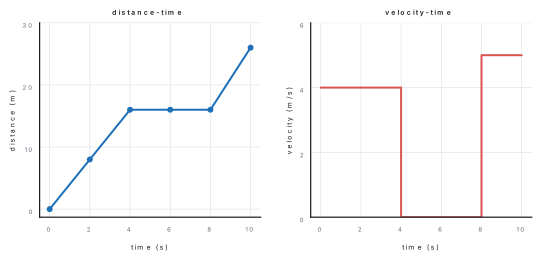
| On a distance-time graph | Meaning |
|---|---|
| horizontal line | body at rest |
| straight sloping line | uniform speed; steeper line = greater speed; slope = speed |
| curve becoming steeper | accelerating |
| On a velocity-time graph | Meaning |
|---|---|
| horizontal line | uniform velocity; area under the line = distance |
| line sloping up | acceleration; slope = acceleration |
| line sloping down | retardation |
Problem. From the graphs, find the speed from 0 to 4 s and from 8 to 10 s, and the total distance.
Solution. 0–4 s: speed =\frac{16-0}{4-0}=4 m/s. 4–8 s: the line is flat, so the body is at rest. 8–10 s: speed =\frac{26-16}{10-8}=5 m/s. Total distance = 26 m (check from the v–t graph: area =4\times4+0+5\times2=26 m).
6.3 Force and its effects; balanced and unbalanced forces
A force is a push or pull that changes or tends to change the state of rest or motion of a body, or its shape. Its SI unit is the newton (N). On the earth, the weight of a 1 kg mass is about 10 N (more exactly 9.8 N).
Effects of force: it can (1) move a body at rest, (2) stop a moving body, (3) change its speed, (4) change its direction, (5) change its shape or size.
Balanced forces are forces on a body whose resultant is zero: the body stays at rest or keeps moving uniformly (e.g. equal teams in a tug of war, a book on a table). Unbalanced forces have a non-zero resultant and change the motion (one team pulls harder; a kicked football).
6.4 Newton's laws of motion in everyday examples
First law (law of inertia). A body at rest remains at rest, and a body in uniform motion keeps moving in a straight line, unless an external unbalanced force acts on it. The property of a body to resist a change in its state is inertia; more mass means more inertia. Examples: passengers fall forward when a bus stops suddenly and backward when it starts suddenly; dust leaves a carpet when it is beaten.
Second law. The acceleration of a body is directly proportional to the applied force and inversely proportional to its mass: F=ma. Example: the same push gives an empty cart more acceleration than a loaded one. A force of 1 N gives a 1 kg mass an acceleration of 1 m/s².
Third law. To every action there is an equal and opposite reaction. Examples: a swimmer pushes water back and moves forward; a rocket pushes hot gases down and goes up; a gun recoils when fired.
Problem. A force of 600 N acts on a motorcycle of mass 150 kg. Find its acceleration.
Solution. a=\frac{F}{m}=\frac{600\ \text{N}}{150\ \text{kg}}=4 m/s².
6.5 Lever: classes, principle of moments and mechanical advantage
A lever is a rigid bar that can turn about a fixed point called the fulcrum (F). The force applied is the effort (E); the body lifted is the load (L). The distance from fulcrum to load is the load distance (L.D.); from fulcrum to effort, the effort distance (E.D.).
Archimedes is said to have claimed: "Give me a lever and a place to stand, and I can move the world."
6.5.1 Classes of lever
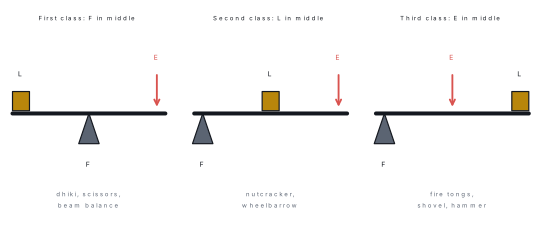
| Class | Arrangement | Examples |
|---|---|---|
| First | fulcrum between load and effort | dhiki, scissors, beam balance, crowbar, see-saw |
| Second | load between fulcrum and effort | nutcracker, lemon squeezer, wheelbarrow |
| Third | effort between fulcrum and load | fire tongs, shovel, hammer |
6.5.2 Principle of lever (principle of moments)
Hang masses on both sides of a metre scale balanced at its middle (Activity 6.3). The scale balances whenever
So the longer the effort distance, the smaller the effort needed.
Problem. A load of 800 N is lifted with a crowbar. The load distance is 50 cm and the effort distance is 1.5 m. Find the effort.
Solution. L=800 N, L.D.=50 cm =0.5 m, E.D.=1.5 m. E\times1.5=800\times0.5, so E=\frac{400}{1.5}=266.67 N.
6.5.3 Mechanical advantage, velocity ratio and efficiency
- Mechanical advantage (MA) =\frac{\text{load}}{\text{effort}}=\frac{L}{E}. MA = 4 means the machine lifts a load 4 times the effort. It has no unit and is reduced by friction.
- Velocity ratio (VR) =\frac{\text{distance moved by effort}}{\text{distance moved by load}}=\frac{E.D.}{L.D.}. It has no unit and is not affected by friction.
- Input work = effort × effort distance; output work = load × load distance.
- Efficiency \eta=\frac{\text{output work}}{\text{input work}}\times100\%=\frac{MA}{VR}\times100\%.
Because of friction, some input work is wasted, so MA < VR and the efficiency of a real machine is always less than 100 %. A machine with 100 % efficiency is an imaginary ideal machine.
Problem. An effort of 150 N lifts a load of 600 N. The effort moves 7.5 m and the load moves 1.5 m. Find MA, VR and efficiency.
Solution. MA=\frac{L}{E}=\frac{600}{150}=4; VR=\frac{7.5}{1.5}=5; \eta=\frac{4}{5}\times100\%=80\%.
Both distances must be in the same unit (both cm or both m). Mixing 50 cm with 1.5 m without converting gives a wrong answer.
6.6 Pressure in solids, liquids and gases; atmospheric pressure
A pen pressed on the wrist with its pointed end hurts more than with its blunt end; a brick standing on its narrow face sinks deeper into foam. The same force has a bigger effect on a smaller area.
Pressure is the force acting perpendicularly on unit area: P=\frac{F}{A}. Its SI unit is N/m², called the pascal (Pa). One pascal is the pressure produced by a force of 1 N acting perpendicularly on 1 m².
Problem. A cupboard of weight 1800 N stands on 1.5 m². Find the pressure. What is it if the area is 3 m²?
Solution. P=\frac{1800}{1.5}=1200 Pa. With 3 m²: P=\frac{1800}{3}=600 Pa. Doubling the area halves the pressure.
Increasing pressure: sharp ploughshare, knife, sickle and nail tips (small area). Reducing pressure: wide foundations of houses, broad back wheels of tractors, double tyres on buses and trucks, broad feet of camels, wide straps on school bags.
6.6.1 Pressure in liquids
Water squirts farthest from the lowest hole of a bottle (Activity 6.6): liquid pressure increases with depth. A liquid presses in all directions.
We find the pressure due to a liquid column of height h and density d.
Setting up. A container of cross-section area A holds liquid to height h; g is the acceleration due to gravity.
Step 1 — volume of liquid. V=A\times h.
Step 2 — mass of liquid. m=d\times V=d\times A\times h.
Step 3 — weight of liquid (the force on the bottom). F=mg=A\,h\,d\,g.
Step 4 — pressure = force ÷ area. P=\frac{A\,h\,d\,g}{A}.
Result. P=hdg.
What it means. Liquid pressure depends on depth h, density d and g — not on the shape of the container or the amount of liquid.
Problem. Find the pressure at the bottom of a 2 m deep tank full of water (d=1000 kg/m³, g=9.8 m/s²).
Solution. P=hdg=2\times1000\times9.8=19\,600 Pa.
Problem. A pressure of 800 Pa acts at the bottom of a 3 m column of a liquid. Find its density.
Solution. d=\frac{P}{hg}=\frac{800}{3\times9.8}=\frac{800}{29.4}=27.21 kg/m³.
Applications: dams and water tanks are thicker at the bottom; deep-sea divers wear special suits; water tanks are placed high on the roof; mercury bottles have thick bottoms. A bucket fills faster on the ground floor than upstairs because the depth of water below the tank — and so the pressure — is greater there. Blood pressure is greater in the feet than in the head for the same reason.
6.6.2 Air pressure, compressed air and atmospheric pressure
Air can be compressed into tyres, balls and cylinders; compressed air has more pressure than the atmosphere and heats up when compressed. It drives air hammers, drills and wrenches, and works the air brakes of trains, buses and trucks. Its pressure is measured with a pressure gauge.
The earth is covered by air, which has weight. The pressure exerted by the weight of the atmosphere on unit area of the earth's surface is atmospheric pressure. It is greatest at sea level, about 760 mmHg ≈ 1.01 × 10⁵ Pa, and decreases with height. It is measured with a barometer. Aeroplanes keep the air pressure inside the cabin suitable for breathing.
Activities. A glass full of water covered with cardboard can be turned upside down without the water falling — the air pressure from below holds the card. A can heated with a little water, closed tightly and cooled gets crushed — the steam inside condenses, the pressure inside falls, and the outside air pressure crushes the can.
Uses of atmospheric pressure: drinking with a straw, filling a fountain pen, filling a syringe, pumping air into a bicycle tyre. When the piston is pulled back, the pressure inside falls and the outside air pushes the liquid in.
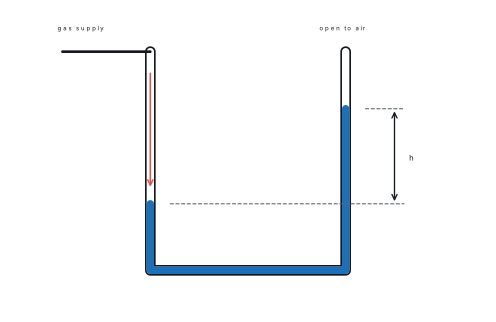
A manometer (U-tube with coloured liquid) measures the pressure of a gas or liquid: the extra pressure pushes the liquid down in one limb and up in the other; the difference in levels h measures the pressure.
6.7 Archimedes' principle, upthrust, floatation and density
A body in a liquid feels an upward push called upthrust (buoyant force), because the pressure on its lower surface (deeper) is greater than on its upper surface. A stone feels lighter in water for this reason.
When a body is wholly or partly immersed in a fluid, it experiences an upthrust equal to the weight of the fluid displaced by it. Upthrust =V\,d\,g, where V is the volume of fluid displaced and d its density.
Density is mass per unit volume, d=\frac{m}{V} (kg/m³ or g/cm³). Water has a density of 1000 kg/m³ (1 g/cm³).
| Condition | Result | Example |
|---|---|---|
| weight > upthrust (body denser than liquid) | sinks | stone, iron nail |
| weight = upthrust | floats fully immersed | fish, submarine at a fixed depth |
| weight < maximum upthrust (body less dense) | floats partly out | wood, ice, a ship |
A floating body displaces liquid equal to its own weight (law of floatation). An iron ship floats because its hollow shape displaces a large volume of water. A submarine sinks or rises by filling or emptying its tanks with water.
Problem. A stone of volume 200 cm³ is fully immersed in water. Find the upthrust (d=1000 kg/m³, g=9.8 m/s²).
Solution. V=200 cm³ =200\times10^{-6} m³ =2\times10^{-4} m³. Upthrust =Vdg=2\times10^{-4}\times1000\times9.8=1.96 N (upwards). The stone seems 1.96 N lighter in water.
Chapter summary
- Rest and motion are relative to a reference point. Speed =\frac{d}{t}, velocity =\frac{s}{t} (m/s); velocity has direction.
- Relative velocity: v_A-v_B (same direction), v_A+v_B (opposite).
- Average velocity = total displacement ÷ total time =\frac{u+v}{2} for steady change.
- Acceleration a=\frac{v-u}{t} (m/s²); negative acceleration is retardation.
- Slope of d–t graph = speed; slope of v–t graph = acceleration; area under v–t = distance.
- Newton: inertia; F=ma; action = reaction.
- Lever: E\times E.D.=L\times L.D.; MA=\frac{L}{E}, VR=\frac{E.D.}{L.D.}, \eta=\frac{MA}{VR}\times100\% (< 100 % because of friction).
- Pressure P=\frac{F}{A} (Pa); liquid pressure P=hdg; atmospheric pressure at sea level = 760 mmHg; barometer, manometer, pressure gauge.
- Upthrust = weight of fluid displaced (Archimedes); a body floats if it is less dense than the liquid.
Practice questions
Group A — Multiple choice (1 mark each) (Textbook exercises.)
- The condition of a body that does not change its position with respect to its surroundings is [1]amotionbvelocitycrestdspeed
- The relative velocity of two bodies moving in opposite directions is [1]av_A/v_Bbv_A-v_Bcv_A\times v_Bdv_A+v_B
- The shortest distance between two points in a particular direction is [1]aspeedbdisplacementcaverage velocitydrelative velocity
- Average velocity is calculated for [1]anon-uniform motionbuniform motionczero accelerationda body at rest
- The SI unit of acceleration is [1]am/sbm/s²cN m²/kg²dm²
- Which statement is true? [1]auniform motion gives negative accelerationbnon-uniform motion has no accelerationcpositive acceleration is retardationdthe rate of change of velocity is acceleration
- Which is a second-class lever? [1]ashovelbdhikicnutcrackerdhammer
- The principle of a lever in balance is [1]aE × E.D. = L × L.D.bE = LcE.D. = L.D.dMA = efficiency
- The work done by the effort is called [1]ainput workboutput workcfrictiondgravitational work
- Which is not affected by friction? [1]amechanical advantagebvelocity ratiocefficiencydinput work
- Which statement is true? [1]athe product of load and effort is VRbthe effort moves less than the loadcMA and VR have unitsdefficiency is output work ÷ input work in percent
- The SI unit of pressure is [1]aN mbN/m²cm/s²dN m²/kg²
- Which statement is true? [1]aless area, more pressurebarea does not affect pressurecpressure rises with areadpressure is the same for any force
- Atmospheric pressure at sea level is [1]a760 mmHgb700 mmHgc1000 mmHgd750 mmHg
- The pressure of water at a depth of 60 m (g=9.8 m/s², d=1000 kg/m³) is [1]a588 Pab5880 Pac58 800 Pad588 000 Pa
- Atmospheric pressure is measured by a [1]athermometerbbarometercmanometerdlactometer
- The pressure of compressed air is measured by a [1]apressure gaugebrain gaugeclactometerdthermometer
- The air brake works on [1]aatmospheric pressurebcompressed aircliquid pressuredupthrust
Answers to Group A
1. (c).
2. (d).
3. (b).
4. (a).
5. (b).
6. (d).
7. (c) — the load (nut) is between hinge and hand.
8. (a).
9. (a).
10. (b).
11. (d).
12. (b).
13. (a).
14. (a).
15. (d) — 60\times1000\times9.8=588\,000 Pa.
16. (b).
17. (a).
18. (b).
Group B — Short answer (2 marks each)
- Differentiate:(a) distance and displacement(b) average velocity and relative velocity(c) acceleration and retardation. [3]
- Define reference point, relative velocity and retardation. [3]
- Differentiate:(a) mechanical advantage and velocity ratio(b) input work and output work. [2]
- Give reasons:(a) The efficiency of a lever is never 100 %.(b) A wheelbarrow is easier to push when the load is moved towards the wheel.(c) MA is always less than VR. [3]
- Which class of lever is a pair of scissors? What can a lever with MA more than 1 do? Write other advantages of a lever besides making work easy. [2]
- Give reasons:(a) Football boots have studs.(b) A ploughshare is made sharp.(c) The bottom of a dam is wider than its top.(d) A bucket fills faster on the ground floor than upstairs. [4]
- How can we show that a liquid exerts pressure? Write two applications of liquid pressure. [2]
- What is atmospheric pressure? Write two uses of it. [2]
Answers to Group B
1. (a) See the table in 6.1. (b) Average velocity is the total displacement ÷ total time of one body in non-uniform motion; relative velocity is the velocity of one body with respect to another. (c) See the table in 6.1.4.
2. A reference point is a fixed point, line or place with which the position of a body is compared. Relative velocity is the velocity of a body with respect to another body. Retardation is the rate of decrease of velocity (negative acceleration).
3. (a) MA = load ÷ effort, affected by friction, always less than VR; VR = effort distance ÷ load distance, not affected by friction. (b) Input work = effort × effort distance (work put into the machine); output work = load × load distance (useful work done by it); output is less than input.
4. (a) Some input work is always lost against friction, so output work is less than input work. (b) The load distance becomes shorter, so by E\times E.D.=L\times L.D. less effort is needed. (c) Friction reduces MA but does not change VR.
5. First class (the pivot is between blade and handle). A lever with MA > 1 lifts a load larger than the effort (multiplies force). Other advantages: changes the direction of the force, increases speed or distance of movement (third class), and allows work at a convenient place (tongs keep hands away from fire).
6. (a) The small area of the studs gives large pressure, so they grip the ground. (b) A sharp edge has small area, so a small force gives large pressure to cut the soil. (c) Liquid pressure increases with depth, so the bottom must be strongest. (d) The depth of water below the tank (h) is greater at the ground floor, so pressure hdg and the flow are greater.
7. Make holes at different heights in a bottle full of water; water comes out from all holes (pressure acts sideways) and spurts farthest from the lowest hole (pressure increases with depth). Applications: dams thick at the bottom; tanks kept high; divers' suits.
8. The pressure exerted by the weight of air on unit area of the earth's surface (760 mmHg at sea level). Uses: drinking with a straw, filling a syringe or fountain pen, pumping tyres.
Group C — Numerical and long answer (4 marks each)
- A bus covers 4.2 km in 7 minutes. Find its average velocity. [2]
- A car starts from rest and reaches 30 m/s in 12 s. Find its acceleration. [2]
- A car starts from rest with an acceleration of 5 m/s² for 6 s. Find its final velocity and average velocity. [3]
- Brakes give a car a retardation of 2 m/s² and it stops in 4 s. Find its initial velocity. [2]
- Two motorcycles move at 50 km/h and 60 km/h. Find their relative velocity in the same and opposite directions. [2]
- An effort of 75 N lifts a load of 300 N placed 25 cm from the fulcrum. Find the effort distance. [2]
- Sarad (550 N) sits 1.5 m from the centre of a see-saw. How far from the centre must Nirmal (300 N) sit to balance him? [2]
- An effort of 300 N lifts a load of 900 N with a 2 m first-class lever; the load is 50 cm from the fulcrum and the effort is at the other end. Find MA, VR and efficiency. [3]
- Prove that P=hdg. [4]
Answers to Group C
1. s=4.2 km =4200 m, t=7 min =420 s. \bar{v}=\frac{4200}{420}=10 m/s.
2. a=\frac{v-u}{t}=\frac{30-0}{12}=2.5 m/s².
3. v=u+at=0+5\times6=30 m/s. Average velocity =\frac{u+v}{2}=\frac{0+30}{2}=15 m/s. (The answer printed in the textbook, 15 m/s and 7.5 m/s, would be correct only for an acceleration of 2.5 m/s²; with 5 m/s² the correct values are 30 m/s and 15 m/s.)
4. Retardation =\frac{u-v}{t}, so 2=\frac{u-0}{4} and u=8 m/s.
5. Same direction: 60-50=10 km/h. Opposite directions: 60+50=110 km/h.
6. E\times E.D.=L\times L.D.: 75\times E.D.=300\times25, so E.D.=\frac{7500}{75}=100 cm =1 m.
7. 300\times d=550\times1.5, so d=\frac{825}{300}=2.75 m.
8. L.D.=0.5 m, E.D.=2-0.5=1.5 m. MA=\frac{900}{300}=3; VR=\frac{1.5}{0.5}=3; \eta=\frac{3}{3}\times100\%=100\% (an ideal lever, friction neglected).
9. See the derivation box in 6.6.1: V=Ah, m=dAh, F=mg=Ahdg, P=\frac{F}{A}=hdg.
Practise more: Science and Technology question bank