Question bank · 29 min read
Chemistry: Unit-wise Objective Question Bank
Group A of the NEB Grade 11 Chemistry paper is eleven one-mark multiple-choice questions, drawn from across the seventeen units of the CDC syllabus. This chapter drills every unit in order. Each section opens with a high-yield facts table (the formulae, reagents and trends the objective questions keep returning to), then gives six to eight MCQs, then an answer key in which every answer carries a one-line reason and, where a wrong option encodes a real misconception, names it.
Almost nothing in Group A is a long calculation. It tests four things: a definition or name, a formula or reagent, a one-step calculation (a mole, a ratio, an oxidation number), or a misconception offered as a distractor. If an MCQ is taking you more than ninety seconds, you have misread it.
NEB does not publish its Grade 11 question papers, and this book could not verify any item against an official released paper. Rather than print a year it cannot stand behind, it prints none. What it can stand behind is the syllabus weighting (General and Physical 48 h, Inorganic 35 h, Organic 30 h, Applied 15 h of 128), and every question below is built from it. Treat this as a bank of exam-shaped questions, not a leaked paper.
5.1 Foundation and Fundamentals
| High-yield fact | Value / form |
|---|---|
| 1 amu | \tfrac{1}{12} of the mass of one carbon-12 atom (1.66\times10^{-27}\ \text{kg}) |
| Relative molecular mass | sum of the relative atomic masses of all atoms in the formula |
| Molecular formula | n\times empirical formula; n = \dfrac{\text{molar mass}}{\text{empirical formula mass}} |
| Mass percentage of an element | \dfrac{\text{mass of the element in one mole}}{\text{molar mass}}\times100 |
| Radical | a group of atoms behaving as one unit and carrying a charge, e.g. \text{NH}_4^{+}, \text{SO}_4^{2-} |
- One atomic mass unit is equal to [1]athe mass of one hydrogen atomb\tfrac{1}{12} the mass of a carbon-12 atomcthe mass of one proton exactlydthe mass of one electron
- The empirical formula of glucose, \text{C}_6\text{H}_{12}\text{O}_6, is [1]a\text{CH}b\text{C}_2\text{H}_4\text{O}_2c\text{CH}_2\text{O}d\text{C}_3\text{H}_6\text{O}_3
- The percentage of oxygen in water (\text{H}=1, \text{O}=16) is [1]a11.1 %b50 %c88.9 %d94.4 %
- Which of the following is a radical? [1]a\text{NaCl}b\text{NH}_4^{+}c\text{CO}_2d\text{H}_2\text{O}
- The relative molecular mass of \text{CaCO}_3 (\text{Ca}=40, \text{C}=12, \text{O}=16) is [1]a56b84c100d116
- A compound has empirical formula \text{CH} and relative molecular mass 78. Its molecular formula is [1]a\text{C}_2\text{H}_2b\text{C}_4\text{H}_4c\text{C}_6\text{H}_6d\text{C}_8\text{H}_8
Answers — 5.1
1. (b) — the definition of the amu.
2. (c) — divide the subscripts 6:12:6 by 6.
3. (c) — 16/18 = 0.889; (a) is the hydrogen percentage, a classic distractor.
4. (b) — \text{NH}_4^{+} is a charged group that moves as a unit.
5. (c) — 40 + 12 + 48 = 100; (b) is \text{MgCO}_3.
6. (c) — 78/13 = 6, so \text{C}_6\text{H}_6.
5.2 Stoichiometry
| High-yield fact | Value / form |
|---|---|
| Avogadro constant | 6.022\times10^{23}\ \text{mol}^{-1} |
| Molar volume at STP (273 K, 1 atm) | 22.4\ \text{L mol}^{-1} |
| Vapour density | \text{V.D.} = \dfrac{M}{2} |
| Laws | conservation of mass (Lavoisier); definite proportions (Proust); multiple proportions (Dalton); reciprocal proportions (Richter); Gay-Lussac's law of gaseous volumes |
| Percentage yield | \dfrac{\text{experimental yield}}{\text{theoretical yield}}\times100 |
| Limiting reactant | the reactant used up first; it fixes the amount of product |
- The number of molecules in 0.5 mol of a gas is [1]a6.022\times10^{23}b3.011\times10^{23}c1.2\times10^{24}d6.022\times10^{22}
- The volume at STP of 8\ \text{g} of oxygen (\text{O}_2) is [1]a2.8\ \text{L}b5.6\ \text{L}c11.2\ \text{L}d22.4\ \text{L}
- The vapour density of a gas of molar mass 44\ \text{g mol}^{-1} is [1]a22b44c88d11
- \text{H}_2 + \text{Cl}_2 \to 2\text{HCl}. The mass of HCl formed from 2\ \text{g} of hydrogen with excess chlorine is [1]a36.5\ \text{g}b71\ \text{g}c73\ \text{g}d146\ \text{g}
- In CO and \text{CO}_2, 12\ \text{g} of carbon combines with 16\ \text{g} and 32\ \text{g} of oxygen. This illustrates the law of [1]aconservation of massbdefinite proportionscmultiple proportionsdreciprocal proportions
- If the theoretical yield is 20\ \text{g} and 15\ \text{g} is obtained, the percentage yield is [1]a25 %b75 %c80 %d133 %
- Which postulate of Dalton's atomic theory is no longer accepted? [1]aatoms combine in simple whole-number ratiosbatoms of different elements differ in masscatoms are indivisibledcompounds form by combination of atoms
Answers — 5.2
1. (b) — 0.5\times6.022\times10^{23}.
2. (b) — 8/32 = 0.25 mol; 0.25\times22.4 = 5.6\ \text{L}.
3. (a) — M/2 = 22.
4. (c) — 2\ \text{g} is 1 mol of \text{H}_2, giving 2 mol HCl = 73\ \text{g}; (a) forgets the factor of two.
5. (c) — the oxygen masses 16 : 32 = 1 : 2 for a fixed mass of carbon.
6. (b) — 15/20\times100.
7. (c) — atoms are divisible into electrons, protons and neutrons.
5.3 Atomic Structure
| High-yield fact | Value / form |
|---|---|
| Quantum numbers | n (size, energy), l (shape: 0 to n-1), m_l (orientation: -l to +l), m_s (\pm\tfrac{1}{2}) |
| Electrons in a shell | 2n^{2} |
| Orbitals in s, p, d, f | 1, 3, 5, 7 |
| de Broglie wavelength | \lambda = \dfrac{h}{mv} |
| Heisenberg | \Delta x\cdot\Delta p \ge \dfrac{h}{4\pi} |
| Exceptions | Cr: [\text{Ar}]3d^{5}4s^{1}; Cu: [\text{Ar}]3d^{10}4s^{1} |
| Rules | Aufbau (lowest energy first); Pauli (no two electrons with the same four quantum numbers); Hund (single occupancy of degenerate orbitals first) |
- The number of orbitals in a d subshell is [1]a1b3c5d7
- The maximum number of electrons in the shell with n = 3 is [1]a8b10c18d32
- The electronic configuration of chromium (Z = 24) is [1]a[\text{Ar}]3d^{4}4s^{2}b[\text{Ar}]3d^{5}4s^{1}c[\text{Ar}]3d^{6}d[\text{Ar}]4s^{2}4p^{4}
- The quantum number that determines the shape of an orbital is [1]aprincipalbazimuthalcmagneticdspin
- Electrons occupy degenerate orbitals singly before pairing, according to [1]aHund's rulebPauli's exclusion principlecAufbau principledHeisenberg's principle
- The number of unpaired electrons in \text{Fe}^{3+} (Z = 26) is [1]a1b3c4d5
- Heisenberg's uncertainty principle states that [1]aelectrons move in fixed orbitsbposition and momentum cannot both be known exactlycno two electrons have the same four quantum numbersdmatter has no wave nature
Answers — 5.3
1. (c) — l = 2 gives 2l + 1 = 5 orbitals.
2. (c) — 2n^{2} = 18.
3. (b) — a half-filled d subshell is more stable; (a) is the unadjusted Aufbau answer.
4. (b) — l gives s (spherical), p (dumb-bell).
5. (a) — Hund's rule of maximum multiplicity.
6. (d) — \text{Fe}\ 3d^{6}4s^{2} loses the 4s pair and one 3d electron, leaving 3d^{5}: five unpaired.
7. (b) — (a) is Bohr's model and (c) is Pauli's principle.
5.4 Classification of Elements and the Periodic Table
| High-yield fact | Value / form |
|---|---|
| Modern periodic law | properties of elements are periodic functions of their atomic numbers |
| Effective nuclear charge | Z_{eff} = Z - S (S = shielding constant) |
| Across a period (left to right) | atomic radius falls; ionization energy and electronegativity rise; metallic character falls |
| Down a group | atomic radius rises; ionization energy and electronegativity fall |
| Electronegativity (Pauling) | F = 4.0 (highest); O = 3.5; N = 3.0; Cl = 3.0 |
| Electron affinity | Cl has the largest magnitude, not F (small size, repulsion) |
- The most electronegative element is [1]aoxygenbchlorinecfluorinednitrogen
- Which has the largest atomic radius? [1]aLibNacKdRb
- Across a period from left to right the first ionization energy generally [1]aincreasesbdecreasescstays constantdfirst falls then rises sharply
- The halogen with the highest electron affinity (magnitude) is [1]aFbClcBrdI
- The correct order of ionic radii of the isoelectronic ions \text{Na}^{+}, \text{Mg}^{2+}, \text{Al}^{3+} is [1]a\text{Na}^{+} > \text{Mg}^{2+} > \text{Al}^{3+}b\text{Al}^{3+} > \text{Mg}^{2+} > \text{Na}^{+}call equald\text{Mg}^{2+} > \text{Na}^{+} > \text{Al}^{3+}
- An element of atomic number 17 belongs to [1]as-block, group 1bd-block, group 7cp-block, group 17dp-block, group 7
Answers — 5.4
1. (c) — F has the highest Pauling value, 4.0.
2. (d) — radius grows down the group; Rb is the lowest in the list.
3. (a) — the nuclear charge rises with no extra shell (small dips at Group 13 and 16 are exceptions).
4. (b) — fluorine's small 2p subshell repels the incoming electron, so Cl exceeds F.
5. (a) — same electrons, more protons pull harder: \text{Na}^{+} is the largest.
6. (c) — Cl, [\text{Ne}]3s^{2}3p^{5}, is group 17 of the p-block (IUPAC numbering); (d) uses the old numbering.
5.5 Chemical Bonding and Shapes of Molecules
| Species | Shape | Hybridization | Bond angle |
|---|---|---|---|
| \text{BeF}_2, \text{CO}_2 | linear | sp | 180^{\circ} |
| \text{BF}_3 | trigonal planar | sp^{2} | 120^{\circ} |
| \text{CH}_4 | tetrahedral | sp^{3} | 109.5^{\circ} |
| \text{NH}_3 | trigonal pyramidal | sp^{3} | 107^{\circ} |
| \text{H}_2\text{O} | bent (V-shaped) | sp^{3} | 104.5^{\circ} |
| \text{PCl}_5 | trigonal bipyramidal | sp^{3}d | 90^{\circ}, 120^{\circ} |
| \text{SF}_6 | octahedral | sp^{3}d^{2} | 90^{\circ} |
- The shape of the ammonia molecule is [1]atetrahedralbtrigonal pyramidalcplanardlinear
- The hybridization of boron in \text{BF}_3 is [1]aspbsp^{2}csp^{3}dsp^{3}d
- The bond angle in water is about [1]a90^{\circ}b104.5^{\circ}c109.5^{\circ}d120^{\circ}
- Which molecule has zero dipole moment? [1]a\text{H}_2\text{O}b\text{NH}_3c\text{CO}_2d\text{HCl}
- The strongest hydrogen bonding occurs in [1]aHClb\text{H}_2\text{S}cHBrdHF
- A coordinate covalent bond is present in [1]a\text{CH}_4b\text{NH}_4^{+}cNaCld\text{H}_2
- The shape of \text{SF}_6 is [1]atetrahedralbtrigonal bipyramidalcoctahedraldsquare planar
Answers — 5.5
1. (b) — three bond pairs and one lone pair; (a) ignores the lone pair.
2. (b) — three bond pairs and no lone pair give sp^{2}, trigonal planar.
3. (b) — two lone pairs compress the angle below 109.5^{\circ}.
4. (c) — the two C=O dipoles of the linear molecule cancel.
5. (d) — F is the most electronegative and smallest; HF forms the strongest H-bonds.
6. (b) — the lone pair of N is donated to \text{H}^{+}.
7. (c) — six bond pairs, no lone pair.
5.6 Oxidation and Reduction
| High-yield fact | Value / form |
|---|---|
| Oxidation | loss of electrons; increase in oxidation number |
| Reduction | gain of electrons; decrease in oxidation number |
| Rules | free element = 0; H usually +1; O usually -2 (-1 in peroxides); sum = charge on the ion |
| Common values | S in \text{H}_2\text{SO}_4: +6; Mn in \text{KMnO}_4: +7; Cr in \text{K}_2\text{Cr}_2\text{O}_7: +6; Cl in \text{HClO}_4: +7 |
| Faraday's laws | m = ZIt; 1\ \text{F} = 96\,500\ \text{C} deposits one equivalent |
| Electrolysis | oxidation at the anode, reduction at the cathode |
- The oxidation number of chromium in \text{K}_2\text{Cr}_2\text{O}_7 is [1]a+3b+4c+6d+7
- In 2\text{Mg} + \text{O}_2 \to 2\text{MgO} the oxidizing agent is [1]aMgb\text{O}_2cMgOdnone
- The average oxidation number of sulphur in \text{Na}_2\text{S}_2\text{O}_3 is [1]a0b+2c+4d+6
- The charge needed to deposit one mole of copper from \text{Cu}^{2+} is [1]a96\,500\ \text{C}b144\,750\ \text{C}c193\,000\ \text{C}d289\,500\ \text{C}
- Reduction takes place at the [1]acathodebanodecsalt bridgedelectrolyte
- The oxidation number of manganese is highest in [1]a\text{MnO}_2b\text{MnSO}_4c\text{K}_2\text{MnO}_4d\text{KMnO}_4
Answers — 5.6
1. (c) — 2x + 2(+1) + 7(-2) = 0 gives x = +6.
2. (b) — \text{O}_2 gains electrons and so oxidizes Mg.
3. (b) — 2(+1) + 2x + 3(-2) = 0 gives x = +2 on average.
4. (c) — \text{Cu}^{2+} + 2e^{-} \to \text{Cu} needs 2\times96\,500.
5. (a) — reduction is gain of electrons at the cathode (RED CAT).
6. (d) — \text{MnO}_2 +4, \text{MnSO}_4 +2, \text{K}_2\text{MnO}_4 +6, \text{KMnO}_4 +7.
5.7 States of Matter
| High-yield fact | Value / form |
|---|---|
| Boyle's law | P_1V_1 = P_2V_2 at constant T |
| Charles' law | \dfrac{V_1}{T_1} = \dfrac{V_2}{T_2} at constant P (T in kelvin) |
| Ideal gas equation | PV = nRT; R = 8.314\ \text{J mol}^{-1}\text{K}^{-1} = 0.0821\ \text{L atm mol}^{-1}\text{K}^{-1} |
| Dalton's law | P_{total} = P_1 + P_2 + \cdots |
| Graham's law | \dfrac{r_1}{r_2} = \sqrt{\dfrac{M_2}{M_1}} |
| Real gases deviate | at high pressure and low temperature |
| Solids | efflorescent loses water of crystallization to air (\text{Na}_2\text{CO}_3\cdot10\text{H}_2\text{O}); deliquescent absorbs water and dissolves (\text{CaCl}_2, NaOH) |
- A gas occupies 2\ \text{L} at 1\ \text{atm}. At constant temperature and 4\ \text{atm} it occupies [1]a0.25\ \text{L}b0.5\ \text{L}c1\ \text{L}d8\ \text{L}
- The ratio of the rates of diffusion of \text{H}_2 and \text{O}_2 under the same conditions is [1]a1:4b1:16c4:1d16:1
- The value of R in \text{L atm mol}^{-1}\text{K}^{-1} is [1]a8.314b0.0821c1.987d62.4
- A gas at 27^{\circ}\text{C} is heated at constant pressure until its volume doubles. The new temperature is [1]a54^{\circ}\text{C}b300\ \text{K}c327^{\circ}\text{C}d600^{\circ}\text{C}
- An efflorescent substance is [1]a\text{Na}_2\text{CO}_3\cdot10\text{H}_2\text{O}banhydrous \text{CaCl}_2cNaCldconc. \text{H}_2\text{SO}_4
- A real gas behaves most ideally at [1]ahigh pressure, low temperatureblow pressure, low temperatureclow pressure, high temperaturedhigh pressure, high temperature
- The boiling point of a liquid is the temperature at which [1]avapour pressure is 1\ \text{atm} alwaysbvapour pressure equals the external pressurecthe liquid freezesdthe surface tension is zero
Answers — 5.7
1. (b) — P_1V_1 = P_2V_2 gives V_2 = 2\times1/4 = 0.5\ \text{L}.
2. (c) — \sqrt{32/2} = 4; the lighter gas diffuses faster.
3. (b) — (a) is in joules; (d) is in \text{L mmHg}-type units.
4. (c) — T doubles in kelvin: 300 \to 600\ \text{K} = 327^{\circ}\text{C}; (a) doubles the Celsius value, the common trap.
5. (a) — washing soda loses water on standing.
6. (c) — molecules are far apart and fast, so forces and volume matter least.
7. (b) — (a) is the normal boiling point only.
5.8 Chemical Equilibrium
| High-yield fact | Value / form |
|---|---|
| Law of mass action | the rate of a reaction is proportional to the product of the active masses (concentrations) of the reactants |
| For aA + bB \rightleftharpoons cC + dD | K_c = \dfrac{[C]^{c}[D]^{d}}{[A]^{a}[B]^{b}} |
| K_p and K_c | K_p = K_c(RT)^{\Delta n}; \Delta n = n_{gas,products} - n_{gas,reactants} |
| Le Chatelier | a system at equilibrium opposes any change imposed on it |
| Catalyst | speeds both rates equally; does not change K or the position |
- For which reaction is K_p = K_c? [1]a\text{H}_2 + \text{I}_2 \rightleftharpoons 2\text{HI}b\text{N}_2 + 3\text{H}_2 \rightleftharpoons 2\text{NH}_3c\text{PCl}_5 \rightleftharpoons \text{PCl}_3 + \text{Cl}_2d2\text{SO}_2 + \text{O}_2 \rightleftharpoons 2\text{SO}_3
- For \text{N}_2\text{O}_4 \rightleftharpoons 2\text{NO}_2, \Delta n is [1]a-1b0c+1d+2
- Increasing the pressure on \text{N}_2 + 3\text{H}_2 \rightleftharpoons 2\text{NH}_3 [1]ashifts it to the leftbshifts it to the rightchas no effectdchanges K_c
- A catalyst in a reversible reaction [1]ashifts the equilibrium to the rightbraises K_cchelps equilibrium to be reached faster without changing itdstops the reverse reaction
- The K_c expression for \text{PCl}_5 \rightleftharpoons \text{PCl}_3 + \text{Cl}_2 is [1]a\dfrac{[\text{PCl}_5]}{[\text{PCl}_3][\text{Cl}_2]}b\dfrac{[\text{PCl}_3][\text{Cl}_2]}{[\text{PCl}_5]}c[\text{PCl}_3][\text{Cl}_2]d[\text{PCl}_5]
- At chemical equilibrium [1]athe forward rate equals the reverse ratebthe reaction stopscconcentrations of reactants and products are equaldthe forward rate is zero
Answers — 5.8
1. (a) — \Delta n = 2 - 2 = 0.
2. (c) — 2 - 1 = +1.
3. (b) — the right side has fewer gas moles (2 against 4).
4. (c) — a catalyst changes the rate, not the position.
5. (b) — products over reactants, each to the power of its coefficient.
6. (a) — equilibrium is dynamic; (c) confuses equal rates with equal concentrations.
5.9 Chemistry of Non-metals
| High-yield fact | Value / form |
|---|---|
| Heavy water | \text{D}_2\text{O} (deuterium oxide); used as a moderator in reactors |
| Ozone | \text{O}_3; bent; depleted by CFCs; turns moist starch–iodide paper blue |
| Ring test | brown ring of [\text{Fe}(\text{H}_2\text{O})_5\text{NO}]^{2+} at the junction of acid and \text{FeSO}_4 solution |
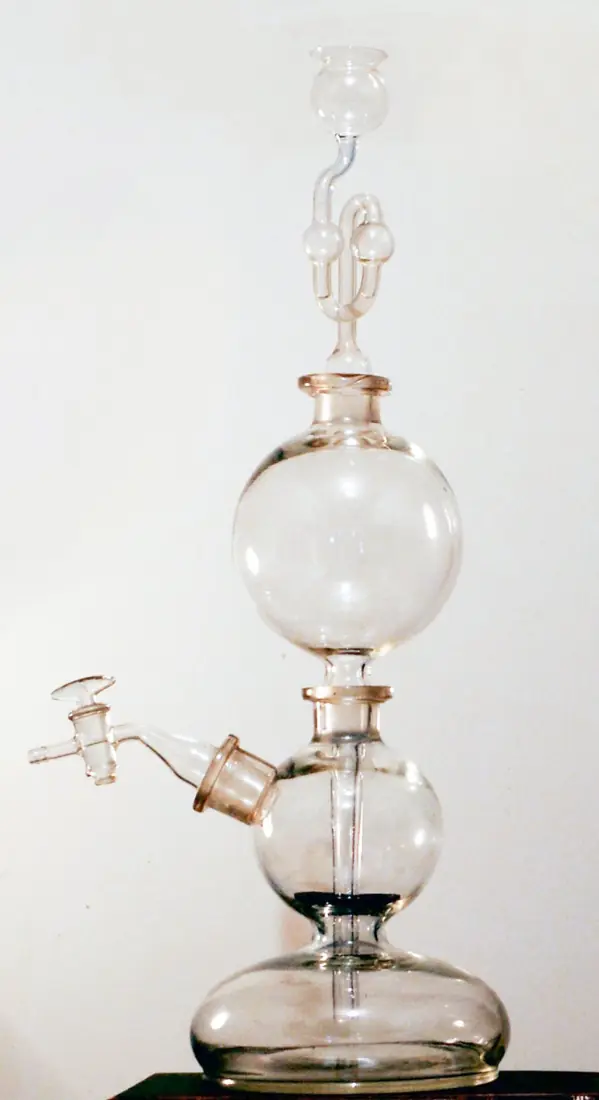
| Kipp's apparatus | \text{FeS} + \text{H}_2\text{SO}_4 \to \text{FeSO}_4 + \text{H}_2\text{S} |
| Oxidation number of N | +5 in \text{HNO}_3; +3 in \text{HNO}_2; -3 in \text{NH}_3 |
| Halogens | \text{F}_2 and \text{Cl}_2 gases; \text{Br}_2 liquid; \text{I}_2 solid; oxidizing power \text{F}_2 > \text{Cl}_2 > \text{Br}_2 > \text{I}_2 |
| Fullerene | \text{C}_{60}, buckminsterfullerene |
| Thiosulphate | \text{Na}_2\text{S}_2\text{O}_3\cdot5\text{H}_2\text{O} ("hypo") |
- The brown ring in the nitrate ring test is due to [1]a\text{FeSO}_4b[\text{Fe}(\text{H}_2\text{O})_5\text{NO}]^{2+}c\text{Fe}_2\text{O}_3d\text{NO}_2
- The gas prepared in a Kipp's apparatus from \text{FeS} is [1]a\text{H}_2b\text{CO}_2c\text{H}_2\text{S}d\text{SO}_2
- Depletion of the ozone layer is mainly caused by [1]a\text{CO}_2bchlorofluorocarbonsc\text{CH}_4d\text{N}_2
- Heavy water has the formula [1]a\text{D}_2\text{O}b\text{H}_2\text{O}_2c\text{H}_2^{18}\text{O} onlyd\text{HDO} only
- The allotrope of carbon containing 60 carbon atoms is [1]adiamondbgraphitecbuckminsterfullerenedcharcoal
- The oxidation number of nitrogen in \text{HNO}_3 is [1]a+1b+3c+4d+5
- The only halogen that is a liquid at room temperature is [1]achlorinebbromineciodinedfluorine
- The formula of sodium thiosulphate is [1]a\text{Na}_2\text{SO}_4b\text{Na}_2\text{SO}_3c\text{Na}_2\text{S}_2\text{O}_3d\text{NaHSO}_4
Answers — 5.9
1. (b) — nitric oxide coordinates to \text{Fe}^{2+}.
2. (c) — \text{FeS} with dilute acid gives hydrogen sulphide; (b) comes from marble.
3. (b) — chlorine radicals from CFCs catalyse \text{O}_3 \to \text{O}_2.
4. (a) — deuterium oxide.
5. (c) — the 60-atom cage.
6. (d) — 1 + x - 6 = 0 gives +5.
7. (b) — bromine; mercury is the only liquid metal.
8. (c) — (a) is sulphate and (b) is sulphite, close distractors.
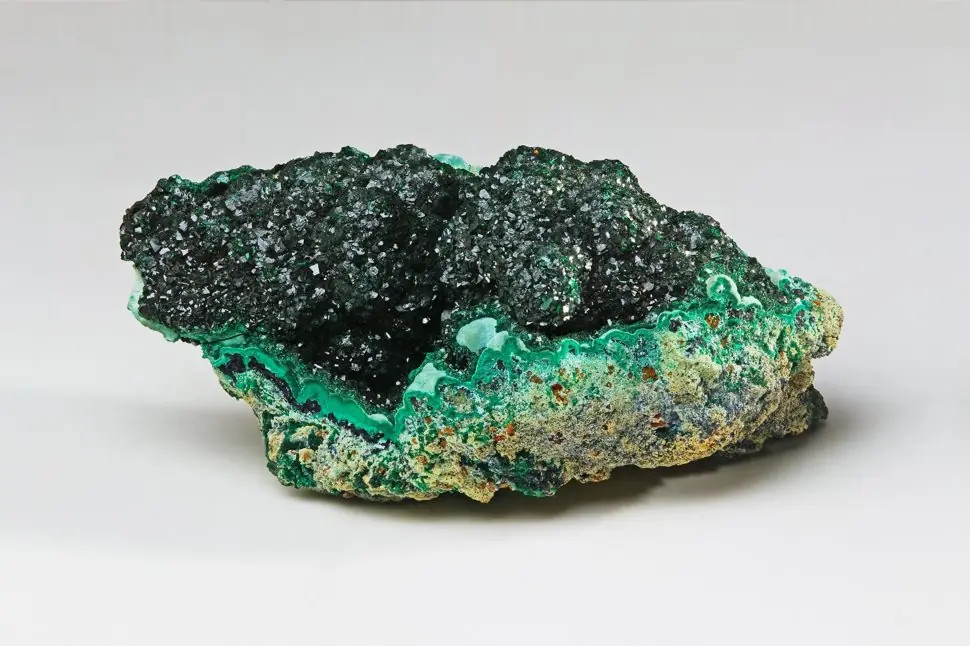
5.10 Chemistry of Metals
| High-yield fact | Value / form |
|---|---|
| Calcination | heating the ore in limited or no air (carbonates, hydroxides) |
| Roasting | heating the ore in excess air (sulphides) |
| Flux and slag | gangue + flux \to slag (\text{CaO} + \text{SiO}_2 \to \text{CaSiO}_3) |
| Thermite | \text{Fe}_2\text{O}_3 + 2\text{Al} \to 2\text{Fe} + \text{Al}_2\text{O}_3 |
| Down's process | electrolysis of fused NaCl (with \text{CaCl}_2) for sodium |
| Plaster of Paris | \text{CaSO}_4\cdot\tfrac{1}{2}\text{H}_2\text{O}; Epsom salt \text{MgSO}_4\cdot7\text{H}_2\text{O}; quick lime CaO; bleaching powder \text{CaOCl}_2 |
| Refining | poling (copper); electro-refining (Cu, Zn) |
- The formula of plaster of Paris is [1]a\text{CaSO}_4\cdot2\text{H}_2\text{O}b\text{CaSO}_4\cdot\tfrac{1}{2}\text{H}_2\text{O}c\text{CaSO}_4d\text{CaCO}_3
- Calcination is heating an ore [1]ain limited or no airbin excess aircwith carbondin an electric current
- In Down's process the electrolyte is [1]aaqueous NaClbmolten NaOHcfused NaCl with \text{CaCl}_2daqueous NaOH
- Epsom salt is [1]a\text{CaSO}_4\cdot2\text{H}_2\text{O}b\text{MgSO}_4\cdot7\text{H}_2\text{O}c\text{ZnSO}_4\cdot7\text{H}_2\text{O}d\text{FeSO}_4\cdot7\text{H}_2\text{O}
- In the thermite process the reducing agent is [1]acarbonbhydrogenccarbon monoxidedaluminium
- The substance formed when a flux combines with gangue is [1]amattebslagcalloydamalgam
- Poling is used in the refining of [1]aironbcoppercaluminiumdzinc
Answers — 5.10
1. (b) — gypsum (a) loses three-quarters of its water on heating to 120^{\circ}\text{C}.
2. (a) — (b) is roasting.
3. (c) — water would give NaOH and \text{H}_2 instead; \text{CaCl}_2 lowers the melting point.
4. (b) — magnesium sulphate heptahydrate.
5. (d) — Al is a stronger reducing agent than Fe.
6. (b) — slag is the fusible product removed from the furnace.
7. (b) — blister copper is stirred with green wood poles to remove \text{Cu}_2\text{O}.
5.11 Bio-inorganic Chemistry
| Metal | Role |
|---|---|
| Mg | central ion of chlorophyll |
| Fe | haemoglobin (oxygen carrier), cytochromes |
| Co | vitamin \text{B}_{12} |
| Zn | carbonic anhydrase and many enzymes |
| Na, K | nerve impulse; sodium–potassium pump moves 3\ \text{Na}^{+} out and 2\ \text{K}^{+} in |
| Ca | bones, teeth, muscle contraction, blood clotting |
| Toxic metals | Hg (Minamata disease), Pb, As, Cd |
- The metal at the centre of chlorophyll is [1]aironbmagnesiumccalciumdzinc
- The metal in haemoglobin is [1]aironbcopperccobaltdmagnesium
- The \text{Na}^{+}/\text{K}^{+} pump moves [1]a2 \text{Na}^{+} out and 3 \text{K}^{+} inb3 \text{K}^{+} out and 2 \text{Na}^{+} inc3 \text{Na}^{+} out and 2 \text{K}^{+} indequal numbers of each
- Vitamin \text{B}_{12} contains [1]aironbzincccobaltdnickel
- Minamata disease is caused by poisoning with [1]aleadbmercuryccadmiumdarsenic
- The enzyme carbonic anhydrase contains [1]azincbironccopperdmanganese
Answers — 5.11
1. (b) — \text{Mg}^{2+} sits in the porphyrin ring (iron is in haem).
2. (a) — \text{Fe}^{2+} binds \text{O}_2.
3. (c) — three sodium out, two potassium in, per ATP.
4. (c) — cobalamin.
5. (b) — methylmercury in fish.
6. (a) — \text{Zn}^{2+} in the active site.
5.12 Basic Concept of Organic Chemistry
| High-yield fact | Value / form |
|---|---|
| Tetracovalency | carbon forms four covalent bonds (sp^{3}, sp^{2}, sp) |
| Catenation | self-linking of carbon atoms into chains and rings |
| Homologous series | consecutive members differ by -\text{CH}_2- |
| Functional groups | -\text{OH} alcohol; -\text{CHO} aldehyde; >\text{C=O} ketone; -\text{COOH} acid; -\text{NH}_2 amine |
| Octane number | iso-octane = 100; n-heptane = 0 |
| Cetane number | rates diesel fuel; cetane (hexadecane) = 100 |
| Cracking | breaking large hydrocarbons into smaller, more useful ones |
- The property of carbon to form long chains is called [1]acatenationbisomerismcallotropydpolymerization
- The functional group of alcohols is [1]a-\text{CHO}b-\text{OH}c-\text{COOH}d-\text{NH}_2
- Successive members of a homologous series differ by [1]a\text{CH}_4b\text{CH}_2c\text{C}_2\text{H}_4d\text{CH}
- The octane number of iso-octane is [1]a0b50c100d120
- The cetane number is a measure of the quality of [1]apetrolbdieselckerosenedLPG
- Cracking is the process of [1]abreaking large hydrocarbon molecules into smaller onesbjoining small moleculescremoving sulphurddistilling crude oil
- The valency of carbon is [1]a2b3c4d6
Answers — 5.12
1. (a) — catenation; isomerism is the same formula with different structures.
2. (b) — (a) is the aldehyde group.
3. (b) — one methylene unit.
4. (c) — the standard for 100; n-heptane is 0.
5. (b) — the ignition quality of diesel; (a) uses octane number.
6. (a) — (d) describes fractional distillation.
7. (c) — tetravalent.
5.13 Fundamental Principles of Organic Chemistry
| High-yield fact | Value / form |
|---|---|
| Lassaigne's test | N: Prussian blue; S: black PbS with lead acetate; halogen: curdy white (Cl), pale yellow (Br), yellow (I) precipitate with \text{AgNO}_3 |
| Isomerism | chain, position, functional, metamerism, tautomerism (structural); geometrical and optical (stereo) |
| Optical isomerism | needs a chiral carbon (four different groups) |
| Fission | homolytic gives free radicals; heterolytic gives ions |
| Inductive effect | -\text{CH}_3 is +I; -\text{Cl}, -\text{NO}_2 are -I |
| Carbocation stability | 3^{\circ} > 2^{\circ} > 1^{\circ} > \text{CH}_3^{+} |
- The IUPAC name of \text{CH}_3\text{CH}_2\text{CH}(\text{CH}_3)\text{CH}_3 is [1]apentaneb2-methylbutanec3-methylbutanedisopentene
- In Lassaigne's test, a Prussian blue colour shows [1]anitrogenbsulphurcchlorinedphosphorus
- Ethanol and dimethyl ether are [1]achain isomersbposition isomerscfunctional isomersdmetamers
- Which compound shows geometrical isomerism? [1]apropenebbut-2-enecethenedbut-1-ene
- Which of the following is an electrophile? [1]a\text{NH}_3b\text{OH}^{-}c\text{H}_2\text{O}d\text{BF}_3
- Which group shows a -I effect? [1]a-\text{Cl}b-\text{CH}_3c-\text{C}_2\text{H}_5d-\text{CH}(\text{CH}_3)_2
- Which molecule contains a chiral carbon? [1]a\text{CH}_3\text{CH}_2\text{OH}b\text{CH}_3\text{COOH}c\text{CH}_3\text{CH(OH)COOH}d\text{CH}_3\text{CH}_2\text{CH}_3
- Homolytic fission of a covalent bond produces [1]acations and anionsbfree radicalsccarbanions onlydcarbocations only
Answers — 5.13
1. (b) — the longest chain is butane with a methyl on C-2; (c) numbers from the wrong end.
2. (a) — \text{Fe}_4[\text{Fe}(\text{CN})_6]_3 forms from cyanide.
3. (c) — \text{C}_2\text{H}_6\text{O} with -\text{OH} against -\text{O}-.
4. (b) — each alkene carbon of but-2-ene has two different groups.
5. (d) — \text{BF}_3 is electron-deficient; the others have lone pairs.
6. (a) — Cl withdraws electrons; alkyl groups push them (+I).
7. (c) — the middle carbon carries H, \text{CH}_3, OH and COOH.
8. (b) — each fragment keeps one electron.
5.14 Hydrocarbons
| High-yield fact | Value / form |
|---|---|
| Wurtz | 2\text{CH}_3\text{Br} + 2\text{Na} \to \text{C}_2\text{H}_6 + 2\text{NaBr} |
| Kolbe | electrolysis of sodium acetate gives ethane at the anode |
| Markovnikov | in \text{HX} addition, H goes to the carbon already holding more H |
| Peroxide effect | anti-Markovnikov, and only for HBr |
| Ethyne | \text{CaC}_2 + 2\text{H}_2\text{O} \to \text{C}_2\text{H}_2 + \text{Ca(OH)}_2 |
| Terminal alkyne | acidic: gives white silver acetylide with ammoniacal \text{AgNO}_3, red copper acetylide with ammoniacal \text{Cu}_2\text{Cl}_2 |
| Tests for unsaturation | bromine water: orange to colourless; Baeyer's reagent (cold alkaline dilute \text{KMnO}_4): purple to colourless |
- Propene reacts with HBr (no peroxide) to give mainly [1]a1-bromopropaneb2-bromopropanec1,2-dibromopropanedpropane
- The Wurtz reaction of \text{CH}_3\text{Cl} with sodium gives [1]aethanebmethanecpropanedethene
- Ethyne gives with ammoniacal \text{AgNO}_3 [1]ano reactionba red precipitateca white precipitateda yellow precipitate
- Baeyer's reagent is [1]aacidified \text{K}_2\text{Cr}_2\text{O}_7bcold alkaline dilute \text{KMnO}_4cbromine waterdTollens' reagent
- Which does not decolourise bromine water? [1]aethenebethynecpropenedethane
- Heating ethanol with conc. \text{H}_2\text{SO}_4 at 170^{\circ}\text{C} gives [1]aethenebethanecdiethyl etherdethyne
- Kolbe's electrolysis of sodium acetate gives [1]amethanebethenecethanedpropane
- The peroxide effect is observed with [1]aHClbHBrcHIdall halogen acids
Answers — 5.14
1. (b) — H adds to the \text{CH}_2 end, Br to the middle carbon (Markovnikov).
2. (a) — 2\text{CH}_3\text{Cl} + 2\text{Na} \to \text{C}_2\text{H}_6; the product has twice the carbons.
3. (c) — silver acetylide, white.
4. (b) — alkaline cold dilute permanganate.
5. (d) — ethane is saturated.
6. (a) — dehydration at 170^{\circ}\text{C}; at 140^{\circ}\text{C} the product is the ether.
7. (c) — 2\text{CH}_3\text{COO}^{-} \to \text{C}_2\text{H}_6 + 2\text{CO}_2 + 2e^{-}.
8. (b) — only the H–Br bond splits homolytically under peroxide.
5.15 Aromatic Hydrocarbons
| High-yield fact | Value / form |
|---|---|
| Hückel's rule | planar, cyclic, conjugated with (4n + 2)\ \pi electrons |
| Benzene | six \pi electrons; all C–C bonds equal (139\ \text{pm}); resonance hybrid |
| Nitration | conc. \text{HNO}_3 + conc. \text{H}_2\text{SO}_4 at about 323\ \text{K} gives nitrobenzene |
| Friedel–Crafts | anhydrous \text{AlCl}_3 with an alkyl or acyl halide |
| Directing groups | -\text{OH}, -\text{CH}_3, -\text{NH}_2: ortho/para; -\text{NO}_2, -\text{COOH}, -\text{CHO}: meta |
| Preparation | sodium benzoate heated with soda lime; ethyne through a red-hot tube |
- The number of \pi electrons in benzene is [1]a2b4c6d8
- Hückel's rule for aromaticity is [1]a4n \pi electronsb(4n+2) \pi electronsc2n \pi electronsdn^{2} \pi electrons
- The nitrating mixture is [1]aconc. \text{HNO}_3 and conc. \text{H}_2\text{SO}_4bdilute \text{HNO}_3c\text{HNO}_3 and HCld\text{NaNO}_3 and water
- The catalyst in the Friedel–Crafts reaction is [1]aNibanhydrous \text{AlCl}_3c\text{V}_2\text{O}_5dPt
- In nitrobenzene the -\text{NO}_2 group directs an incoming electrophile to the [1]aortho positionbpara positioncmeta positiondortho and para
- Benzene is obtained by heating sodium benzoate with [1]aNaOHbsoda limeczinc dustdconc. \text{H}_2\text{SO}_4
Answers — 5.15
1. (c) — one \pi electron from each of the six carbons.
2. (b) — benzene has n = 1.
3. (a) — the sulphuric acid generates \text{NO}_2^{+}.
4. (b) — a Lewis acid; it must be anhydrous.
5. (c) — -\text{NO}_2 deactivates the ring and directs meta.
6. (b) — decarboxylation with soda lime (\text{NaOH} + \text{CaO}); plain NaOH is not enough.
5.16 Fundamentals of Applied Chemistry
| High-yield fact | Value / form |
|---|---|
| Stages of a new product | research in the laboratory, then a pilot plant, then a full-scale plant |
| Batch process | the reactor is charged, the reaction runs, and the product is removed before the next charge |
| Continuous process | feed enters and product leaves without a break (ammonia, sulphuric acid) |
| Fixed capital | land, buildings, machinery |
| Working capital | raw materials, wages, stocks |
| Environmental impact | \text{SO}_2 gives acid rain; fertilizer run-off gives eutrophication |
- A batch process is one in which [1]afeed enters and product leaves continuouslybthe reactor is charged, the reaction is completed, and the product is removedconly gases reactdno catalyst is used
- A pilot plant is [1]athe full production plantba plant for waste onlyca small-scale plant used to test a process before scale-upda laboratory flask
- Which is an example of fixed capital? [1]araw materialsbwagescland and machinerydfuel in stock
- Large-volume products such as ammonia are usually made by [1]abatch processingbcontinuous processingchand mixingdfermentation only
- Acid rain is mainly caused by [1]a\text{CO}_2b\text{SO}_2 and \text{NO}_xc\text{O}_3d\text{N}_2
- Eutrophication is caused by excess [1]anitrates and phosphatesboxygencchlorinedcarbon monoxide
Answers — 5.16
1. (b) — (a) describes a continuous process.
2. (c) — it tests a process on a small scale first.
3. (c) — raw materials and wages are working capital.
4. (b) — steady, high-volume production.
5. (b) — \text{SO}_2 and \text{NO}_x form sulphuric and nitric acids in the air.
6. (a) — nutrient run-off causes algal blooms.
5.17 Modern Chemical Manufactures
| Process | Key facts |
|---|---|
| Haber (ammonia) | \text{N}_2 + 3\text{H}_2 \rightleftharpoons 2\text{NH}_3, \Delta H = -92\ \text{kJ}; Fe catalyst, Mo or \text{Al}_2\text{O}_3 promoter; about 200\ \text{atm} and 450–500^{\circ}\text{C} |
| Ostwald (nitric acid) | 4\text{NH}_3 + 5\text{O}_2 \to 4\text{NO} + 6\text{H}_2\text{O} over Pt–Rh gauze at about 800^{\circ}\text{C}; then 2\text{NO} + \text{O}_2 \to 2\text{NO}_2; 3\text{NO}_2 + \text{H}_2\text{O} \to 2\text{HNO}_3 + \text{NO} |
| Contact (sulphuric acid) | 2\text{SO}_2 + \text{O}_2 \rightleftharpoons 2\text{SO}_3 over \text{V}_2\text{O}_5 at about 450^{\circ}\text{C}; \text{SO}_3 absorbed in conc. \text{H}_2\text{SO}_4 to give oleum |
| Diaphragm cell (NaOH) | brine electrolysed; \text{Cl}_2 at the anode, \text{H}_2 and NaOH at the cathode; asbestos diaphragm |
| Solvay (soda ash) | \text{NaCl} + \text{NH}_3 + \text{CO}_2 + \text{H}_2\text{O} \to \text{NaHCO}_3 + \text{NH}_4\text{Cl}; 2\text{NaHCO}_3 \to \text{Na}_2\text{CO}_3 + \text{CO}_2 + \text{H}_2\text{O}; by-product \text{CaCl}_2 |
- The catalyst used in the Haber process is [1]a\text{V}_2\text{O}_5bfinely divided ironcplatinumdnickel
- The catalyst used in Ostwald's process is [1]aFeb\text{V}_2\text{O}_5cPt–Rh gauzed\text{MnO}_2
- In the contact process \text{SO}_3 is absorbed in [1]awaterbconc. \text{H}_2\text{SO}_4cdilute \text{H}_2\text{SO}_4dNaOH
- The by-product of the Solvay process is [1]a\text{NH}_3b\text{CaCl}_2cNaOHd\text{CaCO}_3
- In the diaphragm cell, chlorine is liberated at the [1]aanodebcathodecdiaphragmdoutlet
- The promoter in the Haber process is [1]a\text{V}_2\text{O}_5bPtcModNi
- The usual temperature of the Haber process is about [1]a25^{\circ}\text{C}b200^{\circ}\text{C}c450^{\circ}\text{C}d1000^{\circ}\text{C}
- The temperature of the catalytic oxidation of \text{NH}_3 in Ostwald's process is about [1]a100^{\circ}\text{C}b450^{\circ}\text{C}c800^{\circ}\text{C}d1500^{\circ}\text{C}
Answers — 5.17
1. (b) — \text{V}_2\text{O}_5 belongs to the contact process.
2. (c) — platinum–rhodium, a trap for those who choose Pt alone.
3. (b) — water gives an acid mist that is hard to condense.
4. (b) — formed when \text{NH}_4\text{Cl} is treated with \text{Ca(OH)}_2 to recover ammonia.
5. (a) — 2\text{Cl}^{-} \to \text{Cl}_2 + 2e^{-} at the anode.
6. (c) — molybdenum (or \text{Al}_2\text{O}_3) improves the iron catalyst.
7. (c) — a compromise between rate and yield for an exothermic reaction.
8. (c) — the gauze glows red-hot, so the reaction is self-sustaining.
Chapter summary
- Group A is eleven one-mark MCQs drawn from all seventeen units; no unit is safe to skip, and the question types are: a name or definition, a formula or reagent, a one-step calculation, or a misconception.
- Stoichiometry: N_A = 6.022\times10^{23}; molar volume 22.4\ \text{L} at STP; \text{V.D.} = M/2; percentage yield = actual/theoretical \times100.
- Atomic structure: 2n^{2} electrons per shell; 2l+1 orbitals per subshell; Cr and Cu are the 3d exceptions; Hund, Pauli and Aufbau.
- Periodic trends: radius falls and IE and EN rise across a period; the reverse down a group; F is the most electronegative, Cl has the highest electron affinity.
- Shapes: linear sp, planar sp^{2}, tetrahedral sp^{3}, pyramidal and bent (lone pairs), sp^{3}d and sp^{3}d^{2} for \text{PCl}_5 and \text{SF}_6.
- Redox: oxidation is loss of electrons; \text{Cr} = +6 in dichromate, \text{Mn} = +7 in permanganate; 1\ \text{F} = 96\,500\ \text{C}.
- Gases: P_1V_1 = P_2V_2, PV = nRT, r_1/r_2 = \sqrt{M_2/M_1}; K_p = K_c(RT)^{\Delta n}.
- Inorganic: ring test, Kipp's apparatus, Down's process, plaster of Paris \text{CaSO}_4\cdot\tfrac{1}{2}\text{H}_2\text{O}; Haber (Fe), Ostwald (Pt–Rh), contact (\text{V}_2\text{O}_5), Solvay.
- Organic: Markovnikov and the peroxide effect (HBr only); Wurtz and Kolbe give alkanes; Baeyer and bromine water test unsaturation; Hückel (4n+2); -\text{NO}_2 directs meta.
Practice questions
Group A — Multiple choice (1 mark each)
- The number of moles in 11\ \text{g} of \text{CO}_2 is [1]a0.125b0.25c0.5d4
- The shape of the methane molecule is [1]aplanarbtetrahedralcpyramidaldlinear
- The gas liberated at the cathode during electrolysis of brine in a diaphragm cell is [1]achlorineboxygenchydrogendnitrogen
- The hybridization of carbon in ethyne is [1]asp^{3}bsp^{2}cspdsp^{3}d
Answers to Group A
1. (b) — 11/44 = 0.25 mol.
2. (b) — four bond pairs, 109.5^{\circ}.
3. (c) — 2\text{H}_2\text{O} + 2e^{-} \to \text{H}_2 + 2\text{OH}^{-} at the cathode.
4. (c) — each carbon forms one \sigma bond to H and one to C, with two \pi bonds.
Group B — Short answer (5 marks each)
- Calculate the mass of \text{CaO} obtained by heating 50\ \text{g} of \text{CaCO}_3. [5]
- State Le Chatelier's principle and apply it to the Haber process for pressure and temperature. [5]
- Write the Lewis structure idea and shape of \text{H}_2\text{O} and explain why its bond angle is below 109.5^{\circ}. [5]
- Distinguish between ethane, ethene and ethyne by two chemical tests. [5]
Answers to Group B
1. \text{CaCO}_3 \to \text{CaO} + \text{CO}_2; 50\ \text{g} = 0.5 mol; one mole of CaCO₃ gives one mole of CaO; mass of CaO = 0.5\times56 = 28\ \text{g}.
2. If a system at equilibrium is disturbed, it shifts to oppose the disturbance. \text{N}_2 + 3\text{H}_2 \rightleftharpoons 2\text{NH}_3 (\Delta H < 0, fewer moles on the right): high pressure favours ammonia; low temperature favours ammonia but slows the rate, so about 450^{\circ}\text{C} with an Fe catalyst is the compromise.
3. Oxygen has six valence electrons, two used in bonds, so there are two bond pairs and two lone pairs (sp^{3}). Lone pair–lone pair and lone pair–bond pair repulsion exceeds bond pair–bond pair repulsion, squeezing the angle to 104.5^{\circ}; the shape is bent.
4. Bromine water: ethene and ethyne decolourise it, ethane does not. Ammoniacal \text{AgNO}_3: only ethyne gives a white precipitate. Baeyer's reagent is decolourised by ethene and ethyne but not ethane.
Group C — Long answer (8 marks each)
- Describe the manufacture of sulphuric acid by the contact process with the reactions, conditions and a flow sheet. [8]
- Describe the Solvay process for sodium carbonate, giving the reactions and the role of ammonia recovery. [8]
Answers to Group C
1. Steps: (i) Sulphur dioxide: \text{S} + \text{O}_2 \to \text{SO}_2 (or roasting pyrites, 4\text{FeS}_2 + 11\text{O}_2 \to 2\text{Fe}_2\text{O}_3 + 8\text{SO}_2); the gas is purified and dried. (ii) Oxidation: 2\text{SO}_2 + \text{O}_2 \rightleftharpoons 2\text{SO}_3, \Delta H = -197\ \text{kJ}, over \text{V}_2\text{O}_5 at 400–450^{\circ}\text{C} and 1–2 atm; excess oxygen and removal of heat favour the yield. (iii) Absorption: \text{SO}_3 is dissolved in conc. \text{H}_2\text{SO}_4 to give oleum: \text{SO}_3 + \text{H}_2\text{SO}_4 \to \text{H}_2\text{S}_2\text{O}_7. (iv) Dilution: \text{H}_2\text{S}_2\text{O}_7 + \text{H}_2\text{O} \to 2\text{H}_2\text{SO}_4. Water is not used for direct absorption because it forms a mist. Flow sheet: burner \to purifier \to dryer \to converter (\text{V}_2\text{O}_5) \to absorption tower \to oleum tank \to dilution.
2. Brine is saturated with \text{NH}_3 in an ammonia tower. In the carbonating (Solvay) tower \text{CO}_2 is passed in: \text{NaCl} + \text{NH}_3 + \text{CO}_2 + \text{H}_2\text{O} \to \text{NaHCO}_3 + \text{NH}_4\text{Cl}; sparingly soluble \text{NaHCO}_3 separates and is filtered. Heating gives soda ash: 2\text{NaHCO}_3 \to \text{Na}_2\text{CO}_3 + \text{CO}_2 + \text{H}_2\text{O} (the \text{CO}_2 is recycled). \text{CO}_2 comes from heating limestone, \text{CaCO}_3 \to \text{CaO} + \text{CO}_2, and the lime slakes to \text{Ca(OH)}_2. Ammonia is recovered: 2\text{NH}_4\text{Cl} + \text{Ca(OH)}_2 \to 2\text{NH}_3 + \text{CaCl}_2 + 2\text{H}_2\text{O}. Overall: 2\text{NaCl} + \text{CaCO}_3 \to \text{Na}_2\text{CO}_3 + \text{CaCl}_2; ammonia is recycled, so only \text{CaCl}_2 is lost.