Unit 14 · Organic Chemistry · 8 teaching hours · 28 min read
Hydrocarbons
What the syllabus asks for 9
- Alkanes: preparation from haloalkanes (reduction and Wurtz reaction), decarboxylation, catalytic hydrogenation of alkene and alkyne
- Alkanes chemical properties: substitution (halogenation, nitration, sulphonation); oxidation of ethane
- Alkenes: preparation by dehydration of alcohol, dehydrohalogenation, catalytic hydrogenation of alkyne
- Alkenes chemical properties: addition with HX (Markovnikov's rule and peroxide effect), H2O, O3, H2SO4
- Alkynes: preparation from carbon and hydrogen, 1,2-dibromoethane, chloroform/iodoform
- Alkynes chemical properties: addition with H2, HX, H2O; acidic nature (sodium, ammoniacal AgNO3, ammoniacal Cu2Cl2)
- Test of unsaturation (ethene and ethyne): bromine water test and Baeyer's test
- Comparative physical properties of alkane, alkene and alkyne
- Kolbe's electrolysis method
A hydrocarbon contains carbon and hydrogen only. Everything else in organic chemistry is a hydrocarbon with something bolted onto it, which is why this unit comes first among the families. Three families are studied: alkanes (CₙH₂ₙ₊₂, all single bonds, saturated), alkenes (CₙH₂ₙ, one C=C) and alkynes (CₙH₂ₙ₋₂, one C≡C). The plan is always the same — how each is made, how each reacts, and how you tell them apart in a test tube.
Every NEB paper takes preparations and properties straight from this list, so learn each reaction as reactant + reagent + condition → product. The three that appear almost every year are Markovnikov's rule with the peroxide effect, Kolbe's electrolysis, and the pair of tests that separate ethene from ethyne. Write the conditions above the arrow — a reaction without its catalyst and temperature loses half its mark.

14.1 Alkanes: preparation from haloalkanes (reduction and Wurtz reaction), decarboxylation, catalytic hydrogenation of alkene and alkyne
Alkanes are also called paraffins (Latin parum affinis, "little affinity") because they are so unreactive. Four laboratory preparations are on the syllabus.
(a) Reduction of haloalkanes
Nascent hydrogen, generated in the flask by zinc and acid, replaces the halogen by hydrogen. The alkane keeps the same number of carbons as the halide.
CH₃CH₂Cl + H₂ --Zn/HCl--> CH₃CH₃ + HCl
CH₃CH₂I + HI --red P, 423 K--> CH₃CH₃ + I₂
Zinc and ethanoic acid, zinc–copper couple in ethanol, or lithium aluminium hydride LiAlH₄ in dry ether all do the same job. The order of ease is R—I > R—Br > R—Cl, because the C—I bond is the weakest.
(b) Wurtz reaction
Two molecules of haloalkane are coupled by metallic sodium in dry ether. The alkane produced has twice the number of carbons of the halide.
2CH₃CH₂Br + 2Na --dry ether--> CH₃CH₂CH₂CH₃ + 2NaBr
- It cannot make methane, and it cannot make any alkane with an odd number of carbon atoms from a single halide.
- With two different halides R—X and R′—X you get a mixture of three alkanes, R—R, R′—R′ and R—R′, which is hard to separate.
- The ether must be dry: sodium reacts violently with water.
(c) Decarboxylation (soda-lime method)
The sodium salt of a carboxylic acid is heated with soda lime (NaOH + CaO, in the ratio 3:1). Carbon dioxide leaves as carbonate, so the alkane has one carbon fewer than the acid.
CH₃COONa + NaOH --CaO, Δ--> CH₄ + Na₂CO₃
CH₃CH₂COONa + NaOH --CaO, Δ--> CH₃CH₃ + Na₂CO₃
Calcium oxide is added to keep the very hygroscopic sodium hydroxide dry and to stop it attacking the glass.
(d) Catalytic hydrogenation (Sabatier–Senderens reduction)
An alkene or alkyne takes up hydrogen over a finely divided metal catalyst.
CH₂=CH₂ + H₂ --Ni, 523–573 K--> CH₃CH₃
CH≡CH + 2H₂ --Ni, 523–573 K--> CH₃CH₃
Nickel needs 250–300 °C; platinum or palladium work at room temperature. This is the reaction used industrially to turn liquid vegetable oils into vanaspati ghee.
| Method | Reagent and condition | Carbon count | Note |
|---|---|---|---|
| Reduction of R—X | Zn/HCl, or Zn + CH₃COOH, or LiAlH₄ | unchanged | ease R—I > R—Br > R—Cl |
| Wurtz reaction | 2R—X + 2Na, dry ether | doubled | symmetrical alkanes only |
| Decarboxylation | RCOONa + NaOH/CaO, Δ | one fewer | good for CH₄ from CH₃COONa |
| Hydrogenation | H₂, Ni at 523–573 K (or Pt/Pd, 298 K) | unchanged | used for vanaspati ghee |
| Kolbe's electrolysis | conc. aq. RCOONa, electrolysis | doubled, minus 2 | Section 14.9 |
14.2 Alkanes chemical properties: substitution (halogenation, nitration, sulphonation); oxidation of ethane
Alkanes have only strong, non-polar σ bonds, so they are attacked neither by electrophiles nor by nucleophiles. Their characteristic reaction is free-radical substitution, which needs heat or ultraviolet light to get started.
Halogenation
CH₄ + Cl₂ --hν / 573 K--> CH₃Cl + HCl
CH₃Cl + Cl₂ --hν--> CH₂Cl₂ + HCl → CHCl₃ → CCl₄
The reaction does not stop at the first product: with excess chlorine all four hydrogens are replaced in turn. Reactivity of the halogens falls sharply, F₂ > Cl₂ > Br₂ > I₂. Fluorination is explosive and iodination is reversible (HI reduces the product back), so iodination needs an oxidising agent such as HIO₃ or HNO₃ to destroy the HI as it forms.

Nitration
In the vapour phase at 673–773 K an alkane reacts with nitric acid vapour. The reaction is also free-radical, and it gives a mixture, because C—C bonds break as well.
CH₄ + HNO₃ --673–773 K--> CH₃NO₂ + H₂O
CH₃CH₃ + HNO₃ --673 K--> CH₃CH₂NO₂ + H₂O
Sulphonation
An alkane heated with oleum (fuming sulphuric acid, H₂SO₄ + SO₃) gives a sulphonic acid. Only alkanes from hexane upwards, and especially those with a tertiary hydrogen, react at a useful rate:
CH₃(CH₂)₄CH₃ + HO—SO₃H --oleum, Δ--> CH₃(CH₂)₄CH₂—SO₃H + H₂O
Methane, ethane and propane do not sulphonate — a favourite one-mark point.
Oxidation of ethane
| Condition | Equation | Product |
|---|---|---|
| Excess O₂, ignite | 2C₂H₆ + 7O₂ → 4CO₂ + 6H₂O | complete combustion, ΔH negative |
| O₂, Cu tube, 473 K, 100 atm | 2C₂H₆ + O₂ → 2CH₃CH₂OH | ethanol |
| O₂, Mo₂O₃ catalyst | C₂H₆ + O₂ → CH₃CHO + H₂O | ethanal |
| O₂, manganese(II) ethanoate, Δ | 2C₂H₆ + 3O₂ → 2CH₃COOH + 2H₂O | ethanoic acid |
Combustion is the reason alkanes matter economically: LPG (a mixture of propane and butane) is the commonest cooking fuel in Nepali kitchens. The complete combustion of butane is
2C₄H₁₀ + 13O₂ → 8CO₂ + 10H₂O
With a limited air supply the products are carbon monoxide and soot instead, which is why a badly ventilated kitchen is dangerous.
14.3 Alkenes: preparation by dehydration of alcohol, dehydrohalogenation, catalytic hydrogenation of alkyne
Alkenes, or olefins, are made by elimination — pulling two groups off adjacent carbons so that a π bond can form.
(a) Dehydration of alcohols
An alcohol loses water over concentrated sulphuric acid at 443 K, or over alumina at 623 K.
CH₃CH₂OH --conc. H₂SO₄, 443 K--> CH₂=CH₂ + H₂O
The ease of dehydration follows carbocation stability: 3° > 2° > 1°. A tertiary alcohol dehydrates with 20 % H₂SO₄ at 358 K, a primary one needs 95 % acid at 443 K.
(b) Dehydrohalogenation
A haloalkane loses HX when warmed with alcoholic potassium hydroxide.
CH₃CH₂Br + KOH (alcoholic) --Δ--> CH₂=CH₂ + KBr + H₂O
Alcoholic KOH gives elimination and an alkene; aqueous KOH gives substitution and an alcohol. The same reagent, a different solvent, a completely different product. Write the word "alcoholic" every time.
When more than one alkene is possible, Saytzeff's rule decides:
In a dehydrohalogenation or dehydration, the hydrogen is removed from the carbon carrying the fewest hydrogen atoms, so the major product is the more substituted — and therefore more stable — alkene.
CH₃CH₂CHBrCH₃ + KOH (alc.) → CH₃CH=CHCH₃ (but-2-ene, 81 %) + CH₂=CHCH₂CH₃ (but-1-ene, 19 %)
The ease of elimination is again 3° > 2° > 1°, and R—I > R—Br > R—Cl.
(c) Catalytic hydrogenation of an alkyne
Adding only one molecule of hydrogen stops at the alkene, provided the catalyst is poisoned so that it cannot go further.
CH≡CH + H₂ --Lindlar's catalyst--> CH₂=CH₂
Lindlar's catalyst is palladium deposited on calcium carbonate and partly deactivated with quinoline or lead ethanoate. Both hydrogens arrive on the same face of the triple bond, so an internal alkyne gives the cis alkene. Sodium in liquid ammonia at 195 K does the opposite and gives the trans alkene.
14.4 Alkenes chemical properties: addition with HX (Markovnikov's rule and peroxide effect), H₂O, O₃, H₂SO₄
The π bond of an alkene is a loose, exposed cloud of electrons above and below the C=C axis. It is therefore a nucleophile, and the characteristic reaction of an alkene is electrophilic addition.
Addition of hydrogen halides
CH₂=CH₂ + HBr → CH₃CH₂Br
Reactivity falls in the order HI > HBr > HCl, which is the order of decreasing acid strength — the easier the H—X bond gives up H⁺, the faster the addition.
With an unsymmetrical alkene there are two possible products, and only one of them forms in quantity.
When an unsymmetrical reagent HX adds to an unsymmetrical alkene, the hydrogen attaches itself to the doubly bonded carbon that already carries the greater number of hydrogen atoms, and the halogen goes to the other carbon.
CH₃CH=CH₂ + HBr → CH₃CHBrCH₃ (2-bromopropane, major)
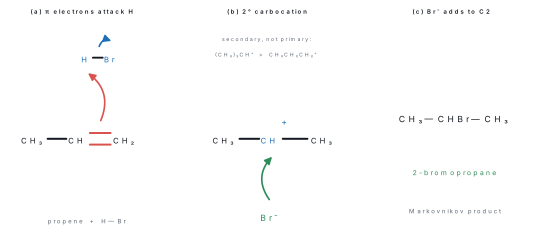
The rule is not a rule at all but a consequence of carbocation stability: the proton adds so as to give the more stable carbocation, and a secondary cation beats a primary one because two +I alkyl groups spread its charge (Section 13.7).
Peroxide effect (Kharasch effect)
In the presence of benzoyl peroxide or simply of air-formed peroxides, the addition of HBr goes the other way round:
CH₃CH=CH₂ + HBr --(C₆H₅CO)₂O₂--> CH₃CH₂CH₂Br (1-bromopropane)
The peroxide provides radicals, so the mechanism becomes free-radical instead of ionic. Br• adds first, and it adds to the terminal carbon because that gives the more stable secondary free radical. The result looks like anti-Markovnikov addition.
With HCl the H—Cl bond is too strong for Cl• to be produced easily, and with HI the H—I bond is so weak that the iodine atoms simply recombine. Only HBr sits in the window where both chain steps are exothermic. So peroxides change the product of HBr addition and of nothing else.

Addition of water (hydration)
Water adds across the double bond in the presence of an acid catalyst, and the addition follows Markovnikov's rule.
CH₂=CH₂ + H₂O --H₃PO₄, 573 K, 60 atm--> CH₃CH₂OH
CH₃CH=CH₂ + H₂O --dil. H₂SO₄--> CH₃CH(OH)CH₃ (propan-2-ol)
Addition of sulphuric acid
Cold concentrated sulphuric acid adds to give an alkyl hydrogen sulphate, which on boiling with water hydrolyses to the alcohol. The two steps together are the industrial indirect hydration of alkenes.
CH₂=CH₂ + H₂SO₄ (cold, conc.) → CH₃CH₂—OSO₃H (ethyl hydrogen sulphate)
CH₃CH₂—OSO₃H + H₂O --Δ--> CH₃CH₂OH + H₂SO₄
With propene, Markovnikov's rule puts the —OSO₃H on C2, so the alcohol obtained is propan-2-ol, not propan-1-ol.
Ozonolysis
Ozone adds across the double bond to give an unstable ozonide, which is then split by zinc dust and water. The zinc is essential — it destroys the hydrogen peroxide that would otherwise oxidise the products further.
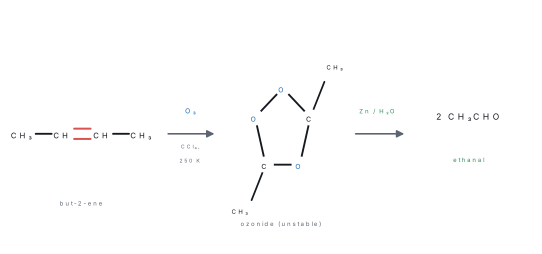
CH₃CH=CHCH₃ --(i) O₃ (ii) Zn/H₂O--> 2CH₃CHO
CH₂=CH₂ --(i) O₃ (ii) Zn/H₂O--> 2HCHO
CH₃CH=CH₂ --(i) O₃ (ii) Zn/H₂O--> CH₃CHO + HCHO
Because each doubly bonded carbon becomes a carbonyl carbon, ozonolysis is the classical method for locating a double bond: identify the two carbonyl compounds and join them back together at the oxygen atoms.
Problem. Give the major organic product of each reaction, with a reason. (a) but-1-ene + HCl (b) but-1-ene + HBr in the presence of benzoyl peroxide (c) 2-methylpropene + H₂O with dilute H₂SO₄ (d) an alkene X, C₅H₁₀, gives only propanone and ethanal on ozonolysis. What is X?
Solution.
(a) Markovnikov: the H goes to C1, which already has two hydrogens, so the Cl goes to C2. Product 2-chlorobutane, CH₃CH₂CHClCH₃. The route through the secondary cation CH₃CH₂CH⁺CH₃ is preferred to the primary one.
(b) Peroxide effect, and the reagent is HBr, so the addition is anti-Markovnikov: Br• adds to C1 giving the secondary radical CH₃CH₂•CHCH₂Br... more simply, the bromine ends on the terminal carbon. Product 1-bromobutane, CH₃CH₂CH₂CH₂Br.
(c) (CH₃)₂C=CH₂ + H₂O: the H adds to the CH₂ carbon, the OH to the carbon carrying the two methyls, because that gives a tertiary carbocation. Product 2-methylpropan-2-ol, (CH₃)₃COH.
(d) Reverse the ozonolysis. Write the two carbonyl compounds facing each other and replace the two oxygens by a double bond:
(CH₃)₂C=O + O=CHCH₃ → (CH₃)₂C=CHCH₃
X is 2-methylbut-2-ene, C₅H₁₀ — the formula checks: 5 C and 10 H.
14.5 Alkynes: preparation from carbon and hydrogen, 1,2-dibromoethane, chloroform/iodoform
(a) From the elements
An electric arc is struck between two carbon electrodes in an atmosphere of hydrogen. This is the only common organic compound made straight from its elements.
2C + H₂ --electric arc, 3000 °C--> C₂H₂
The mixture must be chilled at once, because ethyne is thermodynamically unstable with respect to its elements (ΔH°f is positive, +227 kJ mol⁻¹) and would decompose again if left hot.
(b) From 1,2-dibromoethane
Two molecules of HBr are eliminated by alcoholic potassium hydroxide.
CH₂Br—CH₂Br + 2KOH (alc.) --Δ--> CH≡CH + 2KBr + 2H₂O
The first elimination is easy; the second is difficult, because a vinyl halide is unreactive, so sodamide NaNH₂ at 423 K is often used for the second step:
CH₂Br—CH₂Br + KOH (alc.) → CH₂=CHBr + KBr + H₂O
CH₂=CHBr + NaNH₂ --Δ--> CH≡CH + NaBr + NH₃
(c) From chloroform or iodoform
Heating trihalomethane with silver powder removes all six halogen atoms:
2CHCl₃ + 6Ag --Δ--> CH≡CH + 6AgCl
2CHI₃ + 6Ag --Δ--> CH≡CH + 6AgI
(d) From calcium carbide — the industrial and laboratory route
Most ethyne actually used, including the gas in a gas-welding cylinder, comes from calcium carbide and water:
CaO + 3C --2300 K, electric furnace--> CaC₂ + CO
CaC₂ + 2H₂O → C₂H₂↑ + Ca(OH)₂
14.6 Alkynes chemical properties: addition with H₂, HX, H₂O; acidic nature (sodium, ammoniacal AgNO₃, ammoniacal Cu₂Cl₂)
An alkyne has two π bonds, so it adds two molecules of most reagents, one after the other.
Addition of hydrogen
CH≡CH + H₂ --Ni, 473 K--> CH₂=CH₂ --H₂, Ni--> CH₃CH₃
Addition of hydrogen halides
Markovnikov's rule applies at each stage, so both halogens end up on the same carbon:
CH≡CH + HBr → CH₂=CHBr (bromoethene) --HBr--> CH₃CHBr₂ (1,1-dibromoethane)
CH≡CH + HCl --Hg²⁺, 470 K--> CH₂=CHCl (vinyl chloride, the monomer of PVC)
Addition of water
Water adds only in the presence of mercury(II) sulphate in dilute sulphuric acid. The first product is an enol, which tautomerises at once to the carbonyl compound (Section 13.4).
CH≡CH + H₂O --40 % H₂SO₄, 1 % HgSO₄, 333 K--> [CH₂=CHOH] → CH₃CHO
CH₃C≡CH + H₂O --HgSO₄/H₂SO₄--> CH₃COCH₃ (propanone, by Markovnikov addition)
Hydration of ethyne gives ethanal; hydration of every other alkyne gives a ketone, because Markovnikov's rule puts the OH on the more substituted carbon.
Acidic nature of terminal alkynes
The hydrogen on a triply bonded carbon is weakly acidic. The reason is hybridisation: an sp carbon has 50 % s character, so its electrons are held much closer to the nucleus and it behaves as a more electronegative atom, which makes the C—H bond more polar and the resulting carbanion more stable.
Acidity: HC≡CH > CH₂=CH₂ > CH₃—CH₃ (pKa ≈ 25, 44, 50; s character 50 %, 33 %, 25 %)
Three reactions demonstrate it, and all three need a terminal ≡C—H:
- With sodium metal at 473 K, hydrogen is displaced:
2CH≡CH + 2Na → 2CH≡C—Na (monosodium acetylide) + H₂↑
CH≡C—Na + Na --473 K--> Na—C≡C—Na (disodium acetylide) + ½H₂
- With ammoniacal silver nitrate (Tollens' reagent) — a white precipitate of silver acetylide:
CH≡CH + 2[Ag(NH₃)₂]OH → Ag—C≡C—Ag↓ + 4NH₃ + 2H₂O
- With ammoniacal cuprous chloride — a red precipitate of copper acetylide:
CH≡CH + Cu₂Cl₂ + 2NH₄OH → Cu—C≡C—Cu↓ + 2NH₄Cl + 2H₂O
Ethyne does not turn blue litmus red and does not react with NaOH or Na₂CO₃ — it is a far weaker acid than water. "Acidic character" here means only that it can lose a proton to a very strong base such as Na or NaNH₂. Also remember that but-2-yne, CH₃C≡CCH₃, has no hydrogen on the triply bonded carbons and gives none of these three reactions.
14.7 Test of unsaturation (ethene and ethyne): bromine water test and Baeyer's test
Both tests work because the π bond is attacked and destroyed, taking the colour of the reagent with it.
Bromine water test
Bromine water is reddish-brown. An unsaturated hydrocarbon decolourises it without any hydrogen bromide being given off:
CH₂=CH₂ + Br₂ → CH₂Br—CH₂Br (1,2-dibromoethane, colourless)
CH≡CH + 2Br₂ → CHBr₂—CHBr₂ (1,1,2,2-tetrabromoethane, colourless)
Note that ethyne needs two molecules of bromine and therefore decolourises twice as much bromine water per mole.
Baeyer's test
Baeyer's reagent is cold dilute alkaline potassium permanganate, which is purple. An alkene turns it colourless and throws down a brown precipitate of manganese dioxide:
CH₂=CH₂ + H₂O + [O] --cold dil. alk. KMnO₄--> CH₂OH—CH₂OH (ethane-1,2-diol)
CH≡CH + 4[O] --cold dil. alk. KMnO₄--> HOOC—COOH (oxalic acid)
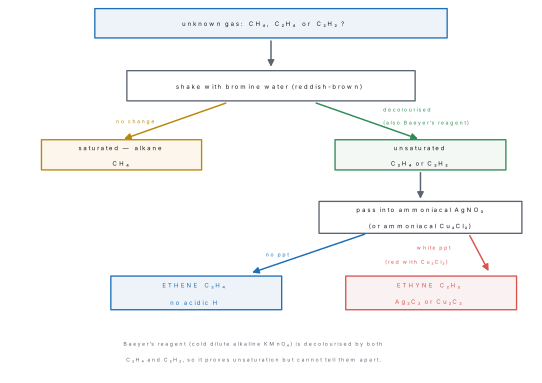
| Test | Reagent | Alkane | Alkene | Alkyne (terminal) |
|---|---|---|---|---|
| Bromine water | Br₂(aq), reddish-brown | no change | decolourised | decolourised (2 mol Br₂) |
| Baeyer's test | cold dil. alkaline KMnO₄, purple | no change | decolourised, brown MnO₂ | decolourised, brown MnO₂ |
| Ammoniacal AgNO₃ | [Ag(NH₃)₂]OH | no change | no change | white ppt Ag₂C₂ |
| Ammoniacal Cu₂Cl₂ | CuCl in NH₄OH | no change | no change | red ppt Cu₂C₂ |
14.8 Comparative physical properties of alkane, alkene and alkyne
| Property | Alkane | Alkene | Alkyne |
|---|---|---|---|
| General formula | CₙH₂ₙ₊₂ | CₙH₂ₙ | CₙH₂ₙ₋₂ |
| Hybridisation of C | sp³ | sp² | sp |
| Bond angle | 109.5° | 120° | 180° |
| C—C bond length | 154 pm | 134 pm | 120 pm |
| C—C bond enthalpy | 348 kJ mol⁻¹ | 614 kJ mol⁻¹ | 839 kJ mol⁻¹ |
| s character | 25 % | 33.3 % | 50 % |
| Physical state (C₁–C₄) | gas | gas | gas |
| Boiling point of the C₂ member | −88.6 °C | −103.7 °C | −84 °C (sublimes) |
| Density | less than water | less than water | less than water |
| Solubility | insoluble in water, soluble in benzene, ether, CCl₄ | same | slightly more soluble (weakly polar C—H) |
| Dipole moment | ≈ 0 | ≈ 0 (trans), small (cis) | ≈ 0 |
| Chemical character | inert; free-radical substitution | electrophilic addition | electrophilic addition + acidic H |
| Flame | blue, non-sooty | slightly luminous | bright, smoky (high C content) |
Within any one family the boiling point rises steadily with the number of carbons, because the van der Waals attraction grows with molecular size, and falls with branching, because a branched molecule is more nearly spherical and its molecules touch over a smaller area.
Problem. 2.8 g of ethene is burnt completely in oxygen. Calculate (a) the volume of carbon dioxide produced at STP, and (b) the mass of oxygen consumed. (C = 12, H = 1, O = 16; molar volume at STP = 22.4 dm³ mol⁻¹.)
Solution. The balanced equation is
C₂H₄ + 3O₂ → 2CO₂ + 2H₂O
Molar mass of ethene = 2(12) + 4(1) = 28 g mol⁻¹.
Moles of ethene = 2.8 / 28 = 0.10 mol.
(a) From the equation, 1 mol of C₂H₄ gives 2 mol of CO₂, so moles of CO₂ = 2 × 0.10 = 0.20 mol.
Volume at STP = 0.20 × 22.4 = 4.48 dm³.
(b) Moles of O₂ = 3 × 0.10 = 0.30 mol, so mass = 0.30 × 32 = 9.6 g.
14.9 Kolbe's electrolysis method
When a concentrated aqueous solution of the sodium or potassium salt of a carboxylic acid is electrolysed, the carboxylate ion is discharged at the anode, loses carbon dioxide and the resulting alkyl radicals couple to give an alkane with an even number of carbon atoms.
For sodium ethanoate the overall change is
2CH₃COONa + 2H₂O --electrolysis--> CH₃CH₃↑ + 2CO₂↑ + H₂↑ + 2NaOH
The mechanism, which NEB asks for in full, is:
At the anode (oxidation).
2CH₃COO⁻ → 2CH₃COO• + 2e⁻
2CH₃COO• → 2CH₃• + 2CO₂↑
CH₃• + CH₃• → CH₃CH₃
At the cathode (reduction).
2Na⁺ + 2e⁻ → 2Na
2Na + 2H₂O → 2NaOH + H₂↑
So ethane and carbon dioxide come off the anode and hydrogen off the cathode, and the solution slowly turns alkaline.
An acid RCOONa with n carbon atoms gives an alkane with 2(n − 1) carbon atoms. Sodium ethanoate (n = 2) gives ethane (2 C); sodium propanoate (n = 3) gives butane (4 C). Methane can never be made this way — sodium methanoate HCOONa would need n = 1, giving zero carbons, and in fact it gives hydrogen and carbon dioxide only. Nor can any odd-carbon alkane be made from a single salt.
2CH₃CH₂COONa + 2H₂O --electrolysis--> CH₃CH₂CH₂CH₃ + 2CO₂ + H₂ + 2NaOH
Electrolysing a mixture of two different salts gives three alkanes, exactly as the Wurtz reaction does. A related use: the potassium salt of a dicarboxylic acid ester gives long-chain diesters, which is how some polymer feedstocks are made.
Problem. A gaseous hydrocarbon A has a vapour density of 27. It decolourises bromine water and Baeyer's reagent, and gives a white precipitate with ammoniacal silver nitrate. On treatment with dilute H₂SO₄ containing HgSO₄ it gives a ketone B. Identify A and B and write the equations.
Solution.
Step 1 — molecular formula. Molar mass = 2 × vapour density = 2 × 27 = 54 g mol⁻¹.
For an alkyne CₙH₂ₙ₋₂: 12n + (2n − 2) = 54, so 14n = 56 and n = 4. The formula is C₄H₆.
Step 2 — which C₄H₆? The white precipitate with ammoniacal AgNO₃ proves there is a hydrogen on a triply bonded carbon, so A is terminal: A is but-1-yne, CH₃CH₂C≡CH. (But-2-yne, CH₃C≡CCH₃, has no acidic hydrogen and would give no precipitate.)
Step 3 — the ketone. Hydration follows Markovnikov's rule, so the OH goes to C2:
CH₃CH₂C≡CH + H₂O --HgSO₄/H₂SO₄--> [CH₃CH₂C(OH)=CH₂] → CH₃CH₂COCH₃
B is butan-2-one, CH₃CH₂COCH₃.
The other equations.
CH₃CH₂C≡CH + 2Br₂ → CH₃CH₂CBr₂—CHBr₂
CH₃CH₂C≡CH + [Ag(NH₃)₂]OH → CH₃CH₂C≡C—Ag↓ + 2NH₃ + H₂O
Problem. Starting from calcium carbide only, and using any inorganic reagents, show how you would prepare (a) ethanal, (b) ethane and (c) ethanoic acid.
Solution.
Step 0 — make ethyne.
CaC₂ + 2H₂O → C₂H₂ + Ca(OH)₂
(a) Ethanal — hydrate the ethyne:
C₂H₂ + H₂O --40 % H₂SO₄, 1 % HgSO₄, 333 K--> CH₃CHO
(b) Ethane — hydrogenate twice over nickel:
C₂H₂ + 2H₂ --Ni, 523 K--> C₂H₆
(c) Ethanoic acid — oxidise the ethanal of part (a):
CH₃CHO + [O] --K₂Cr₂O₇/H₂SO₄--> CH₃COOH
A useful check: every carbon skeleton in the answer has exactly two carbons, as it must, because no step joins or breaks a C—C bond.
- Wurtz doubles the carbons; soda lime removes one; Kolbe gives 2(n − 1).
- Markovnikov: "the rich get richer" — H goes to the carbon with more H.
- Peroxide effect: HBr only.
- Lindlar gives cis, Na/liquid NH₃ gives trans.
- Ozonolysis cuts the molecule exactly at the double bond.
- Ammoniacal AgNO₃ white, ammoniacal Cu₂Cl₂ red — terminal alkynes only.
Chapter summary
- Alkanes are made by reducing haloalkanes (same carbon count), by the Wurtz reaction with Na in dry ether (double the carbons), by heating RCOONa with soda lime (one carbon fewer) and by hydrogenating alkenes or alkynes over Ni.
- Alkanes undergo free-radical substitution — halogenation (hν), vapour-phase nitration (673–773 K) and sulphonation with oleum — and are oxidised stepwise to alcohol, aldehyde, acid and finally CO₂ + H₂O.
- Alkenes are made by elimination: dehydration of alcohols (conc. H₂SO₄, 443 K), dehydrohalogenation with alcoholic KOH, and partial hydrogenation of an alkyne over Lindlar's catalyst. Saytzeff's rule gives the more substituted alkene.
- Alkenes undergo electrophilic addition. HX follows Markovnikov's rule because the more stable carbocation forms; HBr with peroxide goes the other way. Hydration gives alcohols; H₂SO₄ gives alkyl hydrogen sulphates; ozonolysis followed by Zn/H₂O cleaves the molecule at the double bond.
- Alkynes come from C + H₂ in an electric arc, from 1,2-dibromoethane with alcoholic KOH, from CHCl₃ or CHI₃ with silver, and industrially from CaC₂ + H₂O. They add H₂, HX and H₂O (giving CH₃CHO from ethyne, ketones from all others).
- A terminal alkyne has an acidic hydrogen because sp carbon has 50 % s character: it gives H₂ with Na, a white Ag₂C₂ with ammoniacal AgNO₃ and a red Cu₂C₂ with ammoniacal Cu₂Cl₂.
- Bromine water and Baeyer's reagent are both decolourised by alkenes and alkynes but not alkanes; only ammoniacal AgNO₃ or Cu₂Cl₂ separates ethyne from ethene.
- Kolbe's electrolysis of concentrated aqueous RCOONa gives an alkane of 2(n − 1) carbons at the anode along with CO₂, plus H₂ and NaOH at the cathode.
Practice questions
Group A — Multiple choice (1 mark each)
- The Wurtz reaction of bromoethane gives [1]aethanebpropanecbutanedethene
- Heating sodium propanoate with soda lime gives [1]apropanebethanecmethanedbutane
- Propene reacts with HBr in the presence of benzoyl peroxide to give mainly [1]a2-bromopropaneb1-bromopropanec1,2-dibromopropanedpropan-2-ol
- The catalyst used to stop the hydrogenation of an alkyne at the alkene stage is [1]aRaney nickelbLindlar's catalystcanhydrous AlCl₃dHgSO₄
- Ethyne can be distinguished from ethene by [1]abromine waterbBaeyer's reagentcammoniacal AgNO₃dburning it
- Hydration of propyne with HgSO₄/H₂SO₄ gives [1]apropanalbpropanonecpropan-1-oldpropanoic acid
- Kolbe's electrolysis of a concentrated solution of sodium ethanoate gives, at the anode, [1]amethane and CO₂bethane and CO₂cethene and H₂dethyne and O₂
- Which one does not undergo sulphonation with oleum? [1]ahexanebheptanec2-methylpropanedmethane
- The C—C bond length is shortest in [1]aethanebethenecethynedall are equal
Answers to Group A
1. (c) — Wurtz coupling doubles the carbon count, 2 × C₂ = C₄.
2. (b) — decarboxylation removes one carbon from the three-carbon acid.
3. (b) — the peroxide effect makes the addition anti-Markovnikov.
4. (b) — Pd on CaCO₃ poisoned with quinoline.
5. (c) — only the terminal alkyne has an acidic H and gives a white Ag₂C₂ precipitate.
6. (b) — Markovnikov addition puts the OH on C2, and the enol tautomerises to the ketone.
7. (b) — 2CH₃COO⁻ → 2CH₃• + 2CO₂ + 2e⁻, and the methyl radicals couple.
8. (d) — the first three members, methane, ethane and propane, do not sulphonate.
9. (c) — 120 pm, against 134 pm for C=C and 154 pm for C—C.
Group B — Short answer (5 marks each)
- How is ethane prepared from (i) bromoethane by the Wurtz reaction, (ii) sodium propanoate, (iii) ethene and (iv) ethyne? Give equations with conditions. [5]
- Describe the free-radical mechanism of the chlorination of methane, naming the three stages. Why is a trace of ethane always found in the product? [5]
- State Markovnikov's rule and explain it on the basis of carbocation stability, using the addition of HBr to propene. [5]
- What is the peroxide effect? Why is it shown by HBr but not by HCl or HI? [5]
- What is ozonolysis? An alkene C₄H₈ gives only ethanal on ozonolysis. Identify it and write the equations. [5]
- How would you distinguish between ethane, ethene and ethyne in the laboratory? Give the reagent, the observation and one equation in each case. [5]
- Explain the acidic character of ethyne. Write the reactions with sodium, ammoniacal silver nitrate and ammoniacal cuprous chloride, giving the colour of each precipitate. [5]
- What is Kolbe's electrolytic method? Write the anode and cathode reactions for a concentrated solution of sodium ethanoate, and state two limitations of the method. [5]
Answers to Group B
1. (i) 2CH₃Br + 2Na --dry ether--> C₂H₆ + 2NaBr (note bromomethane, not bromoethane, is needed for ethane). (ii) CH₃CH₂COONa + NaOH --CaO, Δ--> C₂H₆ + Na₂CO₃. (iii) C₂H₄ + H₂ --Ni, 523–573 K--> C₂H₆. (iv) C₂H₂ + 2H₂ --Ni--> C₂H₆.
5. Ozonolysis is the addition of ozone across a C=C to give an ozonide, followed by cleavage with Zn/H₂O to give carbonyl compounds. If the only product is ethanal, both halves of the molecule must be CH₃CH=, so the alkene is but-2-ene: CH₃CH=CHCH₃ + O₃ → ozonide, then ozonide + H₂O --Zn--> 2CH₃CHO. (The isomer but-1-ene would give HCHO + CH₃CH₂CHO, and 2-methylpropene would give HCHO + propanone.)
6. Bromine water: no change with ethane, decolourised by ethene and ethyne. Ammoniacal AgNO₃: white precipitate with ethyne only, C₂H₂ + 2[Ag(NH₃)₂]OH → Ag₂C₂↓ + 4NH₃ + 2H₂O. So no change to bromine water = ethane; decolourises bromine water but gives no precipitate = ethene; decolourises bromine water and gives a white precipitate = ethyne.
8. Definition as in Section 14.9. Anode: 2CH₃COO⁻ → 2CH₃COO• + 2e⁻; 2CH₃COO• → 2CH₃• + 2CO₂; 2CH₃• → C₂H₆. Cathode: 2Na⁺ + 2e⁻ → 2Na; 2Na + 2H₂O → 2NaOH + H₂. Limitations: (i) only alkanes with an even number of carbons can be made, so methane and propane are impossible; (ii) a mixture of two salts gives a mixture of three alkanes; (iii) the solution must be concentrated, or oxygen is discharged at the anode instead.
Group C — Long answer (8 marks each)
- (a) Describe, with equations and conditions, four laboratory methods of preparing an alkane. [4](b) What happens when ethane is (i) chlorinated in sunlight, (ii) heated with nitric acid vapour at 673 K, (iii) oxidised with O₂ over a Cu tube at 473 K and 100 atm, (iv) burnt in excess oxygen? [4]
- (a) State Markovnikov's rule and the peroxide effect, and explain both in terms of the stability of the intermediate formed. [4](b) Complete: (i) CH₃CH=CH₂ + H₂O/H⁺ → (ii) CH₂=CH₂ + conc. H₂SO₄ → , then + H₂O, Δ → (iii) 2-methylbut-2-ene + O₃, then Zn/H₂O → (iv) CH₃CH₂CHBrCH₃ + alc. KOH → [4]
- (a) How is ethyne prepared from calcium carbide and from 1,2-dibromoethane? Give equations. [3](b) Explain, with equations, the acidic nature of ethyne and the two precipitation tests based on it. [3](c) 5.6 dm³ of ethyne at STP is burnt completely. Calculate the mass of carbon dioxide formed. [2]
Answers to Group C
2. (b) (i) propan-2-ol, CH₃CH(OH)CH₃ — Markovnikov. (ii) CH₂=CH₂ + H₂SO₄ → CH₃CH₂OSO₃H, and CH₃CH₂OSO₃H + H₂O --Δ--> C₂H₅OH + H₂SO₄. (iii) (CH₃)₂C=CHCH₃ gives propanone (CH₃)₂CO and ethanal CH₃CHO. (iv) but-2-ene CH₃CH=CHCH₃ as the major product (Saytzeff) with but-1-ene as the minor product.
3. (c) The balanced equation is 2C₂H₂ + 5O₂ → 4CO₂ + 2H₂O. Moles of ethyne = 5.6 / 22.4 = 0.25 mol. From the equation, 2 mol of C₂H₂ gives 4 mol of CO₂, i.e. 1 mol gives 2 mol, so moles of CO₂ = 2 × 0.25 = 0.50 mol. Mass of CO₂ = 0.50 × 44 = 22 g.
Practise more: Chemistry question bank