Unit 10 · Inorganic Chemistry · 10 teaching hours · 34 min read
Chemistry of Metals
What the syllabus asks for 3
- Metals and Metallurgical Principles [5 hrs]: metallurgy types; ores; gangue, flux, slag, alloy, amalgam; general principles of extraction (concentration, calcination and roasting, smelting, carbon reduction, thermite and electrochemical reduction); refining (poling and electro-refinement)
- Alkali Metals [with alkaline earth = 5 hrs]: general characteristics; sodium via Down's process; NaOH; Na2CO3
- Alkaline Earth Metals: general characteristics; formulae and uses of quick lime, bleaching powder, magnesia, plaster of paris, epsom salt; solubility trends; stability of carbonates and nitrates
Almost every metal you have ever touched began as a dull rock. Turning that rock into a shining, workable metal is metallurgy — the oldest branch of applied chemistry, and still one of the most important. This unit does two things: first it sets out the general principles by which any metal is won from its ore, and then it applies chemical periodicity to the two most reactive families in the periodic table, the alkali metals (group 1) and the alkaline earth metals (group 2).
Three things recur in every paper: (i) define the technical words — ore, gangue, flux, slag, alloy, amalgam, calcination, roasting, smelting; (ii) draw and label one furnace or electrolytic cell and write its electrode reactions; (iii) explain a group trend (solubility of sulphates, thermal stability of carbonates) with a reason, not just the order. Marks are lost for stating trends without reasons.
10.1 Metals and Metallurgical Principles
10.1.1 Minerals, ores and the three metallurgies
A mineral is any naturally occurring compound of a metal found in the earth's crust. An ore is a mineral from which the metal can be extracted profitably. Every ore is a mineral; not every mineral is an ore. Clay (Al₂O₃·2SiO₂·2H₂O) contains aluminium, but only bauxite is used to make it — clay is a mineral, bauxite is the ore.
The whole set of operations used to extract a metal from its ore and refine it for use is called metallurgy. It is classified by the kind of energy used:
| Type of metallurgy | How the metal is set free | Typical metals |
|---|---|---|
| Pyrometallurgy | high temperature; reduction by C, CO or another metal | Fe, Zn, Pb, Cu, Sn |
| Hydrometallurgy | the metal is leached into solution and displaced by a more reactive metal | Ag, Au, Al (leaching step) |
| Electrometallurgy | electrolysis of the fused salt or of a solution | Na, K, Mg, Ca, Al |
The choice is fixed by the position of the metal in the electrochemical series. Very reactive metals (K, Na, Ca, Mg, Al) hold their oxygen so tightly that no cheap chemical reducing agent will take it away, so they are obtained by electrolysis of the fused salt. Moderately reactive metals (Zn, Fe, Sn, Pb) are reduced by carbon. The least reactive (Cu, Ag, Au, Hg) need little more than heating.
| Ore (common name) | Formula | Metal |
|---|---|---|
| Bauxite | Al₂O₃·2H₂O | Al |
| Cryolite | Na₃AlF₆ | Al |
| Haematite | Fe₂O₃ | Fe |
| Magnetite | Fe₃O₄ | Fe |
| Iron pyrites | FeS₂ | Fe |
| Copper pyrites (chalcopyrite) | CuFeS₂ | Cu |
| Cuprite (ruby copper) | Cu₂O | Cu |
| Zinc blende | ZnS | Zn |
| Calamine | ZnCO₃ | Zn |
| Galena | PbS | Pb |
| Cinnabar | HgS | Hg |
| Cassiterite (tin stone) | SnO₂ | Sn |
| Argentite (silver glance) | Ag₂S | Ag |
| Rock salt | NaCl | Na |
| Magnesite | MgCO₃ | Mg |
| Carnallite | KCl·MgCl₂·6H₂O | Mg, K |
| Dolomite | CaCO₃·MgCO₃ | Ca, Mg |
| Gypsum | CaSO₄·2H₂O | Ca |
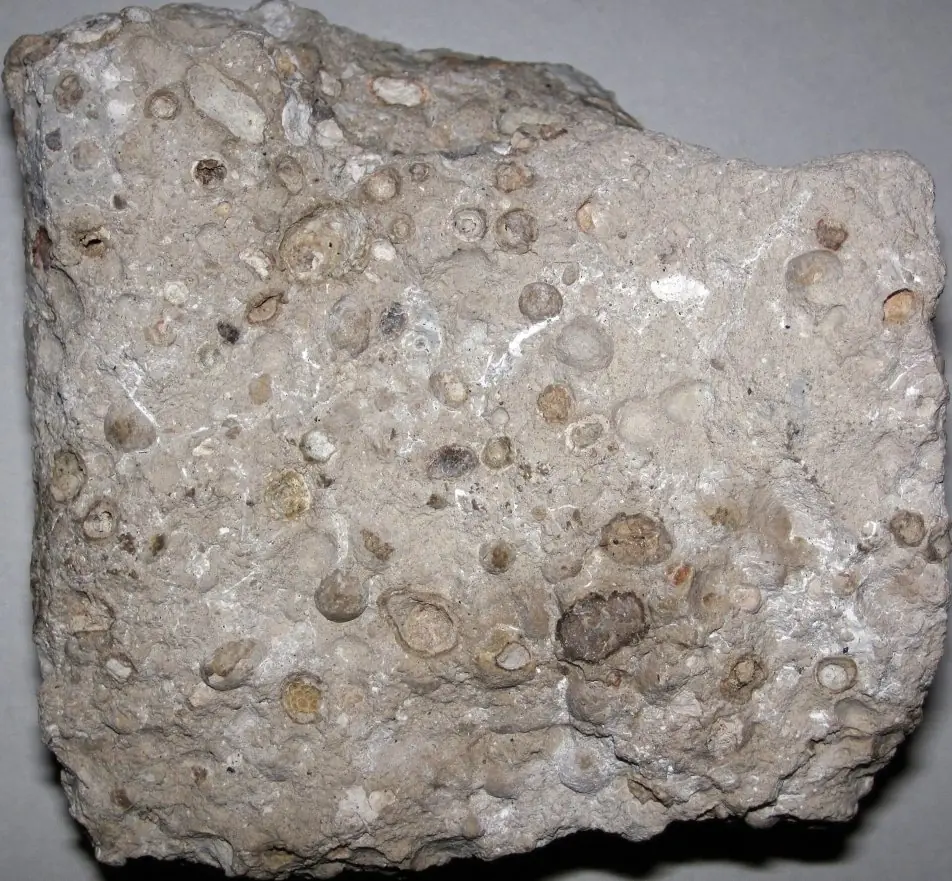
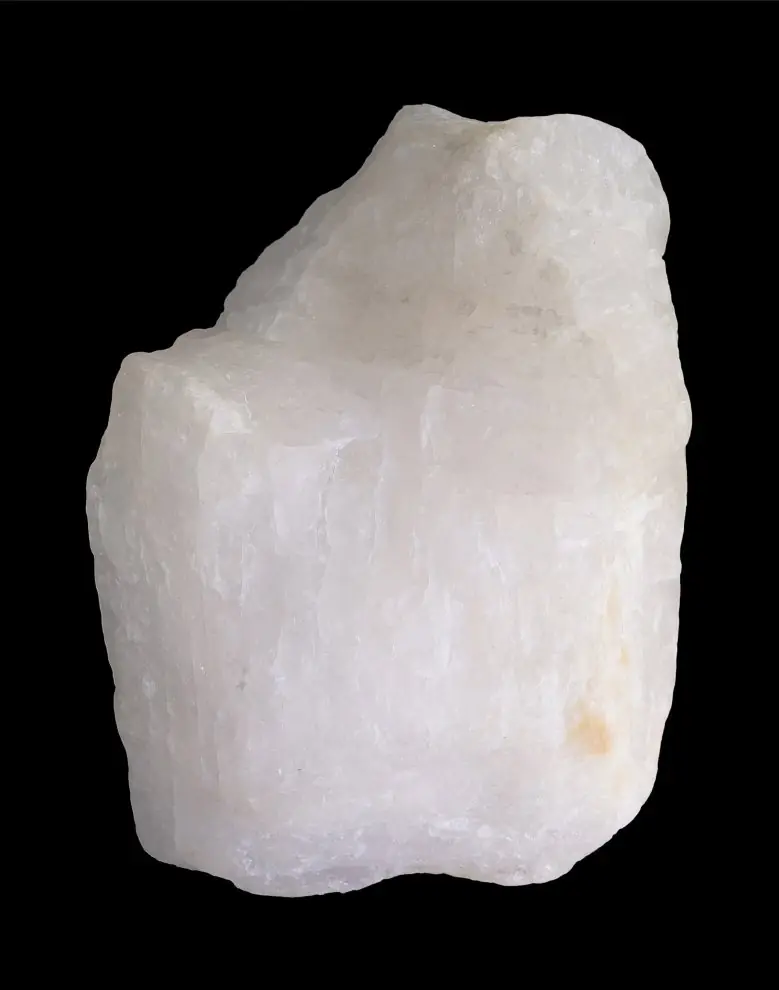
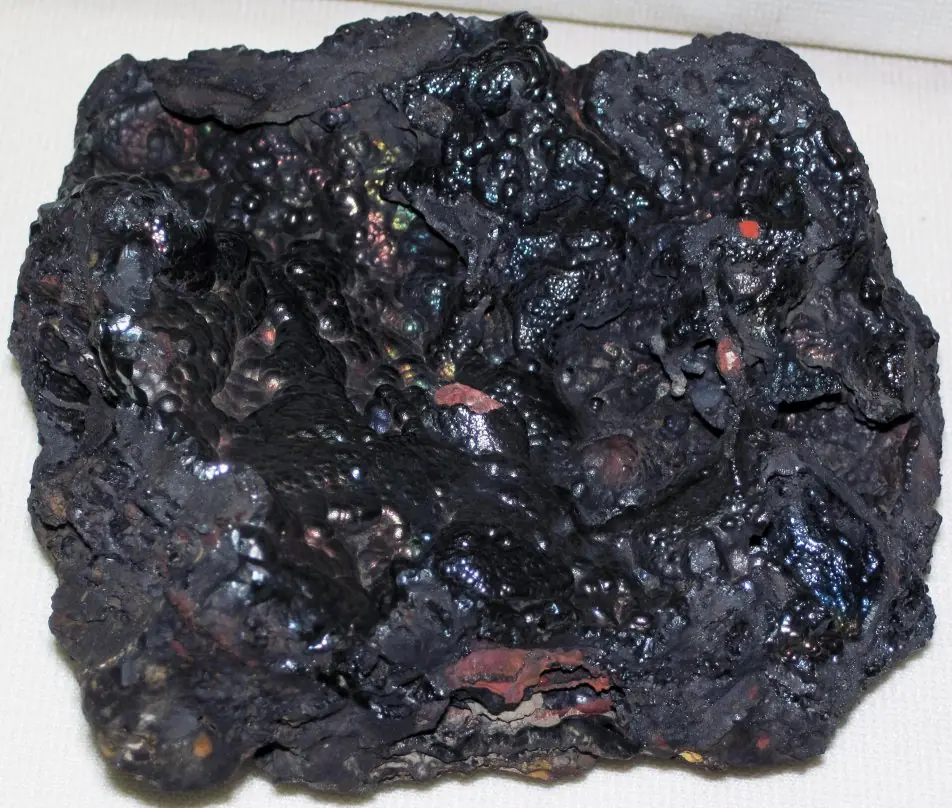
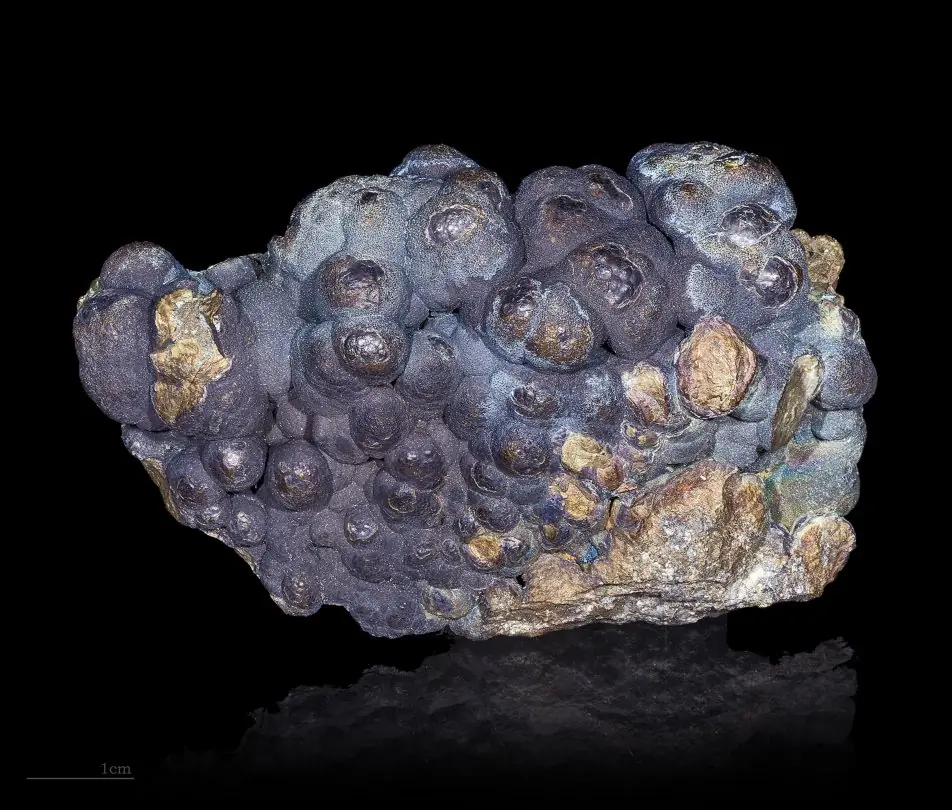
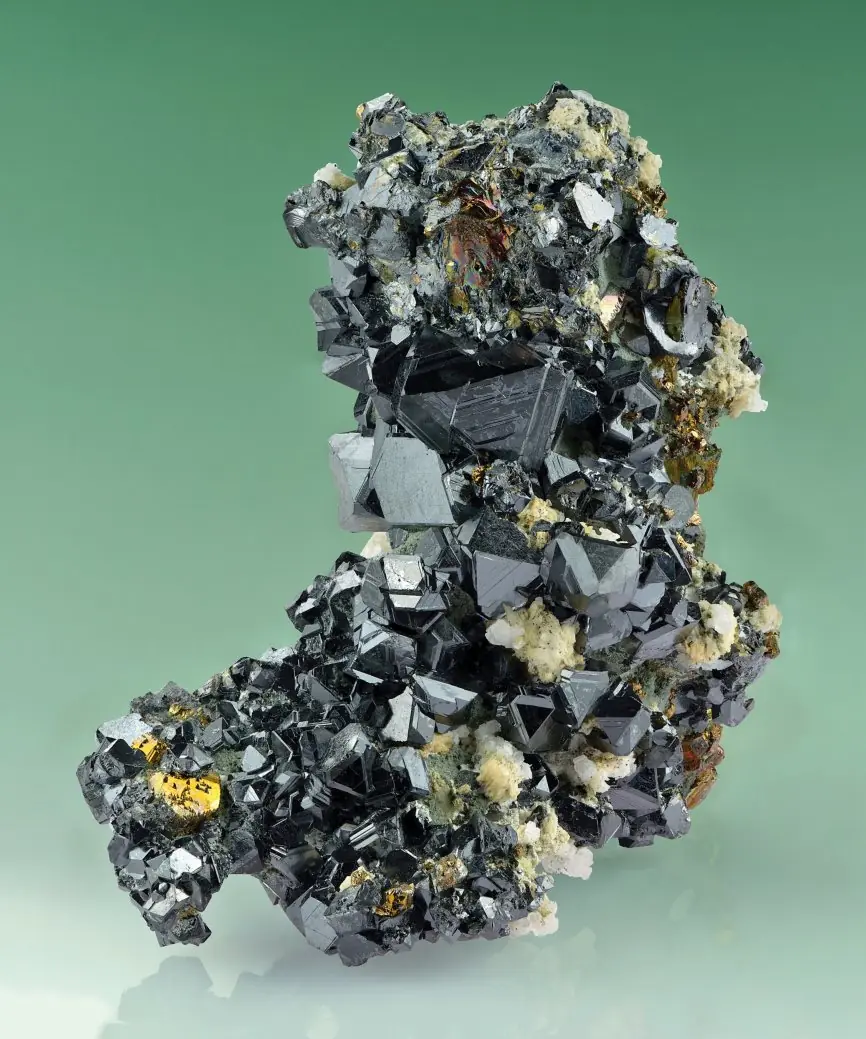
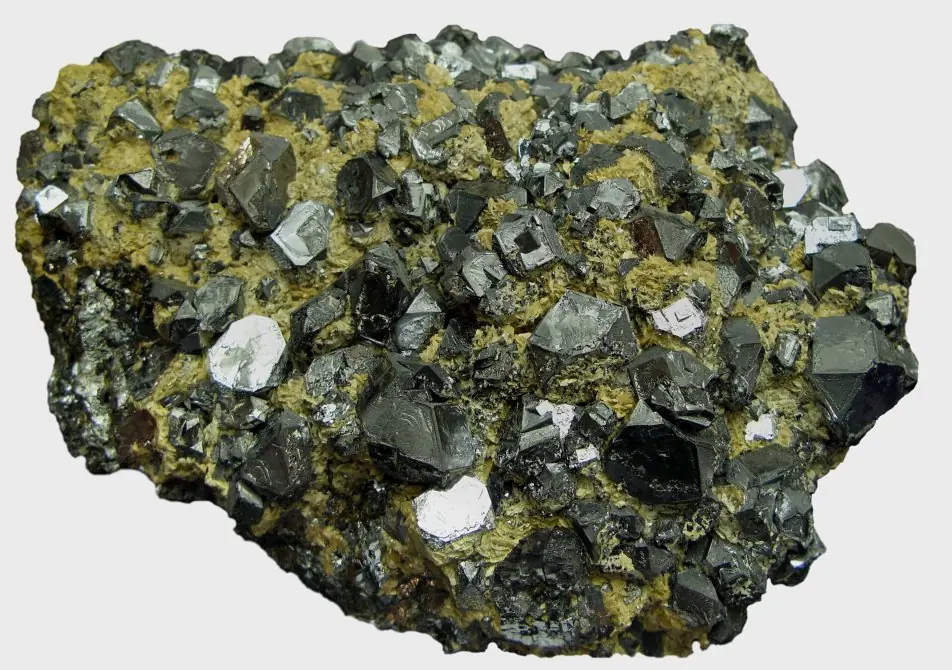
Gangue (matrix). The earthy, worthless material — sand, clay, rock — mixed with the ore. Flux. A substance added during smelting that combines with the gangue to give an easily fusible mass. An acidic flux (SiO₂) removes a basic gangue; a basic flux (CaO, CaCO₃) removes an acidic gangue. Slag. The fusible product formed when flux and gangue combine. It is lighter than the molten metal, floats on it, and is run off separately. Alloy. A homogeneous mixture of two or more metals, or of a metal with a small amount of a non-metal, made by mixing them in the molten state. Amalgam. An alloy in which one of the components is mercury (for example sodium amalgam, or the dental amalgam of Ag–Sn–Hg). Iron forms no amalgam, which is why mercury is stored and carried in iron bottles.
Typical flux reactions:
- Basic gangue with acidic flux: FeO + SiO₂ → FeSiO₃ (fusible slag)
- Acidic gangue with basic flux: CaO + SiO₂ → CaSiO₃
- Phosphate removal in steel making: 6CaO + P₄O₁₀ → 2Ca₃(PO₄)₂
| Alloy | Approximate composition | Used for |
|---|---|---|
| Brass | Cu 70%, Zn 30% | utensils, the karuwa and gagri of Patan metalwork |
| Bronze | Cu 88%, Sn 12% | statues, bells, temple images |
| Duralumin | Al 95%, Cu 4%, Mg 0.5%, Mn 0.5% | aircraft and vehicle bodies |
| Stainless steel | Fe 73%, Cr 18%, Ni 8%, C 1% | cutlery, surgical tools |
| Solder | Pb 50%, Sn 50% | joining wires |
| German silver | Cu 50%, Zn 30%, Ni 20% | ornaments, resistance wire |
10.1.2 Concentration (dressing) of the ore
Concentration removes the gangue and raises the percentage of metal in the charge. The method chosen depends on a physical difference between ore and gangue.
| Method | Physical property exploited | Used for |
|---|---|---|
| Hand picking | colour, visible difference | coarse lumps of any ore |
| Hydraulic washing (levigation, gravity separation) | density — heavy ore sinks, light gangue is washed away | oxide ores: haematite, cassiterite |
| Magnetic separation | magnetic ore or magnetic gangue | magnetite (Fe₃O₄); cassiterite containing wolframite |
| Froth flotation | wetting — the sulphide is wetted by oil, the gangue by water | sulphide ores: ZnS, PbS, CuFeS₂ |
| Chemical leaching | the ore dissolves in a reagent that leaves the gangue behind | bauxite, argentite |
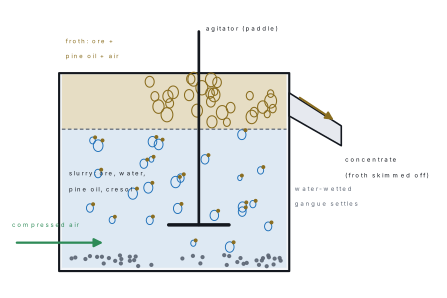
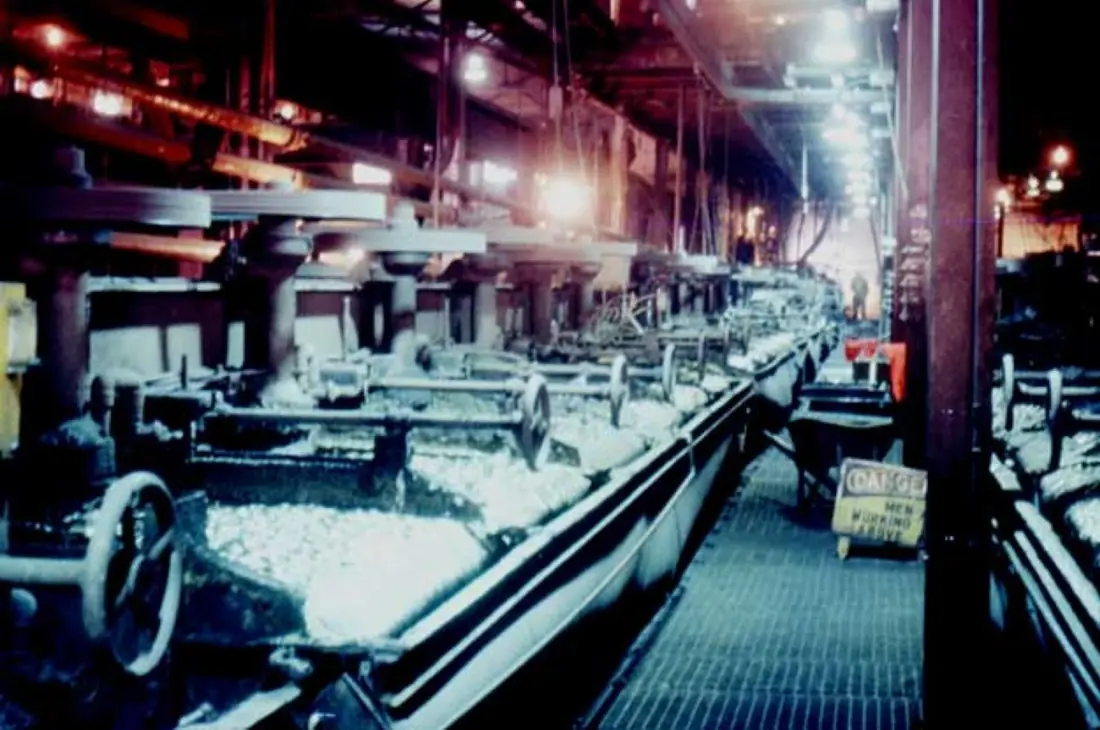
Froth flotation is worth understanding in detail because it is asked with a diagram. The finely powdered sulphide ore is stirred with water to which a small quantity of pine oil (the collector) and sodium ethyl xanthate, together with a froth stabiliser such as cresol, has been added. A blast of compressed air is blown through the agitated slurry. The oil coats the sulphide particles and makes them water-repellent, so they cling to the air bubbles and rise as a froth, while the heavier gangue, which is wetted by water, settles at the bottom. The froth overflows into a launder and is skimmed off and dried.
Leaching is a chemical concentration. Bauxite containing Fe₂O₃ and SiO₂ as impurities is purified by Bayer's process: the powdered ore is digested with hot concentrated NaOH solution at about 470 K under pressure, when the amphoteric alumina dissolves while Fe₂O₃ stays behind as red mud:
Al₂O₃·2H₂O + 2NaOH → 2NaAlO₂ + 3H₂O
The filtrate is diluted, cooled and seeded with freshly prepared Al(OH)₃, which reverses the reaction:
NaAlO₂ + 2H₂O → NaOH + Al(OH)₃↓
2Al(OH)₃ --1470 K--> Al₂O₃ + 3H₂O↑
Silver is leached from argentite by the Mac-Arthur Forrest cyanide process:
Ag₂S + 4NaCN → 2Na[Ag(CN)₂] + Na₂S
2Na[Ag(CN)₂] + Zn → Na₂[Zn(CN)₄] + 2Ag↓
10.1.3 Calcination and roasting
Both convert the concentrated ore into the oxide, because oxides are the easiest compounds to reduce. They differ in the atmosphere used.
| Calcination | Roasting | |
|---|---|---|
| Atmosphere | absence or limited supply of air | excess of air |
| Ore type | carbonate and hydrated ores | sulphide ores |
| What is removed | H₂O, CO₂, volatile organic matter | S as SO₂, and As, Sb as volatile oxides |
| Furnace | reverberatory furnace | reverberatory or multiple-hearth furnace |
| Example | ZnCO₃ --Δ--> ZnO + CO₂↑ | 2ZnS + 3O₂ --Δ--> 2ZnO + 2SO₂↑ |
Other standard equations:
- CaCO₃ --1170 K--> CaO + CO₂↑ (calcination)
- Fe₂O₃·3H₂O --Δ--> Fe₂O₃ + 3H₂O↑ (calcination of limonite)
- 2PbS + 3O₂ --Δ--> 2PbO + 2SO₂↑ (roasting)
- 4FeS₂ + 11O₂ --Δ--> 2Fe₂O₃ + 8SO₂↑ (roasting of pyrites)
- 2Cu₂S + 3O₂ --Δ--> 2Cu₂O + 2SO₂↑ (roasting)
Both operations are carried out below the melting point of the ore, so that the charge stays porous and the gases can escape.
A carbonate ore is often calcined in a limited supply of air, and some oxidation does happen. The examinable distinction is the purpose: calcination drives off water and carbon dioxide, roasting burns sulphur out as SO₂. Sort the example by the ore — carbonate/hydrate means calcination, sulphide means roasting.
10.1.4 Reduction of the oxide to the metal
Smelting is the reduction of the roasted or calcined ore to the molten metal by heating it above its melting point with a reducing agent (coke) and a flux in a furnace. The product separates into two liquid layers: molten metal below and slag above.
(a) Carbon reduction. Coke is cheap and is the universal reducing agent for metals of moderate reactivity:
- ZnO + C --1673 K--> Zn + CO↑
- PbO + C --Δ--> Pb + CO↑
- Fe₂O₃ + 3CO --Δ--> 2Fe + 3CO₂
- SnO₂ + 2C --Δ--> Sn + 2CO↑
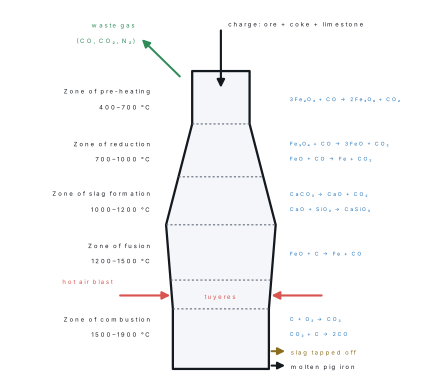
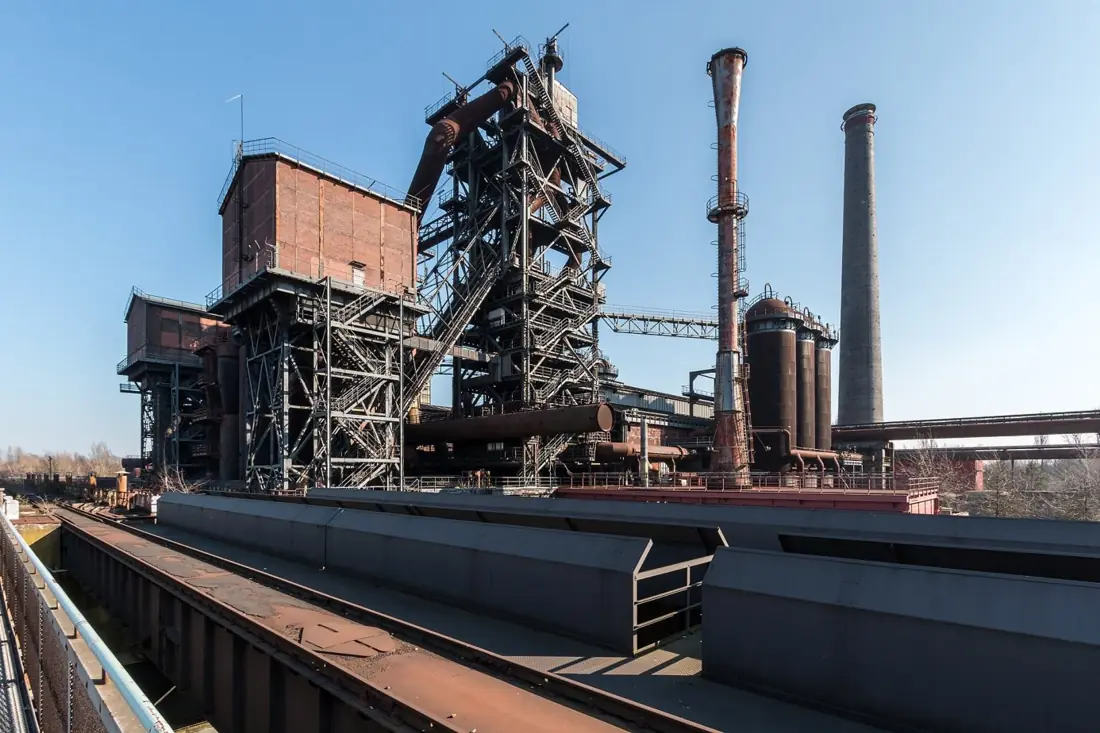
The industrial example to learn is the blast furnace for iron. The charge — roasted haematite, coke and limestone in roughly the ratio 8 : 4 : 1 — is fed in at the top through a cup-and-cone arrangement, and a blast of hot air at about 1000 K is blown in near the bottom through nozzles called tuyeres. Because the temperature falls steadily from bottom to top, different reactions occur in different zones.
(b) Self-reduction (auto-reduction). For copper and lead, part of the sulphide is roasted to the oxide and the two are then heated together without any external reducing agent:
- 2Cu₂O + Cu₂S → 6Cu + SO₂↑
- 2PbO + PbS → 3Pb + SO₂↑
(c) Thermite (aluminothermic) reduction. Aluminium has a very large affinity for oxygen, so it can pull oxygen out of an oxide that carbon cannot reduce cleanly — carbon would form a brittle carbide. Goldschmidt's thermite mixture is the oxide plus aluminium powder, ignited with a fuse of magnesium ribbon and barium peroxide:
Cr₂O₃ + 2Al → 2Cr + Al₂O₃, ΔH = −536 kJ mol⁻¹
3Mn₃O₄ + 8Al → 9Mn + 4Al₂O₃
Fe₂O₃ + 2Al → 2Fe + Al₂O₃, ΔH = −852 kJ mol⁻¹
The last reaction releases so much heat that the iron comes out molten at about 3000 °C; it is used on site to weld broken railway lines and cracked machine parts.
(d) Electrochemical reduction. Metals above aluminium in the reactivity series are obtained by electrolysing the fused halide or oxide — never an aqueous solution, because water would be reduced at the cathode in preference to the metal ion. Two examples:
| Cell | Electrolyte | Cathode reaction | Anode reaction |
|---|---|---|---|
| Down's cell (Na) | fused NaCl + CaCl₂, 850 K | Na⁺ + e⁻ → Na | 2Cl⁻ → Cl₂ + 2e⁻ |
| Hall–Héroult cell (Al) | Al₂O₃ in fused cryolite Na₃AlF₆ + CaF₂, 1220 K | Al³⁺ + 3e⁻ → Al | 2O²⁻ → O₂ + 4e⁻ |
The overall change in the Hall–Héroult cell is 2Al₂O₃ → 4Al + 3O₂↑, and because the anodes are carbon they burn away as C + O₂ → CO₂ and must be replaced regularly.
10.1.5 Refining the crude metal
| Method | Principle | Metals refined |
|---|---|---|
| Liquation | the metal melts at a lower temperature than the impurity and drains away | Sn, Pb, Bi |
| Distillation | the metal is volatile, the impurities are not | Zn, Hg, Cd |
| Poling | dissolved oxide is reduced by hydrocarbons from green wood | Cu, Sn |
| Electro-refinement | anodic dissolution and cathodic redeposition | Cu, Ag, Au, Al, Ni, Pb |
Poling. Blister copper obtained from the Bessemer converter contains about 1% of dissolved cuprous oxide, Cu₂O, which makes it brittle. The molten metal is stirred with poles of green (unseasoned) wood. The heat cracks the wood and releases hydrocarbon gases and carbon monoxide, which reduce the oxide back to metal:
4Cu₂O + CH₄ → 8Cu + CO₂↑ + 2H₂O↑
Cu₂O + CO → 2Cu + CO₂↑
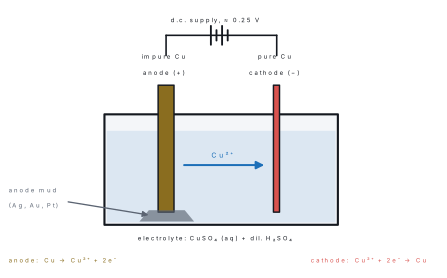
Electro-refinement. A thick block of the impure metal is made the anode, a thin sheet of the pure metal the cathode, and a solution of a salt of the metal the electrolyte. For copper the electrolyte is acidified copper sulphate solution (15% CuSO₄ + 5% H₂SO₄) and the applied potential difference is kept low, about 0.25 V, so that only copper dissolves and only copper deposits:
- Anode: Cu(impure) → Cu²⁺ + 2e⁻
- Cathode: Cu²⁺ + 2e⁻ → Cu(pure)
Impurities more electropositive than copper (Fe, Zn, Ni) pass into the solution as ions and stay there; those less electropositive (Ag, Au, Pt) do not dissolve and fall below the anode as anode mud, from which the precious metals are recovered — the sale of the anode mud often pays for the refining. The copper obtained is 99.95% pure.
Problem. A haematite ore from a deposit contains 80% Fe₂O₃ by mass. Calculate the mass of iron that can be obtained from 1.00 tonne of the ore, assuming the reduction is complete. (Fe = 56, O = 16)
Solution. Mass of Fe₂O₃ in 1.00 tonne = 1000 kg × 0.80 = 800 kg.
Molar mass of Fe₂O₃ = 2(56) + 3(16) = 112 + 48 = 160 g mol⁻¹.
From Fe₂O₃ + 3CO → 2Fe + 3CO₂, one mole of Fe₂O₃ (160 g) gives two moles of Fe (112 g). So the mass of iron is
560 kg of iron per tonne of ore.
Problem. In a thermite welding kit, 1.60 kg of Fe₂O₃ is mixed with exactly the required mass of aluminium powder. Calculate (a) the mass of aluminium needed and (b) the mass of molten iron produced. (Al = 27, Fe = 56, O = 16)
Solution. The reaction is Fe₂O₃ + 2Al → Al₂O₃ + 2Fe.
Moles of Fe₂O₃ = 1600 g ÷ 160 g mol⁻¹ = 10.0 mol.
(a) The equation needs 2 mol Al for each mole of Fe₂O₃, so n(\text{Al}) = 20.0\ \text{mol} and
(b) Each mole of Fe₂O₃ gives 2 mol Fe, so n(\text{Fe}) = 20.0\ \text{mol} and
Check: 1.60 + 0.54 = 2.14 kg in; 1.12 kg Fe + 1.02 kg Al₂O₃ = 2.14 kg out. Mass is conserved.
10.2 Alkali Metals
10.2.1 General characteristics
The alkali metals are lithium, sodium, potassium, rubidium, caesium and the radioactive francium. All have the outer configuration ns¹, so all lose that one electron easily to reach a noble-gas core and show the +1 oxidation state only.
| Property | Li | Na | K | Rb | Cs | Trend down the group |
|---|---|---|---|---|---|---|
| Atomic radius / pm | 152 | 186 | 227 | 248 | 265 | increases |
| First ionisation energy / kJ mol⁻¹ | 520 | 496 | 419 | 403 | 376 | decreases |
| Electronegativity | 1.0 | 0.9 | 0.8 | 0.8 | 0.7 | decreases |
| Melting point / °C | 181 | 98 | 63 | 39 | 29 | decreases |
| Density / g cm⁻³ | 0.53 | 0.97 | 0.86 | 1.53 | 1.90 | increases (K anomalous) |
| Flame colour | crimson | golden yellow | lilac | red-violet | blue | — |
The characteristic properties all follow from one large, loosely held valence electron:
- Softness and low melting point. Only one electron per atom enters the sea of delocalised electrons, so the metallic bond is weak. Sodium can be cut with a knife; caesium melts in the hand.
- Low density. Large atomic volume with a small atomic mass. Li, Na and K float on water.
- Strong reducing power. Low ionisation energy plus a large hydration energy for the small M⁺ ion gives very negative electrode potentials (Na⁺/Na = −2.71 V). Lithium, despite the highest ionisation energy of the group, is the strongest reducing agent in water (−3.04 V) because its small ion is hydrated so strongly.
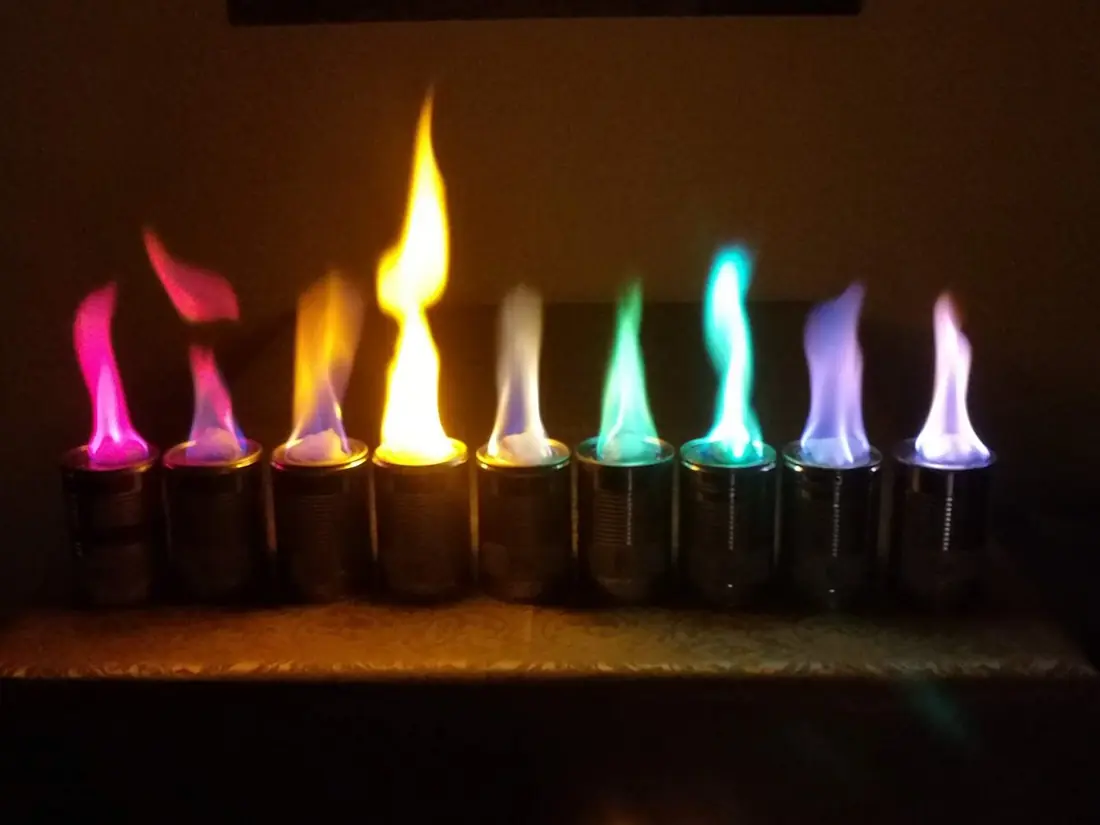
- Flame colours. The flame supplies just enough energy to promote the valence electron to a higher orbital; it emits visible light on falling back. This is the basis of the flame test.
- Photoelectric effect. K, Rb and Cs emit electrons when light falls on them, so they are used in photoelectric cells.
Characteristic reactions of sodium:
- 4Na + O₂ → 2Na₂O (limited air) and 2Na + O₂ → Na₂O₂ (excess air)
- 2Na + 2H₂O → 2NaOH + H₂↑ (vigorous; the hydrogen may catch fire)
- 2Na + H₂ --673 K--> 2NaH (ionic hydride, Na⁺H⁻)
- 2Na + Cl₂ → 2NaCl
- 2Na + 2C₂H₅OH → 2C₂H₅ONa + H₂↑
Because sodium and potassium react with moisture and oxygen in air, they are stored under kerosene.
10.2.2 Extraction of sodium: Down's process
Sodium cannot be obtained by electrolysing brine, because at the cathode water is reduced (2H₂O + 2e⁻ → H₂ + 2OH⁻) far more readily than Na⁺. The salt must therefore be melted. Pure NaCl melts at 801 °C, which is expensive and corrosive; adding about 60% calcium chloride (with a little KF) lowers the melting point to roughly 600 °C.
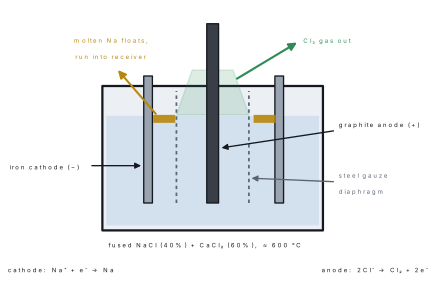
The cell. A steel tank lined with firebrick holds the fused mixture. A thick graphite rod dipping in from the top is the anode; a circular iron cathode surrounds it. A cylindrical steel-gauze diaphragm hangs between the electrodes: it lets ions through but keeps the two products apart, because sodium and chlorine would recombine explosively.
- Ionisation: NaCl (fused) → Na⁺ + Cl⁻
- Cathode (reduction): Na⁺ + e⁻ → Na
- Anode (oxidation): 2Cl⁻ → Cl₂ + 2e⁻
- Overall: 2NaCl --electrolysis--> 2Na + Cl₂↑
Molten sodium (density 0.93 g cm⁻³) is lighter than the electrolyte, so it rises into a ring-shaped receiver and is drawn off under kerosene; chlorine, a valuable by-product, is collected from a hood over the anode. The cell runs at about 7 V and 25 000–40 000 A, and the sodium is about 99.5% pure.
Problem. A Down's cell is used to make 23.0 kg of sodium. Calculate (a) the quantity of electricity required, (b) the time for which a steady current of 10 000 A must be passed, and (c) the volume of chlorine liberated at STP. (Na = 23, F = 96500 C mol⁻¹, molar volume at STP = 22.4 L mol⁻¹)
Solution.
(a) Moles of sodium = \dfrac{23\,000\ \text{g}}{23\ \text{g mol}^{-1}} = 1000\ \text{mol}.
The cathode reaction Na⁺ + e⁻ → Na needs one mole of electrons per mole of sodium, so
(b) From Q = It,
(c) The anode reaction 2Cl⁻ → Cl₂ + 2e⁻ gives one mole of Cl₂ per two moles of electrons, so n(\text{Cl}_2) = 1000/2 = 500\ \text{mol} and
10.2.3 Sodium hydroxide (caustic soda, NaOH)
Caustic soda is manufactured by electrolysing brine. In the Castner–Kellner cell a flowing layer of mercury is the cathode: sodium discharged there dissolves in the mercury as sodium amalgam, which is then decomposed with water in a separate chamber called the denuder.
- Anode (graphite): 2Cl⁻ → Cl₂ + 2e⁻
- Cathode (mercury): Na⁺ + e⁻ → Na (dissolves as Na/Hg amalgam)
- In the denuder: 2Na/Hg + 2H₂O → 2NaOH + H₂↑ + 2Hg
(The diaphragm-cell route is treated in Unit 17.)
Properties. A white, translucent, crystalline solid, melting at 591 K, very soluble in water with a large evolution of heat. It is strongly deliquescent — it absorbs moisture from the air and dissolves in it — so it cannot be used as a primary standard. It is intensely corrosive to skin, which is why it is called caustic soda.
- With acids: NaOH + HCl → NaCl + H₂O
- With carbon dioxide: 2NaOH + CO₂ → Na₂CO₃ + H₂O
- With amphoteric metals: 2Al + 2NaOH + 2H₂O → 2NaAlO₂ + 3H₂↑ and Zn + 2NaOH → Na₂ZnO₂ + H₂↑
- With salts of heavy metals: FeCl₃ + 3NaOH → Fe(OH)₃↓ + 3NaCl
- With ammonium salts: NH₄Cl + NaOH → NaCl + NH₃↑ + H₂O
Uses. Manufacture of soap and detergents, paper and rayon; purification of bauxite (Bayer's process); petroleum refining; mercerising cotton; as a laboratory reagent and in soda lime (NaOH + CaO) for absorbing CO₂.
10.2.4 Sodium carbonate (washing soda, Na₂CO₃·10H₂O)
Sodium carbonate is made industrially by the ammonia–soda (Solvay) process, whose flow sheet is studied in Unit 17. Here we need its behaviour.
Properties. The decahydrate is a white crystalline solid. Left in dry air it is efflorescent, losing nine of its ten water molecules and crumbling to a white powder:
Na₂CO₃·10H₂O → Na₂CO₃·H₂O + 9H₂O
On heating to 373 K it becomes the white anhydrous powder called soda ash, which does not decompose further even at red heat:
Na₂CO₃·10H₂O --373 K--> Na₂CO₃ + 10H₂O↑
Its aqueous solution is alkaline — it is the salt of a strong base and a weak acid, so the carbonate ion is hydrolysed:
CO₃²⁻ + H₂O ⇌ HCO₃⁻ + OH⁻
- With acids: Na₂CO₃ + 2HCl → 2NaCl + H₂O + CO₂↑
- With lime water (test for carbonate): the CO₂ evolved turns lime water milky, Ca(OH)₂ + CO₂ → CaCO₃↓ + H₂O
- Water softening: CaSO₄ + Na₂CO₃ → CaCO₃↓ + Na₂SO₄ (removes permanent hardness)
Uses. Softening hard water; manufacture of glass, soap, paper and borax; in laundries; as a primary standard in volumetric analysis; and in the laboratory for the sodium carbonate extract used in qualitative analysis.
10.3 Alkaline Earth Metals
10.3.1 General characteristics
Group 2 — beryllium, magnesium, calcium, strontium, barium and radium — has the configuration ns². Two valence electrons are lost together, so the only oxidation state is +2; the sum of the first two ionisation energies is more than repaid by the very large lattice and hydration energies of the small, doubly charged M²⁺ ion.
| Property | Be | Mg | Ca | Sr | Ba |
|---|---|---|---|---|---|
| Atomic radius / pm | 112 | 160 | 197 | 215 | 222 |
| First ionisation energy / kJ mol⁻¹ | 899 | 737 | 590 | 549 | 503 |
| Melting point / K | 1560 | 924 | 1124 | 1062 | 1002 |
| Density / g cm⁻³ | 1.84 | 1.74 | 1.55 | 2.63 | 3.59 |
| Flame colour | none | none | brick red | crimson | apple green |
| Reaction with water | none | with steam | with cold water | vigorous | vigorous |
Compared with the alkali metal in the same period, an alkaline earth metal is smaller, harder, denser, higher melting and less reactive, because two electrons per atom enter the electron sea and the nuclear charge is one unit greater. Be and Mg give no flame colour: their ionisation energies are so high that a bunsen flame cannot excite the valence electrons.
Beryllium is anomalous — it is small, highly polarising, forms covalent compounds, and its oxide and hydroxide are amphoteric. It resembles aluminium (a diagonal relationship).
Typical reactions:
- 2Mg + O₂ → 2MgO (dazzling white light — used in flash powder)
- Ca + 2H₂O → Ca(OH)₂ + H₂↑
- 3Mg + N₂ --Δ--> Mg₃N₂
- Ca + H₂ --Δ--> CaH₂ (hydrolith)
10.3.2 Important compounds
| Common name | Formula | Made from | Chief uses |
|---|---|---|---|
| Quick lime | CaO | CaCO₃ --1170 K--> CaO + CO₂↑ | cement, mortar, bleaching powder, basic flux, drying agent (soda lime) |
| Slaked lime | Ca(OH)₂ | CaO + H₂O → Ca(OH)₂ | whitewash, lime water, softening water, bleaching powder |
| Bleaching powder | CaOCl₂ | Ca(OH)₂ + Cl₂ → CaOCl₂ + H₂O | bleaching cotton and paper, disinfecting drinking water, oxidising agent, making chloroform |
| Magnesia | MgO | MgCO₃ --Δ--> MgO + CO₂↑ | refractory bricks for furnace linings, antacid, cement, insulation |
| Plaster of Paris | (CaSO₄)₂·H₂O | 2(CaSO₄·2H₂O) --393 K--> (CaSO₄)₂·H₂O + 3H₂O↑ | plaster casts for fractures, moulds and statues, blackboard chalk, dentistry |
| Epsom salt | MgSO₄·7H₂O | MgO + H₂SO₄, then crystallisation | purgative, bath salts, mordant in dyeing, fireproofing, magnesium fertiliser |
Three points that are asked repeatedly:
Slaking. CaO + H₂O → Ca(OH)₂ is strongly exothermic (about 64 kJ mol⁻¹); the lump hisses, cracks and crumbles. Quick lime must be stored dry. Nepal's cement plants at Hetauda and Udayapur calcine local limestone by exactly this route.
Bleaching powder is not a simple mixture. Its bleaching action comes from the chlorine set free by any acid, even by the carbonic acid of the air:
- CaOCl₂ + H₂SO₄ → CaSO₄ + H₂O + Cl₂↑
- CaOCl₂ + CO₂ → CaCO₃ + Cl₂↑
A good sample contains 35–38% available chlorine. On long standing in air it slowly loses chlorine and becomes useless.
Setting of plaster of Paris. When mixed to a paste with water it sets in 5–15 minutes into a hard, slightly expanded mass of interlocking gypsum crystals:
(CaSO₄)₂·H₂O + 3H₂O → 2(CaSO₄·2H₂O)
The slight expansion is what makes it take a sharp impression of a mould. If gypsum is heated above 473 K instead of 393 K, all the water is lost and dead-burnt plaster, anhydrous CaSO₄, is formed; it will not set.
CaO is quick lime (a basic oxide), Ca(OH)₂ is slaked lime (a base), CaCO₃ is limestone. Lime water is a saturated solution of Ca(OH)₂, and it goes milky with CO₂ because insoluble CaCO₃ forms — then clears again with excess CO₂ because soluble Ca(HCO₃)₂ is produced.
Problem. Calculate the mass of plaster of Paris obtained by heating 1.72 kg of pure gypsum at 393 K, and the mass of water driven off. (Ca = 40, S = 32, O = 16, H = 1)
Solution. Molar mass of gypsum CaSO₄·2H₂O = 40 + 32 + 4(16) + 2(18) = 172\ \text{g mol}^{-1}.
The reaction is 2(CaSO₄·2H₂O) → (CaSO₄)₂·H₂O + 3H₂O, so 10.0 mol of gypsum gives 5.0 mol of plaster of Paris and 15.0 mol of water.
Molar mass of (CaSO₄)₂·H₂O = 2(136) + 18 = 290\ \text{g mol}^{-1}, so
Check: 1450 + 270 = 1720 g, the mass we started with.
10.3.3 Solubility trends in group 2
| Class of salt | Trend down the group | Reason |
|---|---|---|
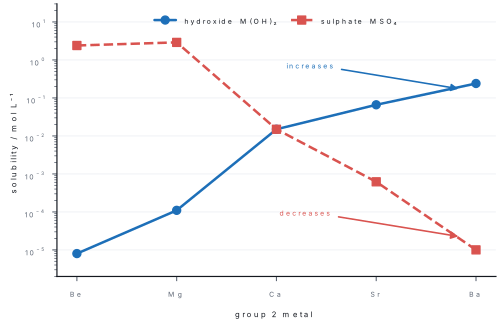
| Hydroxides M(OH)₂ | solubility increases (Be(OH)₂ insoluble → Ba(OH)₂ fairly soluble) | the OH⁻ ion is small, so lattice energy falls steeply as M²⁺ grows, faster than the hydration energy falls |
| Sulphates MSO₄ | solubility decreases (BeSO₄, MgSO₄ very soluble → BaSO₄ insoluble) | the SO₄²⁻ ion is large, so lattice energy hardly changes, while hydration energy falls sharply |
| Carbonates MCO₃ | all sparingly soluble; solubility decreases slightly | same argument as the sulphates |
The competition is always between two energies. A salt dissolves when the hydration energy released exceeds the lattice energy that must be supplied. Whichever of the two falls faster as the cation grows decides the direction of the trend.
10.3.4 Thermal stability of carbonates and nitrates
All group 2 carbonates decompose on heating to the oxide and carbon dioxide:
MCO₃ --Δ--> MO + CO₂↑
The temperature needed rises steadily down the group, so thermal stability increases down the group:
| Carbonate | BeCO₃ | MgCO₃ | CaCO₃ | SrCO₃ | BaCO₃ |
|---|---|---|---|---|---|
| Decomposition temperature / °C | below 100 | 540 | 900 | 1290 | 1360 |
Reason (polarisation). A small, highly charged cation distorts — polarises — the large carbonate ion, pulling electron density out of one C–O bond and weakening it until CO₂ breaks away. Down the group the cation gets bigger, its polarising power (charge/size ratio) falls, the carbonate ion is distorted less, and a higher temperature is needed. The same argument explains why group 1 carbonates (except Li₂CO₃) do not decompose at all: M⁺ is larger and only singly charged.
The nitrates all decompose to the oxide, brown nitrogen dioxide and oxygen, and again the stability increases down the group:
2Ca(NO₃)₂ --Δ--> 2CaO + 4NO₂↑ + O₂↑
2Mg(NO₃)₂ --Δ--> 2MgO + 4NO₂↑ + O₂↑
Contrast this with the alkali metal nitrates, which stop at the nitrite:
2NaNO₃ --Δ--> 2NaNO₂ + O₂↑
Lithium is the exception in group 1 and behaves like a group 2 metal (4LiNO₃ --Δ--> 2Li₂O + 4NO₂↑ + O₂↑), another example of the diagonal relationship between Li and Mg.
C-C-R-R: Concentration → Calcination/roasting → Reduction → Refining. Every extraction question can be answered by walking down this ladder and naming the method used at each rung for that particular metal.
Chapter summary
- A mineral becomes an ore only when extraction from it is profitable. Gangue is the earthy impurity, flux combines with gangue to give fusible slag, an alloy is a homogeneous mixture of metals and an amalgam is an alloy containing mercury.
- Concentration uses a physical difference: levigation (density), magnetic separation, froth flotation (sulphides), leaching (bauxite by Bayer's process, Ag by cyanide).
- Calcination (limited air) removes H₂O and CO₂ from carbonate and hydrated ores; roasting (excess air) converts sulphides to oxides, 2ZnS + 3O₂ → 2ZnO + 2SO₂↑.
- Reduction: carbon/CO for moderately reactive metals (blast furnace, Fe₂O₃ + 3CO → 2Fe + 3CO₂); self-reduction for Cu and Pb (2Cu₂O + Cu₂S → 6Cu + SO₂↑); aluminothermite for Cr and Mn (Cr₂O₃ + 2Al → 2Cr + Al₂O₃); electrolysis of the fused salt for Na, Mg, Al.
- Refining: liquation, distillation, poling (Cu₂O + CO → 2Cu + CO₂) and electro-refinement, in which the impure metal is the anode, the pure metal the cathode, and Ag/Au/Pt collect as anode mud.
- Alkali metals (ns¹) are soft, light, low melting, strongly reducing and give characteristic flame colours; sodium is made in the Down's cell by electrolysing fused NaCl + CaCl₂, giving Na at the iron cathode and Cl₂ at the graphite anode.
- NaOH is deliquescent and dissolves amphoteric metals (2Al + 2NaOH + 2H₂O → 2NaAlO₂ + 3H₂↑); Na₂CO₃·10H₂O is efflorescent and its solution is alkaline by hydrolysis.
- Alkaline earth metals (ns²) are harder, denser and less reactive than their group 1 neighbours; Be is anomalous and resembles Al.
- Down group 2, hydroxide solubility increases and sulphate solubility decreases; the thermal stability of carbonates and nitrates increases because the polarising power of M²⁺ falls.
- Key formulae: quick lime CaO, bleaching powder CaOCl₂, magnesia MgO, plaster of Paris (CaSO₄)₂·H₂O, Epsom salt MgSO₄·7H₂O.
Practice questions
Group A — Multiple choice (1 mark each)
- The process of heating a sulphide ore strongly in the presence of excess air is called [1]acalcinationbroastingcsmeltingdpoling
- Which of the following is used as a flux to remove a basic gangue? [1]aCaObCaCO₃cSiO₂dMgO
- In the Down's process the electrolyte is [1]aaqueous NaClbfused NaCl with CaCl₂cfused NaOHdaqueous NaOH
- The correct order of thermal stability of the carbonates is [1]aBeCO₃ > MgCO₃ > CaCO₃ > BaCO₃bBaCO₃ > CaCO₃ > MgCO₃ > BeCO₃cCaCO₃ > BaCO₃ > MgCO₃ > BeCO₃dall decompose at the same temperature
- The formula of plaster of Paris is [1]aCaSO₄·2H₂Ob(CaSO₄)₂·H₂OcCaSO₄dCaSO₄·7H₂O
- Anode mud obtained in the electro-refining of copper is valuable because it contains [1]aFe and ZnbAg, Au and PtcCu₂OdCuSO₄
Answers to Group A
1. (b) — roasting is always in excess air; calcination is in limited air.
2. (c) — an acidic flux such as silica removes a basic gangue: CaO + SiO₂ → CaSiO₃.
3. (b) — in aqueous solution water would be reduced instead of Na⁺; CaCl₂ lowers the melting point to about 600 °C.
4. (b) — polarising power of M²⁺ decreases down the group, so stability increases.
5. (b) — the hemihydrate, CaSO₄·½H₂O, written as (CaSO₄)₂·H₂O.
6. (b) — metals less electropositive than copper do not dissolve at the anode.
Group B — Short answer (5 marks each)
- Define ore, gangue, flux and slag with one example of each. Why is silica added in the extraction of copper from copper pyrites? [5]
- Describe the froth flotation process with a labelled diagram. Why is it suitable only for sulphide ores? [5]
- Distinguish between calcination and roasting, giving two balanced equations for each. [5]
- A haematite ore contains 64% Fe₂O₃. Calculate the mass of iron obtainable from 5.00 tonne of the ore if the recovery in the blast furnace is 87.5%. (Fe = 56, O = 16) [5]
- Why does the solubility of the sulphates decrease but that of the hydroxides increase down group 2? Illustrate with formulae. [5]
- How is bleaching powder prepared? Write two reactions that show how it acts as a bleaching agent, and state two of its uses. [5]
Answers to Group B
1. Definitions as in Section 10.1.1. Silica is an acidic flux; it removes the basic gangue FeO formed on roasting copper pyrites as fusible ferrous silicate slag, FeO + SiO₂ → FeSiO₃, which floats on the molten matte and is run off.
3. Calcination: limited air, carbonate/hydrated ores, removes CO₂ and H₂O — ZnCO₃ → ZnO + CO₂↑ and 2Al(OH)₃ → Al₂O₃ + 3H₂O↑. Roasting: excess air, sulphide ores, removes S as SO₂ — 2ZnS + 3O₂ → 2ZnO + 2SO₂↑ and 2PbS + 3O₂ → 2PbO + 2SO₂↑.
4. Mass of Fe₂O₃ = 5000 kg × 0.64 = 3200 kg. Theoretical iron = 3200 × 112/160 = 2240 kg. Actual iron = 2240 × 0.875 = 1960 kg = 1.96 tonne.
5. Dissolving requires the hydration energy to exceed the lattice energy. The OH⁻ ion is small, so the hydroxide lattice energy falls rapidly as M²⁺ grows (Be²⁺ → Ba²⁺) while hydration energy falls more slowly — solubility rises from Be(OH)₂ to Ba(OH)₂. The SO₄²⁻ ion is large, so the inter-ionic distance is controlled by the anion and the lattice energy is almost constant, while the hydration energy of M²⁺ falls steeply — solubility drops from MgSO₄ to BaSO₄.
6. Chlorine is passed over dry slaked lime at about 313 K in a Hasenclever plant: Ca(OH)₂ + Cl₂ → CaOCl₂ + H₂O. It bleaches because any acid liberates chlorine: CaOCl₂ + H₂SO₄ → CaSO₄ + H₂O + Cl₂↑ and CaOCl₂ + CO₂ → CaCO₃ + Cl₂↑. Uses: bleaching cotton and paper pulp; disinfecting drinking water.
Group C — Long answer (8 marks each)
- (a) With a neat labelled diagram, describe the extraction of sodium by Down's process, writing the reactions at each electrode. [5](b) Why can sodium not be obtained by the electrolysis of aqueous sodium chloride? What is the function of calcium chloride and of the steel gauze diaphragm? [3]
- (a) Draw a labelled vertical section of the blast furnace and name the reactions occurring in each zone. [5](b) A Down's cell produces chlorine at the rate of 1.12 m³ per hour measured at STP. Calculate the current flowing and the mass of sodium produced per hour. (F = 96500 C mol⁻¹, Na = 23, molar volume at STP = 22.4 L mol⁻¹) [3]
Answers to Group C
1. (a) See Section 10.2.2 and the Down's cell figure: steel tank lined with firebrick, fused NaCl + CaCl₂ at about 600 °C, central graphite anode, surrounding iron cathode, steel gauze diaphragm. Cathode Na⁺ + e⁻ → Na; anode 2Cl⁻ → Cl₂ + 2e⁻; overall 2NaCl → 2Na + Cl₂↑. (b) In aqueous solution the cathode reaction 2H₂O + 2e⁻ → H₂ + 2OH⁻ occurs in preference to Na⁺ + e⁻ → Na because water is far more easily reduced, so hydrogen, not sodium, is obtained. CaCl₂ lowers the melting point of the electrolyte from 801 °C to about 600 °C, saving fuel and reducing corrosion. The steel gauze diaphragm keeps the molten sodium and the chlorine apart so that they cannot recombine.
2. (b) n(\text{Cl}_2) = 1120/22.4 = 50.0\ \text{mol}. Each mole of Cl₂ needs 2 mol of electrons, so n(e^-) = 100\ \text{mol} and Q = 100 \times 96500 = 9.65\times10^{6}\ \text{C}. Since this is delivered in 3600 s, I = 9.65\times10^{6}/3600 = 2681\ \text{A}. Sodium: 1 mol per mole of electrons, so n(\text{Na}) = 100\ \text{mol} and m = 100 \times 23 = 2300\ \text{g} = 2.30\ \text{kg} per hour.
Practise more: Chemistry question bank