Unit 7 · General and Physical Chemistry · 8 teaching hours · 27 min read
States of Matter
What the syllabus asks for 10
- Gaseous state: Kinetic theory of gas and postulates
- Gas laws: Boyle's and Charles' law; Avogadro's law; Combined gas equation; Dalton's law of partial pressure; Graham's law of diffusion
- Ideal gas and ideal gas equation; Universal gas constant and its significance
- Deviation of real gas from ideality
- Liquid state: evaporation and condensation; vapour pressure and boiling point; surface tension and viscosity (qualitative)
- Liquid crystals and their applications
- Solid state: types of solids; amorphous and crystalline solids
- Efflorescent, deliquescent and hygroscopic solids
- Crystallization and crystal growth; water of crystallization
- Introduction to unit crystal lattice and unit cell
Matter exists in three ordinary states — gas, liquid and solid — and the only real difference between them is how strongly the particles hold each other against their own thermal motion. In a gas the motion wins completely; in a solid the attraction wins completely; a liquid sits between the two. This unit builds a quantitative model of the gaseous state first, because gases obey simple laws, and then works down through liquids to solids.
Three things repeat every year: (i) a derivation or statement of the kinetic gas equation and the gas laws deduced from it, (ii) a numerical on the combined gas equation, Dalton's law, Graham's law or PV = nRT, and (iii) short definitions — vapour pressure, surface tension, efflorescence, unit cell. Learn the definitions word-perfect; they are free marks.
7.1 Gaseous state: kinetic theory of gas and postulates
The kinetic molecular theory explains the behaviour of gases from the motion of their molecules. It rests on the following postulates.
- A gas consists of a very large number of extremely small particles (molecules). Their own volume is negligible compared with the volume of the container, so a gas is mostly empty space.
- The molecules are in constant, rapid, random motion in all directions.
- The molecules collide with one another and with the walls of the container. All collisions are perfectly elastic — no kinetic energy is lost.
- There is no force of attraction or repulsion between the molecules.
- The pressure of a gas is the result of the continuous bombardment of the molecules on the walls of the container.
- The average kinetic energy of the molecules is directly proportional to the absolute temperature, and at a given temperature it is the same for all gases, whatever their nature.
- The effect of gravity on molecular motion is negligible.
From these postulates one can show (the derivation is not required at Grade 11) that for N molecules each of mass m in a volume V,
where c is the root-mean-square speed, c = \sqrt{\overline{c^{2}}}. This is the kinetic gas equation. Since the total kinetic energy of the N molecules is E = \frac{1}{2}mNc^{2}, the equation can be written PV = \frac{2}{3}E.
For one mole, mN = M (the molar mass) and PV = RT. Substituting in the kinetic gas equation,
Because M = \rho V_m and PV_m = RT, the same result may be written in terms of density as c_{rms} = \sqrt{3P/\rho}. Also, from PV = \frac{2}{3}E and PV = RT, the kinetic energy of one mole is
so the average kinetic energy per molecule is \frac{3}{2}kT, where k = R/N_A = 1.38\times10^{-23}\ \text{J K}^{-1} is the Boltzmann constant. Note that E depends only on T — this is postulate 6, now proved.
Not all molecules move at the same speed. The fraction of molecules having a given speed is given by the Maxwell–Boltzmann distribution, which broadens and flattens as the temperature rises.
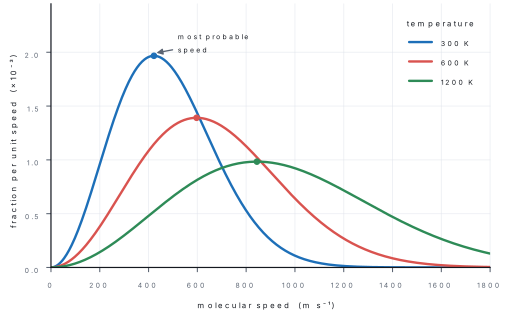
Three speeds are quoted for a gas, always in the same order:
| Speed | Expression | Meaning |
|---|---|---|
| Most probable, c_{mp} | \sqrt{2RT/M} | speed of the largest number of molecules |
| Average, c_{av} | \sqrt{8RT/\pi M} | arithmetic mean of all speeds |
| Root mean square, c_{rms} | \sqrt{3RT/M} | used in the kinetic gas equation |
Their ratio is c_{mp} : c_{av} : c_{rms} = 1 : 1.128 : 1.224.
7.2 Gas laws
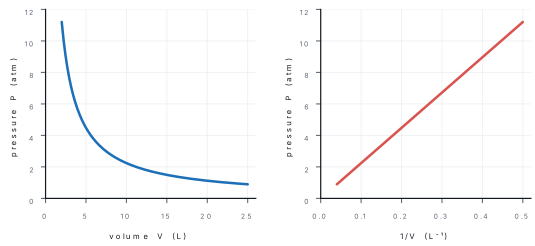
Boyle's law (1662). At constant temperature, the volume of a fixed mass of gas is inversely proportional to its pressure.
A graph of P against V is a rectangular hyperbola (an isotherm); a graph of P against 1/V is a straight line through the origin.
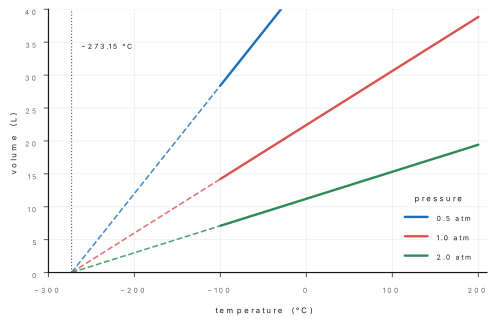
Charles' law (1787). At constant pressure, the volume of a fixed mass of gas is directly proportional to its absolute temperature.
In the Celsius form, V_t = V_0\left(1 + \dfrac{t}{273.15}\right). Every V–t line, whatever the pressure, extrapolates back to zero volume at -273.15\ ^{\circ}\text{C}. That temperature is absolute zero, the zero of the Kelvin scale.
Gay-Lussac's (pressure) law. At constant volume, P \propto T, so P_1/T_1 = P_2/T_2.
Avogadro's law (1811). Equal volumes of all gases, under the same conditions of temperature and pressure, contain an equal number of molecules. Hence at constant T and P, V \propto n. One mole of any gas occupies 22.4\ \text{L} at STP (0\ ^{\circ}\text{C}, 1 atm).
Combined gas equation. Putting Boyle's and Charles' laws together for a fixed mass of gas,
Problem. A gas occupies 300\ \text{cm}^3 at 27\ ^{\circ}\text{C} and 380\ \text{mm Hg}. What volume will it occupy at STP?
Solution. Convert temperatures to kelvin first.
T_1 = 27 + 273 = 300\ \text{K}, P_1 = 380\ \text{mm}, V_1 = 300\ \text{cm}^3; T_2 = 273\ \text{K}, P_2 = 760\ \text{mm}.
The volume falls, as expected: the pressure has doubled while the temperature has only dropped slightly.
Dalton's law of partial pressures. The total pressure of a mixture of gases that do not react is the sum of the partial pressures of the component gases:
The partial pressure of a component is the pressure it would exert if it alone occupied the whole volume. In terms of mole fraction x_i,
The commonest use is correcting for water vapour when a gas is collected over water: p_{dry\ gas} = P_{atm} - p_{water\ vapour} (the aqueous tension).
Graham's law of diffusion (1833). At constant temperature and pressure, the rate of diffusion (or effusion) of a gas is inversely proportional to the square root of its density, and therefore of its molar mass:
Graham's law compares rates, not volumes. If different volumes diffuse in different times you must first form r = V/t for each gas. Writing V_1/V_2 = \sqrt{M_2/M_1} when the times differ is the standard lost mark.
Problem. 120\ \text{cm}^3 of a gas diffuses through a porous plug in 20\ \text{s}, while 180\ \text{cm}^3 of oxygen diffuses through the same plug in 15\ \text{s} under identical conditions. Calculate the molar mass of the gas.
Solution. Form the rates first.
By Graham's law,
Squaring, \dfrac{1}{4} = \dfrac{32}{M_{gas}}, so M_{gas} = 128\ \text{g mol}^{-1}. (Hydrogen iodide, HI, has a molar mass of 127.9 — the gas is almost certainly HI.)
7.3 Ideal gas and ideal gas equation; universal gas constant and its significance
An ideal gas is a hypothetical gas that obeys Boyle's law, Charles' law and Avogadro's law exactly at all temperatures and pressures. Its molecules have no volume of their own and exert no attractive force on one another. No real gas is ideal, but real gases approach ideal behaviour at low pressure and high temperature.
Combining the three laws for n moles gives the ideal gas equation:
Since n = w/M (mass over molar mass), two very useful working forms follow:
R is the universal (molar) gas constant — universal because its value is the same for every gas.
| Units of P and V | Value of R |
|---|---|
| Pa, m³ (SI) | 8.314\ \text{J K}^{-1}\text{mol}^{-1} |
| atm, litre | 0.0821\ \text{L atm K}^{-1}\text{mol}^{-1} |
| mm Hg, litre | 62.4\ \text{L mm Hg K}^{-1}\text{mol}^{-1} |
| calorie (energy) | 1.987 \approx 2\ \text{cal K}^{-1}\text{mol}^{-1} |
Significance of R. R = PV/nT, and pressure × volume has the dimensions of energy (force per area × volume = force × distance). So R is an energy per mole per kelvin. Physically, R is the work done by one mole of an ideal gas when its temperature is raised by one kelvin at constant pressure.
Problem. 0.30\ \text{g} of a volatile liquid, on complete vaporisation, occupies 100\ \text{cm}^3 at 27\ ^{\circ}\text{C} and 1\ \text{atm}. Calculate its molar mass. (R = 0.0821\ \text{L atm K}^{-1}\text{mol}^{-1})
Solution. Work in litres and kelvin: V = 0.100\ \text{L}, T = 300\ \text{K}.
A molar mass of 74 fits butan-1-ol, C₄H₉OH.
7.4 Deviation of real gas from ideality
Real gases obey PV = nRT only approximately. The deviation is measured by the compressibility factor
For an ideal gas Z = 1 at every pressure. For real gases:
- At low pressure, Z < 1 for most gases — the gas is more compressible than ideal, because intermolecular attractions pull the molecules together.
- At high pressure, Z > 1 for all gases — the gas is less compressible than ideal, because the molecules' own volume can no longer be ignored and short-range repulsion dominates.
- Hydrogen and helium have Z > 1 at all pressures at room temperature: their attractive forces are too weak to matter.
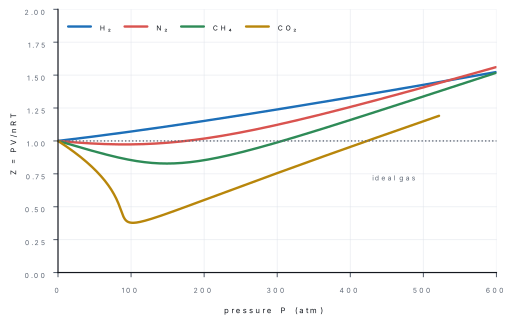
The deviation arises because two of the postulates are false for a real gas: molecules do attract one another, and they do occupy volume. Van der Waals corrected the ideal gas equation for both:
- an^{2}/V^{2} is the pressure correction. A molecule about to strike the wall is pulled back by its neighbours, so the observed pressure is less than the ideal one. The constant a measures the strength of attraction; its unit is atm L² mol⁻².
- nb is the volume correction (the excluded volume). The space actually available to the molecules is less than V. The constant b is about four times the actual volume of one mole of molecules; its unit is L mol⁻¹.
Gases that are easily liquefied (CO₂, NH₃, SO₂) have large a; permanent gases (H₂, He, N₂) have small a. The temperature at which a real gas obeys Boyle's law over an appreciable range of pressure is its Boyle temperature, T_B = a/Rb.
7.5 Liquid state
Evaporation and condensation
Evaporation is the escape of molecules from the surface of a liquid into the vapour phase, and it happens at all temperatures. Only the fastest surface molecules have enough energy to break free, so the molecules left behind have a lower average kinetic energy — which is why evaporation causes cooling. It is an endothermic, surface phenomenon. It is faster when the temperature is higher, the surface area is larger, the air is dry and moving, and the intermolecular forces are weak.
Condensation is the reverse: vapour molecules returning to the liquid. In a closed vessel the two rates soon become equal and a dynamic equilibrium is reached.
Vapour pressure and boiling point
The vapour pressure of a liquid is the pressure exerted by its vapour when the vapour is in dynamic equilibrium with the liquid at a given temperature.
Vapour pressure increases rapidly with temperature and is larger for liquids with weaker intermolecular forces (ether > ethanol > water > mercury). It does not depend on the surface area of the liquid or on the amount of liquid present.
The boiling point of a liquid is the temperature at which its vapour pressure becomes equal to the external (atmospheric) pressure. When the external pressure is 1 atm (760 mm Hg) it is called the normal boiling point.
This explains a familiar Nepali experience. In Kathmandu, about 1,350 m above sea level, atmospheric pressure is roughly 86 kPa instead of 101 kPa, so water boils near 95\ ^{\circ}\text{C} and rice takes longer to cook. Higher up, at Namche Bazaar (3,440 m), water boils at about 89\ ^{\circ}\text{C}. A pressure cooker solves the problem by raising the pressure above the liquid, which raises the boiling point to about 120\ ^{\circ}\text{C}.
Surface tension and viscosity
A molecule inside a liquid is pulled equally in all directions, but a molecule at the surface is pulled only sideways and inwards. The surface therefore behaves like a stretched elastic skin.
Surface tension (\gamma) is the force acting at right angles to a line of unit length drawn on the surface of a liquid. Its SI unit is N m⁻¹ (equivalently J m⁻², energy per unit surface area).
Surface tension explains why raindrops and mercury droplets are spherical (a sphere has the least surface area for a given volume), why a needle can float on water, why water rises in a narrow capillary, and why insects can walk on a pond. It decreases as temperature rises (molecular motion weakens the attractions) and falls sharply when a detergent or soap is added — which is why soapy water wets cloth and cleans it.
Viscosity is the resistance offered by a liquid to its own flow, caused by internal friction between adjacent layers. The coefficient of viscosity \eta has the SI unit N s m⁻² (pascal second); the CGS unit is the poise (1\ \text{P} = 0.1\ \text{Pa s}).
Viscosity increases with stronger intermolecular forces and with larger, more tangled molecules — glycerol and honey are far more viscous than water, and water is more viscous than petrol. Unlike gases, the viscosity of a liquid decreases as the temperature rises, which is why engine oil thins in summer.
7.6 Liquid crystals and their applications
Some organic substances with long, rod-shaped molecules do not melt directly from a solid to a normal liquid. Between the two they pass through a cloudy intermediate state that flows like a liquid but keeps some of the molecular order of a crystal. This state is called the liquid crystal or mesophase. It was discovered in 1888 by Friedrich Reinitzer in cholesteryl benzoate, which melts at 145\ ^{\circ}\text{C} to a turbid liquid and becomes a clear liquid only at 179\ ^{\circ}\text{C}.
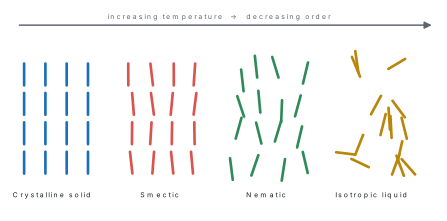
Types of liquid crystals
| Class | Driven by | Sub-types and description |
|---|---|---|
| Thermotropic | temperature | Nematic — molecules parallel but not in layers; Smectic — parallel and arranged in layers; Cholesteric (chiral nematic) — layers whose direction twists from layer to layer, giving bright colours |
| Lyotropic | concentration in a solvent | soap and detergent solutions, cell membranes, phospholipid bilayers |
Applications
- Liquid crystal displays (LCDs) in calculators, digital watches, laptops, mobile phones and televisions. A small voltage twists the nematic molecules and changes how they transmit polarised light, so a segment turns dark.
- Thermometers and temperature strips. Cholesteric liquid crystals reflect a colour that depends on temperature — used in forehead thermometers, aquarium strips and mood rings.
- Medical diagnosis. A liquid-crystal film on the skin maps surface temperature and can reveal tumours or blocked veins, which are warmer.
- Non-destructive testing. Films placed on electronic circuit boards or pipes reveal hot spots and cracks.
- Optical shutters, pressure sensors and some drug-delivery systems.
7.7 Solid state: types of solids; amorphous and crystalline solids
In a solid the particles occupy fixed mean positions and can only vibrate, so a solid has a definite shape and volume and is nearly incompressible. Solids are of two kinds.
| Property | Crystalline solid | Amorphous solid |
|---|---|---|
| Arrangement of particles | long-range regular order | only short-range order |
| Melting point | sharp, definite | melts over a range; softens gradually |
| Geometry | definite geometrical shape, plane faces | irregular shape |
| Heat of fusion | definite | not definite |
| Cutting | clean cleavage along planes | irregular breakage |
| Physical properties | anisotropic (vary with direction) | isotropic (same in all directions) |
| Nature | true solids | pseudo-solids / supercooled liquids |
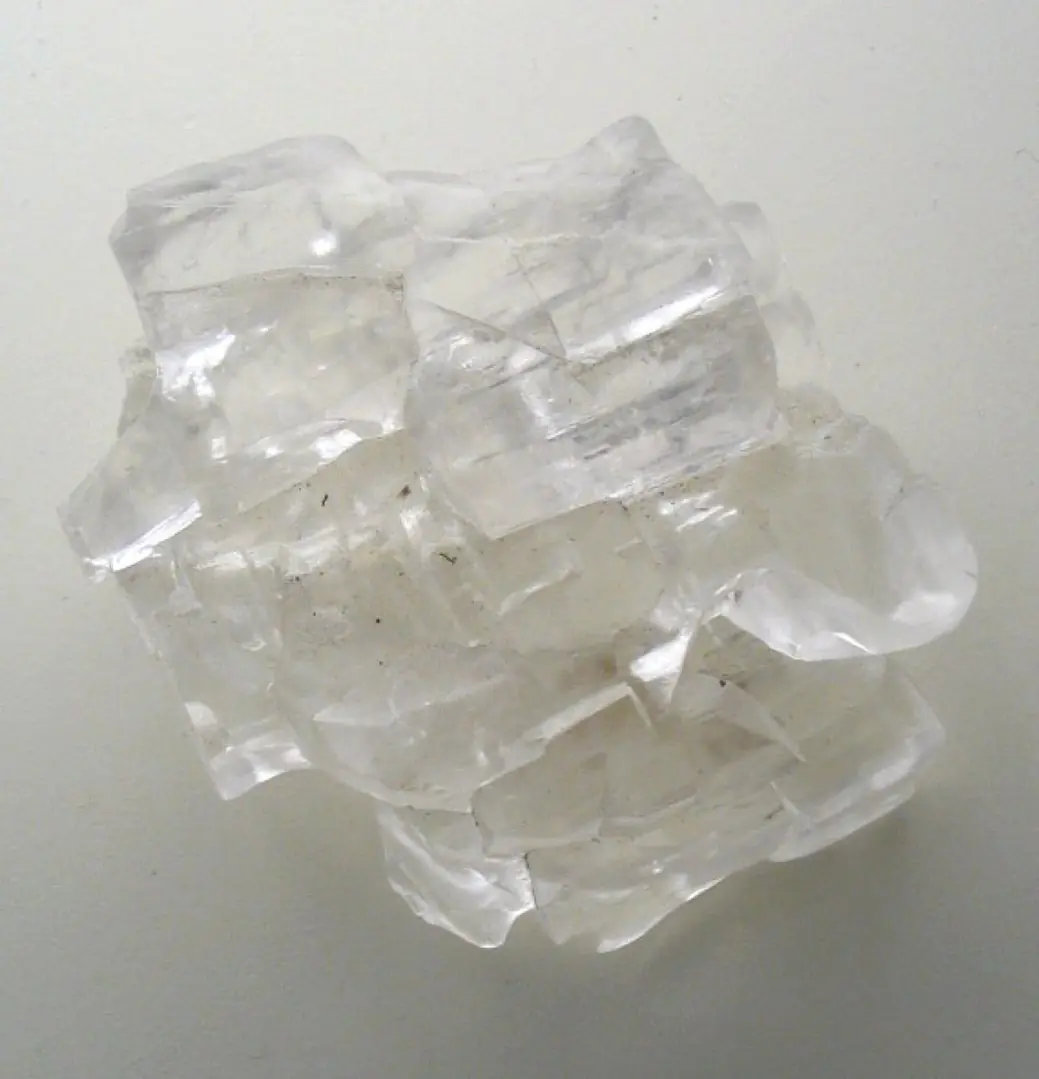
| Examples | NaCl, diamond, quartz, ice, sugar | glass, rubber, plastic, fused silica, coal tar |
Crystalline solids are further classified by the kind of particle at the lattice points and the force holding them together.
| Type | Particles | Binding force | Examples | Typical properties |
|---|---|---|---|---|
| Ionic | cations and anions | strong electrostatic | NaCl, KNO₃, ZnS | hard, brittle, high m.p., conduct when molten or aqueous |
| Covalent (network) | atoms | covalent bonds throughout | diamond, SiO₂, SiC | extremely hard, very high m.p., non-conducting (graphite is the exception) |
| Molecular | molecules | van der Waals or H-bonds | I₂, dry ice (CO₂), ice, S₈ | soft, low m.p., volatile, insulators |
| Metallic | metal ions in a sea of electrons | metallic bond | Cu, Fe, Na, Al | malleable, ductile, lustrous, good conductors |
7.8 Efflorescent, deliquescent and hygroscopic solids
| Term | Behaviour in air | Result | Examples |
|---|---|---|---|
| Efflorescent | loses its water of crystallization to the atmosphere | crystal becomes dull and powdery | Na₂CO₃·10H₂O, Na₂SO₄·10H₂O, FeSO₄·7H₂O, MgSO₄·7H₂O |
| Deliquescent | absorbs so much moisture that it dissolves in it | solid turns into a solution | CaCl₂, NaOH, KOH, MgCl₂, FeCl₃, ZnCl₂ |
| Hygroscopic | absorbs moisture but does not dissolve in it | solid stays solid, merely damp | CaO (quicklime), silica gel, anhydrous CuSO₄, P₄O₁₀, conc. H₂SO₄ (a liquid) |
Efflorescence happens when the vapour pressure of the hydrate is greater than the partial pressure of water vapour in the air; deliquescence happens when the saturated solution of the salt has a vapour pressure lower than that of the air. Deliquescent and hygroscopic substances are used as drying agents (desiccators, drying towers) — anhydrous CaCl₂ for most gases, quicklime for ammonia, concentrated H₂SO₄ for acidic and neutral gases.
Both absorb water. The difference is what happens next: a deliquescent solid dissolves in the water it absorbs and ends up as a puddle of solution; a hygroscopic solid only becomes damp. Every deliquescent substance is hygroscopic, but not every hygroscopic substance is deliquescent.
7.9 Crystallization and crystal growth; water of crystallization
Crystallization is the process of obtaining pure crystals of a solid from its hot saturated solution (or from a melt). It is the standard laboratory method of purifying a solid, and the industrial method of making sugar, common salt, alum and copper sulphate. The steps are:
- Dissolve the impure solid in the minimum amount of hot solvent to make a saturated solution.
- Filter hot to remove insoluble impurities.
- Cool slowly. The solution becomes supersaturated and crystals separate; soluble impurities remain in the mother liquor.
- Filter the crystals, wash with a little cold solvent and dry between filter papers.
Crystal growth happens in two stages. First nucleation: a few particles come together to form a tiny nucleus. Then growth: further particles deposit on the faces of the nucleus in a regular pattern. Slow cooling and an undisturbed solution give a few large, well-formed crystals; rapid cooling or stirring gives many small ones. Dropping in a tiny seed crystal starts the process where nucleation is slow.
The water of crystallization is the definite number of water molecules chemically combined with one formula unit of a substance in its crystalline state. It gives the crystal its shape and often its colour; on heating it is driven off and the crystal crumbles.
CuSO₄·5H₂O --Δ--> CuSO₄ + 5H₂O (blue crystals → white powder)
| Common name | Formula | Water molecules |
|---|---|---|
| Blue vitriol | CuSO₄·5H₂O | 5 |
| Green vitriol | FeSO₄·7H₂O | 7 |
| White vitriol | ZnSO₄·7H₂O | 7 |
| Washing soda | Na₂CO₃·10H₂O | 10 |
| Glauber's salt | Na₂SO₄·10H₂O | 10 |
| Gypsum | CaSO₄·2H₂O | 2 |
| Epsom salt | MgSO₄·7H₂O | 7 |
| Borax | Na₂B₄O₇·10H₂O | 10 |
| Mohr's salt | FeSO₄·(NH₄)₂SO₄·6H₂O | 6 |
| Potash alum | K₂SO₄·Al₂(SO₄)₃·24H₂O | 24 |
Problem. A hydrated salt MgSO₄·xH₂O loses 51.2\ \% of its mass when heated to constant weight. Find x. (Mg = 24, S = 32, O = 16, H = 1)
Solution. Formula mass of anhydrous MgSO₄ = 24 + 32 + 4(16) = 120. Formula mass of the hydrate = 120 + 18x. The mass lost is the water, so
The salt is MgSO₄·7H₂O, Epsom salt. Check: 18(7)/246 = 51.2\ \%. ✔
7.10 Introduction to unit crystal lattice and unit cell
A crystal (space) lattice is the regular three-dimensional arrangement of points in space that represents the positions of the constituent particles of a crystal. A unit cell is the smallest repeating portion of the lattice which, when repeated in three dimensions, generates the whole crystal.
A unit cell is described by six cell parameters: the three edge lengths a, b, c and the three angles \alpha (between b and c), \beta (between a and c) and \gamma (between a and b). Different combinations give exactly seven crystal systems, which in turn give 14 Bravais lattices.
| Crystal system | Edges | Angles | Example |
|---|---|---|---|
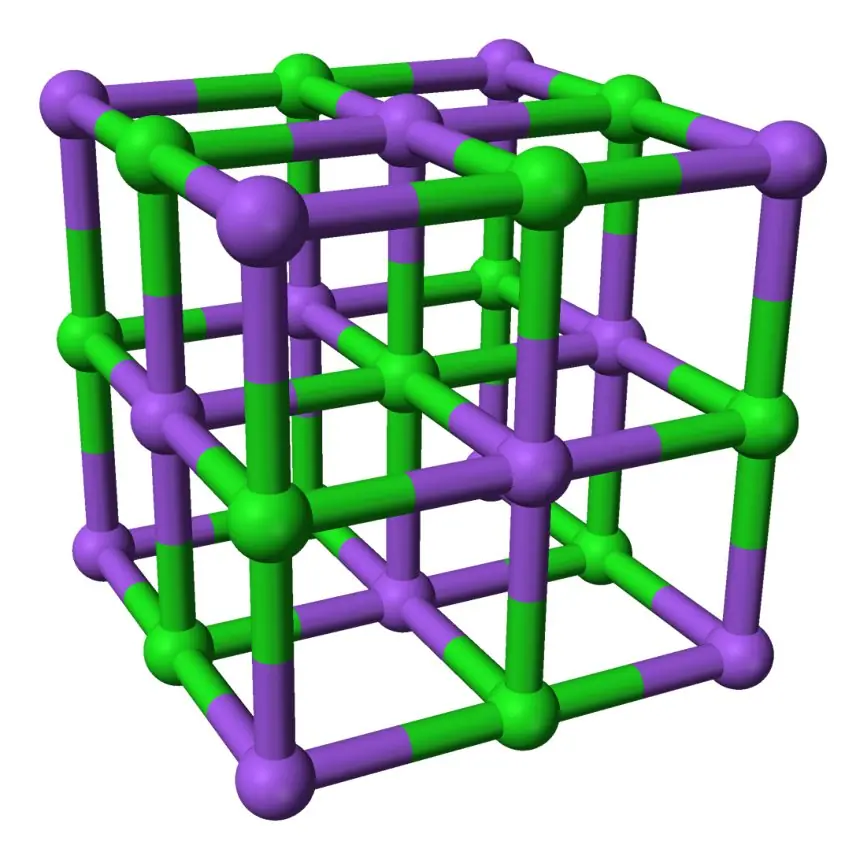
| Cubic | a=b=c | \alpha=\beta=\gamma=90^{\circ} | NaCl, Cu, diamond |
| Tetragonal | a=b\ne c | \alpha=\beta=\gamma=90^{\circ} | SnO₂, white tin |
| Orthorhombic | a\ne b\ne c | \alpha=\beta=\gamma=90^{\circ} | rhombic sulphur, KNO₃ |
| Monoclinic | a\ne b\ne c | \alpha=\gamma=90^{\circ},\ \beta\ne90^{\circ} | monoclinic sulphur, Na₂SO₄·10H₂O |
| Triclinic | a\ne b\ne c | all \ne 90^{\circ} | CuSO₄·5H₂O, K₂Cr₂O₇ |
| Hexagonal | a=b\ne c | \alpha=\beta=90^{\circ},\ \gamma=120^{\circ} | graphite, ZnO |
| Rhombohedral | a=b=c | \alpha=\beta=\gamma\ne90^{\circ} | calcite, cinnabar |
Within the cubic system there are three important unit cells.
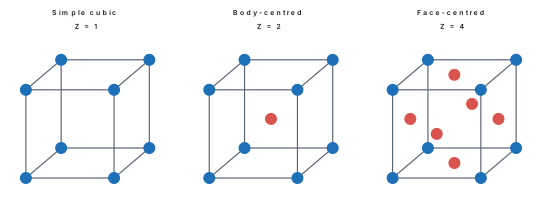
A particle sitting on a corner, edge or face is shared with neighbouring cells, so only a fraction of it belongs to the cell being counted.
| Position of particle | Shared between | Contribution to one cell |
|---|---|---|
| Corner | 8 cells | 1/8 |
| Edge | 4 cells | 1/4 |
| Face centre | 2 cells | 1/2 |
| Body centre | 1 cell | 1 |
Hence the number of particles per unit cell, Z:
- Simple (primitive) cubic: 8 \times \tfrac{1}{8} = 1
- Body-centred cubic (bcc): 8 \times \tfrac{1}{8} + 1 = 2
- Face-centred cubic (fcc): 8 \times \tfrac{1}{8} + 6 \times \tfrac{1}{2} = 4
- End-centred: 8 \times \tfrac{1}{8} + 2 \times \tfrac{1}{2} = 2
Problem. Copper crystallises in a face-centred cubic lattice with edge length a = 3.61\times10^{-8}\ \text{cm}. Calculate the number of atoms per unit cell and the density of copper. (Cu = 63.5\ \text{g mol}^{-1}, N_A = 6.022\times10^{23})
Solution. For fcc, Z = 8\left(\tfrac{1}{8}\right) + 6\left(\tfrac{1}{2}\right) = 1 + 3 = 4 atoms.
Volume of the unit cell:
Mass of the unit cell = Z \times (mass of one atom) = ZM/N_A:
This matches the measured density of copper, which confirms the fcc structure.
Chapter summary
- Kinetic gas equation: PV = \frac{1}{3}mNc^{2}, giving c_{rms} = \sqrt{3RT/M} = \sqrt{3P/\rho} and kinetic energy per mole E = \frac{3}{2}RT.
- Gas laws: Boyle P_1V_1 = P_2V_2; Charles V_1/T_1 = V_2/T_2; combined P_1V_1/T_1 = P_2V_2/T_2; Dalton P = \sum p_i with p_i = x_iP; Graham r_1/r_2 = \sqrt{M_2/M_1}.
- Ideal gas equation PV = nRT = (w/M)RT, so M = \rho RT/P; R = 8.314\ \text{J K}^{-1}\text{mol}^{-1} = 0.0821\ \text{L atm K}^{-1}\text{mol}^{-1}, the work done by one mole per kelvin at constant pressure.
- Real gases deviate because molecules attract and occupy volume: Z = PV/nRT \ne 1, and \left(P + an^{2}/V^{2}\right)(V-nb) = nRT.
- Vapour pressure rises with temperature; a liquid boils when its vapour pressure equals the external pressure. Surface tension (\gamma, N m⁻¹) and viscosity (\eta, Pa s) both fall as temperature rises.
- Liquid crystals are mesophases: thermotropic (nematic, smectic, cholesteric) and lyotropic; used in LCDs, thermometers and medical thermography.
- Crystalline solids are anisotropic with sharp melting points; amorphous solids are isotropic pseudo-solids. Efflorescent solids lose water, deliquescent solids dissolve in absorbed water, hygroscopic solids merely absorb it.
- A unit cell is the smallest repeating unit of a crystal lattice; corner contributes 1/8, face 1/2, body 1, giving Z = 1 (sc), 2 (bcc), 4 (fcc), and \rho = ZM/a^{3}N_A.
Practice questions
Group A — Multiple choice (1 mark each)
- At constant temperature, the graph of pressure against 1/V for a fixed mass of gas is [1]aa hyperbolaba straight line through the originca parabolada horizontal line
- The value of the universal gas constant in SI units is [1]a0.0821b1.987c8.314d62.4
- Which of the following is a deliquescent substance? [1]aNa₂CO₃·10H₂ObCaCl₂cCaOdCuSO₄·5H₂O
- The number of atoms per unit cell in a face-centred cubic lattice is [1]a1b2c4d8
- Amorphous solids are [1]aanisotropic with a sharp melting pointbisotropic with a sharp melting pointcanisotropic with no sharp melting pointdisotropic with no sharp melting point
Answers to Group A
1. (b) — Boyle's law gives P = k(1/V), of the form y = mx.
2. (c) — 8.314\ \text{J K}^{-1}\text{mol}^{-1}; 0.0821 is in L atm units.
3. (b) — CaCl₂ absorbs moisture and dissolves in it; CaO only becomes damp (hygroscopic).
4. (c) — 8(1/8) + 6(1/2) = 4.
5. (d) — no long-range order, so properties are the same in all directions and they soften over a range.
Group B — Short answer (5 marks each)
- State the postulates of the kinetic molecular theory of gases and write the kinetic gas equation, explaining each term. [5]
- Define vapour pressure and boiling point. Explain why water boils at about 95\ ^{\circ}\text{C} in Kathmandu but at 100\ ^{\circ}\text{C} in Biratnagar. [5]
- A closed vessel contains 4 g of hydrogen and 64 g of oxygen at a total pressure of 1.5 atm. Calculate the partial pressure of each gas. (H = 1, O = 16) [5]
- Distinguish between crystalline and amorphous solids, giving two examples of each. [5]
- Calculate the volume occupied by 4.4 g of carbon dioxide at 27\ ^{\circ}\text{C} and 2 atm pressure. (R = 0.0821\ \text{L atm K}^{-1}\text{mol}^{-1}) [5]
Answers to Group B
1. Give the seven postulates of §7.1, then PV = \frac{1}{3}mNc^{2}, where P is pressure, V volume, m the mass of one molecule, N the number of molecules and c the root-mean-square speed.
2. Definitions as in §7.5. Kathmandu (≈1,350 m) has a lower atmospheric pressure (≈86 kPa) than Biratnagar (≈100 kPa, near sea level). A liquid boils when its vapour pressure equals the external pressure, so in Kathmandu that condition is reached at a lower temperature.
3. n_{H_2} = 4/2 = 2\ \text{mol}; n_{O_2} = 64/32 = 2\ \text{mol}; total = 4\ \text{mol}. Mole fraction of each = 2/4 = 0.5. Hence p_{H_2} = 0.5 \times 1.5 = 0.75\ \text{atm} and p_{O_2} = 0.75\ \text{atm}.
4. Use the comparison table of §7.7 — long-range order, sharp vs. ranged melting point, anisotropy vs. isotropy, clean cleavage vs. irregular breakage. Examples: NaCl and quartz (crystalline); glass and rubber (amorphous).
5. n = 4.4/44 = 0.1\ \text{mol}, T = 300\ \text{K}. V = nRT/P = (0.1 \times 0.0821 \times 300)/2 = 2.463/2 = 1.23\ \text{L}.
Group C — Long answer (8 marks each)
- (a) State Boyle's law, Charles' law and Avogadro's law, and combine them to obtain the ideal gas equation PV = nRT. [4](b) What is meant by the universal gas constant? Give its value in two sets of units and state its physical significance. [2](c) 0.50 g of a gas occupies 280\ \text{cm}^3 at STP. Calculate its molar mass. [2]
- (a) Why do real gases deviate from ideal behaviour? Define the compressibility factor and sketch how it varies with pressure for H₂ and CO₂. [4](b) Write the van der Waals equation for n moles and explain the physical meaning and units of the constants a and b. [4]
- (a) Define crystal lattice and unit cell, and name the seven crystal systems. [4](b) A metal of molar mass 56\ \text{g mol}^{-1} crystallises in a body-centred cubic lattice with a = 2.87\times10^{-8}\ \text{cm}. Calculate its density. [4]
Answers to Group C
1(c). At STP one mole occupies 22400\ \text{cm}^3. So n = 280/22400 = 0.0125\ \text{mol} and M = 0.50/0.0125 = 40\ \text{g mol}^{-1} (argon).
2. (a) Two postulates fail: real molecules attract one another and have a finite volume. Z = PV/nRT; Z = 1 for an ideal gas. CO₂ dips well below 1 at moderate pressure (strong attractions) and rises above 1 at high pressure; H₂ stays above 1 throughout at room temperature. See Figure 4. (b) \left(P + an^{2}/V^{2}\right)(V - nb) = nRT; a measures intermolecular attraction (atm L² mol⁻²) and b the excluded volume, about four times the true molecular volume of one mole (L mol⁻¹).
3(b). For bcc, Z = 2. a^{3} = (2.87\times10^{-8})^{3} = 2.364\times10^{-23}\ \text{cm}^{3}.
which is the density of iron.
Practise more: Chemistry question bank